This is topic identify these soundtrack types in forum Film Handlers' Forum at Film-Tech Forum ARCHIVE.
To visit this topic, use this URL:
https://ft-forum.com/ft/cgi-bin/ubb/ultimatebb.cgi?ubb=get_topic;f=1;t=011227
Posted by Scott Norwood (Member # 30) on 04-24-2012, 09:32 PM:
I thought that we already had this discussion, but I cannot find it with the "search" function here. In any case, I am continuing with some spring cleaning and working through a to-do list that is several years old.
What is the proper name for each of these soundtrack types:
track 1:
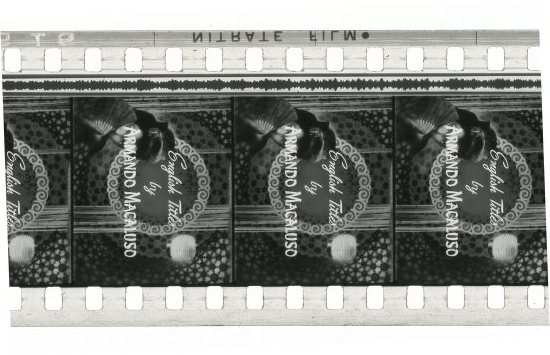
track 2:
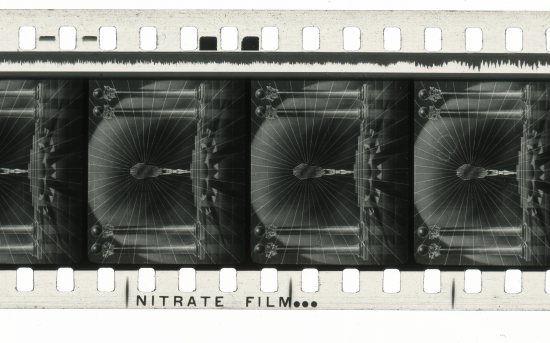
Both are on film stock datecoded 1945.
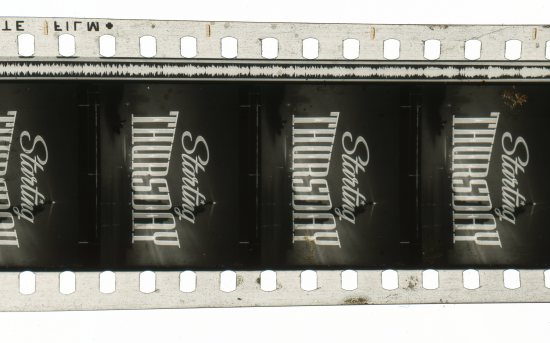
And what about this one (curiously printed on BH-perf stock, datecoded 1941)
track 3:
Am I correct in assuming that track 2 will not play properly on a modern (i.e. split solar cell) sound system?
Posted by Robert Minichino (Member # 3495) on 04-24-2012, 09:39 PM:
The top is single bilateral variable area and the second is unilateral variable area. The third is also single bilateral variable area, but in negative compared to the first (which doesn't really matter).
In my experience, the unilateral track will play well enough on a split-cell sound head that has its outputs properly summed, possibly with a little extra noise and distortion.
Posted by Sean Weitzel (Member # 244) on 04-25-2012, 12:07 PM:
how about this one? I've heard it referred to as a Maurer track in a 16mm application but wonder what the deal is on a piece of 35mm in this example:

Posted by Robert Minichino (Member # 3495) on 04-25-2012, 03:05 PM:
If dual bilateral is good, then triple bilateral must be better! ![[Smile]](smile.gif)
The extra tracks improve the distortion performance in the presence of azimuth misalignment, and retain the superior signal-noise performance of variable-area over variable-density (it gets slightly worse with more tracks). I wonder who printed 35 mm soundtracks like this (and who manufactured the equipment)?
Posted by Frank Angel (Member # 248) on 04-25-2012, 06:28 PM:
Hah! Triple tracks on 16mm? I've seen SIX laterals in the 16mm soundtrack area. Why the need for that many? No idea. Theoretically it can reduce azmuth error distortion, but seems to me the there would come a point of no return where the advantage of compensating for azmuth errors would be offset by the inability of any one of those tracks to reproduce high end frequencies. Wouldn't the HF variations in the tracks be getting down to the size of the film grain?
Posted by Doug Thompson (Member # 6546) on 04-26-2012, 09:57 PM:
Paul Ivester has an interesting page on his site which has examples of film stocks with soundtrack examples at the bottom of the page. Following is a cut and paste of the description of the multi stripe:
"More about the Maurer Soundtrack:
From “Audio Cyclopedia”, by Howard M Tremaine (1969 Howard M. Sams) Page 915.
“In Multiple Variable-area sound-track recording, six or more identical bilateral sound tracks are recorded side by side. Such sound tracks are generally used with 16-mm photographic sound recording. The advantages claimed for this method of recording are that because the tracks are quite narrow, distortion caused by azimuth deviation and uneven slit illumination is considerably reduced, and the signal-to-noise ratio is increased. This type sound track is used by Maurer, and the German Tobias-Klang-film Co. A method of recording 13 sound tracks, developed by Siemens-Halske, also of Germany, has been described in the literature.”
And the page link:
http://www.paulivester.com/films/filmstock/guide.htm
Posted by Monte L Fullmer (Member # 2797) on 04-27-2012, 12:48 AM:
I have an 35mm Ad reel of the Dual red/blue emulsion Cinecolor from the early 50's .. pretty thick stock.
Posted by Leo Enticknap (Member # 534) on 04-28-2012, 04:44 PM:
The one at the top is known as RCA Duplex, because that combination of opaque background and clear modulation was unique to RCA sound cameras (the reverse type of single, bilateral VA track is what was recorded by virtually every other type of single bilateral sound camera in mainstream use).
I believe this had something to do with the RCA cameras using ultra-violet light to make the exposure, combined with a type of negative stock that was formulated specifically for them, but I'd have to go back to my notes from film archiving school to find the chapter and verse.
Posted by Stephen Furley (Member # 1277) on 05-01-2012, 07:02 AM:
quote: Scott Norwood
I thought that we already had this discussion, but I cannot find it with the "search" function here. In any case, I am continuing with some spring cleaning and working through a to-do list that is several years old.
Scott,
I posted some scans of various track types, and I'm shocked to see that it was almost ten years ago now. I used 16mm examples for reasons which were given in the original post. It's in the thread entitled 'What are the sound formats on 16mm film?' in the Film Handler's Forum.
Almost every type of mono track used on 35 mm was also used on 16 mm, except push-pull to the best of my knowledge. There's even an example there with eight bias lines, though only four can be seen as the others are covered by a half width mag stripe.
The picture quality in your examples looks very good; are these just normal prints? I suppose they would probably have been printed direct from the camera negs in those days.
The BH perfs would have been unusual on print stock by that time; they were used on things like rear projection plates and various optical effects elements where very precise registration was required, but these would be unlikely to have a track on them, and these are not lavenders; the contrast is too high, unless you increased it when you scanned, so they do look like normal prints.
Posted by Leo Enticknap (Member # 534) on 05-01-2012, 08:53 AM:
Yup - I remembered correctly. In the mid-1930s, RCA carried out experiments with an ultra-violet light source in the sound camera mastering variable area tracks, which was eventually rolled out commercially in conjunction with Kodak optical soundtrack mastering stock that was specifically formulated for use with U/V: type 1357 (negative) and 1360 (fine-grain positive). It improved the signal-to-noise ratio and was more resilient in duplication through multiple generations, compared to sound records exposed using light in the visible spectrum (even if the final release print was exposed that way from a combined interneg). The top example is an RCA Duplex, ultra-violet track.
References:
G.L. Dimmick, "Improved resolution in sound recording and printing by the use of ultraviolet light", Journal of the SMPE no. 27 (August 1936), p. 168.
J.W. Kellogg, "History of Sound Motion Pictures, part 2", J/SMPE vol. 64 (August 1955), reprinted in Raymond Fielding (ed.), A Technological History of Motion Pictures and Television, U. Calif. Press (1968), pp. 209-210.
Posted by Scott Norwood (Member # 30) on 05-01-2012, 12:02 PM:
Thanks, Stephen. That was the thread that I was thinking of, but I did not remember that it was primarily about 16mm soundtracks.
Yes, the above fragments are from positive prints. I was given a bunch of snipes a few years ago, and I finally got around to scanning them. The artwork on many of them is quite amazing.
I would actually like to get rid of the nitrate, so if anyone knows of a suitable archive that would take these as a donation, let me know.
Posted by Leo Enticknap (Member # 534) on 05-01-2012, 01:59 PM:
Can you give me an idea of what the actual films are (as in, the title and content of them)? Are they all snipes? If the subject is more national than regional, my first thoughts would be either the Library of Congress (Culpeper, VA) or the UCLA Film and Television Archive, which I would guess are probably the two largest non-profit collections in the US. There are lots of others, though, many of which are subject or region-specific in terms of what they collect. If the film was either made by or has a significant connection to a US Government agency, the National Archives and Records Administration (NARA) also has a major audiovisual department (College Park, MD). One of the studio archives might be interested, if your films would fill in gaps in their own collection. Please feel free to email me privately if you'd like more info or contact names in any of these places.
Powered by Infopop Corporation
UBB.classicTM
6.3.1.2