This is topic 35mm lens on 16mm projector. in forum Film Handlers' Forum at Film-Tech Forum ARCHIVE.
To visit this topic, use this URL:
https://ft-forum.com/ft/cgi-bin/ubb/ultimatebb.cgi?ubb=get_topic;f=1;t=011237
Posted by Ian Parfrey (Member # 5122) on 05-21-2012, 06:45 PM:
I'm not sure if I have a unique issue here, but I'd like to see if anyone can offer a solution.
I have a request to run some 16mm at our location. I have worked out the focal length for the lens required which is 1.5".
No problem there, but I don't have that focal length available and I'm in no position so blow $200-300 on one.
I have a stack of 35mm lenses handy and I need to know what (35mm) focal length I could use to get an identical image size through a (16mm) 1.5" lens.
Just to clarify, I want to run 16mm films with a 35mm lens which is a 1.5" 16mm equivalent.
Would any one know how I can calculate this?
Cheers
Posted by Scott Norwood (Member # 30) on 05-21-2012, 07:00 PM:
1.5"
The focal length is a property of the lens, not the film format.
Posted by Ian Parfrey (Member # 5122) on 05-21-2012, 11:20 PM:
Thanks for the info Scott.
As that mean a 1.5" 16mm lens and a 1.5" 35mm lens would both give the same screen width using the standard 16mm aperture width of 0.380" through each lens, then it is perfectly feasible to use a 35mm lens with the only issues remaining being barrel diameter and back focus.
Posted by Monte L Fullmer (Member # 2797) on 05-24-2012, 12:35 AM:
When comparing 16mm to 35mm, I've used the 2/1 ratio of sizing.
A common lens for 16mm lenses have been the 2inch variety, where in 35mm terms that would almost be a 4inch lens to project the same size image close to the same throw distance since the frame size of 16mm to 35mm is almost double in size (give or take a few feet on the throw since the frame size isn't exactly a 2/1 size comparison), but it's close.
16MM = .404 x.295 (1.369:1 aperture)
35MM = .838 x.700 (cinemascope aperture) .825 x .600 (academy 1.37:1 aperture)
You can see that the difference between 16mm and 35mm with academy aperture are almost double in size.
Thus, a 3inch, 35mm lens would be close to the 1.5inches that your 16mm setup uses, would be needed.
Posted by Scott Norwood (Member # 30) on 05-24-2012, 01:37 AM:
Monte -- interesting method.
I just went through this for a venue that will use 130mm lenses for 1.37:1 Academy. If they ever run 16mm, they will need a 62mm lens (which they don't actually make, but whatever...60mm could be made to work if the masking is brought in on all sides). Which is fairly close to the 65mm that your method would predict.
In most theatres, 38mm (1.5") is in the ballpark for 16mm, or at least close enough to get away with.
I never understood why most 16mm classroom projectors come with a 2" lens. In most classrooms and other venues, the resulting picture is just way too small. A 1.5" lens would have been a much more reasonable standard.
edit: re-did math and corrected focal length
[ 05-24-2012, 07:12 PM: Message edited by: Scott Norwood ]
Posted by Rick Raskin (Member # 1561) on 05-24-2012, 05:21 AM:
How does one mount a 35mm projector lens on a 16mm projector?
Posted by Randy Stankey (Member # 64) on 05-24-2012, 08:04 AM:
How about using the ratio between the hypotenuse of the picture area to determine the scale factor of the lens?
16mm: SQRT(0.404^2 + 0.295^2) = 0.50024...
35mm: SQRT(0.825^2 + 0.600^2) = 1.02011...
0.50 ÷ 1.02 = 0.49 -OR- 1.02 ÷ .50 = 2.04
Thus, when changing from 35mm to 16mm you multiply by 0.49. When changing from 16mm to 35mm you multiply by 2.04.
Or, if you only want to remember one number, multiply by 2.04 when going to a larger film but divide by 2.04 when going to the smaller. Yes, you could use 0.49 but I think it's easier to do the math in your head if you use 2.04.
The rationale for this comes from photography. When deciding on a lens for a camera with a given film format, one often uses the hypotenuse of the film frame as a starting point. (i.e. Determining the size of the "normal" lens for a given film format.)
As we know, a projector is basically a "reverse" camera. Right?
Therefore, the method of choosing a lens for a given format of movie film should hold true. No?
Therefore, I would say calculations show that Monte's method makes sense.
Scale the lens, up or down, by a factor of 2 or, if you want to be exact, use 2.04.
Or, if you want to be hair-splitting exact, calculate the ratio of the hypotenuses.
quote: Rick Raskin
How does one mount a 35mm projector lens on a 16mm projector?

Posted by Gordon McLeod (Member # 33) on 05-24-2012, 09:11 AM:
If you calculate that you need 1.5" lens it makes no difference if it was designed for 16 35 or 70mm film now if you went the other difection and tried to use a lens from a 16mm machine with 70mm film the lens would not be able to accept the image size and would vignette
The only big issue maybe getting the physically larger diameter of the 35mm lens close enough to the film plane because of mechanical restrictions to focus
Posted by Louis Bornwasser (Member # 3063) on 05-24-2012, 10:29 AM:
Thank you, Gordon. I think they are over thinking this! Louis
Posted by Scott Norwood (Member # 30) on 05-24-2012, 11:58 AM:
The Kinoton FP-38E uses the same lens mount for both 35mm and 16mm, and 35mm lenses are used on it as a matter of course.
Otherwise, there seems to be little standardization in 16mm lenses. The Prevost takes a slightly larger barrel diameter than the B&H 500-series. The Eiki lens barrel is slightly smaller than the B&H, and the Elmo lens barrel is even smaller, with a different focus mechanism. If I remember correctly, the Hortson takes the same lenses as the Prevost, but don't quote me on that.
Posted by Monte L Fullmer (Member # 2797) on 05-24-2012, 03:20 PM:
quote: Scott Norwood
I never understood why most 16mm classroom projectors come with a 2" lens. In most classrooms and other venues, the resulting picture is just way too small. A 1.5" lens would have been a much more reasonable standard.
I would call it two things, but I'm sure that more factors play into this:
1- The size of classroom-being the length and with the machine in the back of the room-and the size of their pulldown, or tripod screens that were had.
....or...
2- With the size of the frame on this smaller gauge, the light output would have to be increased being most 16mm units carried only 750 to 1kW bulbs (and newer units used 250w halogens) in them to give a decent presentation.
Posted by Jeff Taylor (Member # 443) on 05-24-2012, 03:37 PM:
It's too bad you say you need a 1.5" or 38mm lens. I don't know what projector/barrel size you're using, but longer lenses are a dime a dozen on ebay. It's only the short (i.e. less than 2"/50mm) lenses that carry a premium. Still, I got a 1" standard barrel recently for $29 (vs I don't care to say what I paid for a 30mm Schneider for Eiki xenon!).
Posted by Gordon McLeod (Member # 33) on 05-24-2012, 03:48 PM:
Hortson and FP16 Eiki Fumeo use a 42.5mm diameter
The Prevost/Zeis Favorite are 62mm
Which i believe is the B&H lens
Posted by Steve Guttag (Member # 268) on 05-24-2012, 04:13 PM:
And the 16mm projectable image size is .286 x .380
Posted by Jeff Taylor (Member # 443) on 05-24-2012, 04:30 PM:
B&H models 5xx-25xx use 52.5mm barrel lenses, as do Eastman 25, 275, and JAN's. Eiki and Hokushin are 42.5mm, as are B&H 35xx machines which are re-badged Eiki's. The old standard lenses used in RCA (except 1600), DeVry, Ampro, Movie Mite, Natco, Victor, etc, etc, are 1-5/8". I'm not dead sure on Elmo (slightly larger than the Eiki's), or the 1xx-3xx Bell&Howell (slightly smaller than the old standard variety as are Pageants).
Posted by Monte L Fullmer (Member # 2797) on 05-24-2012, 04:31 PM:
..close to a 1.33:1 image.
Posted by Manny Knowles (Member # 1171) on 05-24-2012, 05:16 PM:
...but far from the dimensions you provided:
quote: Monte L Fullmer
16MM = .404 x.295 (1.369:1 aperture)
Posted by Steve Guttag (Member # 268) on 05-24-2012, 05:55 PM:
That is because Monte gave, improperly, the "Camera Aperture" dimensions (without the tolerance too, ref ANSI/SMPTE 7). As far as SMPTE is concerned, the projectable image area (ANSI/SMPTE 233) are .286 x .380...which to three sig.figs...is 1.33:1.
Posted by Monte L Fullmer (Member # 2797) on 05-25-2012, 12:57 AM:
Dang, good ol' Google does it again .. whoever posted those figures that I copied over, were wrong then...
That's okey: in 10 days, I'll won't be doing film anymore ... another victim of the digital domain.
Posted by Steve Guttag (Member # 268) on 05-25-2012, 07:47 AM:
It isn't Google's fault or Wikipedia or whatnot...it is the person that does not verify their research's fault for making erroneous statements. Remember, there is a lot of information out on the Internet and MOST of it is either wrong or opinion. Heck Wikipedia is a run by popular opinion! One can only trust the content to the extent one knows the source and the source's credibility.
Posted by Leo Enticknap (Member # 534) on 05-25-2012, 11:33 AM:
Going in the opposite direction from using a 16mm lens for 35mm projection, there are folks on Ebay who have put the lenses from Super 8mm projectors into sleeves to make them fit 16mm machines. I've got two - a Eumig 18-30mm zoom that works great on my Eiki NT-2 (42.5mm barrel adaptor), and an Elmo 25mm prime that has significant vignetting around the edges of the frame - the lens elements are just too small, I suspect.
I'd have thought that it would be relatively easy to construct a bracket for 35mm lenses, to attach to a 16mm machine in the same place that an anamorphic swing-on lens does.
Posted by Jeff Taylor (Member # 443) on 05-25-2012, 12:58 PM:
Among the 16mm community there's a guy who seems to always be able to produce either adapted lenses or the necessary bushings: Omer Whayne owhayne342(at)aol(dot)com. ICECO (Steve Krams) in Miami also has bushings.
Posted by Ian Parfrey (Member # 5122) on 05-25-2012, 07:51 PM:
Many thanks to all the contributions for my question. It's proven to be a fascinating task and I appreciate all the help. ![[thumbsup]](graemlins/thumbsup.gif)
The Debrie D16 Professional which is the machine to be used for these screenings has a lens mount 52.4mm diameter and suits the large barrel B&H lenses, Singers, Carousel AV lens barrels, and with an suitable adapter, Isco and Schneiders.
So all things going well, and with a back focus not too great, I'm expecting a class image- possibly better than an equivalent purpose designed 16mm lens...and cheaper too.
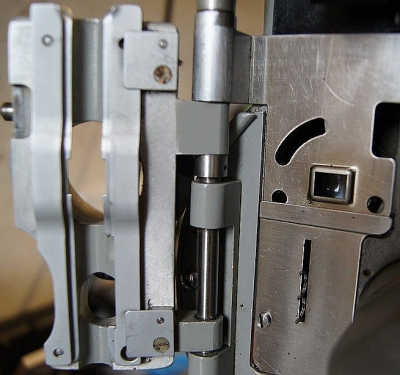
The curved gate sets the film plane back from the rear lens element by about 7 mm and should help with the back focus of a 35mm lens and providing the lens doesn't extend too far out from the lens mount then there will be no need for a support bracket.
![[Cool]](cool.gif)
Powered by Infopop Corporation
UBB.classicTM
6.3.1.2