This is topic What Killed 3-D in the 1950's? in forum Film Handlers' Forum at Film-Tech Forum ARCHIVE.
To visit this topic, use this URL:
https://ft-forum.com/ft/cgi-bin/ubb/ultimatebb.cgi?ubb=get_topic;f=1;t=011262
Posted by Robert Furmanek (Member # 7026) on 06-30-2012, 01:22 PM:
Hello friends,
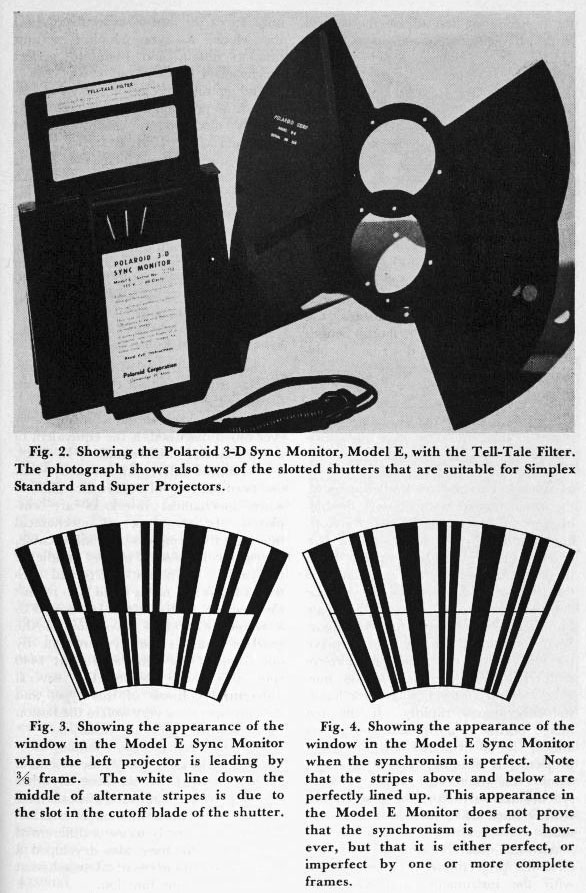
Jack Theakston and I have recently written an article explaining the reasons for 3-D's quick demise in 1954. I think you will find the technical aspects interesting, especially the details on the Polaroid Sync Unit. http://www.3dfilmarchive.com/what-killed-3D
I look forward to your comments!
Bob Furmanek
3-D Film Archive, LLC
www.3dfilmarchive.com
Posted by Monte L Fullmer (Member # 2797) on 06-30-2012, 02:22 PM:
I've ran the older 3D setups using single projector setups.
The classic one was "the Stewardesses", in 1971. There was a dual image on the film - a side-by-side image that was squeezed vertically to fit within the frame. Thus the results on the screen was a 1.33:1 image.
The lenses were a split vertical prime and convergence elements to blend the two images together, then the front anamorphic attachment to expand the image. Obviously, the prime elements had to be squared in with the frame to make the correct convergence.
We had to run larger carbons, modify our exhaust for such, put in infared reflectors to get more light out.
Thing about the old system is that it was the linear polarization, where if you sit on the sides, you lose the 3d effect.
Luckily, we still had the silver screen that was installed for these initial early 50's releases (including the CinemaScope releases), thus we were in good shape there.
Posted by Stephen Furley (Member # 1277) on 06-30-2012, 06:57 PM:
Hi Bob, haven't heard from you for a long time. It's almost 1 a.m. now, but I'll read that tomorrow.
Monte, I've never seen 'The Stewardesses', but I did once visit the box at the National Film Theatre the day after it had been shown, and saw the optics which were used for it; I don't think I've ever seen so much hardware hung on the front of a projector.
I did see 'House of Wax' in this format, the image was rather dim, but I was told that the print was rather dark, which didn't help. Were any other films released in this format?
Posted by Robert E. Allen (Member # 1351) on 06-30-2012, 08:40 PM:
At the time operators I knew said the biggest complaint from customers was about the cardboard glasses. I don't remember there being any up-charge for 3D.
Posted by Robert Furmanek (Member # 7026) on 06-30-2012, 08:52 PM:
Hi Stephen, nice to see you again. It's been a while!
Robert: people didn't mind the glasses too much, as our article shows. However, they did not understand technical matters of projection. If a film was shown out-of-sync or out-of phase - which Polaroid discovered in field tests was about 50% of the time - the public would blame the faulty image on the glasses.
Many years ago, I knew a gentleman in New York who worked for the Skouras chain in 1953. It was his responsibility to spot-check 3-D shows in their theaters. He told me it wasn't unusual to see a show running out of sync by one or two frames. People were complaining about headaches. He'd run up to the booth and find the Union guys reading a paper, totally oblivious to the eyestrain their bad presentation was causing.
Of course, one or two bad experiences with 3-D and the people stopped going. That's what killed the process.
Bob
Posted by Robert E. Allen (Member # 1351) on 06-30-2012, 09:39 PM:
Well I must have been a better union projectionist than I thought as I never received a complaint about the 3D performances I ran. Man, that was a lifetime ago and I don't remember the technical aspects of the operation other than the two machines were interlocked.
Posted by Robert Furmanek (Member # 7026) on 06-30-2012, 10:16 PM:
That's nice to hear, Robert. You're one of the 50% that actually cared and did a good job.
I realize that we're going back nearly 60 years, but do you remember any of the theaters you worked or the movies that you ran in 3-D?
Many thanks for your recollections. It's wonderful to hear from someone who was there.
Posted by Claude S. Ayakawa (Member # 1401) on 07-01-2012, 12:25 AM:
Welcome to the forum, Robert. Although I never responded to your discussions about 3-D at the Home Theatre Forum, I have been very interested in the various topics about the process at that site
Honolulu only had one theatre set up for first run dual projection 3-D films in the fifties. It was the Liberty theatre on Nuuanu Street, operated by Consolidated Amusement. Beside the Liberty there were four others that was equipped for dual projection 3-D. They were the Varsity, Haleiwa, Victory and the Pearl City that showed the movies after they played at the Liberty.
All of the earlier films in 3-D were shown at the Liberty and the other theatres but after a period of time, all of the better films such as KISS ME KATE, DIAL M FOR MURDER, MISS SADIE THOMPSON and HONDO were shown in 2-D in Honolulu at Consolidated's other first run theatres such as the WaikIki, Kuhio, Princess and the Hawaii. Just when I thought 3-D films was dead, the Liberty showed one more in 3-D. It was THE CREATURE FROM THE BLACK LAGOON and it was fantastic! The 3-D presentations at the Liberty and the Pearl City were flawless and because of that I never got an eye strain. The glasses in the fifties were very comfortable and I never had a problem with them. I did not wear prescription glasses at the time but I do now and I still do not mind wearing them today when I watch an excellent 3-D film like AVATAR and HUGO.
I have always loved 3-D of the fifties ever since I first saw BWANA DEVIL and have seen almost every one that was shown in the process either at the Liberty or the Pearl City near where I live. The current 3-D films shown in digital IMAX, Real D and Dolby 3-D are good but they just cannot compare to the dual projection process used in the fifties. The over /under single strip process used in the seventies was dreadful and I did not like it all all. The 3-D lacked depth and because only one projector was used, the picture was extremely dark.
-Claude
Posted by Robert E. Allen (Member # 1351) on 07-01-2012, 01:02 AM:
Robert: I ran 3D at the Fox West Coast State theatre in Pomona, California. It was a 500 seat house. I don't remember the name of any of the films but one of them had something to do with natives throwing spears. But back then weren't people throwing things at the camera in just about every 3D film?
Posted by Louis Bornwasser (Member # 3063) on 07-01-2012, 01:18 AM:
I think it is safe to say that many good ideas for film died at the hands of TV.
While many of these ideas were good: Cinerama, Scope, 3D, the TV idea was a mega-trend and the improvements of 35mm (incl 70) were just that improvements. In may towns 90% of the existing screens failed due to TV.
Reduced budgets stopped innovation. Louis
Posted by Frank Angel (Member # 248) on 07-01-2012, 03:18 PM:
As a kid, I only saw FORT TI and THE HOUSE OF WAX and never experienced eye strain, possibly because the theatre I saw them in was the Century Fresh Meadows which, at that time, was one of Century's Flag Ship theatres and a beautifully run house. I am assuming projection was top draw as well. And like Claude, the glasses never bothered me. By the time I saw HOUSE OF WAX, the glass had improved to plastic with the plastic covered wire that you formed the exact distance around your ear.
Thanks to Bob for those great 3D observations. The one thing I would add to the reason for the death of 50s 3D -- after sitting through nearly all the 50s 3D titles that still exist at the 3D World Expo, it becomes painfully obvious to me that most of those titles were at best, grade B titles. Aside from THE HOUSE OF WAX, DIAL M FOR MURDER, KISS ME KATE, HONDO and possibly FORT TI and THOSE REDHEADS FROM SEATLE, the rest were really pretty awful and you could see how people could associate just really terrible films with 3D given the 3D output. I would venture that schlock like GOG did as much to turn people off to 3D as did the technical problems.
Then just in time, along came CinemaScope and THE ROBE with its high power cast, religious theme and huge advertising budget not to mention Zanuck's white lie that implied it was 3D that you could see without glasses, and the fickle public turned away from the 3D screen to marvel at shiney (silver) new wide, wide CinemaScope screen. Had the studios invested as much in good stories and their A talent in 3D, it might have survived long enough for the kinks to actually be worked out. Some 3D had already been release in stereo sound and as Bob pointed out -- Polaroid had developed a sync kit, but it was too late.
Given the ease of the anamorphic process on both the production end as well as the ease of operation for exhibition in the booth, it's no wonder both ends of the industry dumped 3D in favor of the new kid on the block, CinemaScope.
Whereas 3D was a way to fight the flight to TV as America's primary entertainment, CinemaScope worked on two fronts. Yes, it functioned to compete with TV as did 3D, but it also was a way to capitalize on the infatuation the public had with that upstart Cinerama which was packing houses at nearly every show and which hadn't sprung from the loins of the Hollywood studios. The studio heads were painfully aware of that fact and they wanted some of THAT MONEY!
Everything about CinemaScope, from the wide, curved screen to the multichannel stereo sound with a surround channel, it all mimiced Cinerama. CinemaScope was a poor many's Cinerama and it did boffo business...so who needed 3D? ![[Frown]](frown.gif)
Posted by Claude S. Ayakawa (Member # 1401) on 07-01-2012, 03:20 PM:
I do not believe it was television that caused the demise of the 3-D format in the fifties. The many complaints I am hearing about current 3-D is the surcharge, poor 3-D from 2-D conversion and the reluctance of having to wear glasses to watch the movies. The only complaint I remember hearing about 3-D in the fifties was eye strain and nothing else.
As I had stated in my earlier post, I loved the 3-D of the fifties. Beside HOUSE OF WAX, some of the other memorable films I remember seeing in 3-D were INFERNO, THE MAZE, THOSE REDHEADS FROM SEATTLE, SANGAREE, FORT TI, ARENA and IT CAME FROM OUT OF SPACE. There was one film I saw during the fifties in 2-D because it was only released that way but it would have been fun to have seen it in it's original 3-D. The film was TOP BANANA starring Phil Silvers and it was from a Broadway show he was in. There were others I had seen in 2-D that would have looked cool in 3-D. Two that come to mind were DRUMS OF TAHITI and ROBOT MONSTOR. I know ROBOT MONSTOR was released in 3-D but it never played at the LIBERTY. Did DRUMS OF TAHITI ever play in 3-D anywhere?
-Claude
Posted by Robert Furmanek (Member # 7026) on 07-01-2012, 06:26 PM:
Frank: I respectfully disagree with your comment that most of the films are poor. See Myth #6: http://www.3dfilmarchive.com/home/top-10-3-d-myths
Titles like THE GLASS WEB, INFERNO, DANGEROUS MISSION, MONEY FROM HOME, CHARGE AT FEATHER RIVER, SECOND CHANCE and MISS SADIE THOMPSON are good examples of well done, entertaining 3-D films.
Robert: the film with the native throwing a spear is BWANA DEVIL. the first feature. Interesting to hear that the one shot stays in your mind; it's on screen for about 5 seconds! The rest of the film is not very memorable.
Did you work at the Pomona Fox on West Third street? What a gorgeous theater. The listing on Cinema Treasures says 1,751 seats.
Claude: Thank you for sharing your memories of seeing the films first-run. That's very interesting to hear.
DRUMS OF TAHITI had some 3-D bookings, but not many. I know that it opened flat in New York and Los Angeles. It was a Sam Katzman/William Castle programmer from Columbia. Not one of the better ones.
And I agree 100%. Dual 35mm Polaroid 3-D, properly presented, stands head and shoulders above the quality of today's 3-D product.
Posted by Claude S. Ayakawa (Member # 1401) on 07-01-2012, 08:16 PM:
Robert,
With the demise of dual projection 3-D in the fifties after it was replaced with other film formats such as Cinerama, CinemaScope, VistaVision, etc, I never had the pleasure of seeing all the wonderfull 3-D films again because the Liberty was sold and became a first run venue for films from Japan's Nikkatsu Studio. A few years later it was sold again and it became Hong Kong's Shaw Brothers first run venue for their films. Because iof a lack of interest, Consolidated never botherd with 3-D revival showings at their other 3-D theatre , the Varsity and that was a shame. When you had a grand revival showing of 3-D at the Egyptian Theatre with almost all of the classic films on the program about fifteen years ago, I really wanted to be there but because of my busy schedule with my photographic career, I was not able to hop on a plane and spend a week seeing my favorites as well as other films I have never seen in 3-D.
Now that DIAL M FOR MURDER and CREATURE FROM THE BLACK LAGOON has been announced for release on Blu Ray, what do you think of the possibility of one or two day showings of some of the classic 3-D films of the fifties in theatres? It would be great if Turner Classic Movies could do something similar like they did with CASABLANCA and the current SINGING IN THE RAIN theatrical showings with 3-D films such as KISS ME KATE , DIAL M FOR MURDER and HOUSE OF WAX. Although Paramount was short sighted when they recently released HONDO in 2-D only on Blu Ray when when they could have released it in 3-D as well because restored elelments of the movie in the format was available, this movie could also be shown in theatres again in 3-D.
-Claude
Posted by Robert Furmanek (Member # 7026) on 07-01-2012, 09:06 PM:
I'm a strong proponent of Golden Age 3-D for theaters. Now with D-Cinema, it takes all the guesswork out of 35mm projection. While I love film, the amount of sloppy 3-D revivals I've seen over the past 30 years has not done the process any good.
Posted by Claude S. Ayakawa (Member # 1401) on 07-01-2012, 09:24 PM:
With D Cinema, will the films look exactly the same when it was properly presented in theatre on film with dual projection, Robert?
-Claude
Posted by Robert E. Allen (Member # 1351) on 07-01-2012, 10:01 PM:
I believe a digital picture will be superior to most film presentations.
Posted by Claude S. Ayakawa (Member # 1401) on 07-01-2012, 10:10 PM:
Yes, I know that about the picture quality but I was asking about the 3-D, Robert The reason I ask is due to the Real D presentation of a Donald Duck short that was produced during the golden age of fifties 3-D that was shown with MEET THE ROBINSONS several years ago that did not impress me at all. The 3- D effect was good but not as good as what I had come to expect from that period. Was 3-D animation in the fifties lacikng the natural perception of depth like live action or was it the short comings of current 3-D motion picture imaging ?
-Claude
Posted by Monte L Fullmer (Member # 2797) on 07-01-2012, 10:48 PM:
I'd almost take that 3D animated product was about the same as looking at cartoons through a "ViewMaster".
One can still do this (if they have access to any film nowdays..): take two frames, esp of a still shot, hold them apart and up to a light, cross your eyes to where you get a middle image between the two and you got 3D from the middle image. Works with both live and animated images.
I take it that the simple "supply and demand" attribute - cinemas not wanting to do this conversion - is what killed 3D along with what Louis mentions.
Posted by Robert E. Allen (Member # 1351) on 07-02-2012, 01:22 AM:
Sorry Claude, I don't recall any 3D cartoons. as best as I can remember at our house we had a newsreel, coming attractions and a standard cartoon. Then we had an intermission to set up the 3D stuff.
Posted by Stephen Furley (Member # 1277) on 07-02-2012, 06:33 AM:
I wasn't born until 1957, so I never saw the original '50s presentations, but I have in more recent times seen most of the original Festival of Britain prints,plus a number of feature films, from both the '50s and the '80s. I've seen 3-D in two-strip, side-by-side anamorphic and under and over and anaglyph formats on 35mm, anaglyph and two-strip on Imax and also demonstrations of two digital systems at Bradford, one was Dolby, and the other was another white screen system which they now have installed there; I can't remember the name.
For me, the technology of traditional polarised 3-D is still too intrusive. Of the other enhancements which have been made to film over the years most, sound - and later stereophonic sound, colour, widescreen etc. have become almost universal; films are only made without them these if an artistic choice has been made to make them that way, they are not made without for reasons of cost or technical difficulty. This has never happened with 3-D, it has always been something which was used for a minority of films, though the total made over the years is quite large. The technical complications with 3-D seem to be largly with exhibition, making a live action 3-D film is not that different today to it was in 1950, even if it's shot with digital cameras today. Contrast this with sound for example, where in the early days the camera had to be in a fixed position in a soundproofed booth, and in the case of sound on disk, editing was difficult and could only be done by copying from one disk to another, or with Cinerama, where actors in different panels had to not look at each other on the set to seem to be looking at each other on the screen. These sort of problems inhibited the production of films in these processes until the technology improved.
In the case of 3-D the technical problems were largely at the exhibition end; there is just too much to go wrong. Most of the 3D films which I've seen have been at the National Film Theatre, where the staff may be expected to be more familiar with it than elsewhere, but even there I have seen various technical problems which have occurred. These were not only with two-strip; on one occasion at the start of a under and over print something was obviously wrong, the images for each eye were swapped over. A few people who didn't know how the polarised system worked swapped their glasses left to right, others who did know turned them upside down. After a couple of minutes the entire audience was sitting holding their glasses upside down. At that point either the projectionist either realised what had happened or somebody told them, and the racking was pulled up by a couple of perfs. At this point the entire audience took off their glasses and turned them over. As a one-off event it was quite funny, but not something tou'd normally want to happen, and it does show that single strip films were not imune to problems.
Many of the large 'Super cinemas' of the late '20s and '30s were not really suited to silver screens. They often had wide, fan-shaped, auditoria, where many of the seats towards the ends of many of the rows would be almost unusable. Where was also the problem of the vertical viewing angle, and of the steep projection rake often found in such theatres, with the projection box often being high up above the back of the balcony. Many such theatres had to install new projection boxes at the back of what we would call the stalls (the downstair seats, I don't think you use the word stalls over there but I don't know what you call them) but I don't think this was done for 3-D. I've never been a fan of silver screens; the only one I've seen which didn't have problems was at the Lafayette, Suffern, NY. I don't know how they've managed it, but I didn't even realise that it was a silver screen at first. I've never seen a 3-D film there, but the relatively small screen and long, narrow, auditorium, more typical of older theatres would probably work better than the large '30s style ones. A problem im many modern multiplex type auditoria is that the screen often has no curtains, and the screen is within reach of the audience as they walk past it; an invitation to touch it. Not generally a problem in the '50s, but likely to be so today with a silver screen.
I don't like the way that with linear polarised systems you lave to hold your head perfectly upright, or you start seeing crosstalk between the images; I want to watch the film, not worry about exactly how I'm sitting, or holding my head.
You say that people didn't mind the glasses. For an occassional show you're probably right; the novelty of the process probably outweighs the disadvantage of the glasses, but would people want to wear them for every film they saw, or would they get fed up with them once the vovelty had worn off? Could this be part of the reason why 3-D films were initially very popular, but declined rather rapidly after ajust a few years, both in the '50s and in the '80s? I have seen projected 3-D without glasses, the Russian lenticular system, and I wasn't impressed, glasses is about the best we can do at present. I didn't like the active LCD shutter glasses which the long defunct Pepsi London Imax used either.
One particular problem with the glasses at the NFT, both polaroid and anaglyph, was that they used disposable cardboard ones, but collected them in for re-use. Apart from any possible hygene issues they used to run 3-D films in short seasons every few years, with maybe a dozed films, in various formats, over a couple of weeks or so. The glasses were discarded at the end of the season, and for the next season there would be new ones, but for a film towards the end of the season they would be in poor condition. I don't know if this happened at any other theatres, either in the '50s or later.
I was quite impressed with the two brief digital 3-D demonstrations which I've seen, but these were both computer generated animated material. This seems to be what most of the new 3-D films are from the adverts which I see on the sides of buses on my way to work. They're also mainly children's films. You can get away with showing even poor quality 3-D material to children because of its novelty value, by the time that's worn off they've grown up a bit and there's a new group of children you can show it to.
In short, I think the technology has simply been to intrusive for 3-D to become a 'normal' thing in the past. There's an interesting point though. If a film was made in a poor early sound system, or a poor early colour process then there's nothing you can do about it. It may be historically interesting to see and hear it as it was, but you cannot improve it. With 3-D films, as long as the elements for both eyes exist, you can show it in any system you like. Original two-strip films were later show in single-strip and/or anaglyph form. If a better system is developed then the older films can be shown using it, and will make use of the advantages of it. It would be interesting to see how a live action 3-D film like 'House of Wax' would look on one of the white screen digital systems. I'd still want it to be shown in its original format, so it could be seen as it used to look as well.
Claude, I have to disagree with what you say about the under and over single strip system. I've seen a few films in it, and I think that it can work quite well, with a couple of provisions. Firstly, if should only be used for films close to 2.35 aspect ratio. There really isn't enough film area to start cropping the image. Secondly, it should be used on screens of moderate size, up to maybe 8-10 metres. I agree that it looks poor on large screens.
Posted by Mark J. Marshall (Member # 1409) on 07-02-2012, 07:07 AM:
quote: Claude S. Ayakawa
With D Cinema, will the films look exactly the same when it was properly presented in theatre on film with dual projection, Robert?
I know this was a question for Bob, but I'd like to say that it partially depends on the projection method. If it's a single projector 3D system operating exactly perfectly, then it will look like an improperly done presentation from the 50s with the 35mm projectors being slightly out of phase. If it's done with a dual digital projector setup (or using the single projectors with two light engines, lenses, etc.) then it should look more like the 35mm setup running correctly.
Having said that, I've sat through close to 50 dual projector 35mm presentations now, and a bunch of digital 3D presentations too, and I still don't think the best dual digital projector 3D presentation is quite up to par with the best 35mm dual projector 3D presentation. Almost, but not quite. The 3D TVs are nowhere near close to 35mm or even dual digital setups, for what that's worth. But I have high hopes that they will get there someday.
Posted by Frank Angel (Member # 248) on 07-02-2012, 03:46 PM:
To add to that, Mark, I think dual digital projection IMAX 3D is on par with correctly presented dual film 3D. If there is something I want to see in 3D, I will go to the IMAX theatre here in Brooklyn. If it's not in IMAX, I probably won't see it in 3D. The IMAX image is always MUCH brighter than regular RealD and of course IMAX being dual projection has both images on the screen at the same time; ReelD and the others alternate Left eye/Right eye so there is a temporal disparity that is perceived by many people. In fact, Mark, wasn't it you who said that you find that time disparity really annoying?
Anyway, digital 3D can look as good as film, mostly because it eliminates all those things that Bob already point out that can go wrong in a dual film presentation. IMAX I think is on par with dual film (when dual film is done with impeccable precision). Digital takes the untrained projectionist out of the equation. It was difficult even back in the 50s when there were at least a fair number of trained and conscientiously guys working the booths. Imagine what dual 3D film would be like if it were tired with the level of booth incompetence that was rampant just a few years ago before the mass conversion.
Then again, there is nothing other than staggering cost that would prevent a non-IMAX theatre from installing two digital projectors and doing the same thing as IMAX does....like THAT would ever happen.
And about those ViewMaster 3D slides -- The depth in those was fantastic. I had a friend who's dad had a ViewMaster projector, a silver screen and polariod glasses. He also had a Realist camera and projector for 3D slides he himself shot. It was great watching these in his basement. I don't remember ever seeing ViewMaster material shot with the convergence set where any part of the image came forward from the screen. I guess their philosophy was that the screen was a window and you were looking out of it. ViewMaster offered some beautiful photography regardless of the 3D on all sorts of subjects, even though I think it really suffered from the square format.
Posted by Claude S. Ayakawa (Member # 1401) on 07-02-2012, 05:02 PM:
Frank,
In my opinion, I do not think even dual projection digital IMAX 3-D has the same impact of the 3-D films I had enjoyed in the fifties. The only presentation that was identical to fifties 3-D in my opinion was the CAPTAIN EO short film starring the late Michael Jackson at Disneyland about twenty five years ago.
I was thinking about View Master when Robert Furmanek started this discussion about the demise of 50's 3-D. What ever happened to View Master? When I was a kid I had two viewers and a very nice collection of reels covering all subjects but somehow they all disappeared over the years. I sure wish I had them today.
If you are interested in still 3-D photography and participate on Facebook, request to be Hillary Hess's friend because she has an ongoing discussion about still 3-D photography with a lot of people who share her interest including Robert Furmanek. The images people post are very interesting and I think you will enjoy them.
Robert Allen ,
For some reasons, the 3-D shows at the Liberty did not include anything other than the movie itself. The Pearl City once included a short featuring a band playing fifties dance music. I realize now there were a lot of wonderful 3-D shorts produced in the fifties and I am puzzled why they were never shown here except the one I saw at the PC.
-Claude
Posted by John Stewart (Member # 989) on 07-02-2012, 06:45 PM:
Bob, I saw the Polaroid info sheet about the Sync and control kits they sent to the theaters. We have one of those Sync control boxes still in the booth of the Paramount. I wondered how it worked so this was the first info I've seen on this.
I remember seeing sheets of polarizing material (that was to be hung in front of the lens) tucked into a drawer of my neighborhood theater when I was a kid. Never did see any 3D films when they were first out.
Posted by Gordon McLeod (Member # 33) on 07-03-2012, 10:05 PM:
I have never had an issue with the phase issue on single film 3d and many subjective tests in the 50's said that shutter phase was not a big issue to most viewers
Also any imax 3d with the gt projector will have a phase issue as the rotors are offset
Posted by Mark J. Marshall (Member # 1409) on 07-03-2012, 11:00 PM:
quote: Frank Angel
In fact, Mark, wasn't it you who said that you find that time disparity really annoying?
Yep that was me. In fact we kicked it around here for a while in the beginning because I wasn't exactly sure what I was seeing. I thought it was some kind of flicker at first.
quote: Gordon McLeod
I have never had an issue with the phase issue on single film 3d and many subjective tests in the 50's said that shutter phase was not a big issue to most viewers
Most people don't notice when film is scratched either, so if that's true that doesn't surprise me. Everyone has different tolerances for things, and for me it's like nails on a chalk board.
Posted by Don Sneed (Member # 955) on 07-06-2012, 12:03 AM:
My only 35mm 3D was an then X-Rated film (an R-Rated now) in the early 1970's, the film was called Love in 3D...as a 16yr old....yea this was almost looking at the real thing... the film ran on Reel to Reel, with the big box split lens, two frames per normal 35mm frame. I saw panties fly out of a window where I could almost reach out & grab it...the 3D looked great back then, but never caught on, & I never saw 3D again as a tech in 35mm film until recently.
Posted by Robert Furmanek (Member # 7026) on 07-08-2012, 11:34 AM:
The late Dan Symmes had a wonderful quote on the attraction of 3-D movies. He compared them to a circus. "They're great when they come to town, but would you want to go every week?"
WORKING FOR PEANUTS in the Real-D format looked comparable in depth to the original shown out-of-phase. Walt Disney was not a fan of 3-D and his two cartoons are mostly flat with occasional depth. However, in the case of MELODY, the finale is quite impressive in 3-D.
The best use of 3-D in a cartoon would be BOO MOON, in my opinion. It features very effective use of layering and even has some well done off-screen effects.
For the most part, the 3-D movies of the 1950's utilized the View-Master window approach to composition and convergence. It wasn't until the 1970's when filmmakers started placing an abundance of action out of the stereo window. Unless done properly (SEA DREAMS, MAGIC JOURNEY) that can be VERY tiring and hard on the eyes.
The craftsman who created the films in the 1950's did an excellent job.
The 1950's boom lasted shorter than most realize. The studios began shooting features in January and February of 1953. By October, the last ones had wrapped. As a result, American Cinematographer published an article in December 1953, "Is 3-D Dead?"
Posted by John T. Hendrickson, Jr (Member # 849) on 07-08-2012, 12:11 PM:
By the time I got into projection, the 3D craze was over, but I distinctly remember two 3D experiences as a kid.
I saw Chargwe At Feather River at the Carlton in Red Bank NJ. I remember being blown away by the arrows that were shot at us, getting that rush in the middle of the chest. Also recall a knife being throw as well. The film was in color, which also was a big deal back them. I remmeber walking out thinking what a great time I had just had.
The other experience I remember was It Came From Outer Space. It was in black and white, and did not blow me away like Charge At Feather River. Interestingly, I walked out of that one with a huge headache.
So, same theatre, but two different recollections. This would lend credence to the theory that It Came From Outer Space was being shown out of sync.
Posted by Robert Furmanek (Member # 7026) on 07-09-2012, 05:46 PM:
IT CAME FROM OUTER SPACE is very well photographed. If you left the show with a headache, it was certainly the presentation.
"Bob, I saw the Polaroid info sheet about the Sync and control kits they sent to the theaters. We have one of those Sync control boxes still in the booth of the Paramount. I wondered how it worked so this was the first info I've seen on this."
John, is that the Paramount in Austin? The sync unit is still in the booth? That's pretty amazing, considering they were installed 59 years ago!
Any chance you could post some pictures? I'd love to see an original installation.
Posted by Claude S. Ayakawa (Member # 1401) on 07-09-2012, 06:10 PM:
As I had mentioned in a earlier thread, I never got a headache from watching dual projection 3-D. I still remember Universal International's IT CAME FROM OUT OF SPACE having great 3-D effects and I enjoyed the film very much. I was about fifteen years old when I saw it it
I just saw THE AMAZING SPIDER-MAN about a week ago in Real D and although the 3-D was very good. it was no way as good as any dual projection films of the fifties. The closest thing to fifties 3-D I saw in the modern format was last years HUGO in Real D and even that was not as good.
-Claude
Posted by Robert Furmanek (Member # 7026) on 07-12-2012, 10:32 PM:
We've added some comic book covers to Myth #1 which may explain why nearly 60 years later, some people confuse anaglyph comics with the movies.
http://www.3dfilmarchive.com/home/top-10-3-d-myths
Posted by Robert Furmanek (Member # 7026) on 10-11-2012, 04:03 PM:
Our new article is now on the website. We present our review of the new DIAL M FOR MURDER Blu-ray plus the background and history on this landmark 3-D production. We also clear up a few long-standing myths along the way!
http://www.3dfilmarchive.com/dial-m-blu-ray-review
Greg Kintz and I hope you will enjoy it.
Bob
Posted by Robert E. Allen (Member # 1351) on 10-11-2012, 05:50 PM:
I just re-read my first post and noticed it should have said "..there WAS someone throwing something at the screen...".
Powered by Infopop Corporation
UBB.classicTM
6.3.1.2