This is topic Experiment: Replacing Xenon lamps with a LED array in an old 35mm projector in forum Film Handlers' Forum at Film-Tech Forum ARCHIVE.


To visit this topic, use this URL:
https://ft-forum.com/ft/cgi-bin/ubb/ultimatebb.cgi?ubb=get_topic;f=1;t=011293

Posted by Marcel Birgelen (Member # 6801) on 08-10-2012, 01:24 PM:
 
I recently had a discussion with an owner of an arthouse cinema. He was complaining about the costs of replacing the Xenon Arc lamps in his old 35mm projectors.

I guess, for a small scale operation like many arthouse cinemas are, those costs can take quite a bite out of their exploitation.

During this discussion, the debate about replacing those lamps with high powered LED arrays came up. Neither of us could come to any definitive conclusion if this would lead to a satisfactory result.

LED seems to have many advantages over more traditional Xenon lamps:
- At least in theory, they should far outlive Xenon Arc lamps.
- They are far more efficient, so they consume less energy and produce less heat.
- They don't look all that expensive.

If you look at current offers, you will find all sorts of LED technology, like LED arrays that should be able to produce the same amount of light as e.g. a 5 kW Xenon Arc lamp. Also, they're available in many different color temperatures.

But, if you look at the professional projector market, nobody seems to offer any kind of LED based solution. The only LED based projectors you will find, is a limited section of home-cinema projectors.

So, what am I missing here? Why is nobody really embracing LED as a new light source? LED is the new shiny toy that gets broad application almost everywhere right now, but not in professional projection technology.

Is it because the companies that are in the game are afraid of killing the goose with the golden eggs? Just like Gillette will never ever offer any razor blades with a decent life span? Or HP that will never ever offer you an ink cartridge that prints twice as long, for the same price?

Or, am I missing something else. Is the technology not fit for professional use yet? Are there concerns about the light temperature or the brightness? Or are there any other problems I didn't think about?
 
Posted by Victor Liorentas (Member # 5272) on 08-10-2012, 02:02 PM:
 
Pretty sure the light output in these great home theater projectors is already maxed out with current LED technology.
They can only get them bright enough for smaller screens so far.
It's laser light sources which we will be seeing on big theater screens!
Also I don't know if it's possible to make LED or laser work with film?
 
Posted by Rick Raskin (Member # 1561) on 08-10-2012, 03:45 PM:
 
Years ago there was an engineer in the Washington DC area by the name of Russ Claggett who had experimented with mounting a bulb in a Peerless Magnarc. The experiment was implemented at the Plaza theater in downtown DC and from what I can recall was somewhat promising. The modification was known locally as "Claggett's bulb" and I did see it in operation. The light was a little warm on the screen but overall looked good.

Maybe someone from old Local 224 has a better memory and can shed more light on this, and what became of it all. But from what I can remember, it did offer a cost effective way for a small theater to light their screen.
 
Posted by Kevin Fairchild (Member # 4985) on 08-10-2012, 03:48 PM:
 
I've always been curious to put one of these in a projector.

http://gizmodo.com/5880609/this-15000-lumens-led-light-cannon-will-turn-night-to-day

This 15,000 Lumens LED Light Cannon Will Turn Night to Day
You can forget about hanging it from your belt, because this miniature sun—masquerading as a flashlight—is heavy enough to need two hands to operate. And with 15,000 lumens, the XM18 is bright enough to illuminate a small planet.

As you can see, it's actually composed of 18 smaller LED flashlight components, all wrapped in a custom housing powered by 32 lithium batteries and cooled with its own fan. LEDs are definitely more efficient than incandescents, but 15,000 lumens worth still produces a lot of excess heat.

What's even crazier is that the $2,500 photon cannon (built only as a custom order) is shaped like a hexagon so multiple units can be easily mounted together. Because apparently the company is worried that 15,000 lumens might not be enough for their most discerning customers who need to blind entire herds of deer at once.
 
Posted by Stephen Furley (Member # 1277) on 08-11-2012, 04:17 PM:
 
I've seen a video of this thing. It is indeed very bright for LEDs, but 15,000 lm is only about half the light output of a very ordinary 400 W metal halide lamp. It's not much more than the 150 W ceramic metal hides in the street lamps on the main road at the end of my road.

The luminous efficacy of xenon short arc lamps is rather low, around 40 lm/W for this 1960's 2 kW three electrode one from a tank:

web page

I doubt if modern xenons have an efficacy much greater than this, but even this one puts out 80,000 lm.

This lamp looks very similar to the ones which were used in early film projector xenon conversions.

I suppose that you could design a huge array of LED lamps and some sort of optical system to concentrate the light into a projector, but it would probably be several times the size of the projector, and cooling would be a problem; LEDs don't like getting hot.

Philips make a LED replacement for the 12 V 20 W halogen capsule lamp. It's only 1.5 W, but the light output is only half that of the halogen. It really needs to be about 2.5 W as a minimum, but at the moment they can't deal with the heat in such a small lamp.

Metal halide lamps have a considerably higher efficacy than xenons, that's the reason why the old GE Marc 300 put out more light than a xenon of the same Wattage in 16 mm portable machines, but the light quality was not as good, and the lamp life was much shorter.
 
Posted by Randy Stankey (Member # 64) on 08-11-2012, 09:15 PM:
 
The harder you drive an LED the shorter it's life span. It only makes sense. Right? It's the same as with an ordinary light bulb.

As far as I know, we are already driving LEDs as hard as we can and, as you mentioned, they are already generating a lot of heat.

It is my bet that, in order to produce enough light to project a movie in a theater, we'd have to have an array of several of those LED units which, itself, is an array of LED elements. We'd end up with array upon array of LEDs with has as much current being shoved through them as they can possibly take. I'm betting that would be an expensive and troublesome job to engineer in the first place and just as expensive to maintain.

As much as the idea sounds good, I don't think it's ready for Prime Time yet.
 
Posted by Louis Bornwasser (Member # 3063) on 08-11-2012, 10:15 PM:
 
You will find that LEDs rate out at 15ma per unit. You will need a lot of units to have enough to fill even a 10 ft screen.

Even the Dolby red LED is 24 segments at an absolute max of 15ma each. They are not overly bright in the scheme of things. Louis
 
Posted by Monte L Fullmer (Member # 2797) on 08-11-2012, 11:00 PM:
 
...along with the Kelvin temperature being up in the 8K area .. you'd have to color time your prints to compensate..
 
Posted by Jeff Stricker (Member # 224) on 08-12-2012, 06:34 AM:
 
I wonder how you could focus an array of LEDs such that all (or most) of the light energy is concentrated on the aperature?
 
Posted by Ian Parfrey (Member # 5122) on 08-12-2012, 07:01 AM:
 
I've seen this idea a million times and it just won't cut it.
There are reasons why this has not taken off with the professional lamphouse manufacturers.

First off, the ideal light source is a point source. There is no way a stack of over-run led's will ever achieve this aim.

Second, in the event of a led failure (when, not if), trying to change that when compared to changing a xenon bulb will be a nightmare.

Three, in order to get anywhere near the output of a xenon bulb, the amount of led's would be huge - and this along with the associated led supplies would result in a tangled mess.

Four, for an equivalent light output, the heat thrown out from the led's and the heatsinks would rival the xenon's heat output.

Five, the number of led's would in total rival the cost of a xenon lamp.

Six, experience dictates that led's rarely live to their advertised lifespan... and if you have a dirty supply, it won't take much to fry the whole bunch.

I have looked into led's for a 16mm Debrie D16 conversion I am doing for a 20' cinema screen and the led's are a non-starter.

For the reasons listed above, I found the led conversion to be a waste of time and money - but if you want to do it for shits and giggles then give it a whirl.

But the ultimate concern I have is that if they were an effective replacement, xenons would have been replaced long ago and that just hasn't happened.(and won't in the near future)
 
Posted by Marcel Birgelen (Member # 6801) on 08-12-2012, 02:19 PM:
 
Thanks for all the answers so far. Well, it was obvious it wasn't just as simple as putting some big "LED bulb" into the lamp house, but after looking around a bit, I'm still not sure it is entirely unworkable.

quote:
The luminous efficacy of xenon short arc lamps is rather low, around 40 lm/W for this 1960's 2 kW three electrode one from a tank:
According to information on-line, an average LED will achieve about 80 lm/W. A modern, high-end LED could go as far as 150 lm/W. I've even found manufacturers that claim 180 lm/W, but I doubt that's accurate. So, an average LED is about twice as efficient as Xenon, at least on paper.

quote: Monte L Fullmer
...along with the Kelvin temperature being up in the 8K area .. you'd have to color time your prints to compensate..
Well, that doesn't really seem to be a problem anymore. I've done a bit of research (read: Googling around) and LEDs are available in almost all color temperatures you could wish for. So, 6500K for example, seems to be no problem.

quote: Jeff Stricker
I wonder how you could focus an array of LEDs such that all (or most) of the light energy is concentrated on the aperature?
It depends of course, on how big your array or array of arrays will be in the end, but if it gets really big, you will need a very big lens, which is quite expensive of course. Maybe it's a stupid idea, but why not put a Fresnel lens in front of it? [Smile]

Sure, you would need a Fresnel lens that could cope with the heat.

quote: Ian Parfrey
First off, the ideal light source is a point source. There is no way a stack of over-run led's will ever achieve this aim.
Maybe I'm mistaken here, but wouldn't be the ideal light source a rectangle with equal light intensity across the surface with exactly the same aspect ratio as the aperture?

quote: Ian Parfrey
Three, in order to get anywhere near the output of a xenon bulb, the amount of led's would be huge - and this along with the associated led supplies would result in a tangled mess.
I've found some suppliers that offer single-chip LED arrays that claim to achieve 500W or even up to 900W. Those modules are just a few square inch in size. Of course, I don't know if those are any good, but to achieve the same output as a small Xenon bulb you, in theory, would only need a single one of them or maybe just two or three.

quote: Ian Parfrey
Four, for an equivalent light output, the heat thrown out from the led's and the heatsinks would rival the xenon's heat output.
Sure, where there is a lot of energy, there is almost certainly a lot of heat. But still, the amount of heat emitted by those LEDs should be still quite a lot less than that of Xenon bulbs. Still, it isn't a problem to cool the Xenon lamps, so it should be no problem to cool LEDs, given the heat-sinks offer sufficient surface.

quote: Ian Parfrey
Six, experience dictates that led's rarely live to their advertised lifespan... and if you have a dirty supply, it won't take much to fry the whole bunch.
The most LED arrays I've found advertise with a lifespan of about 50.000 hours. Well, if they even could achieve 1/5th of that, it would far outperform Xenon.

quote: Ian Parfrey
But the ultimate concern I have is that if they were an effective replacement, xenons would have been replaced long ago and that just hasn't happened.(and won't in the near future)
Yeah, I share that concern. But I'm still not entirely sure that's because the technology doesn't work, or simply because selling the actual lamps is like selling those refill ink cartridges: quite a profitable business.
 
Posted by Scott Norwood (Member # 30) on 08-12-2012, 04:08 PM:
 
Do full-spectrum LEDs exist now? Last time I looked into such things, "white" LEDs did not provide reasonably consistent output across the entire spectrum of visible light, which would make color prints look odd.
Xenon looks expensive, but it really isn't, when the cost per hour of operation is considered.
 
Posted by Marcel Birgelen (Member # 6801) on 08-12-2012, 06:19 PM:
 
quote: Scott Norwood
Do full-spectrum LEDs exist now? Last time I looked into such things, "white" LEDs did not provide reasonably consistent output across the entire spectrum of visible light, which would make color prints look odd.

I guess they don't, but the result is "close enough" for the human eye, But that's the bit I'm a little bit "afraid" of.

But, on the other hand, LEDs are being used for LCD/TFT backlight purposes too those days and that seems to work pretty well. The first LED driven backlights looked far to blue, but I'm currently looking at one and the color temperature is adjustable and OK.
 
Posted by Gary Wachter (Member # 5833) on 08-23-2012, 12:42 AM:
 
I actually experimented with a 100 element LED array last year. The results were less than spectacular. Pretty much of what the earlier posts state is true.

 -

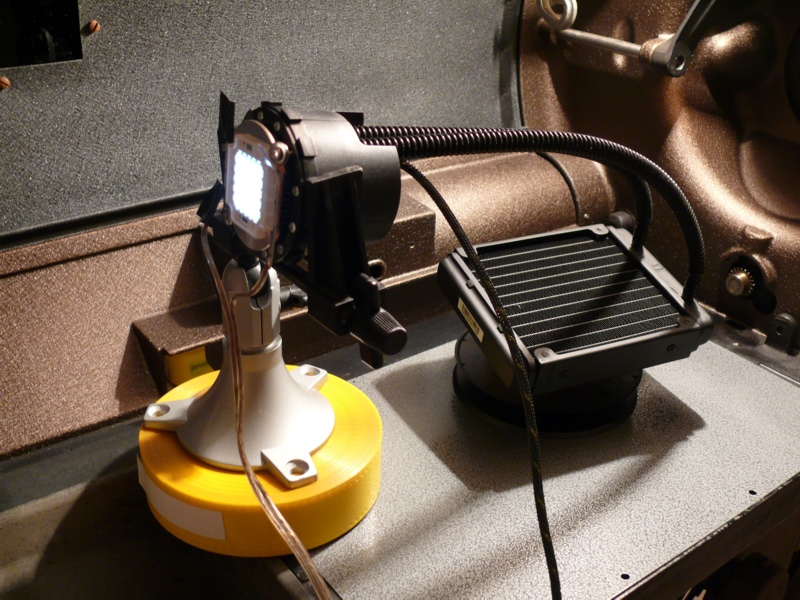
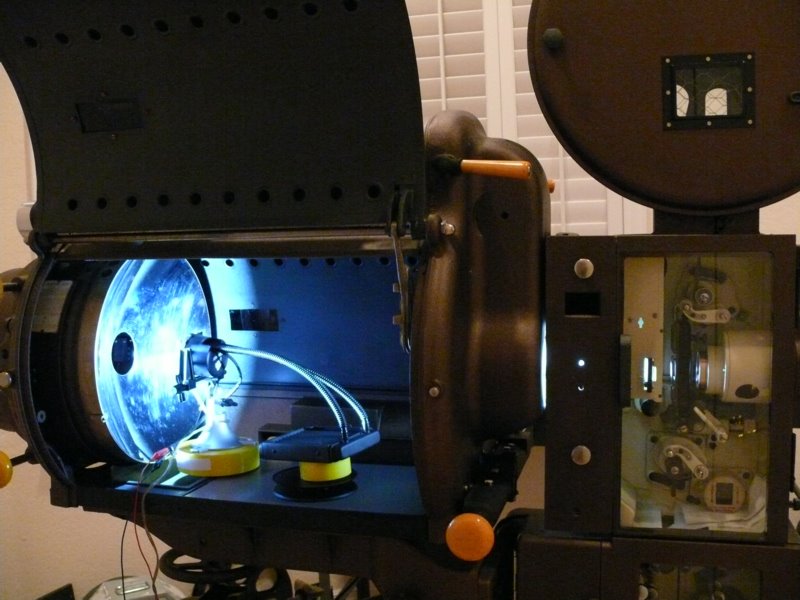
The LED array required a sizeable heatsink and was attached to a liquid CPU cooler with radiator. It was easily moved around on an improvised Panavise stand.

 -

The LED light is not a point source and was difficult to focus. It also has a dispersion angle of 170 degrees. The mirror is designed to gather and focus light from a very small area. A LOT of light gets wasted. The brightest output from the array is also lost to the center hole in the reflector.

 -

The color temperature is also very much on the blue side, even though it was rated "warm". I also tried direct illumination of the gate, bypassing the mirror altogether. The light output was even lower. Probably with a custom designed condensor lens, more of the light can be recaptured and directed forward.

Bottom line. A lot of fun to play with, but not practical (at this time!).
 
Posted by Carsten Kurz (Member # 5396) on 08-23-2012, 05:57 AM:
 
It doesn't make sense to use LEDs the same way as a xenon, that is, through the existing mirror.

The light output of an LED does not need to be even a fraction of a xenon if used properly - because with an optimal lightpath, a lot less light is wasted.

See how existing LED projectors create up to 3000 lumens from LEDs.

Also, with LEDs you don't need the mechanical shutter, and instead flash the LED. That also allows you to get closer access to the film-gate.

Barco created nearly 60.000 Lumens projector output from only 600 watts optical power.

Conventional Xenon lamphouses waste more then 90% of the lamp optical output (not even to mention total energy efficiency).

The problem is to find an LED with the right etendue and then create a suitable light path.

- Carsten
 
Posted by Marcel Birgelen (Member # 6801) on 08-26-2012, 08:53 AM:
 
quote: Gary Wachter
I actually experimented with a 100 element LED array last year. The results were less than spectacular. Pretty much of what the earlier posts state is true.
It is great to see somebody actually trying this in real life [Wink] .

I have some questions though:

- It's a LED module of 100 x 1 Watt LEDs, is that correct?
- What was the specified color temperature of this LED array?
- How do you drive the LED? With a specific LED driver or just a regular DC power supply?

quote: Carsten Kurz
Also, with LEDs you don't need the mechanical shutter, and instead flash the LED. That also allows you to get closer access to the film-gate.
That's actually true, but you would need to find a reliable synchronization source for that.

quote: Carsten Kurz
The light output of an LED does not need to be even a fraction of a xenon if used properly - because with an optimal lightpath, a lot less light is wasted.
Well, I guess you could do with just a single condenser lens and a small reflector. Those LED arrays come in squares and rectangles. If you could find one that matches the aspect ratio of the gate, you could essentially focus it directly on the gate, this way your light loss should be at an absolute minimum.

But I'm curious if you would see some artifacts from the "dots" in the light source in the final projection.
 
Posted by Lyle Romer (Member # 1266) on 08-26-2012, 11:10 AM:
 
quote: Monte L Fullmer
...along with the Kelvin temperature being up in the 8K area .. you'd have to color time your prints to compensate..
Not just the color temperature but you have to compensate for the spectral peaks and valleys.

quote: Scott Norwood
Do full-spectrum LEDs exist now? Last time I looked into such things, "white" LEDs did not provide reasonably consistent output across the entire spectrum of visible light, which would make color prints look odd.
No they don't. The closest I've seen is CREE makes some 95 CRI LED bulbs but they are nowhere near the lumen output of a 2k xenon.

quote: Marcel Birgelen
But, on the other hand, LEDs are being used for LCD/TFT backlight purposes too those days and that seems to work pretty well. The first LED driven backlights looked far to blue, but I'm currently looking at one and the color temperature is adjustable and OK.
The reason that LEDs (and flourescent for that matter) work as backlights for LCD displays is that the spectrum of the backlight is known so the LCD can be calibrated to produce the desired output. If you took an LED backlight and used it to light your room, the color rendering would not be nearly perfect.

Then again, we are being forced to used CFL bulbs that don't produce very "white" light even thought they are much better than they used to be. I guess at some point using the technique that CREE uses, LED bulbs might get very close to incandescent spectrum. They basically mix white LEDs with red in an array and combine the light together.

LEDs have a long way to go to be able to be used for high power applications. If they could do it, they would be using them in stadiums to replace the 1500 watt metal halide floods.
 
Posted by Jonathan Bodge (Member # 4072) on 08-26-2012, 01:19 PM:
 
My boss man sent me this a few weeks ago...

Salem, NH—Apr 11, 2012
Laser Light Engines and SONY Present First Public Demonstration of
High Brightness Laser 3D Cinema on a Silver Screen
NAB technology preview delivers on promise of high performance
laser illumination

Laser Light Engines, Inc. (LLE), a venture-backed,
laser-illumination developer today announced the world’s first public
demonstration of fully-despeckled, high brightness 3D, high frame rate
(HFR), wide color gamut (WCG) laser projection on a silver 3D screen

And:

Christie Hosts Cinema Industry Heavyweights at First-Ever High
Frame Rate (HFR) Laser Projection Demo
Prototype Christie Laser-Engine Projector Shows James Cameron HFR
demo reel and generic clips
Christie® hosted a high frame rate (HFR) Summit yesterday at
Christie’s worldwide center for engineering, research and development
in Kitchener, Ontario, touring cinema-industry luminaries through its
manufacturing facility and providing the first-ever laser projection
of high frame rate cinema and alternative content on to a 30-foot
white screen.
 
Posted by Ken Leibert (Member # 7150) on 08-26-2012, 03:03 PM:
 
As Rick stated, I was head projectionist at the Super 29 Drive In, in Fairfax, VA, which was under maintenance contract with RCA. The late Russell Claggett was the engineer. He was going to try out his "clagg light" at the drive in of all places, but before he could do it RCA sent out a letter to all theaters under RCA's contract that there would be no experimenting with a "clagg light" or "clagg horn", so I never got to see the results. I did hear a clagg horn at an indoor theater and was not impressed with the sound. Apparently he was using a University PA horn as a high frequency speaker.
 
Posted by Louis Bornwasser (Member # 3063) on 08-26-2012, 09:48 PM:
 
The old TECO used a University Cobraflex as a hf: no good. louis
 
Posted by Richard Fowler (Member # 893) on 08-27-2012, 01:53 AM:
 
TECO speakers which could barely reach 7 KHZ [puke] I ripped out a dumpster load of these...
 
Posted by Fred Georges (Member # 505) on 08-27-2012, 07:37 AM:
 
UGGGH..The University "CobraFlex". Should only be used to about 3K & then the distortion is at least 3 times as high as a straight axis Horn. Paul Klipsch called them "Irritating". [thumbsup]
 
Posted by Gary Wachter (Member # 5833) on 08-28-2012, 03:59 PM:
 
quote: Marcel Birgelen
It is great to see somebody actually trying this in real life .

I have some questions though:

- It's a LED module of 100 x 1 Watt LEDs, is that correct?
- What was the specified color temperature of this LED array?
- How do you drive the LED? With a specific LED driver or just a regular DC power supply?


Yes, it was a square 100 watt array. The power supply I purchased with it (from the Chinese supplier) was not able to supply the current and shut down. So I just used a set of three 12v lead gel batteries in series to get 36 volts at 11 amps. That worked out with a steady and solid DC voltage.

I don't remember what the exact ordered color temperature was supposed to be, but was not even close!

If it showed promise, I was going to try to sync it (on/off)with the shutter shaft and remove the mechanical shutter. It would not have provided much more light since the duty cycle would have to be 50% to avoid travel motion blur, but it would have reduced the heat load considerably.
 
Posted by System Notices (Member # 2357) on 08-01-2014, 06:27 AM:
 

It has been 702 days since the last post.


Posted by Alastair Bowlie-Evans (Member # 8327) on 08-01-2014, 06:27 AM:
 
I know this is an old thread--but Ive been doing some experiments along these lines.

A few observations and experiments showed pretty early on that using a conventional lamphouse mirror and optics isnt going to work with an LED light-source, as they are designed for a point-source.

I believe the correct description of the LED lightsource is Lambertian, meaning it has a very wide field of view.
Couple this with the fact that the light is derived from a square say 20mm in size means some other different type collumation is needed.

Ive tried some cheap 80mm glass aspheric lenses from ebay with good results.
Usually condenser lenses need to have their convex sides facing each other. It seems that this doesnt work out for these lenses and the LED.

Having both convex facing the screen, the LED at 1cm from the first, second lens practically touching the first, and the film plane at 3.5cm from the convex of the second lens gives the best brightness with no image of the light-source chips on the 100w LED.
The placement of the film at 3.5cm is pretty critical. This is the point (In my set-up) of maximum collumation (brightness) of the light-beam.
This however presents issues with many projector mechs due to the shutter distance from the gate and the way the projector is made.
Some machines--Like the Philips/Kinoton the shutter is pretty close--actually the furthest point away is 2.7cm, so for this we can easily mount the LED and improvised condenser and satisfy the focus requirements.

Ive done a fair bit of research (Googling!) into condenser design which describes the requirements of having the film plane at the focus of the second lens, and the image of the light-source at the Nodal Point Inside the Projection-lens for maximum light and even distribution.

Philips used a pulse-lamp in their SP20-S machine--It was a tiny quartz glass tube about 4mm diameter and about 5cm long,--the light production area in this tube was about 1cm long. It was held in a water-filled 'lamphouse' and current return for one lamp electrode was through the coolant water. --Good failsafe idea, no coolant, no lamp light/heat.

It was driven at 72 Hz and synchronised by three cut-outs in the Intermittent flywheel and picked up by a taco generator arrangement. This drove a 'rectifier' full of valves and spark-plugs that sustained the lamp at 800W in sync with the intermittent movement.

Doing something similar with a 100W LED will enable me to reduce heat dissipation--Or increase the light output, as its heat that kills the LEDs.
Theoretically I could double the effective drive due to the 50% duty-cycle, although in real life I could probably only manage around 1/3 more light with reasonable reliability

Something to keep in mind for driving an LED--Dont just connect it to the required voltage source, They are constant current devices, meaning that a tiny increase in voltage can mean a huge difference in current flow--which could well make the LED operate well outside its max ratings, with colour shift and very short life due to excess phosphor heating.

I plan some experiments along these lines, but will have only two 'on' cycles per frame/24th second, to maximise the light transmission.

My experiments so far at only a couple of watts dissipation from the LED while designing/messing with lenses etc show a fair colour rendition--Sure nowhere near 'Academy' Standard but reasonable for my home cinema....

At full power--the spectral response of the LED may change from what I observed at 2-10W. Its allegedly a 6K 10,000Lm 100W LED of cheap Chinese origin. If these experiments prove worthy, I can replace this device with one of the latest 5600K 98 CRI 100/150W LED's from a reputable manufacturer.

Experiments continue....
 
Posted by Carsten Kurz (Member # 5396) on 08-01-2014, 06:55 AM:
 
Most colour conversion substances ('phosphors') in these 'white' LEDs nowadays have some 'inertia'. While the LED itself can be clocked at very high rates and reacts quickly, the color conversion layer will not follow. It's a bit like with incandescent lamps, you can switch/drive them at 50/100 Hz (or 60/120 if you like), but due to the 'heat inertia' of the wire filament, it will give a near even light output.

Now, that doesn't prevent you from driving the LED with an electronic shutter, but when you look at the datasheets of these high-power LEDs, you will usually notice that the allowed current in pulsed mode is not much higher than in continuous mode. It still is a valuable goal to try it, even if it only yields some 10-20% improvement.

Interesting stuff about the condensor design. This is so far the best description I have seen. A friend of mine put a medium power LED source into his Super8 projector, and without any real adjustments, reached light output near a common tungsten bulb. So, there is room for improvement, and it also allows interesting applications like flicker-free 18fps or silent movie projection, still projection without the need of reduced lamp power, etc.

These 100W LEDs are available on ebay for very little money. Philips lighting has some very good 50W modules with CRIs of >90, and we're certainly not yet at the end of that development.

- Carsten
 
Posted by Alastair Bowlie-Evans (Member # 8327) on 08-01-2014, 09:52 AM:
 
Ah Carsten, Thanks for the compliments, much appreciated.

I know very little about Optics generally, all the new terms like 'Etendue' and 'pupils' I see in various optical tekkie stuff goes right over my head!

I did find a page intended for photographic enlargement,--which is basically a glorified projector anyway, which had some interesting stuff on it here--
http://www.durst-pro-usa.com/world_images/specular_light.htm

It gives perhaps the best info Ive found that is reasonably easy to understand, and will apply no matter what the source of light actually is.

As to the 'persistence' of the LED Phosphors, I hadn't considered that issue--but stands to reason there is persistence--seeing the phosphors are probably similar to those found in TV CRT's and oscilloscope CRT's....

Not sure if it works both ways, ie- time it takes to full brightness versus time to fully dark when switched...

I might need to build in some kind to 'timing advance' for the operation of the LED into the driver circuitry, or the mechanics. Shouldn't be difficult to overcome....
 
Posted by Gordon McLeod (Member # 33) on 08-01-2014, 10:43 AM:
 
Zeiss Ernemann 8b had a secondary condensor lens that went right behind the aperture plate and flattened the field of light and it was matched to each projector lens I cant remember the name of that little lens it started with a B in german
Also Kodak did experiments with a lamphouse design that used 4 cermax lamps focused into a cloverleaf condenser in the snood of the lamphouse
Phillips first horizontal unit had the lamp mounted in a cage with 4 condensors focusig onto 4 flat mirrors that convered into a cloverleaf lens
 
Posted by Alastair Bowlie-Evans (Member # 8327) on 08-01-2014, 10:51 AM:
 
Hmm--Interesting!

Ive been looking at LED collumation, seems while aspherics are OK, seems a better option are lightpipes, due to the LED wide angle of light dispersion, of around 160-180 degrees, Aspheric lenses wont gather all the light generated....

Basically all these are is a rod of glass or hollow tube with an internal mirrored surface. A rough length based on what Ive read would be 20-30cm long by 2cm diameter....
Thinking one could be made up out of glass-mirrored strips, the LED is square--so is the gate.....
 
Posted by Mark Gulbrandsen (Member # 72) on 08-01-2014, 12:32 PM:
 
Louis, There are huge LED's now that draw into the amp range on current. And doing this with a reflector just allows for more light loss.

Mark
 
Posted by Alastair Bowlie-Evans (Member # 8327) on 08-01-2014, 01:06 PM:
 
The LED I'm using is rated at 3.1A and 33-34V, so a little over 100W--allegedly.

I noticed above, that Gary was running his 100W LED from three lead-acid 12v gel-batts in series at 11A.....

No wonder it had Horrible light chroma! It was being run at 396W! Wonder it survived that heavy overload!
 
Posted by Lyle Romer (Member # 1266) on 08-01-2014, 02:28 PM:
 
quote: Alastair Bowlie-Evans
the LED is square--so is the gate.....
Most high power LEDs (and even the low output) are actually led arrays on a chip. The shape of the LED is square but the light pattern is not. The light pattern is whatever the pattern of each led in the array is with a very small offset for each one.
 
Posted by Alastair Bowlie-Evans (Member # 8327) on 08-01-2014, 04:18 PM:
 
Yes--Thats right, The LED is square, and composed of 100 x 1W led chips within the phosphor covering stuff.

--The light-guide/pipe arrangement by its nature diffuses this effect, according to the white-papers Ive read.

Correct implementation using suitable glass lenses for a condenser and you'll not have any patterning of the chips on the screen, Ive proved that already with the arrangement previously described.....

Its only when the implementation is incorrect--like you try and use the wrong focal-length lenses or position of lenses/film/projection-lens, or use Lamphouse mirrors to focus the light that you get the image of the chips on screen and very unsatisfactory light output.....

Focus and lens position is everything, just as the projection-lens must be focussed accurately to the film for a sharp image, the condenser lenses and their position need careful alignment for optimum light coupling to the picture-gate, with minimum artifacts.
 
Posted by Gordon McLeod (Member # 33) on 08-01-2014, 04:42 PM:
 
the lens that Ziess Ernemann used was called the "Bildfensterlinse"
 
Posted by Alastair Bowlie-Evans (Member # 8327) on 08-01-2014, 05:17 PM:
 
Hmm--Picture-window-lens.....

In German, its common--it appears, to join words together.....

Guess we would call the same part, an Aperture-Lens, although I think the German translation is more descriptive....
 
Posted by Marcel Birgelen (Member # 6801) on 08-06-2014, 04:53 AM:
 
I don't really get how a lightpipe is supposed to focus the light correctly onto the gate, because the light that enters the pipe at an angle, will also come out at the other end at an angle. Sure, you could capture almost all the light from the LED array with it, but a light pipe itself doesn't focus the light. It might help to sufficiently blur the individual dots of the LED array and you can probably extend the distance between the gate and the light source to a more workable length.

But, before you put it trough the light pipe, wouldn't you still need some kind of condenser to "straighten" the light so it comes out as a somewhat straight bundle on the other side?
 
Posted by Mark Gulbrandsen (Member # 72) on 08-06-2014, 07:36 PM:
 
Rather then a light pipe I always thought an integrator as used in a digital projector would be well adapted to use in a film projector. Not only does it direct the light but it also mixes it and keeps the illumination even across an area. Expensive it would certainly be however it should work very well.

Mark
 
Posted by Monte L Fullmer (Member # 2797) on 08-06-2014, 11:42 PM:
 
^ and this would be a good reason for film to come back into theatres as its medium.
 
Posted by Marcel Birgelen (Member # 6801) on 08-07-2014, 02:07 AM:
 
quote: Mark Gulbrandsen
Rather then a light pipe I always thought an integrator as used in a digital projector would be well adapted to use in a film projector. Not only does it direct the light but it also mixes it and keeps the illumination even across an area. Expensive it would certainly be however it should work very well.
I've looked at those in the past, but it's almost impossible to get them, unless you take them out of an old projector and they will never match with your condenser lens(es).

You may try to work the other way around (get a condenser lens that somehow matches your integrator lens array, if at all possible), but getting hold of the exact focal length of the lenses in such an integrator isn't really easy for someone that lacks the proper equipment.
 
Posted by Alastair Bowlie-Evans (Member # 8327) on 08-07-2014, 06:33 AM:
 
This Integrator....

Are you thinking of the flys-eye lenses often found in LCD projectors....?

I tried messing round with those in combination with lenses and on their own, but couldnt get much sense out of them.

I trashed an old LCD projector for all the glassware inside, but couldn't get anywhere with any of it....

The light-pipe idea--while good and would certainly combine any hot-spots and image of the light producing device would definitely still need a collimating lens/lenses after it....

I thought of improvising one with some mirrored strips, but thought how am I to make them aligned to each other accurately enough--maybe I'll still try this for a larf.....

My current experimental set-up uses two large aspheric lenses supplied by the cheapo Chinese LED suppliers, and does a pretty reasonable job, considering.

I'm currently waiting for a larger lens of a similar type and F/L, as I'm losing some light at the second lens as its a bit small in diameter, rough estimate of around 30% light-loss at the moment due to spillage.

We see how it looks with two 88mm lenses as opposed to one 88mm and one 65mm.....

When collimated, --even though the LED is a 'cold' source of light and while not hot enough to burn film, it certainly hot enough to burn your hand,--and thats only running 60W into the 100W LED!
(Power-limited at the moment due to bench-PSU voltage-limit, 31.5V--Good enough to prove concept)
 
Posted by Carsten Kurz (Member # 5396) on 08-07-2014, 02:35 PM:
 
Some digital projectors indeed use fly eye lenses instead of light pipes. But D.I.Y, a classic condenser is the best you can achieve. Fly eyes need to be computed and made exactly to match a specific projection path. And light pipes are just too expensive. Even with a light pipe, you need a set of mirrors or lenses to couple the light in and out.

- Carsten
 
Posted by Mark Gulbrandsen (Member # 72) on 08-07-2014, 04:41 PM:
 
The integrator's in cinema DLP are typically made of pyrex or quartz glass and there are several "mixing chambers" within it that even out the light passing through. I was told that Christie integrator's are actually made of fused glass fiber otics. The Xenon lamp actually gets focused on the input end of this integrator on metal input aperture that is just slightly smaller than the integrator cross section itself. So for an optical system like this to work efficiently the reflector, integrator and lamp have to be designed as a system. This wouldn't be for use with LED but it would work with laser sources.

Mark
 
Posted by Marcel Birgelen (Member # 6801) on 08-07-2014, 05:42 PM:
 
quote: Alastair Bowlie-Evans
Are you thinking of the flys-eye lenses often found in LCD projectors....?
Yeah, those "lens arrays". The whole process is called "Köhler integration" if I remember correctly.

Usually, you'll find two of those lens arrays in any given system. You can see a very rudimentary explanation of it right here.

Many modern digital projectors use those, but as Carsten has already explained, they're designed specifically for the given application.

A year or two ago as a hobby project, I actually fiddled around with a set of them I got from an old DLP venue projector. I tried to use them in a DIY LED projector retrofit, but I wasn't able to reliably figure out the focal length of those arrays, so I gave up on them rather quickly.
 
Posted by System Notices (Member # 2357) on 11-22-2015, 06:19 PM:
 

It has been 472 days since the last post.


Posted by Lloyd Bumm (Member # 9133) on 11-22-2015, 06:19 PM:
 
I know this is a an old thread, but I am very interested to learn if anyone has had any success. LEDs are improving so I am hopeful.

I can tell you that a light integrator is probably not needed because the LED array has a larger area than a short arc xenon lamp. Because the xenon arc lamp is basically a point source, the light intensity on at the film plane will be brightest at the center fall off toward the edges. The light integrator is used to scramble the light in a specific way to flatten the intensity across the field. A piece of frosted or opal glass will do that too, but at the cost of a huge intensity loss. This would only be needed for an LED if the gaps between the array elements was a problem. And then there are simple types of diffusers that can help.

For an LED array the real issue seems to be is there enough light? And how much can be captured and directed toward the film without over filling the projection lens. That is to say, the light from a large LED array can be tightly focused on to the film to achieve high intensity, but if the light is so tightly focused that the diverging light cannot be accepted by the projection lens, it is wasted. (This is the well know etendue problem.)

Really one wants to work backwards from the lens to determine what the LED characteristics need to be.

I see a number of members have tried this. I am curious what the results were?

I have some Eiki SSL-O projectors I would like to retrofit. We are competing with the ELC lamp. Also now that liquid coolers CPU coolers are readily available, it would be pretty easy to incorporate that into the design, if heat were an issue.
 
Posted by Justin Hamaker (Member # 2165) on 11-22-2015, 06:39 PM:
 
I don't know much about this technology, but it seems like it's getting more possible. We recently replaced the field lights at our drive-in with LEDs, and we're getting about the same light output and range as we did with a halogen bulb. I think these fixtures have a single very large LED, rather than an array.

Going in a different direction, I would think art house theatres might be able to make a deal with local cinemas to buy their used bulbs. Because of warranties and contracts, theatres are changing out bulbs at the end of their rated live, but most of these bulbs are still working just fine at 1500 hours. I'm not sure if a Ushio UXL-30SC can be directly adapted to a regular Xenon lamp house. If they can, I probably have 25-30 bulbs on my self with 1500 hours.
 
Posted by Simon Wyss (Member # 6218) on 11-23-2015, 07:19 AM:
 
Found this thread only now

As has been said the ideal light source has the form of a point. Basically a LED comes close to the ideal but the energy conversion or transmission possible in its tiny room is very limited.

The open electric discharge arc is still quite small, yet it has a very if not the very important property for cinema projection: continuous spectrum. The spectrum contains also violet and ultraviolet, that part of the energy output that can cause fluorescence with a whited screen (lime). This was an unsconsciously but nevertheless powerfully acting magnet of early cinema.

Doped carbons provide even more ultraviolet rays and spectral peaks. Pure carbons without a copper sleeve cannot be burnt at so high power values. They’re thicker, too.

Now, upon reviewing the development of motion-picture film projection optics we find the introduction of the aspheric mirror in the early 1930s. Emil Busch optical works of Rathenow, Germany, offered the Neoplan mirror in 1935. It doesn’t produce an image of the arc (with caustic) but a light hose (Lichtschlauch), an elongated constriction in which center is placed the film.

The deep ellipsoidal mirror in conjunction with the xenon arc lamp is not more efficient.

What I find interesting is that solid-state technology almost always finds a dead end. Most efficient and at the same time most economic processes involve consumption of materials, cheap renewable materials. Manufacture of cinema carbon rods as well as their use is simpler and cheaper than all other technology and due to the form of the xenon arc between tungsten electrodes the brightest area of the carbon arc is more compact and more uniform.

I don’t think that there has ever been anything technically better and a more beautiful theatrical light than that of the High Intensity carbon arc in conjunction with an aspheric mirror and a matched lens.
 
Posted by Jack Ondracek (Member # 1466) on 11-23-2015, 09:22 AM:
 
quote:
We recently replaced the field lights at our drive-in with LEDs,
As have we, Justin. We're also getting ready to replace our readerboard lights with LED. In our case, it looks like we're getting about double the light with the Cooper fixtures that we were with the old halogen lamps... all for a fraction of the wattage.

This doesn't do much for the topic here, but at least in this case, LEDs have found another worthwhile purpose.


Powered by Infopop Corporation
UBB.classicTM 6.3.1.2