This is topic CS Perfs "Fox Hole Perfs" in forum Film Handlers' Forum at Film-Tech Forum ARCHIVE.
To visit this topic, use this URL:
https://ft-forum.com/ft/cgi-bin/ubb/ultimatebb.cgi?ubb=get_topic;f=1;t=011342
Posted by Paul Gordon (Member # 3320) on 11-16-2012, 08:57 AM:
For those who may not have seen Foxhole Perfs. Used by 20th Century Fox back in the day. I guess they sent projector sprockets to theatres so they could play back the prints.
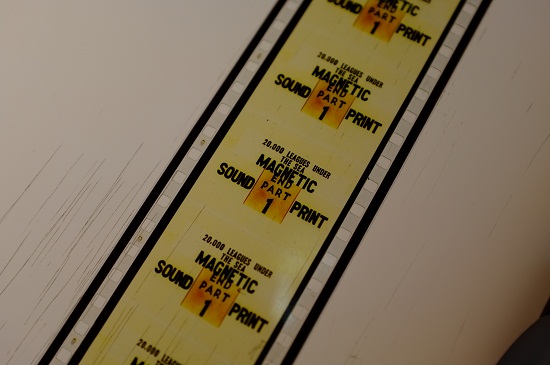
Posted by Robert E. Allen (Member # 1351) on 11-16-2012, 09:35 AM:
I'm staring at the film strip trying to understand what you want us to see. It looks like an ordinary strip of 35mm film I saw from 1945 until I retired in 2007. Please explain.
Posted by Paul Gordon (Member # 3320) on 11-16-2012, 09:40 AM:
really look at the perfs on the left do they look normal? there almost square
-pg
Posted by Richard P. May (Member # 3598) on 11-16-2012, 10:07 AM:
In the early days of CinemaScope, when magnetic sound tracks were placed on both sides of the sprocket holes, print stock was produced with narrower holes. New sprockets were required in projectors to accomodate this film. No, I don't think the sprockets were supplied by the distributors. It was another expense for the exhibitor when converting projectors, screens, sound systems to play 'scope prints and magnetic sound.
The sprockets with narrower teeth could run any type print stock, and quickly became standard for 35mm projectors.
With the elimination of mag striped prints, the "Fox-hole" film stock was no longer necessary. It got its name because 20th Century Fox introduced CinemaScope, and consequently the need for the different print stock.
Posted by Leo Enticknap (Member # 534) on 11-16-2012, 11:47 AM:
quote: Richard P. May
The sprockets with narrower teeth could run any type print stock...
Would the vibration of the film caused by full-sized perfs not sitting snugly through the sprocket teeth not cause damage to the edges of the perfs themselves?
If not, I wonder if the sprocket teeth fitted as standard to modern projector mechanisms are Foxhole-compliant of not. I've just had a quick look at the ones in our booth (Cinemeccanica Vic 5), and the sprockets look too large at the base to me. It would be interesting to get my hands on some Foxhole footage and find out for sure.
I have only shown a 35mm combined mag print once in my life, on a DP-70, and can't remember having to change the dual profile sprockets for it. So I'm guessing that this machine at least had sprockets that worked with both types of perforation without any swapping needed.
Posted by Steve Guttag (Member # 268) on 11-16-2012, 12:46 PM:
CS sprockets were indeed used by most all machines after that. Note, the tooth was never wall-to-wall on the perforation.
VKF sprockets by LaVezzi were CS compliant though with any appreciable amount of shrinkage in the film the VKF sprocket would be an issue as the film could no longer seat...this was particularly true in the Intermittent where the tighter radius would get one into trouble on shrunken film.
The last generation of VKFs...the VKF-2 was not CS compliant but by then little or no CS film was being made.
Note, even LaVezzi's Positrol sprocket (which was for running KS perfs) only had one wide tooth to allow for shrinkage. One would use the wide tooth on the fixed guide side of a projector (lateral guide roller in the gate...one is fixed one is spring loaded) so in a Simplex, for instance, you would put the wide tooth outboard so if the film has shrunk the narrow tooth would accommodate.
Posted by Jock Blakley (Member # 6552) on 11-16-2012, 04:18 PM:
Perhaps using their proper name - CS-type perforations - would be better than the unofficial and somewhat confusing "fox hole" in a post designed to educate people?
Posted by Jim Cassedy (Member # 4115) on 11-16-2012, 05:34 PM:
quote: Jock Blakley
Perhaps using their proper name - CS-type perforations - would be better than the unofficial and somewhat confusing "fox hole" in a post designed to educate people?
I remember running many of these in the late 60's & early 70's,
and we always referred to them as 'Fox Perfs" of "Fox Holes".
It wasn't until years later after they'd become obsolete that
I learned their 'real' name while working in a film lab.
As for the projectors themeselves, most all of them had the
"fox sprockets" (or whatever they were called) installed, so
there was no chance of ruining a mag-optical print.
I can only recall working two theatres that didn't have the
sprocket upgrade, and there were HUGE signs all over the
booths warning not play mag-optical prints.
Posted by Stephen Furley (Member # 1277) on 11-17-2012, 05:14 AM:
Were special negatives needed for contact printing on cs perf stock?
I've run a couple of mag/opt prints, but it was many years ago now. I also once saw o standard optical only print with cs perfs. I don't know why.
what were Dubray Howell perforations used for? I believe that they were a similar shape to Kodak Standard, but with the same slightly reduced height as Bell and Howell. I don't think I've ever seen any but I can't be sure; I doubt I'd notice the difference from Kodak Standard.
Posted on train, just about to arrive at Oakworth station, where 'The Railway Children' was filmed.
Posted by Robert Throop (Member # 61) on 11-17-2012, 01:26 PM:
When the magoptical print was adapted in the mid fifties Fox announced they would only release magoptical prints thus necessitating the near universal implementation of Foxhole sprockets.
Posted by Robert E. Allen (Member # 1351) on 11-17-2012, 06:50 PM:
Thanks to Richard I see what you're talking about Paul. I remember changing the sprockets to accommodate CinemaScope prints. You obviously were not around when CinemaScope was first released.
Posted by Monte L Fullmer (Member # 2797) on 11-17-2012, 09:33 PM:
(His above sample was on IB tech stock...)
I take care of two drive-ins (Century SA and an XL in each respective booth) and both machines have "foxhole"-narrow tooth sprockets mounted on each machine.
In my collection, I have a gray, Griswald "Foxhole", wet cement splicer along with a gold CIRO "guillotine", 'foxhole' tape splicer.
Some of us can remember the reel shipping bands that came on FOX prints and each band had its associated color assigned to print format:
Green - Flat/optical
Red-CinemaScope/optical
Black-CinemaScope/Mag-optical
Blue-CinemaScope/optical w/"foxhole".
To this date, only print that I knew that FOX released in optical w/foxhole was 'Snow White and the Three Stooges'. It was odd to see a foxhole print assigned with optical only.
Four track magnetic - outboard with left, inboard was right, center was inboard and surround was the smaller stripe running within the optical track. When running optical from a mag/optical print, one had to turn the gain up a few to compensate the loss of one half of the optical track.
I did run a full coat mag only (no optical backup) of "Fantasia" in the late 70's. I had RCA come do a full tune at our theatre for this presentation, for being only a one week run.
-Monte
Posted by Steve Guttag (Member # 268) on 11-18-2012, 09:38 AM:
A common mistake...the smaller stripe, surrounds, actually runs inboard and NOT with the optical sound track. It is the full size Center channel that runs with the optical track and hence covers one of the bilateral stripes.
Posted by Doug Thompson (Member # 6546) on 11-18-2012, 10:47 AM:
I've have seen only "CS" sprockets on the projectors I've used. Even the 70mm sprockets on the DP-75s, AA-IIs, and JJ I've used look to be compliant (were they to have made "CS" 70mm stock.)
We ran the butt warmer "Woodstock" as a midnight show. It was the only "CS" print I have ever seen. Even though the DP-75 had its Ampex head, the Eprad processor didn't have a mag input. The center stripe didn't quite cover half of one of the dual bilateral optical stripes resulting in very noticeable distortion when the optical track had low level sound. It wasn't so bad during louder sections. Adding to the aggravation, the theatre was platter only, and we had only "KS" splicers. I got a roll of clear perforated tape from a local camera/AV store and hand made every reel join. I aligned the sprocket holes by eye, taped the two aligned layers together and cut them with a (degaussed) paper cutter. After taping the cut ends to the straight edge of the paper cutter, I lined up a piece of the perforated tape with a razor blade much like one would do in audio tape splicing. Thankfully, the print was in very good condition. I left the one lab splice in. All this for one showing.
Posted by Jack Theakston (Member # 4484) on 11-18-2012, 02:20 PM:
quote: Monte L Fullmer
To this date, only print that I knew that FOX released in optical w/foxhole was 'Snow White and the Three Stooges'. It was odd to see a foxhole print assigned with optical only.
There were mag prints of this title, too, so the print run was probably done all at once.
I've also seen prints that WERE mag/op with CS perfs, but after the mag run were reperfed with KS perfs for subrun, anticipating that few subrun places would be set up for mag.
Posted by Robert Throop (Member # 61) on 11-19-2012, 10:07 AM:
I once ran a reissue print of "Sound of Music" that had fox holes and was optical only. I assumed that the mag tracks from the original release had somehow been stripped off.
quote: Jack Theakston
anticipating that few subrun places would be set up for mag.
I think that with the introduction of the magopttical print virtually all theatres were equipped with the new sprockets. I don't think I ever worked a house that was not fitted.
There were repair shops that specialized in grinding down wide tooth sprockets.
Posted by Frank Angel (Member # 248) on 11-19-2012, 01:18 PM:
This lad has been looking for a Neumade CS splicer (or the Splyce knockoff) for decades -- I still have to rely on a modified Griswald to splice mag. I had just came across a stunning technicolor mag print of BEH HUR -- it would have been nice to have a real splicer to work on that print.
Running mag/optical using the optical track was a nightmare. Not only did you have to crank the volume, but the slit reads the edge of the mag stripe and that is not as razor sharp or clean as it looks to the eye -- look at it under a microscope and it is a pretty jaggard edge. It creates low frequency rumble. It was painful when I worked a house that didn't have mag, so I had to run THE SOUND OF MUSIC in MONO (yuck) using the optical track of a mag/op print. It was mono, it rumbled, it was THE SOUND OF DOG POO.
Samual Goldwyn used to have (they may still have) mag prints of OKLAHOMA! on standard stock with L C R mag stripes, no surround track at all -- no room with standard sprocket holes. The stripes were placed in their normal positions which meant the standard sprocket holes cut into the outboard L and R mag tracks. Although it played and you got stereo sans surround, it certainly couldn't have been good for mag heads to have parts of the sprocket holes running over them.
Anyone have a CS splicer they want to part with?
Posted by Rick Raskin (Member # 1561) on 11-19-2012, 03:50 PM:
You old timers should remember this one:
When splicing mag/opt prints you had to use a little film cement to wipe away the mag tracks on the left side of the splicer. I'd raise the left side a little bit and then using a dab of cement, wipe away the mag tracks. Then I'd use some spit to moisten the emulsion and proceed to scrape it away. A perfect splice every time.
Gross huh ![[Wink]](wink.gif)
Frank,
I have a glue type CS splicer if you are interested.
Rick
Posted by Robert Throop (Member # 61) on 11-19-2012, 06:26 PM:
quote:
Samual Goldwyn used to have (they may still have) mag prints of OKLAHOMA!
There were also 3 track large perf prints of SOUTH PACIFIC and JESUS CHRIST SUPERSTAR.
Posted by Leo Enticknap (Member # 534) on 11-20-2012, 06:02 AM:
I've only ever shown one four-track mag CS print, which was a gorgeous IB print of Bad Day at Black Rock in the early '90s. It came on 1,000 foot (ten minute) reels, with instructions from the archive supplying it to the effect that cutting the leaders and tails off carried the death penalty, and so I was kept pretty busy between changeovers! I wasn't that experienced at the time and this was at a quite high profile London rep house. The chief was a bit nervous about leaving me to it that evening, but his wife was in hospital and he just couldn't be there. My only real memory of it was that that each reel left a huge amount of oxide crud on and around the heads and the gate components - much more than when we ran a typical 70mm print - and it really was a case of trying to beat the clock cleaning the film path after each reel finished and then relacing in time for the next changeover. I had to leave several reels un-rewound and do them at the end of the show.
I ran several magopticals, though, (though all with KS perfs as far as I can remember), and second everyone's comments about their general crappiness.
Posted by Louis Bornwasser (Member # 3063) on 11-20-2012, 06:17 AM:
Back about 1978 to 1985 I did a lot of world premiere/tests. I would order the picture on fox-hole material, have mag tracks added, then sounded at the studio. No dubbers needed. I had a Motiograph (will fit anything) head along with an mpu from Dolby in my suitcase. Mono was still normal then so I had mono on all four tracks. Most of the time Century JJs and AA2 were in the theatre so I didn't even need the mag nead. Great sound; no sync issue. Louis
Powered by Infopop Corporation
UBB.classicTM
6.3.1.2