This is topic Worst 70mm Presentation EVER of IAMMMMMW in forum Film Handlers' Forum at Film-Tech Forum ARCHIVE.
To visit this topic, use this URL:
https://ft-forum.com/ft/cgi-bin/ubb/ultimatebb.cgi?ubb=get_topic;f=1;t=011363
Posted by Frank Angel (Member # 248) on 12-29-2012, 01:52 PM:
It was at the prestigious Walter Reade Theatre at Lincoln Center. They were screening a number of 70mm titles and I went with a long-time projectionist/tech friend of mine to the 6pm screening. According to my friend, the WR has TWO Local 306 projectionists on board for all 70mm screenings.
I have been to other 70mm screening of IAMMMMW, at least three in 70mm, one in real Ultra Panavision on a deeply curved screen; I have run 35mm mag prints of it and even have seen a screening in 16mm IBT anamorphic. My friend, who is an avid fan of this title, also ran it for many weeks in its initial release and in subsequent rereleases as well, so both of us are quite familiar with the title. We both agreed after the show that if this is the best the Walter Reade can muster with 70mm, they should just pack it in and leave live ballet and symphonies to Lincoln Center and leave motion picture exhibition to venues that know what they are doing.
First off, with TWO union operators, they can't go on screen IN FRAME? With TWO operators, they leave the dowser opened for the overture music so all the white scratches and slash marks dance across the black screen? -- and there were PLENTY of them. And at this so-called "prestige" creme-de-la-creme venues, they don't have curtains, so the audiences sits looking at a naked screen and now for the overture the lights are dimmed so all the scratches and blotches show even more pronounced and when I tell you it looked like they had dragged that first 3 minutes of film overture over the projection booth floor, I am not exaggerating.
OK, that's bad enough, but now comes the opening credits and they are sharp on the corners and OUT OF FOCUS in the center of the screen. Never did either me or my friend see ANY attempt to focus the picture throughout the run.
Next we listen to terribly harsh and strident sound. It seemed unbalanced right to left, but that aside, it had no bottom end. And I KNOW this film and this mix -- it has PLENTY of bottom end; that rich music score should be FELT in your belly. How did they compensate? They turned the level up much too loud. You know how painful screechy, high frequency sound is when it's too loud? Just go to the Walter Reade and you will find out.
There are no visible surrounds; the only time I thought I heard any surround at all was briefly, and that could very well have just been that the stereo imaging from the screen speakers can sometimes give the illusion of coming from on the side or behing you -- it happens all the time with my TV. It certainly didn't sound like the surround content that I remember is in this film.
Then comes the overall look of this print. I can't tell you if it was the print or the xenon adjustment, but everything was to much too warm -- it had a dirty look to it. As my friend pointed out, there were no whites. When I tell you, if you didn't know this was a 70mm print, you would swear you were watching 35mm -- it looked that ordinary (although I could have gotten better focus even with 35mm).
The WR screen can't be more than 40ft width, so with 70mm, this image should have been RAZOR sharp, bright, practically grainless and with deep, saturated colors. This was the opposite on each count. Now yes, this could have been the print (that's what managers will always say when you complain), but how do you account for coming out of intermission out of frame? Was that the print too? -- supposedly the top projectionists at a premiere house in Manhattan and he was out of frame, not to mention at the end of the final credits he let leader crap show as well! I have NEVER seen a 70mm presentation this mediocre.
Worst thing of it all, these are probably the very last times anyone will get to see these 70mm prints and to have the experience for that audience so much less than what it should have been is shameful. Give me a spanking new 35mm print and I could have done better than they did. Shameful indeed.
Posted by Jim Cassedy (Member # 4115) on 12-29-2012, 02:43 PM:
First of all, I think you've added an extra "M" in the title! ![[Smile]](smile.gif)
Unfortunately, good 35/70 operators (union or non union)
are getting hard to find.
Several months ago, I was called in at the last minute to
'save' a big special show which had already been assigned one
(& possibly two) union operators. In all fairness, the union
guys were top experts in large screen live event digital
projection & set up, they were a bit out of their element and
'in over their heads' when it came to dealing with this booth.
Ironically, even though digital has resulted in me getting
kicked out of my long time booth,(overnight!) since now
any village idiot can run a show for minimum wage, I've
suddenly become in demand for 'saving' various film situations.
I got one call on Christmas day for which I got $100 cash
for about 15min of work. (My standard "Christmas Day Show
Saving" Fee) I've even found myself doing some carbon arc and
double-system sound jobs recently since it's getting hard to
find folks who know how to run that stuff, or who even know
what a 'double system playback' is. And I'm able to charge good
money, cuz usually by the time I get called, people are desperate.
Posted by James Westbrook (Member # 3690) on 12-29-2012, 02:47 PM:
I thought there were 4 M's in the title, too.
Posted by Jim Cassedy (Member # 4115) on 12-29-2012, 02:52 PM:
I think the 70mm version had an extra "M"! ![[Roll Eyes]](rolleyes.gif)
Posted by Tony Bandiera Jr (Member # 2365) on 12-29-2012, 04:30 PM:
Sorry Frank, but this "Tango Uniform" at a world-renowned theatre here in Hollyweird has your story beat: (From a post I made in 2006):
quote:
quote: Paul Linfesty
NOTE: The Chinese Theatre handled the 70mm print of THE RIGHT STUFF by showing all but the last 2 reels on platter, then doing a changeover to second projector using a doubled-up reel.
Maybe during the first part of its run, but when I went to see it near the end of the run (dragging my sister and some friends thru the hideous LA traffic) they managed to totally screw up the presentation from beginning to end! No n/sync, threading with the penthouse hot, putting the leader on the screen, out-of-frame, soft focus, bad sound, etc.
And they took intermission at the end of the scene where the astronauts march up toward the camera! The film then tailed out to white screen!
Coming out of the intermission was even worse! Same threadup and this time, instead of the SMPTE leader, we were treated to an upside-down image of a "pagoda" style building until we got into the film, with the last few notes of the previous scene's music heard before the picture opened on the rocket Al Shepard was to ride.
Needless to say I was more than a little pissed, as was most of the 300+ in the house. My post-show tirade had the manager in fear of his life and got most all the house refunds! I also sent a scathing letter to the Ladd Company.
Several years later I met Alan Ladd, Jr. and he remembered me from that letter and asked if it was really that bad. I told him it was. He offered me a job as a secret screener for his future productions. ![[Big Grin]](biggrin.gif)
Posted by Ben Wales (Member # 92) on 12-29-2012, 04:45 PM:
Sounds like an ideal place to see a 70mm Presentation (NOT)
I wonder how many prints they either scratched/marked as the website they are screening Archive Prints as well.
Posted by Manny Knowles (Member # 1171) on 12-29-2012, 04:57 PM:
Search bait "It's a Mad Mad Mad Mad World" -- that's 4 M's
Posted by Frank Angel (Member # 248) on 12-29-2012, 05:24 PM:
Yes, it's 4ms -- got it right in the body, but must have been carried away in the header. Maybe it was an extra M left over from Dial M for Murder (sorry, bad booth humor).
Tony, I would say we are neck n neck for bad presentation (although some pagoda footage attached to the head of the reel SHOWING on the screen is pretty high up on the kill-the-projectionist scale, and I admit, I only had to brave slow-moving traffic on the Grand Central.
Actually we probably should have made more of a stink afterward. Or maybe like Jim, my friend or I could have saved the day and gone up their and just tweeked the damn focus! We both have licenses and my friend is even 306. I may write to Lincoln Center as they are going to run more 70mm prints, maybe get someone to do something for the next audiences.
As I said, in all fairness, there may be some issues with the print itself because it did have a muddy look throughout and my buddy pointed out that the opening frames of the credits which he says should be bright yellow, so much so that it lights up the whole theatre, in this print was a washed out, very light brownish color. But DIRT on the print certainly didn't come from the lab. And for a one-time showing where people come in from the tri-state area just BECAUSE it's a 70mm print....I would have been there hand-cleaning every frame of whatever gook was on that print.
I must say, it was good to hear audiences laugh at with film. That film needs an audience. It also needs a decent presentation.
Posted by Manny Knowles (Member # 1171) on 12-29-2012, 08:44 PM:
What is "pagoda footage" ?
Posted by Chris Slycord (Member # 4239) on 12-29-2012, 08:59 PM:
Presumably, footage of a pagoda.
Something that looks like 
Posted by Frank Angel (Member # 248) on 12-29-2012, 09:27 PM:
Manny, it's referencing Tony's 70mm Done Badly experience ...
quote:
Coming out of the intermission was even worse! Same threadup and this time, instead of the SMPTE leader, we were treated to an upside-down image of a "pagoda" style building until we got into the film,
Chris, thanks for the visual aid.
Posted by Frank Cox (Member # 6258) on 12-29-2012, 10:01 PM:
Ahem:

Posted by Bill Enos (Member # 440) on 12-29-2012, 11:04 PM:
Membership in a club (the union) doesn't necessarily mean these guys would know what they are doing in every booth, just that their dues are current and they haven't pissed anybody off. Give 'em a break for
probably being in a strange booth and likely having to figure everything out at the last minute.
In my opinion one of the most unfunny comedies ever made, 45 min. of material dragged out interminably.
Posted by Chris Slycord (Member # 4239) on 12-29-2012, 11:11 PM:
It wouldn't have to be upside down like that. An idiot adding junk leader that way might've attached it any old way...
Posted by Tony Bandiera Jr (Member # 2365) on 12-29-2012, 11:18 PM:
Chris and Frank C, thanks for the visual aid... ![[thumbsup]](graemlins/thumbsup.gif)
Now it's time for me to be a sourpuss:
quote: Bill Enos
Give 'em a break for
probably being in a strange booth and likely having to figure everything out at the last minute.
Bill, there is absolutely NO excuse whatsoever for the kinds of problems Frank experienced. If necessary, the RIGHT thing to do was to delay the start of the show for a few minutes rather than go onscreen all fucked up like that. The focus problem is totally inexcusable, if someone doesn't know how to focus a projector they have absolutely no business in a booth, especially with 70mm. The sound? Could have been an improperly threaded penthouse (too loose) or dirt build-up on the mag heads.
quote: Bill Enos
Membership in a club (the union) doesn't necessarily mean these guys would know what they are doing in every booth, just that their dues are current and they haven't pissed anybody off.
The main reasons that Unions have lost projection jobs is because they continually allowed incompetent boobs into booths where they had no business being. Management has a reasonable expectation that by paying Union wages that they get a competent operator for cripes sakes. All too often, that didn't happen and that's why Unions lost so many contracts. (The operators in the "Right Stuff" caper were supposedly Union and look how bad they fucked it up. )
I am not anti-Union, but when the Union fails to live up to the most basic requirement, then they frankly deserve to die.
Posted by Jarod Reddig (Member # 6363) on 12-30-2012, 04:39 AM:
I agree Tony. Frank what a shame they messed up that classic!! Union lol. More like Western Union that night. Bill how can you not find IAMMMMW humorous?? It's hilarious!!
Posted by Jock Blakley (Member # 6552) on 12-30-2012, 05:34 AM:
Huh, when I read of 70mm junk pagoda leader I was expecting something along these lines:

We acquired at one point from a collector a 70mm print of THE MISSION that appeared to have, on the head in front of the original leaders, dozens of feet of an original print of KHARTOUM.
Posted by Rick Raskin (Member # 1561) on 12-30-2012, 08:14 AM:
quote: Tony Bandiera Jr
The main reasons that Unions have lost projection jobs is because they continually allowed incompetent boobs into booths where they had no business being.
I disagree. It was all about money; nothing more.
Need a good 70mm operator? I know a few people here who can fill the bill.
Posted by Leo Enticknap (Member # 534) on 12-30-2012, 11:43 AM:
quote: Ben Wales
I wonder how many prints they either scratched/marked as the website they are screening Archive Prints as well.
Enough for archives to be imposing increasingly strict conditions on letting their prints out, even to venues they've previously dealt with.
Like Jim, I am noticing an uptick in requests for help from venues that want to show an archive title but need assistance in complying with their conditions, and archives wanting me to check out venues they haven't previously dealt with, either at all or for a significant length of time.
This is only going to get worse as time goes on, and for two reasons.
1 - the manufacture of film stock is declining, and there is going to come a time when 35mm release printing is no longer going to be possible at any price. I suspect this'll be quite soon for colour, though given the much simpler chemistry involved b/w motion picture printing will probably be possible to maintain as a boutique operation, albeit at a very high cost. So archives will be looking at a situation whereby if someone wrecks their print, they simply will not be able to replace it. Therefore, the mindset that most large scale non-profit archives used to have - that the preservation master stays in the vault, but that some risks can be taken with release prints because they can be replaced if necessary - goes out of the window. In the last year I've heard two senior archivists tell me that they now regard prints as physical, primary evidence of how a film looked to its original audience, and now should be treated as master elements. In other words, no projection - they're used only to examine colour balance and gather other information to be used in the creation of digital surrogates.
2 - the infrastructure of film projection is declining, both in terms of the craft skills and spares and maintenance for the hardware. OK - projectors are mechanically simple, but if your CP650 blows a board in 20 years' time...
The problem is that this is self-feeding: the more stories we get about sh!tty presentations such as this one, the more programmers and archivists will conclude that however much purists want to preserve the film experience, it's easier, cheaper and less risky just to go digital. And especially now that done properly, a decently transferred and encoded BD, presented with care and on a projector with decent resolution and colour space can give 35mm a run for its money.
Posted by Louis Bornwasser (Member # 3063) on 12-30-2012, 12:28 PM:
Are you telling me that changeover operators with 70mm experience will become like circuit-riding preachers. . . . no, ROCK STARS with Lear jets delivering them from site to site. I want to be the one who writes the contract-with-riders. ("M&Ms with all of the yellow ones removed; Perrier, 5 gallons, 16 White Castles with extra pickle, Mexican Coca Cola, etc") Louis
Posted by Robert Koch (Member # 3728) on 12-30-2012, 06:50 PM:
I agree completely with Rick Raskin on the demise of the operators. Money and the corrupt leadership in the international office of the IA were the causes of no more operators charters in the IATSE. Things were better when George E. Browne was president.
Posted by Martin McCaffery (Member # 37) on 12-30-2012, 07:21 PM:
Although it sounds like much suckitude was involved, I wonder if there was an opportunity for a test run. Sounds like a crappy print and operators who may have been told to show up an hour before the show in a booth that hadn't run 70mm in a while.
Posted by Bill Duelly (Member # 3612) on 12-30-2012, 09:50 PM:
For a place like New York, one would expect there to be a wealth of qualified booth personnel. However that is not the case. There are only a smattering of venues that can be considered 'premiere' or 'exceptional' venues. Radio City doesn't run any film shows, Ziegfeld is only for sporadic runs and premieres, which leaves Museum of Modern art, Lincoln Center and a handful of other venues. Bernie Anderson and myself, came over from New Jersey to run the Bryant Park film series last summer (35mm with changeovers in Cinevision's Airstream, a complete booth on wheels). HBO who co-sponsors the series were very impressed with what should be basic showmanship... proper ratios; alignment; tweaking light sources; screen masking; good changeovers; but evidently was lacking in the past. Sad but true, we are a dying breed. Lets face it, the closest a lot of folks have to being a 'projectionist' was to build a print on a platter, thread up, press a button and walk away.
Posted by Jim Henk (Member # 3628) on 12-30-2012, 10:56 PM:
Louis, I'm sorry, but that's not correct.
The White Castes should be ordered with *no* pickles!
Posted by Manny Knowles (Member # 1171) on 12-31-2012, 10:36 PM:
<-- Ready for some rockstar treatment!
...and THANKS for the clarification on the whole "pagoda" business.
Posted by Frank Angel (Member # 248) on 01-01-2013, 05:43 AM:
quote: Martin McCaffery
Sounds like a crappy print and operators who may have been told to show up an hour before the show in a booth that hadn't run 70mm in a while.
Well, even if you hadn't run a 70mm print for years, do you forget how to adjust focus? BOTH these guys let it play without any attempt to correct soft focus in the CENTE of the screen; and if it were something with the projector gate or whatever that would cause film to buckle, then at LEAST focus the CENTER of the image and let the sides go soft. And btw, this was the SECOND show, not the first; the first show was five days before -- plenty of time to make corrections for this show. So if they didn't have time for a test run, the first show five days before was their "test" run. They should have seen the reels that had DIRT in various areas and one of these two hot-shot union guys should have manually cleaned those areas. When I run classics, I routinely clean the film of big globs of dirt before I go on the screen and otherwise subject an audience to it.
In all fairness, someone said this was indeed the "bad" print of the two that were struck. Evidently it was run at the Cinerama Dome to a really pissed audience. Knowing that, MGM sent it to Lincoln Center instead of junking it? Screw Lincoln Center AND MGM.
Posted by Rick Raskin (Member # 1561) on 01-01-2013, 06:34 AM:
Putting everything else aside, there is absolutely no excuse for going on screen out of frame.
Posted by Paul Linfesty (Member # 214) on 01-01-2013, 09:21 AM:
When I saw it at the Dome in 2003 (for the combined 40th anniversary of both film and theatre), the newly struck print was excellent (except for the badly faded credit sequence). The masking was a bit bizarre, curving upward from the center bottom to the sides. They seemed to be determined to get every bit of the UP70 image onscreen, including the lens refractions at top and bottom of frame. There was also no sign of changeover cues (this print was run from a platter so they wouldn't have been needed). However, it was professionally presented as far as light and curtain cues, which seemed properly timed, sound levels were good, etc. Focus was sharp, even with the UP70 lens attachment (suposedly on loan from Panavision).
I have given up on 70mm presentations of classic films, however. I saw West Side Story back in 2008 at UCLA's Billy Wilder Theatre in L.A. and the sound was up WAY too loud and very shrilly with bad EQ to the point of being painful and headache inducing. Projection was good (print had allegedly been just struck), but light and curtain cues were messed up for intermission. And the curtains opened halfway through the Entracte. here was actually LEADER seperating the end of the Entracte music and beginning of part 2...how did that happen?
And then this past summer I saw SOUTH PACIFIC at the Egyptian Theatre. The sound was also painfully shrill and too loud and the print was filled with small specks of dirt. I left at intermission. And am no longer interested in film prsentations of these classics. It's done.
Posted by Michael Goucher (Member # 199) on 01-01-2013, 11:15 AM:
I agree that large-format film is rapidly disappearing. However the Walter Reade spent quite a bit of marketing and publicity money to build up this showing of real 70mm screenings. Fact is, as a New York union person I can vouch for the fact that almost everyone on that crew saw 70mm for the first time when this series of films showed up in the booth. Even their chief projectionist came from a 35mm screening room downtown before it closed so his 70mm experience is minimal, at best. Funny how in that situation, instead of calling on their union for help by sending over a person who had shown 70mm in a Broadway house or elsewhere, they "toughed it out" on the basis of ego and a pay check. This doesn't stain the union at all. It stains the crew and the crew chief for having more ego than brains. One person with experience would have changed the entire picture on IAMMMMW.
Posted by Martin McCaffery (Member # 37) on 01-01-2013, 01:52 PM:
Well Frank, if that's the case, you're right (though maybe this should be in the Hey! You Suck string).
I find it hard to believe there aren't enough people in NYC who have run 70mm. Admittedly, it has been about 27 years since I have, but I think I could still put on a show. Whoever made the decisions leading up to this screwup really need to be dealt with in a harsh manner.
Posted by Mark Ogden (Member # 43) on 01-01-2013, 03:27 PM:
quote:
their chief projectionist came from a 35mm screening room downtown before it closed so his 70mm experience is minimal, at best . . . . It stains the crew and the crew chief for having more ego than brains.
It sounds, Michael, like you’ve got some personal issues with Don Schul. I mean, I'm hearing some bitterness here. Have you considered telling him this stuff to his face, as opposed to running he and his operation down behind their backs?
quote:
Funny how in that situation, instead of calling on their union for help by sending over a person who had shown 70mm in a Broadway house or elsewhere, they "toughed it out" on the basis of ego and a pay check . . . One person with experience would have changed the entire picture on IAMMMMW.
Who are the heavy 70mm people still in 306? Were they available for a 12-hour call during Christmas week? Why do you think their help was even needed? Because of one anecdotal, unsubstantiated report of a bad show? I attended the Walter Reade screening of 2001: A Space Odyssey last week that Kier Dullea appeared at. It was a beautifully presented show, flawless, and I hear that Ryan’s Daughter looked great as well. In fact, on all the other various film-related forums where this festival has been discussed, there have been no real reports of projection issues at all, save for a single mis-cue with the intermission of Mad World the first time it was run. Which leads me to:
quote: Michael Goucher
Fact is, as a New York union person I can vouch for the fact that almost everyone on that crew saw 70mm for the first time when this series of films showed up in the booth.
And as a long-time FSLC member, I can vouch for the fact that you are wrong. Over the years there have been plenty of 70mm prints in and out of both that booth and Alice Tully Hall. I have seen Playtime there at least twice, 2001 at least once before last week, West Side Story and others. They don’t get a great deal of it, but it comes in. Films from all over the world come into that booth, and receive clean presentations, and I’ve personally seen quite a few over the years. Really, I don’t EVER recall seeing a badly projected film there in all the while it has been open.
So, basically, they are running 70mm in that booth just fine. But here is this (wildly exaggerated sounding) tirade about a not-very-well-handled presentation of a single show, and all of a sudden the torches and nooses are out and the whole booth crew is a bunch of incompetent, inexperienced, egotistical money-grubbing whores.
Crock of shit.
Posted by Tony Bandiera Jr (Member # 2365) on 01-02-2013, 01:14 AM:
Wow Mark, don't hold back, tell us how you really feel.
Your tirade just emphasizes the reasons why the projectionist' union has suffered a well-deserved BAD reputation.
Such simple things as FOCUS and starting IN FRAME and WITHOUT projecting leaders (or upside-down pagodas) are skills that ANY projectionist HAS to be able to do, even if they have never been in a particular booth before. What part of that is so hard for you (and some of the others who posted here defending the train wrecks Frank and I posted about) to comprehend?
Unions are supposed to represent (and provide) the HIGHEST STANDARDS of PROFESSIONALISM AND COMPETENCE of a given trade.
None of the actions/events Frank and I posted about demonstrate any shred of high standards or professionalism.
Now one thing in your post I agree with 100%:
quote: Mark Ogden
....the whole booth crew is a bunch of incompetent, inexperienced, egotistical money-grubbing whores.
As Gus Grissom said in "The Right Stuff" : Fuckin-A bubba.
Posted by Louis Bornwasser (Member # 3063) on 01-02-2013, 07:30 AM:
Plenty of people in NYC and Long Island who know how to do 70mm premieres. Probably no urge to retain them. For example: Andy Marglin of Kelmar fame and Carl Greenberg. Carl probably presided over more premieres and screenings than any one other person. Both are fully qualified to install and tweak the equipment also.
Bad when something sounds fishy even down here in Louisville. Louis
Posted by Bill Gabel (Member # 1105) on 01-02-2013, 08:44 AM:
In 1993 we had a shortage of 70MM operators to go out and cover extra jobs in our local in Los Angeles. The operators in theatres that wanted time off had a problem finding good 70MM operator off the extra board so their jobs would be safe. Since theatre chains had to ok them. I got so much work during that last great year of 70MM in so many theatres. I was lucky to have run many of the first run Los Angeles houses in 70MM. One of the jobs they sent me on was for Cineplex and it lasted around a year. The local sent 4 operators to check out the booth that week, three of them had never run a DP-75 in 35mm or 70MM. They were getting a 70MM booking that Friday. Another one of the jobs was to run the twin upstairs theatres over at the Avco in Westwood. That booth at the time had V-8's and was auto change-over with doubled reels in 70MM. I never had anything that came close to what Frank wrote and saw. As Louis said Carl Greenberg would have never let that happen.
Louis it was great talking to you a few months ago. When I was doing a show with Carl. And the story about the Plitt Century Plaza opening for "Heaven's Gate".
Posted by Scott Norwood (Member # 30) on 01-02-2013, 08:58 AM:
If one regularly works in a theatre with 35/70 machines or 16/35 machines, isn't it (or shouldn't it be) part of the job to know how to convert the machines over and operate it properly for the "alternate" format? This is not that hard to figure out, and it seems that an afternoon spent with the manual and a junk reel of film would be far preferable to the embarrassment of the screening described in this thread.
(That said, I would not be so quick to blame the operator for poor focus--that could have been a print issue. And the sound issue could have been a setup issue or a print issue. But the crappy changeovers and the general lack of attention don't really seem to be excusable, especially with two operators and a festival whose entire purpose is/was to show off the format.)
There must be a bunch of good operators in NYC with 70mm experience who would love to work with the format...someone at the venue should have made a point to find them.
Posted by Louis Bornwasser (Member # 3063) on 01-02-2013, 08:48 PM:
By definition, it is ALWAYS a management failure. It is their job to only allow properly trained people to work or to get them trained. Yes, this costs money; that is why it is a management failure. Louis
Posted by Richard Fowler (Member # 893) on 01-03-2013, 06:59 AM:
I have known Carl Greenburg a long time...We did a recent premiere at a location where the management was compromising the set-up...a minute of in your face , diplomatic refusal to accept conditions via verbal exchange and a quick phone call made that go away.
Posted by Frank Angel (Member # 248) on 01-03-2013, 09:57 AM:
Hey Mark, before you get your pantyhose all up in a knot, let me point out that I was only commenting on THAT particular Saturday show. I haven't seen many shows at the WR probably only two other times and years ago at that, it's not a venue I frequent. So I can't and was not commenting on their general level of presentation that has gone before; my comments were specific to the way they handled 70mm presentation for that screening and that led me to comment that IF that was they way the handled 70mm, they should get out of the film exhibition business. I stand by that statement.
You claim you've seen many shows and they were always "just fine." I am glad for you. But the one I saw wasn't just fine and it was that screening that my "tyrade" was about. If an image is out of focus and I don't see ANY attempt to focus it, I call that sloppy projection work; you seem to call it a "wild exageration" -- sounds like you would just shrug that off and just fine. For me, out of focus is out of focus. If a dowser is left open for overture music in black with the lights already dim and at no time do either of the two guys in the booth have the sense to close it as crap dances all over the screen, I call that sloppy projection....what would you call it? Mis-frame? If Brad had his way, the guy wouldn't have been able to correct it be he feels that the frame knob should be removed and the shaft locked down because a projectionist should know how to frame when he threads. It's not a tyrade and it's not a crock of shit, brother, it's an objective observation based on what I know a presentation SHOULD look and sound like. OK, you never saw bad projection at that theatre since it was opened, lucky you, but you weren't at THAT screening and I was; I wasn't commenting on every 70mm screening the Walter Reade ever ran in the past, I was commenting on the one I sat through for 154 minutes and it was a C- level presentation.
Scott, yes, sound could have been the print, but uncomfortably loud? And if the focus was a print issue (possibly warmping, although unlikely as this was proclaimed a new print), but I've run a badly VS mag print of PORGY AND BESS and when I found out with a test run of the problem I had a second buddy up there and one of us was always at focus knob keeping the center of the action in focus. You and I certainly can tell when there is an attempt to keep the center in focus. Guys who have short throws and huge screens are ALWAYS needing to touch up focus. This thing just never moved. My hand was trying to turn an invisible focus knob thru the whole show. And if they KNEW there was a focus problem (this was the second show of this print) they should have made an announcement and at least explained and apologized to the audience.
Posted by Leo Enticknap (Member # 534) on 01-03-2013, 11:18 AM:
I wasn't there and have never seen a show at this theatre, and so cannot and will not comment on this particular screening. I do agree that projecting black overture music spacing, missing changeovers and making no attempt to keep the picture in focus or in rack, wherever that happens, is a failure of basic craft skills, either because the projectionist didn't have them or, for one of a number of reasons, was unable to use them.
What I do know, both as a projectionist and an archivist, is that the availability both of film projectionist skills and spares and support for the hardware is only going to decline from here on in. When I first signed up on F-T in 2000, there were probably around 100-150 posts a day on Film Handlers' Forum. Now, there are a dozen at most. That is how quickly film projection has gone from being a mainstream to a legacy technology. Another demonstration is that even in big, downtown venues in cities that are the showcase of a country's film industry (I'm thinking of the scratched 70mm print of The Master in London), it's proving difficult to put on a good presentation.
Therefore, if we want to be able to preserve the ability for audiences to see 'film done right' into the medium term future, even if only in a handful of venues worldwide, it's going to take some joined up thinking and planning. Shameless Plug: the Projection and Presentation Committee of AMIA (Association of Moving Image Archivists) held a panel about this at last month's conference in Seattle, and we have plans afoot for an archival projection workshop at this year's, in Richmond, VA, in December. I'm hoping that we'll be able to make some videos and other resources at that event which can serve as an online go-to place for venues and festivals that do wish to persevere with film (either for film's sake, or because what they want to show is not available in good quality digital), and in particular for solving the vicious circle whereby archives are imposing ever more stringent conditions while at the same time venues are losing the skills and equipment needed to meet them.
As the plans for this take shape, and when AMIA's new website is launched (we're promised, later this month) and the P & P Committee establishes its presence on it, I'll post updates on what we're doing, and all input and suggestions would be welcome.
Posted by Paul Gordon (Member # 3320) on 01-03-2013, 11:41 AM:
quote: Leo Enticknap
the Projection and Presentation Committee of AMIA (Association of Moving Image Archivists) held a panel about this at last month's conference in Seattle, and we have plans afoot for an archival projection workshop at this year's, in Richmond, VA, in December
Hi Leo,
So is AMIA in Richmond this year (2013)? I couldn't make it to Seattle (even though I work for a National Archive...nuff said) but Richmond is closer.
Posted by Mark Ogden (Member # 43) on 01-03-2013, 12:46 PM:
That’s all very well and good, Frank, but here’s the thing: you DID SEE JUST ONE SHOW, as you have just admitted. During the festival, the Reade ran 26 shows of 15 separate titles. So, 25 shows go without a hitch. The show of Mad World that you saw, well, there were issues.
Each and every one of us on this forum has had bad shows, and if any of you deny it I will call you a liar right to your profile picture. Many years ago here I admitted to one of mine, and there were more. During my years in the booth, ninety percent of which were in single screen changeover houses, I probably started about 7000+ shows, with what, 35,000 changeovers? Believe me, not all of them were clean, including a showing of For Your Eyes Only to a packed 700 seat theatre while in the middle of a blinding migraine. It was ugly.
But I’m proud to say 99.9% of my shows were clean, sharp and in-frame, I don’t think I was off the screen due to carelessness more then the once in 15 years, and I was considered a reliable professional. So this is what pisses me off about this thread: I know by my long patronage at the Film Society of Lincoln Center that their projection staff is highly competent in both 35 and 70mm. But it looks like you had a bad experience (and Frank, be honest, are you sure that you didn’t exaggerate just a teeny-weeny bit about how bad this show was)? And this is what it turned into on this thread:
The staff at the FSLC is incompetent! They’ve never seen 70mm before last week!! Don Schul (Lincoln Center projection HOD) is an inexperienced egotist!!! They should have called the union office for someone with more experience (because God knows, IA306 has got plenty of of 70mm Century JJ guys waiting around for calls during Christmas week)!!!! They are just out for their paychecks!!!!! THEY’RE UNION MEMBERS, SO WHAT DID YOU EXPECT FOR CHRISSAKES!!!!!!!!
. . . . followed by a lot of furious chest pounding about how nobody here would have ever ever allowed such a shoddy presentation.
C’mon, with this crap.
By the way, Frank, did you walk out or ask for you money back? No?
Couldn’t have been that bad, I guess.
Posted by Sean McKinnon (Member # 612) on 01-03-2013, 09:37 PM:
Um... If local 306 does not have a bunch of guys that can operate a JJ in 70mm then that is pretty damn sad. If that is true then what separates the brothers ( and sisters) from the popcorn shovelers?
With that said I worked with some 306 folks in the past at SVA who were professional and could run 70 on a dp70 so I don't get it?
Posted by Brad Miller (Member # 2) on 01-03-2013, 10:48 PM:
With almost every single projectionist gone at this point, are we REALLY having the union discussion again?
Union or not doesn't matter. It is the person's skill as a projectionist that matters. Not their age. Not their gender. Not how many years they have been doing it.
Honestly hearing about a botched showing of a 70mm print isn't what bothers me. What bothers me is was there damage to the print on that show? One mistake and that's it tainting all future presentations! One show running slightly out of focus is only a one time bad thing.
Still even with that being said, few people truly know how to run 70mm. If it was as simple as flipping parts around and "threading bigger film", then things like "JJ scratches", sprocket damage and mag track wear wouldn't be such a common issue with 70mm prints.
Posted by Jim Henk (Member # 3628) on 01-04-2013, 12:29 AM:
What's a "JJ scratch"?
Posted by Edward Havens (Member # 4715) on 01-04-2013, 09:28 AM:
Jim, check out Steve Guttag's post on the bottom of the first page from this thread from 2001.
Posted by Leo Enticknap (Member # 534) on 01-04-2013, 10:39 AM:
quote: Paul Gordon
So is AMIA in Richmond this year (2013)? I couldn't make it to Seattle (even though I work for a National Archive...nuff said) but Richmond is closer.
Yup - confirmed for Richmond this year. I wasn't at Seattle either (couldn't get the time off work), but hear from people who were that it was announced at the members' meeting. Can't give you the dates as they didn't tell me and the website hasn't been updated yet - sorry.
Posted by Stephen Furley (Member # 1277) on 01-05-2013, 05:42 AM:
quote: Leo Enticknap
Enough for archives to be imposing increasingly strict conditions on letting their prints out, even to venues they've previously dealt with.
Like Jim, I am noticing an uptick in requests for help from venues that want to show an archive title but need assistance in complying with their conditions, and archives wanting me to check out venues they haven't previously dealt with, either at all or for a significant length of time.
Presumably a major requirement is going to be a proven history, over a long period, of not damaging prints. That would make it very difficult for any new venue to be added to the 'approved' list I would think.
Posted by Richard Hamilton (Member # 321) on 01-05-2013, 08:03 AM:
quote: Brad Miller
Union or not doesn't matter. It is the person's skill as a projectionist that matters. Not their age. Not their gender. Not how many years they have been doing it.
Couldn't agree more . As well as skill I would add desire. I have trained 18 year old "booth virgins" in 8/70 booths, and they haven't scratched a print yet and they don't even speak English. The special venue stuff is different, the projectionists know there is a lot riding on providing the best presentation. Plus I always tell them how expensive it is to replace a reel or print.
I had one install in Orlando where the main projectionist wasn't paying attention because he had been running film for years and said he had run 70mm before. He ended up ruining "Beauty and The Beast" before they even previewed it. I had to explain to Disney that it was "operator error", not mechanical.
I've stated my opinions on unions in different threads in the past.
Rick, Local BA1 (That's Local Bad ASS) if anyone wants to join, I'm accepting dues to join my "club".
Posted by Leo Enticknap (Member # 534) on 01-05-2013, 12:07 PM:
quote: Stephen Furley
Presumably a major requirement is going to be a proven history, over a long period, of not damaging prints. That would make it very difficult for any new venue to be added to the 'approved' list I would think.
For a growing number of cagey access and print loan officers, a long-standing reputation is no longer enough. You're right - 10 years ago, if you were a programmer in one of a list of 'usual suspect' venues, you'd only need to pick up the phone and the print would be booked with few if any questions asked (and most of those questions would be about rights clearance, not technical issues, because most archives do not own the screening rights to the titles in their care, and so licences have to be bought separately).
For obvious reasons I can't name any names, but last summer I was asked by an overseas (as in, not in the UK) archive to visit and check out a cinema in England that wanted to show two of its prints as part of a festival. What I found was that their film projection installation was OK as far as what hardware was there in the booth went. But it had only been used twice in the last year, and that the chief projectionist who had taken care of all the 'special' shows for decades previously had retired around the time they installed DLP/DCP. He hadn't trained the only other person remaining on their staff with any film experience, and she hadn't so much as performed a changeover or encountered any type of film other than 35mm 1:1.85 and 'scope.
This place had been on the archives' unofficial 'whitelist' for decades previously, until the previous year's festival when a hand-tinted silent print had been badly heat-damaged (probably because the speed had been decreased without installing the three-blade shutters). That, I suspect, was why I was asked to check the place out.
Looking back on it, this wasn't an unusual staffing arrangement in a typical arthouse/rep venue (outside London, at any rate): you'd have a highly skilled and experienced chief, sometimes who'd been in the biz since the nitrate days, who often decided to take charge of the projection of technically difficult and/or high profile shows himself, with the result that the other projectionists working with him did not pick up the higher level skills. And these chiefs are now retiring, in many cases without having passed those higher level skills on.
Because the stakes are so high if you get a show like that wrong (in the case of the one that started this thread, the whole world is talking about it online!), the instinct of a real pro is often to do rather than to delegate, resulting in wasted training opportunities. But it's like any other job where the consequences of getting it wrong are serious, I guess - you can only become experienced by getting experience. Every pilot has to fly a 737-load of holidaymakers for the first time once, and every surgeon has to do their first heart transplant once.
The problem we've got now is that film projection has already disappeared almost totally from the mainstream, a lot of the projectionist workforce in the arthouse/rep sector were close to retirement age when the digital transition began, and so a lot of the people out there who have basic projection skills and many decades of working life in front of them are going to need the extra training to make the transition from a multiplex projectionist to a fully manual, multi-format arthouse/rep projectionist. Because, that, I guess, is where most of the film projection that happens from now on is going to be.
Posted by Sean McKinnon (Member # 612) on 01-05-2013, 12:17 PM:
My point which I don't think I communicated clearly is that there *Are* people in ny capable and experienced with running 70 mm. Perhaps they were unavailable or no longer members?
Posted by Tony Bandiera Jr (Member # 2365) on 01-05-2013, 12:22 PM:
quote: Brad Miller?
.....One show running slightly out of focus is only a one time bad thing.
Ok, who are you and what have you done with our Grand Poo-Bah? I fell out of my chair reading that from someone who is the biggest proponent of "Film Done Right".
The whole point is simply this: For the patrons of any given show, there is only ONE chance to make the right impression and give them the presentation they came and paid for. (Especially "boutique" screenings like Frank's). At both the University and on the "Bel-Aire Circuit" ALL shows are "one-offs", and there is NO second chance to get it right. On the Bel Aire Circuit, you screw up, just once, however slight, and odds are you will lose that client forever.
Since the majority of folks here have run traditional cinema operations, yes a botched show, while bad, isn't the end of the world as you can allow anyone who was disappointed to see the next showing of the feature on the same or next day or whatever.
quote:
Union or not doesn't matter. It is the person's skill as a projectionist that matters. Not their age. Not their gender. Not how many years they have been doing it.
Most of that I agree with..guess which part I don't? ![[Wink]](wink.gif)
Union or not DOES matter, because as I stated before, the fact of the higher prevailing wage/benefits that has to be paid out for a Union Operator, combined with the fact that the Union was supposed to keep only skilled tradespersons in the craft, means that if I hire a Union operator he (or she) damn well better KNOW how to run my booth...and if they don't, they'd better get someone who does. Otherwise I will train a kid at minimum wage who actually CARES about his/her skills to do the job right.
I was in the LA local for many years and we had a few very good operators, some who I would call adequate but sadly far too many who were total fuckups. It was that group that killed our local.
How bad was the LA Local's reputation? In 1981-82, while stationed in Tucson with the Air Force, I went to the local Plitt to see "TRON" in 70mm. The show was well done, and I asked to see the booth. The operator reluctantly let me in to see it (Simplex 35/70, AW3 and CP-100) and asked where I was from. I told him Los Angeles. He snorted and said "Huh. Local XXX" (I am leaving the local number out to spare the guilty, but anyone from the area knows). I asked him what he meant...and he proceeded to tell me all about the foul balls in the Local, who I ended up meeting most of in person once I joined. ![[Eek!]](eek.gif) And proved his statements to be true.
And proved his statements to be true.
By contrast, the New York Local was always spoken of highly as one with the most professional members.
All that said, everyone has an off day/night, or a show where things go wrong, but again I cannot understand or condone running an ENTIRE SHOW out of focus with no attempts made to correct it, or starting out of frame (rare exception I would forgive an out-of-frame start after a film break, as long as it is corrected right away) or projecting leaders or pagodas.
What Frank described was incompetence, plain and simple.
Posted by Brad Miller (Member # 2) on 01-05-2013, 01:00 PM:
quote:
quote: Brad Miller .....One show running slightly out of focus is only a one time bad thing.
quote: Tony Bandiera .....Ok, who are you and what have you done with our Grand Poo-Bah? I fell out of my chair reading that from someone who is the biggest proponent of "Film Done Right".
Tony, 70mm prints are (in my opinion) in this day and age no longer about perfect presentations. It's about not damaging them!
We have people who don't have extensive experience running 70mm like I and a handful of others do now handling what may be the very last 70mm copy that will ever be made. So you tell me what's worse. A show that runs out of focus last week, but the print didn't get damaged so future shows can be presented from that print with proper professionalism...or that show which ran out of focus last week was damaged and future shows will be from a damaged print, or a print that isn't runnable again.
Remember, no more 70mm prints are being made. This is it!!! There is no room for people to make a mistake here. If that means the curtain and lights aren't timed right for one show, but the print doesn't get damaged, then bring on the poor curtain and light timing. That doesn't make it ok, but really what is the lesser of the two evils? You've got to get your priorities straight.
Here is an example. Everyone has heard "the show must go on" and many venues have strict rules the show is not to stop no matter what. So I'm at Telluride my first year and they are the first people running that newly struck Playtime print. These are not professional 70mm operators. Yes they were able to make it run, but in no way were they truly knowledgeable in 70mm. Reel 1 is running. They are about to make the changeover into reel 2. They have misthreaded reel 2 with the emulsion scraping across the outer frame of the penthouse. I see this from the back of the booth as I had just happened to swing by to get a booth tour. None of the projectionists noticed this obvious misthread. Had I not been there that reel would've been destroyed forever.
Now 5 years ago they could've struck another reel 2, but today? Nope. That's it. PERMANENT DAMAGE!
That being said I can still guarantee you that there are operators not removing the 35mm pad roller on a JJ. There are still operators not making adjustments to the gate on a print-by-print basis (which is terribly important on JJ turret machines). There are still operators that don't properly degauss the system before running a 70mm print. There are still operators that think 70mm is just "big 35mm" and treat it as such. Hell, these guys don't even understand how to properly size their 70mm loops! The list is endless, and these 70mm prints won't last long with everyone trying to jump on the bandwagon doing "70mm revival festivals" that in all honesty maybe shouldn't be doing them.
It only takes one pass to destroy a print, and 70mm is more fragile than 35mm. People keep forgetting that and that really pisses me off because 5/70 has always been my favorite film format.
Posted by Steve Guttag (Member # 268) on 01-05-2013, 07:46 PM:
Who says 70mm prints are no longer being made? I must have missed something there. We have a client that has them made regularly.
Posted by Brad Miller (Member # 2) on 01-05-2013, 08:14 PM:
Wakey wakey Steve. With a few rare exceptions, the studios aren't going to go out and re-strike more 5/70 prints for repertory use. As of right now I'm not aware of ANY studio that will even make more 35mm prints for repertory use unless it is VERY special circumstances. With print stock about to start getting scarce and printing costs about to go through the roof, it's time for everyone to realize these 70mm prints that are being shown at revivals are in all probability the last ones that will ever be made, and each time they are sent out, they will get a little bit worse.
Leo did an excellent job of explaining this on page 2 of this thread, which I will quote here.
quote: Leo Enticknap
the manufacture of film stock is declining, and there is going to come a time when 35mm release printing is no longer going to be possible at any price. I suspect this'll be quite soon for colour, though given the much simpler chemistry involved b/w motion picture printing will probably be possible to maintain as a boutique operation, albeit at a very high cost. So archives will be looking at a situation whereby if someone wrecks their print, they simply will not be able to replace it. Therefore, the mindset that most large scale non-profit archives used to have - that the preservation master stays in the vault, but that some risks can be taken with release prints because they can be replaced if necessary - goes out of the window. In the last year I've heard two senior archivists tell me that they now regard prints as physical, primary evidence of how a film looked to its original audience, and now should be treated as master elements. In other words, no projection - they're used only to examine colour balance and gather other information to be used in the creation of digital surrogates.
Posted by Steve Guttag (Member # 268) on 01-05-2013, 09:25 PM:
I guess we'll see. I have not seen that yet. If anything, 70mm screenings are on the rise and there have been new 70mm prints within the last year.
Posted by Brad Miller (Member # 2) on 01-05-2013, 10:12 PM:
It's a mathematical certainty.
Posted by Will Kutler (Member # 770) on 01-05-2013, 11:49 PM:
Hi Tony
I just e-mailed you. The Tucson theater you must be referring to was the El Dorado and I think I know who the Projectionist was that you spoke with....
Anyhow, I have been reading these posts regarding incompetent projection...and am quite irritated regarding what I am reading.
One of the major reasons for the demise of I.A.T.S.E. Projectionists was the major infiltration of organized crime into the union. There are now several published scholarly works on the subject, such as The Perils of Moviegoing in America 1896-1950
By the late 1970s thru the early 1980s, there was also a major change in cinema ownership and operation from showmen to lawyers and bean-counters. These individuals cared nothing about the quality of their product. The same era also saw the mass introduction of platters, xenon and basic automation. The introduction of this technology paved the way for these bean counters to tear down the grand single and 2 screen theaters and replace them with cheap multi-plexes. This technology also provided the bean counters with the power to oust I.A.T.S.E. because, in their eyes, with the exception of initial threading, booths could be treated as "lights-out" entities.
For further reading on the subject, look through the archives of the Arizona Daily Star and Tucson Citizen, which can be found at the Arizona Historical Society as well as the Tucson ABC, NBC and CBS affiliates. Tucson was a small city back then and cinema was a major source of entertainment. The friction between I.A.T.S.E. and cinema owners/operators was well documented by the Tucson news media!
So, what makes a Projectionist? Lots of work and dedication to showmanship! Anyone who states that running a booth, be it single screen change-overs or 20-plex, includes sitting on your keister most of the time does not belong in a booth!!
I am very proud of my accomplishments during the time I was involved with running a very successful 20-plex booth. Yes, the studios would send in "secret shoppers/viewers" to inspect quality. We were always complimented on the excellence of presentation, including insuring that the proper trailers were being run...which apparently was a rariety! Quality presentation included a top-bottom cleaning of at least 4 projectors per day, inspecting each projector at least 1-2 times per show, inspecting the presentation from inside each theater 2Xs daily, checking/adjusting bulb focus and settings(with light meter)once a week. Furthermore, bulbs were changed at manufacturer's recommeded hrs regardless of performance. Every Thursday night all new prints would be test-run, and all defects immediately reported and new reels obtained. Memory is off, but we ran Film-Guard on either 4 or 6 prints daily with the pad rollers being changed daily. Manufacturer's recommended preventive maintenance was met or exceeded. This is just some of the work that went into running a successful booth....
Running a successful booth also takes both mechanical and electrical prowess! For example, another FT member, who I consider a friend, asked me to work as a Relief Projectionist for the independant theater that he worked at. At the time I was a full-time collge student working on my Engineering Degree. However, I managed to go to the theater a few days in advance to familiarize myself with that theaters equipment and to recieve required training...this having been done on my own time. later that week, I was almost late to my shift at the theater due to college class. The theater was a two screen venue equipped with Simplex Millenniums with turrets. I started the first show and attempted to start the second auditorium but came accross a roadblock. I needed to change formats, and could not unlock the turret latch. No projector manual or tool box available!! A quick inspection of the first projector revealed that the latch had been taken apart and reassembled backward. Luckily I was able to find some simple tools and rectified the problem and got the show off on time! This all happened in a span of 10-15 minutes. Preforming a competitent repair to a machine that I was unfamiliar with!!
This is what it takes to be a Projectionist
Cheers
Kutler
Posted by Thomas Hauerslev (Member # 566) on 01-05-2013, 11:51 PM:
FotoKem recently made at least 16 70mm prints of "The Master" - probably even more. Arane in Paris also makes 70mm prints.
Posted by Frank Angel (Member # 248) on 01-06-2013, 10:11 AM:
Mark, I'll not joust with you on whether or not I exaggerated, all I know is that the IA306 fellow sitting next to me who has been a projectionist, booth designer and installer and one of the best operators in NYC, came to the same conclusion as I did. You weren't there, so for you to say my assessment was an exaggeration is meaningless. And no, I didn't ask for my money back but I did point out the problem at intermission but to no avail.
My last point on this will be to Brad's observation --
quote:
70mm prints are (in my opinion) in this day and age no longer about perfect presentations. It's about not damaging them!
The very next day, I am told, for the screening of 70mm print of MY FAIR LADY, which had focus problems throughout as well, there was a frame burn which the entire audience got to watch as it burned the frame completely thru. Evidently neither of the two projectionists at the Walter Reade are aware that there is a dowser on those JJs.
That's it for me.
Posted by Leo Enticknap (Member # 534) on 01-06-2013, 11:06 AM:
My earlier comments about how possible it will be to make film prints (of all gauges and formats) in the future had the next 3-8 years in mind, rather than here and now.
In order to make a film print, you need three things:
- The raw stock
- The chemistry needed to process it
- The lab (including its infrastructure and expertise) needed to do the work
I'll probably stand to be corrected on this, but as far as I can establish, Eastman Kodak is now the only remaining company in the world that manufactures tripack, substantive dye-coupler colour film for motion picture use (Fuji continues to make it for still photography only, and OrWo and Tasma also make b/w negative stock). EK's market for release print stock has been in steady and rapid decline since about 2008-09 - most industry guesses are of a drop in production of somewhere between 60-80% since then. Around 20-30 lines of camera and intermediate stock have either been discontinued altogether, or placed on a special order basis (i.e. we'll make you some if you put an order down for at least a million feet and are willing to wait nine months for delivery) during this time, as production goes steadily digital as well.
So, some colour print stock is still being made, and with a remaining small but existent demand for special format and the occasional resurgence of 5/70, such as for the release of The Master, there are a small number of labs worldwide that can still make 5/70 DTS prints.
But realistically, how long is this going to continue for? All the signs are that the 25% or so of mainstream venues in the developed world that are not all digital will be soon. At least two of the Hollywood majors are discontinuing distribution on film altogether this year.
I admit that this is speculation, but I'd guess that the crunch is going to come soon, the main reason being the cost and complexity involved in making (substantive, dye-coupler, three-colour) colour film emulsion and processing chemistry. Mannes and Godowsky were unable to do it until Kenneth Mees threw open the doors of Kodak's research labs to them. At around the same time, Goebbels was throwing the kitchen sink at trying to do the same thing - he spent over a decade, hundreds of millions (in today's money) and some of the Nazis' best chemists at the problem, and even then Agfacolor mk. I was an unreliable, hit-and-miss process.
And even when the problem had been cracked, colour film depended on massive economies of scale to be able to be made at anything like a sane price. Those economies of scale existed from roughly the late '50s to the early '00s, when hundreds of millions of feet were consumed annually in still and motion picture production. But even at its height, there were never more than 15-20 manufacturers worldwide.
Since the early '00s, the cost of colour film stock, processing and the services involved in using it has increased as its use has declined. Sooner or later the time is going to come when Kodak runs the numbers and discovers that the manufacture of colour film, period, is a loss-making operation. When they stop, I can't see any small companies or non-profits stepping in. Colour film is not like, say, vinyl records, where the technology involved is either relatively simple and cheap to make, or can be adapted from stuff made for other purposes. It's more like sophisticaed pharmaceutical products or jet engines - you simply can't make it unless you have the infrastructure and resources of a big multinational.
I don't think the situation is as depressing with b/w, for which it is possible to make the emulsions and processing chemistry on a smaller scale and still sell it at a price that is viable for the remaining market of enthusiasts and archives to pay, hence the reason OrWo and Tasma still make it. But it will still probably get more expensive.
Sorry about the long post, and to sound so negative (excuse the pun!). Basically, I'm agreeing with Brad: from here on in, we have to work on the assumption that any print we handle probably cannot be replaced if damaged, and therefore the #1 priority being to avoid print damage is now more important than it ever was.
Posted by Bobby Henderson (Member # 840) on 01-06-2013, 12:21 PM:
Once film stock production and processing is gone we can say "welcome to the new era of 'TV in public'."
It's gonna take a long time for digital video technology to catch up to what 70mm could do. It's trying to get there for 35mm. Unfortunately it takes a LOT more than just matching resolution. There's still a lot of issues involving color depth and low light performance. Overall, the death of film is a big step backwards for cinematography. The large format industry might as well just close shop. HDTV resolution projectors showing 4:2:2 material aren't an acceptable replacement for any 70mm system, be it 5/70 or 15/70.
Posted by Steve Guttag (Member # 268) on 01-06-2013, 01:28 PM:
I've always operated with the thought that each print was the last one in existence. I'm not as gloomy about 70mm (personal belief). Note, Technicolor in the US opened a 70mm printing line while closing down their 35mm one in relatively recent times.
I absolutely agree that it will likely come down to someone making the stock (and what that will cost in the short-run era we are already living in.
Posted by Jim Henk (Member # 3628) on 01-07-2013, 02:38 AM:
While we're reviewing old arguments, let me stir this in:
quote: Tony Bandiera Jr
I was in the LA local for many years and we had a few very good operators, some who I would call adequate but sadly far too many who were total fuckups. It was that group that killed our local.
I worked the extra board for both LA 150 and Orange County 504 for many years in the 80s, and most every projectionist there stonewalled me when I asked about learning anything from them. Thought it would threaten their job if too many people knew what they knew. And yes, many told me exactly that. They were *not* afraid that I would be a bad or irresponsible student.
Were there a lot of f*****s in the locals? You betcha. The locals made sure of it. Nobody would teach us jack-spit. Why else do you think I recently had to ask what a Century scratch is right on this thread? Never heard of it before.
Sure, there's inexcusably lazy in every industry. But to *ensure* that your *own* people don't know what they're doing? That's a real good reason right there that there were incompetent people upstairs. *And it was very often not even their fault!* Let me re-iterate that. Knowledge not taught was criminally irresponsible to their guys, to the theatres, and suicidal to the IA as a whole. (not hyperbole)
Yes. It's a sore spot to this day. And I should probably get over it. Yes doctor, I'll come quietly...
Posted by Martin Brooks (Member # 1269) on 01-07-2013, 04:16 PM:
Frank-
I was at the WR earlier that same day to see Lord Jim in 70mm. While the presentation wasn't as bad as yours (it was in focus), I also found the sound to be very thin, which surprised me because that is supposed to be a very well-equipped theatre. As for the surrounds, I think they're mounted within the fabric walls.
I almost stayed for the IAMMMMW presentation, but I couldn't see myself sitting for another several hours and I found the WR screen to be disappointingly small. The whole point of those 70mm presentations, even the Ultra-Pan 70 (single projector Cinerama) ones, was a screen of overwhelming size.
However, even if I had been at the IAMMMMW presentation, I don't think I would have rated that as the worse 70mm presentation of recent years. That's reserved for "The Master" at the Ziegfeld. The print had positive dirt from end to end. It looked like a 70mm print that was leftover from the 1970s, not a new print that had been playing for just a week. After that presentation, I decided that the age of film was truly over - if that's what 70mm is going to look like, I'd actually rather see a digital print. I find that incredibly sad. I was so excited that "The Master" was released in 70mm.
Posted by Mark Lensenmayer (Member # 134) on 01-09-2013, 12:10 PM:
<Interrupt = ON>
quote: Tony Bandiera Jr
In 1981-82, while stationed in Tucson with the Air Force, I went to the local Plitt to see "TRON" in 70mm. The show was well done, and I asked to see the booth.
quote: Will Kutler
The Tucson theater you must be referring to was the El Dorado
According to the list at in70mm.com, TRON played at the EL CON in Tucson.
Now returning you to your normal programming.
<Interrupt = OFF>
Posted by Jonathan Goeldner (Member # 4854) on 01-19-2013, 08:26 PM:
quote: Martin Brooks
Frank-
I was at the WR earlier that same day to see Lord Jim in 70mm. While the presentation wasn't as bad as yours (it was in focus), I also found the sound to be very thin, which surprised me because that is supposed to be a very well-equipped theatre. As for the surrounds, I think they're mounted within the fabric walls.
I almost stayed for the IAMMMMW presentation, but I couldn't see myself sitting for another several hours and I found the WR screen to be disappointingly small. The whole point of those 70mm presentations, even the Ultra-Pan 70 (single projector Cinerama) ones, was a screen of overwhelming size.
However, even if I had been at the IAMMMMW presentation, I don't think I would have rated that as the worse 70mm presentation of recent years. That's reserved for "The Master" at the Ziegfeld. The print had positive dirt from end to end. It looked like a 70mm print that was leftover from the 1970s, not a new print that had been playing for just a week. After that presentation, I decided that the age of film was truly over - if that's what 70mm is going to look like, I'd actually rather see a digital print. I find that incredibly sad. I was so excited that "The Master" was released in 70mm.
'Lord Jim' at the AFI Silver screening looked like it was shot last week - can't say I recall the sound, I didn't find fault with it.
as was the print with 'The Master' - there were no print imperfections at the Silver and was damn impressive, but my beef was with the soundmix which really did not add much or heighten the surround sound channels.
I had read that early-test 65mm shooting of 'Les Miserables' had been done, but was ultimately abandoned ... ![[Frown]](frown.gif)
guess we'll have to see if the rumors are true that the new film version of 'Ivanhoe' will indeed be filmed in it's entirety in 65mm.
Posted by Tony Bandiera Jr (Member # 2365) on 01-22-2013, 02:14 PM:
quote:
<Interrupt = ON>
quote: Tony Bandiera Jr In 1981-82, while stationed in Tucson with the Air Force, I went to the local Plitt to see "TRON" in 70mm. The show was well done, and I asked to see the booth.
quote: Will KutlerThe Tucson theater you must be referring to was the El Dorado
According to the list at in70mm.com, TRON played at the EL CON in Tucson.
Now returning you to your normal programming.
<Interrupt = OFF>
The website is wrong, it was the El Dorado (a twin) for the screening I was at. EL CON was a six-plex.
Posted by Will Kutler (Member # 770) on 01-22-2013, 08:05 PM:
Agreed. If memory serves me correctly, The El Con 6 was one of the first multiplexes in AZ. I remember reading something about this in the AZ Daily Star or Tucson Citizen. El Con was not 70mm capable.
Both the El Dorado and Buena Vista were originally single screens, then twinned. By twinning, the existing theaters were not split in two. Rather new auditoriums were added on.
Posted by Tony Bandiera Jr (Member # 2365) on 01-23-2013, 07:54 PM:
Will, now that you mentioned the Buena Vista, was it 70mm equipped? My memory of 30+ years ago is questionable at best, but Buena Vista seems to be the theatre I was at..I seem to recall finding it amusing to see a Buena Vista film at the theatre of the same name.....or I could be wrong.
Posted by Will Kutler (Member # 770) on 01-23-2013, 10:45 PM:
I do not believe that the Buena Vista was 70mm...I do not remember 70mm being advertised there.
The south theater (B.V. II) was a change-over booth. B.V. I was platter.
Cue proximity sensors (in B.V. II) were installed with "Annie". I was in the booth when the detector failed to work causing tails (and sound) to flash on the screen at closing credits. I informed the projectionist of this situation (he was at the rewind bench). He busted tail running to the projector, shoving me asside and every expletitive you can think of comming out of his mouth.
And yes, Disney Buena Vista films were shown at the "Buena Vista". I also remember that, now that you mention it.
After B.V. closed and became a live venue event...then closed for good I attempted to get in touch with the property owner/manager for one final look inside. I was not successful. Another F.T. member asked me to look for the cornerstone with architect info. He told me were to look, but never did find it.
Posted by Sean Weitzel (Member # 244) on 01-26-2013, 04:22 PM:
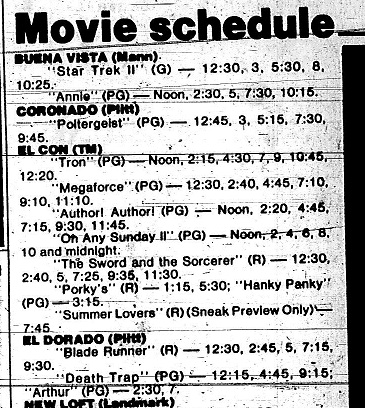
Hey guys, Michael Coate asked me to drop a scan of this Tuscon newspaper clipping from Tron's opening day. Seems to back up what is published at in70mm.com:
Posted by Will Kutler (Member # 770) on 01-26-2013, 04:59 PM:
I never did say that Tron did not play at El Con. It did, and I saw it there. However the El Con Six was not, and I repeat was not a 70MM house. This theater had deep, narrow auditoriums with non-curtained flat screens. The movie listing you uploaded does not mention 70mm.
The El Dorado was Tucson's 70MM house. BTW, the Tucson Fox was originally designed for Grandeur, but I do not believe that equipment was never installed.
70MM presentations at the El Dorado were heavily advertised. The El Dordao auditoriums resembeled the Martin Cinerama in Seattle as pictured on Page 2 of the Cinerama forum at the WideScreenMuseum.com
[IMG]
]http://www.widescreenmuseum.com/widescreen/wingcr2.htm[/IMG]
Posted by Sean Weitzel (Member # 244) on 01-27-2013, 12:22 AM:
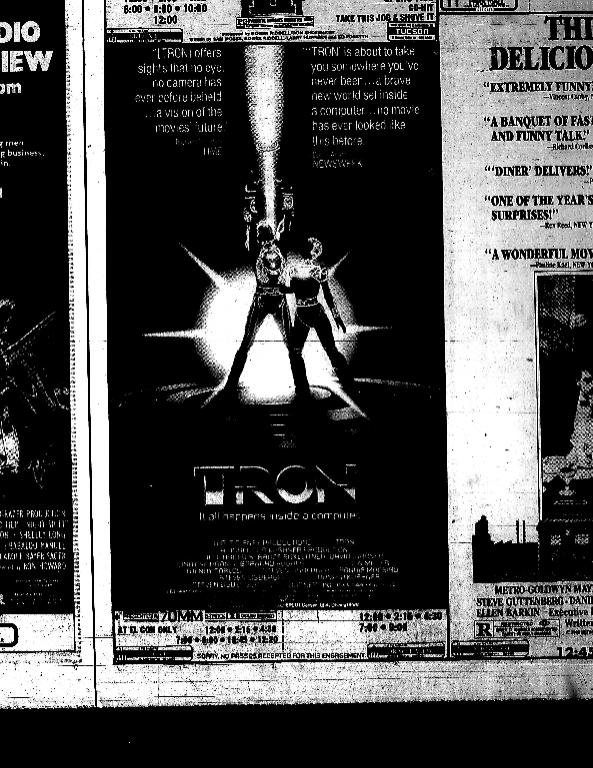
Mike asked if I could post this last scan which seems to indicate the El Con did play Tron in 70mm which brings my question, were newspaper movie listings for 70mm more often accurate or not so much?
Posted by Michael Marini (Member # 3490) on 01-28-2013, 11:39 AM:
HomeServicesProjectsCompaniesResourcesContact
Large Format Services
65mm
FotoKem has assembled the world's most complete range of 65mm post production services. We've simplified
the process of capturing images on 65mm negative - the highest resolution motion picture imaging canvas ever
created - to make ultra-high resolution image capture a practical alternative for today's filmmakers.
Our 65mm services include negative processing, HD dailies, optical and digital format conversions, and high resolution (up to 11K) film scanning. Our 65mm pipeline's simplicity and reliability brings this tried and true capture medium into the digital age. And with all 65 support services located on our Burbank main campus, FotoKem is the only place you'll need to go for originating or finishing on 65/70mm film.
PRODUCTION / DAILIES SUPPORT OFFERINGS
65mm negative processing
65mm HD telecine
35mm optical reduction dailies
Digitizing dailies for production editorial
Global Data worldwide data transfer of dailies and scans
DELIVERABLES OFFERINGS
65mm high resolution scanning (up to 11K)
65mm high resolution film recording (up to 8K)
70mm release printing
4K 2D and 3D digital intermediates
4K digital cinema services
“FotoKem was incredible and helped us
through whatever we wanted to do.”
Ben Rosenblatt
Associate Producer
View Larger Image
DIGITAL INTERMEDIATE THEATER
View Larger Image
DIGITAL INTERMEDIATE THEATER
Posted by Jarod Reddig (Member # 6363) on 01-30-2013, 12:25 PM:
Looks like the El Con was a 70mm house unless as mentioned they advertised incorrectly in the paper?
Posted by Tony Bandiera Jr (Member # 2365) on 01-30-2013, 02:31 PM:
No Jarod, it was not 70mm. Newspapers were notorious for getting it wrong...sometimes the fault of the paper, sometimes the fault of the theatre person placing the ad. (There were a few theatres here in So Cal notorious for lying about formats and digital sound to try to draw bigger crowds.)
Will Kutler is a Tuscon native and knows what he is talking about. I was just in the Air force there for a few years.
Posted by Jarod Reddig (Member # 6363) on 01-31-2013, 07:29 PM:
Thank you Tony.
Posted by Michael Coate (Member # 757) on 01-31-2013, 09:05 PM:
quote: Tony Bandiera, Jr.
[TRON] was not 70mm [at El Con 6]. Newspapers were notorious for getting it wrong
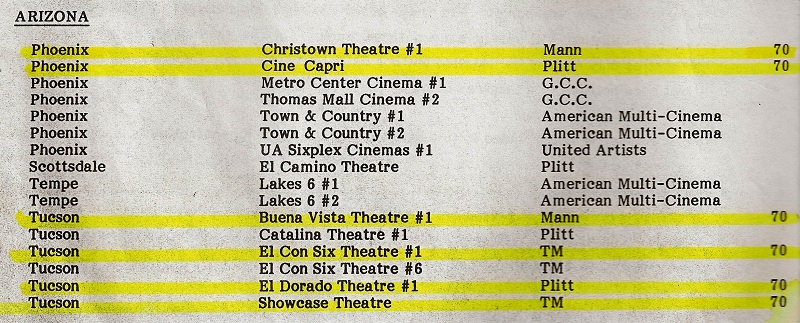
Not so fast, guys. In addition to TRON, I'd like to point out that RETURN OF THE JEDI and BRAINSTORM had 70mm-promoted engagements at El Con 6. As well, Dolby's installation records confirm the installation of a CP100 at El Con 6 (see image below).
That makes four separate examples of evidence that El Con 6 was capable of presenting movies in 70mm (on one of its screens). Mr. Kutler's only evidence that El Con wasn't 70mm-equipped is that the "theater had deep, narrow auditoriums with non-curtained flat screens" and his belief that El Dorado was Tucson's only 70mm theater.
Anyway, here's a scan of something relevant supplied to my by a contact at Dolby Labs. It is the Arizona section of a listing of theaters equipped with Dolby Stereo around the timeframe of the engagements being discussed. The "70" notations indicate the theater had a CP100. No notation indicates a CP50. (The highlights are mine.)
Posted by Michael Coate (Member # 757) on 02-12-2013, 09:53 PM:
quote: Will Kutler
I do not believe that the Buena Vista was 70mm...I do not remember 70mm being advertised there.
Among the 70mm-promoted engagements at Buena Vista were INDIANA JONES AND THE TEMPLE OF DOOM and TOP GUN.
quote: Will Kutler
The El Dorado was Tucson's 70MM house.
My research shows that Tucson had nine theaters in total that could run 70mm prints. In addition to the four theaters cited in my previous comment, Tucson had the following which opened (or had equipment upgrades) after 1982:
Campbell Plaza 3
Century Park 16
Foothills 4
Galleria 6
Park Mall 4
If you have information to the contrary, let's hear it.
Posted by Bobby Henderson (Member # 840) on 02-25-2013, 02:44 PM:
I had been observing this part of the thread, just letting others talk. But I'll throw in these thoughts. Back in the late 1970's through early 1990's it was a lot easier for movie theaters, ad agencies and newspapers to advertise 70mm than it was for the digital sound formats that followed. The situation with the lossy compressed digital sound formats of the past 20 years (Dolby Digital, DTS & SDDS) was far more complicated, resulting in a lot of the "ads that confuse" mess. In a lot of markets the theaters, agencies and newspapers just said "screw it" and dropped all the technical info from the ads completely.
In short, a newspaper or movie theater would have to goof up on a substantially larger scale to get it wrong with 70mm listings.
Not nearly as many theaters were equipped to show 70mm. At its peak I don't think there was any more than about 1500 screens in North America capable of running 70mm. Compare that to the tens of thousands of screens that added Dolby Digital, DTS or SDDS (or combinations of 2 or 3 formats in the same booth) over the years.
In the 70mm Dolby blow-up era (late '70's thru early '90's) if a multiplex had 70mm capability it typically had it only on 1 screen. Some theaters had 2 screens capable of 70mm. Very few theaters had 3 or more 70mm capable screens. In a good year 10 or more movies would have various number of 70mm prints made. It was a great year if the number got above 20 movies with 70mm prints. Quite a few 70mm equipped screens rarely played movies in 70mm. In New York I remember seeing ads for some movies featuring only one or two 70mm prints in Manhattan theaters despite the fact dozens of theaters across the NYC metro area were equipped to show 70mm.
Far more digital sound systems were installed in the 1990's and in a far more varied manner. Some theaters would have 1 or 2 screens equipped with it while others had it on every screen. Some theaters went with just one format. Others mixed the formats around the complex or even had portable roll around carts so numerous screens could share various sound format processors. In the early 1990's I saw some theaters do THX Dolby SR analog in one room and have digital sound in another. Every movie distributor had its own philosophy on which digital sound formats it was going to support and how frequently it would be used, be it on every studio release or only on the big movies that really justified it. It was difficult to tell if some movies had any digital sound prints at all, particularly "indie" releases. The Dolby "tri" logo in use from late 1993 through early 1995 made that situation much worse. Not every movie had "single inventory" prints. In the 1992-1993 time frame not very many Hollywood movies had 5.1 digital sound mixes. But it didn't take long for the number of 5.1 audio movie releases in North America to jump from a couple dozen per year to well over 100 or more. Numerous features would be shown on more than one screen in a multiplex and not always in the same digital sound format.
Dolby NR was used on almost every Hollywood feature film 70mm release from 1976 on up through the early 1990's. Cobra, Spies Like Us and the 1990 re-release of The Sound of Music are the only movies I can think of that didn't have the Dolby name associated with 70mm mag prints during that period. From 1976 to 1994 if a Hollywood movie was going to be shown in 70mm it was almost always shown in "70mm six-track Dolby Stereo."
Regarding 70mm and auditorium size, I've personally been in modest sized auditoriums that I knew were equipped to play 70mm. Auditorium size doesn't mean anything with 70mm if the theater operator mainly installed the capability for the six track audio.
Manhattan had lots of 70mm equipped screens with all sorts of shapes and sizes. Some rooms, like the Ziegfeld or Astor Plaza, were huge. Others like the Loew's 19th East theater weren't very big at all. In Oklahoma City General Cinema's Penn Square Mall theater wasn't very big; it was tiny compared to the 1100+ seat GCC Northpark #1 screen in Dallas. The AMC Memorial Square 8 theater on the north side of OKC had a 70mm equipped screen. It wasn't a big room either. The Memorial Square 8 closed in the late 1990's when AMC opened their 24-plex nearby at Quail Springs Mall. The Penn Square Mall 10 is still open, but has changed owners a number of times (Hollywood, Dickinson and now AMC). The 70mm gear was removed years ago.
I figure if a certain theater in Tucson was advertised to have shown certain movies in 70mm and Dolby has records on the screen having a 70mm capable cinema processor then chances are the screen was indeed equipped to play 70mm.
Posted by Jarod Reddig (Member # 6363) on 02-27-2013, 02:37 AM:
Very informative post. Thanks for your insight Bobby. My wife and I frequent the Moore, OK Warren which I prolly kinda close to you. We also go to the 21st street Warren in Wichita,KS. Bobby do you have any idea what speakers are used at the Warrens if you happen to know? I really like there THX stadium rooms and was curious as to the brand Mr. Bill Warren had installed. Also curious what brand are in the IMAX's at both locations. Didn't know how familiar you are with there equipment. Thanks again Bobby.
Posted by Bobby Henderson (Member # 840) on 02-27-2013, 09:17 AM:
I don't know what brand of speakers Warren is using in its auditoriums. If I had to guess I would figure they're using QSC. If not that then maybe JBL. At any rate the speakers have to be up to a certain standard of quality since all of Warren's "regular" auditoriums and "director's suites" are THX certified. Their IMAX Digital theaters are the only ones that aren't THX certified.
I do know Warren Theaters uses Dolby Digital Cinema (and Dolby 3D) gear in their non-IMAX booths. Oddly, Warren hasn't been on the forefront of installing Dolby Atmos. OTOH, very few movie productions have used Atmos up to this point. AFAIK only around 50 theaters in the US have installed Atmos on at least 1 screen, most of those in California (and not far from Dolby's offices). Perhaps Atmos will gain a little more momentum this summer.
Atmos kind of gets back to how the "ads that confuse" situation may be worse than ever.
The lossy compressed digital sound formats for 35mm film are quickly disappearing from commercial movie theaters. D-cinema uses superior yet generic uncompressed Linear PCM audio. That should simplify things, but it has rarely ever been accurately advertised. The end credits of new movies still show logos for SDDS, Dolby Digital (with their new logo screwed up) and DTS -or rather, "Datasat" Digital Sound. No mention of 24-bit 5.1/7.1 uncompressed LPCM audio in d-cinema presentations. You don't see that on the movie posters either (but the lossy digital sound formats are still there). Dolby did try to apply a "Dolby Surround 7.1" brand to LPCM 7.1 audio on DCPs, but that's not really accurate.
Have any movie posters, TV commercials or movie end credits bothered to mention Dolby Atmos? I certainly didn't see anything in the national ad materials for Brave. I kind of wonder if the term "Atmos" made it into any of the newspaper ads. Unless someone already knows about Atmos, knows a movie used Atmos in post production and knows which theaters have it installed he's not going to find the information in an easy way. I think most moviegoers that are finding out about Atmos are only doing so incidentally, not deliberately.
THX seems to have dropped off the radar scopes, even though some theaters are still going to the trouble of using the certification service.
The projection end of things is a mess. If a moviegoer wants to see a movie shown in a specific d-cinema projection format, such as 4K versus 2K, he's probably going to have to know what's installed in the booth. He's not going to find out about it in advertising. The 3D situation is also confusing. RealD and IMAX pushes their brands like crazy. Dolby 3D is rarely ever mentioned in any advertising. And then there's other systems like Xpand 3D. These systems don't all deliver the same results.
IMAX won't specify film or digital in their theater installations or how the movie is being shown. Various wannabe IMAX digital theaters (XD, ETX, RPX, etc.) aren't clear on how they're better, worse or equal to an IMAX Digital theater. Are they using 2 projectors? Are they using a better sound system than what IMAX installs? None of this is clear.
Even the movies themselves aren't clear with what's happening in camera and during post production. Was the movie shot on film? Was it shot on video? What's the native resolution of the shot footage, CGI elements and finished digital intermediate? 2K? 4K? How is the friggin' DCP encoded? One studio will deliver a 2 hour feature in 2K JPEG 2000 at a 250GB file while another studio provides a movie the same length but as only a 50GB file.
Basically there's more bullshit than ever going on with movies these days. If the movie looks/sounds good or bad it's not going to be clear just why it looks/sounds good or bad. There's more variables than ever affecting that now. One thing is certain: it costs a hell of a lot more to see a first run movie than it did a few years ago. Ticket prices are higher and snack bar prices have gone way up.
It was a hell of a lot more simple when the difference was 35mm stereo optical and 70mm magnetic.
Posted by Shawn M. Martin (Member # 6762) on 02-28-2013, 05:29 AM:
A Good Day to Die Hard's credits have the Atmos logo. That's the only movie I've seen with it so far.
Posted by Jonathan Goeldner (Member # 4854) on 02-28-2013, 09:52 AM:
so Bobby, can the audio processor's for DCI audio playback anything higher than 48kHz - yes, I know it's the standard encode, but I know that Dolby has had voiced their opinion to have studios encode movies at a higher hertz rate (96kHz) (but if processors can't, it seems like a pointless moot endeavor).
Posted by Bobby Henderson (Member # 840) on 02-28-2013, 10:17 AM:
Some of the newest cinema processors can handle high resolution audio. The Dolby CP750 supports 96kHz audio. So does the Ultra Stereo JSD-100. The Datasat AP20 can do 96kHz and 192kHz (in addition to the standard 44.1kHz and 48kHz sample rates).
The movie studios could certainly produce and mix their movie sound tracks at 96kHz sample rates if they liked (hard disc space is abundant). I'm not sure how commercial movie theaters will benefit from that, however. With so many d-cinema conversions little if anything has been done to existing sound systems. Sound is kind of an afterthought anymore. Digital projection, 3D, bigger screens and stadium seating are higher priorities. In order for a commercial theater to get something out of 96kHz audio they would already have to be doing a great job presenting 48kHz audio. Most are not doing that. In the vast majority of theaters 96kHz would be overkill. You wouldn't hear any difference between it and a standard 48kHz track. For 96kHz to work well in a commercial theater the speakers need to be top notch, the auditorium and its acoustic treatment needs to be very well done (it isn't in most theaters) and the damned sound system needs to be carefully maintained (the vast majority of sound systems are not).
The way I see it, if a movie is mastered with 96kHz 5.1/7.1 audio the only people who are going to notice the benefit are those with high end home theater systems when that 96kHz mix is transferred over to Blu-ray disc and the Dolby TrueHD and DTS HD Master Audio formats that support 96kHz playback.
Posted by Jonathan Goeldner (Member # 4854) on 02-28-2013, 01:31 PM:
"sound" definitely seems like an afterthought (five front channels anyone, anyone?? nope, it's there for DCI application but no one's recorded or distributed a movie as such) - it's just odd that home theaters and audiophiles can get blurays/CDs/downloads at 96kHz and 128kHZ but studios really won't go state of the art. I think they claim if the movie is really REALLY loud at 48kHz - moviegoers don't hear the difference anyways.
Posted by Manny Knowles (Member # 1171) on 02-28-2013, 01:40 PM:
Normally, I'd say "follow the money" but, in this case, I doubt that's the issue. It really shouldn't cost money to increase the sample rate. (But it wouldn't surprise me if post houses tried to charge more for it.)
The main issue is probably that Hollywood's "average" customer seems satisfied with 48kHz. You could probably bet that "nobody" knows what the "standard" sample rate is and, by extension, not knowing indicates not caring.
I agree with Bobby -- cinemas need to exhaust the limits of 48kHz first. But, having said that, I think so-called "home theatres" have a much longer way to go. (Let's face it, most "home theatres" are glorified TV Rooms.)
So, in the case of a DVD or Bluray with 96kHz audio, does that mean that the film was mastered that way? Is the home market getting better audio? Or is that the result of sample-rate conversion? In other words, is it "just marketing"?
Posted by Jonathan Goeldner (Member # 4854) on 02-28-2013, 01:50 PM:
I know of only one film where the audio was initially recorded at 192, encoded at 48 for cinema distribution, but encoded at 96 on blu - that was 'Neil Young: Journeys'
Posted by Bobby Henderson (Member # 840) on 03-01-2013, 01:12 PM:
Production wise, I'm not sure just how much it would increase costs to produce audio at 24-bit 96kHz versus standard 24-bit 48kHz (or 44.1kHz). Movies use a lot of stock sound elements, so it might force sound designers to generate more of their own stuff. Obviously they would need to be using better audio recording equipment.
The 96kHz rate would use double the amount of hard drive space used on a project. In a ProTools layout with dozens of different sound elements on the time line the 96kHz rate would double the processing work load. However, modern desktop computers are very powerful. It's hard to say just how many audio elements at 24/96 it would take to really bog down a well equipped computer. I don't know if 96kHz would or would add many hours or days of work to a sound design project.
quote: Manny Knowles
The main issue is probably that Hollywood's "average" customer seems satisfied with 48kHz. You could probably bet that "nobody" knows what the "standard" sample rate is and, by extension, not knowing indicates not caring.
96kHz is definitely more of an audiophile niche market thing. The general public hardly even cares about what qualifies as "CD quality" -severely compressed MP3 and AAC music files seem good enough for them. Most don't even realize the difference, thinking since it's all digital the quality is all the same.
quote: Manny Knowles
So, in the case of a DVD or Bluray with 96kHz audio, does that mean that the film was mastered that way? Is the home market getting better audio? Or is that the result of sample-rate conversion? In other words, is it "just marketing"?
If it was a digital recording it would have had to be originally recorded at the 96kHz sample rate. There's no need or benefit to blowing up a 48kHz recording to 96kHz. If the recording was originally from analog sources of very high quality that could be converted to 24-bit 96kHz with good results. Lots of music on DVD Audio and SACD has been mastered that way.
Most 24-bit 96kHz material on Blu-ray is concerts or other music related material. Baraka is one of the few movies I can name off hand that has a 96kHz recording.
The home market has been getting better quality audio technoloy than commercial theaters since the late 1990s. The Dolby Digital and DTS formats for home theater are better than their theatrical counterparts. They could play at higher bit rates and/or had unique features. DD theatrical played at 320kb/s; the home version did 384kb/s & 448kb/s on DVD and 640kb/s on Blu-ray. DTS theatrical played at 820kb/s; the home version of lossy could play at nearly double that rate (1509kb/s). The DVD format dumbed it down to 754kb/s, but Blu-ray has pushed it back up to the full rate. Home DTS could play 6.1 discrete audio while its theatrical version was really matrixed 5.1.
D-cinema has pulled commercial theaters back to more of a reasonably even setting with audio in home theater and on Blu-ray disc. However, more Hollywood movies have been remixed for 7.1 only for Blu-ray while their theatrical mixes were 5.1. Movie sound tracks are put together in a hurry in the last few weeks leading up to theatrical release. I'm guessing a "good enough" quality mix is getting put together for theaters. The sound crews go back and fix things and do more for the Blu-ray.
Posted by Antti Nayha (Member # 4980) on 03-02-2013, 05:57 AM:
I still haven’t seen any scientific proof (as in ”backed with double blind testing”) that we need anything higher than 48 kHz for presentation, no matter how high-end the equipment.
In fact, the evidence strongly suggests that 16 bits / 44.1 kHz is already indistinguishable from higher bit depths / sampling rates to the human ear. And the current 24-bit / 48 kHz de facto standard has plenty of headroom for high-dynamic applications such as cinema presentation.
Here’s an article which I’ve posted before, but it’s still great reading.
Posted by Bobby Henderson (Member # 840) on 03-02-2013, 01:38 PM:
That article talks about 24-bit 192kHz audio, not 24-bit 96kHz audio. Currently most D/A converters can have problems dealing with 192kHz sample rates. Those problems do not exist with 24-bit 96kHz audio.
In the context of Apple and iTunes delivering 24/192 audio the situation gets pretty damned funny. 24/96 and 24/192 audio is only worth doing if the audio is either uncompressed or lossless compressed. If the audio is crushed into a small .AAC iTunes file then the entire effort is a fucking waste of time. Apple has NEVER followed through on even offering audio that comes close to standard 16-bit 44.kHz uncompressed CD quality standards, much less anything that goes above the red book CD standard.
There is plenty of technical justification for audio to be recorded, mastered and distributed at 24-bit 96kHz quality. However, the audio must be treated properly to allow 24/96 to make a difference.
If someone is doing double blind testing using current popular recorded music and the atrocious compressing and clipping techniques that typically come with it most people taking part in double blind tests will have a hard time telling the difference between a LPCM music CD track and a lossy compressed 192 kilobit per second version of it. Nevermind throwing in a 24/96 variant.
Posted by Manny Knowles (Member # 1171) on 03-02-2013, 07:07 PM:
Bobby, just so I understand...
Are you saying that you would consistently be able to distinguish the 24/92kHz recording from its 24/48kHz counterpart in a blind test?
And are you saying that you can tell if a film was recorded at 48 or 92 just by listening to it?
Posted by Antti Nayha (Member # 4980) on 03-03-2013, 07:21 AM:
Bobby, if you read the whole article, you will notice that it’s not just about 24/192:
quote:
Sampling rates over 48kHz are irrelevant to high fidelity audio data
quote:
This means we can use low rate 44.1kHz or 48kHz audio with all the fidelity benefits of 192kHz or higher sampling (smooth frequency response, low aliasing) and none of the drawbacks (ultrasonics that cause intermodulation distortion, wasted space).
Most importantly, the double blind tests discussed in the ”Listening tests” chapter also included well mastered, dynamic 24/96 DVD-A audio. The result: 16/44.1 sounds just as good.
Regarding iTunes downloads… 128 kbps AAC has already been surprisingly hard to tell apart from uncompressed CD audio for some time, as proved in this test from 7 years ago. Nowadays, of course, iTunes is using 256 kbps AAC, which is only distinguishable on rare ”problem samples”. On iTunes and similar services, lossy compression is a complete non-issue compared to real problems such as the loudness war.
(No, that doesn’t mean I’m proposing that we go back to lossy compression for cinema audio presentation. But according to the evidence, 24/48 LPCM is perfectly good.)
Posted by Rick Raskin (Member # 1561) on 03-03-2013, 07:42 AM:
Just to clarify, what is being discussed is the sampling rate and not the frequency response.
48 KHZ requires sampling every 20.833 microseconds. This in comparison to the standard telephony sampling rate of 8K or every 125 microseconds.
I assume we are still referring to providing audio within the range of human hearing.
Posted by Jarod Reddig (Member # 6363) on 03-03-2013, 07:43 AM:
Thanks a lot Bobby! I appreciate it very much.
Posted by Bobby Henderson (Member # 840) on 03-04-2013, 10:59 AM:
quote: Manny Knowles
Are you saying that you would consistently be able to distinguish the 24/92kHz recording from its 24/48kHz counterpart in a blind test?
I think my hearing is good enough to do it. Provided if all the variables involved were properly handled. The audio material must be of high quality and be a native 24-bit 96kHz recording, not an artificial blow-up to 24/96 at any point in the editing/engineering process. The sound system playing the material would need to be high end.
quote: Manny Knowles
And are you saying that you can tell if a film was recorded at 48 or 92 just by listening to it?
No. I would need to know at least some of the variables involved before being able to say, "hey that's a 96kHz recording!" For one, I would already have to know the sound system is a friggin' great sound system. I certainly couldn't walk into an average or even really good movie theater or listen on some friend's pretty good stereo system and be able to tell the difference.
quote:
Regarding iTunes downloads… 128 kbps AAC has already been surprisingly hard to tell apart from uncompressed CD audio for some time, as proved in this test from 7 years ago. Nowadays, of course, iTunes is using 256 kbps AAC, which is only distinguishable on rare ”problem samples”.
I think those tests are either flawed or biased. Hell, I've heard people try to float the idea that 96kb/s audio was CD quality while trying to sell some form of satellite radio or "HD Digital" radio. I can hear clear differences between music in uncompressed LPCM versus versions saved down to 128kb/s AAC or MP3 format. The 128kb/s level is very severe. Differences are still easy to hear at 192kb/s. I've listened to music sold from Amazon and Apple at the 256kb/s level (Amazon's MP3 files are 256kb/s variable bit rate) and still hear noticeable differences with the uncompressed LPCM counterpart. If I make any MP3 conversions from the .WAV files I've ripped from my own music CDs I always encode at 320kb/s. That still isn't perfect.
quote: Rick Raskin
I assume we are still referring to providing audio within the range of human hearing.
Yes. Human hearing on average falls within a range of 20Hz and 20kHz. The 96kHz sample rate isn't recording a bunch of stuff above and below the range of human hearing. It is allowing double the amount of audio detail to be placed within that audible range.
Posted by Tony Bandiera Jr (Member # 2365) on 03-05-2013, 12:52 PM:
I think we have set a record for F-T thread drift with this epic. We've gone from:
- A crappy 70mm presentation at a prestigous location to:
- A bit of Union Bashing (rightfully so in this case) to:
- What a JJ scratch is, to:
- Whether or not 70mm prints are made anymore to:
- Debate on which Tucson cinemas have 70mm capability to:
- Detailed discussion of bitrates and compression.
Wonder which direction this will go to next?
Posted by Bobby Henderson (Member # 840) on 03-05-2013, 01:18 PM:
The thread was kind of dead (or at least comatose) for awhile until I threw in my 2¢ on the Tuscon 70mm situation.
Debates on lossy data compression in audio and 24-bit 48kHz and 96kHz are getting a little far from the 70mm topic. Although with d-cinema using uncompressed 24-bit LPCM that should at least get the soundtracks on par to what 70mm Dolby SR mag could deliver. Or do we need to go to 24-bit 96kHz for that?
![[Razz]](tongue.gif)
IIRC the talk of all this d-cinema audio stuff came from the "ads that confuse" (or just no ad info at all) situation that's actually quite a bit worse than it was back when 35mm Dolby optical and 70mm Dolby mag were the main movie formats being distributed/advertised.
Posted by Michael Coate (Member # 757) on 03-05-2013, 03:36 PM:
You've got some balls, Tony, for chiming back in at this point after you (and Will) arrogantly dismissed my research.
Posted by Manny Knowles (Member # 1171) on 03-05-2013, 07:28 PM:
Next topic: Bobby's balls.
Posted by Sam D. Chavez (Member # 1841) on 03-05-2013, 07:53 PM:
At least now we are on to something funny, or so I'm told.
Posted by Jim Henk (Member # 3628) on 03-05-2013, 08:21 PM:
I seem to recall when I first joined the forum, agreeing to (among other things) never taking things personally. That's a policy I really like.
Posted by Tony Bandiera Jr (Member # 2365) on 03-05-2013, 09:03 PM:
quote: Michael Coate
You've got some balls, Tony, for chiming back in at this point after you (and Will) arrogantly dismissed my research.
Well now I am gonna call you out for being a douchebag. Will lives in Tucson, I was stationed there and went to the theatres in question so I am gonna have a lot more faith in the person who actually lives there and my own personal observations than someone who obviously has an axe to grind. Your scan is suspiciously cut and pasted to align the 70 notations to suit your needs, and the "around the timeframe of the engagements being discussed" is vague and could be interpreted to be anytime within a year before or a year AFTER "TRON" played in Tucson. So get your panties out of the knot they're in.
And Manny baby, we're on the topic of my balls now evidently.
Aww c'mon now Jim, let your hair down and join in on the lunacy.
Posted by Manny Knowles (Member # 1171) on 03-05-2013, 10:30 PM:
quote: Tony Bandiera Jr
And Manny baby, we're on the topic of my balls now evidently
How the HECK did I miss THAT!
<-- Leans forward.
In all seriousness, regarding the "research" versus "I was there," I'm reminded of Gene Kranz's quote regarding Neil Armstrong's decision to override the Lunar Lander's autopilot: "Neil had the one thing we didn't have, and that was the view out the window."
Posted by Sean Weitzel (Member # 244) on 03-06-2013, 01:51 AM:
Can I ask a question here? What would Mike gain by digitally manipulating a newspaper ad from 30+ years ago to post on an internet forum for a subject that a mere three people are arguing about? I just don't understand why this is such a big issue. While I don't want to take sides I will say that I like Bobby's perspective on it - While a newspaper ad for cinema showtimes in the late 70's early 80's denoting a 70mm presentation may not be 100% accurate, it's probably far more likely to be accurate than printed showtimes in the 90's for various digital sound presentations. Mike presented several newspaper ads that indicate some kind of 70mm presentation at the 6. If I was a historian, I would probably include that as admissible evidence. Let me close that by stating that(despite having met Tony in person a few weeks ago) this post was in no way influenced by Mike's, Manny's, Tony's, Will's, or anyone else's balls. The only balls I can comment upon would be my own pair and those are not up for discussion as there are no newspaper ads to prove anything about them. ![[beer]](graemlins/beer.gif)
Posted by Michael Coate (Member # 757) on 03-06-2013, 10:15 AM:
quote: Tony Bandiera Jr
Your scan is suspiciously cut and pasted to align the 70 notations to suit your needs
Tony... Are you actually accusing me of fabricating the TRON advertisement??? Dude, that might just be the funniest thing I've ever heard! Your position now reeks of desperation, and I'm reminded of something a friend said recently about arguing with members of the Flat Earth Society.
Posted by Bobby Henderson (Member # 840) on 03-06-2013, 10:28 AM:
One thing I'd like to know is if Will Kutler and/or Tony Bandiera visited the projection booth at the El Con 6, particularly during this period where the El Con 6 was advertised as playing movies in 70mm. I could understand one inaccurate advertisement of a theater claiming it was showing something in 70mm. But multiple times? I don't know how they could get away with that unless various others involved, including the theater's competition, were incompetent. I know if I was running a movie theater and a rival was claiming to be showing a movie in a special, coveted format when that wasn't the case I damned sure wouldn't let it slide. I'd report that falsehood to the newspaper, the movie distributor, maybe even Dolby or anyone else involved with the 70mm issue.
I lived in New York City for 5 years, from 1986-1991. During that period lots of theaters in the NYC metro area had 1 or more screens equipped with 70mm. Many of these theaters rarely, if ever, got to show anything in 70mm. Most of the time any 70mm prints stayed in Manhattan. If any of the "suburb" theaters got 70mm prints it was usually the same few theaters. I'd see an ad from a company like Cineplex Odeon about a theater opening in Brooklyn or somewhere in New Jersey. 70mm would be one of the features listed. But then as the movies with 70mm prints came out many of these 70mm capable theaters would be left out. If I counted 70mm equipped screens based only on theaters that were advertised as getting prints of generous 70mm releases like Hoffa or Dick Tracy I'd defintely miss a few.
Even with theaters in Manhattan, I couldn't tell anyone for sure just how many 70mm equipped screens were in a multiplex like the Loew's 84th Street Six. I remember some theaters opening, like the 9-plex Cineplex Odeon opened on 23rd Street to replace the old Chelsea Cinemas theater (which is now the School of Visual Arts Theater). I remember the ads for that new 9-plex boasting 70mm capability, but I'm not sure it ever got to play anything in 70mm. Havana maybe?
Then one has to factor in how booth equipment may get installed or removed and moved to a different theater. I know this has happened during the 1990s with digital sound equipment. Our local Carmike 8 originally opened in 1994 with 2 theaters equipped with DTS-6 machines (in two no longer THX certified screens). Five DTS-6D machines and one other DTS-6 unit were added to the remaining analog-only houses (along with sound system upgrades). Those DTS machines came from other theaters. I wonder how much record keeping went on to record those changes. I'm thinking not much. The Carmike 8 rarely got any separate DTS trailer discs despite having five DTS-6D machines.
In the end, actually seeing what gear is in the booth is probably the best proof.
quote: Manny Knowles
Next topic: Bobby's balls.
quote: Sam D. Chavez
At least now we are on to something funny, or so I'm told.
I'm black from the waist down.
![[evil]](graemlins/evil.gif)
Posted by Manny Knowles (Member # 1171) on 03-06-2013, 11:05 AM:
Posted by Brad Miller (Member # 2) on 03-06-2013, 12:24 PM:
Guys, what's up with the drama. Really?
I find myself skimming when this comes up so I haven't sat and read these long bickering posts, but the one thing Mike is not going to do is photoshop an ad. There is some sort of personality mismatch here, but Mike is incredibly anal when it comes to tracking down the proper information on things, and as Sean stated, I would agree trusting a 70mm newspaper ad vs. something from the 90s vs. some random person's memory of watching a movie in a particular auditorium...the newspaper ad is logically going to be the most accurate.
There, we have now gone from balls to anal. Happy Manny?
Posted by Manny Knowles (Member # 1171) on 03-06-2013, 01:06 PM:
I just want to send out a big "thank you" to everyone, for taking the time to think of "li'l ole me" in the midst of all of this.
Posted by Tony Bandiera Jr (Member # 2365) on 03-06-2013, 01:25 PM:
Brad, Mike fired the opening salvo in this discussion with his smart-ass comment and I am not going to sit idly by and let him get away with it. I just pointed out the obvious flaws with his post of the scan.....whether he did it, or he got a bad file from his contact at Dolby doesn't matter. It puts his position in a bad light. Someone so anal about facts as you pointed out would have NEVER posted such a sloppy representation of the data he is using to back his position. It seriously undermines his credibility. For example, if you were to present such a sloppily formatted quotation to a client for an install, what impression do you think they will have of your integrity?
As for the veracity of his claim, I like Manny's quote:
quote:
..In all seriousness, regarding the "research" versus "I was there," I'm reminded of Gene Kranz's quote regarding Neil Armstrong's decision to override the Lunar Lander's autopilot: "Neil had the one thing we didn't have, and that was the view out the window."
Or more accurately in this case, the view into the booth.
And another thing: Anyone on this board would not have to enter a booth to tell if a film was presented in 35mm vs. 70mm. The splice at the first reel change will give confirmation of what format is in use.
Michael: I never accused you of fabricating the NEWSPAPER ads. You expect us to believe the validity of your data, yet you can't even get your facts straight in your disagreement with me. I have nothing personal against you, whether you choose to believe it or not. But a little humility would be in order and maybe conceding you might be in error.
Bobby: The reason I disagree with the accuracy of a lot of the newspaper ads even back then is because most of those ads for the major chains here were usually prepped by someone at a desk in the corporate office. They had NO CLUE what equipment each theatre had, often relying on the word of the manager (who was also clueless most of the time). I back this up with the FACT that I serviced many of the chain's theatres back in my days with RCA Service and KNEW which booths had 70mm and which ones didn't. And there were many of MY theatres that advertised 70mm when I knew they did not.
As for the idea of someone reporting false format advertising, are you serious? 90% plus of the patrons and most likely the same number of rival theatre owners were/are clueless about the presence of 70mm equipment. Only a tech or projectionist would even be able to tell or care if 70mm was being run or not.
Customers always have been clueless about technical aspects of projection. Look at how long people thought we ran DVD's and could pause or skip back to the part they missed.
Posted by Brad Miller (Member # 2) on 03-06-2013, 02:30 PM:
Don't make me send the two of you to your rooms.
This thread is going nowhere. CLOSED
Powered by Infopop Corporation
UBB.classicTM
6.3.1.2