This is topic Last can of Taken 2 in forum Film Handlers' Forum at Film-Tech Forum ARCHIVE.
To visit this topic, use this URL:
https://ft-forum.com/ft/cgi-bin/ubb/ultimatebb.cgi?ubb=get_topic;f=1;t=011389
Posted by Adam Ladds (Member # 6757) on 02-08-2013, 09:57 AM:
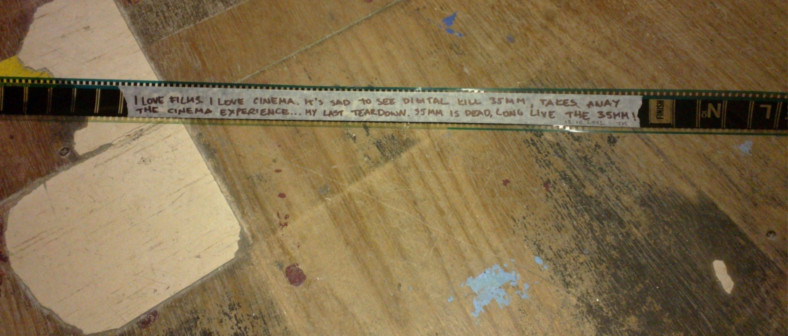
On the final can of a print of Taken 2 I was making up I saw this:
http://i.imgur.com/ses30Or.jpg
We're not digital yet, but we aim to be before the end of 2013. It is sad when you see something like this ![[Frown]](frown.gif)
Posted by Robert E. Allen (Member # 1351) on 02-08-2013, 10:57 AM:
The saddest part is that exhibitors have to fork over a ton of money to save the distributors money. That's the only reason for the digital switch. A good film presentation will equal digital any day.
Posted by Bill Enos (Member # 440) on 02-08-2013, 11:57 AM:
If cheapskate exhibitors had their way motion pictures would still be sound free, black and white, projected in 1.33 in unheated, unairconditioned theaters with salvaged church pews for seats.
Posted by Jay Glaus (Member # 6011) on 02-08-2013, 12:43 PM:
Posted by Brad Miller (Member # 2) on 02-08-2013, 12:56 PM:
quote: Robert E. Allen
A good film presentation will equal digital any day.
Not anymore Bob. Unless you have access to EK prints, everything theaters are receiving today is being cranked out by Deluxe. The last few theaters I've converted I was looking at the images and they were awful. Deluxe was never very good in the first place and it is clear absolutely nobody cares anymore.
You can simply never make that statement again regarding current 35mm prints. With rare exceptions, you can't even make that statement regarding most repertory prints, as most of them have dust and at least light scratches on them from handling.
Posted by Jonathan Wood (Member # 4614) on 02-08-2013, 01:55 PM:
It's the 'dust and light scratches' that I will miss the most !
Posted by Robert E. Allen (Member # 1351) on 02-08-2013, 03:22 PM:
That's too bad Brad. Thanks for the tip.
Posted by Bill Enos (Member # 440) on 02-08-2013, 04:14 PM:
The last dozen or so 35mm prints we received were covered with cross frame scratches. damaged SRD tracks etc. Most took at least 3 replacements to get something playable, one needed 5 replacement
prints. This would indicate that the remaining film theaters don't know what they are doing.
Posted by Brad Miller (Member # 2) on 02-08-2013, 05:59 PM:
Well also of the theaters still standing, those are the ones (with exceptions) that are being held together by duct tape where the owners don't have the money to do anything to improve. It's simple math that these last film theaters will be the worst of the bunch.
Posted by Mike Blakesley (Member # 26) on 02-08-2013, 06:25 PM:
quote:
It's the 'dust and light scratches' that I will miss the most !
That's kind of hilarious given that before the advent of digital, "dust and scratches" were the worst things that could happen to a movie, and people were touting home video as a way to watch a movie "without all the dust and scratches."
And there were products like Film Guard created to GET RID OF the dust and light scratches. So now people are NOSTALGIC for film damage?! Give me a break.
Posted by Victor Liorentas (Member # 5272) on 02-08-2013, 06:45 PM:
I have never been nostalgic for film damage.
We just went way out of our way to get a 35mm print made by Deluxe of Django Unchained and it is far superior to the DCP I viewed. This is a move over engagement.Everything has been digital for Django up until now.
I am selling it that way on our website and facebook pages...See it the way QT would prefer you to see it!
http://www.hylandcinema.com/pub/hyland1/moviedetails/816
I hope to do Lincoln the same way and then I expect film to be about over for new releases. Just saying that not all prints are crap right now.
Posted by Brad Miller (Member # 2) on 02-08-2013, 08:53 PM:
Maybe you got lucky. The Django print I saw had horrible mis-timed colors and ridiculous amounts of negative dirt. The Deluxe bouncey bouncey dance wasn't too awful, but that's because Django is scope.
That being said there were 2 shots near the beginning of the movie that looked awful from compression (dark scenes) and there were a few shots with blown highlights, but overall most of the movie looked very good in digital. I'm surprised Quentin let those shots slide.
Posted by Manny Knowles (Member # 1171) on 02-08-2013, 10:07 PM:
People who like the dust and scratches are stupid.
If you're really going to pose as a purist, you should insist on seeing the movie WITHOUT all of those imperfections.
Seeing a film that's been damaged or mishandled is not seeing the film "as the director intended" or "as it was meant to be seen."
If the only thing that matters is that it's on film, just collect 16mm prints and watch them at home.
BTW -- Did that film hugger label that poor film with masking tape?
Posted by Joe Redifer (Member # 3) on 02-08-2013, 10:15 PM:
quote:
It's the 'dust and light scratches' that I will miss the most !
omg i will miss the brainwraps the most lol i had them ever show we were like lol film man i miss those days i think in the back of there minds custoemrs miss that to
Posted by Jock Blakley (Member # 6552) on 02-08-2013, 10:36 PM:
quote: Brad Miller
Not anymore Bob. Unless you have access to EK prints, everything theaters are receiving today is being cranked out by Deluxe. The last few theaters I've converted I was looking at the images and they were awful. Deluxe was never very good in the first place and it is clear absolutely nobody cares anymore.
Unfortunately very true. Comparing prints we hold that were struck by all sorts of labs (Technicolor, CFI, Atlab, LTC St Cloud, and so on) in the '90s verses "modern" prints illustrates it so clearly.
Of course the DI also helped with the overall reduction in the image quality of release prints, but still.
Personally I also think that 5/2386 was a much nicer stock than 2383. I look at the colour and saturation of prints like BARAKA and HAMLET, both 70mm EXR prints from 65mm EXR neg, and can't believe how far things have slipped.
Posted by Brad Miller (Member # 2) on 02-08-2013, 11:43 PM:
quote: Manny Knowles
BTW -- Did that film hugger label that poor film with masking tape?
Yes he did, and he also apparently didn't care enough to add extra protection leader to the end, he just let the tail end of the credits get crapped up a little more every time the film tailed out. ![[Roll Eyes]](rolleyes.gif)
Posted by Manny Knowles (Member # 1171) on 02-09-2013, 01:45 AM:
Ah -- drag strips -- memories.
Posted by Jonathan Wood (Member # 4614) on 02-09-2013, 04:55 AM:
quote: Manny Knowles was the last to post
People who like the dust and scratches are stupid.
Hardly stupid Manny, just I think in this context misunderstood!
How many times have you seen something on tv given the 'old film look' a post effect that overlays false grain, print weave and scratches? Its this I meant; the nostalgia and cultural association we all have for film. Obviously no one wants to pay good money to see a beat up print, but for me there is something about seeing A LITTLE dust and the ODD scratch especially on an older movie, it reminds us that we are watching something that has been physically created by human beings rather than a series of 1's and 0's, streamed from a black box. It was probably the the imperfections of film as a child that initially made me curious about what the stuff was in the first place. I know this is Film TECH and I dont expect that many people to agree but as a working DOP who has spent his working life shooting both film and Digital; I have lost track of the number of times that Directors have asked me for a 'film look'and there have been many occasions when a film grain has been overlaid in post along with a light dust speckle ! This might seem crazy to some, but if you consider it in the cultural sense it helps people to subconciously connect to what they are watching. It's almost as if the Director believes that its the 'filminess' of the image , warts and all, that gives the image its gravitas and vitality? Anyway its all in my opinion, but its rude to say people are stupid for having an opinion.
BTW I'm very tired of hearing that 'as the director intented' nonsense. This is a phrase coined up my marketing types designed to sell us wide screen DVD's of 4:3 VHS' we already owned ! Sure some directors have a vision and some dont know what it is until they see it, in my experience ! And that vision changes with each generation as new technologies allow us to see old films with new clarity, compare the VHS and Blu Ray of The Red Shoes, I hardly think Powel and Pressburger could have envisioned that ! Anyway, talk about off topic! ![[Smile]](smile.gif)
Posted by Ramon Lamarca Marques (Member # 3621) on 02-09-2013, 07:19 AM:
quote: Jonathan Wood
the nostalgia and cultural association we all have for film
Absolutely spot on Jonathan, I have made similar comments in the past. There is an emotional connection many of us have to film. I have complained in the past about many bad 35mm repertoire prints that have been screened and so I do not enjoy a bad 35mm print. A while ago I went to see Yolanda and the thief just to enjoy the Technicolor colours and the 35mm print the British Film Institute has is atrocious, the hues are all wrong, a DVD screening would have been better. Nevertheless seeing a good 35mm repertoire print manages to take me back to that era, a bit like seeing original objects in a museum. It does it in a way that a very pristine DCP with very clean digital sound doesn’t. It is all subjective but I like it!
However, as it has been said on Film-Tech, digital has managed to remove people who know about image presentation from theatres. The other day I went to see Life of Pi. The adverts were all shown in fast forward mode. I thought to myself, digital is great! Then the film started and there was more flickering than seeing an 8mm print on an IMAX screen (and it was digital 3-D). It was dreadful. The sound was almost non-existent. I went out to complain and there were only popcorn engineers available, who looked at me like if I was talking nonsense. I came back to the auditorium frustrated. More people complained and they started the film again, it did not work, more complaints. Someone came to check the screening. He checked the 3-D screening, without glasses, and said it was fine. More complaints, finally the 3rd time and with 30 minutes of delay the image was OK but the sound was not. More complaints. The sound was finally fixed. I no longer go to a big cinema chain in the UK because they show flat films through 3-D polarisers because they can’t be bothered to remove them. This is my main fear with digital, quality control. And I want better blacks and 4K as a standard.
Posted by Steve Guttag (Member # 268) on 02-09-2013, 08:19 AM:
I'm sure someday Manny will wax nostalgic about diagonal lines with stair steps in them or the hyper-depth-of-field of 2K DCPs, without actual resolution (actually I don't think he will but it is fun to poke at him anyway).
I've never marveled or looked fondly at film's shortcomings...just tolerated them as something out of my control. There are things that digital definitely brings to the movie going experience. In that same vein, the notion that film should be discounted as inferior to digital simply due to its short comings is to also dismiss digital's shortcomings too. I don't particularly like the 2K DCinema look, myself. I don't particularly like the look of 35mm release prints either.
I find it humorous that some regard the prints of the '90s as something special too. The stocks have steadily received finer grain but the quality of release print making has all been about speed ever since the googleplexes came about. Even in the '80s, prints were a hodgepodge of great and abysmal.
Looking at some release prints of earlier decades would let you see just how ripped off later generations were when it came to prints.
Posted by Louis Bornwasser (Member # 3063) on 02-09-2013, 08:47 AM:
To add to Steve's excellent posting: I once ran test premieres on Xanadu. The print we had was off of the camera negative. When I saw the release print, the grains were 4 inches across! It was difficult to believe that the same negative originated the 2 prints.
I believe printers now run at 3000 ft/minute routinely. Time is money.
Posted by Jonathan Wood (Member # 4614) on 02-09-2013, 09:24 AM:
Ramon, thanks for the support.
Its funny how we evaluate a medium by it's shortcomings. I too dislike the current 2KDCP look but am not a huge fan of some of the muzzy looking stuff that was released on 35 either towards the end.
I've seen stuff I've shot on 35 struck straight from the neg and the results can be staggering, such clarity and colour and then you see them after the IP/IN stage and the difference is huge. I remember going to what I thought was a digital screening of one of the 'Bourne' films at the odeon Leicester Sq a few years back. There was a big sign saying that due to unforseen circumstances they were resorting to showing a film print and offered their apologies. However the 35 turned out to be a showprint and it looked fantastic! And that big old screen isn't easily satisfied!
Unfortuntately how many showprints were ever out there ? It's the economies of scale that made bulk printing necessary. Last time I was at Deluxe London it was around the time of the last but one harry potter, they told me they were making more 35 than ever ! I think their printers could run at around 5000 ' per min?
Am I the only one who misses seeing a WELL MADE tape join going through the gate on the screen?!! And don't forget you could always count the cue dots to work out how much was left of a bad movie!
Posted by Ramon Lamarca Marques (Member # 3621) on 02-09-2013, 10:25 AM:
quote: Jonathan Wood
Ramon, thanks for the support.
Its funny how we evaluate a medium by it's shortcomings. I too dislike the current 2KDCP look but am not a huge fan of some of the muzzy looking stuff that was released on 35 either towards the end.
I saw The Master in 70mm at the Odeon West End and I thought it is a shame that 65mm printed onto 70mm does not become the norm. It was a pleasure, a perfect screening. I also think that 2K DCP is not good enough and now that they are talking about 4K Blu-ray we will see what they'll do with all the obsolete digital projectors. It must be tough being an exhibitor these days and I sympathise with them.
Posted by Martin McCaffery (Member # 37) on 02-09-2013, 10:43 AM:
Coming in late but here to support the look of film. There is something different about the look of light going through emulsion as opposed to bouncing off a chip. Decide for yourself which is better.
Having finally seen a digital image projected the way it is supposed to be all I can say is "Wow, that's really good looking TV."
And I'm sure the general public is perfectly fine with that, considering how long they've tolerated without complaint crappy video projection after decades of crappy film projection.
Still, lost cause though it may be, I'm hoping 35mm film survives as a craft boutique format, at least for we arthouses who don't need 4000 prints run off at high speed.
And though it is true some of the remaining theatres held together with duct tape, may have the last remaining bad projectionists, some of us still do our best to do it right.
And we will be starting our Kickstarter campaign to finance the digital additon next month.
Posted by Jay Glaus (Member # 6011) on 02-09-2013, 12:41 PM:
Brain wraps lol, I'll never forget a brain wrap one night that induced panic in a guy in the field who claimed the booth was on fire when he saw the film burn through. Afterwards we explained to him what actually happened but he was still insistent the booth was burning down, we ran in there and put it out, and just didn't want to say so.
Anyhow, putting my two cents worth in on the film. I was suprised this past year the amount of problems we had with prints. I had a reel of Dark Shadows that looked like someone took it in the shower with them which was a new print, water marks galore. They sent us a new reel for that one. Then, MIB3, half of the film on a new print was so warped and bent, I thought I could play it however, which I did. But the first 4 reels you could see how it wouldn't sit right going through the gate, so I had to assist with focus between characters at times. Tried everything I could think of, tension, everything. They ended up sending me a whole new print and it was fine. I think there was a third one this past year too but I can't think of which one it was.
We've always had a new print come with an issue once every blue moon, but never quite as often as this past year. Don't know if that has to do with the digital conversion and making less prints or what. Just thought I'd throw it out there.
Jay
Oh and P.S., I do like the look of film, think film is great, and will miss it much, just as long as it is printed well.
Posted by Chris Slycord (Member # 4239) on 02-09-2013, 01:54 PM:
quote: Jonathan Wood
Anyway its all in my opinion, but its rude to say people are stupid for having an opinion.
No one called you stupid for merely having "an opinion." You made a statement, the statement was called stupid and then you qualified it by essentially saying "Sorry, I forgot to give you the context of the statement." Heck, you even agreed that the way you wrote it, the opinion seemed stupid...
My $0.02
Posted by Manny Knowles (Member # 1171) on 02-09-2013, 03:17 PM:
quote: Jonathan Wood
for me there is something about seeing A LITTLE dust and the ODD scratch especially on an older movie, it reminds us that we are watching something that has been physically created by human beings rather than a series of 1's and 0's, streamed from a black box.
Do you honestly think that a movie that is projected digitally was not made by humans?
quote:
but as a working DOP who has spent his working life shooting both film and Digital;
I have said MANY times on here that I'm 100% in favor of shooting on film and archiving to film. I trust cinematographers and archivists with film. Sad to say but, generally speaking, I don't trust today's "projectionists" with actual film. I've projected quite a few restored movies via D-Cinema and the "film look" comes across very well.
quote: Jonathan Wood
BTW I'm very tired of hearing that 'as the director intented' nonsense. This is a phrase coined up my marketing types
That may be where the phrase came from but I believe the sentiment had already existed -- they just gave it a name. But let's play pretend -- if the filmmakers don't care and it's a free-for-all, then it doesn't matter if we play a pristine print, or a battered print, or a DCP -- or if people just watch it on their iPods.
It may be true that many directors don't have a vision, but should the great directors suffer because we're playing to the lowest common denominator?
quote: Ramon Lamarca Marques
digital has managed to remove people who know about image presentation from theatres.
It also removed A TON OF PEOPLE who knew nothing about image presentation from theatres.
Posted by Ben Wales (Member # 92) on 02-09-2013, 04:53 PM:
quote:
We just went way out of our way to get a 35mm print made by Deluxe of Django Unchained and it is far superior to the DCP I viewed. This is a move over engagement.Everything has been digital for Django up until now.
I am selling it that way on our website and facebook pages...See it the way QT would prefer you to see it!
I never thought to see the day where you can get to see a 35mm Theatre Experience
Posted by Monte L Fullmer (Member # 2797) on 02-09-2013, 05:35 PM:
Course, nothing was said on if the OP is losing, or has lost his job due to the conversion. That's the big one that dwells on some minds.
Posted by Jonathan Wood (Member # 4614) on 02-10-2013, 06:14 AM:
[It may be true that many directors don't have a vision, but should the great directors suffer because we're playing to the lowest common denominator?]
No one is suggesting we pander to the lowest common denominator; its an industry after all and all industries are dictated to by economics. Only a few top directors will be able to call ALL the shots. I would argue that it's a producers' industry and this is always where the power is, it's just more palatable to talk about the 'director's vision' rather than the producers. Not to say of course that directors are without input or vision, look at people like Terrence Mallick and Wes Anderson, as close as you can get to true auteres.
Years ago before I started shooting, I went for an interview for a TK grader at the BBC in London. I went happily through the initial technical selection process and then I came face to face with a panel of BBC dinosaurs who asked me what I thought about pan and scan. This was the 80's - the age of 4:3 TV's and before the vogue of showing letterboxed films, and I genuinely hated seeing anamorphic films pan and scanned , so I said I thought that films shot anamorphically should be transferred in a letter box format. They looked at me as if I were from Mars and quietly asked me if that meant I wouldn't be intending to use the millions of pounds worth of new pan and scan TK equipment they had just installed? How times have changed. (I didnt get the job. )
And of course I dont believe that digitally projected movies are not made by humans. ( Everyone knows they are fashioned in the depths of Venusian mines by slave labour ? )
Also, I know there are/were some uncaring projectionists out there but there were/are also of lot of dedicated people who were passionate about film, shame they are all facing an uncertain future.
Posted by Ramon Lamarca Marques (Member # 3621) on 02-10-2013, 07:38 AM:
quote: Jonathan Wood
Years ago before I started shooting, I went for an interview for a TK grader at the BBC in London. I went happily through the initial technical selection process and then I came face to face with a panel of BBC dinosaurs who asked me what I thought about pan and scan. This was the 80's - the age of 4:3 TV's and before the vogue of showing letterboxed films, and I genuinely hated seeing anamorphic films pan and scanned , so I said I thought that films shot anamorphically should be transferred in a letter box format. They looked at me as if I were from Mars and quietly asked me if that meant I wouldn't be intending to use the millions of pounds worth of new pan and scan TK equipment they had just installed? How times have changed.
Good for you! I remember when a group of people, including myself, started complaining and putting pressure on TV channels in Spain in the 80s so they would stop the atrocity of pan/scan. They told us that the big American studios would not provide them with letterbox versions. After a lot of complaining and a celebrated manifesto in Barcelona signed by many famous film directors the issue of presenting a film as the director intended was addressed. I remember the first time the Spanish TV apologised for showing a film in pan/scan, The Adventures of Quentin Durward, they said the letterbox version had not arrived in time and promised to show it properly later on, as they did. That change came about because the TV general director was a film director herself, Pilar Miró. Nowadays people are watching academy aspect ratio films deformed so they fit their widescreen TV! It’s a Mad, Mad, Mad World!
Posted by Manny Knowles (Member # 1171) on 02-10-2013, 12:04 PM:
It's clear we agree on many things.
Just about the only thing we seem to disagree on is this: I always hated film's inherent shortcomings -- dust, dirt, scratches, splices, and you embrace them.
Other factors that turned me off of film -- not inherent to the medium, but still beyond my control -- Digital Intermediaries (DI) and ultra-high-speed printing. At this point, 2K delivers a better image than we were getting with film for the past two decades or so.
I also hate color fade. Now, I'm NOT accusing anyone (here) of liking this -- but it is an old problem that remains relevant to me, because I screen a lot of repertory titles which were affected by it. And the people who sit through these shows are the ones who supposedly love film. I guess when they profess their love of "film" they're talking about the medium itself, and not the art form. And I guess the love is unconditional -- as long as it's on film, that's all that matters.
For me, the characters and the story are the top priority. Not the medium itself. The more defective the print, the more I am reminded/aware of the medium. The more I'm reminded of the medium, the more I'm distracted from what matters most to me.
"Things which matter most must never be at the mercy of things which matter least." (said by Goethe?)
And then there's the decline of real projectionists. My observation is that presentation quality improved when cinemas got converted. At least, the ones I've been to -- which is a lot of cinemas in a few different cities and states (Southern California, New York, Indiana and Florida). Note that I didn't say things are perfect, just improved. But noticeably, appreciably improved.
Now, I know this will make me seem like an insensitive prick, but...
A few rhetorical questions:
Of the projectionists who lost their jobs because of the transition to digital, how many of them were real "career" projectionists, working full-time (40 hours) as a projectionist, with no other duties (i.e. box office, concession, usher, manager)?
How many of them were any good to begin with?
How many were far from retirement age (under 60)?
How many of them simply "quit" rather than learn and master the new technology?
Posted by Steve Guttag (Member # 268) on 02-10-2013, 01:00 PM:
Manny,
One thing in your "discussions" about digital vs. film you don't seem recognize is that what is imported to some people in the image may not be as important to others. The dust and the occasional scratch that grates on you like fingernails on a chalkboard do not affect others in the same way. The stair-step lines, the lack of depth, the lack of resolution of 2K digital, the lack of contrast range grate on others. It isn't so cut and dried as to what is so important to each individual.
While, I'll grant you that in the last 10-years, film prints have been a poor representation of what film can be, going back 20-years, film prints were generally superior, image wise to what 2K digital is. While you could still point out the bad print or that yes color stability between reels is not as good as digital is today...if you look at all criteria of "quality" film is likely to win. Go back 30-years film is going to win in even more categories...except color fade if it was made on Eastman stock. Go back 40-years and film wins in a slam-dunk (except in the color fade...unless it was IB). And in ANY decade, an EK print beats the pants off of digital.
But again, each person has the things they think make something better/worse, as a medium. Personally, I prefer the film look, perhaps from upbringing, perhaps digital's shortcomings are more grating to me than the film's shortcomings. Oddly enough, one of the things I'm really happy digital has done away with is the strobing associated with the shutter itself. As such, I prefer 3-wing shutters for film...if you can get the light!
Posted by Ben Wales (Member # 92) on 02-10-2013, 01:51 PM:
quote: Manny Knowles
Of the projectionists who lost their jobs because of the transition to digital, how many of them were real "career" projectionists, working full-time (40 hours) as a projectionist, with no other duties (i.e. box office, concession, usher, manager)?
You should ask that question here in the UK where around 200+ Full-Time Projectionist's were made redundent, yes there were Bad ones, but the Exhibition Industry has lost most of the Technical Experienced People.
Posted by Manny Knowles (Member # 1171) on 02-10-2013, 02:20 PM:
Steve, I'll readily accept nearly all of that.
But, frankly, I don't care if anyone loves, likes, or isn't offended by the dust, dirt, etc. The point is that those flaws aren't supposed to be there. It's a down-side of film that I'm glad to be rid of. When I run film, I accept those defects as a reality over which I possess a limited degree of power, but I refuse to embrace such flaws. Or, worse, defend them.
If those were the only issues, I might be more resistant to digital. But those aren't the only issues. The problem includes what happened to prints in too many instances. I've seen very bad damage during opening weekend. And I've seen even worse if I waited longer to see the movie. And I saw this with such regularity that I finally decided to just buy a Bluray player.
I think the situation had slipped to the point where, to me, digital seems better. You're right -- it *seems* better than where film was when it died. It seems a lot better.
Could it improve? Sure, why not?
I'm not saying 2K is where it's at. But I suspect the reason we ended up with "only" 2K is most likely that the situation had been allowed to slip to a point where digital didn't really *need* to be any better than that to compete with film, such as it was. If print making and film presentation quality had remained the same since 40 years prior -- or had improved over that time-frame -- we'd need a better digital standard to compete with that.
It's always been my understanding that the digital transition was actually more about money than quality. If it was primarily about quality -- who knows!? -- we might have started out at 8K.
Ben -- yes, my thinking was globally-limited -- but even the best projectionist is compromised when the print is no-good.
Posted by Rick Raskin (Member # 1561) on 02-10-2013, 02:44 PM:
FWIW, I recently saw "Lincoln" in 4K; my first experience with digital projection. I must say that it beat the pants off of comparable 35mm. There was excellent focus, no jitter or weave and obviously no dirt or scratches.
I found it a little unnerving not to see cue marks or to hear the projector running during the quiet parts, but that's just me from my old projectionist days. Also, the image didn't quite fill to the scope masking on the horizontal but I didn't find that objectionable.
During several scenes there would be a knock at a door, but the sound system made it appear someone was trying to enter the theater. That was strange.
Other than that, a good presentation at Regal Stadium 14 & IMAX, Manassas, VA.
Posted by John Wilson (Member # 269) on 02-10-2013, 05:37 PM:
In the interest of keeping the archives better arranged, here is the photo the original poster linked to...
Posted by Monte L Fullmer (Member # 2797) on 02-10-2013, 06:11 PM:
I saw the HD for "Lincoln" and it was 2k content, but scaled down from a SONY 4K if it was a REGAL location.
If you really want to see 4K content, that Legend of the Guardians" (2D version) CGI movie definitely was 4K content (outside of seeing the "4K" on the content listing on the HD)-on how sharp that pict looked on the screen as it was being shot through a SONY unit.
I adapted well from the world of the 35mm to the digital since I took steps in learning how the system worked.
Thus, making me available for technical troubleshooting/maintenance (with communicating with the NOC at times) at the location that I work at - where I'm mainly floorstaff now and location maintenance with a spattering of some management duties- being a decent trade from being location projectionist.
At least, I managed to keep my employment secure and intact.
Posted by Bruce McGee (Member # 131) on 02-11-2013, 12:28 PM:
I wrote something similar on the tail of the print of MAGIC MIKE that I broke down in August, 2012. It was a rough night at the theatre.
Posted by Brent Francis (Member # 5008) on 02-11-2013, 02:09 PM:
"Of the projectionists who lost their jobs because of the transition to digital, how many of them were real "career" projectionists, working full-time (40 hours) as a projectionist, with no other duties (i.e. box office, concession, usher, manager)?"
Speaking as a professional for 25 years, who worked in a lab with other dedicated professionals who worked 24/7 to give you lot the best quality prints, I can assure you a LOT of people lost a vocation, not a job. Four in my department alone.
Also, spare a thought for us lab people who were caught in the middle between a desire for the best picture possible and the bottom line. As production got less, it cost more to replace prints. (Losing 1 in a 200 print run is OK. In a 5 print run...). Ditto replacing equipment.
People did care. And DO. But ultimately, it's a business.. run like any other business in this 21st century.
Posted by Manny Knowles (Member # 1171) on 02-11-2013, 08:02 PM:
deleted (by Manny)
Posted by Connor Wilson (Member # 6088) on 03-09-2013, 11:39 PM:
quote: Monte L Fullmer
I saw the HD for "Lincoln" and it was 2k content
Um. The DCP of "Lincoln" was actually in 4K, as you can tell in this thread. The film was shot in 3-perf Super 35, which is nowhere near as detailed as anamorphic 35mm and looked somewhat better than the 4K DCP of the digitally-shot "Skyfall" (even though I watched "Lincoln" on a smaller screen). No aliasing I remember, as this was a clean presentation in Barco 4K and Dolby 7.1 at the Cobb Village 12, auditorium #2.
I think there is a loss of "film printing done right" in the industry with the push of digital and cheaper, low-res digital intermediates which creates the illusion that digital is "better." I still have faith in film, and here's why:
I saw a 35mm print of "The Dark Knight Rises" at the Avalon and it blows 2K D-Cinema out of the water. The fact that a DI wasn't used for the movie possibly beats even 4K. All photochemical editing and the IMAX sequences taken from 8K scans (and of course, not looking as good as they did in a 15/70mm IMAX).
So am I saying 35mm is better? In rare moments and in few aspects, yes. I think anamorphic 35mm film yields slightly better resolution than 5K and films shot in that format can use a photochemical finish for maximum quality, but I think Super 35 films look better on a digital intermediate.
Posted by Mike Blakesley (Member # 26) on 03-10-2013, 01:05 AM:
quote: Bruce McGee
I wrote something similar on the tail of the print of MAGIC MIKE that I broke down in August, 2012. It was a rough night at the theatre.
I'm a bit surprised at myself that I didn't react this way to the end of film here. I went to great lengths to insure we could still run film after the digital changeover -- partly as a little bit of insurance in case we had an equipment failure or coudln't get a digital print -- neither of which happened -- but also partly because I figured I would occasionally want to run my small collection of old prints and my about-eight-hours worth of trailers, snipes and other things I've collected over the years.
I felt a little bit of sadness as I broke down my last film print. It was "Robin Hood." I took a couple of pictures of the last reel coming off and the boxes sitting in the UPS pile being shipped out, but that was it. We haven't run any film since then; I've been much more excited to sit down with my wife and watch a Blu-Ray on the REAL big screen rather than our puny 55" at home.
I've fired up the old film lamphouse a few times to make sure it still works, and I run the projector machinery now and then to keep the gears lubed....but other than that it's seen zero use since June 16, 2010. Kind of strange, because normally I'm a very nostalgic person!
Posted by Manny Knowles (Member # 1171) on 03-10-2013, 01:24 AM:
And, did I mention how much I hate getting those prints with excessive amounts of masking tape all over the heads and tails?
Here's what I pulled off of one print earlier this week:
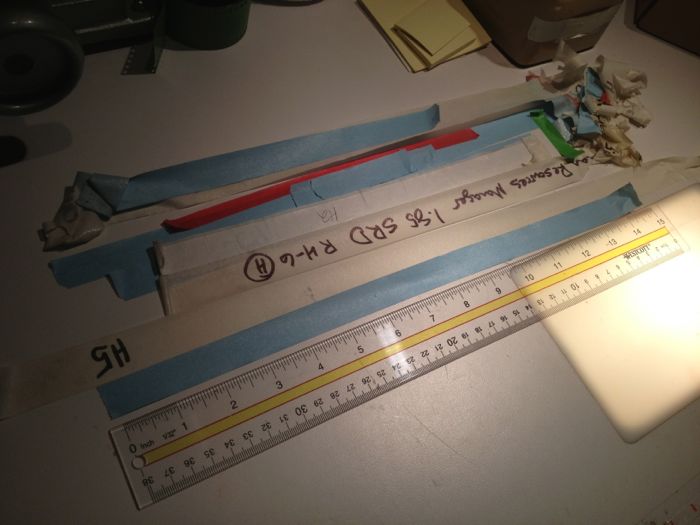
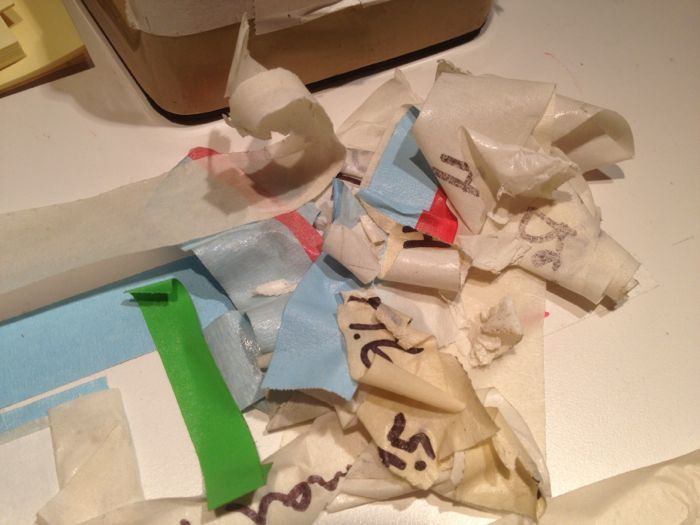
And all that tape did nothing to prevent two out of six reels from unspooling in the cans.
Here's what happens when you try to remove masking tape:
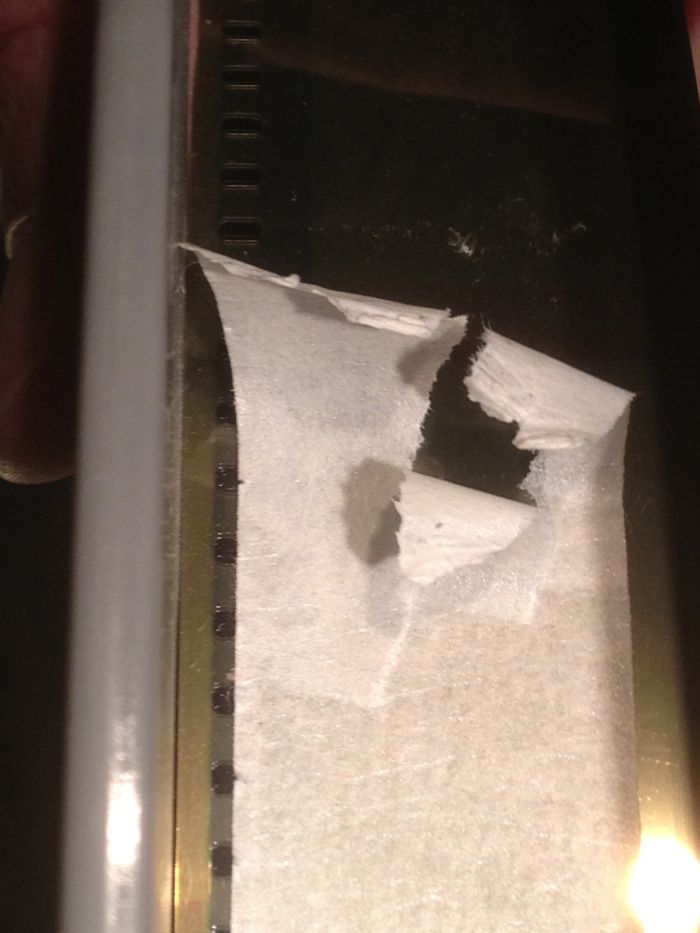
All too often, it comes off in shreds, and leaves adhesive behind. Lengthy (stupid) love notes leave a lot of adhesive behind. And that adhesive starts collecting dirt, which then migrates into the reel.
So here's a tip: If you really love film so much, don't use masking tape on it.
Posted by Justin West (Member # 920) on 03-10-2013, 11:42 AM:
quote: Brent Francis
Also, spare a thought for us lab people who were caught in the middle between a desire for the best picture possible and the bottom line. As production got less, it cost more to replace prints. (Losing 1 in a 200 print run is OK. In a 5 print run...). Ditto replacing equipment.
People did care. And DO. But ultimately, it's a business.. run like any other business in this 21st century.
Brent: I hear you, this changeover is costing a lot of people their "career" jobs. Not only projectionists but the folks who manufacture film, process film, print it, warehouse it, deliver it, run it, and so on. As the demand for film drops, the pressure is on for the companies involved to cut costs and cutting labor is a savings...but quality suffers as a result as the few people who remain must pick up the slack. I don't blame you for the losses in quality control, management and the almighty dollar are forcing your hand. I'm sure the studios and their reduced orders are forcing the labs' and distributors' hands. We are witnessing the death throes of 35mm...and it is not pretty.
Posted by Michael Kurtzke (Member # 7512) on 03-11-2013, 04:15 AM:
quote: Connor Wilson
Um. The DCP of "Lincoln" was actually in 4K, as you can tell in this thread. The film was shot in 3-perf Super 35, which is nowhere near as detailed as anamorphic 35mm and looked somewhat better than the 4K DCP of the digitally-shot "Skyfall" (even though I watched "Lincoln" on a smaller screen). No aliasing I remember, as this was a clean presentation in Barco 4K and Dolby 7.1 at the Cobb Village 12, auditorium #2.
Connor,
I've worked at Cobb Village 12 since the day it opened, and actually there are no 4K projectors in that building. In Auditorium #2, you have a BARCO 2k-12C and 5.1 audio. Even though the Amps were wired up for 7.1, our QSC sound processors only handle 5.1
Posted by Connor Wilson (Member # 6088) on 03-14-2013, 09:42 PM:
I was told by one of the ticket takers that the VIP auditoriums have 4K projectors, at least 4K upgradable. I did notice something weird about auditorium #2. There were only two speakers on the back wall, not the usual four or five, so to be honest, I wasn't sure if it was a 7.1 presentation.
But I DEFINATLEY heard 7.1 at the Cobb Village 12. When "The Adventures of Tintin" played in auditorium #1, it was most certainly 7.1. Sounds were coming four directions at me. Also, "Wreck-It Ralph" in auditorium #8 had that rich sound directionality 7.1 can only provide. The difference was that the former used the back surrounds aggressively, while the latter was more conservative. So I can assure you 7.1 is in at least some auditoriums at the Village 12.
I'm planning to get a job at the Village 12 someday. Kind of a bummer to hear no sight of 4K, but those 2K projectors are some of the best in the market. Beats Sony in the polarized 3D department.
Powered by Infopop Corporation
UBB.classicTM
6.3.1.2