This is topic Is the end of 35mm closer than I think? in forum Film Handlers' Forum at Film-Tech Forum ARCHIVE.
To visit this topic, use this URL:
https://ft-forum.com/ft/cgi-bin/ubb/ultimatebb.cgi?ubb=get_topic;f=1;t=011408
Posted by Terry Lynn-Stevens (Member # 7349) on 03-26-2013, 03:06 PM:
I wondering if anyone can give me some information on the end of 35mm. We still run 35mm but have been told that the end is coming in the summer of 2013, we initially were under the impression that 2015 is when film would end.
We also were told that by the end of 2013 is the best possible forecast.
Does anyone have some concrete information?
Posted by Martin McCaffery (Member # 37) on 03-26-2013, 03:22 PM:
There is no fixed date, but Fox has made noises that the end of 2013 is the end of film for them. Others will follow soon enough.
The small art distribs that I usually work with are going DCP/BluRay now, simply because they cannot afford dual inventory. We are still film, but have a Kickstarter campaign going right now to get the money to add digital (shameless plug: http://kck.st/139WF5V ).
There will be archival film around for years, but that may not be relevant to your theatre.
Posted by Carsten Kurz (Member # 5396) on 03-26-2013, 05:04 PM:
I don't know for the Americas, but for Europe, end of 2013 is my best guess. It's already tough to get 35mm in decent time here. A lot of the smaller cinemas are now installing the cheaper S2k and Sony machines, with or without public funding.
Within 6-9 months, most mainstream content will have no 35mm distribution anymore.
- Carsten
Posted by Dave Rodriguez (Member # 7476) on 03-26-2013, 05:40 PM:
I've heard 2013 as the "end of days" for 35mm distribution for a while now, at least with regard to first-run, mainstream releases.
May Haduong of the Academy Film Archive wrote an excellent article in the Fall 2012 issue of THE MOVING IMAGE which gives a rather comprehensive "state of union" with regard to print accessibility in the foreseeable future. See below for the link on JSTOR...
http://www.jstor.org/discover/10.5749/movingimage.12.2.0148?uid=3739832&uid=2&uid=4&uid=3739256&sid=21102048286777
Posted by Mike Blakesley (Member # 26) on 03-26-2013, 06:49 PM:
I had an interesting conversation with our booker today. He told me that a client of his, which still runs 35mm and plans to close when the "end" comes, was going to be charged $400 flat to play a three-day weekend run of a relatively recent flop movie. The same title on DCP would have been $250. Their reasoning was that there is a "fuel surcharge" on the heavier 35mm print. (Which makes zero sense since the theater pays all shipping charges.)
So it looks like predictions about film prints getting more expensive as they get rarer are coming true.
Posted by Leo Enticknap (Member # 534) on 03-26-2013, 07:38 PM:
Long-ish post alert - sorry.
quote: Dave Rodriguez
May Haduong of the Academy Film Archive wrote an excellent article in the Fall 2012 issue of THE MOVING IMAGE which gives a rather comprehensive "state of union"...
While her survey results were interesting and give us a useful take on what the arthouse/rep theatre sector and the managers of some of the major circulating collections believe is going to happen and when, my gut feeling is that not including technology vendors, maintainers and labs in her survey was a significant flaw.
AFAIK, Kinoton is now the only major film projector manufacturer that is still providing full-scale service and support backup for its machines in the field, and even then not for all of them. What the rep theatre programmers (and, I suspect, some archive access officers) aren't taking into account, is that once the parts and expertise needed to keep your film projectors and associated audio A-chains operational are no longer easily available, that's going to be an added pressure.
Furthermore, I only have anecdotal evidence for this (which is why it would have been great if May could have included the lab sector in her survey), but I get the impression that there is a widespread belief among the archival community that film stock and the lab services neeeded to use it will always be available, but just at a higher price as the economies of scale turn in the wrong direction.
An informal experts' working group that the British Film Institute put together last year to develop their archival strategy for the post-film (as a mainstream technology) era concluded that, as far as it's possible to speculate, it probably will be possible to continue black-and-white film manufacture and processing as a small-scale boutique operation, but not colour: the chemistry of dye coupler stocks is just too difficult and complex to be viable for the size of market that archives, rep exhibitors and still photographers who still want to use film for artistic reasons would represent.
Support for this position can be found in this article, written by a curator in a major London art gallery. The author visited the OrWo factory, and asked their CEO how likely they would be to restart dye coupler colour film manufacture if and when Kodak quit the business. His reply:
quote:
If you are able to produce an order for an amount over the size of two football fields (120 m long and 90 m wide) and have 2 Million Euros to spare for testing and are able to give us 2 years’ notice, we could look into this further.
So my contribution to this crystal ball-gazing is that when the end of (colour, at any rate) film finally comes, it won't be because archivists and rep programmers decide to abandon it, or because you can no longer buy replacement pressure plates for your FP-30 etc. It'll be because Kodak announces that they're no longer going to make motion picture colour film stock (they are now the only remaining manufacturer of it in the world, after Fuji announced the discontinuation of all its motion picture stocks except a fine grain b/w one used for preservation seps), or the chemistry needed to process it, anymore. We know that the situation at Kodak is not good: from the analyses that Jim Lindner has been posting on the AMIA list, it's clear that they're still making a substantial operational loss, are burning through their remaining capital reserves, that the restructuring to date has not turned the company around and the numebrs suggest that they're nowhere nearer to exiting Chapter 11.
Sorry to sound so negative (excuse the pun!), but I fear that within 2-3 years at most, the last colour release prints will probably have been struck. Obviously for mainstream commercial theatres, all the signs are that this moment will be a lot sooner.
Posted by Scott Norwood (Member # 30) on 03-26-2013, 09:56 PM:
Is there any economy of scale with B&W motion-picture film and lab services now? Outside of the occasional wide-ish release print order, I would think that most B&W motion-picture stock is currently being used for archival storage purposes, anyway. It would not surprise me if more square feet of B&W film are being used for still photography than for motion-picture work every year. I suspect that the situation is quite the opposite for color. Does anyone know the real story here?
Would anyone be surprised if Kodak raises prices after Fuji exits the motion-picture business at the end of the week?
Posted by Paul H. Rayton (Member # 1817) on 03-27-2013, 01:28 AM:
Two times now we have been sent a print of a classic movie, originally made in b/w, but now supplied to us on color (2383) stock. Just this week, it was "The Wages Of Fear", from 1953. A few months ago, it was "Marty" (1955). In the latter case, the print was rather milky-looking and, IMHO a disgrace -- esp. for a film that actually was nominated for an Oscar for best cinematography.
I'm guessing that, while b/w stock may still be available, the cost of making a print on such film is higher than going to color stock. After all, there's got to be less [expensive] silver in the color stock, for one thing. Does such a print do justice to the original cinematography? Well, no, but such minor details don't seem to matter in the current world of exhibition.
It's a film print, dammit, what more do you want? Shut up and stop fussing about "quality". Sheeeesh!
Posted by Justin Hamaker (Member # 2165) on 03-27-2013, 03:16 AM:
I haven't posted here for while, but I'll weigh in with what I know.
1. I have sat in on conference calls with NATO, Cinedigm, and the CBG about various digital issues. Although no one had an official answer when the question was posed, John Fithian says his conversations with various studio people lead him to believe it will be the end of 2013.
2. I have heard from various sources that it's come to the point where most everyone is waiting for someone else to be the first to do a digital only release on a wide release. My gut tells me we will first see it on something that breaks in 1600-1800 theatres, rather than a tent pole release.
3. I have a discount theatre near me which is still running 35mm. In the past they have typically opened a movie the Friday after it comes off my screens. Over the last few months it has become increasingly common for them to be opening more like a week or two after it comes off my screens. And they don't always get pictures you would expect them to play. Although anecdotal, this suggests they are having a more difficult time getting prints.
If my understanding is correct, the industry is at about 85-90% of US screens being digital, and that represents well over 90% of the gross. I have to imagine it's getting very close to the point where film prints just aren't viable because they can't generate enough gross to justify the expense.
Posted by Jure Maticic (Member # 7197) on 03-27-2013, 03:44 AM:
Well, our distributors have a clear answer for this one: last 35mm orders are being made by the end of this month. Then 35mm is over. The stock may last us till autumn, perhaps till the end of 2013, but after that the cinemas not converting to digital might as well close .... or run archival material.
This is all happening a little faster then I anticipated, but I suppose in mid 2012 one could see this coming.
Jure
Posted by Louis Bornwasser (Member # 3063) on 03-27-2013, 05:07 AM:
Boy, talk about saying everything but the obvious. . . . be careful about quoting Fiithian, he has multiple vested interests.
2013 is safe, officially in the USA. After that, no guarantees. What we are seeing here is a high stakes game of chicken. Louis
Posted by Leo Enticknap (Member # 534) on 03-27-2013, 11:46 AM:
quote: Justin Hamaker
I have heard from various sources that it's come to the point where most everyone is waiting for someone else to be the first to do a digital only release on a wide release. My gut tells me we will first see it on something that breaks in 1600-1800 theatres, rather than a tent pole release.
quote: Louis Bornwasser
What we are seeing here is a high stakes game of chicken.
Interesting. So basically, the mainstream distributors are biding their time until a high enough proportion of theatres have gone digital that they can cut the remainder loose without a significant dent in their bottom line.
When this happens, I can see cash-strapped theatres developing low cost, low quality DIY alternatives to a full-scale 2K or 4K projector, which down-rez the picture and squash the colour space considerably from the DCI specs. For example, there is now a software package that will play encrypted DCPs on a Windows PC (Fraunhofer Easy DCP Player) - that, plus a fast enough computer and a classroom/boardroom XGA projector can be had for ten grand or so. That won't exactly be a step forward from 35mm in the viewing experience for the customers of these theatres, but it'll be better than closure, I guess.
quote: Scott Norwood
Is there any economy of scale with B&W motion-picture film and lab services now? Outside of the occasional wide-ish release print order, I would think that most B&W motion-picture stock is currently being used for archival storage purposes, anyway.
Good point, and reinforced by the fact that Kodak have discountinued or put on special order several b/w lines in recent years. The current state of play is that 5366 and 5324 (b/w fine grain intermediate neg and pos), and 2302/5302/7302 (b/w print) are still officially available as items from stock, but I've heard anecdotally that orders for 5222/7222 (b/w camera negative - their last remaining line) can now involve a significant wait time. If true, this would suggest that archives are now the only remaining buyer of b/w motion picture stock in significant quantities.
quote: Paul H. Rayton
I'm guessing that, while b/w stock may still be available, the cost of making a print on such film is higher than going to color stock. After all, there's got to be less [expensive] silver in the color stock, for one thing. Does such a print do justice to the original cinematography? Well, no, but such minor details don't seem to matter in the current world of exhibition.
One thing that occurs to me is the sound issue. Paul's print of The Wages of Fear (he very kindly showed me a reel on a recent visit to the Egyptian) had a cyan track on it. Could it be that Janus made the decision to print on colour because so many theatres now have laser or red LED readers, that compatibility with them was considered more important than the authentic monochrome look? But yes, cost could be an issue. Not only because of the silver, but because very few labs now process b/w at all (in the US, Film Technology Co. in Hollywood, and two or three independent labs on the East Coast, plus the in-house lab at George Eastman House are the only ones I can think of, plus PresTech and the BFI's lab in London), and their price per foot is probably a lot more for b/w now, to reflect the set-up time, chemistry mixing and so on.
Posted by Louis Bornwasser (Member # 3063) on 03-27-2013, 11:50 AM:
I recall an announcement some time ago where Eastman was no longer going to STOCK b&w. Note that this does not mean it is unavailable; but just has a lead time. Reason given is that stocks time limit expired.
Likewise, the printers are no doubt set up for color stock. Louis
Posted by Paul Gordon (Member # 3320) on 03-27-2013, 03:29 PM:
News to use. We are still buying black and white poly dupe, print and FGMP film from Kodak. They also keep telling us they have millions of feet of the stuff in stock and will make millions more.
quote: Louis Bornwasser
I recall an announcement some time ago where Eastman was no longer going to STOCK b&w. Note that this does not mean it is unavailable; but just has a lead time. Reason given is that stocks time limit expired.
Posted by Carsten Kurz (Member # 5396) on 03-28-2013, 03:48 PM:
quote: Leo Enticknap
When this happens, I can see cash-strapped theatres developing low cost, low quality DIY alternatives to a full-scale 2K or 4K projector, which down-rez the picture and squash the colour space considerably from the DCI specs. For example, there is now a software package that will play encrypted DCPs on a Windows PC (Fraunhofer Easy DCP Player) - that, plus a fast enough computer and a classroom/boardroom XGA projector can be had for ten grand or so. That won't exactly be a step forward from 35mm in the viewing experience for the customers of these theatres, but it'll be better than closure, I guess.
Leo - I think you have it wrong. These softwareplayers are able to play encrypted content IF the key is available. They can not 'crack' encrypted content. But they will not get keys for content to play on these software players - with some very few exceptions (some few arthouse features actually come unencrypted). A softwareplayer is not DCI compliant, hence the distributors will not issue KDMs for them.
Whatever, no independet cinema can survive on that supply. They will more likely reside on DVD and BluRay.
- Carsten
Posted by Leo Enticknap (Member # 534) on 03-28-2013, 05:47 PM:
Do distributors actually ask you what sort of server hardware you're using before issuing a KDM? If so, sorry - didn't know that.
Posted by Bajsic Bojan (Member # 4928) on 03-28-2013, 05:53 PM:
If you want a valid KDM, you have to supply the distributor your server make and serial number, as per DCI specs.
One cannot make a KDM for a DCP CPL without knowing on which server (or IMB) that specific CPL will play.
Posted by Justin Hamaker (Member # 2165) on 03-28-2013, 06:44 PM:
Just to add to Bajsic Bojan's post, the studios will issue one KDM per auditorium for each version of the content. It gets a little confusing when you have something like The Croods, which has about 16 different CPLs. (2D, 2DCC, 2DOC, 2D_7.1, 2D_7.1_CC, 2D_7.1_OC, 3D_3.5FL, 3D_3.5FL_7.1, 3D_6FL, 3D_6FL_7.1, etc).
Posted by Jock Blakley (Member # 6552) on 03-28-2013, 10:22 PM:
quote: Leo Enticknap
because very few labs now process b/w at all
A lot of our recent B&W prints have come from Eclair and LTC St Cloud. Do you happen to know if they still do B&W?
Posted by Scott Norwood (Member # 30) on 03-28-2013, 11:09 PM:
Add Alpha Cine to the list of labs that can do B&W. They do excellent work.
Posted by Leo Enticknap (Member # 534) on 03-30-2013, 12:15 PM:
quote: Jock Blakley
A lot of our recent B&W prints have come from Eclair and LTC St Cloud. Do you happen to know if they still do B&W?
Are they genuine b/w prints or a monochrome image on colour stock?
Eclair's website doesn't say specifically if it offers a b/w service, but it looks like their site hasn't been updated for nine years (copyright notice at the bottom), and therefore I'd be very surprised if they still offer the full range of photochemical services (especially 16mm) that the site says that they do.
I can't find a website for LTC at all (I tried Googling 'laboratoires LTC Paris' and 'LTC film lab Paris'), and according to IMDB, their last production credit was in 2008. This leads me to wonder if they're still in business. Are the LTC prints you've been showing of recent titles (or re-releases)?
Thanks to others for info on KDMs. I do wonder if distributors will come under pressure from smaller, indie theatres looking to use cheap, sub-DCI solutions once 35mm is no longer an option to issue KDMs that will work with those solutions, though, or even if some third party vendor will produce software that enables a cheap computer to mimic a DCI-compliant server in order to trick the KDM into working.
Posted by Christian Appelt (Member # 1067) on 03-30-2013, 06:28 PM:
Unfortunately, L.T.C. seems to have gone out of business some time ago:
LTC liquidation
Very sad because they turned out quality prints, I get to handle one almost every week. As for black & white, there are more labs in Europe that will handle it:
- ANDEC of Berlin (8, 16, 35mm color and b&w), additional services for small format like cleaning and magnetic striping, even wet-gate (!) printing Super 8 color negatives to positive.
- TF CINENOVA GmbH of Wiesbaden (formerly ABC TaunusFilm), they have great experience in handling restoration and protection work, just added Digital lab services;
- CINEPOSTPRODUCTION GEYER BERLIN, the oldest German film lab founded in 1908, AFAIK also does b&w work.
- FILM 16 near Munich, a small lab owned by Helmut Rings, still does optical work like S16 blowup and specializes in ORWO b&w printing and duplicating work;
- LISTO FILM, Vienna seems to do photochemical work, too.
- So does EGLI FILM LAB of Zurich
- And there is of course ARRI LAB, Munich, that offers full service.
This is just for the German speaking territories, there are other European labs specializing in certain types of work, for example the French CINEDIA GROUP, Paris, handles not only 35 and 16mm, but even 9,5mm and Super 8.
Posted by Jock Blakley (Member # 6552) on 03-30-2013, 06:34 PM:
Re-releases on genuine B&W in both cases. Now you mention it it's been some years since we had an LTC print, but I seem to recall the most recent Eclair print was only three or so years back.
Thanks for the info Leo.
Posted by Leo Enticknap (Member # 534) on 03-31-2013, 12:27 AM:
Many thanks for the info on the Paris labs, Christian.
quote: Christian Appelt
Unfortunately, L.T.C. seems to have gone out of business some time ago
...
Very sad because they turned out quality prints...
...and not least because LTC and Eclair were two iconic names in French film history - one or other of their logos can be seen on the credits of virtually every French arthouse classic, going back at least to the 1950s.
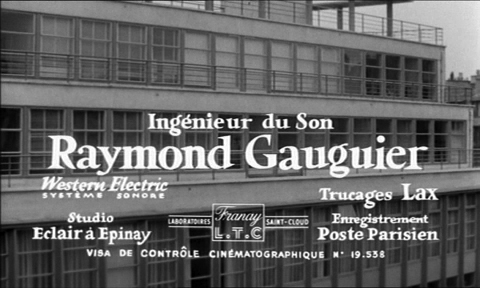
(From Ascenseur pour l'échafaud / Elevator to the Gallows)
Posted by Christian Appelt (Member # 1067) on 03-31-2013, 08:23 AM:
The lens manufacturer SATEC was also located at Saint Cloud, at 11, Rue Marius Franay (the guy who started this lab in 1935). In the 1950s SATEC made anamorphic lenses under the trade name DYALISCOPE which can be found in many credits of European films from the fifties and sixties. I recall some black & white Dyaliscope features in vintage prints that looked extremely sharp. Those lenses were used for decades on low budget films all over the world.
Marty Hart has a Dyaliscope promotional leaflet, on page three one can see the different converters and block anamorphics for Arriflex, Caméflex, Debrie and Mitchell cameras.
DyaliScope
Powered by Infopop Corporation
UBB.classicTM
6.3.1.2