This is topic Porthole for projection booth in forum Film Handlers' Forum at Film-Tech Forum ARCHIVE.
To visit this topic, use this URL:
https://ft-forum.com/ft/cgi-bin/ubb/ultimatebb.cgi?ubb=get_topic;f=1;t=011421
Posted by James Collins (Member # 7565) on 04-13-2013, 01:50 PM:
Hello,
I recently built a projection booth in my basement. I had a local carpenter build the booth. Its basically like a small closet in my basement.
I have a porthole in the front to project through and a side door for entrance.
Initally i had a glass door in the front. It was put in by a carpenter. And i would project through that. And it worked pretty good but it didnt look right so i had another carpenter sort of finish the booth off. One thing i should say this was a regular glass door, and it worked good with no reflections, if i remember correctly. He took out the glass door, put in a little square window to project out of and put the door on the side.
I like everything about the booth except when i turn my projector on i get a reflection on the back wall of the booth. Like when i turn the projector lamp on some of the light from the lamp was getting projected onto the back wall of my booth. There is actually two squares being projected onto the back of the booth. I think i get to square because i have two pieces of glass for my porthole.
Initially i had the glass straight. Because i thought i could angle the projector to supress light reflections. But when my carpenter had framed the glass and put it in i got reflections. I then had my carpenter take the porthole out. And when he framed it the second time he put the glass in at a 2 degree angle. Because i had read about angling the glass online. I had my carpenter fit the porthole in with out nailing it in so i could check the reflections.
I still got the two squares of light being projected on the back wall. And we tried putting the glass in so the angle angled toward my screen. Tried it angling toward the opposite way. And even tried increasing and decreasing the angle. Because the porthole hadn't been completely installed yet. But no matter what we did i still got reflections.
This was the second time my carpenter had put in the porthole. So i told him to just put the porthole in with the glass at a 2 degree angle.
So my questions are regarding the reflections on the inside of my booth. I wondered if it would effect my projected image, like i thought if part of the light from the projector is being reflected back as it goes through each panel of glass. Wouldnt at least the brightness of the projected image be affected? Would i run into focusing problem?. I showed a 16mm print through the porthole and it was hard to focus, but i dont know if that was because of the print.
I had bought the glass online from a computer optics company out in california. I payed about a $150.00 for two panes, at two different thicknesses. The guy i bought them from said the different thicknesses would help with sound proofing. The guy i bought the glass from new i wanted it for a projection booth. I believe it was white glass. I looked online and i think someone reccommended this company to me. But did i get the wrong glass. Like maybe it should be anti-reflective glass?
I thought about either living with the porthole how it is or having redone. But this would be the third time redoing it. One other reason i might have it redone is because i can't get to the glass to clean it. Like i can clean the inside and outside of the booth but not in the middle.
Anyway any info or help would be appreciated.
Posted by Rick Raskin (Member # 1561) on 04-13-2013, 02:30 PM:
I would angle a single pane of glass to the thickness of the wall (I assume 4" studs) and forget using a second pane. The top should be closer to the booth and the bottom closer to the viewing room. That will put the reflections on the floor.
Posted by Carsten Kurz (Member # 5396) on 04-13-2013, 02:38 PM:
You need antireflective glass. Any framing shop should be able to source it. It is used in 2mm gauge for professional, non-reflective frame surface glass.
Professional cinemas very often need fire protection glass - (e.g. Pyran). But for your private home cinema, normal antireflective glass without fire protective features is sufficient.
You will be surprised about the low amount of reflection with glass types like Amiran or Mirogard.
Please make clear you need glass with a antireflection COATING ('interference coating')- not surface etched/grated glass like on cheap antireflective frames. The latter also reduces reflection somewhat, but creates a very blurred image.
http://en.wikipedia.org/wiki/Anti-reflective_coating
I recently received a piece of high-class antireflective coated mirogard 17cm*12cm for around 15US$ incl. shipping from an internet framing service.
Putting it in at an angle is still useful to retain contrast and image sharpness - even the best antireflective glas will still create a reflection on the lens or the back of your booth - just a very dim one. With a non-angled port glas, you will have multiple reflections between port glas and lens, and reduced sharpness and contrast. Even a small angle will have it bounce out of the optical axis.
- Carsten
Posted by Joe Elliott (Member # 4006) on 04-13-2013, 02:42 PM:
Even with optical glass, with anti-reflective coating, the glass reflects some image. I was told the angle of the glass was primarily so that the reflection hits the floor, instead of the back wall. This is because in many booths you have projectors across from each other, and the reflection would shine out the opposing projectors port hole. For the most part, you can't get rid of the reflection.
Posted by Randy Stankey (Member # 64) on 04-13-2013, 02:43 PM:
You're always going to get some reflections. The trick is to adjust the glass so that they go somewhere that doesn't re-reflect back into the viewing area, preferably onto the floor or low on the wall behind the projector.
I've never seen a booth that didn't have at least a little bit of reflection unless there was no glass at all. If you want to keep the seating area free of noise from the booth you have to put glass in the port. The only compromise would be to make the port hole as small as possible.
Posted by Frank Angel (Member # 248) on 04-19-2013, 02:15 PM:
....and get the projector lens as close to the port glass as possible. Also, tilting the glass isn't only a matter of stopping reflections into the room, but to eliminate the possibility of the reflections bouncing back to hit the lens which can cause a secondary image on the screen. The lens and the port glass should never be parallel.
As has been said, you will always get reflections back into the room; in one of our locations, we needed to paint the back wall flat-black because the reflection hit the original light-colored wall and would actually bounce light off it and out into the theatre and impact the screen. That location unfortunately had no port but a full wall-to-wall window as the "port," AND it was not titlted -- very problematic. In that booth, ANY light at all in the booth would be "seen" by the screen, hence, painting everything black was necessary as well as the use only of little winkie lights rather than more normal booth lights.
Rule-of-thumb -- when you have the ability to design your booth from scratch (a great advantage), always construct the projection port to be ONLY as large as necessary to pass the pojection beam uninhibited. If you are faced with an existing port as most of us are, I have have been known to mask the existing port down with black poster-board to only slightly larger than the largest projection beam, i.e., the scope width and the 1.37 height.
Posted by Louis Bornwasser (Member # 3063) on 04-19-2013, 02:20 PM:
Love the poster board idea/Rechnicolor 3D.
We built a cinema of 8 screens in 1974. The booths were very tight. I decided to use the large window concept: 40"w x 28" high. The projector was positioned to allow access and then afterward, the light beam and the view port were marked. Masonite was cut to fit with the holes made 1" wider than the beam. Perfect. Painted both sides black. louis
Posted by James Collins (Member # 7565) on 07-25-2013, 11:40 AM:
Hello,
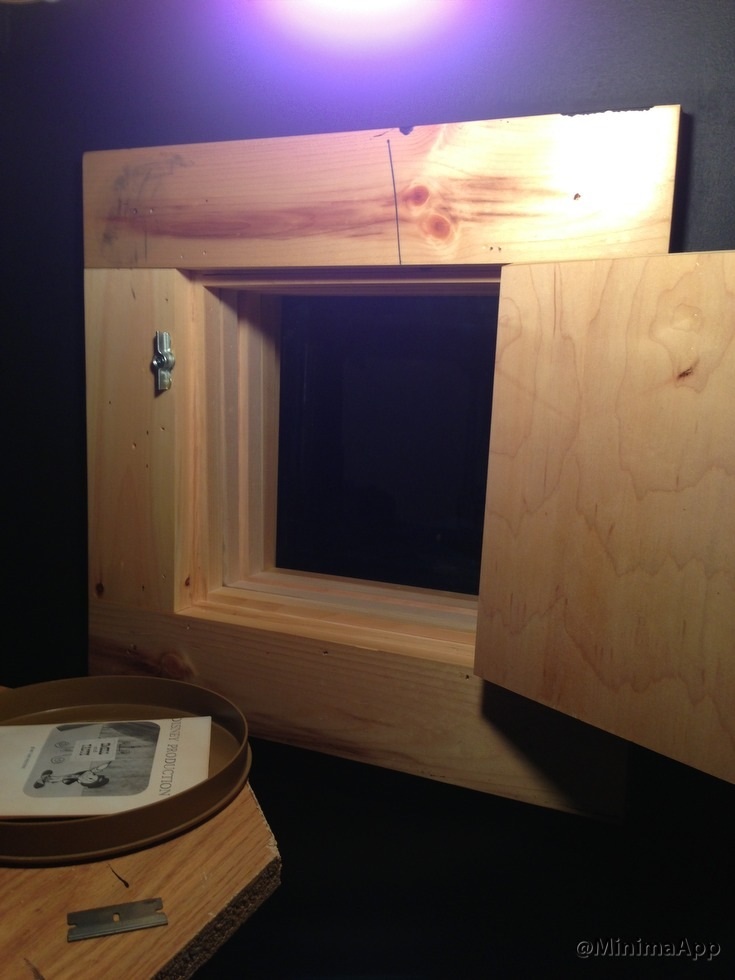
Just a follow up to my porthole questions. As my porthole is right now, i have no way to get to the inside of the glass to clean it.
I have a little door on the inside of the porthole that the wood do to humidity wont close. So i might have my carpenter adjust the wood and hinge. But i might have him redo the porthole so i would be able to get to the inside of the glass to clean it.
So i wondered is this very important. Like over months or years is it esential to be able to clean the glass. Or could i get by with just being able to clean the outside?
Also if i have it redone, could the carpenter make it sound proof by lets say framing the glass in rubber or some material to help with sound proofing?
Posted by Jay Glaus (Member # 6011) on 07-25-2013, 11:48 AM:
I agree with what everyone is saying, you'll still get a little reflection with AR glass, so I would paint the back wall flat black and that should ensure optimum picture quality.
Always thought of putting a theater set up in my basement, never got around to doing it yet though.
Posted by Marcel Birgelen (Member # 6801) on 07-25-2013, 12:22 PM:
If the space between the panes isn't perfectly isolated, dust and moisture might find its way in over the years, as it always does.
Why are you using two panes of glass if I may ask? Is it because of sound proofing? Wouldn't be a single pane of double glass be much better then?
Also, you sure want to put some isolation between the frame and the glass to avoid nasty vibrations.
There was a theater around here that was built back in the 70s. It had some badly isolated glass panes in the back of the auditorium. No idea what the deal was, but someone must have thought it was awesome back then. Besides creating nasty sound reflections, those glass panes also had the tendency to vibrate in their metal frames. You definitely want to avoid that.
Posted by Robert E. Allen (Member # 1351) on 07-25-2013, 01:03 PM:
In my 25 years in the business I have never worked a theatre that DIDN'T have reflections. I've had them on the back wall, on the floor and on the ceiling. What's the problem?
Posted by Marcel Birgelen (Member # 6801) on 07-25-2013, 01:24 PM:
quote: Robert E. Allen
In my 25 years in the business I have never worked a theatre that DIDN'T have reflections. I've had them on the back wall, on the floor and on the ceiling. What's the problem?
As long as they don't end up on your screen, there is no problem. Glass that's 100% transmissive and 0% reflective hasn't been invented yet.
Posted by Sam D. Chavez (Member # 1841) on 07-25-2013, 03:07 PM:
Double pane glass does not work well for ports as you get reflections between the sheets and you will have trouble controlling where the reflections end up. They need to be at an angle to each other. There is also the issue of coated glass. I've never seen it in double pane where all surfaces are coated.
Posted by Steve Guttag (Member # 268) on 07-25-2013, 10:17 PM:
All of our double-pain ports are coated on both sides of both pieces of glass. The glass is angled opposite form each other such that one reflects up, the other down to prevent re-reflection. We used them almost exclusively for film cinemas to keep the projector noise out of the theatres. For digital cinema...we are moving back to single panes. While a digital projector makes a bit of noise...it is a steady state noise that doesn't have splices and such causing changes and such (let alone a proper changeover booth).
Posted by Monte L Fullmer (Member # 2797) on 07-28-2013, 03:13 AM:
What I'm going to present here may seem rather odd, but I had no problems with the results:
At a six plex cinema that I used to work at, we had Kelmar port frames with the removable, port glass panes that had the magnetic striping around the glass to hold the pane within the framework of the port assembly.
If anybody had any experience with these Kelmar units, they are great, but something can go wrong when the glass falls out and shatters - like if someone throws something at the port window from inside of the auditorium, or the window just wasn't replace securely in the frame.
One day, the latter occurred when an employee decided to clean the glass and didn't get it back into the frame and hit the floor and shattered (regular temper pane glass being full of lead).
Thus, we had an open port to deal with with projector noise entering down into the auditorium.
What I did, to 'baffle' the noise from going out into the auditorium was to create such a baffle..a double baffle assembly.
I use sheets of cardboard that I cut out with the front baffle being the width of the scope image and the height of the flat image, and the inside baffle, which would be lot smaller that would mount on the inside part of the port assembly, was cut out just the width of the light image for both scope and flat.
With this home made sound baffle assembly, I was able to contain the machine noise within the booth and none was heard out in the auditorium.
I did get the window section replaced so I didn't need my baffle assembly, but kept these two pieces just in case another window gets broken.
-Monte
Posted by Rick Raskin (Member # 1561) on 07-28-2013, 03:47 PM:
I take it from the film can in pictured your latest post you are running 16mm. Unless your projector sounds like a rock crusher a single pane glass should suffice. Angle it towards the floor to redirect reflections and you are good to go. Anything else is overkill.
Posted by Gary A. Hoselton (Member # 3447) on 07-31-2013, 05:44 PM:
I agree, I've built my screening room with single pane of the 25mm (~1/4") thick coated glass from Germany via Los Angeles, angled down so reflection from screen will be absorbed by seatbacks. This puts booth-side reflection up on back wall which I painted flat medium gray, and that trivial reflection is absorbed in booth ceiling.
Determine port glass tilt angle by constructing elevation view along center line of room, showing projector lens and screen at actual heights and any inclination of screen from vertical. Then draw light reflection lines from top and bottom of image on screen back thru port glass to lens, and determine tilt of port glass so bottom screen reflection off of glass returns to below screen. In my room, tilt is about 5 degrees, but that depends on your screen height and throw.
Do not tilt glass up to put screen reflection on ceiling, as your audience will be looking up at image on ceiling rather than at screen and you will feel dumb.
Posted by Steve Guttag (Member # 268) on 08-01-2013, 06:41 AM:
25mm = 1/4-inch? Ummmmm....no. 25mm is nealy a full inch! 6mm is typically the 1/4" equivalent in glass.
Powered by Infopop Corporation
UBB.classicTM
6.3.1.2