This is topic Home theatre screen size and aspect ratio in forum Film Handlers' Forum at Film-Tech Forum ARCHIVE.
To visit this topic, use this URL:
https://ft-forum.com/ft/cgi-bin/ubb/ultimatebb.cgi?ubb=get_topic;f=1;t=011451
Posted by James Collins (Member # 7565) on 05-17-2013, 01:49 PM:
Hello,
In another thread i had asked about a screen for a basement home theatre.
In the other thread someone had suggested mdo plywood painted white, with a black border and a curtain as a screen. I have pretty much decided this is a good screen for me. And it fits my budget, i will be working with a carpenter.
I have a 16mm projector, super 8 projector and a regular 8 projector. I have started collecting prints mostly in 16mm. But i did buy some prints in super 8(i have a 200ft super 8 print of star wars.) I could see me buying more super 8 prints in the future. And i could see buying, lets say some cinemascope prints in the future. I also found some regular 8 footage, mostly from thrift stores. I also shoot my own home movies. I started out in super 8, for a couple of years. I got my fathers super 8 home movies. And even did a super 8 roll with a wild magnetic soundtarack. My super 8 projector has magnetic sound my 16mm has optical.
After shooting in super 8 for a couple of years, i got into 16mm to work with sync sound. I aquired some editing equipment for 16mm. But i was seeking advice on what size screen i should have for now and in the future. And how to go about actually measuring my screen size so i can talk to my carpenter?
I thought of threading up one of my 16mm prints in my projection booth. And projecting onto the wall were my screen will eventually go. I was then going to measure the projected image. I figured this would be a good guess at the actual screen size. I was going to compensate for the curtains( although i could put the curtains up so they open beyond the left and right borders of my screen). I realize the screen will be a permanent installation, so i want to get size and placement right before i go ahead and have my carpenter start making my screen.
I am looking at some motorized curtains that i will be able to operate from within my projection booth. The ones i am looking at come in varying sizes. And can be programmed for all the way open or all the way closed. From the other thread the guy was telling me i can also use the curtains to control the size of my screen. I talked to the company that sells the curtains, and the guy said i could take the curtains off, move some stoppers on the track, and thereby change were the curtains open to. I figured, lets say if i got a cinemascope print, i could ahead of time adjust the curtains to have them ready for showtime?
But i am looking for advice on screen size as it relates to aspect ratio. I figured a screen big enough so down the road if i needed more area would be good. But i wondered astecically if it would look ok to project an image that is smaller than the screen? Like even if i am using my super 8 projector the image area would be a lot smaller than 16mm right? I know i have used sheet rocked walls to project on for years and have been happy with the results. I wondered also, i think i can use my curtains to mask the screen right? But what about the upper and lower limits of the image and how they relate to aspect ratio?
Anyway any advice or info on screen size and aspect ratio would be great. And maybe some general ideas on how to go about actually measuring for my screen taking into acount the throw of my projector would be great.
Posted by Scott Norwood (Member # 30) on 05-17-2013, 02:29 PM:
Projected film normally has soft edges, as the edges of the aperture plate on the projector focus on a different plane from the image on the film itself.
The fix for this is to surround the projected image with black non-reflective masking material that just barely covers the soft edges of the picture. That gives the illusion of an image with sharp edges and the black material also increases the apparent contrast of the film image.
In cinemas, this is usually done with curtains. In your case, if you end up with a fixed 1.33:1 screen, you can just use black paint. Or use black paint for the top and bottom of the image and black curtains for the left and right edges if you want to be able to open up the masking for a Cinemascope print.
While "common height" masking systems are generally preferred, some cinemas reduce the height of the screen for Cinemascope films or do some combination of adjusting width and height to fit various picture formats.
Posted by Jack Theakston (Member # 4484) on 05-18-2013, 12:21 PM:
As mentioned here and in other threads, since you're running 16mm and theoretically running only two aspect ratios (1.33 and 2.66), a good compromise would be a screen that has a native ratio of about 2:1, so that you can use full height for 1.33 and full width for 'scope. Adjust with masking accordingly. As Scott pointed out, masking can be painted on or, preferably in my scenario, done with black cloth over a lumber frame
Posted by James Collins (Member # 7565) on 05-18-2013, 06:40 PM:
Jack,
Thanks for the reply.
Lets take cinemascope as an example. When people say they have a 'scope' print, does that mean cinemascope? Would a cinemascope print be the same height as a standard print, like would it be the same height as a standard 16mm print only wider? Because if that is the case i would have to figure out how much wider, make the screen that much wider, to compensate and then mask the screen for a standard 16mm print? I was planning on using mdo plywood painted white with a 2 inch black border and using my curtains to mask?
I did look up cinemascope on wikipedia, from wikipedia; Walt Disney's first animated feature to use CinemaScope was Lady and the Tramp in 1955. I looked at an old ebay auction of a print of lady and the tramp, in the description it called the print a scope print? I also remember reading about scope star wars prints? Are these cinemascope prints?
I know that the lady and the tramp print, i would have definaly been interested in. It went for like $200.00.
In another thread someone had mentioned scope, flat and academy. I am wondering are these the main aspect ratios, i would be concerned about, for my print collection? I am not concerned with odd ball prints like lets say super 16mm, although i dont know, i dont want to put down super 16mm. But am more concerned with the majority of prints out there now, like the 16mm prints i see on ebay?
Also a little off topic but if i bought a cinemascope print to show it on my projector, i would have to buy an anamorphic lens and take off the lens on my projector and then put on the anamorphic lens to show a cinemascope print? Is that correct?
Posted by Scott Norwood (Member # 30) on 05-18-2013, 07:02 PM:
The most common theatrical aspect ratios for 35mm are as follows:
1.33:1 full-aperture silent--no soundtrack on print
1.37:1 Academy
1.66:1 European flat widescreen
1.85:1 US flat widescreen
2.39:1 Cinemascope
A well-equipped cinema should be able to show any of these formats correctly. Changing formats typically requires changing some combination of masking, lenses, and aperture plates.
For 16mm, you generally have these formats:
1.33:1 "flat"
2.66:1 Cinemascope (aka "scope")
Almost every feature made before 1952 is 1.37 in 35mm, which is very close to 1.33 on 16mm. The widescreen formats were introduced in the 1950s as a response to television. Very few American feature films were made to be shown in the Academy ratio after about 1955. Television has always been 1.33:1 (the video people call it 4x3) until the last decade or so when HD became popular; now, HD television is 1.78:1 (video people call it 16x9).
Showing a scope print requires a regular spherical lens with an anamorphic adapter in front of it. The height of the picture stays the same, but the width doubles (unless you change the spherical lens, too). The image on the film is "squeezed" and the anamorphic projection lens "unsqueezes" it. Most 16mm projectors need a special bracket to hold the anamorphic lens.
Occasionally, you will run across a 16mm print that is "hard matted" (letterboxed) to 1.85 or 1.66, but that is rare.
Regarding nomenclature: "flat" refers to any format that is not anamorphic (picture on film looks "normal"--i.e. not squeezed); "anamporphic"/"scope"/"Cinemascope" all refer to the widest format, where the image on the film looks "squeezed" (i.e. people look tall and thin) and needs to be "unsqueezed" through the use of an anamorphic lens.
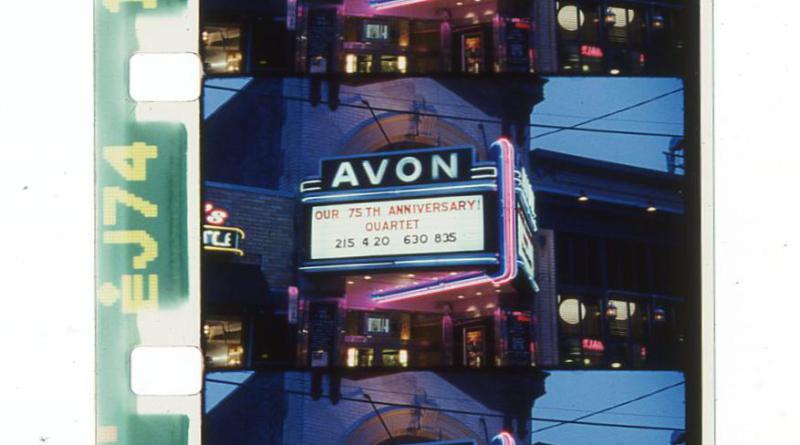
Super-16 is really just a camera format. It extends the image area into the space where the soundtrack would be on a 16mm print. This gives a wider image that is suitable for 35mm blowup or HD video transfer. Unless you are making your own films, you will likely never see a super-16 print, as there is no place left on the film to print the soundtrack.
edit: here is an example of a super-16 image; note how it extends almost to the far edge of the film and that there is no place for a soundtrack to be printed
Posted by Aaron Garman (Member # 1653) on 05-18-2013, 07:40 PM:
Why was 16mm scope 2.66?
I never knew that.
AJG
Posted by Jack Theakston (Member # 4484) on 05-18-2013, 07:45 PM:
Because there is no 1.37 in 16mm. The standard spec calls for a 1.33 aperture. So, with a 2x anamorphic squeeze: 2.66-1. Titles that were originally 2.35 are usually cropped a little top and bottom.
James: I see that you are in Lowville. My theater is in Rome: http://www.romecapitol.com. Drop by and I will be happy to give you a tour of how we do shows, multiple aspect ratios, etc.
Posted by James Collins (Member # 7565) on 05-18-2013, 08:26 PM:
Jack,
That sounds great. I would love to stop by.
Posted by Steve Guttag (Member # 268) on 05-18-2013, 08:41 PM:
Scott omitted the 1.75 but it was also popular with some studios.
IN-Flight (airpanes) used a special 16mm scope that used a 1.7 anamorphic (I believe it was 1.7...I'll have to check).
-Steve
Posted by James Collins (Member # 7565) on 05-22-2013, 09:06 AM:
Jack or anyone else who could answer this,
a good compromise would be a screen that has a native ratio of about 2:1, so that you can use full height for 1.33 and full width for 'scope.
If 'scope' is 2.66:1 wouldnt a screen that is 2:1 be not suitable for scope? Wouldnt there be a .66 overhang? Or am i missing something?
Posted by Jack Theakston (Member # 4484) on 05-22-2013, 12:04 PM:
quote: James Collins
If 'scope' is 2.66:1 wouldnt a screen that is 2:1 be not suitable for scope? Wouldnt there be a .66 overhang? Or am i missing something?
You mask on the top and bottom to 2.66 at full width for 'scope, and mask on the sides to 1.33-1 for that ratio. You'll need two different focal length lenses to pull this off, of course.
Posted by Frank Angel (Member # 248) on 05-31-2013, 01:08 PM:
James, you only touched on what would be the source of the films you will show in 16mm, and that would be the collectors' community, because the non-theatrical rental houses, have long abandoned renting 16mm prints. So the problem you will be up against would be, where to find prints to screen in your home theatre.
I am afraid you will discover that you won't find many anamorphic 16mm prints to show. Even when I was running a 16mm theatre venue in the 70s, which was the height of 16mm being rented from non-theatrically distribs like Films Inc., Audio Brandon, Twyman Films, etc., very few studios were supplying anamorphic prints for the non-theatrical market. The demand for anamorphic print, even back then was a relative niche market and a very small one compaired to the 16mm users who were showing films in dedicated theatre settings. The bulk of 16mm renters back then were schools and "shut-in" where the setups were temporary and not dedicated and were not outfitting their equipment to screen CinemaScope titles properly; the majority of the existing equipment in the field was set up to show standard prints with standard lenses and a standard "square" screen. Very few 16mm rental customers were equipped to utilize the full potential of the 16mm format.
I recall the many fights I had with the 16mm houses to get anamorphic prints. The 16mm renters had many more "converted" scope titles which were either TV pan & scanned versions (a horror) or a combination of side cropping plus letterboxing (usually to 1.85) into the 16mm 1.33 frame. I refused to play pan&scan prints they were so dreadful, but being able to get even a letterboxed 16mm print of a scope title was difficult. Seems the non-theatrical houses preferred to inventory more TV P&S prints than letterboxed prints.
So that history of the 16mm scope format translated today in 2013 into a harsh reality -- you will be very hard pressed to find 16mm anamorphic prints to screen. In the collectors community, they are highly coveted and don't come cheap. They also don't come with anything that passes for good color as most were printed on Eastman stock and are now all red. If 16mm anamorphic prints are rare, 16mm Technicolor anamorphic prints are even rarer.
16mm prints made with the Technicolor dye-transfer or imbibition process are the only ones that today, 40 years later, will have retained enough color that comes anywhere near what would be called acceptible. All the Eastman color prints will have lost the blue and yellow dyes with only the magenta layer remaining and will look beet red. You will be very lucky indeed if you are able to get your hands on all but a precious few anamorphic 16mm Technicolor prints. That given, my advise would be -- don't spend a lot of money and energy setting up an anamorphic lens rig and scope screen for your 16mm projector until you actually have access to actual anamorphic Technicolor 16mm prints. Get the print(s) first, THEN decide if it is worth the hassle of going scope.
My guess is, someplace along the line you will add a video projector to your setup and then a scope ratio screen would be needed, so if you want to start with a full scope screen, that would probably be a good idea, but I would wait on trying to obtain a used anamorphic lens and adaptor for the projector just yet -- they are a royal pain to Jerry-rig an adaptor if the model projector you already own wasn't designed to accept it's own adaptor, and second, again, I point to the scarcity of prints.
Posted by Simon Wyss (Member # 6218) on 06-02-2013, 02:34 AM:
James, movies and home movies have been shown and seen three-to-four since 1912, actually since 1909 when the industry adopted this aspect ratio and every private film show happened with projectors that complied with the standard.
Pathé’s 28,5mm Kok didn’t change that, nor the Pathé Baby 9,5mm system, nor any other film gauge initiative. 16mm, Double Eight-Regular 8, and Super-8/Single-8 are all 3:4. Wide screen presentation has been a professional thing until far into the 1970s. Amorphing ratio 2 reduction prints exist but the extra light the bigger screen demands might become a problem.
My suggestion is to prepare a board in the three-to-four format, painted white, hung up on black nylon threads or better still suspended from a wall like a basketball goal backboard. You project just slightly bigger onto it. A foot or two in front of the black hung wall makes the picture sort of levitate, a fantastic experience. One instantly is pulled into the action.
For wide-screen shows have a second board prepared in 1:2,35. That’s the COMOPT 35mm AR found with the vast majority of CinemaScope releases. Only the early CS COMMAG films were 1:2,55 on the screens. If a 16mm print bears the full 1:2,66 negative image (decompressed), you are free to decide what to do. Another board is not expensive.
The best and the most beautiful films were produced in 3:4, anyway.
At Sputnik cinema that I managed from 1992 to 1995 we had a white wall and the speakers on the sides, hidden in black painted wood panels. The interesting thing about the speakers is that they were of elliptical shape. I found them to perform superior to what I’ve heard from round ones.
I’m curious to learn which Regular-8 projector you have!
Posted by James Collins (Member # 7565) on 06-23-2013, 05:44 PM:
Frank and Simon thanks for the replies. Simon when i get home ill take a picture of my regular 8 projector.
Posted by Ed Inman (Member # 2583) on 06-23-2013, 07:48 PM:
There are actually several 16mm Scope prints on ebay right now including some James Bond films from the 80s. As late as 1997 October Films released 16mm Scope prints of "Lost Highway" and "Breaking The Waves." I was helping with a weekly 16mm film series and remember having to rent special lenses and build a new double-wide screen. Those were the last 16mm scope prints I ever saw.
Posted by James Collins (Member # 7565) on 06-24-2013, 10:50 AM:
Hello,
Thanks all for the replies. The way my basement and booth are layed out. Looks like i will concentrate my screen for flat prints.
I have a strucural beam in the way of having a wide screen. I could vear it to the right but it wouldnt look right. Anyway thanks for the info. I would buy a scope print just not maybe show on the screen i am having done. I know i would love to get the first three star wars films on 16mm, and i think i read online of them being out there in scope. I know i dont mind buying a film that has red shifted. Anyway thanks for the info.
Curious though, if i have my screen set up for a flat print. With or without masking can i still use my booth to show a scope print? Like if i didnt use my booth but wanted to show a scope print could i just move the projector closer and without masking show a scope print, if the screen is set up for flat? Like i said there is a structural pole that as far as i can tell limits my screen to the left? But by moving the projector closer or using a different focal length i could still show a scope print right?
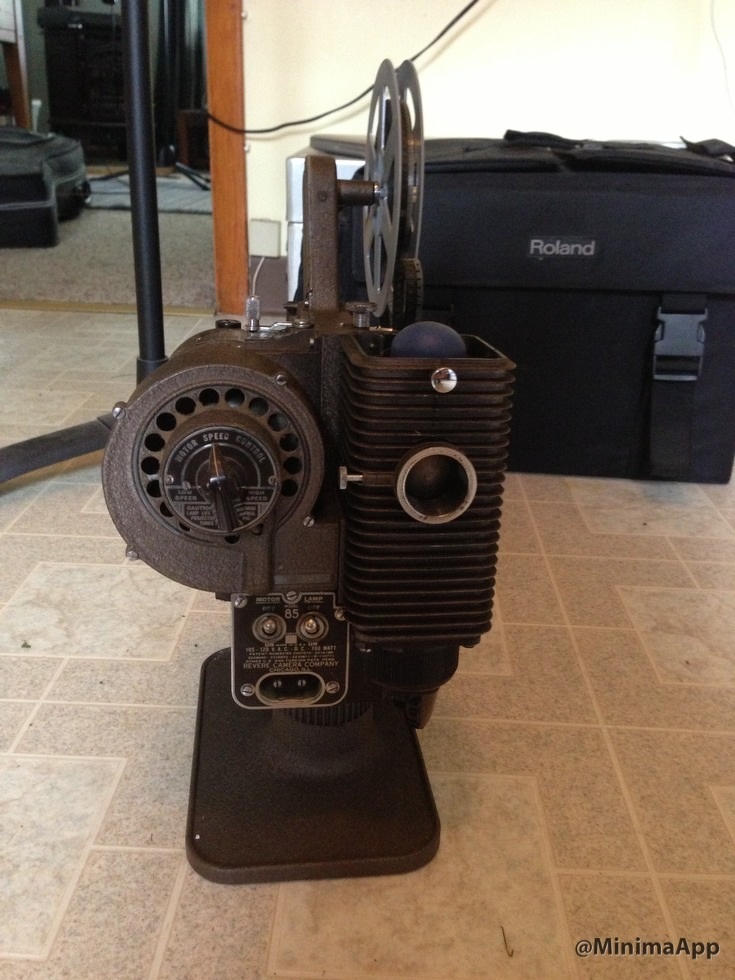
Anyway simon, i got out my regular 8 projector. It says revere camera company chicago. ill.
There isnt a model number, but it does say revere de luxe 8mm projector. There are also patent numbers i took some pictures i will post.
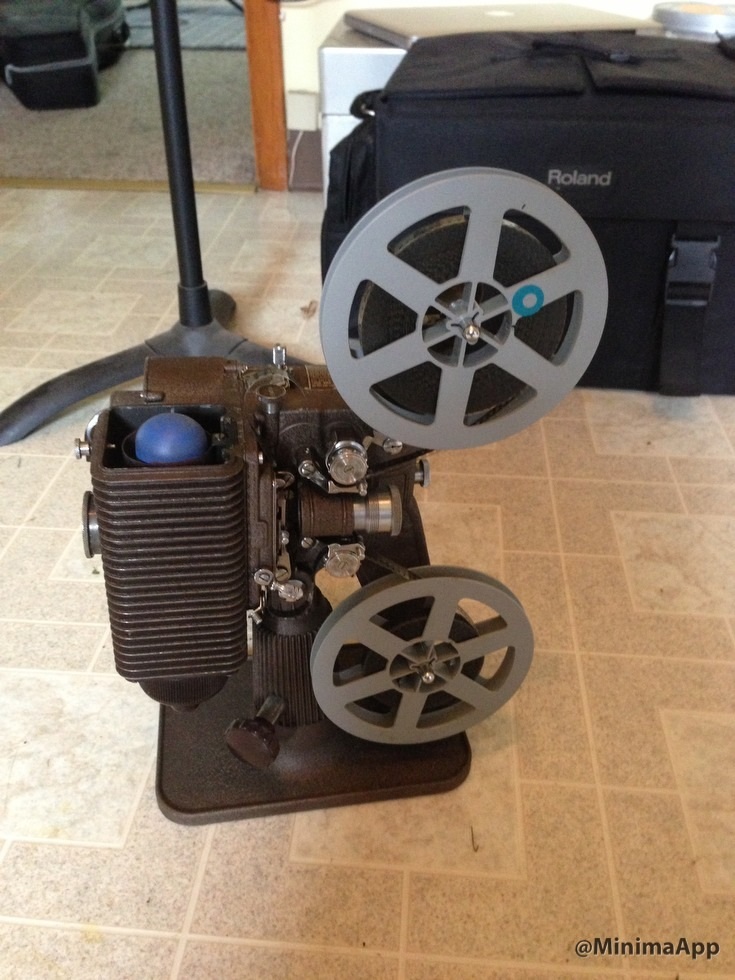
Posted by James Collins (Member # 7565) on 06-24-2013, 02:47 PM:
Simon,
I turned on my regular 8 projector, and the lamp was smoking and i think i threaded it wrong, one of the wheels wasn't turning?
Do u know what is wrong?
Posted by Jack Theakston (Member # 4484) on 06-24-2013, 02:59 PM:
More information? Which reel isn't moving and in what position?
Disassemble the backplate on the reel arms to make sure there is a pulley on both of them.
Posted by James Collins (Member # 7565) on 06-24-2013, 03:18 PM:
Jack, i adjusted the lower loop, went in forward it worked shown part of a cartoon. There is some hairs on the gate i think. Could use a cleaning.
Posted by John Wilson (Member # 269) on 07-02-2013, 02:03 AM:
Just took a look at 16mm features on eBay for the first time in years. Wow, the expected prices are rediculous. Unsurprisingly, most of them remain unsold at the end of the auction, including the aforementioned print of For Your Eyes Only that they wanted $975 for!!
Sheeeeeeeesh...
Powered by Infopop Corporation
UBB.classicTM
6.3.1.2