This is topic Norelco DP70 pressure roller in forum Film Handlers' Forum at Film-Tech Forum ARCHIVE.
To visit this topic, use this URL:
https://ft-forum.com/ft/cgi-bin/ubb/ultimatebb.cgi?ubb=get_topic;f=1;t=011452
Posted by Robert Sobin (Member # 7635) on 05-17-2013, 02:27 PM:
I acquired a Norelco DP70. By looking at the DP70 manuals on film-tech I noticed that the drawings show a pressure roller below the magnetic cluster, mounted on an arm assembly. When I began looking at mounting the magnetic cluster that I received with the projector, I noticed that the actual roller located where the pressure roller is located in the drawings, is not attached to an arm assembly. And it doesn't look like the pressure roller in the drawings. I have posted a picture below of my DP70. Is the roller in this picture an intended variation of what is shown in the manuals on film-tech for the pressure roller? My goal is to be able to use the magnetic sound head.
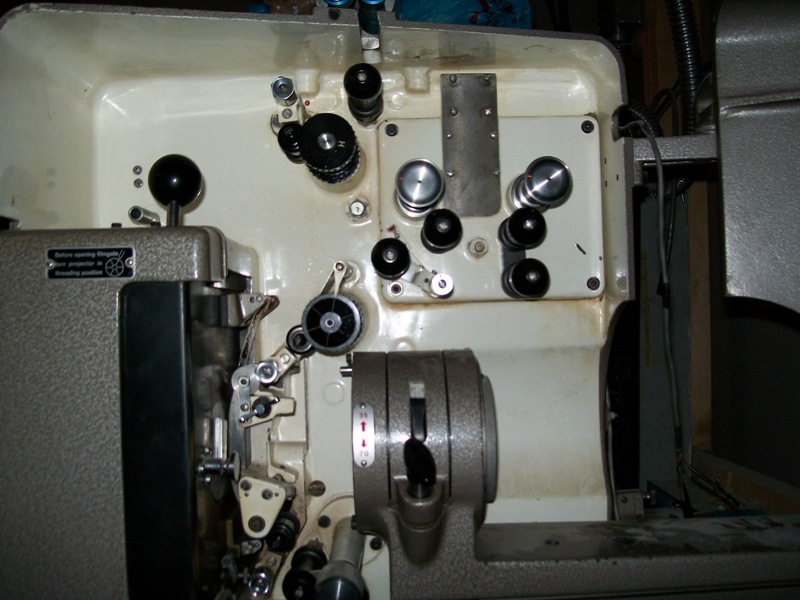
Posted by Dave Macaulay (Member # 813) on 05-17-2013, 03:20 PM:
I don't know the image you refer to, showing a pressure roller. But the DP70 has no pressure roller, nor can I imagine where one would go. The mag reader is a tight loop design, with the film in tension between the upper sprocket and the second sprocket. The mag head assembly (missing in your photo) has a socket for the actual head block, and a shielding cover with a slot the film goes through. There's no place for a pressure roller...? The rollers on either side of the head damp out any flutter.
Posted by Robert Sobin (Member # 7635) on 05-17-2013, 04:38 PM:
Dave,
I found an exploded view of the magnetic soundhead in the "Norelco AAII parts manual" in the warehouse. The view is on page 22 and is labeled figure 14. Please reference items 27 and 29 in this figure.
Posted by Scott Norwood (Member # 30) on 05-17-2013, 05:11 PM:
There _is_ a spring-loaded roller to maintain tension on the mag heads. Is that what you are thinking of here? It is #14 in the diagram that you reference and right next to #6 on page 29 of the installation and operation manual. It is the first roller in the film path after the upper feed sprocket. The idea is that the arrow (#6) should line up with the arrow on the casting to ensure proper tension and sound sync. The position of one of the arrows is adjustable depending upon the size of the auditorium.
Posted by Steve Guttag (Member # 268) on 05-17-2013, 05:22 PM:
The pinch roller for the magnetic soundhead was only used in the two earlier variants (only double-motor versions)...the pinch roller was replaced by a fixed roller in later versions and was offered as an upgrade to earlier versions.
Furthermore, the first generation also had a pressure assembly for holding the film on the heads...I don't know how long that was on the machines or if it ever really made it into the field but even the earliest machines I've dealt with had it removed so I've never seen it in the flesh. It was eliminated on the first addendum.
Posted by Robert Sobin (Member # 7635) on 05-18-2013, 01:16 PM:
Scott,
On page 29 of the installation and operation manual,the roller in question is #5, referred to on page 28 of the same manual as a "nylon pressure roller" in the itemized list.
Steve, that helps as I wasn't sure if I was missing any needed parts. Do you know if the fixed roller which replaced the pinch roller is intended to be used for both 35mm and 70mm applications?
Dave and Scott, thank you for your input as well.
Posted by Steve Guttag (Member # 268) on 05-18-2013, 05:07 PM:
Yes, the fixed roller is used for both. The pinch roller was deemed unnecessary and possibly could cause issues because Norelco used the same sized stabilizers and flywheels. As such, if you look at the film traveling over the heads, you will likely see bobble a little as the two stabilizers beat off of each other. A better design, used on the Century penthouse, is asymetric stabilizers and having lower mass on the leading stabilizer will cause the film to self-tension. In later Kinoton designs, one used 4 plates on the leading stabilizer, 6 plates on the output stabilizer.
In any event, not to worry, you have what you should have and the performance will be as good or better than the versions with the pinch roller.
Powered by Infopop Corporation
UBB.classicTM
6.3.1.2