This is topic Flat or 1.66 in forum Film Handlers' Forum at Film-Tech Forum ARCHIVE.
To visit this topic, use this URL:
https://ft-forum.com/ft/cgi-bin/ubb/ultimatebb.cgi?ubb=get_topic;f=1;t=011456
Posted by Terry Lynn-Stevens (Member # 7349) on 05-19-2013, 11:59 PM:
Can someone on here give me the rundown on my film print we ran tonight?
We ran the The Shining tonight in 35mm. The print turned red and was Eastman Kodak 19 I believe.
2. Anyways, we noticed it was not scope and no cropped flat. I looked like it was full frame flat. It worked perfect with our flat lense. Now was this 1.66 and if so, does anyone know if this was an American print or a print from Europe?
2. We ran the print in A-Chain and noticed that is was mono (which would be correct). Question is, was the tracks on the print stereo with just the recording on the center channel?
Posted by Monte L Fullmer (Member # 2797) on 05-20-2013, 12:26 AM:
1.66:1 comes from the cut opening of the aperture plate.
The film was full frame 1.37:1, which was great to use for 4:3 TV and/or video tape, or laserdisc releases of its day.
quote: Terry Lynn-Stevens
We ran the print in A-Chain
That'd be the tech's department where the "A chain" tests checks for optical alignment.
You would have set your processor for Dolby "A", format 04, but found out that it was a mono release why the sound came out of center channel only. There you should have set the processor to "Format 01 = mono"
Posted by Terry Lynn-Stevens (Member # 7349) on 05-20-2013, 12:32 AM:
Thanks Monte
So what we had was 1.37 full print? We used the 1.85 plate. We projected it 1.85...the image used the entire frame, there was no matting and from a distance, one would assume that it was a scope feature.
From what I understand, there are 1.66 prints in Europe.
Posted by Monte L Fullmer (Member # 2797) on 05-20-2013, 12:37 AM:
Negative ratio was the 1.37:1
European releases used the 1.66:1 projected image.
USA releases used the 1.85:1 projected image.
quote: Terry Lynn-Stevens
and from a distance, one would assume that it was a scope feature
If this was released as a scope feature, the full frame image would have been squeezed vertically with a 2.00:1 ratio.
Hope this helps. good luck-Monte
Posted by Terry Lynn-Stevens (Member # 7349) on 05-20-2013, 12:39 AM:
So this would of been a 1.66 print? I am confused because there was no matting however we ran it with the 1.85 aperture plate.
Does this make any sense?
Are there flat prints without matting?
Posted by Monte L Fullmer (Member # 2797) on 05-20-2013, 12:43 AM:
You mean "hard matting" on the frame itself - the black bars inbetwen each frame? Disney used the 1.66:1 hard matt on their flat film releases in the 80's and 90's.
When I ran this movie back in the '80's, we used the 1.85 aperture plate for presentation from a 1.37, full frame print.
Posted by Terry Lynn-Stevens (Member # 7349) on 05-20-2013, 12:46 AM:
There were no black bars on the print. So it makes sense now that you stated you had an full frame and projected it in 1.85.
Thanks Monte!
Posted by Randy Stankey (Member # 64) on 05-20-2013, 01:34 AM:
"Flat" basically refers to any movie print which is not anamorphic or Cinemascope. ("Scope.")
Anamporphic, Cinemascope lenses have the property of magnifying images horizontally and vertically at different ratios. "Flat" or "spherical" lenses magnify images horizontally and vertically the same way.
Therefore, 1.85, 1.66, 1.78 and 1.37 aspect ratios are all considered "flat" because they don't use an anamorphic lens.
The different flat formats usually require a specific combination of lens focal length and aperture plate but it is often possible to project one flat format through a different lens/aperture combination with little or no noticeable difference. However, you might run into an objectionable cropping or image "spillover" situation when you do this.
Complicating the matter is the fact that some prints are "hard matted" with black bars between the frames. The image area of the film frame is supposed to match closely with the aperture/lens in order to fit onto the screen with minimal spillover.
This is where the funkiness comes in.
If you project a print composed in one aspect ratio using a projector set up for another, often, what you will find is that you have to be careful to frame the image properly or else you will cut off the tops of the characters' heads and their feet. Other times, you might be able to see microphone booms in the picture where you shouldn't.
Now, if the print is hard matted and you project in the wrong aspect ratio, you might end up with black bars at the top and bottom of the picture. The movie will look like it's been letterboxed when it really isn't supposed to be.
The best solution is to have the correct lens and aperture plates to project each format of movie at the right aspect ratio. If you can't afford more than one lens, it is possible to cut aperture plates for the different movies using only one lens. The down side, here, is that, unless your screen has moveable masking, the picture might not fit. If you can't do either of those things, the only thing you can do is to watch the movie closely and carefully adjust the framing as well as you can so that heads and feet are not cut off or so that extraneous objects don't show on the screen when they shouldn't.
Movies should be marked with the right aspect ratio. Often, it is marked right on the leader but, just as often, it is not. Sometimes, you can look the movie up on IMDB.com or other places to find the aspect ratio but you can't always count on that. In the end, you just have to be on the lookout and be ready to make adjustments on the fly.
This is one reason why I always insisted on pre-screening movies before showing to the public. It gives you a chance to discover problems like this and come up with a solution if you can. If you can't do that, just stay close to the projector for the first showing and be ready to fix a problem if you have to.
Posted by Marcel Birgelen (Member # 6801) on 05-20-2013, 03:22 AM:
If the print was 4 perf full frame, the aspect ratio would've been 1.37 : 1 (full academy aperture). As far as I remember, Kubrick wanted most of the stuff shown in 1.85 : 1 in movie theaters and The Shining was composed for exactly that aspect ratio.
For example: If you do this correctly, the helicopter rotor blades and shadow in the opening shot, should not be visible (except for a few frames that crept in as a cutting error).
Posted by Monte L Fullmer (Member # 2797) on 05-20-2013, 04:07 AM:
I know that "A Clockwork Orange" was in 1.66:1 hard matt.
I didn't have to roll the FRAME knob too much to catch the hard matt edges on both top and bottom.
...and the same with his last movie, "Eyes Wide Shut" - was hard matted 1.66:1 and the same with the FRAME knob.
Posted by Leo Enticknap (Member # 534) on 05-20-2013, 04:31 AM:
The bottom line is that the matte (shape of the frame) on your actual print is not necessarily the one it is intended to be shown in. You will often find with 'flat' release prints that many shots have a 1.38 or even a full gate frame, but some processs shots (e.g. titles, dissolves, shots that incorporate CGI effects etc.) are matted to 1.85. That's because the movie was shot on a camera that had a a full aperture gate (because it's designed for use with flat and anamorphic lenses), and the shots that only needed timing in post-production were contact printed through every generation to the release print. The process shots, however, needed to be optically printed and/or have digital filmouts incorporated, and those introduced the matte of the actual ratio intended to be projected.
As others point out, if the aspect ratio the filmmakers want you to project it in isn't stated on the cans or leaders, it's either a case of trying to find it online, or making an educated guess. From the late '50s, Hollywood was using 1.85 pretty much exclusively. I can't think of any Hollywood movie that was actually intended to be projected in 1.66. 1.66 was used mainly, but not exclusively, in France.
Another complicating factor is that many features were made using the 'shoot to protect' technique. If, for example, you're shooting a movie that you know is going to be shown in theatres in the US, Europe and on television, you frame the action such that it can be shown in either 1.38 (without panning and scanning), 1.66 or 1.85 without the loss of vital action, even if you're framing for 1.85 looking its best. You're not going to be able to tell which just by examining the print.
Soundtracks:
quote: Terry Lynn-Stevens
We ran the print in A-Chain and noticed that is was mono (which would be correct). Question is, was the tracks on the print stereo with just the recording on the center channel?
I'm guessing you mean Dolby A-type?
You can tell whether a print is mono or SVA (stereo variable area) from a visual examination, but you can't distinguish between the different flavours of SVA. For example, this:
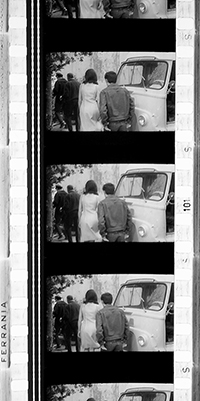
is a twin bilateral, optical mono track. Both of the two optical records are identical, and printing a mono track this way was invented in order to reduce noise compared to a single bilateral track (e.g. RCA Duplex). If you look through 10-20 feet of a typical print and the two tracks look consistently identical, it's mono.
This one...
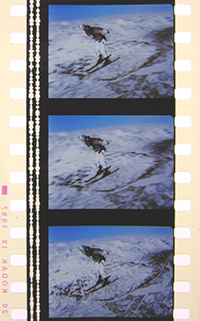
...is stereo - the two tracks clearly have a different signal on them. There's no way of telling whether they're A-type without surround, A-type with, SR, Ultra Stereo, DTS Stereo or whatever. Given that The Shining was made long before SR was launched in 1988, then if your print has a visibly stereo track on it, then it's almost certainly A-type with surround (04).
Posted by Michael Cornish (Member # 6529) on 05-20-2013, 08:24 AM:
Several years ago I was a projectionist for a local Rep. house and we ran Creep show. When I was inspecting it I noticed a printed note on all the leaders matted for 1:33:1 so I showed it in !;33. The manager asked why I did that,that his dad worked for Showcase and that they showed it in 1:85. Showcase couldn't show it in 1:33 unless it was a matted print. I showed him the notice on the print, but he made me switch it to 1:85 for the rest of our shows. I felt that the director wanted to give it the "old style" feeling that was the reason for the note on the leads. Anyones feeling on that?
Posted by Scott Norwood (Member # 30) on 05-20-2013, 08:28 AM:
I have always shown The Shining at 1.85. It looks fine in that format, no heads or titles are cut off, and there is no chance that lights or cables or other "undesirable" items may appear in the frame.
The prints that I have shown were all mono, although the DCP has a fake multichannel remix.
For a heated discussion, we could start debating the intended aspect ratio of Dr. Strangelove (which I have shown at 1.66).
Posted by Louis Bornwasser (Member # 3063) on 05-20-2013, 08:37 AM:
My dealings with the production side are that hard mattes are avoided unless there is something to hide: mikes, cables,etc. In that case, 1.85 matte is printed.
I have alsways loved 'scope. It avoids all of that since you need it all. Louis
Posted by Marcel Birgelen (Member # 6801) on 05-20-2013, 09:59 AM:
quote: Scott Norwood
For a heated discussion, we could start debating the intended aspect ratio of Dr. Strangelove (which I have shown at 1.66).
I guess 1.66 : 1 is correct. It's at least the conclusion of most debates about the subject. The 2009 Blu-Ray release also uses that same aspect ratio.
Posted by Mitchell Dvoskin (Member # 751) on 05-20-2013, 10:52 AM:
Many "flat" films are printed open mat, ie 1.37, however after 1954 they were not intended to be shown that way. They were intended to be cropped in the projector.
As to The Shining, the "recommended" aspect ratio was 1.66, but Kubrick knew that only a handful of theatres in the USA could show it that way, so the image was "protected" for 1.85 during filming.
Posted by Gordon McLeod (Member # 33) on 05-20-2013, 12:36 PM:
Hard printing a matte didnt become common lab practice until the late 70s by most labs
basically if it was made in us mainstream it would have been composed for 185:1 i have seen many examples of lights and mic booms dropping into the frame if shown with a larger plate
Posted by Sean Goodrich (Member # 475) on 05-20-2013, 03:33 PM:
The Shining is 1.85, protected for 4:3 so it could be shown open matte on television.
Here it is in Kurbick's own handwriting.
Posted by Leo Enticknap (Member # 534) on 05-20-2013, 03:50 PM:
Not meaning to split hairs, but does that sketch indicate that he actually wanted it to be projected in 1.85, or just that he knew that it would be in the majority of theatres whether he liked it or not, and was therefore indicating 1.85 protection on his storyboard of the shot and his written instructions on it?
By the late '70s / early '80s, how many theatres outside France would have the lenses and plates for 1.66? Apart from a smattering of well-equipped arthouse and rep venues, bugger all would be my guess. So even if he did have an artistic preference for 1.66 (I've just had a look at my BD of Grover Crisp's restoration of Dr. Strangelove, which is indeed matted to 1.66, but annoyingly it doesn't say anywhere on the packaging why Kubrick preferred the ratio - haven't had time to go through the making-of extras, though), he must have known that the movie was not going to be projected that way in 99 out of every 100 theatres it played in, and therefore designed the production accordingly.
If you raised the top line of the aperture on that drawing right to the top of the page, that would give you 1.66, more or less, and the line of the trees goes up to it.
Posted by Sean Goodrich (Member # 475) on 05-20-2013, 04:12 PM:
Here's what the notes say for this story board:
quote:
IGNORE WHAT LOOKS LIKE
A CENTRAL PATH JUST HAVE
THE SNOW SMOOTHLY AND
ROUNDLY CHANGE ITS DIRECTION
UP THE SLOPE AT ABOUT THE
POSITION OF WHAT IS
DRAWN AS A CENTRAL PATH
THE FRAME IS EXAXCTLY 1-1:85
Obviously you compose for that
but protect the full 1-1:33 area.
In order to accurately get the
central path curve, you have to
set up the shots and put stakes
in the ground so that the curve
as seen through the ground
glass corresponds to what is
drawn. THERE IS NO OTHER WAY
TO DO IT REPEAT NO OTHER
WAY exercise the greatest
care as the compositional
effect of a different path might
be BAD BAD BAD
MAKE SURE IT DOESN'T
WIND UP LOOKING LIKE
A SNOW PLOW DID IT
After you push the snow around
the wind and fresh snow fall
should keep it from looking plowed
I don't think there are many hairs to be split when he says "EXACTLY 1.85"
Then he talks about having the image through the ground glass (the frame ground into the camera's viewfinder) corresponds to the drawing, anything different would be "BAD BAD BAD".
Kubrick started out as a photographer for Look Magazine. He knew what he wanted, and how to talk to cameramen to get it.
Using his previous films' aspect ratios is not much proof. Most filmmakers aren't married to a single ratio.
Posted by Jason Metcalfe (Member # 5739) on 05-20-2013, 04:32 PM:
quote:
You can tell whether a print is mono or SVA (stereo variable area) from a visual examination, but you can't distinguish between the different flavours of SVA. For example, this:
I've found the best way to confirm mono from dolby-a is to look at the very very end of the credits for the "Dolby Stereo" logo (or SR or whatever). It's usually the last thing on there
Posted by Louis Bornwasser (Member # 3063) on 05-20-2013, 05:31 PM:
Problem is; there were mono prints made of Dolby Stereo films. Dolby visual is not a reliable indicator on 1976 to 1986 films. louis
Posted by Jack Theakston (Member # 4484) on 05-20-2013, 06:51 PM:
quote: Sean Goodrich
Using his previous films' aspect ratios is not much proof. Most filmmakers aren't married to a single ratio.
Correct, and the winning decision was usually who was putting up the money, not who was at the helm. By 1980, making a flat film in anything other than 1.85-1 would have been defeatist*.
Also, in the outtakes from the "Making of" documentary, the video assists are all marked off for 1.85.
*Yes, I'm aware Coppola shot ONE FROM THE HEART for 1.37, but the film flopped before it could even get a fair run, which I'm sure would have been pillerboxed in a 1.85 frame.
Posted by Steve Guttag (Member # 268) on 05-20-2013, 09:48 PM:
I know we've set up MANY theatres for 1.66. It was/is more prevalent than you might imagine. Those systems that had a 3rd lens (either in a turret or in a separate lens holder), the 3rd lens was most likely to be a 1.66...not a 1.37 (at least in the bulk of the theatres I worked/set up.
As for preference...1.66 is close to the "golden ratio" and seems to have the right mix of width/height for composing a shot. Personally, I prefer 1.66 to 1.85 too. Then again, I prefer 2.2 and wider most of all.
Posted by Manny Knowles (Member # 1171) on 05-20-2013, 10:10 PM:
FWIW the DCP of "The Shining" is 1.85.
Also, if the track is Center-Only (mono) that does not automatically mean that it is Format-01. It may need the noise reduction offered by Format 04 (Dolby-A) or 05 (Dolby-SR). It depends on how it was encoded. Sometimes this information is clearly marked on a print. Other times, you have to take the time to listen to it in each format and pick the one that sounds the best.
Muddying the waters somewhat further, I've run a number of movies that were released before the "Dolby era" but were re-released with new Dolby encoded soundtracks.
Also, the absence of a hard matte does not mean there aren't any mic's (or other "junk") in the full-frame image. I've seen many, many instances where the mic was allowed to drop into the full-frame area, just outside the projected area.
Posted by Monte L Fullmer (Member # 2797) on 05-20-2013, 10:17 PM:
My hometown theatre, being the Paramount Theatre - a 1100 seat single house palace, we could run all flat formats - from 1.37:1 to 2.00:1 due to the available side and top adjusting masking tabs.
Our default flat masking was 1.66:1
I even had 2.66:1 scope apertures for my XL's since we had magnetic sound - which was installed right after CinemaScope was introduced and Fox Intermountain, who was the owner of this palace, went all the way for anamorphic presentation. Thus installed a movable, curved silver screen (since we still used the stage), Altec A-4 speakers, full adjustable maskings, all Simplex magnetic sound system with XL-Deluxe setup.
Posted by Stephen Furley (Member # 1277) on 05-21-2013, 07:45 AM:
Who actually makes the decision as to what ratio a film will be composed for?
Posted by Marcel Birgelen (Member # 6801) on 05-21-2013, 07:48 AM:
quote: Stephen Furley
Who actually makes the decision as to what ratio a film will be composed for?
The one who is paying for it...
In reality, there is probably no single right answer.
Posted by John Wilson (Member # 269) on 05-21-2013, 08:31 AM:
I've played 'The Shining' in both 1.66 and 1.85 and 1.66 looks much better. I don't know why you would even think of running a 1980 film in 1.375.
Posted by Mitchell Dvoskin (Member # 751) on 05-21-2013, 08:59 AM:
> Who actually makes the decision as to what ratio a film will be composed for?
The director of photography, or possibly the producer.
> Who actually makes the decision as to what ratio will be recommended for a film.
For "flat" films in the 1950's and early 1960's, the studio marketing department. They did not always agree with the director.
> Who actually makes the decision as to what ratio a film will be shown.
In a theatre, the projectionist. For home video, the person who makes the master. In theory, both should follow the director's/studio's recommendation, but we all know that is not always the case.
Posted by Scott Norwood (Member # 30) on 05-21-2013, 09:45 AM:
Interesting point--theatres that converted to Cinemascope early may have only had one "flat widescreen" format before 1.85 and 1.66 were standardized.
The masking at the theatre where I worked when I was in college was configured in 1955 for 1.37, 1.75, and scope. It stayed that way until 1998, so 1.66 and 1.85 films both played at 1.75:1. I am sure that some theatres are still set up in an unusual configuration like this.
I seriously doubt that most American cinemas, with the exception of art and repertory houses that played foreign films regularly, would have made a distinction between 1.85 and 1.66 between about 1955 and 1980 or so. They would have played everything in whatever "flat widescreen" format they had. Obviously, this is not correct, but it would likely have been common practice.
As for mono vs. stereo--this should be marked in the soundtrack area on the leaders. Dolby prints should say "STEREO" for Dolby A or "STEREO SR" for Dolby SR. Mono prints should either say nothing or be marked "MONO." If there are no markings, then it should be easy enough to look at the track during the opening title or end credits (when there would likely be music in the soundtrack). As for distinguishing Dolby A from Dolby SR on a poorly marked print, I find it easiest just to listen to the sound. Dolby A (and mono) prints sound miserable when played in SR.
Posted by Jack Theakston (Member # 4484) on 05-21-2013, 11:16 AM:
I recommend a trip to Bob Furmanek's widescreen article for those who haven't read it:
http://www.3dfilmarchive.com/home/widescreen-documentation
The people who decided the aspect ratio of the film were the producers of the picture.
I reiterate, the monitors during the filming of THE SHINING were marked for 1.85-1.
quote: Scott Norwood
I seriously doubt that most American cinemas, with the exception of art and repertory houses that played foreign films regularly, would have made a distinction between 1.85 and 1.66 between about 1955 and 1980 or so. They would have played everything in whatever "flat widescreen" format they had. Obviously, this is not correct, but it would likely have been common practice.
Correct. Many places ran films at 2-1, with flat films being cropped top and bottom, and 'scope films with the sides cut off. Loew's Inc. installed screens at an aspect ratio of 1.75-1, a holdover from when that was MGM's house aspect ratio.
Posted by Manny Knowles (Member # 1171) on 05-21-2013, 11:55 AM:
quote:
> Who actually makes the decision as to what ratio a film will be composed for?
The director of photography, or possibly the producer.
Spielberg used to be on record as preferring the 1.85AR but he used Anamorphic for Indiana Jones movies because that's what George Lucas wanted.
This web article discusses his recent return to the Scope format, and mentions his earlier preference for 1.85.
quote:
Spielberg and Kaminski make no apologies about their preference for film. Like every live-action feature they’ve made together, Lincoln was shot in 35 mm, in this case KODAK VISION3 500T Color Negative Film 5219, a stock Kaminski calls “the best in the world.” The format was 3-perf Super 35 for a widescreen 2.40:1 aspect ratio, like War Horse, a departure from Spielberg’s longtime 1.85:1 standard.
Yes, I'm aware that they rounded 2.39 up to 2.40. No, I don't like it. But I won't let it be the end of the world.
quote: Scott Norwood
As for mono vs. stereo--this should be marked in the soundtrack area on the leaders. Dolby prints should say "STEREO" for Dolby A or "STEREO SR" for Dolby SR. Mono prints should either say nothing or be marked "MONO." If there are no markings, then it should be easy enough to look at the track during the opening title or end credits (when there would likely be music in the soundtrack).
--Emphasis added.
Yes, but only in a perfect world. I've received sooooo many prints where there was no indication on the leader.
Looking at the soundtrack, as you describe, is quite often useful.
Sometimes the optical track will have some useful hand-written note regarding which format to use.
I've also received prints with a note from a previous projectionist. In those cases, I still listen to the track in the other formats before making my final decision. Anyone who has followed F-T forums for a while should know by now that projectionists often disagree.
Posted by Gordon McLeod (Member # 33) on 05-21-2013, 04:02 PM:
If there is a SRD digital track in between the perfs the analogue is SR
where it gets messy Some DTS features were dolby A
And for fun remember that there were a few US and many european DOLBY A Mono prints usually with just a Dolby System in the credits
Also remember to confuse things Ben Schlanger was advocating a 1.66 image in his maskingless screen surrounds
Posted by Louis Bornwasser (Member # 3063) on 05-21-2013, 06:04 PM:
Also, remember early on, many Dolby Stereo prints had no surrounds; a memorable one was Chariots of Fire. Sounded good with them on, but editorial errors on audio (small blips) rang up the surrounds just before they ran on the screen. We ran it no surrounds, until the last reel. Louis
Posted by Leo Enticknap (Member # 534) on 05-22-2013, 01:27 AM:
quote: Gordon McLeod
where it gets messy Some DTS features were dolby A
Some of the early Universal DTS pics had something called 'DTS Stereo' as its analogue optical track, which was an SVA mastering system developed by DTS, presumably in order to avoid having to pay royalties to Dolby. I distinctly remember one of these films (possibly the second or third Jurassic Park) having 'Play in SR if you don't have DTS (Digital)' labels on the cans. We certainly did play these DTS SVA tracks as SR, but I knew other projectionists who would play them in A-type, too. Did these tracks have the extra dynamic range of SR (or at least some of it), or is it known for definite that they were supposed to be played in A-type? Having just Googled 'DTS stereo variable area', I can't find anything obvious online.
Posted by Mitchell Dvoskin (Member # 751) on 05-22-2013, 11:51 AM:
> And for fun remember that there were a few US and many european DOLBY A Mono prints usually with just a Dolby System in the credits
And of course back then, there were print with just a Dolby System in the credits that were not Dolby, the credit just indicated that the sound mixers used Dolby noise reduction during the mastering of the film, not necessarily for the release print.
It is my understanding that DTS Stereo, Ultra-Stereo and possibly others were just Dolby A knockoffs. Dolby A goes back to the 1960's, and the patent had run out by the early 1990's.
Posted by Manny Knowles (Member # 1171) on 05-22-2013, 01:57 PM:
quote: Leo Enticknap
I distinctly remember one of these films (possibly the second or third Jurassic Park) having 'Play in SR if you don't have DTS (Digital)' labels on the cans.
The format war may have stabilized by the time the JP sequels were released.
For example:
Jurassic Park III info on Film-Tech.
JP III was definitely released in the Quad-Track era. Since it carried SRD, the analog-optical WOULD have been Dolby SR.
Strangely, JP2 isn't listed in the F-T database. Didn't anybody show that??
Posted by Brent Francis (Member # 5008) on 05-22-2013, 03:50 PM:
Don't forget(for silent film workprint dailies) - Super 35 and 1:1.75.
Posted by Leo Enticknap (Member # 534) on 05-22-2013, 04:25 PM:
quote: Manny Knowles
Strangely, JP2 isn't listed in the F-T database. Didn't anybody show that??
It must have been JP II that I showed, because I remember this print being at the theatre I worked at from 1996-99, and this one came out in 1997. Pretty sure it was our summer family film for that year.
There was definitely nothing but DTS on that print: no Dolby (analogue or digital) or SDDS. The only digital format we had was Dolby and so we had to play the SVA analogue, hence remembering the 'play this in SR' stickers.
That could have been one of the last big Universal releases that was exclusively DTS, though.
Posted by Louis Bornwasser (Member # 3063) on 05-22-2013, 06:21 PM:
The Flintstones also was dts only. Both that and Jurassic Park had dialog "issues." Dolby most certainly is a release format, but there are a couple of "magic boxes" that are used during mixing. Without them, dialog doesn't "pop." louis
Powered by Infopop Corporation
UBB.classicTM
6.3.1.2