This is topic Vistavision ???? in forum Film Handlers' Forum at Film-Tech Forum ARCHIVE.
To visit this topic, use this URL:
https://ft-forum.com/ft/cgi-bin/ubb/ultimatebb.cgi?ubb=get_topic;f=1;t=011547
Posted by Steve Matz (Member # 1890) on 11-10-2013, 03:21 PM:
I have always wanted to discuss V V but I have never run into a projectionist in all my years doing this that ever ran it or had ever been in a Projection Room that ever had any of the equipment.Which leads me to believe that not that many theaters were willing to buy the Equipment and have to alter their Booths to accomidate this wide screen process. On paper it looks like a slick way of producing a wider image but they had to be conscious of the fact that theater owners that had traditional dual vertical type projection systems weren't going to want to spend that kind of money;both for the projectors and alterations to the Booth for something that isn't going to look that much better than cinemascope,Todd AO, etc.
I don't remember of any other Projector Mfg other than Century ever producing these horizontal running Projectors.I believe other Companies were inclined to believe that this was going to be a flash in the pan format and weren't willing to risk capitol on Equipment that would be sitting in their warehouses never being ordered. Do any Vistavision Prints even still exist and does anybody have information records of how many Projection systems Century actually sold back in the day.I'm sure the theaters that did invest in this venture could have spent money better elsewhere.....s.m. ![[Confused]](confused.gif)
Posted by Jock Blakley (Member # 6552) on 11-10-2013, 06:02 PM:
It's my understanding that VistaVision enjoyed virtually no use as an exhibition format, even though Paramount had other plans for it.
I'm lead to believe that WHITE CHRISTMAS, STRATEGIC AIR COMMAND, TO CATCH A THIEF, and THE BATTLE OF THE RIVER PLATE each had a handful of 8-perf prints struck and shown for preview engagements and premieres, but after around 1956 it was realised that the quality of the Technicolor dye-transfer 4-perf reduction prints was completely sufficient and the whole idea of VistaVision exhibition rather disappeared after that.
I understand that the only theatres in the world outside of Paramount's establishments to install VistaVision projection equipment were the twin Patriot Theatres at Colonial Williamsburg, in order to show the film WILLIAMSBURG: THE STORY OF A PATRIOT. It was photographed in VistaVision and presented from 8-perf contact prints on CS-perf stock, which accommodated a unique implementation of six-track mag sound (which at 36 in/sec must have sounded pretty damn good).
Since that film was digitally restored in 2001 it's now shown in standard 5/70 with DTS sound.
Posted by Dick Prather (Member # 1136) on 11-10-2013, 06:16 PM:
Kalee in the UK made a horizontal 8 perf VistaVision machine. In the US I believe LA, NYC, & Chicage had VV set-ups. They were made by Century.
Posted by Steve Guttag (Member # 268) on 11-10-2013, 06:35 PM:
Kinoton will still make VV machines...in fact, they will make it run in either direction. Normal VV machines look as if they are running backwards (film moves from bottom to top.
I want to say that Ballantyne also made some 8/35 machines too.
The Williamsburg VV machines were relatively short lived. They switched to 70mm in the early '60s. As I was told, the VV machines really didn't hold up well to the grind operation that that Williamsburg runs. Conversely, 70mm has done well there for about 50-years.
Posted by Leo Enticknap (Member # 534) on 11-10-2013, 08:11 PM:
quote: Dick Prather
Kalee in the UK made a horizontal 8 perf VistaVision machine.
And it pretty much scuttled projector manufacturing in Britain, Graf Spee-style (sorry; couldn't resist, given the Battle of the River Plate reference). Gaumont-Kalee, which by that stage had become part of the Rank empire, bet the farm on a VV machine, and when 8/35 lost the widescreen projection format war, they had to write off a huge R & D investment. At about the same time, some tax regulations changed (can't remember the details if I ever knew them - sorry) which effectively gave Rank a big tax break for importing rather than manufacturing domestically, hence the reason Cinemeccanicas became standard issue in Odeons for the next four decades.
The received wisdom seems to be that Paramount envisaged VV to be essentially an origination and post-production medium, with the aim of improving the image quality in normal 4/35 release prints, not a mass-market theatrical projection medium. Whether that was always what they had in mind, or if the slow uptake of sales prompted them to take that line after the event I don't know. Wish I had access to my copy of John Belton's Widescreen Cinema, but it's currently in storage back in England, awaiting shipping. Drat.
Incidentally, on a tour of the BFI's conservation centre in the mid-90s, I was shown a reel of a VV 8/35 projection print of Simon and Laura on a bench: if I remember correctly, it was an IB print and had a VD optical track. I'm guessing it was probably made for the Odeon Leicester Square, as IIRC that was the only UK theatre that actually projected VV in revenue-earning shows, and I can't imagine that movie having ever been distributed in the US (the humour in it is so English and parochial that it would have gone down like a lead balloon in America, I'd guess).
Posted by Scott Norwood (Member # 30) on 11-10-2013, 08:27 PM:
The Colonial Williamsburg film was an oddball format--35mm VV with CS perfs and six-track magnetic sound. Plus an optional 6-track mag reel on a dubber for foreign-language tracks.
As Steve said, it has been run in 5/70 for many years in the original theatres (the only existing viewing spaces originally designed for VV exhibition!). It is also the longest-running film of any type, anywhere, having run continuously since April 1, 1957. It actually premiered a day or two before then at the Eastern State mental hospital down the street, as some of the patients appear in the film as extras.
Posted by Martin McCaffery (Member # 37) on 11-10-2013, 08:34 PM:
FWIW: Didn't Lucas buy up as many VV projectors as he could get his hands on? I got to see some dailies for either Gremlins 1 or 2 run on the VV projectors at whatever studio that was (it's been 30 years). I assume all of that has been ditched for CGI and digital.
Posted by Mark Gulbrandsen (Member # 72) on 11-10-2013, 08:43 PM:
If you're ever in Salt Lake City you can stop by and see mine run. I built it for dailies use and it served well running tens of thousands of feet of film. I also have a reel of dailies from Martin & Lewis and Ten Commandments. The dailies are beet red but still run fine. Along with that I also have some footage I shot with my 8 perf camera. Projector pictures were or probably still are in the F-T warehouse section.
Running VistaVision is not all that different than running standard 35mm. You follow the same precautions and practices as you would running any other format. It just travels faster at 48 fps equivelent.
And... There is still at least one Kalee VistaVision projector still in existance...
Mark
Posted by Brad Miller (Member # 2) on 11-10-2013, 09:31 PM:
The link to Mark's pictures is here.
The only thing that ever bugged me about the whole VV thing was the tight 90 degree twist to get to the reels. It seems like overall it would be gentler on the film if there was either more room to twist or the takeup reel ran horizontally. Its not much of a problem with polyester film base, but back in the VV days that didn't exist. One small knick in the edge of the film and it could tear with such a short twist.
Posted by Stephen Furley (Member # 1277) on 11-11-2013, 02:24 AM:
There were two cinemas in London equipped, one was the Odeon Leicester Square, there is a picture showing the two Kalee machines and the three BTH Mk.1 SUPAs which were installed there at the time. I think the other was a Paramount somewhere, but I'm not sure. The Odeon machines had very high-power Mole Richardson arcs, rather than the Kalee Presidents normally used on the Kalee 21 conventional machines. I believe that Pinewood studios was also equipped, but whether this was another pair, or those from one of the cinemas, I'm not sure.
When I was at Wandsworth Tech, now South Thames College, in the mid '70s there were two lecturers there who taught projection, by then just 16 mm, but in the past they had 35 mm and did train projectionists; I think this ended in the late '60s.
One of these lecturers was old, old enough to have worked with silent film, and sound on disk, and the other was in very poor health, so they are probably both long-dead now, but they said that one pair of machines was taken to the College, but I don't think they were ever assembled. They were not there in my time, nor were the normal 35 mm machines, just a 16 mm xenon machine. Dick Vaughan may have something to add here.
Some years ago there was an exhibition held at a small studio in London, there was an Arri 765 camera there which was recently introduced, so that gives some idea of the date. One of the exhibits was a modern VistaVision projector, with no soundhead, on which they ran a very faded reel of 'Battle of the River Plate', probably from the original print which ran at Leicester Square. Even in this condition it looked impressive. The track would probably have sounded less impressive if we could have heard it. it was mono optical of the magenta VD type, often seen on old 16 mm prints. I don't know if it had Perspecta or not.
Kershaw, the maker of Kalee projectors, also fitted at least one machine with a magnetic soundhead, and 'Varamorph' prismatic variable anamorphic. Again, a photograph exists, as does a document about a trade demonstration of Technirama with it, but I don't think any machines were actually sold thus equipped.
Lots of pictures, including both Century and Kalee projectors, and the various cameras in the Widescreen Museum:
web page
There is also a picture of a 8-perf print, but this is a workprint from the restoration of 'Vertigo', and so has no soundtrack.
VistaVision was not a new idea, there are few things which are, Alberini (sp?) designed an even wider system, either 10 or 11 perf I think, a couple of decades or so before.
Posted by Allan Young (Member # 6332) on 11-11-2013, 07:48 AM:
quote: Leo Enticknap
The received wisdom seems to be that Paramount envisaged VV to be essentially an origination and post-production medium, with the aim of improving the image quality in normal 4/35 release prints, not a mass-market theatrical projection medium. Whether that was always what they had in mind, or if the slow uptake of sales prompted them to take that line after the event I don't know. Wish I had access to my copy of John Belton's Widescreen Cinema
<digs out Belton book>
"Though double-frame VistaVision could be exhibited in only two theaters - Radio City Music Hall in New York and the Warner Beverly in Beverly Hills - Paramount's high-quality 35mm reduction prints provided a convincing argument for filming with large-area negatives and printing down for theatrical release".
He doesn't go into any detail as to whether Paramount initially expected VistaVision projectors to become prevalent.
Posted by Bobby Henderson (Member # 840) on 11-11-2013, 09:32 AM:
VistaVision was certainly a lot more popular as a production format than an exhibition format. Obviously the sales pitch for VV was delivering large format quality while using the common 35mm film gauge.
The Technirama process was interesting in that it used "lazy 8" 35mm film for the photographic process, along with mild anamorphic compression lenses. In post production the 8/35 imagery could be transferred to 4/35 'scope prints (plain Technirama) or blown up a little to 5/70 (Super Technirama 70). I get the feeling Technirama acknowledged the popularity of 'scope and Todd AO 70mm along with the truth VV projection was never going to become commonplace at all.
Posted by Steve Kraus (Member # 476) on 11-11-2013, 09:36 AM:
Mark designed his VistaVision machine to have a sprocket in the normal vertical running orientation. It's actually the Century sprocket dummy that took the place of a projector head on the old 1950's R8 3-track sound follower that was used with 3D installations.
The point is that the film doesn't have to go around any roller to get to the take up. With the final projector sprocket feeding film into empty space and the dummy sprocket taking film out of empty space and being the holdback against the pull of the take-up reel, within that empty space the film can do whatever twists and turns you need with zero chance of scratching because it's never touching anything. Vertical take-up allows the machine to take up less space. (The feed was horizontal off a flange.)
The projector itself is based on a Century casting. Besides the conversion to larger aperture, bigger sprockets, and related changes to the pad roller there is a huge and crucial change: The lens mount was relocated to the back of the projector while the shutter was located to the front, with all the changes to the casting that that entails. That's because if you simply turned a machine into an 8-perf machine, it would run the wrong way.
If you think about how a camera runs and is threaded and operated from the left, if you lay it on its side, the film runs right to left. That's how VistaVision runs. So if you take a projector that is threaded and operated from the right side, and laid it over, the film would run left to right which is backwards.
We both observed and used a machine built by a guy who built stuff for ILM which was also a Century casting atop a box of drive components. (And flanges at both ends for feed and take-up making for a very wide machine.) This guy did not make the changes to account for direction and so it pushed film instead of pulling. It ran better in reverse! Hence Mark's desire to do it right. The projector uses a Kalee self-locking framer so the forces involved cannot make the framing creep and is driven by a DC servo motor.
Posted by Mark Gulbrandsen (Member # 72) on 11-11-2013, 10:01 AM:
quote: Brad Miller
The only thing that ever bugged me about the whole VV thing was the tight 90 degree twist to get to the reels.
The Century VV projectors were this way because they ran double reels to maintain the 20 minute change over time, plus they still had to fit in the existing port openings and within the width between ports theaters had back then. I only had my take up at 90 degrees and I only did it because I had a couple of the actual Century compartments laying around. Dailies are always just 1000' max length so I used a set of Kelmar arms and shortened them. I could still get the porjector in next to an existing projector easily. ILM had VV projectors that ran all horizontally and pushed the film through the gate. After using one on Baby's Day Out and having nothing but problems with it I decided to build one the right way.
Posted by Gordon McLeod (Member # 33) on 11-11-2013, 11:34 AM:
Micron in Italy also made a horizontal machine, and the ballantyne ran right to left so not a true vv format machine
The Imperial in toronto had vv machines as did the uptown here
The imperial machines were still in place upto the day it was converted to a six plex
I was told that there were 12 of the original installs with converted century c machine an article on its design i gave to marty and he has on his site
the purepose designed machine by century was much better in design
the williamsburg machines were odd in that they had a different gate design and mag rather than optical/perspecta sound
Posted by Mark Gulbrandsen (Member # 72) on 11-11-2013, 02:11 PM:
Well, the first Century's made for VV were essentially hand built prototypes based on the model C. They used alumnium sprockets held to the star shaft by three taper pins. The sprockets and pins used to work themselves loose and trouble ensued. Steve Krams had a box of those old 32 tooth taper pin sprockets on the shelf in Miami back in the 80's. Later on these projectors were retrofitted with Brenkert intermittents and also had a hand built optical sound head by Westrex. A version with the brenkert intermittent and Westrex optical sound is at Boston Light & Sound. This projector looked like this...
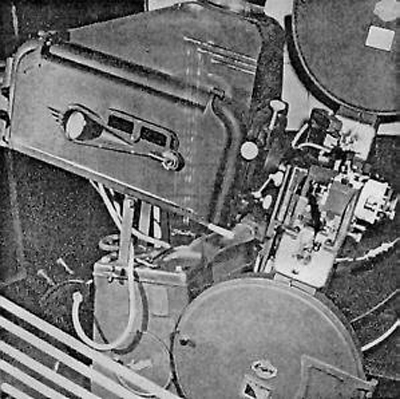
Century also made a production version that included an optical sound reproducer and it looks like this.
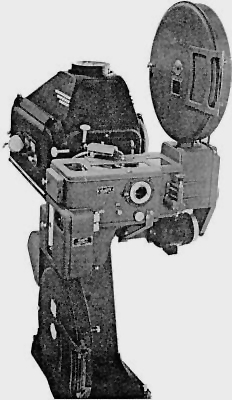
I have no idea how many sets of these were built. These are smiilar to the projectors that were at Colonial Williamsburg. These were based on the newer model H mechanism and they had a heavier duty star weel with a sprocket secured by screw and nut.
Posted by Leo Enticknap (Member # 534) on 11-11-2013, 04:48 PM:
quote: Allan Young
He doesn't go into any detail as to whether Paramount initially expected VistaVision projectors to become prevalent.
Many thanks - it's so frustrating being without most of my books and notes.
What I find fascinating about the British VV experience is the significant number of quite interesting but obscure films that were made in the format, including several b/w ones (e.g. Ill Met by Moonlight and Hell Drivers), which disappeared more or less without trace after their initial release. It's almost as if Rank regarded the system as totally experimental, and (with the arguable exception of Powell and Pressburger, whose careers were over the hill by the mid-50s anyway) did not risk letting their A-list filmmakers use it; unlike Paramount in the US, who let Hitchcock loose with it, not to mention several big budget musicals and action pics.
Irritatingly, Geoffrey Macnab's book (J. Arthur Rank and the British Film Industry) barely mentions the Rank Organisation and VV. If the company documents survive, there's possibly a standalone book to be done on it. I don't think you'd get the whole story from trade papers and whatever the BFI has if they don't, though.
Posted by Scott Norwood (Member # 30) on 11-11-2013, 05:09 PM:
I would think that the primary issue with VV as an exhibition format is that there is no easy way to build a dual-format projector that can run both 4-perf 35mm and 8-perf VV. Unless the format had completely taken over the industry, every theatre that wanted to show VV prints would need a completely separate set of projectors. That would be a tough sell to theatre owners.
By contrast, most (all?) 5/70 systems can be easily converted to run 4/35, making 5/70 a much better choice for large-format exhibition in mainstream theatres.
Posted by Claude S. Ayakawa (Member # 1401) on 11-11-2013, 05:19 PM:
Was Lawrence Olivier's RICHARD 111 released in 8/35 Vista Vision in the UK, Leo? I have the movie on a Criterion blu ray and the gorgeous picture quality on the disc indicate how fantastic the movie would have looked in the full VV format if it was released in a theatre that way.
-Claude
Posted by Mark Gulbrandsen (Member # 72) on 11-11-2013, 05:46 PM:
Scott... It could be done and it wouldn't be all that hard. Two sets of gates and traps located in different for-aft positions and interchangeable sprockets. Alas I am pretty sure Paramount was thinking it would be for exhibiting only in certain large theaters back then.
Posted by Brad Miller (Member # 2) on 11-11-2013, 11:31 PM:
Very interesting info Mark. Its ashamed Paramount decided to create VV as 1.85 when they could've dedicated more perfs and created a 2.35'ish ratio and made it even better.
Posted by Steve Matz (Member # 1890) on 11-12-2013, 12:09 AM:
In this Martin Hill camera collection video he mentions one of them being used for vistavision, Boy has this guy got some equipment with some real providence. what a kool collection to have...check it out!!! ![[Eek!]](eek.gif)
http://www.youtube.com/watch?v=k-dfm5k358E
Posted by Stephen Furley (Member # 1277) on 11-12-2013, 06:59 AM:
Brad,
Even the Alberini 10-perf system didn't get that wide. You'd need about 12 perf to get close to 2.35. Would triacetate stock stand up to those sort of speeds with a conventional intermittent?
As an alternative you could have kept with 8-perf, reduced the height somewhat, and made room for 4-track, or even 6-track optical sound above the frame. Or were you thinking of a camera format only?
Or as another alternative, create Technirama.
Posted by Bobby Henderson (Member # 840) on 11-12-2013, 09:05 AM:
Maybe the creators of VistaVision liked the 8 perf width since it is the same format used by 35mm still cameras.
Posted by Leo Enticknap (Member # 534) on 11-12-2013, 11:01 AM:
quote: Claude S. Ayakawa
Was Lawrence Olivier's RICHARD 111 released in 8/35 Vista Vision in the UK, Leo?
Yup - that was a Rank VV title. It was Olivier's decision to use it on Otto Heller's advice: he'd been under pressure from Rank and Korda to shoot in Cinemascope, but after a few test shots decided that 'scope (very wide ratio and not much detail in the relatively grainy Eastmancolor camera stocks of the time, which really showed up in the IB release prints) would not work. Dunno if it was ever screened commercially in VV, but at least some of the major British VV titles were shown at the Odeon Leicester Square in 8-perf VV prints, so I guess it could have been.
Ironically, the film reached its largest audience through a US television broadcast (i.e. b/w, NTSC and with an average screen size of 11" in those days! - source). If Olivier and Heller had known that ahead of time, maybe they'd have shot it with a 16mm Bolex!
Posted by Mark Gulbrandsen (Member # 72) on 11-12-2013, 12:11 PM:
Brad,
There does exist a prototype 12 perf mitchell type movement but I don't know if it ever made it into a complete camera form or not. Lensing back in those days would have been real iffy not to mention projecting it. There was also a wide frame movement in development for Cinerama that cold replace the three cameras. That 12 perf movement was owned by the guy that runs Ultraflat. I saw it and actually held it in my hand back in the 80's. Perhaps if Bob Destolphi sees this post he can chime in about it because he kows about it too.
ILM actually DID extract up to a 2.35 area out of the effects plates they shot with their VV cameras. By then film and lensing was far more advaced than it was in the 50's and the results even at the 2.35 extraction were certainly superior in term of resolution to what was achieved with 1.85 and Dye transfer release back in the 50's.
Mark
Posted by Randy Pryde (Member # 7488) on 11-12-2013, 11:00 PM:
Mark,
I believe this is the Cinerama camera movement to which you are referring. In conjunction with a wide angle lens, the goal was to create the full Cinerama field of view on a 35mm horizontal frame of 16 perforations in width. Reportedly this prototype could only achieve a speed of 20 frames per second.
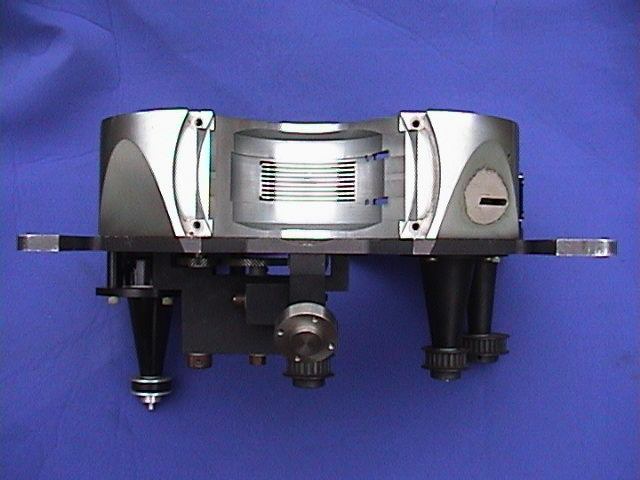
Posted by Steve Kraus (Member # 476) on 11-12-2013, 11:32 PM:
I posted this to Random Photos years ago. It's 12-perf, intended as an origination format for 70mm.

Obviously the solution to the getting Scope format from 8-perf is Technirama which is essentially VistaVision shot with 1.5X squeeze optics. An additional 1.33X in optical printing down to 4-perf gives you normal 2:1 squeezed Scope format prints which will be of higher quality due to the double sized camera negative. Or unsqueeze onto 65mm intermediate and make 70mm prints. "Super Technirama 70" in that case.
1.5 : 1 approximate aspect ratio of the 8-perf frame times 1.5 squeeze is 2.25 so a lose a little height and you get the 2.35 A.R. of the Scope of that era. Perhaps some prints were at 2.55 (the mag-only Scope aspect ratio.)
The question of whether there ever were 8-perf print of Technirama titles has never been conclusively answered. There is some belief that there may have been some in Europe. The consensus seemed to be that they would have been 4-track mag.
Posted by Stephen Furley (Member # 1277) on 11-13-2013, 04:34 AM:
Three pictures from this page:
web page
From the Widescreen Museum seem to confirm that the system got as far as trade demonstration, but whether there were ever any public screenings is unclear.
Posted by Dick Vaughan (Member # 540) on 11-18-2013, 03:22 PM:
We have parts of two of the Kalee Vistavision projectors in the collection here at the National Media Museum in Bradford.
They came to us through Willem Bouwmeester who was our IMAX service tech for many years and was the man responsible for helping us re-create Cinerama in Pictureville Cinema.
They had been in store at Cinemateriel in Paris for several years before they gave them to us in 1992.
It's my understanding that an American film maker then living in France had acquired two almost complete machines. He wanted to get them up and running so asked Cinemateriel to remanufacture missing parts. In the box of parts we received is a "new" 32 tooth intermittent they made. For some reason several parts were sent to a company in Switzerland who specialised in special venue projection systems. We did try to trace them and get them back but with no luck.
We aren't sure but believe these two machines to be the ones that were at Wandsworth College referred to by Stephen earlier.
It's our understanding that only 4 complete Kalee machines were made all of them going to theatres. One pair then went to Pinewood Studios the other pair to the college.
A lot of the Kalee company papers are at Leeds Industrial Museum a few miles away. When I have some time I need to check them out to see if we can discover any more about these machines.
Posted by Stephen Furley (Member # 1277) on 11-19-2013, 07:09 AM:
This picture shows the Kalee Vistavision machines at the Odeon Leicester Square, with the three BTH Mk. 1 SUPAs between them.
The Odeon has been through five generations of film projectors in its life; in each case three machines were installed. One of the final set remains in place today. I think the VV machines must have been using followspot ports; there were two spots with a Ross Scenoscope, basically a Ross copy of the Brenograph between them at the right hand end of the box, but I can't remember what was at other end but an old picture shows two more machines to the left of the original film projectors but it's difficult to see what they were; I think they are two more spots. I would have thought that there would be considerable horizontal keystoning with the VV machines being that far out, and quite noticable at changeover.
I think it's likely that these were the machines which went to pinewood, so the parts which you have are probaby from the other set. What parts do you have?
Posted by Dick Vaughan (Member # 540) on 11-19-2013, 09:04 AM:
Stephen I'll try and post some pictures later this week.
Posted by Stephen Furley (Member # 1277) on 11-19-2013, 09:45 AM:
Do you have a more or less complete mech from one of them? If so, have you considered putting it on display at the Widescreen Weekend? I think it's the 60th anniversary next year, isn't it?
Posted by Leo Enticknap (Member # 534) on 11-19-2013, 10:05 AM:
Being hypothetical and speculating aloud for a moment, I wonder how feasible it might be actually to do an (essentially) authentic VV screening? Assuming that at least one working projector could be assembled (and if only one, it could be fed from a platter, presumably, though it might need modification to run at 180 feet per minute, especially towards the start of the movie), the remaining obstacle would be finding, or making, a release print of a movie.
I'm going to assume that there are no remaining VV projection prints from the '50s that would still be showable. Acetate from that far back, even if it's spent some of its life in an atmospherically controlled archive vault, is likely to be so brittle that projection at 180 feet per minute is not going to be viable, even if colour dye fading doesn't rule that route out (though at least some of the '50s VV projection prints were IB - I've seen one on a bench).
So we're looking at a new print. Problem: most if not all of the major restoration projects of VV films have involved creating new preservation masters, either optically reduction-printed to 4/35, or by the Robert Harris technique of transferring the image (I believe by contact printing, though am not 100% sure) to 5/65.
The lowest-practical-cost route nowadays would probably be to scan a surviving VV IN (to avoid having to recreate photochemical post-production steps, e.g. timing and incorporating opticals, that you'd have to if you went back to the camera neg - in effect, a full-scale restoration), do basic, one-click colour correction on it, Arrilaser (or equivalent)-out a new IN, create a new track neg and then make your new print on a high-speed continuous contact panel printer, just as you would a normal 4/35 one. Sound cameras exist that can basically just take a balanced line in (e.g. this one), and so an existing restoration track master could be used as the source pretty easily. I'm not sure how possible it would be to master a new VD track (if you wanted to go the whole hog and incorporate Perspecta): at one point in the not-too-distant past, Martin Sawyer Sound Services in London offered this service (i.e. they had a VD sound camera in working order), but whether they still do or not, I don't know.
Even so, I'm guessing it would be a $50k-$70k project to come up with a release print of a full-length VV feature doing it this way. It would be a great museum project if it could be done, though, and one of the headline features for which the system became famous (e.g. White Christmas or North by Northwest) could be seen again in VV projection.
Posted by Stephen Furley (Member # 1277) on 11-19-2013, 11:11 AM:
quote: Leo Enticknap
Being hypothetical and speculating aloud for a moment, I wonder how feasible it might be actually to do an (essentially) authentic VV screening? Assuming that at least one working projector could be assembled (and if only one, it could be fed from a platter, presumably, though it might need modification to run at 180 feet per minute, especially towards the start of the movie), the remaining obstacle would be finding, or making, a release print of a movie.
I don't think it would be technically difficult, but very expensive. If you couldn't find a complete original projector you could probably hire Mark's one, or the similar one which I saw at the exhibition at Grip House Studios probably still exists somewhere. (I don't suppose that was your machine there, was it Mark? You'd need to find some way to mount an optical sound head, possibly further away than normal, and delay the sound by a suitable amount. Depending on how authentic you wanted to be you could also use DTS; easier to fit a timecode reader than a soundhead.
Even with polyester would a complete VistaVision print fit on a platter? If it was much more than about two hours you'd probably need an intermission.
quote: Leo Enticknap
I'm going to assume that there are no remaining VV projection prints from the '50s that would still be showable. Acetate from that far back, even if it's spent some of its life in an atmospherically controlled archive vault, is likely to be so brittle that projection at 180 feet per minute is not going to be viable, even if colour dye fading doesn't rule that route out (though at least some of the '50s VV projection prints were IB - I've seen one on a bench).
The reel of 'Battle of the River Plate' which I saw was totally magenta, but the triacetate base seemed fine, and it ran through the projector ok, but that was probably about 15 years ago. I have triacetate prints of several shorts from the '50s which still run fine, and doesn't the NFT still run several of the Festival of Britain 3-D prints occasionally? I agree though, you'd probably need a new print; if a complete IB one existed in projectionable condition it would probably be considered to valuable to risk screening.
quote: Leo Enticknap
So we're looking at a new print. Problem: most if not all of the major restoration projects of VV films have involved creating new preservation masters, either optically reduction-printed to 4/35, or by the Robert Harris technique of transferring the image (I believe by contact printing, though am not 100% sure) to 5/65.
I believe the restoration of 'Vertago' was mainly done in 8-35, with conversion to 5-65 being done at the end of the process. There are some frames from a 8-35 workprint in the Widescreen Museum. I think a complete interpos, or interneg, or possibly both, exists. If an interneg then that would almost certainly be your cheapest option, but if only an interpos then the cost of making a neg would be high. The new 8-35 elements may be missing things like the restoration credits.
quote: Leo Enticknap
The lowest-practical-cost route nowadays would probably be to scan a surviving VV IN (to avoid having to recreate photochemical post-production steps, e.g. timing and incorporating opticals, that you'd have to if you went back to the camera neg - in effect, a full-scale restoration), do basic, one-click colour correction on it, Arrilaser (or equivalent)-out a new IN, create a new track neg and then make your new print on a high-speed continuous contact panel printer, just as you would a normal 4/35 one. Sound cameras exist that can basically just take a balanced line in (e.g. this one), and so an existing restoration track master could be used as the source pretty easily. I'm not sure how possible it would be to master a new VD track (if you wanted to go the whole hog and incorporate Perspecta): at one point in the not-too-distant past, Martin Sawyer Sound Services in London offered this service (i.e. they had a VD sound camera in working order), but whether they still do or not, I don't know.
Still sounds a very expensive process, unless the restoration was being done anyway and the new VV print could be made as part of that project. Could the print be made direct from the digital files, or would a negative have to be made for conventional printing?
I think Kodak ceased production of VD recording stock around 1965. I doubt if anybody else continued much longer, so you wouldn't be able to record a new negative. I think new prints can still be made from existing VD negatives, though existing tracks are sometimes re-recorded as part of a restoration process. If I remember correctly, this was being done with 'The Third Man' the last time I was at the BFI.
Not all VV prints were VD; the odd reel which I saw at the college when I was there had a VA track. I don't know what the film was. Isn't an existing track negative likely to be useable, and in better condition than Chromogenic picture elements? Perspecta is no problem; there are several original integrators in working order, or for an easier option use one of Dion's cards. I'd lend them mine, plus an old SA-4 to put it in if necessary!
quote: Leo Enticknap
Even so, I'm guessing it would be a $50k-$70k project to come up with a release print of a full-length VV feature doing it this way. It would be a great museum project if it could be done, though, and one of the headline features for which the system became famous (e.g. White Christmas or North by Northwest) could be seen again in VV projection.
I think that may be a conservative estimate the way prices are going these days, for a single print that will be shown how often, and in how many theatres? How many people would even know what the difference was? Probably better to make a 5-70 print; at 1.85 the frame area is similar, and there are plenty of places which can still run 70 mm.
Posted by Leo Enticknap (Member # 534) on 11-19-2013, 11:30 AM:
quote: Stephen Furley
Could the print be made direct from the digital files, or would a negative have to be made for conventional printing?
The Arrilaser takes 3.8 seconds to burn a 4-35 'scope frame from a 4K DPX file: let's assume 8 seconds for a VV frame, or about three hours per minute of footage. That's about 2-3 weeks of machine time (assuming 24/7 operation) to burn out an entire feature film. This is why direct filmout of release prints is virtually never done: the cost in machine time on a machine that costs 450k euros means that it makes no sense to burn out a print directly, when the cost of making extra prints from an IN is so much lower than that of laser-ing them directly.
Agreed totally that the subjective quality of a projected VV picture would be no better than 5/70: the only justification for doing it would be as a living museum exhibit.
Posted by Steve Kraus (Member # 476) on 11-19-2013, 12:13 PM:
Leo, if the VVLA (VistaVision Large Aperture) IN is not too faded why not just time it for one-light printing and make a contact print? That's assuming the VVLA EK doesn't have the titles and effects already cut into it but you'd know more than me if that is even likely. Otherwise if there is an IP that incorporates everything and has the scene to scene timing, make a new 8-perf IN, timed for the fading, and then a contact print. Contact printing should not be that costly. So unless the fading is beyond the reach of photochemical and/or the cost of digital work can be justified by making yet another Blu-ray edition or something like that, hopefully it would be unnecessary.
Surely 8-perf to 65mm is done via optical printing unless it's a digital restoration. I'm not aware of a way to do it by contact printing.
Posted by Leo Enticknap (Member # 534) on 11-19-2013, 06:39 PM:
It's not so much that bad fading is beyond the reach of photochemical (if there's any green/cyan or blue/magenta dye left at all, the image can be rescued photochemically by adjusting the colour temperature of the printer's light source) but that two hours' worth of negative is very unlikely to be evenly faded across its entire length, meaning that one-light printing would not give you a very good result.
But the main problem with contact printing a 1950s element onto modern stock is going to be shrinkage causing serious instability in the projected image. More than around 0.3-0.5% shrinkage and it would need to be step printing on something like a Matipo. That in turn would mean printing the soundtrack in a separate pass, and if the sound neg has shrunk differently from the pic neg, you're into loss of sync territory. If you're going to go there and address that, you've basically got yourself into a full-scale restoration.
If a VVLA interneg of a feature survives in astonishingly good condition for its age, a straight photochemical print with relatively little post-production intervention (restoration work, in other words, and [wo]man-hours is where the bulk of the money goes in a full-scale feature film restoration project) might be possible. Admittedly I was jumping to conclusions in assuming for argument's sake that none does.
Posted by Mark Gulbrandsen (Member # 72) on 11-28-2013, 10:59 PM:
@Randy Pryde,
No, that's not the movement I saw in L.A. back in the 80's. Bob Destolphi knows about it though and probably where it went.
Mark
Posted by Randy Pryde (Member # 7488) on 11-29-2013, 01:48 AM:
Mark,
That movement, along with a lens, was listed on ebay at least 10 years ago. Had a minimum bid of $5000. The auction was quickly pulled and never relisted. Thomas' in70mm webpage has a copy of an undated Internatial Cinerama Society newsletter that shows the camera and lens that I am referencing.
Cinerama newsletter
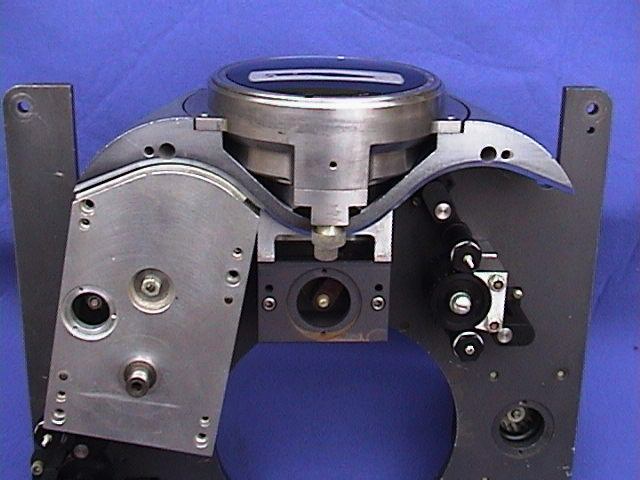
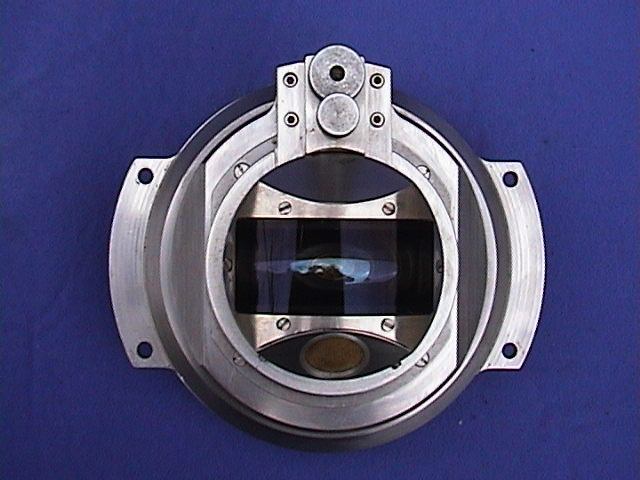
Posted by Mark Gulbrandsen (Member # 72) on 12-02-2013, 08:03 PM:
Thats a nifty design but definatey not the one I was shown...
Powered by Infopop Corporation
UBB.classicTM
6.3.1.2