This is topic Wikipedia page for the DP70 in forum Film Handlers' Forum at Film-Tech Forum ARCHIVE.
To visit this topic, use this URL:
https://ft-forum.com/ft/cgi-bin/ubb/ultimatebb.cgi?ubb=get_topic;f=1;t=011612
Posted by Leo Enticknap (Member # 534) on 02-26-2014, 11:30 AM:
The thread about the drive shaft had me re-reading bits of Thomas's DP70 site last night, from which a process of clicking led me to discover that there was no Wikipedia page for the DP70. This struck me as a notable omission, as most of the other major systems and inventions related to widescreen do have a page. So I have had a stab at writing one - here - based mainly on information on in70mm.com. I thought the regulars here might like to check it and make corrections/additions as described. A picture or two (I don't have any that I own the copyright to, or else I'd have put one on), plus some more references would probably be useful.
If anyone doesn't want to edit the page themselves but has suggestions for revisions, please feel free to put them here and I'll update the page when the discussion has run its course.
Posted by Sam D. Chavez (Member # 1841) on 02-26-2014, 12:38 PM:
Great work and a god start.
I believe some final assembly and finishing was done in the USA as some of the operating side of the projector's fasteners were SAE and not metric. Perhaps this was all done in Holland for USA sales, not clear on that. Someone knows I'm sure.
Posted by Louis Bornwasser (Member # 3063) on 02-26-2014, 05:55 PM:
Sam; I know for a fact that the base and lamphouse table were USA. I was called to a theatre that had "a basement full of old projectors" and found all of the AAII crates (along with paperwork) full of the 1920s projectors that were removed when AA2's went in for "Raintree County." Louis
Posted by Scott Norwood (Member # 30) on 02-26-2014, 08:46 PM:
Is there a list somewhere of changes in the design of the machine over its production run? I am thinking of things like the color of the glass in the door (went from clear to dark green), the switch from two motors to one, and the color of the rollers.
Posted by Mark Gulbrandsen (Member # 72) on 02-27-2014, 01:50 PM:
When the machine was known as the AA-2 (about 1966) I believe the base parts were actually made by Ballantyne (This is way before they ever bought Strong and Simplex). John Wilmers who is very much still around would know this for sure. They also distributed the projector around that time period. Somewhere around here I have a magazine ad in it from Ballantyne selling the AA-2.
Although the first batches of projectors were likely fully imported as complete units Todd-AO would have later on contracted some US manufacturer to build the pedestal parts while they were distributing it... Also, the European and USA electrics and motors and mounts were completely different from each other. It could not have been worth shipping those heavy parts over seas even back then unless it was more localized there in Europe or the Middle East.
Mark
Posted by Gordon McLeod (Member # 33) on 02-27-2014, 03:07 PM:
The first machines came straight from eindhoven later ballantyne under Ed Nelson made the magazines and bases for them as well as a lot of the FP20 columnes and DP75 columnes ever wonder how they came up with the framing coupler for the PRO35 hmm they were assembling for phillips
Posted by Steve Guttag (Member # 268) on 02-27-2014, 04:49 PM:
Ever notice that a Pro-35 aperture fits an FP20/30? The Ballantyne was a rip off of the DP75 mechanism.
Posted by Louis Bornwasser (Member # 3063) on 02-27-2014, 06:42 PM:
We even had FP-20 drive ins here; full Ballantyne contract. They distributed Norelco for awhile. that did not work out so well for . . . Norelco. Louis
Posted by Leo Enticknap (Member # 534) on 03-01-2014, 03:17 PM:
Thanks, folks - I've tweaked the page to take in everyone's comments.
Some secondary fact-checking revealed a bit of confusion as to when the AAII version was launched, though: Thomas's site says 1963, but I've found one or two other places that say 1966. I've gone with 1963 in this write-up, because in70mm.com looks far more authoritative to me than anything that contradicts it, and the production run was either over or almost over by 1966, and so it doesn't make sense that a major revision to the model would be launched that late.
Posted by Thomas Hauerslev (Member # 566) on 03-01-2014, 04:20 PM:
AAII is short for Academy Award, Class II
Nice write-up Leo.
Posted by Sam D. Chavez (Member # 1841) on 03-01-2014, 05:09 PM:
I was just looking at Thomas's 70mm site.
The last two pictures labeled as being in LA are actually of the Galaxy in San Francisco. I took part in the installation and had salvage rights just a few years later for everything except the projectors which were donated by Regal to a facility in LA. Maybe USC or UCLA.
Regards the Coronet and Alexandria; I had salvage rights to these as well. The related note regarding someone from Dolby acquiring the DP70's is close but I had exited Dolby Labs years before. Lost track of the machines but I believe they went to Claco in Salt Lake City. Some of these ended up in Randy Pryde's cinemas in Utah and Wyoming. Now four out of service machines from Randy Pryde are back in LA with Jess Daily, ex of UCLA. I will see if I can obtain the serial #'s.
BTW, Alexandria and Coronet had 5 large Ampex speakers behind the screen. All went to audio collectors in Japan.
Posted by Paul Mayer (Member # 355) on 03-01-2014, 05:36 PM:
I seem to recall that when Fox West Coast built their Charleston Plaza location in Las Vegas in 1965, they put in Norelcos...
Posted by Thomas Hauerslev (Member # 566) on 03-02-2014, 12:56 AM:
Thanks Sam, pictures are moved to the UA Galaxy, SF. I seemed to remember they were some sort of cinema in Pasadena, where Todd-AO had had one rebuilt for Compact Distribution Print in 1994. I saw a test with "Scent of a Woman" there - but could not remember the place. And 20 years later, it turns out to be in SF.
Btw, there are US states without the DP70: http://www.in70mm.com/dp70/country/usa/index.htm
At least, I have no records. Most DPs are in CA and NY
Posted by Mark Gulbrandsen (Member # 72) on 03-02-2014, 09:52 AM:
Sam,
I thought that Bob McRae ended up with the DP-70's that were at Dolby? Didn't Ray call them Nazi projectors or something along those lines?
Mark
Posted by Sam D. Chavez (Member # 1841) on 03-02-2014, 10:55 AM:
Mark,
Dolby had a pair AA11's back in 1984 from Circle Theatres in DC. They never got used in favor of brand new DP75's.
They were sold to Malco's Mike Thompson along with 2 others.
Ray did express disappointment when he saw he saw the DP75's and said he thought we were getting "the big ones."
Thomas, I hope I did not cause confusion. The pictures I was referring to were marked LA Theatres with no names. I think it was under California cinemas.
Posted by Steve Kraus (Member # 476) on 03-02-2014, 11:03 AM:
Great article. Do you really want to credit Mike Todd as inventor of Todd-AO? Perhaps Dr. Brian O'Brien and American Optical sponsored by Todd.
Did Todd really care if the projectors could project regular movies? I know he made a point of making his "events" very unlike going to an ordinary movie (allegedly popcorn was forbidden) and with the prospects of shows running many months before making way for the next Todd-AO spectacle I'm not sure, unless he was thinking of Todd-AO reductions.
EDIT TO ADD:
You probably need to correct the part about using a variac to regulate speed for silent movie speeds. What is needed is an inverter that can vary the frequency. In some cases this requires replacing the motor with one that doesn't mind the odd waveform; in other cases the inverter output is a decent enough sine wave that a regular motor can handle.
Posted by Thomas Hauerslev (Member # 566) on 03-02-2014, 11:58 AM:
Mike Todd & Brian O'Brien and Todd-AO: http://www.in70mm.com/news/2003/todd_ao_birth/index.htm
Posted by Leo Enticknap (Member # 534) on 03-03-2014, 10:42 AM:
Noted - thanks - will update again soon.
Posted by Gordon McLeod (Member # 33) on 03-03-2014, 11:04 AM:
quote "(though a separate head assembly is required for 35mm magnetic" actually they supplied a 10 track head as standard for years as they also did for the DP75
And the head mount was the weakest designed assembly as it had no azimuth adjustment of any quality
Posted by Steve Guttag (Member # 268) on 03-03-2014, 12:05 PM:
Given the way the Phillips head was made...what difference would azimuth would have made...the alignment of the head cores themselves was a bit wanting.
Teccon made a special version (at no additional cost) of their head for the Noreloc/Kinoton projectors...they shaved the mount on the head in half and then mounted a metal dowel pin to that so the head could have an azimuth adjustment but without danger of messing up the zenith of the head. Worked exceptionally well.
Posted by Rick Raskin (Member # 1561) on 03-03-2014, 12:29 PM:
quote: Leo Enticknap
Thomas's site says 1963, but I've found one or two other places that say 1966.
1966 is incorrect. I ran AAII machines in 1964 at the demolished Beltway Plaza in Greenbelt, Maryland. I recall that Ballantyne was selling a complete package back then that included the AAII and their transistorized sound system.
Posted by Mark Gulbrandsen (Member # 72) on 03-03-2014, 01:08 PM:
There was a 1966 version of the DP-70 for sure and it is the subject of a four page brochure. Changes to the plastic rollers (white material to black material) and a few other insignificent refinements. Probably more marketing hype than any other aspect to try to get more sales. I have been through so many of these projectors that it's very difficult to actually find any of the 1966 refinements other than the black rollers.
I personally don't think any mention of the development of Todd-AO belongs on the DP-70 page. That deserves a page all of it's own with a link on the DP-70 page. It's a fascinating story in it's own right.
quote: Steve Kraus
You probably need to correct the part about using a variac to regulate speed for silent movie speeds. What is needed is an inverter that can vary the frequency. In some cases this requires replacing the motor with one that doesn't mind the odd waveform; in other cases the inverter output is a decent enough sine wave that a regular motor can handle.
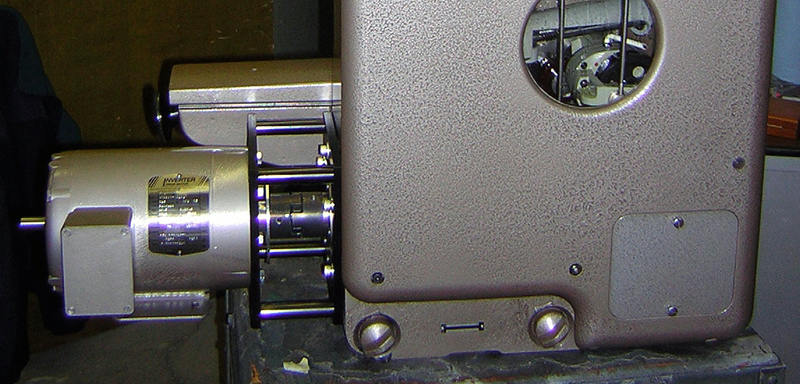
Exactly! You can't do that because they are synchronous motors. It takes a three phase motor powered from an invertor(single to three phase) to do that. At a previous job we bought a bunch of DP-70 that had no motors. So this was my solution to that. This is a three phase inverter drive motor.
I made a few changes to the paragraph about the motors. Would someone please go in and check my spelling and punctuation?
Posted by Sam D. Chavez (Member # 1841) on 03-03-2014, 03:06 PM:
The original blue colored heads were a real weak spot. Very soft and the difference in the gaps between channels were visible so azimuth would have been pointless. Teccon's were the best thing to happen to these projectors in the '80's.
The response to this thread has been amazing. We all love this machine.
Posted by Rick Raskin (Member # 1561) on 03-03-2014, 03:50 PM:
They are truly the Cadillac of projectors.
I added some text about the water cooled gate.
Posted by Steve Kraus (Member # 476) on 03-03-2014, 08:32 PM:
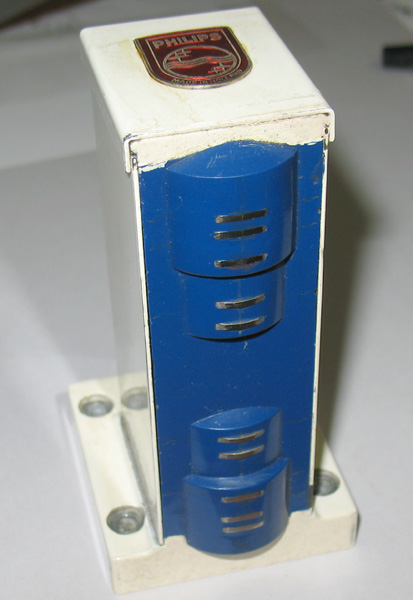
I have a couple of ten track heads stashed away. I think they're from Chicago's Cinestage. This one says installed 4/7/64.
Posted by Sam D. Chavez (Member # 1841) on 03-03-2014, 08:48 PM:
The 4 track heads look to be unused as expected.
I just got some used ones from Randy Pryde today.
Posted by Leo Enticknap (Member # 534) on 03-03-2014, 10:52 PM:
Thanks everyone. Tweaks and cleanups done as follows:
1. Paragraph about Todd specifying that the machine had to be dual gauge replaced with "A core objective of the project was to create a single machine that could project both the Todd-AO 5/70 format and the 4/35 format which was, and was likely to remain, the dominant standard for theater exhibition."
2. "Though a separate head assembly is required for 35mm magnetic" deleted.
3. The features section has been split into subsections (it was getting a bit long).
4. Minor tweaks to Mark's and Rick's additions for consistency of style with the rest of the text.
quote: Mark Gulbrandsen
I personally don't think any mention of the development of Todd-AO belongs on the DP-70 page. That deserves a page all of it's own with a link on the DP-70 page. It's a fascinating story in it's own right.
I think it needs a mention, because the machine was invented in the first place as part of the Todd-AO project. In the article as it currently stands, Todd-AO is only mentioned substantively in two sentences, and includes a link to the main Todd-AO page. So I hope it doesn't veer too far off topic.
All we need now are some pics...
Posted by Mark Gulbrandsen (Member # 72) on 03-04-2014, 06:32 PM:
It's looking good! How do we add pictures to that page? I have some good internal pictures but I'll leave the external original looking shots to some one else. I also have a lot of updated shots with various sound readers and DTS in place of penthouse, etc.
A line or two perhaps with a link to a more comprehensive story of it. Perhaps linked to Thomas's page.
Posted by Leo Enticknap (Member # 534) on 03-04-2014, 10:52 PM:
Thomas's site is linked in the "external links" section at the bottom. Couldn't think of any others to add. In terms of the bibliography, I'm not sure if Torkell Sætervadet's projection manual mentions the DP70 specifically (my copy is still in shipping from Britain to the US, along with all my other books), but I'll add that when I can get hold of it and if it does.
As for photos, Wikipedia is very picky about copyright - you have to be the actual copyright owner to upload them. Having the copyright owner's permission is not enough (I once had a pic taken down by moderators that I was given to upload by someone else, with their permission), because they want you to grant a Creative Commons license, blah blah blah. They have to be uploaded by the actual owner.
Paul Rayton has kindly invited me to take some in the booth of the Egyptian the next time I'm in LA, and so I'll do that and put them into the page when I get a chance.
Posted by Ben Wales (Member # 92) on 03-06-2014, 04:36 PM:
quote: Sam D. Chavez
The response to this thread has been amazing. We all love this machine.
Great reading about this and having a DP70 at Home and seeing it everyday is always something to look forward too after a days hard work.
Posted by Leo Enticknap (Member # 534) on 03-13-2014, 01:02 AM:
We have pictures. Hope they're OK.
Posted by Mark Gulbrandsen (Member # 72) on 03-13-2014, 12:31 PM:
Looking good... My custom Kelmar change overs are in those DP-70!!
Posted by Markus Ito (Member # 6207) on 03-14-2014, 12:07 AM:
This looks great! I've learned lots of interesting details about these projectors after reading through the wiki page. The booth at the Egyptian looks like it has everything you can add on to the DP70.
Posted by Emiel De Jong (Member # 4225) on 03-15-2014, 07:47 AM:
Just a detail, but:
"In the United States, the American Optical Company (the AO in Todd-AO) gave the original version of the DP70 the catalog number EL4000. "
The EL numbers were typically given by Philips, for example their "portable" 16mm projector was the EL5000; on my FP20 is a plate with EL4022.
Posted by Leo Enticknap (Member # 534) on 03-16-2014, 11:18 PM:
Many thanks - much appreciated.
To avoid the article history log becoming a great long list of entries, each of which is just one minor change, I'm collecting a snagging list and will update the page again, probably in a few days. If you'd like to do so before then, please do - that's the whole point of Wikipedia!
I'm assuming that EL4000 was the original, mk. I DP70. If so, what was the EL number for the mk. II (AAII) single motor variant? Many thanks in advance.
Posted by Thomas Hauerslev (Member # 566) on 03-17-2014, 04:07 AM:
EL4000/01 & EL4000/00 was always Philips' catalog number. All though the entire delivery (00 was for 50 Hz and 01 was for 60Hz)
The machine had 1 motor and a gear to change between 24/30 fps. In the US, they came with 2 motors, one for each frame rate. The 2 motor version was abandoned in favour of the 1 motor version.
See the brochures if you like: http://www.in70mm.com/dp70/library/brochures/index.htm
Or the German Philips flyer from 1955: http://www.in70mm.com/dp70/library/brochures/philips/Der%20Projector%20DP70.pdf
Posted by Sam D. Chavez (Member # 1841) on 03-17-2014, 09:18 AM:
One detail that should be modified is in the description of converting from 35 to 70. It mentions changing the sprockets. It's actually the pad roller assemblies that are changed. There may be a more exact name for this assembly but it's not coming to me at the moment.
Posted by Mark Gulbrandsen (Member # 72) on 03-17-2014, 12:09 PM:
Two Pad rollers and one gate assembly would be the correct terminology there Sam... There are two pad rollers that are part of the gate. That leaves the upper feed sprocket pad roller and the hold back pad roller to change out. Most of the time the 70mm pad roller just lived on the upper position anyways.
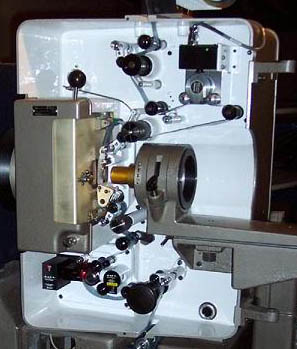
Another correction that needs to be made is under "removable components" where it says "detachable reel magazines can be fitted to accommodate the projection of Nitrate film. Where the reel magazines were actually part of the design of the projector and there were actually two sets of fire trap rollers that came with the early projectors sold in the 1950's. One blue set for safety film and one red set for nitrate. The red set has a much smaller gap between the two rollers and barely has any relief in the picture and sound area. The blue set came relieved to accommodate both 35mm and 70mm safety film. The red rollers were probably only included so the projectors would meet the antiquated fire codes still in effect at the time in places like Chicago and Boston. Boston was the most stringent actually requiring double sets of fire trap rollers in projectors.
I'm not going to go in and change this around yet until some of you offer some more feedback on exactly how to word the changes.
I did make one addition under water cooling and that was the fact that all the copper components were silver plated for maximum heat conductivity. Not may people were aware of this. One batch of dp-70 we rebuilt at Claco we had the cooling plates re-silvered during overhaul.
Mark
Posted by Mark Gulbrandsen (Member # 72) on 03-22-2014, 05:06 PM:
I finally ran across my old AA-2 Eight page brochure that was dated 1962. This also dates the appearance of the AA-2 version of the DP-70 to 1962. Most are not aware of all the slight differences and the subtle improvements that were made and they include:
Changeable 35mm/70mm reel shafts
Able to use standard 5" hub reels (take up gearing was different)
New Non-Glare Door Window
New theading guards on agnetic shield and idler roller.
New Improved Intermittent (I've torn down quite a few and never
noticed ANY difference!)
New Oil Vapor Leak Protection (There were no added seals or anything so it may have been a sealent type of coating applied to the main casting before painting.)
New Douser (Essanay Style C/O was adopted)
Heavier Main Drive Gear Set
New Single Motor Drive
New Two Speed clutch
New Style Contactor
New Lamp house Bracket (Xenon was starting to make inroads)
Spiral Gear Take Up Instead Of Straight Bevel Gearing
Graphite Impregnated Rollers and Idlers (Switch to black rollers from the white ones.)
I have scanned the original brochure and placed it in my drop box. If anyone wants it just send me an IM and I'll send you the link.
Mark
Posted by Paul Vollmers (Member # 927) on 03-24-2014, 04:24 AM:
Thanks Thomas.
I often wondered what AA11 stood for, or where it came from.
Although I own a DP70, double motor, 24/30 fps.
Wonderful machine....but heavy.
Posted by Michael Coate (Member # 757) on 04-10-2014, 05:05 PM:
Leo...
Have you considered including any information on which theaters (at least early on) installed the DP70?
Posted by Leo Enticknap (Member # 534) on 04-15-2014, 10:22 AM:
No, but I'm not averse, especially if a sentence or two could be crafted in a way that kept it "on topic" for Wikipedia, i.e. in this case it provides evidence that the invention/development/rollout of the DP70 was of above average significance in the overall history of movie technology. Can you think of any examples of prominent theaters or chains that bought DP70s in controversial or pioneering circumstances, or whose programming or business model changed substantially as a result of installing them, etc. etc.?
Will do other updates/cleanups resulting from this thread soon.
Posted by Leo Enticknap (Member # 534) on 05-07-2014, 12:13 AM:
Updates done as follows. Sorry it took me so long...
1. Sentence and reference on Kinoton providing spares updated to reflect the fact that Kinoton is now no more.
2. Correction - EL4000 now stated as a model number deriving from Philips, not AO.
3. Correction - "changing sprockets" changed to "changing pad roller assemblies."
4. Under Removable Components, added "Special fire trap rollers for nitrate were also available, to comply with fire regulations in some jurisdictions."
I haven't included anything on early installer theaters, because I can't find anything easily citable from a quick Google search. Michael or anyone - feel free to add!
Posted by David Kilderry (Member # 142) on 05-20-2014, 07:50 AM:
In Australia, we always referred to them as EL 4000's. Until the internet days I had not even heard the terms DP 70 or AA11.
I had four, now down to three. Looking for a good home for one them.
Powered by Infopop Corporation
UBB.classicTM
6.3.1.2