This is topic Who is showing film in 2014 by choice? in forum Film Handlers' Forum at Film-Tech Forum ARCHIVE.
To visit this topic, use this URL:
https://ft-forum.com/ft/cgi-bin/ubb/ultimatebb.cgi?ubb=get_topic;f=1;t=011616
Posted by Scott Norwood (Member # 30) on 03-02-2014, 11:14 AM:
Subject says it. What venues are showing film (16mm, 35mm, 70mm, Imax, etc.) in 2014 for reasons other than the inability or unwillingness to pay for D-cinema equipment?
For the purposes of this discussion, let's include venues with D-cinema or other video capability that maintain the ability to show film and do so on at least a semi-regular basis. We can also include special venues that only show one film (e.g. tourist information centers) and nontheatrical venues (college campus theatres, museum theatres, etc.).
Feel free to post about your own theatre or other theatres or venues that you know are showing film on film.
Posted by Steve Guttag (Member # 268) on 03-02-2014, 11:46 AM:
Of the theatres we service...
AFI/Silver in Silver Spring, MD: Runs film regularly in 16, 35 and 70mm and will continue to do so and has DCinema on all screens...it just depends on the title as to what is run.
Ambler Theatre, Ambler, PA: Digital Cinema is their primary but consolidated their Kinoton FP30E projectors so that a pair wound up on one of their screens. It is noted that they redid their booth wall from a single projector with a video projector to three sets of ports with two film projectors and DCinema. They have possession of a film collection so source material is there for film.
Campus Theatre: (Bucknell University): Not only didn't remove their film projector, they plan on adding a second this year with both 16mm and 35mm capability.
Cinema Arts Theatre, Fairfax, VA: Retained film capability on at least one screen and has run film since DCinema conversion. I do not know the frequency of it though. It is definitely primarily DCinema.
Colonial Theatre: Phoenixville, PA (same theatre featured in THE BLOB with Steve McQueen): Were 2-projector changeover before DCinema and still are. They run a mix of film and DCP. They have always catered to Retro, Art as well as sub-run.
Patriot Theatres, Colonial Williamsburg, VA: In the Visitor's Center, they continue to run 70mm for their signature film "A Story of a Patriot". They also have 16mm and 35mm projection. I do not know their programming to know how often the other formats are used.
DC Jewish Community Center, Washington DC. They retained their film projectors and DCinema projector merely replaced their A/V projector (actually they kept their A/V projector too. It is a very versatile theatre where what they need can be wheeled up and used in that space.
Goethe Institut, Washington, DC: They show 16 and 35mm film in addition to DCinema and conventional video.
Grace Street Theatre, Richmond VA (VCU campus): Runs 35mm
International House of Philadelphia: DCinema only added to its capabilities and they continue to run 16mm, 35mm in addition to adding DCinema to their "Video" capabilities.
Kimball Theatre(s), Colonial Williamsburg, VA: Still run 35mm film on both screens. Though they should obtain DCinema in 2014, film will be retained.
Library of Congress, Culpeper,VA "Packard Theatre": 16, 35 and 70mm film are its main forms of presentation. They have showings for the public every week, last I checked.
Lyric Theatre, Blacksburg, VA: 16mm was removed to make room for DCinema but 35mm remains. I don't know how often they have used the 35mm equipment since DCinema was installed in 2013
National Geographic, Washington, DC: Retained 35mm equipment as the DCinema projector merely replaced their existing video projector. The 35mm equipment is only used for festival like engagements.
National Gallery of Art, Washington DC: Regularly runs most media types on film...including slides, 16mm and 35mm as their PRIMARY media form. DCinema merely compliments their rep.
Roxy Theatre, Northampton PA: The owner (and Film-Tech member) insisted on keeping film capability with the DCinema conversion.
Roxy Theatre, Philadelphia, PA (aka Philadelphia Film Society): installed a pair of 35mm projectors with their DCinema in January 2014. Time will tell what their programming does with them. Thus far, they have been exclusively DCinema.
State Theatre, State College, PA: 35mm film with no plans for removal. They do cater to art/rep.
If I think of others, I'll post them. Most of the theatres above use Kinoton "E" projectors though Century and Simplex are represented as well.
Posted by Steve Moore (Member # 4753) on 03-02-2014, 11:56 AM:
Cottage Road in Leeds, single screen, though on a daily basis play DCP, we still retain our CInemeccanica V9 which gets a run each month, when we have our classic film night. If we can get 35mm prints will run that, though if the classic is digital we still run a collection of period ads, trailers and sales for that show on 35mm.
Posted by Martin McCaffery (Member # 37) on 03-02-2014, 12:39 PM:
Capri Theatre, Montgomery Alabama. We went DCP in January, but retain our dual projectors 35mm for films available on film. Just ran Inside Llewyn Davis on 35mm. We are supposed to get The Invisible Woman on Friday, but may have to bump that as The Book Thief (DCP) is doing way too well. Have a classics series that runs film and DCP. In The Heat of the Night this Thursday on DCP, Dr No later in the month on 35mm.
Posted by Victor Liorentas (Member # 5272) on 03-02-2014, 12:53 PM:
Hyland Cinema in London Ontario. We went digital in November 2012 but kept both platter and changeover capability. Even try to keep upgrading. Just bought a Blue Star Anamorphic which turns out to be in need of repair ![[Frown]](frown.gif)
![[Mad]](mad.gif)
We only use 35mm for one off monthly classics at this point.
The last thing I went out of my way for 35mm was Django Unchained.
If it were totally up to me we would run more 35mm.
Posted by Mark Lensenmayer (Member # 134) on 03-02-2014, 01:39 PM:
Wexner Center for the Arts -- Columbus, OH
Equipped for 16mm, 35mm and 70mm projection with 2 Kinoton projectors. 4K DCP 2D & 3D available.
They will show the movie in the best available format. Wide variety of programming is shown here.
Posted by Brad Miller (Member # 2) on 03-02-2014, 02:39 PM:
I would expect special venues to have the capability of running film for a long, long time. I mean, why pull it? That unfortunately doesn't mean that as the real projectionists retire or move on that their replacements won't become film shredders.
I find mainstream theaters running film more interesting at this point in the game. That being said, the same thing is a concern as with the special venues. What's even more scary are these regular theaters that dig up a 70mm projector and suddenly think they can run 70mm properly. (Newsflash...you people don't know what you are doing and you are in all probability destroying the last of the best thing to ever happen to commercial cinema.)
Really the issue that will continue to get worse and worse with each year is an issue of an actual PROJECTIONIST, not some kid who thinks it's cool to watch the reels spin and calls himself a projectionist because he is able to get the film inside of the machine and put an image on screen.
Posted by Rick Raskin (Member # 1561) on 03-02-2014, 02:46 PM:
Several of the Smithsonian's auditoria have 35mm capability but film screenings are infrequent. I'm told they have Kinoton machines.
My contact there is a real projectionist -- changeovers and carbon arc from back in the day and 70mm experienced too. He's retired but does a part time gig with them.
Posted by Pete Naples (Member # 761) on 03-03-2014, 03:30 AM:
On my patch.
Edinburgh Filmhouse. 3 Screens, DCP, 35mm, 70mm & 16mm
Glasgow Film Theatre, 3 screen. DCP, 35mm, 70mm & 16mm
Cameo Edinburgh. 3 screens DCP. 1 35mm retained.
Belmost Aberdeen. 3 Screen DCP. 2 35mm retained.
Kino, Glenrothes. 3 Screens DCP. 2 35mm retained.
Playhouse Perth, 7 screens DCP. 2 retain 35mm
Grosvenor Glasgow. 2 Screen DCP. 1 35mm retained.
Alhambra, Keswick, DCP & 35mm
Plaza Workington, 6 screens DCP. 2 retain 35mm
Zeffereli's, Ambleside. 5 Screens DCP. 2 retain 35mm
Brewery Arts Centre, Kendal. 3 screens DCP. 1 35mm retained.
Rheged, Penrith. 1 Screen. DCP, 8/70, 5/70 & 35mm retained.
Plaza, Stockport. 1 screen. DCP, 35mm (2 Westars, 1 Kalee with carbon arc + sound on disc all working!)
Posted by Steve Guttag (Member # 268) on 03-03-2014, 07:21 AM:
Thanks Rick for jogging my memory...
From our Smithsonian friends:
The Freer: 16mm and 35mm film projection addition to DCinema, 16mm is infrequent at this point
American History Museum's Warner Brothers Auditorium (formerly the Carmichael), has both film and DCinema...the film equipment was installed at the same time as the DCinema for a complete renovation.
The Hirshhorn Ring Auditorium: 16mm and 35mm
The National Archives (not a Smithsonian, I know but in the "museum" theme from a visitor's standpoint): 16mm/35mm film with DCinema.
The MPAA Theatre in Washington DC 35/70mm projection alongside DCinema (4K). I believe their film showings are very infrequent but it does happen.
As to Brad's VERY valid concerns about projectionists...the "popular" film theatres from my list(s) (ones that run film regularly)...the average age of the projectionists are around 50. As such, there is a bit of "life" left in them. Places like the NGA have the means to train younger people in the skills they need, including 16/35 projection and their standards are VERY high. I believe one of their newer techs in the AVS department is in his early 30s, for instance...so you have a bit of longevity there, personnel wise.
I'll admit, however, some of the sites on my lists have "projectionists" where they were not well trained and I cringe at the thought of some of them running archival prints. One site I was called to to "Fix the Projector"...when I found nothing wrong with the projector, I asked them to thread up and show me what they are doing. If you could have seen my eyes it would have looked like it came out of a cartoon (with the eyes shooting out with an Ahooga-horn sound). There is some very scary stuff out there...particularly in government...where jobs are assigned or worse, bidded out via an A/V package. That is, rather than hire new government employees, the government will take bids to run their A/V equipment throughout a facility...sounds good on paper as it stimulates private sector jobs, keeps us tax payers from supporting benefits...etc. But it is real bad for having qualified projectionists...there are no means to ensure quality standards.
Then there are the people at other government facilities where the projectionists do it out of love, clearly...the take extremely good care of the equipment and the films and treat them both like the special things they are.
Posted by Brad Miller (Member # 2) on 03-03-2014, 05:43 PM:
quote: Steve Guttag
But it is real bad for having qualified projectionists...there are no means to ensure quality standards.
And right now the only way this is "measured" is "do they run reel to reel or platter?" Obviously that's absolutely ridiculous, as the method of presenting the film isn't nearly as important as the operator handling the print. Sure the reel to reel rule keeps them from chopping the leaders (in theory), but bad film handling is bad film handling. If the existing 35mm archive prints are to be kept in a condition that will make people in the future not view them and say "man, film was really crap" then these half-assed "projectionists" need to go away.
Posted by Jim Henk (Member # 3628) on 03-03-2014, 07:10 PM:
quote: Brad Miller
these half-assed "projectionists" need to go away
Nope.
Sorry, but this hits a button for me. That's only partially true.
Having been in a union world (actually two...) where *proper* training was *denied* to the new guys, I say that there are/were plenty of people who would have flourished and been productive members of the projectionist community, if only the isolationist jerks who were more interested in protecting their own little piece of turf had gotten off their self-serving behinds, and trained the next generation.
Are/were there lazy operators who don't give a flip? Of course there are. That's true in any trade whatsoever. Just look at some of the hacks that call themselves plumbers. Yes. *Those* people need to find another line of work. But don't over-generalize. It isn't fair at all to blame those who care, but never found the resources to advance their own professionalism. And that covers a *lot* of people. It happened to me and everyone anywhere near my age range. (late 20s - early 30s at the time)
That blame falls squarely on the generation before them, with hardly any qualification. It's absolutely no wonder at all that exhibitors saw no value in having real projectionists upstairs. The numbers of the competent shrank and shrank. After an ever shortening time-frame, what good were the overpaid button pushers upstairs? I'd feel the same way, if I were in their shoes. I'm convinced that *that* was the death of the Projectionist. No perceived value. And by the time the "mentor" class got through, the companies were damn right to dump them all, too. Technology certainly helped the problem along, but even before that was all handed off to ushers, even that was being handled stupidly by paid operators who never were taught any better.
Personally, I have both a high school and college background in stage lighting for legitimate theatre. I won awards for my designs every year I was there. I really enjoy seeing, or putting on a good show. I loved it! Being a projectionist, at least I could still stay just that close to what I loved. But with no pathway to learn what I needed to advance my value to the craft, well... that's why I got out decades ago. I was stagnating as one of those hacks, myself.
So don't be so quick to blame the hacks. Instead, blame the people who made them into hacks.
Here endeth the rant.
Posted by Carsten Kurz (Member # 5396) on 03-03-2014, 07:31 PM:
I would say that the fact that most locations now show DCPs routinely but film only on the occasion actually have a better chance to have skilled projectionists - because there is no economical need anymore to employ anyone to run the daily shifts on film. Instead, there is time now to find and educate those who are willing.
- Carsten
Posted by Steve Kraus (Member # 476) on 03-03-2014, 08:07 PM:
Chicago's Music Box Theatre (an art house) can run 16mm, 35mm, 70mm, and DCP.
Gene Siskel Film Center (part of the Art Institute of Chicago) can run film or digital.
At the University of Chicago, the Max Palevsky Cinema (home to the DOC Films series) can run both. Also at U of C is a brand new two screen facility, The Reva and David Logan Center For the Arts, that can run film or digital on both screens.
The Northwest Chicago Film Society runs film by choice exclusively. Their current home, the Patio Theatre, has DCP projection so I guess that qualifies for this list.
The Northbrook (IL) Public Library has 35mm projection and has used it regularly. They are undergoing an upgrade that includes a DC installation. I don't know if film projection will be retained.
I do not know the status of Block Cinema at Northwestern University. Certainly they will get DC if they don't already have it. I'm sure they would retain film.
Posted by Chris Slycord (Member # 4239) on 03-04-2014, 12:05 AM:
quote: Carsten Kurz
I would say that the fact that most locations now show DCPs routinely but film only on the occasion actually have a better chance to have skilled projectionists - because there is no economical need anymore to employ anyone to run the daily shifts on film. Instead, there is time now to find and educate those who are willing.
If they have no economical need to employ anyone to run daily shifts, there won't be any economical need to train someone to do the same.
Posted by Elena Rossi-Snook (Member # 8069) on 03-04-2014, 09:54 AM:
The New York Public Library for the Performing Arts projects 35mm and 16mm.
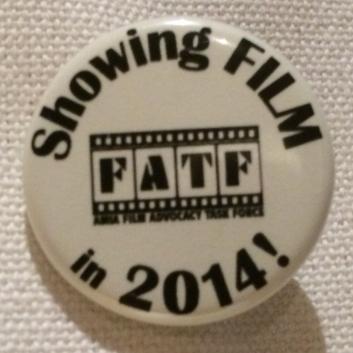
Also, for those interested, the Film Advocacy Task Force of the Association of Moving Image Archivists has these glow-in-the-dark buttons for those showing film in 2014. If you'd like one, send me an e-mail: filmbat@gmail.com
Elena Rossi-Snook
Archivist, New York Public Library
Chair, AMIA Film Advocacy Task Force
Posted by Manny Knowles (Member # 1171) on 03-04-2014, 11:38 AM:
Indiana University Cinema
Last time I tallied, we were at about 35% film versus all video formats combined.
Posted by Kilian Henin (Member # 8098) on 03-04-2014, 12:38 PM:
The Toby Theatre in Invermere, BC, Canada. It's a small-town single screen theatre open since 1952 (original projector).
It just played the Hunger Games: Catching Fire. The owner is hoping to be able to stay open until the end of this summer.
As part of the movie-viewing public, I am quitting going to movie theatres. I just don't like the look of digital (too bright and flat looking). It's sad - I hope the bigger directors with clout can manage the odd film release in the future.
Posted by Donald Brown (Member # 5427) on 03-04-2014, 01:38 PM:
The Skowhegan Drive-In Theatre in Skowhegan, Maine is 100% film and proud of it!
Posted by Jerry Axelsson (Member # 3175) on 03-04-2014, 03:44 PM:
I am the manager for three cinemas at the Swedish Film Institute in Stockholm. We screen 35mm archival prints on a daily basis, reel-to-reel + 16mm and 70mm a few times a year.
We just bought two brand new Kinoton FP-30D projectors with three-blade shutters and variable speed from 15-30fps. (just as back-up)
Our goal is to continue to project analogue film for 50-100 years.
Posted by Jonathan Wood (Member # 4614) on 03-04-2014, 04:37 PM:
We're running 100% film at this years Chalke Valley History Festival . The remit is it has to be on 35mm , no DCP ! Dedicated cinema showing 12 features over six days .
Also the George St Odeon in Oxford retains 35mm in one screen (DP 75)
Posted by Manny Knowles (Member # 1171) on 03-05-2014, 06:21 PM:
quote: Jerry Axelsson
Our goal is to continue to project analogue film for 50-100 years.
Isn't film digital? ![[Razz]](tongue.gif)
Posted by Jerry Axelsson (Member # 3175) on 03-06-2014, 12:49 AM:
Hello Manny,
The new stuff is digital...
But our 27000 prints in our archive is not.
A lot of the things which interests our visitors are only available in analogue prints at this time.
Posted by Rick Raskin (Member # 1561) on 03-06-2014, 06:34 AM:
quote: Manny Knowles
Isn't film digital
/tech hat on/
One could argue that film is a frame based protocol with the contents of each frame being grains that are analogous to bits. One could also argue that playback is constant bit rate (CBR) as in the highest priority class of service in ATM (Asynchronous Transfer Mode)networks.
Be that as it may, I think that argument would be a stretch especially since the "bits" in each frame are physical layer and are not relative to a protocol stack for decoding into an application. One might also argue that the transmission of light through each frame constitutes decoding, but I think that is also a stretch.
/tech hat off/
Posted by Martin Brooks (Member # 1269) on 04-20-2014, 04:42 PM:
quote: Brad Miller
I would expect special venues to have the capability of running film for a long, long time. I mean, why pull it?
IMO, there was no reason for commercial theaters to pull every last film projector out of their booths. Why couldn't they have kept at least one per multiplex (and maybe kept a second for parts)? It's not like they were getting big dollars by junking them (where are all those film projectors going anyway?)
Posted by Ben Wales (Member # 92) on 04-20-2014, 05:35 PM:
Here in my Home Town Southampton.
Harbour Lights Picturehouse 35/70mm Screen One and 35mm in Screen Two, screen the odd 35mm Film mainly in Screen Two on rare ocasions this year. no Projectionist left Trained or know how to screen 70mm at this venue.
Cineworld (Ocean Village) Screen 3 35mm (not been used since 2012)
The Point (Arts Centre)Eastleigh, will be screening 35mm in May on a 35mm projector, last remaining (Film Only) venue in Hampshire.
Posted by Frank Angel (Member # 248) on 04-20-2014, 10:01 PM:
Brooklyn Center Cinema (Brooklyn NY) 16mm Eastman modified by Full Aperture in Chicago (James Bond) 25B/zenon, 35mm Simplex/Peerless carbon arc -- but in actually, the last piece of film we ran thru the Simplexs was BAT MAN DARK KNIGHT about 3 years ago. Nothing since. There has been talk about installing a Christie, but it's just talk. Truth is, we stopped running film because of lack of interest on the part of the administration. Even if we were to get a digital box, the 35 and 16 machines would remain, at least if I am still there when the Christie goes in.
Cantor Theatre, Brooklyn Museum. 16mm Eastman Full Aperture modified 25B, 35mm Simplexes and non-DCI compliant digital. They put in digital and run DVDs -- haven't run film since. The last piece of film thru any of the projectors was the Rolling Stones' COCKSUCKER BLUES (16mm).
Last I knew, the Browing Cinema at the DeBartolow Performing Arts Center (Notre Dame) dual 35mm and still run film and were poised to install DCI digital. Aaron, the 35mm machines still in place or did one of them have to go for the digital box?
Walter Reede Cinema at Lincoln Center, 35mm, 70mm and digital.
Thing is, as has been rightly pointed out here, any facility that keeps their film capability will be solely dependent on archive prints -- these are becoming quite literally, museum artifacts; how long will they be available? Studios are resisting sending whatever they have out and so even with the will to show film, the means continues to become more and more elusive, and it's not for want of a projector.
Posted by Steve Wilson (Member # 2411) on 05-06-2014, 11:31 PM:
Print numbers of Captain America was 721 at our theater
Posted by Jim Henk (Member # 3628) on 05-28-2014, 03:57 AM:
Just visited the La Paloma Theatre in Encinitas, CA (just up the 5 along the coast from San Diego)
They are still very proudly running 35mm, and intend on continuing until the day they can no longer get film at all. Though they do have a Christie digital to one side for the releases that they can't get a print for now. On the other side of the Christie digital is a 16 as well. Terrific!
Single screen run by a really nice guy named Allen. Will definitely be going back.
Posted by Leo Enticknap (Member # 534) on 05-28-2014, 11:06 AM:
We (American Cinematheque, where I'm now working) show 35 and 70 (DTS regularly, 70 mag occasionally and 35 mag once in a blue moon) regularly in both the Egyptian in Hollywood and the Aero in Santa Monica. We can also play 16mm at the Egyptian, and typically do so to a paying audience once or twice a month. Both venues also have DCP projectors and servers. Both venues have DP70s - AAIIs at the Egyptian and mk. Is, with the two motors, at the Aero (including serial no. 8, built in 1954). For 16mm at the Egyptian we have an FP38E.
As I'm not a programmer, I'm not sure how the decision-making process works as to whether to go with film or DCP for titles for which both are available. I suspect that most film prints we show are of older and more obscure titles which don't have a DCP option as yet. We do, however, have a hard core of members and regulars who demand film, and especially 70mm, and so our plans are to carry on playing film regularly for as long as we can. There is an equally vociferous core who complain about bad prints, though, and so we appear to be in the trenches of the film vs. digital war!
Posted by Kenneth Wuepper (Member # 1174) on 05-28-2014, 11:44 AM:
The Court Street Theatre in Saginaw, Michigan continues to show film. Our print numbers have become very small. Often we get #00001.
Posted by Jonathan Goeldner (Member # 4854) on 05-28-2014, 01:21 PM:
Landmark E Street has one screen outfitted to playback in 35mm (and DCinema), as does one screen at the Angelika Mosaic.
and excuse my language but the Hirshhorn 'film' presentations look like shit, by just throwing the image onto a white wall - no screen ... unless that's changed.
Steve: what digital projector do they have at the National Gallery of Art?
can the Smithsonian Art Museum do 35mm?
Posted by Steve Guttag (Member # 268) on 05-29-2014, 05:45 AM:
The NGA has a Barco DP2000 in the East Building Large Auditorium. It was installed long before they had DCP capability but with an eye towards when they would. They have had DCP capability for years now.
The Portrait gallery does indeed have film capability. Both 16mm and 35mm. However, I recall it also being projected on a wall. It has been a while since I've been in there to put an image on the "screen" If it is a screen, I recall it not being masked.
The best of museums in DC for film shows is definitely the NGA. They do most everything first-rate. However, even they suffer from design by committee. So sound wise, the triangular shaped EBLA (with hard walls, including glass on one side wall) presents challenges.
Posted by Jonathan Wood (Member # 4614) on 05-29-2014, 05:58 AM:
Any one in the UK who fancies seeing films they way they were meant to be then please come along!
http://www.cvhf.org.uk/programme-2014/old-dark-picture-house/
Posted by Aaron Garman (Member # 1653) on 05-29-2014, 10:31 AM:
Browning Cinema
We still run 35mm changeovers, along with DCP and other flavors of video.
Film seems to be dwindling though, but it's always a nice treat when we get a print. We've been very fortunate to get some archival prints of some classics that looks just gorgeous.
AJG
Posted by Frank Angel (Member # 248) on 05-31-2014, 03:24 PM:
One of the guys on the DI forum said that his booker told him that at least a few studios (none named) have decided to settle on striking a number of prints for their big releases (no titles named) -- 35 prints for the West coast and 35 prints for the East coast. How accurate these 3rd party rumors are is questionable of course, but if true, then at least the problems associated with high speed printing -- jitter, weave, etc would be eliminated. In actuality, they would be getting EK Show Prints. Not a terrible thing for those venues that still want to run 35mm.
Posted by Martin McCaffery (Member # 37) on 05-31-2014, 03:49 PM:
We'll see how that really works out. We still show the occasional new 35mm (Grand Budapest Hotel right now). The quality is still iffy. Though it is nice to get a 35mm print 13 weeks into the run that isn't butchered.
Posted by Jonathan Wood (Member # 4614) on 05-31-2014, 03:55 PM:
If they are only making 70 prints then how much quality control and attention to timing will there be? They still have to burn a new neg from the DI, which will be a big expense for 70 prints which makes me think they might cut corners even further and go for some tele recording type process ! The prints will probably still be struck on high speed release printers. ![[Smile]](smile.gif)
Posted by Brad Miller (Member # 2) on 05-31-2014, 05:25 PM:
Frank, no way will they be sending out 70 EK prints. Think about it.
Posted by Chad Palmer (Member # 8233) on 05-31-2014, 09:28 PM:
Could you post a link to the DI forum thread you mentioned reading this on? Sounds like an interesting discussion
Posted by Leo Enticknap (Member # 534) on 05-31-2014, 10:35 PM:
A showprint in the traditional sense of the word is a contact print made straight from the cut camera negative, with dissolves, opticals, titles etc. printed in manually, just as would be done when making a fine grain IP.
I'm guessing that with DI workflows now, "showprint" means release print stock being burnt directly in the Arrilaser (or whatever), rather than a contact print made from a filmout IP. I'd be very surprised if anyone would contemplate making as many as 70 copies that way: the cost of making a filmout IP would surely be a tiny fraction of the machine time needed to filmout that many prints. Hopefully the contact printers used to make the release prints will be running a bit more slowly and receiving more TLC than in the days when thousands of copies were being printed at speeds faster than most of us would rewind film, though.
Posted by Jonathan Wood (Member # 4614) on 06-01-2014, 03:05 AM:
I don't think anyone would use an expensive film out laser printer to make prints , would be massively slow and expensive. Here in the uk , Deluxe would usually film out to a new neg from the DI which would then be traditionally contact printed to make IP / IN then bulk release. They also could film out direct to IP, it depended on the producer, the diss advantage of this was grading would be necessary for each ip struck as several would usually be needed- a neg would have all the corrections incorporated. Quality control was massively important in bulk release printing - no way would 70 prints be give that much tlc. Sadly now all academic.
Posted by Bill Gabel (Member # 1105) on 06-01-2014, 11:09 AM:
We still make limited runs for clients of 35mm prints using the Arrilaser printing here in New York at Technicolor.
Posted by Leo Enticknap (Member # 534) on 06-01-2014, 12:05 PM:
Out of curiosity, at what sort of print volume does the tipping point lie, above which it makes more economic sense to filmout an IN and make contact prints from that rather than directly laser all the prints you need? Is it as high as 70?
Posted by Bill Gabel (Member # 1105) on 06-01-2014, 12:33 PM:
The runs are limited to 1-12 prints depending on the clients needs here. Larger runs are done by Deluxe, but no one is ordering high numbers.
Posted by Scott Norwood (Member # 30) on 06-01-2014, 12:46 PM:
I am confused. The photochemical process goes camera negative -> IP -> multiple INs -> release prints. The IP has timing corrections incorporated into it and the IN may have slight further corrections. Multiple optical track negatives are made as well. A check print is made from each IN for approval. The IP becomes a preservation element can be used for video transfers.
With a DI, does the Arrilaser (or whatever) normally output an IP or an IN?
Logic would dictate outputting to an IP, since only one is needed and since INs can be contact-printed from the IP faster than outputting multiple INs. Is that what is normally done?
Posted by Leo Enticknap (Member # 534) on 06-01-2014, 02:08 PM:
Many thanks Bill. Scott - AFAIK, in a typical workflow you'd filmout an IN, the logic being to introduce the lowest possible number of analog duplication steps between camera original and release print. The files produced as the final step in the digital post-production process are the digital equivalent of the fine grain IP.
Filmout machine time is expensive enough that doing dozens of release prints that way is too expensive to be viable, but not so expensive that doing half a dozen INs (as distinct from just one or two IPs) is prohibitive. But of course the number of release prints being needed of any movie from here on in is going to be so small that I can't imagine more than one IN (which typically has a printing life of 200-300 prints) being needed, anyway.
Of course, knowing the challenges in preserving digital data, filming out an IP makes sense for archival preservation, and many higher budgeted productions do this. But it's not generally used for make printing INs from in the original release.
Posted by Jonathan Wood (Member # 4614) on 06-01-2014, 03:32 PM:
The practice in the Uk , specifically Deluxe was almost always to film out to negative. As Leo said this , once graded , would have all the efx and grade incorporated the IP should then just contact directly from it. It's important to realise that at this stage , since a contact printer is used, only basic density / timing corrections can be made so all the more reason to get the neg right. Deluxe didn't refer to this new neg as an IN as strictly speaking it was for all intents and purposes a new negative and as far as I can remember was struck on camera negative stock with an ISO of 50 as opposed to intermediate stock ? No one was really using IP as a video transfer master anymore as the DI files had now become the new master for such purposes. I believe on occasion 'show prints' were also struck from the ' new neg' depending on the producers needs for more prestigious screenings . In the UK I think the last movie released using traditional photo chemical IP / IN was theBrad Pitt movie Troy, simply because there wasn't enough time for a laser film out.
Powered by Infopop Corporation
UBB.classicTM
6.3.1.2