This is topic Question About 1916 (!) Projector in forum Film Handlers' Forum at Film-Tech Forum ARCHIVE.
To visit this topic, use this URL:
https://ft-forum.com/ft/cgi-bin/ubb/ultimatebb.cgi?ubb=get_topic;f=1;t=011632
Posted by Ted Schaar (Member # 8158) on 03-31-2014, 08:41 AM:
I’m writing a story about early movie theaters in my hometown of Janesville, Wisconsin. One of the things I’m trying to figure out, decipher, or interpret is the following from an article (attached) about a then-new theater called the Beverly that appeared in the *Janesville Gazette* on April 20, 1916: “Two projecting machines will eliminate any pause between reels; the Beverly will be the only picture theater in Janesville with two machines and also the only one with a direct electric light converting system…” The part I don’t understand is “…the only one with a direct electric light converting system…” I'm hoping someone here might know what this is referring to. Thanks, Ted
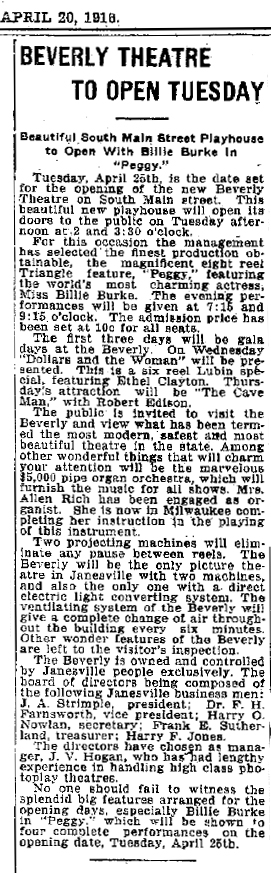
Posted by Konrad Schiecke (Member # 393) on 03-31-2014, 08:58 AM:
Refers to a direct current arc lamp system. Others of that era used ac arcs.
Posted by Ted Schaar (Member # 8158) on 03-31-2014, 09:03 AM:
Thanks, Konrad. Are there advantages of a direct current arc lamp system versus an AC system? Would viewers notice any improvement in the look of the film image?
Posted by Leo Enticknap (Member # 534) on 03-31-2014, 02:21 PM:
"Direct electric light converting system" = what we would now call a rectifier.
quote: Ted Schaar
Are there advantages of a direct current arc lamp system versus an AC system? Would viewers notice any improvement in the look of the film image?
High intensity carbon arc lamps need a low voltage, high current DC power source to work at all. The essential point this story is trying to make is that the projectors are equipped with high intensity carbon arc lamps (the technology was essentially invented by Elmer Sperry in the early teens, and started to be used in movie projector lamphouses at around the time your theatre opened), not gas/chemical illumination (e.g. limelight) or lower intensity, AC-powered arcs.
In short, it would be like a theatre advertising that it had 4K laser projection now - the state ot the art in imaging technology.
Incidentally, are you aware of the Center for Film and Theater Research at the University of Wisconsin-Madison? I'm guessing that their document archive might have material relating to film exhibition in the state which could be relevant to your research.
Posted by Ted Schaar (Member # 8158) on 03-31-2014, 02:31 PM:
Many thanks, Leo.
Posted by Steve Kraus (Member # 476) on 03-31-2014, 05:28 PM:
How did they avoid shutter flicker with an AC arc?
Posted by Leo Enticknap (Member # 534) on 03-31-2014, 05:36 PM:
My guess is that they didn't, and that they didn't care. In those days, the illusion of a moving image was so remarkable in itself that a flicker or strobe effect was just accepted as coming with the territory. So when the DC, rectified current lamp came along and got rid of a lot of the flicker, it was sold as being a step forward, which indeed it was.
Posted by Louis Bornwasser (Member # 3063) on 03-31-2014, 10:05 PM:
Leo. I see no errors in your process.
Posted by Lindsay Morris (Member # 1430) on 04-01-2014, 05:21 AM:
Not having ever run a machine on 60Hz supply as in USA I cannot comment... But on our 50Hz supply in Australia the flicker or more correctly the strobing of the AC fed arc timing with the 24FPS shutter would produce a slowly changing intensity of the screen light.
The quick and dirty fix was to wind a few turns of the old fabric type insulation tape onto the motor drive pulley and slightly increase the speed to around 25FPS and the strobing all but ceased.
In those days as well the slight increase in speed ever so slightly improved the top end frequency response and had barely any effect on the sound of the actors voices.
The later higher frequency rotary converters available took the arc AC frequency up to about 400Hz I think it was and problem solved....but cost a lot.
The insulation tape trick was cheaper and very popular amongst AC mains arc users ![[Wink]](wink.gif)
Lindsay
Posted by Scott Norwood (Member # 30) on 04-01-2014, 06:20 AM:
quote: Steve Kraus
How did they avoid shutter flicker with an AC arc?
Maybe just crank at 15fps? Assuming 60Hz power and a 2-blade shutter, that should do it. But wasn't DC municipal power available at that time, too? Why not just use that?
Posted by Gordon McLeod (Member # 33) on 04-01-2014, 07:44 AM:
The original low intensity arcs had a very large diameter carbon and as such the thermal lag tended to eiliminate a lot of the flicker
By the 40 Ashcraft came out with the cyclex which used ac 7mm carbons and a 400 hz mg set
Posted by John Eickhof (Member # 323) on 04-01-2014, 12:08 PM:
In the early days, for AC incandescent and AC arcs, the use of three bladed shutters(at silent speed 15-16 fps)increased the cutoff from 30-32 cycles to approx 48 cycles thus there was still some flicker but more so there was the slight variation in the light overall (variable light output as the shutter would interrupt the AC crossover) And of course there was an additional loss of light on the screen. However, 3 bladed shutters had one larger blade that barely covered while pulling film down, the other two 'cutoff blades' were smaller and the shutter only lost approx 5-8% more light than a conventional two blade. Once sound speed was established, larger DC arcs were being produced so the two blade shutter was the standard and still cut off at 48 cycles. Thus it was above the avarage person's flicker thresh hold.
Posted by Simon Wyss (Member # 6218) on 04-05-2014, 01:51 AM:
quote: Leo Enticknap
the technology was essentially invented by Elmer Sperry in the early teens
Sperry stole the invention from Heinrich Beck (b. September 20, 1878, d. August 17, 1937). Deutsches Reichspatent, number 262913, to Körting & Mathiesen, Inc. of Leutzsch-Leipzig, September 13, 1910. A perfectly working prototype was presented to the German navy in 1912.
Beck got stuck in the U. S. A. at the outbreak of the war and could only return home in 1920. The American patents were sold to GE.
http://www.becklaser.de/heinbeck/hbeckframeset.html
Posted by Leo Enticknap (Member # 534) on 04-05-2014, 11:00 AM:
Interesting! He has certainly slipped under the radar of the mainstream technological history books. Has any substantial biography or paper been published about him in English? I'm also wondering if a similar situation emerged in France and Germany with high-intensity carbon arcs as did with the Tri-Ergon optical sound patents: that the American manufacturers were severely limited in their ability to sell into the European market, because the technology had essentially been invented independently by others at around the same time, but whose patents protected them in much of Europe but not in the US (hence US-made variable density sound cameras being virtually unheard of in mainland Europe).
Posted by Jim Cassedy (Member # 4115) on 04-05-2014, 06:24 PM:
quote: Gordon McLeod
By the 40 Ashcraft came out with the cyclex which used ac 7mm carbons and a 400 hz mg set
I used to work at a theater that had a pair of old Cyclex lamps & MG sets in the
basement. I still have the manuals. The Cyclex lamphouses ran at 96hz.(not 400hz)
You can find quite a bit of interesting info on the old Cyclex lamps if you
look through the 1939-40 issues of International Projectionist.
Posted by Simon Wyss (Member # 6218) on 04-08-2014, 11:56 AM:
quote: Leo Enticknap
that the American manufacturers were severely limited in their ability to sell into the European market
As far as I know about the photographic sound initiatives, there were conflicts not to be underestimated but these got settled with the 1930 Paris sound film agreement. RCA and Western Electric actually shared the entire western world among them while Europe was divided into continent and Britain. Much like the MPPC trust that closed the US from 1909 to 1915 the sound technology was held in firm hands until the patents expired. The last ones run off in 1943.
As a side note, Bell & Howell executives knew already in 1924 that they would lose the studio floor camera realm to Mitchell when 1000-ft. magazines were asked for on Vitaphone cameras. As soons as the Mitchell NC became available, 1927-28, Chicago had no choice than change direction towards a) substandard ciné equipment, b) projectors, also substandard, and c) substantially improved handheld cameras. The Eyemo got a three-port turret in 1929, a high-speed governor in 1930, and in 1931 the reflex shutter system was licenced to Germany.
Posted by Leo Enticknap (Member # 534) on 04-08-2014, 06:35 PM:
Many thanks.
quote: Simon Wyss
there were conflicts not to be underestimated but these got settled with the 1930 Paris sound film agreement.
That's really what I meant by "severely limited". Unlike in the rest of the world, there had been significant invention and patent activity in Europe (mainly Tobis/Tri-Ergon) in that area by the time the American systems were ready for the market. That was why the ERPI conference/settlement had to happen at all, and also why in Britain, various rebadgings and ripoffs happened in order to circumvent the agreement, e.g. Visatone-Marconi (almost certainly reverse-engineered RCA Photophone) and British Acoustic Film (rebadged Tri-Ergon/Tobis).
Posted by Simon Wyss (Member # 6218) on 04-10-2014, 02:12 AM:
The inventors:
Eugène Augustin Lauste (b. Jan. 17, 1857, d. Jun. 27, 1935) pat. app. Aug. 11, 1906 by Robert Thorn Haines, iss. 1907
Sven Archadiusson Berglund (b. Jul. 20, 1881, d. May 1937), early work in 1906, DRP 282'778, Aug. 28, 1912; world’s first public presentation of synch sound film in Stockholm, Feb. 17, 1921; multiple strand var. ar.
Boyer, Cinéphone 1913 (?)
Dénes v. Mihály (b. Jul. 7, 1894, d. Aug. 29., 1953), var. dens. with tungsten arc lamp 1914, Projectophon pat. 1917, then joins with Bristol (Bristolophone)
Theodor W. Case, Earl Ives Sponable, Case Research Lab. 1916, var. dens. AEO Light Nov. 1922 (Thalofide Cell), sold to Fox in 1926; Fox Movietone News Apr. 30, 1927
Hans Vogt, Joseph Massolle, Dr. Jo Engl, Tri-Ergon 1918, 42-mm. film, premiere Sep. 17, 1922 at Alhambra, Berlin; Jul. 5, 1927 U. S. licence to Fox against $50,000; licence to UFA for Germany, to be cont. as option to world rights until Dec. 31, 1925, contract until Jun. 30, 1940
Lee de Forest, begins 1919, first sound film Jul. 9, 1921, Nov. 1922 with Case, acquires rights from E. E. Ries patent Nov. 16, 1926 (app. 1913, iss. 1923); Forest Audion Tube US pat. 841,386 Jan. 15, 1907; Robert v. Lieben, Kathodenstrahlrelais 1906
Bullis, Whitson; pat. phot. sound proc. 1920
Harry Grindell-Matthews, sound film Sep. 26, 1921; see U K Wikipedia
Charles Hoxie (Pallophotophone) and C. W. Hewlett experiment at RCA, Bell Telephone Labs Dec. 27, 1924; RCA Photophone, Inc. Mar. 22, 1927; resonance at 10 kHz
Joseph Tykociner Tykocinski leaves Westinghouse in 1921, var. dens., picture and sound between hole rows of standard film Jun. 9, 1922 Univ. ILL
Axel Petersen and Arnold Poulsen var. ar. Oct. 12, 1923 in Copenhagen, two films; licence to Deutsche Tonfilm-Ag. in 1926, from there to TOBIS; lic. to Léon G. (Cinéphone Gaumont-Petersen-Poulsen, 1928); Ortofon AS 1951
Dr. Edward Christopher Wente, condens. microphone US pat. 1,333,744 Mar. 16, 1920, and ? Nakken with Bell Tel. Labs, perfected Jun. 8, 1926; var. dens., resonance at 9500 Hz, loudspeaker built by J. P. Maxfield in 1925; to Warner Bros. 1930
Erwin Gerlach with Siemens & Halske, var. ar. 1927; Kerr cell by Prof. Karolus, 1927
Selenophon-Gesellschaft, Vienna 1929, diss. by Nazi Germany in 1938; var. ar. and var. dens., resonance at 14 kHz
Powered by Infopop Corporation
UBB.classicTM
6.3.1.2