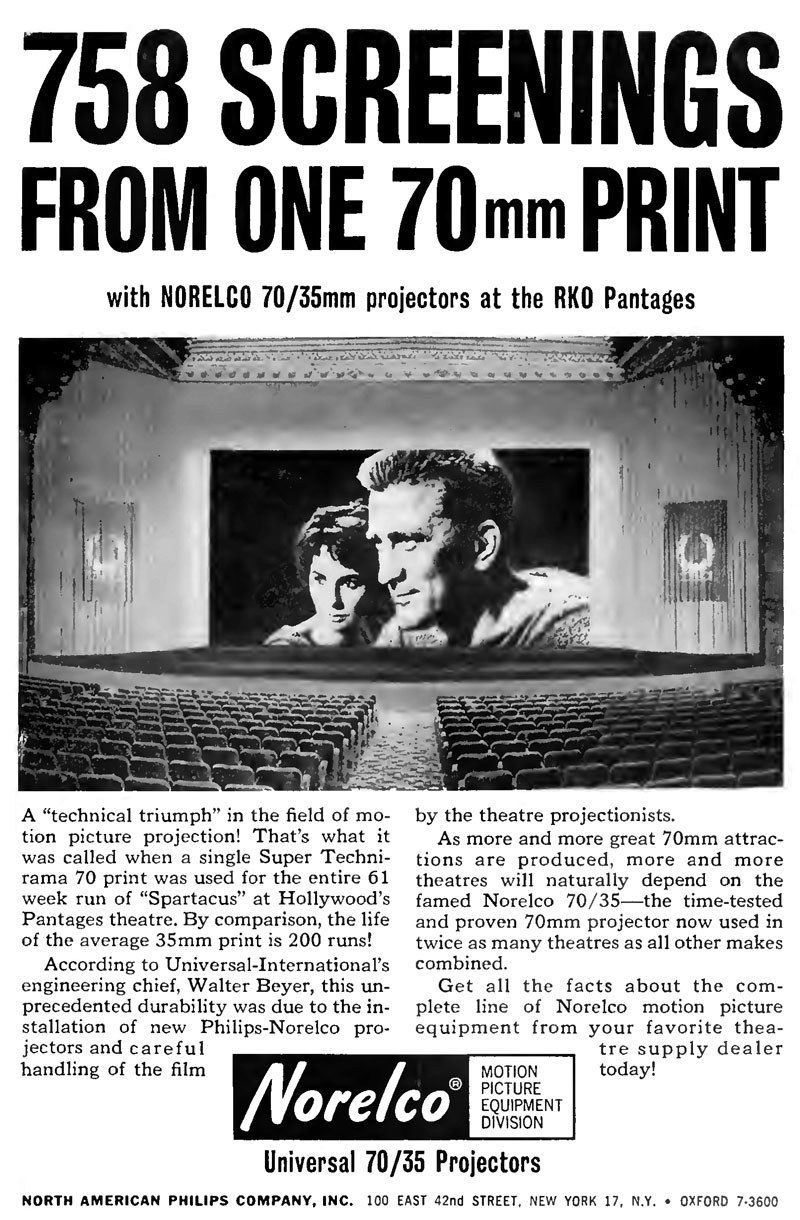
This is topic Service Tech Opinions on 70mm Norelco Ad in forum Film Handlers' Forum at Film-Tech Forum ARCHIVE.


To visit this topic, use this URL:
https://ft-forum.com/ft/cgi-bin/ubb/ultimatebb.cgi?ubb=get_topic;f=1;t=011656

Posted by Steve Matz (Member # 1890) on 05-07-2014, 09:45 PM:
 
Having a little back and forth exchange on the 16mm Film-talk concerning how many projections a Print can endure before it's not presentable in a Theater Venue any longer. Obviously a number of Factors play into this.(i.e. Competent Projectionist,Equipment,Gate/Pad Pressure,Cleanliness of Transport/and Print,etc.

I'm not sure which Model Norelco this ad would be referring to at the Pantages back then; Possibly a DP70. What I would like to hear from Service Techs up here that have worked on these Norelco's is this a Realistic situation in a general 70mm Booth.
Since Norelco was promoting the sale of this model Projector; I'm sure everything was treated with kid gloves concerning Print Handling, Projector Setup,Maintainence,etc. I IMHO feel that this is an exception to the Rule. I believe the Projector/s supplied to the Pantages for this Showing weren't your off the assembly line Projector that would be going to General Movie Houses.

I think these were probably meticulously hand assembled units that were indexed and blueprinted beyond anything the average Theater would receive. After all our reputation is at stake here also.I haven't heard that much from Projectionists on these machines as to how gentle they are on Film,reliability,etc.

Your Feedback on this Ad would be most informative and appreciated, Thanks!....S.M.

 -
 
Posted by Brad Miller (Member # 2) on 05-07-2014, 11:06 PM:
 
758 passes from a print is actually very easy to do on a LOT of different equipment. For example the GCC Northpark put more passes on 70mm prints than that with Century JJs and never had a mark on them.
 
Posted by Steve Matz (Member # 1890) on 05-07-2014, 11:41 PM:
 
Found this Neat Video of A DP70 used in a Home Venue. I'm still not sure if this would have been the Model used back then at the PANTAGES for the "SPARTACUS" Showing. The video covers both 35mm and the conversion to 70mm. I've heard both sides of the coin regarding NORELCO Projectors. I know like any other make your going to have your PROs and Cons. Since I have never ran one I can't critize or Defend its Engineering and Reliability. It looks impressive in the Video... (about 9+ minutes long)

http://www.youtube.com/watch?v=uY00JZhfR9M
 
Posted by Leo Enticknap (Member # 534) on 05-08-2014, 12:04 AM:
 
That's Ben Wales in the video, isn't it?

When Kodak launched triacetate stock in 1948, they published an SMPTE Journal article, which included the results of research in which they tried to establish the typical life expectancy of a release print in a normal, suburban theater situation. The problem with pre-triacetate safety stocks (diacetate, butyrate and propionate, mainly) was that they were a lot more fragile and expensive than nitrate. These tests were designed to convince studios and theater chains that the new safety stock was as good as nitrate in terms of tensile strength and durability.

My memory is hazy and I don't have a copy of the article immediately to hand (nor a subscription to look at the PDF online), but if I remember correctly, a nitrate print was considered to be capable of withstanding 500-600 projections in what were then considered to be normal projection booth and handling conditions.

But of course a prestige theater in downtown Hollywood is not exactly normal booth and film handling conditions: it's going to have better maintained equipment and probably better trained personnel than a second-run suburban house. It's not really the model of projector that's the biggest determination of print life, but rather the quality of maintenance and film handling in the booth, and how a print is used. A print that plays three bookings a month is probably going to wear out a lot more quickly than one which stays in the same booth, playing four times a day for many months.
 
Posted by Claude S. Ayakawa (Member # 1401) on 05-08-2014, 12:19 AM:
 
I saw SPATACUS at the Pantages in Hollywood back in early 1961 from way in the back of a deeply sloped stadium seat theatre. The movie was great but the viewing experience in this theatre from where we sat was not a good way to see films. The Pantages as I remember was a very huge house.

-Claude
 
Posted by Monte L Fullmer (Member # 2797) on 05-08-2014, 12:56 AM:
 
When "Titanic" opened up in 1997, I ran a print through a P35GPS Christie where when that one print left our complex in July of 1998, it never obtain a scratch during the 7 month run on that print .. and my splices had never any hinge issues or signs of weakening.

We didn't have FG, but had Kelmars, mounted on our AW3R platters to keep the print clean as possible.
 
Posted by Louis Bornwasser (Member # 3063) on 05-08-2014, 05:42 AM:
 
35mm Smokey and the Bandit played 5x a day for 14 months. It was not a new print when we got it. Color faded and the sprocket holes were longer but very watchable at the end.Century SA and Autowind 2. Louis
 
Posted by Stephen Furley (Member # 1277) on 05-08-2014, 05:42 AM:
 
If this was early '60s (61?) it would have been DP-70s. I think the last ones were built in 1967 and there was a couple of years or so overlap in production between those and the first DP-75s.
 
Posted by Rick Raskin (Member # 1561) on 05-08-2014, 06:28 AM:
 
A projectionist at Colonial Williamsburg once told me they got 2000 runs on a 70mm print of "Story of a Patriot" before discarding it. That was on JJs.

I heard they recently ordered 6 new 70mm prints. So if true, 70 will be alive there for some time to come.
 
Posted by Steve Guttag (Member # 268) on 05-08-2014, 06:49 AM:
 
The DP70 was certainly one of the most gentle projectors ever made. The film had no aggressive turns. The tension could be maintained better than others (continuously adjustable gate tension and the clutches were better than most). It also used large sprockets which distributed any tension over more perforations than most of the others.

That said, I've never had to replace a print and at the Uptown in DC, we ran Century JJs and our typical run would be many hundreds of shows...400-500 was not unusual. We wore out Teccon mag heads there from so many runs.

Of the machines I personally ran, I would put the Simplex 35/70 as the harshest of them due to its gate design (or lack there of). Anyone that knows that projector knows it truly was just the PR1014 with wider sprockets and spacers to adapt the standard 35mm parts to a 70mm system. It is caught between 65 and 70mm as the sprockets and gate/trap are not 70mm wide as such it has piss-poor lateral stability and the intermittent shoes rub across tracks 2 and 5 on the mag tracks. This will leave marks/wear on those two tracks only. In fact, I've seen, in some theatres, where they were worn OFF. One had to space the shoe off the sprocket, like a pad roller to avoid aggressive wear.

Compare that to the Norelco where the intermittent used an actual pad roller and the sprocket had a significant wrap around it to distribute the tension.

The Century JJ is like walking in a mine field...if you know where the mines are, you can navigate around them. I always found that the JJ did better on 35mm than the SA too.

I don't have experience with the Ballantyne but the Walt Disney Company did/does. They used them pretty much exclusively and they definitely would get more than 700 passes on a print. They were/are used on their attractions at their theme parks (though many/most have now been replaced by digital).
 
Posted by Richard Fowler (Member # 893) on 05-08-2014, 08:36 AM:
 
We averaged 3500+ passes of 35mm film at Planet Ocean Museum in Miami. Ballantyne Pro with VKF sprockets and a film cabinet with compressed air film cleaning. We could do more but the image color was a change issue.
 
Posted by Bill Gabel (Member # 1105) on 05-08-2014, 01:02 PM:
 
The Pantages theatre engagement of "Spartacus" was a Roadshow run. Which ran one or two shows a day and the first 70MM engagement for the theatre. During that time frame the theatre was a two man Union booth. Those Norelco's were installed in 1960 and lasted till 1977 when the theatre closed as a movie theatre and was reopened for Broadway touring shows. They were removed during that time and during the mid 1990's we reinstalled 4 Norelcos back into the theatre. I worked for Pacific Theatres during that time.

On the seating for this engagement, Kubrick had the theatre reduce the seating capacity by curtaining off parts of the auditorium on the far sides and in the rear balcony. The theatre went from 2700 seats to 1512 seats for this engagement.
 
Posted by Steve Matz (Member # 1890) on 05-08-2014, 01:19 PM:
 
Very Interesting responses; I guess my skepticism comes from back when all of our indoor theaters in the 50's and 60's were using E7 Simplex's that had been installed as far back as 1941 at the FOX Theater. The 2 projectionists that I knew well enough to know they were Competent Old School Licensed Electricians and could fix anything in their Booths use to tell me on any long run feature that went 12 weeks or longer; they usually asked for a replacement Print after around 7 or 8 weeks.

I know these Projectors were well maintained as I remember being in 2 of these theater's Booths and they were immaculate. The Projectors,Lamphouses,Rectifiers,etc. still looking like they were brand-new.

So if you know your Projectionist is more than competent and keeps a clean projector/equipment,print,etc., is conscious about using minimal Gate/pad pressure short of Flutter,etc. Why would these prints have to be replaced in roughly a 2 month period with an average number of 6 showings a day/night. I know from talking to other old school Projectionists that ran numerous brands of Projectors back then always said Simplex(super,E7,XL straight gate) were rougher on film than other Brands. Even the NORELCO AD said the average life of a 35mm Print was 200 or so Projections. If Simplex's were that rough on Film why were there so many out there and the company surviving while others folded in the 50's. I know going to a curved gate improved the later XL's but I hear more Cons than Pros on them being Rougher on Film than any of the Other Mfgers Equipment...
 
Posted by Sam D. Chavez (Member # 1841) on 05-08-2014, 02:09 PM:
 
Simplex were and are not any rougher on film than other projectors. There are a lot of XL's out there grossly out of adjustment. Film tension way too tight, etc.

The projectionists you mention, good as they were did not usually get a lot of experience on other brands being rooted in one booth or smallish geographical area so what they were citing were opinions gathered from talking to other operators. Anecdotal at best.

A lot of operators loved the Motiograph because it was an intricate device, but proof of the pudding...
 
Posted by Bill Gabel (Member # 1105) on 05-08-2014, 02:10 PM:
 
What years are you talking about for those 12 week runs and what size city and was it a single screen?
 
Posted by Steve Kraus (Member # 476) on 05-08-2014, 02:16 PM:
 
I think 70mm mag benefits from the mag stripes creating a hair of space from the next layer of film on the reel or platter.
 
Posted by Steve Matz (Member # 1890) on 05-08-2014, 04:21 PM:
 
[quote]What years are you talking about for those 12 week runs and what size city and was it a single screen? [quote]

Well some of the first longer runs were probably before my time but Films like "The Ten Commandment","Ben Hur" had long engagements. In the 60's "Mary Poppins" went 16 weeks from what I remember. Of course these are single Screen theaters,one of them being built before 1920.Because our FOX Theater was part of their chain we got "THE ROBE" 2 months after it's Premiere and the theater had already been converted for SCOPE in mid 53.I think it still only played 2 weeks back then.

When "STARSWARS" Played at the Babcock Theater in 1977 it had a 13 week run with a brand new Lab Print. That Projectionist said they asked for a replacement print after week 8 if I remember correctly.

Most of the Old School Projectionist that I conferred with over the decades are Gone Now,So what happen in their Booths and the way they ran Film back then has gone with them. I can't speak for the XL but I've been more than around the Block on interviewing Projectionists in many cities who Ran E7s and a big Majority of them although they Loved the Projector said it wasn't that Gentle to Film. If NITRATE was able to take more abuse than Safety Film then those Prints should have been able to go longer runs...
 
Posted by Claude S. Ayakawa (Member # 1401) on 05-08-2014, 06:20 PM:
 
A 70mm print of THE SOUND OF MUSIC print played for over a year at the Kuhio Theatre here in Honolulu before it had to replaced with a 35mm during it's 1st run road show engagement.

-Claude
 
Posted by Michael Coate (Member # 757) on 05-08-2014, 06:24 PM:
 
quote: Steve Matz
In the 60's "Mary Poppins" went 16 weeks from what I remember.
My research shows that the first-run "Mary Poppins" in Billings was for 3 weeks.

quote: Steve Matz
When "STARSWARS" Played at the Babcock Theater in 1977 it had a 13 week run with a brand new Lab Print. That Projectionist said they asked for a replacement print after week 8 if I remember correctly.
First-run "Star Wars" in Billings was at the Rimrock 4 and ran 27 weeks.
 
Posted by Rick Raskin (Member # 1561) on 05-08-2014, 06:29 PM:
 
I ran just about every type of machine in the DC area and none of them were particularly rough on film. You have to realize that in those days we seldom got lab new prints. Even in first run houses the prints had often been run elsewhere. Many times though we'd get a new green print that would shed like crazy in the machine, necessitating complete cleaning at each thread-up.
 
Posted by Bill Gabel (Member # 1105) on 05-08-2014, 06:57 PM:
 
I got to run over 60 theatres over the years in the Los Angeles market. I also got to run almost every kind of projector made. It all depended on what part of the food chain your theatre was on as to the type of print you got from the film depot. The first run houses in Hollywood and Westwood areas got back-up prints.
 
Posted by Steve Matz (Member # 1890) on 05-08-2014, 07:27 PM:
 
Michael Coate: I don't know who compiled the information you posted but they either got their Cities/theaters wrong or their outright Liars. The Rimrock 4 never even existed in 1977 and everytime I went downtown for Months "MARY POPPINS" was still on the Marque,even after the new school year started in September. Now I see Why when a person looks up History/Film Info on a Certain Theater/Movie House it's usually inaccurate much of the time. These People need to look for another JOB....
 
Posted by Sam D. Chavez (Member # 1841) on 05-08-2014, 08:00 PM:
 
Well this is interesting.

Coate's data has a lot of credence even when it disagrees with my memory.

[evil]

On the other hand, I have to believe Matz remembers when the Rim Rock was built so there is a discrepancy. No reason to call someone doing research a liar though.
 
Posted by Steve Matz (Member # 1890) on 05-08-2014, 09:35 PM:
 
SAM: I wasn't directing my Comments directly at Michael.I have found MP Related sites that have completely inaccurate information on everything from what theaters were in your town/city and the years they opened/closed. I think people that compile information that is Put on WebSites need to do multible verifications first....
 
Posted by Adam Martin (Member # 641) on 05-08-2014, 10:18 PM:
 
Rimrock opened on October 15, 1975, and was profiled in Box Office Magazine that December.
 
Posted by Sam D. Chavez (Member # 1841) on 05-08-2014, 11:50 PM:
 
I did my bit. Steve's on his own.
 
Posted by Steve Matz (Member # 1890) on 05-09-2014, 12:44 AM:
 
Well I'm sure glad that People that live in other States know more about the Town I lived in close to 65 years. I believe That would have been Rimrock 5(actually carmike 7 which was a CARMIKE THEATER on Overland Ave and is now an Empty Building slated for an Office Complex.Probably why they went out of business, they gave the address of a large mall we had on 24th street W called Rimrock Mall. Everytime they added a theater they changed the number and confused even the Yellow Pages. Come on Guys your making me look like I've got ALZHEIMERS!I've got a good five years before that happens [beer]
 
Posted by Scott Norwood (Member # 30) on 05-09-2014, 06:26 AM:
 
So, for those who felt the need to order replacement prints in the middle of a long run of screenings, did the distributors pay for those or did the theatres? If the former, then this ad campaign seems a bit odd to me, since theatre owners do not normally buy prints.

There are plenty of things to like about Norelco projectors, but this does not seem like the sort of advantage that would encourage theatre owners to buy then. A better campaign might have provided information about the parts and service cost on these machines (since the parts almost never need replacement).

Plus, as mentioned above, print life is heavily dependent on the operators and the Pantages likely had far better operators than the average theatre of the time.

Today, with polyester prints, don't Imax venues regularly get 2000+ screenings out of a print?
 
Posted by Steve Guttag (Member # 268) on 05-09-2014, 07:08 AM:
 
Another thing about Mike...he normally has the newspaper evidence to back up his statements. I know very few people that tend to do more research on his info than Mike. If his source data was wrong or interpreted incorrectly, he will generally come clean on that too. That is the kind of guy he is so this will be interesting.

I know that people often have memories of things that are not quite accurate to the empirical evidence available.

Newspaper evidence is normally pretty good about locations showing a movie though not always accurate about the format it is shown in. I know back in the day, they would not always put the asterisk or box around our theatres correctly. Generally they got the 70mm locations right though.
 
Posted by Mark Lensenmayer (Member # 134) on 05-09-2014, 09:49 AM:
 
Box Office article on Rimrock 4
 
Posted by Mark Gulbrandsen (Member # 72) on 05-09-2014, 11:03 AM:
 
Back in the day prints used to fade just from being run so many times. Early Eastman was not long lived and the short life was exacerbated by the high heat from the huge arc lamps in use at the time. The DP-70 still offers the best cooling of any 70mm projector out there. The gate plate on them is silver plated copper as are the aperture plates. Some prints would have to be replaced during a very long run road show engagement ... and most of them were run just twice daily. Beginning in the mid 1970's prints began lasting much longer with Fuji making some real breakthroughs. Just imagine running an Imax with a 15kw lamp on that old early 1960's 70mm stock... 50 to 100 passes perhaps at best!

Mark
 
Posted by Victor Liorentas (Member # 5272) on 05-09-2014, 01:11 PM:
 
At our 70mm house in London the Park theater played The Empire Strikes Back exclusively all summer in 70mm.

By the end of it's long run the Fox logo had been removed and entire sections of it,a few seconds here and there.Not sure how much but I was given about 3 seconds of an important space shot. Imperial march introduction.

They had to switch to the 35mm back up for the final week which was end of September.
The piece I have showed a brittle sprocket damage state.

Over the years I heard these prints were prone to succumbing to brittle damage but I also heard it was being mis threaded too often.
I know Jedi ran without these issues 3 years later but perhaps they were aware of the problem by that point.
They were dual Vic 8 carbon arc.
 
Posted by Sam D. Chavez (Member # 1841) on 05-09-2014, 01:30 PM:
 
Disney ran 70mm on Star Tours rides in Orlando and got 5000 runs before replacing prints due to color fade. Polyester stock. Occasional mechanism failures would result in the projector and blimp being ripped out. They had spares ready to go.
 
Posted by Steve Guttag (Member # 268) on 05-10-2014, 06:47 AM:
 
The K-B Cinema in Washington, DC played Empire Strikes Back in 70mm from the opening day until about November (don't remember the month exactly)...but Paul McCartney's "Rock Show" replaced it. In any event, same print for the entire run and virtually blemish free.

The projector(s)? Norelco AAII. Those machines started life at the K-B Apex and were there until it closed in 1976ish. They were then donated to the Loews Jersey.

At the Cinema (or any K-B Theatre) we never needed a replacement 70mm print. Our worst 70mm experience at the time was running Temple of Doom on the Christie AW3 in 70mm. The humidity that summer combined with that film stock and how Christie arranged the center cluster rollers would pinch the film at the bottom and the film would un-thread itself in mere moments. Flipping the film had the film film "hug" the center roller and one location put a "guard" on the guide posts to prevent the film from being able to slip out on its own.
 
Posted by Leo Enticknap (Member # 534) on 05-10-2014, 03:46 PM:
 
quote: Mark Gulbrandsen
Back in the day prints used to fade just from being run so many times. Early Eastman was not long lived and the short life was exacerbated by the high heat from the huge arc lamps in use at the time.
And some were faded by repeated projection, but not time. If you get a 70 year-old IB print that has hardly been projected at all, the colors are likely still to be great (assuming nitrate decomposition hasn't done for it). But a 1960s one that has done 500 passes will have thin, washed-out dyes. Same thing with Kodachrome reversal dupes.
 
Posted by Steve Matz (Member # 1890) on 05-10-2014, 05:46 PM:
 
I always wondered on CINERAMA where they were projecting 3 separate 35mm Prints at once if one or more Prints started wearing more than the others and upset the projection IMAGE Balance after a long period of time. I never heard how many projections they were getting from a print back then. I think the Cinerama Venue we saw in Seattle during the Worlds Fair in 62; they were using Century C Projectors...
 
Posted by Mark Gulbrandsen (Member # 72) on 05-11-2014, 02:55 PM:
 
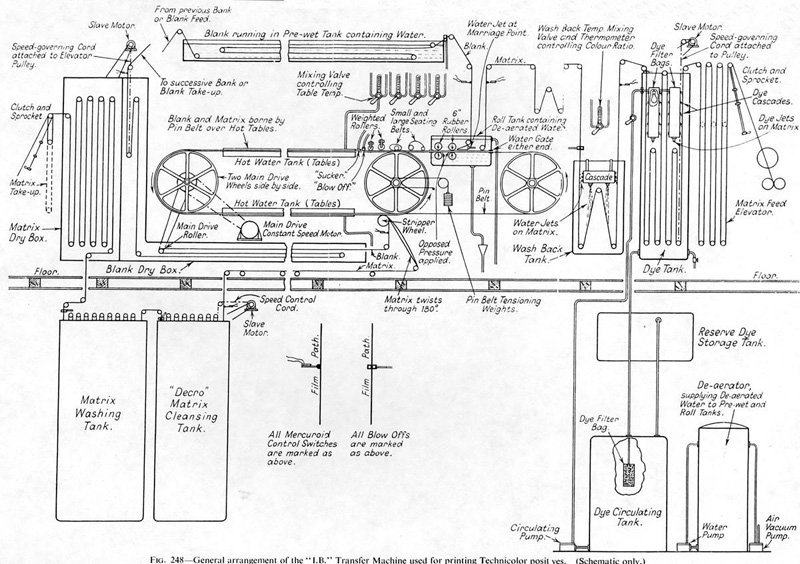
Most big Cinerama pictures were dye transfer Technicolor. Those prints are still being projected to this day. Technicolor kept a 1000' reference reel of every film they printed so they could make exact duplicates again at a later time. And since Technicolor could change the color balance and density somewhat on the fly it was easier to keep them matched up. Technicolor printing was an absolutely amazing process and if you study the materials, chemicals and equipment used to do it it is really amazing that it could even be done. There were some Eastman 3 panel movies though. Windjammer I believe was Eastman... at least the surviving ones are. Cinerama Holiday had some Eastman prints. Eastman is also not too difficult to match up when printing as this is a known art but is about to vanish for ever.

The following diagram shows just one third of the printing machine. There were stages just like this for Magenta, Yellow and cyan dyes. The completed print was dried and went through high speed inspection projectors and reels were put on cores and shipped. The cool thing is it was carried out in the light. Once the sound track and frame lines were printed onto the receiver film and processed there was no light sensitive film to worry about.

 -
 
Posted by Robert Furmanek (Member # 7026) on 05-11-2014, 11:09 PM:
 
Mark: I was under the impression that none of the three-panel films were printed in dye-transfer until the early sixties with HOW THE WEST WAS WON, BROTHERS GRIMM and a reissue of scenes from THIS IS CINERAMA as THE BEST OF CINERAMA?
 
Posted by Mark Gulbrandsen (Member # 72) on 05-12-2014, 08:54 AM:
 
The print of This Is Cinerama I watched in Dayton was very definitely dye transfer.
 
Posted by Robert Furmanek (Member # 7026) on 05-12-2014, 09:11 AM:
 
I'm pretty sure that's a 1960's printing.
 
Posted by Mark Gulbrandsen (Member # 72) on 05-12-2014, 09:27 AM:
 
Hard to say. I do remember John saying it was made up out of a number of different prints as were most of his 3-panel films. The prolog was the drive in version in spite of the fact that I had sent him an original 35mm B&W prolog I found in the Palace Theater booth in Chicago.
 
Posted by Steve Matz (Member # 1890) on 05-12-2014, 04:20 PM:
 
Thanks Mark, Very interesting about having a Reference Print for Cinerama Productions which would make sense since you want all those Prints to have the same consistency. Reading the Book on the Making of Wizard of Oz and all the work both in actually Filming 3 strip Technicolor and the complicated and expensive Lab Processing.It still is amazing how many films were made threw the Years using that process...

Intersting to note that Technicolor Corporation didn't sell any of their Equipment to Studios or anyone for that Matter. it was all leased out and at the time of Filming Wizard(1938); there was a 2 year waiting list from different Studios that had a feature they wanted to shoot in 3 Strip.

Employees of Technicolor would deliver the Cameras,Equipment,etc. early in the Morning and stay there all day til Shooting was over for that day; than load everything back up and take it to their headquarters where it was inspected,cleaned, etc. then delivered again the next day for that day of Filming. Technicolor never let any of their cameras,etc out of their site or left them over night at any Production they were being used.

There is a 3-strip Tech Camera in the Smithsonian and I believe a couple more still in existence. One of them way back when fell into the Grand Canyon some how.

 -
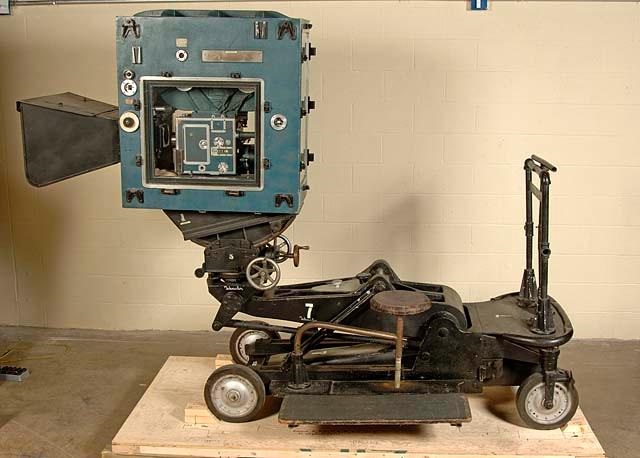
Technicolor DF-24 3-Strip 35mm Beam Splitter Camera
 
Posted by Leo Enticknap (Member # 534) on 05-13-2014, 12:17 AM:
 
Two cameras were exported to Britain in the late '30s and were in constant use until 1955 (including throughout WWII). The wet leasing and "color consultant" system operated there, too, and there was a dye transfer printing line at their UK lab in West London. At least one of them is now owned by the National Media Museum in Bradford, though when I saw it in, I would guess, 2003 or '04, it was in an exhibit store and not on public display. The curator who showed it to me told me that it was in fully working order, and that he was trying to get a project together to shoot some new footage on it, with surviving cinematographers and camera assistants who used it in the '40s and early '50s. I don't know if that ever happened, or where the other one is (or even if it still exists).
 
Posted by Thomas Hauerslev (Member # 566) on 05-13-2014, 05:00 AM:
 
Amadeus had a very long run in London - see this add: http://in70mm.com/library/70mm_in/england/london/images/amadeus_1082.jpg

"South Pacific" played 4 years in Copenhagen 1958 - 1962 - maybe only 2 70mm prints.

There are many other examples. The DP70 is the best - simple!
 
Posted by Stephen Furley (Member # 1277) on 05-13-2014, 07:28 AM:
 
Wasn't there a 3-strip in MOMI at one time? There was certainly one in the Science Museum in London before they removed from display just about anything of interest.

There's a famous picture of an actress being filmed by a blimped camera, I can't remember what the film was now, but other than that I've never seen the blimp for it. I was at an event some years ago where Jack Cardiff talked about mounting the prism in the first camera to arrive in this country.

Of course, Kodak introduced the dye-transfer printing process for still photography, sometime in the '40s I think. By the '70s it was alreadty in decline, and something over twenty years ago Kodak discontinued all of the materials, but a handful of photographers bought up stocks of all the materials while they were still available, and somebody even tried coating their own matrix film.

The photographer Ctein finally stopped making dye transfer prints a few months ago, and is selling off his sets of work prints and matricies, at a much lower price than his normal prints. The print I was sent is a very good one, and of course for still photography where the matrix size is the same as that of the print, as opposed to a cinema print there the image is greatly enlarged onto the screen, the reduced sharpness is not as noticeable as it is with a cinema print.
 
Posted by Jim Cassedy (Member # 4115) on 05-13-2014, 10:42 AM:
 
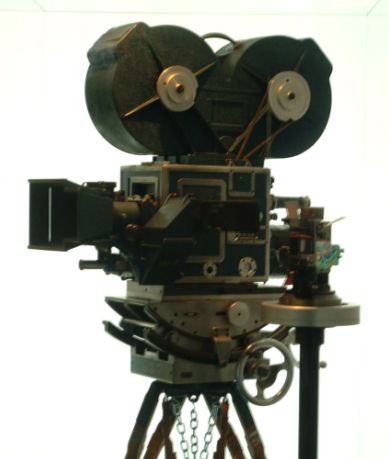
This (unblimped) 3-Strip Technicolor Camera is
at the Disney Family Museum here in San Francisco
and was apparantly used on several Disney films:
 -

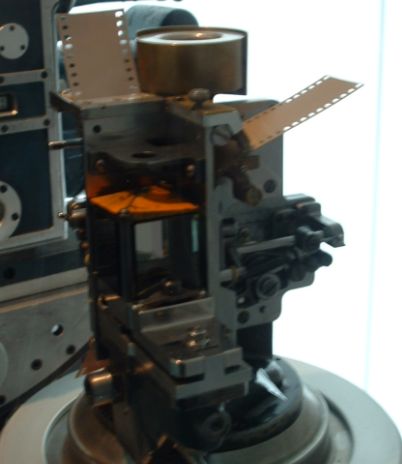
Also with the camera is displayed this "spare"
prisim assembly & movement for the Tehnicolor
camera. I was there doing a projection job and
I didn't have my good camera with me, so this
pic isn't the greatest, but the beam-splitter
prisim is on the left, the gate & pull down
is on the right of the mechanism.
 -

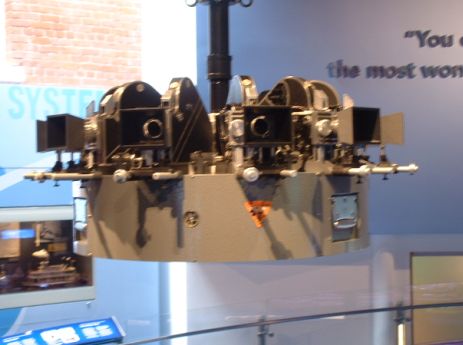
If you're ever in SF, the Disney Museum has lots of Disney related film
'hardware' including one of Walt's muliplane animation cameras, a huge,
custom built optical printer, & even an original "circlevision" camera rig:
 -
-jc-
 
Posted by Robert Furmanek (Member # 7026) on 05-13-2014, 03:06 PM:
 
From Cinerama expert, Dave Strohmaier.

"All the travelogues (incl. Windjammer) were eastman color prints to keep a first generation image on the screen.

They could advertise as Technicolor as thats the lab they used and M.C. Cooper was on the board of Technicolor or something.

Later TIC was done as IB tech Probably in 1959 -60

The Renalt commercial did have a few IB tech prints made."

As I expected, none of the travelogs were dye-transfer in their initial runs.

By the way, Steve didn't mention it but we provided the Norelco ad that he shared at the start of this topic.

Additional material can be found on my website: www.3dfilmarchive.com
 
Posted by Steve Matz (Member # 1890) on 05-13-2014, 04:26 PM:
 
How a 3-strip Technicolor camera like the DF-24 Beam Splitter worked was as follows. Two strips of 35 mm black and white film negative, one sensitive to blue light and the other to red light, ran together through an aperture behind a magenta filter, which allowed blue and red light to pass through. A third film strip of black and white film negative ran through a separate aperture, behind a green filter. The two apertures were positioned at 90 degrees to each other, and a gold-flecked mirror positioned at 45 degrees behind the lens allowed 1/3 of the incoming light to go directly through to the green-filtered aperture, and reflected the remaining light to the magenta-filtered aperture. Because of this division of light between three film strips, Technicolor photography required much more lighting than black and white photography. These Lights I believe were called Klieg(sp)Lights and put out a tremendous amount of light that actually caused eye damage to a number of actors in Wizard of Oz. Just The Electric Bill for "Wizard" back then was over a 1/4 million Dollars.Technology advancements in Film stock later on made it possible to not have to use those Powerful Lamps in Future Productions...

Bob Furmanek: my apologies Bob, for not mentioning your name on the Norelco Ad. Sorry; Brain Fade!
 
Posted by Robert Furmanek (Member # 7026) on 05-13-2014, 04:44 PM:
 
That's okay Steve, it's all good!
 
Posted by Claude S. Ayakawa (Member # 1401) on 05-13-2014, 06:58 PM:
 
I have known Philip Stewart Charis, M. photog, Cr. for many years now and have always admired his work that equals the beauty of many of the great portrait artists of the past such as Rembrendth Van Rijn, Thomas Gainsborough, Joshua Reynolds and American artist Gilbert Stewart. I do not know if he is still doing it but for many years, Mr. Charis created only dye transfer prints for his clients .

As a student at Brooks Institute in the early sixties, I learned how to create die transfer prints but never applied it during my very long photographic career.

-Claude
 
Posted by Michael Coate (Member # 757) on 05-16-2014, 01:45 AM:
 
I wasn't planning on chiming back in, but it would appear some of you are anticipating a double-check on my part. So, to be fair, here goes...

 -
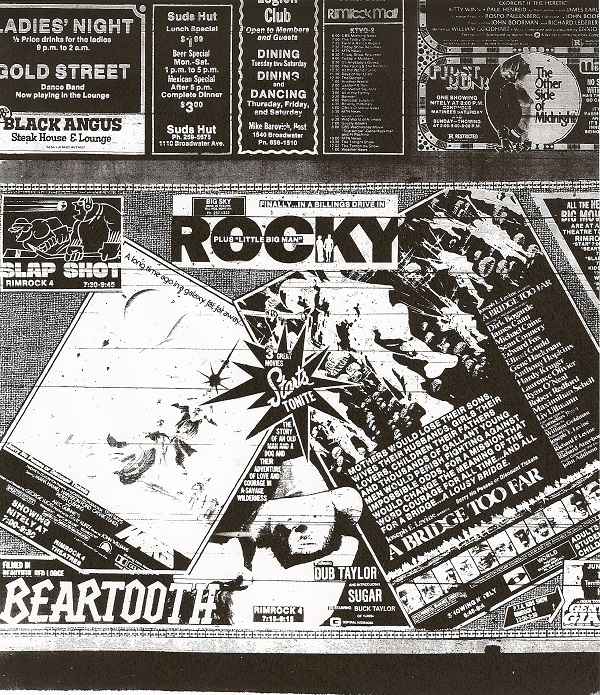
Billings Gazette, June 15, 1977

It's a strangely-designed ad, for sure, but if you look at it carefully you'll see "Star Wars" is playing at Rimrock 4. Also, in the upper right corner you can see a different movie ("The Other Side of Midnight") playing the Babcock.

As for "Mary Poppins," it checks out as a 3-week first-run engagement (at the Fox) beginning April 13, 1965, and closing May 5, 1965 (and replaced on May 6 with "Circus World"). So...I think Steve Matz is simply confusing it with another movie. "The Sound of Music," perhaps? Same lead actress... same genre... it played for several months...
 
Posted by Steve Matz (Member # 1890) on 05-16-2014, 04:37 AM:
 
OK,I admit I screwed up on Mary Poppins;I remember it being Julie Andrews so it was actually Sound of Music. I remember it starting before School was even out in May 65 and running the whole summer even after the new school year started in the Fall.The Fox Theater and their Projectionist was an old Schooler named Jim Nelson.

But I still say Babcock for "STARWARS" Rimrock's theaters were more than short under a 1000 seats that Box Office Magazine reported. More like 800 Total Capacity. Very small theaters and the Screen size on 2 of the theaters wasn't even 25Ft wide.Babcock had main floor and Balcony Seating and their screen was more like 40+feet.Maybe it was Planned for SW's to play at RR4 but it wouldn't have made sense for a tiny multiplex to play that big of a Movie when The long established Babcock.had more seating Capacity and Larger Screen. I guess I will have to track down some Photos at the Chamber of Commerce and find a Pic of the Babcock Marque during that Run.

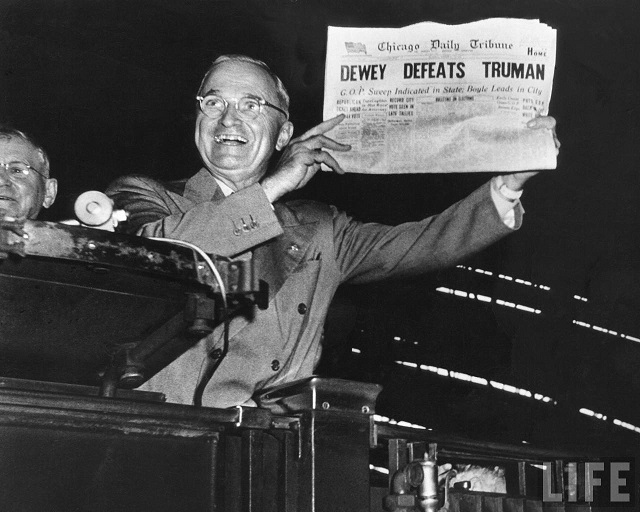
I don't doubt your Thoroughness and accuracy on Films and Venues Michael but Newspapers aren't always accurate.If they were Thomas Dewey would have been President in 1948 instead of TRUMAN.
The Rimrock Theaters ended up being a Disaster and I think they were all gone around 81. Maybe if they had quit giving the Address of Rimrock Mall even when they moved to Overland Ave. People would have showed up to the right theater [Wink]

 -
 
Posted by Steve Guttag (Member # 268) on 05-16-2014, 06:43 AM:
 
Are you really comparing a paper going to press and predicting a President due to time-line constraints and getting the jump to a mere movie "Now Playing" ad? Furthermore, the paper didn't continue to publish the wrong information day after day, week after week.

I agree that newspapers can/do get it wrong from time to time. But it normally does not extend for weeks on end. I'll wager that Michael could continue to produce newspaper ads that show the same theatre showing the movie week after week.
 
Posted by Michael Coate (Member # 757) on 05-16-2014, 12:27 PM:
 
Good grief, Steve (Matz). You're as bad as Tony and Will!

And to screw with your head even more, I'll clarify that the Billings "Sound of Music" roadshow run was held in 1966, not 1965, and played the Babcock, not the Fox.
 
Posted by Mark Gulbrandsen (Member # 72) on 05-16-2014, 01:00 PM:
 
I can remember it on the marquee of the Babcock in fact. 1966 was the first time I went to Billings to visit friends with my dad. It might have played in 4 track mag there... certainly NOT 70mm because Babcock never had 70mm capabilities, nor did any other Billings theater.

Mark
 
Posted by Steve Matz (Member # 1890) on 05-16-2014, 06:03 PM:
 
Well Michael I'm sure Glad that someone that Lives in LA Knows everything about every town in the U.S. Who even really cares up here besides you what played in a theater 30 or more years ago.
I'm done with this Topic; nothing I say is going to change your mind about what you believe is accurate reporting. But if you would like to wager a real bet (say 5000 Dollars) I will produce what I have said all along about SW's playing at the Babcock. If not then this subject is closed as far as I'm concerned.
 
Posted by Jim Cassedy (Member # 4115) on 05-16-2014, 06:36 PM:
 
My recently departed dad, who worked in advertising for many years, would be
the first one to point out that this ad doesn't really make any substantial claims.

As Brad pointed out early on in this thread, 758 showings could be done on any
projector. The ad doesn't claim it could ONLY be done on a Norelco, nor does
it make any claim or provide any proof that the print was still in good shape
after 758 runs.

And there are no film photos or frame blow-ups to back up the claims
they're not making.

The reader is left to infer that the print was still almost 'lab fresh" solely
from the 'headline' of the ad. The ad actually leaves out more than it says.

Also, just as a point of curiousity, according to an article about the
"Sparticus" prints in a 1960 issue of 'International Projectionist" the
70mm print they examined was on Eastmancolor stock.
 
Posted by Edward Havens (Member # 4715) on 05-16-2014, 08:13 PM:
 
Steve, I hope you have the cash ready, because I would trust Michael and his research far more than any individual's memory.

And for posterity's sake, if Michael accepts the bet and Steve deletes the message and tries to claim he never made the bet...

quote: Steve Matz
Well Michael I'm sure Glad that someone that Lives in LA Knows everything about every town in the U.S. Who even really cares up here besides you what played in a theater 30 or more years ago.
I'm done with this Topic; nothing I say is going to change your mind about what you believe is accurate reporting. But if you would like to wager a real bet (say 5000 Dollars) I will produce what I have said all along about SW's playing at the Babcock. If not then this subject is closed as far as I'm concerned.


Posted by Adam Martin (Member # 641) on 05-16-2014, 09:28 PM:
 
Don't do it! It's a trap!

quote: Steve Matz
When "STARSWARS" Played at the Babcock Theater in 1977 it had a 13 week run with a brand new Lab Print.
"STAR WARS" may not have played the Babcock, but maybe "STARSWARS" did. [Razz]
 
Posted by Chris Slycord (Member # 4239) on 05-17-2014, 07:40 AM:
 
Steve,

Although you've apparently bowed out of the thread...
It seems a little disingenuous to get pissed about what Michael posted, put up rants about it, then claim that no one besides him cares. If no one cared, that would've included you and the posts you made wouldn't exist...
 
Posted by Mike Blakesley (Member # 26) on 05-17-2014, 12:52 PM:
 
Well I can't say I'm completely accurate, memory-wise, but I can back up Michael when he says Star Wars played at the Rimrock 4. The first run was 27 weeks but then it went into second run and stayed there for another six months or so. I remember reading the article in the Gazette proclaiming it was the first movie in their knowledge to run for a year in Billings.

I don't remember it ever playing at the Babcock, but maybe it played there on a re-release.

I went to lots of movies in the Rimrock 4, Cine 3/4/7 and Fox back in the day, but I only ever went to one movie (Indiana Jones and the Temple of Doom) at the Babcock.

That article about the Rimrock 4 does get some things wrong. Obviously "1,000" square feet must be a typo (10,000 is probably more correct) and the manager was "Lanny" Wagner, not Larry as the article states. So there is something to be said for actual memory vs print.

One thing for sure though, disaster or not, the Rimrock 4 was definitely there longer than 1981. It was expanded to five screens and ran until the mid/late '90s when the Carmike Wynnsong 10 was built next to the mall. I think it opened about the time Star Wars Episode I came out.
 
Posted by System Notices (Member # 2357) on 06-07-2019, 12:25 AM:
 

It has been 1846 days since the last post.


Posted by Michael Coate (Member # 757) on 06-07-2019, 12:25 AM:
 
quote: Steve Matz
But if you would like to wager a real bet (say 5000 Dollars) I will produce what I have said all along about SW's playing at the Babcock.
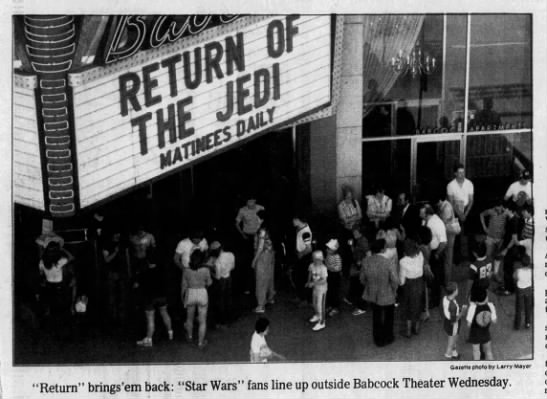
I should've taken you up on the bet!

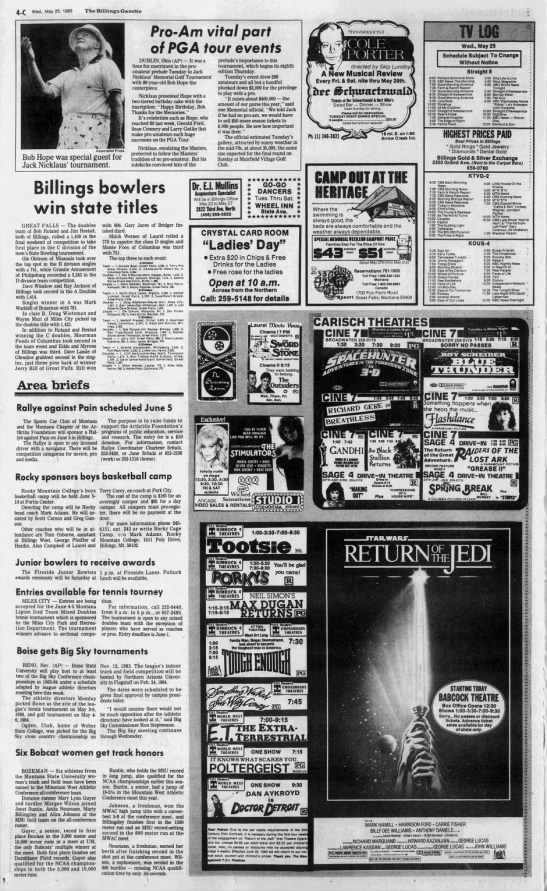
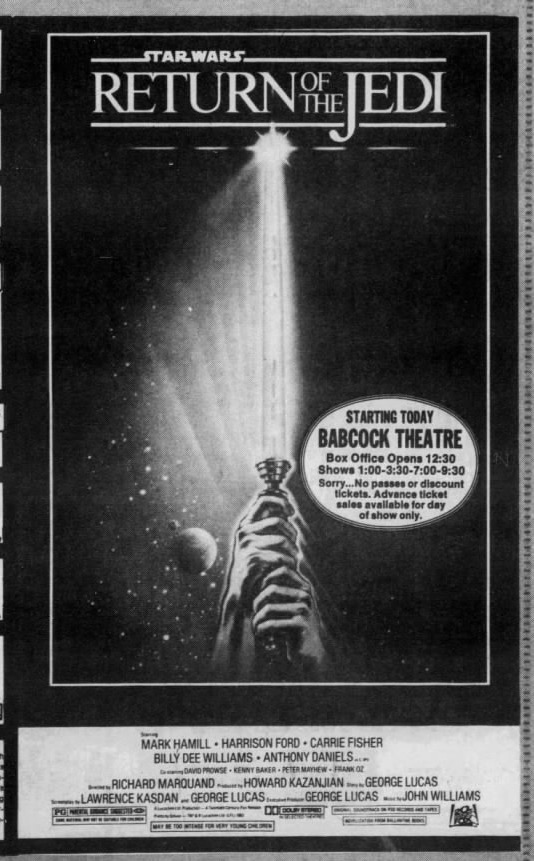
Here is what is perhaps the root of your (mistaken) recollection:

 -
Billings Gazette, May 26th 1983

 -
Billings Gazette, May 25th 1983

 -
Billings Gazette, May 25th 1983
 
Posted by Thomas Hauerslev (Member # 566) on 07-03-2019, 01:59 AM:
 
"Out of Africa" ran 9 months, three times a day in Copenhagen. About 800 7OMM screenings on lovely DP70s. No big deal. The print is still in very good condition.

All DP70s were hand built / assembled. Real Dutch craftmanship.

"South pacific" ran 4 years 1958 - 1962, and wore out two Todd-AO prints according to the legend from those days.
 
Posted by Mark Gulbrandsen (Member # 72) on 07-03-2019, 04:00 AM:
 
A friend in Great Britain ran Sound Of Music on DP-70's for four years straight. That is a record for run time on a single print far as I know....

Mark
 
Posted by Marcel Birgelen (Member # 6801) on 07-03-2019, 08:13 AM:
 
The development of the DP70 is a pretty interesting story in itself. It was essentially developed by a single man, Jan-Jacob Kotte, who was obsessed with projection and film from an early age. He got a free card from Phillips to work from home, pretty unconventional back in the day and he spent about a year on his attic designing every element of the machine.

I think it's a great example of what engineering driven design can yield, compared to the often almost entirely cost-driven approach of today.
 
Posted by Steve Guttag (Member # 268) on 07-03-2019, 10:40 AM:
 
I don't know if he designed "everything" on it since the optical sound looks strikingly like the FP56 optical sound.

I'm sure the cost of it was a large reason for its discontinuation. It had a relatively short production run for projectors of that era. Certainly, nobody thought the DP75 was remotely up to the DP70 standards but I'm sure it was less costly to make.
 
Posted by Marcel Birgelen (Member # 6801) on 07-03-2019, 01:43 PM:
 
He certainly didn't design every last screw, but according to lore, he was also one of the primary Optical Sound guys at Philips and was at least heavily involved with the FP series. He started to work at Philips in 1928, apparently at the division that was tasked to bring "synchronized sound to film", which was still a pretty big thing back then.
 
Posted by Mark Gulbrandsen (Member # 72) on 07-03-2019, 04:32 PM:
 
Jan Kotte actually DID design everything on it. Some of it was just adapted from other projectors (FP-56, FP-7) that HE also designed. I do remember reading on IN70mm.com that he actually came home and designed the DP-70 in his attic office. He had a deadline to build some working prototypes and could concentrate best at home.

Mark
 
Posted by Emiel De Jong (Member # 4225) on 07-17-2019, 02:21 AM:
 
The Oscar Jan Kotte had at home was on display last year when we celebrated the 55th anniversary of the DP70 Oscar:
https://in70mm.com/news/2018/dp70_1656/uk/index.htm

As if it was the plot of one of the original Adventures of Tintin that day the frontpage of the local paper was hijacked by another ex-Philips man presenting from his shopping bag what he claimed as being the original Oscar:
 -
 
Posted by Mark Gulbrandsen (Member # 72) on 07-17-2019, 06:24 PM:
 
The problem with 35/70 XL's was the teeny intermittent and non driven penthouse. Not to mention it was really a 35/65 projector. But with care the prints could last on them.
 
Posted by Thomas Hauerslev (Member # 566) on 08-06-2019, 01:22 AM:
 
https://in70mm.com/newsletter/2000/62/philips/index.htm
 
Posted by Thomas Hauerslev (Member # 566) on 08-06-2019, 03:10 AM:
 
@Emil, that is Mr Nijsen, who wrote most of all press copy for Philips's cinema products. Mr. Nijsen was present at the Oscars in 1963, and Anton Kotte's OSCAR is the extra copy made for Jan Kotte.
 
Posted by Emiel De Jong (Member # 4225) on 08-06-2019, 04:23 AM:
 
Thanks Thomas; I know who he is... the sad thing was that the son of Jan Kotte had put a lot of effort in making this small exposition happen in the Philips museum and then on opening day the frontpage of the local paper is the story of Mr. Nijsen sort of ridiculing these efforts. Of course, this could have been more the newspaper wanting to print a juicy story than Mr. Nijsen necessarily being evil. Anyway it would have been much better if before all this Mr. Nijsen and Mr. Kotte had met (like in your photograph...) and had decided to put both Oscar statues on display. Both are "real" in the sense they are both official statues, of course only one of them was there during the ceremony...
 
Posted by Thomas Hauerslev (Member # 566) on 08-07-2019, 01:43 AM:
 
For Emil: https://in70mm.com/news/2018/dp70_1656/uk/index.htm


Powered by Infopop Corporation
UBB.classicTM 6.3.1.2