This is topic "Hot" Photocell ! in forum Film Handlers' Forum at Film-Tech Forum ARCHIVE.
To visit this topic, use this URL:
https://ft-forum.com/ft/cgi-bin/ubb/ultimatebb.cgi?ubb=get_topic;f=1;t=011657
Posted by Jim Cassedy (Member # 4115) on 05-11-2014, 04:16 PM:
This ancient W-E photocell was in a box of vacuum
tubes I acquired from an old theater several months
ago. It still "works" if I connect 90vdc & an ammeter!
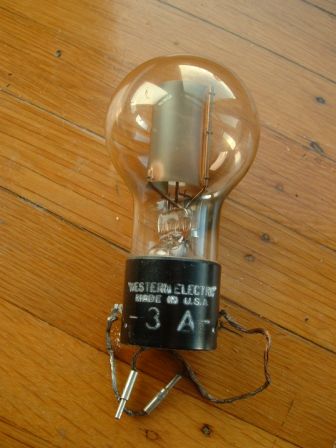
I knew from its' general type & design that it was
from the early 1930's. . . I was right (of course!)
since I was able to find an article about the "new"
type 3A photocell in a 1931 projection magazine.
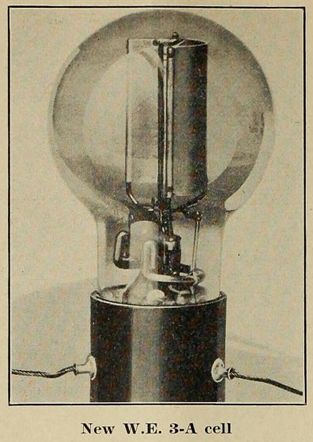
In the article, it stated that the cylindrical electrode was coated with a caesium
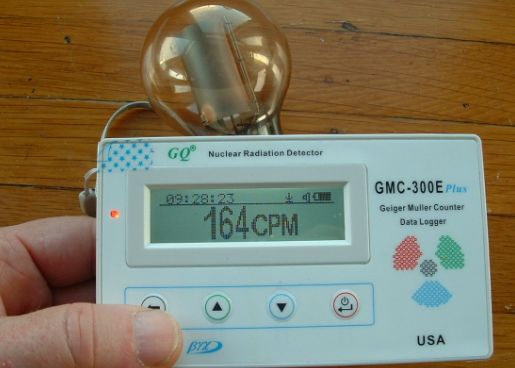
oxide compound. I knew that caesium-oxide is a bit radioactive, so, out of
curiousity, I pulled out my giegercounterthingy & was able to get a reading.
This thing is moderately "hot" when you consider that the normal background
radiation count here in my apartment is approximately 16-18CPM.
(actually, I was able to get a small reading off a lot of the vacuuum tubes
too, since many of them had thoriated filaments, which was common at that
time. I think early xenon bulbs had thorium coated electrodes too)
So, what does this prove?
Nothing. (other than perhaps I have too much spare time on my hands)
Posted by Leo Enticknap (Member # 534) on 05-12-2014, 10:55 PM:
90V and 3A - yikes! That cell drank 270 watts of DC power: slightly more than today's solid state ones.
As for the radiation, uranium sulphate was used as a yellow tinting dye for silent prints in the 1920s. On a tour of the British Film Institute as a student in the '90s, the then curator held a Geiger meter over a reel of 1920s nitrate print. The thing went berserk! Apparently the level of radioactivity in a reel that has been treated with this stuff is only just below the threshold at which special handling and storage precautions are needed.
Posted by Jim Cassedy (Member # 4115) on 05-12-2014, 11:36 PM:
quote: Leo Enticknap
90V and 3A - yikes! That cell drank 270 watts of DC power
Leo, I think the "3-A" was simply the tube designation, and did not stand for 3 amps.
While the old photo-tubes required a high voltage potential, I think the actual
current they handled was only a few milli-amps.
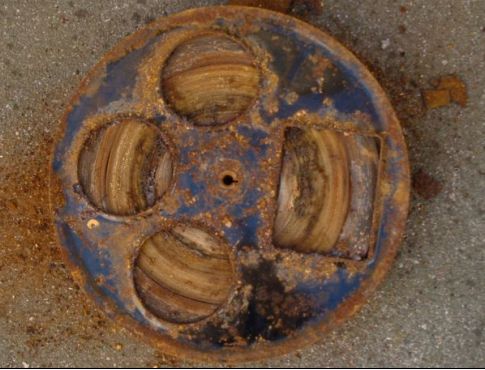
Interesting what you said about the nitrate. I recently dumped a bunch of nitrate film
found at another old theater, all of it in very bad shape. (see photo)
Next time I come across some I'll have to check it with my geiger-meter now that
you've piqued my curiousity about the possiblility of it being slightly radioactive.
Last fall I uncovered a stash of nitrate film reels in a (very) damp theater basement.
This picture is typical of the condition most of the cans were found in:
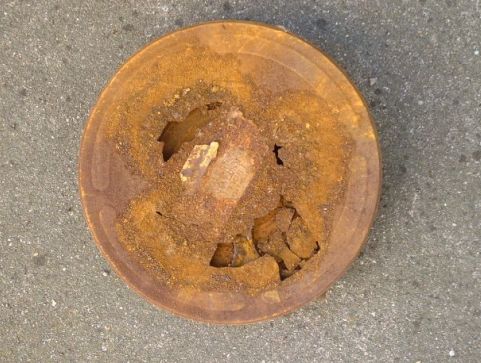
The reels of themselves were pretty much one gelatinous mass. The emulsion was
almost completely eaten away. It was impossible to unspool even a few inches
of film to try & identify it, as it was just all gooey & stuck together.
-jc-
Posted by Leo Enticknap (Member # 534) on 05-13-2014, 12:09 AM:
Yup - sadly, those are well and truly beyond hope. I'm a little surprised: the chemistry experts who've researched this stuff seem to be agreed that heat kills nitrate more than humidity (whereas with triacetate, it's the opposite), and so nitrate stored in a damp but relatively cool environment should stand a better chance of survival than the other way round: hence the reason something like 90% of the Dawson City collection was not only salvageable, but in reasonably good shape. Though in this case, if the theater basement had heating plant in it or some other reason why the temperature was high, that would explain it.
Posted by Dave Macaulay (Member # 813) on 05-15-2014, 07:06 AM:
The Dawson City stash was used as fill in a disused swimming pool as I recall.. who would have even attempted an outdoor pool in Dawson, anyway??? I've been to "The Town of Dawson City"; the few weeks it would be warm enough to use a pool, anyone nuts enough to try swimming would be swarmed by billions of blood sucking insects. I can easily understand why it was abandoned and filled in.
Dawson has permafrost so anything buried would be basically kept frozen until dug up again.
Powered by Infopop Corporation
UBB.classicTM
6.3.1.2