This is topic Buzzy Booth Monitor in forum Film Handlers' Forum at Film-Tech Forum ARCHIVE.
To visit this topic, use this URL:
https://ft-forum.com/ft/cgi-bin/ubb/ultimatebb.cgi?ubb=get_topic;f=1;t=011681
Posted by Jim Cassedy (Member # 4115) on 07-09-2014, 07:07 PM:
I pulled this booth monitor out of a small screeing room today.
It's still weakly amplifying, but has a LOUD 120hz buzz overpowering the audio.
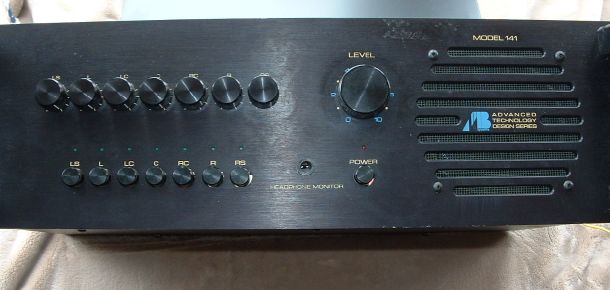
As you can see, it's of fairly simple construction. I'm suspecting the filter caps on either
the power supply or the main amp board. Or mabye one of those small diodes is bad.
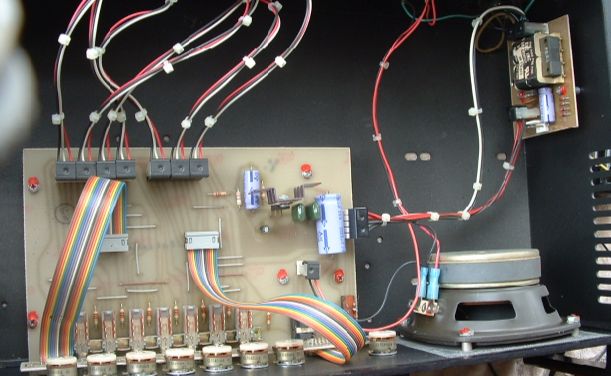
I can't seem to find any info online. Anybody have a schematic or fixed one of these before?
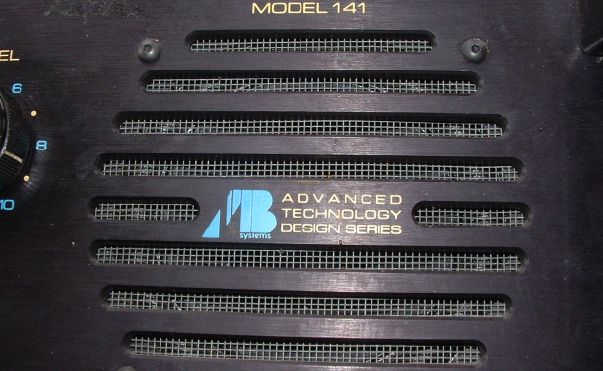
(yea, I know- - I probably could have swapped the caps & diodes in the time it took to
take pictures & post this- - but it's been a long day & I'm looking for an easy fix)
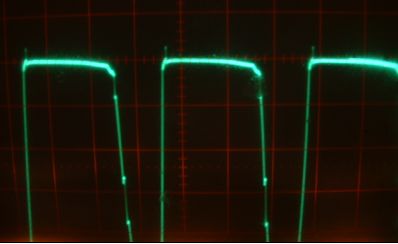
>BONUS INFO: The buzz sounded "rough" - - like a square wave. So I looked, & it was:
ALSO> Booth monitor had been turned off for a couple of days when I pulled it out
of the rack. Now that I've had it turned on for awhile, I've noticed that the
transformer & what I think is the voltage regulator on the PS board is very hot.
I'll keep pokin' around- -but any ideas (or a circuit diagram) would be appreicated!
Posted by Tony Bandiera Jr (Member # 2365) on 07-09-2014, 11:22 PM:
Jim, problem is those cheap electrolytics on the main and power supply board that AB used.
Replace them with ones of the same value and equal or higher voltage rating and you'll be good to go again.
The transformer and regulator are getting hot because the caps are not filtering properly and causing either oscillation or internal arcing in the caps.
About $10 in parts total and it'll be fixed.
Posted by Jim Cassedy (Member # 4115) on 07-10-2014, 10:07 AM:
Thanks, Tony. That's the conclusion I was begining to come to also, after thinking about it a bit.
The PS gets really hot even when I disconnect it from the "main" circuit board, so the problem is
definitely with the power supply.
The caps are standard values,so I can probably find them at Rat Shack and I might even
replace the voltage regulator & those 4 small diodes with a bridge rectifier since I've got
spares of both componants in my 'junk parts' box.
Posted by Gordon McLeod (Member # 33) on 07-10-2014, 11:09 AM:
Interesting havent seen a tape laidout circuit board in a long time. Those in the time frame it was made were standard caps used in many industries
Posted by Leo Enticknap (Member # 534) on 07-10-2014, 11:22 AM:
quote: Tony Bandeira, Jr.
Jim, problem is those cheap electrolytics on the main and power supply board that AB used.
I remember reading somewhere that in the early '90s, a factory in Hong Kong ripped off a "recipe" for electrolytic capacitors from one in Japan but didn't quite do it right, with the result that bazillions of short-lived and unreliable capacitors found their way into consumer and professional electronics products the world over. If you have an appliance from around the mid-90s to the mid-00s that starts acting up, the chances are high that this is the reason. It certainly was in a backyard sprinkler control unit that died on me last September: after replacing the two capacitors on the motherboard, it's worked perfectly ever since.
Posted by Mark Gulbrandsen (Member # 72) on 07-10-2014, 02:05 PM:
WOW... There's an early 80's piece! Yea, replace all the electrolytics. Or replace the whole monitor. AB is still around and not too far from you, but honestly they never manufactured very good stuff. The last made 6 channel power amplifiers for Smart... which was a really dumb idea. Their aluminum chassis were nice and I've built several much better sounding home brew amplifiers in them. AB Systems Web Site
Posted by Steve Matz (Member # 1890) on 07-11-2014, 01:23 AM:
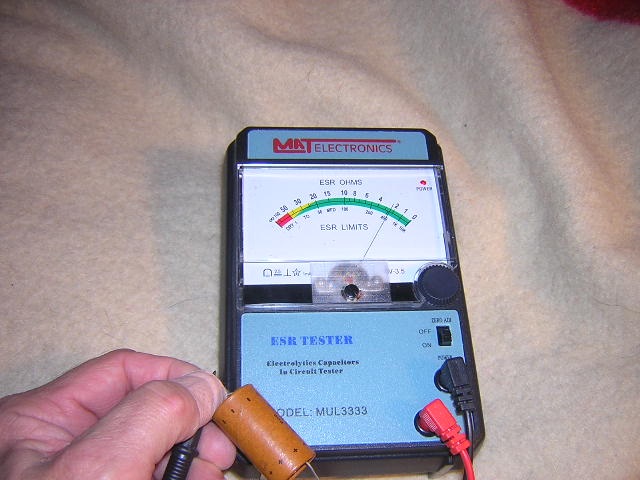
This is the best tool to have for diagnosing Electrolytics. I have had a couple different ESR METERS going back to the early 80's when I was repairing/rebuilding GI Jerrold Cable Converters.They are extremely accurate. If the Cap is leaking or partially dried up the needle will usually stay in the red/yellow. if the the cap is open the needle will not move at all. A fresh electrolytic will Register high or almost peg the green scale.
If you work on Electronics with a ton of Electrolytics,you can check them in circuit fast and quick. you will want one of these...Ohm/volt meters can't keep accuracy with caps in circuit.
Posted by Gordon McLeod (Member # 33) on 07-11-2014, 09:35 AM:
AB has changed owners several times and in most cases has no record of their older products
Thow they did admit that there was a period that their amps were actually being made in Asia with made in USA on them
they have no records for most of the 2 unit high amps they sold either under their name or Smarts I have the schematics of those but they are not completely accurate as the input has a seperate board probably made by AB in the states so they could stick a made in USA label on it
That said the amps are not crap as mark claims
unless abused they usually have little or no grief from them other than the usual fan issues
They also made amps for IMAX/SONICS and for Paramount
The company is still in business and they are very helpfull in trying to help but they actually commented to me once that I had more drawings of their products than they had :-)
Posted by Mark Gulbrandsen (Member # 72) on 07-11-2014, 01:09 PM:
Yes Gord... The amps that Smart was selling were for sure made in Asia. You can tell just by looking at the construction of the boards. They also used all Asian semiconductors.
Posted by Gordon McLeod (Member # 33) on 07-11-2014, 06:13 PM:
the semi's were all bog standard
Posted by Jim Cassedy (Member # 4115) on 07-11-2014, 08:08 PM:
UPDATE- - The buzzy booth monitor is fixed ! !
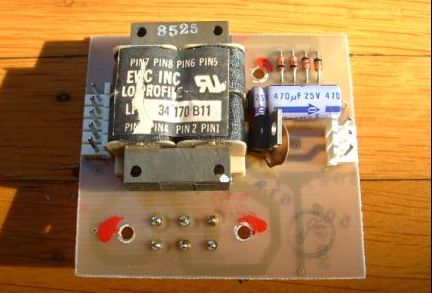
The problem did turn out to be a bad 470uf filter cap on the power supply board.
As long as I was at it, I replaced the 4 diodes with a bridge rectifier, since I had
some spare ones in my junk box. I did the repair this morning and have had the
monitor hooked up to a small radio & it's been running OK all day. Woo Hoo!
"BEFORE" Photo- I repaced the cap & the diodes seen here on upper right side
quote: Leo Enticknap
I remember reading somewhere that in the early '90s, a factory in Hong Kong ripped off a "recipe" for electrolytic capacitors from one in Japan but didn't quite do it right, with the result that bazillions of short-lived and unreliable capacitors found their way into consumer and professional electronics products the world over.
Yes, I recall that. It's quite possible this cap was one of those, since once I pulled it out, you could
see that one end was bulging out a bit, which was one of the symptoms of those defective caps.
I had 3 DTS XD-10 units that had power supply failures due to those crummy capacitors.
A number of them also found their way into several models of SHARP flat screen TV's & computer monitors
back then too. SHARP issued a recall notice back then and you could get the caps replaced free if you
brought your TV/Monitor to the nearest SHARP service center. I wound up replacing several of them for
friends with large screen SHARP TV's who didn't want to go through the hassle of lugging them in for service.
Posted by Steve Matz (Member # 1890) on 07-11-2014, 08:20 PM:
As far as Cap Mfger's go"GENERAL INSTRUMENTS" back in the 80's was using every mfger around as these Cable Boxes were probably the worst abuser of electrolytics on the planet. Because of their small height and basically no air circulation,and being on all the time once the AC was plugged in they ran hotter than a firecracker. They also from a design oversight placed the transformer way to close to the Power Supply and Filtering Caps and had no shielding between the Caps and Transformer.
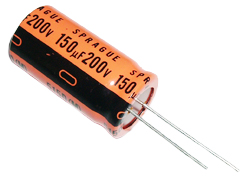
Finally after using SPRAGUE MFGing Electrolytics we were able to get some longevity out of these Cable Converters.Even if you don't have major heat issues I would still use the +105degreeC over the +85degree on both Radial & Axial Aluminum Electrolytics as the cost between the two is minimal. I have used Sprague Caps in every other type Electronic since that time and their reliability and longevity IMHO makes them one of/or the best in the Industry... ![[thumbsup]](graemlins/thumbsup.gif)
Posted by Ron Lacheur (Member # 1126) on 07-11-2014, 08:46 PM:
Most " audio " caps are rated at 85C for some reason. I've been using Panasonic FC and FM for years with great success.
Posted by Steve Matz (Member # 1890) on 07-11-2014, 09:50 PM:
In industrial equipment where ripple currents are high the cap will heat internally. That 105C spec is important. Audio equipment idles 99% of the time and 85C should be fine. An exception might be tube equipment where everything runs hot! Also, watch out for design error 101 where some hot power resistor has a short trace to a filter cap, leading (no pun intended) heat right up into the body. I like 105's; the cost difference is minimal...
Powered by Infopop Corporation
UBB.classicTM
6.3.1.2