This is topic film handling workshop, Austin in forum Film Handlers' Forum at Film-Tech Forum ARCHIVE.
To visit this topic, use this URL:
https://ft-forum.com/ft/cgi-bin/ubb/ultimatebb.cgi?ubb=get_topic;f=1;t=011707
Posted by Liz Coffey (Member # 4353) on 08-25-2014, 12:46 PM:
Hi there,
I'm not sure if anyone has posted this yet, but...
The Association of Moving Image Archivists (AMIA) will present a Film Projection Workshop in partnership with the Alamo Drafthouse to offer training for managers, curators and projectionists presenting 35mm film in theaters. The workshop will be held October 28, 2014 in Austin at the Alamo South Lamar location.
The workshop will offer a hands-on tutorial for projectionists and theater staff working with 35mm film prints and will focus on film preparation and projection as well as special stipulations for archival projection, coordinating with lending institutions, and paperwork. Class size will be limited to 20 participants.
For more information and to register go to www.projectionworkshop.org.
Posted by Frank Cox (Member # 6258) on 08-25-2014, 01:15 PM:
... where you will find a webpage that says "This Site Is Under Construction and Coming Soon."
I think you forgot something....
Posted by Michael Putlack (Member # 6523) on 08-25-2014, 01:21 PM:
Remove the last period from the URL and it'll take you to the right place.
http://www.projectionworkshop.org/
Posted by Frank Angel (Member # 248) on 08-25-2014, 07:28 PM:
It's a little late in the game trying to teach managers and curators how to handle film without damaging it and doing FDR (Film Done Right), isn't it?
This might have done some good maybe 20 years ago when exhibitors started firing real projectionists in favor of letting high school kids at minimum wage have at film prints and giving them titles like "projection attendants" -- an AMC executive actually used that term in, of all places, an SMPTE meeting of the Projection Practices Committee -- and he said it with a straight face and even a hint of pride -- while everyone around the table groaned and the committee chair, our own late, great John (FDR) Pytlak, nearly choked on his coffee.
Posted by Leo Enticknap (Member # 534) on 08-25-2014, 08:17 PM:
I'm guessing that the object of this day is awareness raising rather than the serious belief that a one day course will enable managers and curators to project archival prints in a theater safely and to an acceptable standard of on-screen presentation. If that's the case and the idea is that managers and curators come away with a realistic idea of what is needed to enable the presentation of archival film prints in their venue, then it's a great idea.
Posted by Monte L Fullmer (Member # 2797) on 08-25-2014, 09:08 PM:
Should create one to show managers on the proper way in doing bulb changes, along with the correct way in focusing the bulb for best lumen outputs.
Then, on the correct procedure on building SPL's with knowing how to read the content naming string and what each term inbetween the underscores means, how to cue the program and schedule it.
Then, finally on projector prevent maintenance - like filters, lens and port glass cleaning, et.al.
-Monte
Posted by Leo Enticknap (Member # 534) on 08-25-2014, 09:59 PM:
They've only got a day. It took us years of patient supervision and practice to learn this sort of stuff. I know many of the people who are organizing this event, and they're not idiots. They're not going to turn a manager or curator into someone who can change a xenon bulb or do an A-chain alignment (and I agree that film handling is only a small part of the skills needed for archival print presentation: projector and audio system maintenance and repair is going to be a big challenge for screening venues that are making a long-term commitment to keeping film running). But if the people who go to this event come away from it with a realistic idea of what the organizations they are working for will have to plan for, then it will have achieved something.
Posted by Frank Angel (Member # 248) on 08-26-2014, 02:25 AM:
I didn't mean to sound snarky -- there certainly isn't anything wrong with the goal; it's just that so many of us spent a life-time doing all the things right, learning our craft, loving making film come alive on the screen and spending hour upon hours handling prints with the care and respect one would lavish on a living thing, and yet here we are with film presentation ripped out of our booths.
Preserving prints might help in the short term....VERY short term, but training a few specialists, a few real craftsmen on how to preserve what little is left in the way of runnable prints has to be viewed within the reality that whatever very fuew pirnts may still be around, they have a finite life and once that life is over, it's over.
How long do we give it? Another generation...possibly two before any decent film prints will no longer be around to run....by anyone? If the studios refuse to keep film alive by replenising that dwindling inventory there is, then the best trained, most meticulous film preservationist/archivist/projectionist won't be a skill worth much if eventually there simply isn't any film to handle.
Posted by Liz Coffey (Member # 4353) on 08-27-2014, 09:10 AM:
Thanks Michael, and sorry about that bad link!
True, Frank, I wish we had pulled this together a while ago too.
This is aimed at people who are already experienced projectionists, but who have not worked extensively with archival film.
As you no doubt are aware, many places that still want to show 35mm are running into problems finding prints to show. Many film archives have prints that can be borrowed under certain conditions, and this project is a step toward making more cinemas capable of borrowing archive prints.
It's our hope that theatres that are trying to hold onto their film projectors in addition to DCP will find this useful.
There are a lot of prints out there, and it would be a shame to just allow them to rot in storage instead of letting them out to entertain us. Sure, they won't last forever, but what will?
Posted by Leo Enticknap (Member # 534) on 08-27-2014, 11:22 AM:
quote: Liz Coffey
This is aimed at people who are already experienced projectionists, but who have not worked extensively with archival film.
In that case I tend to agree with Frank that it's going to be an uphill struggle.
This is a 70mm print of The Untouchables I showed on Monday:
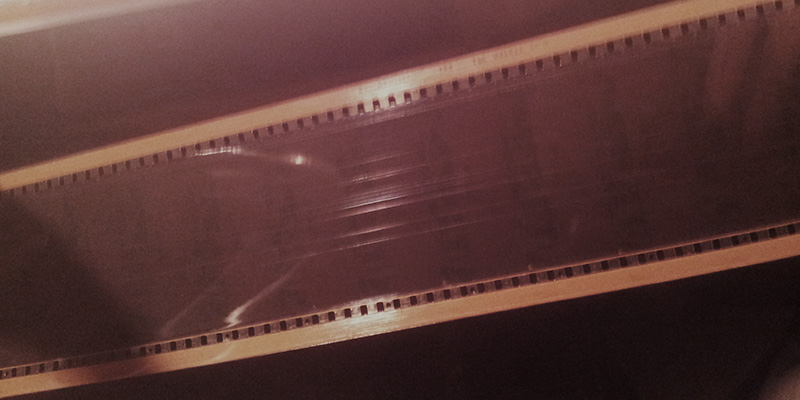
We (as in, the American Cinematheque - I didn't work there at the time) last played that print in 2012, and the condition report from that screening describes it as being in near-perfect condition. In other words, those scratches weren't there then. The fact that they are now is significant for two reasons.
1. It's 70mm. Because there are so few 70mm prints that are now left in circulation, distributors and archives tend to be even more cagey about where they go than with 35. The fact that in the last two years, a 70mm house still did this to the print, in spite of the gatekeeping that now exists, shows us what we're up against. Frankly, I was very shocked to see this sort of damage. Until relatively recently, 35mm was a crapshoot because the prints - especially the ones from smaller rep distributors - will have gone to anywhere that would book them, including university film societies, places on a shoestring budget that couldn't afford decent maintenance, etc. etc. But 70mm, as a general rule, only went to relatively well-resourced theaters and was only handled by professionals. What I found on Monday is clear evidence that this rule of thumb is not true anymore. And then there's The Master - proof that film's not dead, etc. etc. etc. Most of the 70mm prints were damaged within a few passes, including the one in London on its very first show, so much so that the scratch was commented on in national press coverage, by a critic who thought that this was part of the natural charm of the analog medium!
2. The pattern and intensity of the vertical (in relation to the frame) scratches varies from reel to reel. In particular, the scratches are a lot worse (including a gnarly green one in the second half of reel 1, where the emulsion has been gouged away) in reels 1-3-5 than in 2-4-6. Therefore, this damage was done at a changeover house, and is yet more evidence that the traditional archive mantra of "no platters, and everything will be OK" is simply untrue.
Spending a day teaching projectionists not to cut heads and tails and to look for changeover dots is not going to prevent this sort of damage from happening. Most crucially, you need the mindset that inflicting that sort of damage is unacceptable and the belief that it's worth investing time and care to avoid doing so. It's not rocket science, but it does require a certain level of attention to detail and consistency (i.e. working in a high pressure, "no second chances" situation: once you've made the error and scratched the print, it can't be undone) that basically, either you're willing to aim for or you're not. But after that, equipment maintenance is probably more important than film handling skills: winding and threading a film without scratching it is something that an experienced projectionist who has not worked with archive prints should be able to do. If (s)he can't or won't, that person is not a fit and proper person to be let loose on archive prints, however much training you give them.
Therefore, if the focus of this day is going to be on educating managers and curatorial staff that they are going to need to have people who can align reflectors, maintain airflow and cooling systems, replace worn sprockets and pad rollers, keep mechanisms properly lubricated, keep film path components properly aligned and clean, maintain and adjust appropriate gate pressure, etc. etc., then it's a good idea, because they'll come away with a realistic expectation of what they need to achieve (or more accurately, facilitate the achievement of) than they will be reading "film forever" cheerleading type stuff.
But any experienced projectionist who can't do this stuff is already a lost cause. The only specific archival training for a projectionist who already has significant experience in the basics I can think of is in identifying and playing legacy aspect ratios and audio formats.
Posted by Mark Gulbrandsen (Member # 72) on 08-27-2014, 12:14 PM:
Gee, that's some nasty damage!
Posted by Scott Norwood (Member # 30) on 08-27-2014, 06:16 PM:
I saw this on a 70mm print of Ghostbusters, back in 2004 ![[Eek!]](eek.gif) The yellow tape was, admittedly, fixable, but anyone who is running 70mm should be smart enough not to use it.
The yellow tape was, admittedly, fixable, but anyone who is running 70mm should be smart enough not to use it.
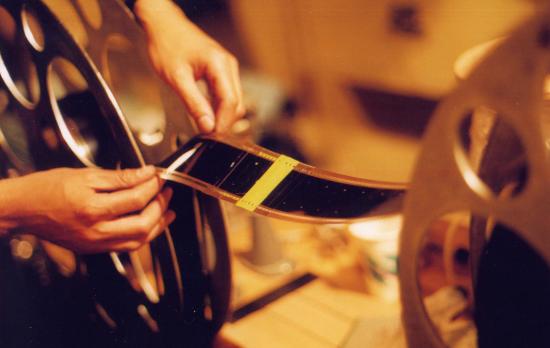
And I ran across the same thing more recently in a non-platterable archive print from MOMA:
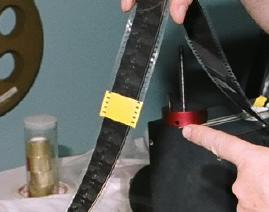
Posted by Brad Miller (Member # 2) on 08-27-2014, 06:59 PM:
Leo a big part of the problem is as theaters are tossing their 70mm projectors, people who have never handled 70mm are suddenly deciding "I'm going to run 70mm" and even though they THINK it's just "bigger 35mm", it isn't. A similar problem is happening with theaters that have also never ran 70mm, nor have a truly experienced 70mm projectionist, that gets their hands on a 70mm projector and starts to do 70mm revival shows.
The prints are DOOMED because of this foolish mindset! There are probably only half a dozen projectionists in the US who should be handling 70mm that are not already retired.
And as nice of an idea as this workshop is, it won't change anything. It's just TSA for changeovers, to give people a false sense of security in thinking that all is perfect and wonderful out there.
Posted by Leo Enticknap (Member # 534) on 08-27-2014, 08:31 PM:
Your explanation is the only one that makes sense in explaining how this print got this badly damaged. In my past experience, 70mm prints from as far back as the early '80s tended to be in very good condition relative to the 35mm copies of the same title floating around, because 70mm houses demanded more from their projectionists in terms of skills, experience and pride in their work. But this clearly isn't the case now, or else that print wouldn't have got that way.
I am wondering if a botched 35-70 conversion might have been done here, though, because the scratches are in two areas: in the middle of the frame and near one edge. Maybe a 35mm component should have been removed from the film path but wasn't, and this caused the center scratching and pushed the edge such that it rubbed against something it shouldn't have nearby?
quote: Brad Miller
And as nice of an idea as this workshop is, it won't change anything. It's just TSA for changeovers, to give people a false sense of security in thinking that all is perfect and wonderful out there.
If that's what they're going to do (and I note that no detail on what they're covering and what not has been published as yet), I agree entirely; hence my point is that if they're going to focus this day on educating the people who will ultimately sign the checks to keep archival projectionists in work and their equipment working as to why those checks will need to be as big as they will be, then it might achieve something useful. But if, as you say, they're going to spend a day saying "Throw your splicer in the trash and watch for the little black blobs every 20 minutes", I fear that it'll be a futile exercise.
Posted by Brad Miller (Member # 2) on 08-28-2014, 01:46 AM:
Leo, do you recall some of my horror stories about a couple of places that claim (and truly believe) they have super-projectionists missing a roller and scratching? I think that's what has happened here. Case in point that new print of Playtime in 70mm I prevented from getting scratched was because the projectionist skipped the first roller in the JJ penthouse. The angle of the film coming off the dts reader over the pad roller (like 35mm typically threads) meant the emulsion was dragging up against the penthouse casing just as is seen here. I saw it from 10 feet away, but the "skilled professional changeover projectionist" missed it. Fortunately the projectionist at that venue admitted his mistake after it was pointed out to him and just before the show started he threaded it around that first roller. Had I not been in the booth saying hi, the print would've looked just like that one you posted.
Unfortunately that was not the case at another venue I visited which prides itself on running changeovers. Again I was 10 feet away and saw it plain as day, but that "senior professional changeover projectionist extraordinaire" guy told me I didn't know what I was talking about...so he tookup the film direct from the holdback sprocket onto the takeup reel, skipping the idler roller that kept the film from being scratched on the soundhead chassis.
I at least have respect for the guy in the first example who admitted he was capable of making a mistake and fixed it.
Posted by Louis Bornwasser (Member # 3063) on 08-28-2014, 09:11 AM:
This situation will not improve. While I do encourage the attempt to improve, I am not hopeful.
Posted by Leo Enticknap (Member # 534) on 08-28-2014, 09:33 AM:
quote: Brad Miller
Leo, do you recall some of my horror stories about a couple of places that claim (and truly believe) they have super-projectionists missing a roller and scratching? I think that's what has happened here.
Yes, and no human being is perfect and almost every projectionist will have accidentally scratched a film at some point in their career - I know that I have. But someone who mistreads and refuses to take on board that they've made an error really isn't someone you want handling the dwindling number of film prints now in circulation, which is why your second anecdote is so scary. My earlier point was that anyone being let loose on these films now has to be of the mindset that one scratching incident is one too many and that they're going to do everything possible to identify what went wrong and prevent another. I'm also worried about the fact that that on the AMIA emailing announcing this class, they say that they're going to give people a certificate for attending, but not that there is going to be any test or exam before they hand out a bit of paper suggesting that people are qualified to project rare and irreplaceable prints. So basically, people are going to be given these certificates just for showing up! I hope these certificates aren't going to be used to lull archives and distributors into a false sense of security that their prints will be in safe hands.
I've never used a JJ, and was scratching my head (excuse the pun!) to work out how that damage could have been done on the two machines I have substantial experience running 70mm (the DP70/Norelco AA and the Cinemeccanica Vic 8). Your explanation makes complete sense, especially if an unconventionally mounted penthouse reader was in the path and the film went the wrong way through or around it.
Posted by Brad Miller (Member # 2) on 08-28-2014, 11:49 AM:
quote: Leo Enticknap
I hope these certificates aren't going to be used to lull archives and distributors into a false sense of security that their prints will be in safe hands.
They will. And there will also be a false sense of "I know what I'm doing" by the attendees just because they attended.
At this stage of the game, my honest opinion is that any training seminar shouldn't even be considered as a one-day course. It should be a solid week long and should include MANY specifics on more than just how to inspect, wind and thread the film. Also when I see training seminars working with or suggesting the use of less-than-ideal equipment, that also discredits the class.
Posted by Buck Wilson (Member # 5885) on 08-28-2014, 12:47 PM:
Brad, I feel like you need to go just to see what it's all about... For science.
Or for that matter, just to tell them that they've got it all wrong.
Posted by David Buckley (Member # 2600) on 08-28-2014, 03:53 PM:
quote:
Brad, I feel like you need to go just to see what it's all about... just to tell them that they've got it all wrong.
They should sell tickets for that, its likely to be very entertaining!
Posted by Leo Enticknap (Member # 534) on 09-09-2014, 02:01 AM:
Herewith another anecdotal which supports the widely expressed belief on this thread that if the organizers of this event believe that a one-day training course will turn your average multiplex projectionist into a proficient exhibitor of archival prints, they are seriously mistaken.
I screened a print from a major FIAF archive a while back, and received an email from that archive today saying that they'd examined it on return and found nicks in the leading edge of the perforations in reels 1 and 3 of a three-reel print. The pattern of damage suggests that one of our two DP70s probably did it: I suspect a worn or hooked sprocket tooth on the lower sprocket, and will be checking with a magnifying glass tomorrow, and running a loop of virgin spacing.
The significant thing is that these nicks are truly minute: I had to magnify the picture they sent me up to around 3x to see what they were talking about, which was the tiniest of strains in one corner of the leading edge of the perfs on one side. Of course this shouldn't have happened and I'll be looking for the fault thoroughly, but my point is that archives are now complaining to theaters about what would have been considered routine wear and tear on prints only a few years ago. All they'd look for on returned prints is scratching, if the heads and tails had been cut and really egregious edge and perf damage (as in, edges crushed from poor rewinding over several feet or more, sprocket punch marks in the film, that sort of stuff).
The two of us who worked that weekend probably have around 70 years of projection experience between us, and yet we didn't catch this damage taking place (and unless we'd been winding the reels through very slowly with a high powered magnifier on the rewind, there's no way that we or anyone could have - no way could nicks that small have been seen by shining a flashlight on the film as it wound onto the take-up reel, which I always do after each changeover).
I'm guessing that the policymakers in these archives have been reading the stuff all over the Internet about how the end of film is imminent, blah blah blah, and have decided that from now on, they will expect the same sort of film handling in the booths that show their prints that goes on in the labs that clean, repair and print their camera negatives. And into this environment they're going to send people who have only ever threaded up platters in a multiplex or run portable classroom 16mm machines after a one-day course, and expect them to handle prints to the archives' satisfaction?!
Posted by Manny Knowles (Member # 1171) on 09-10-2014, 02:13 PM:
I predict they will arrive at the conclusion that access copies will have to be DCP's.
Posted by Frank Cox (Member # 6258) on 09-10-2014, 03:03 PM:
Even if the prints never move, they won't last forever. Will they?
Posted by Jarod Reddig (Member # 6363) on 09-10-2014, 03:22 PM:
I applaud the efforts but as said its just too little too late. These types of siminars should have been common practice years ago but the industry doomed us to our current situation. Film is going the way of the Dodo. So sad.
It seems the bigget issue with film is the film itslef. Its just too darn delicate. With everything right of course a print can go un-blemished for years and years but it just takes that one mess up (like Leo's example) and that in and of itself is a shame.
Posted by Fiona Nancy Dulake (Member # 8508) on 10-08-2014, 07:13 AM:
Hi there. Just read all your comments and thought that interesting points were made. Film is indeed dying out, but there is a small percentage of people in the world determined to keep it alive. The one day training course in film handling I can appreciate from your opinion is not enough. It takes years to become a skilled projectionist. But what other training opportunities are available out there right now for people wanting to seriously learn for the first time? The younger generation who have a passion for film and cinema are at a disadvantage as the chance of gaining the same level of experience that retired projectionists have had in their life are no longer there.
Do they just give up though? I myself would like to become experienced working with 70mm projectors. But I live in a seaside town in the south of England. Ain't no training available there. Nowhere in England that I have found. I would be prepared to travel abroad though and spend more than just one day learning. Unfortunately that opportunity isn't available, so if a one day course is all there is right now, then some one like me is gonna wanna go for that.
If you know of any places that offer 70mm film handling training, please reply. But again, I do appreciate it can't be learnt over night but I gotta start somewhere. Thanks Fi
Posted by Leo Enticknap (Member # 534) on 10-08-2014, 06:50 PM:
It's a difficult one, and I think that places which are serious about keeping film projection alive are going to have to look carefully at how other heritage technology operations maintain their skills base, and see how we can learn lessons from them. There are organizations out there flying DC-3s and running steam locomotives (for example), and the people doing that are now at least one generation further on from the last generation to have worked with these technologies in mainstream commercial use. I'd guess that a lot of it is volunteering, and that many of them are the sons and daughters of others to have done it.
At 42, I'd guess that I'm the youngest of the projectionists in my workplace (possibly the second youngest), and certainly in the last generation to have worked with 70mm when it was commercial and mainstream. Anyone learning any sort of film projection "cold" from here on in is probably going to be doing it as a hobby rather than a career.
Many of the museums, cinematheques and arts center type venues that claim to be making a commitment to keeping film projection alive are probably going to want to think about expanding their volunteer/intern programs into the booth (traditionally somewhere only paid staff went, even if volunteers and/or interns worked in other areas of the operation). The basics can only be learnt by lots of practice, trial and error. Learning basic film handling, projector operation and maintenance is like learning to play the piano: there is no shortcut, however much of an aptitude you have for it, and furthermore, the number of paid jobs doing it in the future is going to be so tiny that no-one is going to be motivated to learn as a marketable skill.
That is why I really don't think this Austin workshop is taking the right approach: you can't get confident with the basics in a day. Where one-off, short training events might be more useful is for the more advanced stuff. A higher level maintenance job, e.g. swapping out an intermittent mechanism or doing an A-chain alignment, is something that a focused course might give someone the bedrock of knowledge for which they can then use to practice and firm in once back at their home venue.
So if you're really interested in learning film projection, I'd find a like-minded organization and volunteer as a first step. Projected Picture Trust? Leigh-on-Sea to Bletchley Park is a bit of a drive, but not out of the question, I'd have thought.
Posted by Jonathan Wood (Member # 4614) on 10-09-2014, 05:16 AM:
Hi Fiona
Are you a member of the Projected Picture Trust?
http://www.ppttrust.org
Might be worth joining as although they don't offer official training , they do have 70mm equipment that , once you get involved , you would be able to gain experience with.
Jon
Posted by Fiona Nancy Dulake (Member # 8508) on 10-09-2014, 10:22 AM:
Thanks for your response Leo and Jon. Leo, luckily there is a small film society here in Southend that uses 35mm projectors for many of their screenings. I could always volunteer with them to get experience. Also my stepson's school teacher used to own a cinema and has worked with 70mm projectors in the past so he too could be of help. Last month I rather spontaneously bought a 70mm projector. The above comments talk about how projectors are falling into the hands these days of just anybody, and yes, I too now have got one but I'm prepared to learn everything about it to use it safely and correctly. Though if I was to ever rent 70mm films from a distributor (though I'm aware one must have a trusting relationship with a distributor in order to rent films), I would call upon someone with more experience to handle the film. There is an old cinema here in Southend for sale, waiting for a group of people to revive it. This is something myself, my husband and my stepson often talk/dream about. If we approach our local council for financial support, who knows, perhaps they may buy it and Southend will have a fully functioning revivalist cinema/alternative theatre one day....Jon, will check out the ppttrust website. Cheers
Posted by Jason Metcalfe (Member # 5739) on 10-09-2014, 07:54 PM:
I'm not sure where the misinformation began but the AMIA workshop is definitely not supposed to take someone from 0->100 in a day, I see it more as a way for projectionists who have only ever been trained on the job, like many of us in this thread were, to establish a real bearing on their current set of capabilities. This is especially important for those that don't have the resources to make it to conferences like AMIA or take a class at NYU yet want to increase their skill level.
I was trained for a few months on threading and platters and the basic operation of a CP650 and left to my own devices, everything else I learned from a manual, gleaned from another more experienced person or these forums, like many of you I'm sure. If there were classes available or workshops I would have taken them but there weren't and that can be a frustrating paradigm to work in.
Anyway, what I'm trying to say is that I don't understand the backlash against this at all, it's going to help a few people have better film handling skills, it's increasing the awareness that this is an important job that should be preserved, and it will hopefully help increase the number of these events that happen in the future. /rant
Posted by Kirk Futrell (Member # 5006) on 10-24-2014, 03:22 PM:
quote:
I don't understand the backlash against this at all,
You must be new to the Film-Tech Forums. Backlash is the main reason I waited 8 years before my first post. But hey, we come here for the opinions right? And boy do we got 'em.
Posted by Mike Blakesley (Member # 26) on 10-24-2014, 08:24 PM:
quote: Jason Metcalfe
I don't understand the backlash against this at all
I don't think it's a backlash as much as a caution against attendees thinking they can learn the whole craft in a day. As we all know it's not possible to do that, but hopefully a session like this can spur more people to learn and/or preserve the art of projection.
Powered by Infopop Corporation
UBB.classicTM
6.3.1.2