This is topic 35mm "Judge" Printing Error in forum Film Handlers' Forum at Film-Tech Forum ARCHIVE.
To visit this topic, use this URL:
https://ft-forum.com/ft/cgi-bin/ubb/ultimatebb.cgi?ubb=get_topic;f=1;t=011722
Posted by Jim Cassedy (Member # 4115) on 10-13-2014, 10:47 AM:
Earlier this week, I did a special 35mm screening of "The Judge".
(Ironically, some of the people attending were actually judges!)
It was a change-over show. Almost everything was fine until the last reel.
As the credits were rolling, it suddenly looked like someone was playing with
the framing knob. First they began to move down, then up, than half-way
down again before they came to rest. Everything from that point on
(Including the WB logo & ratings tag) was out of frame.
The image was "off" by about perfsworth.
It was a new "lab fresh" print, & there were no splices in the credits.
Im guessing that either the negative or the print stock slipped in the
printer when they were making the print.
ALSO- - Reel 3 was printed SLIGHTLY out of frame. The frame line wasn't
exactly where it was supposed to be, so I had to do some minor re-framing
when I did the change-over. Then, I had to re-frame back a bit when I went
to the next reel on that machine. (Reel 5) So "3" had some sort of error too.
It wasn't too bad- - just a bit of black frame-line at the bottom of the
screen that wasn't there on any of the other reels. Examining the print
after the show, I could see the FL wasn't printed exactly where
it shouldda been.
(To be technically accurate: the ENTIRE FRAME wasn't where it
should have been. So that meant the frame-lines were off too)
Unfortunately, I didn't have my camera or camera-phone with me, or I'd
have some pix to show. I guess good lab talent & QC are disappearing,
or maybe "that ship has already sailed" - - -
Anybody else running "The Judge" in 35mm? I'm wondering if all the prints
are this way, or only mine. (Which is probably the case)
I assume the DCP's are OK.
Posted by Steve Matz (Member # 1890) on 10-13-2014, 12:19 PM:
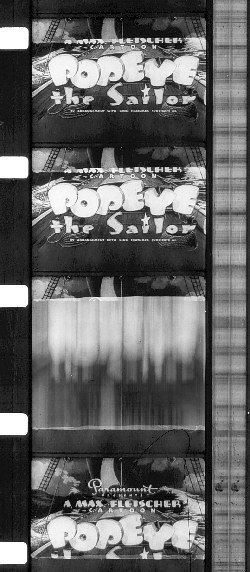
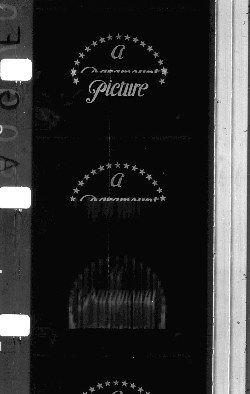
I have some 35mm/16mm Reduction Prints that had Pin Registration Slippage. It happens every so often, even on the Best Made Printers. That error should have been caught though and reprinted. Pretty sloppy Lab Work ![[thumbsdown]](graemlins/thumbsdown.gif)
Posted by Julian Antos (Member # 5497) on 10-13-2014, 12:42 PM:
Jim, was there any indication of where the print was struck?
Posted by Jim Cassedy (Member # 4115) on 10-15-2014, 10:25 AM:
Well, Julian,
I was able to get a look at the print box before it got shipped out.
It was shipped from the Technicolor Distribution center in Ontario, CA
There was a also a label on the box that had the 'bogus' film title
("Search for Truth") & the words "Deluxe - - Warner Brothers"
Now here's where it gets interesting - - - - - - - -
The film leaders had lab labels that looked like this:
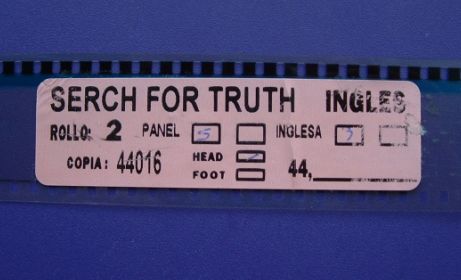
At first I thought maybe the print came from Ontario CANANDA, and not CA.
But then I had a quick flashback to my high-school level French and realized
the misspelled label was not French, but most likely Spanish.
I can't recall ever seeing a lab-label like this before. (Unless of course I
was running a foreign film festival and the prints were made outside the USA)
So who knows where this print came from? ? ?
Perhaps Deluxe is now using labs in Mexico? (Or Spain?)
Posted by Steve Matz (Member # 1890) on 10-15-2014, 05:30 PM:
quote: Jim Cassedy
It was a new "lab fresh" print, & there were no splices in the credits.
I doubt it was printed in California; Both Technicolor and Deluxe had their AUCTIONS in June; I even bought an old MAIER HANCOCK Hot Splicer from Deluxe. I didn't think either Company was doing Film processing because they sold a Ton of Equipment...
Posted by Jim Cassedy (Member # 4115) on 10-15-2014, 10:49 PM:
Then, obviously, there were no splices- - because YOU'VE got their friggn' splicer! ![[Roll Eyes]](rolleyes.gif)
Posted by Leo Enticknap (Member # 534) on 10-15-2014, 11:34 PM:
I believe that FotoKem still offer release printing, but if this print was distributed out of Ontario, I'm guessing south America (maybe Argentina, where there is rumored to be a still operating release printing lab?) for the origin. There is a large airport in Ontario that has very few passenger flights (owing largely to a dispute between the city and LA World Airports, the owner of ONT), but is a UPS hub and one of the largest air freight terminals in the south-western US. A lot of those flights go to and from Latin America.
Posted by Julian Antos (Member # 5497) on 10-16-2014, 10:05 AM:
Fotokem does indeed do release printing and does a great job. The name of the lab (and the date the print was struck, which is really useful) is always on the head of Fotokem prints so you'll know when you get one.
Posted by Carsten Kurz (Member # 5396) on 10-16-2014, 11:07 AM:
Out of curiosity - how would a 'better' lab prevent that kind of issue - would they simply have better machines and maintenance to reduce the probability, or would they have optical QC control scanners (e.g. 'looking' for correctly spaced frame lines) to automatically detect such issues? I guess even the best lab does not have the time/budget to check every single print by human eye?
- Carsten
Posted by Frank Angel (Member # 248) on 10-16-2014, 12:39 PM:
Looking at those 16mm snaps reminds me of a question I had been asking since I ran a 16mm theatre in my dorm in college, but never found an reasonable answer. I understand that when wet splices were the method of splicing, it didn't matter where the frame line fell as the splices were overlapping film, but once tape splices became the norm, why didn't someone revise the standard so that the frame line didn't fall in the center of the sprocket hole. To cut on the frame line (necessary with tape splices) this necessitated cutting across the sprocket hole. This causes the two halved sprockets at the spice to be much weaker than necessary, if the cut would be made somewhere other than on the sprocket hole structure -- ANYplace else would have made for a much stronger splice -- the most intuitive place would have been equidistant between the two sprocket holes. A butt splice made on non-sprocket hole geography would have much less tendency to fold at the joint.
Also, whereas I have seen many multiple stripe tracks in 16mm soundtracks on variable area prints (as many as 6), I have never come across a dual stripe track made with a variable density soundtrack like the ones in the pics. How it took Dolby so long to come up with the A system is a mystery. Just looking at those tracks screams LOOK -- Left Channel, Right Channel!
Posted by Steve Matz (Member # 1890) on 10-16-2014, 03:17 PM:
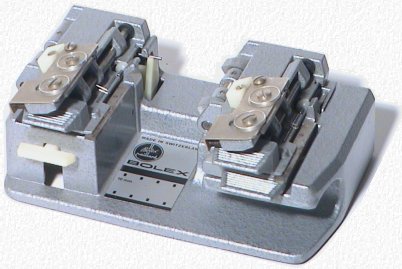
When I bought and started using this BOLEX BEVEL Splicer I didn't cut through a Sprocket hole. Since the Splicer put Beveled edges on both sides of each film strip,they came together as the original thickness of the film stock and the splice line was so fine it was almost undetectable going through the gate/aperture. I did hundreds of splices with this Bolex and would still use it over the Hercules Buttweld Splicer I bought back in the 70's and paid almost 800 bucks for....
Posted by Jesse Skeen (Member # 586) on 10-16-2014, 06:07 PM:
Remember getting a print of "Finding Forrester" that went out of frame within the first few minutes, no splices in that either til I had to cut a few perfs out to fix it.
Posted by Richard Fowler (Member # 893) on 10-16-2014, 06:13 PM:
Delux has a large lab in Spain which generally turns out excellent prints.
Posted by Scott Norwood (Member # 30) on 10-16-2014, 06:39 PM:
Even good labs make mistakes sometimes. The difference is that the good ones make fewer mistakes and check prints more carefully to ensure that the bad prints never make it out to the customer.
The label above is not from Foto-Kem. Here is a Foto-Kem 35mm label:
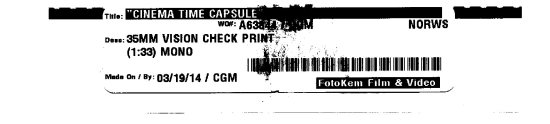
And here is a Foto-Kem 16mm label:

Posted by Steve Matz (Member # 1890) on 10-16-2014, 07:44 PM:
In the old days of DELUXE & TECH, where they were only cranking out a few hundred Theatrical Release Prints of a Feature;you would never see that. A competent Printer Operator would double check the run and reprint if necessary.When the Labs started Cranking out thousands of Prints per Feature than you know the Quality control wasn't going to be 100%.If you had this slippage in the Credits;it wouldn't really be an issue(except to a collector) and if it was only one or 2 frames it would probably only be noticeable to a keen eyed Film Person. Still at having to pay something like $1200 or more for a Print, it should be Flawless. Many of These High Speed Optical Printers can Print at a rate of 1200FPM...
Posted by Brent Francis (Member # 5008) on 10-20-2014, 05:01 PM:
As the supervisor in charge of release printing for Technicolor Toronto, I assure you we checked EVERY print by eye. Also, the film processing division closed in March 2012.
Posted by Carsten Kurz (Member # 5396) on 10-20-2014, 05:14 PM:
Wow, I didn't believe that was possible/feasible with these print numbers and time/budgetary constraints.
Was there any technical equipment involved in quality control that could aid in the process? I guess slipped frame lines could be detected even by counting perforation steps in to out? At least that would give an indication that something happened, and also, where, depending on the counting process and evaluation techniques.
- Carsten
Posted by Jim Cassedy (Member # 4115) on 10-22-2014, 01:00 AM:
quote: Frank Angel
I have never come across a dual stripe track made with a variable density soundtrack like the ones in the pics.
Frank- I don't believe there was ever a 2channel density recording.
There were 'push-pull' variable density sound tracks, but they didn't really
look like the ones in Steve's photos.
HOWEVER- I used to have an Auricon variable density recorder, and the
light valve in that unit produced a VD track with a faint line down the
middle just like the one you see in Steve's photos. I never figured out
why the line was there. I assumed it was some idiosyncrasy of the optics
in the recorder. But it didn't seem to affect the track.
As for the question about 16mm tape splicers and the weakening of the
film due to the splice bisecting a sprocket hole- - I remember someone
made a 16mm tape splicer that cut a sort of "U" or "lazy S" into the film
at the splice point, instead of making a straight cut. It still bisected a
sprocket h ole, but the irregular cut spread the stress over a larger
area than a straight cut. (but I think it also made the splice more
visible on screen) I have a couple of prints with those "U" splices
in them around here somewhere.
(Jim Sez:"If you want to see films in France, go to Cannes. If you want
to see films in cans, come to my house. I got film cans everywhere!") ![[Razz]](tongue.gif)
Posted by Brent Francis (Member # 5008) on 10-22-2014, 07:10 AM:
Two people per shift watching 2 reels each at twice normal speed (plenty slow enough to see that mess on the Judge print) can go through a lot of prints. Some labs had 6 or more people per shift, 8 hrs. per, 5 days a week (plus OT if needed).
OMG I remember those U shaped splices!
Posted by Scott Norwood (Member # 30) on 10-22-2014, 07:35 AM:
The Kodak "Presstape" splicer makes the U-shaped splices. I believe that these are still made (or, at least, still available as NOS items). The splicer itself is rather inexpensive (contrasted with a Ciro or Neumade splicer), but the splicing tape is specific to that unit and is exteremely expensive per splice. Also, the splice will show on screen, as it intrudes on the picture area.
Powered by Infopop Corporation
UBB.classicTM
6.3.1.2