This is topic Kinoton FP-30D Projector PRICING..... in forum Film Handlers' Forum at Film-Tech Forum ARCHIVE.
To visit this topic, use this URL:
https://ft-forum.com/ft/cgi-bin/ubb/ultimatebb.cgi?ubb=get_topic;f=1;t=011726
Posted by Dan Edwards (Member # 7602) on 10-22-2014, 01:20 AM:
Hi,
I am new here. I have come into a pair of FP-30D's - from a well known owner. Both are work as they should. Anyone know where to price these?
I will get far more details once I pick them up, but they are large, with that stands - so at 290lbs each, not light.
Anything direction is appreciated.
Dan
Posted by Marcel Birgelen (Member # 6801) on 10-22-2014, 08:53 AM:
What do you want to know? The price when they were new or their current value?
I honestly doubt you'd be getting more than $2000 for a well-maintained, complete set nowadays.
Posted by Dan Edwards (Member # 7602) on 10-22-2014, 09:02 AM:
Thanks Marcel -
Indeed, what folks are paying for these now. I will be picking these up in Hollywood (yes, I know that sounds funny - but indeed it is true) and was told by SilverScreen Theater that they 'should be worth $10,000'.
If they could be moved for $4,000 or $5,000 for the pair, I'd be happy. Each comes with this massive box, some power adapter/converter which allows 110/120/240? I can't recall what exactly it was, but was told those are highly desirable. We shall see if they really are!
I am an audio guy - but ended up with some 16mm projectors, 35mm projectors, rewind reels, and other pieces that were all owned by individuals. These individuals would high a company or person to come to run these projectors for the showings. Usually these are actor/actresses that own these.
I haven't a use for them and want them gone.
Posted by Leo Enticknap (Member # 534) on 10-22-2014, 10:12 AM:
At the recent round of Hollywood lab auctions, machines like these went for between $500 and $2k ish a piece.
As a completely rough guess, I'd say that Marcel's guess of $4-5k for the pair is ambitious, but not totally hitting it out of the park if you're prepared to be patient and do a little work looking for a venue that really wants them.
The thing about these projectors is that they are very specialized pieces of hardware. To 99% of the population they are junk, but an arthouse venue that already has a pair and is making plans to continue showing film into the medium term future would jump at the chance to buy them, especially as Kinoton is no more and therefore spares availability is only going to become more difficult from here on in. The home of an actor or actress is a very unlikely destination for them: apart from a very small number of celeb movie types who have jumped on the "film is cool" bandwagon, their homes will all be showing DCPs and BDs now. Even the Bel Air Circuit has recently acquired the adjective "digital" in its title!
My instinct is that if you want to be rid of them quickly, you're unlikely to get more than a few hundred. But if you're prepared to play a waiting game and do some work to find the ideal customer, you could make significantly more.
Posted by Dan Edwards (Member # 7602) on 10-22-2014, 11:15 AM:
Leo -
These have not come from any auction, in fact, if you are in Hollywood or close by, you likely know there machines. They are fairly well known in the area.
If they would not even fetch $4,500 for the pair - I will let them go to the recycle bin. They are large, heavy, delicate and frankly, not worth the floor space.
Thanks for your input - $200 per unit is garbage time.
Posted by Mitchell Dvoskin (Member # 751) on 10-22-2014, 12:52 PM:
I find it impossible to believe that at this point you will ever get more than $1500 to $2000 for the pair, if you are very lucky.
Posted by Scott Norwood (Member # 30) on 10-22-2014, 01:16 PM:
If you are space-constrained, it might be worth salvaging some of the parts. The reel shafts, gates and traps, lens holder assemblies, lamphouse reflectors, motors, and ceramic guide rollers in the trap are all items that theatres will need in the future. The electronics inside the projector are probably worth saving, too. These smaller items take up little space and could be shipped easily, making them worth keeping.
Posted by Marcel Birgelen (Member # 6801) on 10-22-2014, 06:45 PM:
quote:
Each comes with this massive box, some power adapter/converter which allows 110/120/240? I can't recall what exactly it was, but was told those are highly desirable. We shall see if they really are!
That's most probably the rectifier for the lamp. You wouldn't want to watch a movie on a projector driven by a lamp powered by AC current ![[Wink]](wink.gif) .
.
quote: Dan Edwards
If they would not even fetch $4,500 for the pair - I will let them go to the recycle bin. They are large, heavy, delicate and frankly, not worth the floor space.
The problem is, since everybody threw their 35mm gear out the last couple of years, there's an abundance of this gear on the market. In some cases you can even get whole multiplexes worth of 35mm gear for almost nothing, if you only arrange for pickup.
I'm almost certain this stuff will become more valuable over time, once the majority of 35mm projectors have been scrapped and a few people operating in a niche are desperate for replacement parts.
But instead of just throwing them into the garbage, you might as well try to give them away to some interested party. The "free" argument might dramatically increase your chances find a potential "buyer".
It's always a bit of a shame when some good, functional hardware is wasted.
Posted by Jim Cassedy (Member # 4115) on 10-23-2014, 11:29 AM:
quote: Dan Edwards
Each comes with this massive box, some power adapter/converter which allows 110/120/240?
As someone else has pointed out by now, it's likely those big boxes are
the power DC power supplies for the xenon lamphouses. They are more
than just "desirable" as you need them to get light out of the projector.
The Kinotons are nice machines. I run 5 of them at two different
screening rooms I regularly work at. (Two 35mm's, Two 35/70's &
One 35/16) I really like them.
As for what they are worth- - my dad, who was an advertising executive
for may years, would say "They're worth whatever you can get someone
to pay for them."
If I had a place to store them, I'd buy them from you, but I've
already got 'too much stuff'
Here's Some Actual Photos (WoW!)
I run two Kinotons in this booth. 99% of the
time I'm running changeovers, but occasionally
I'll run a show off of 12K reels from the low-boy
transport barely visible behind the projector.
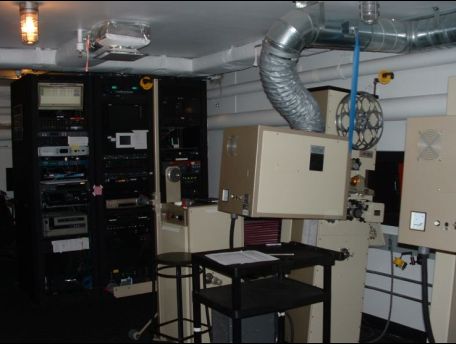
The 35/70's In Another Booth I Work At.
These are still set up to do both Dolby Digital & DTS
and we can also do 35/70 mag sound if necessary.
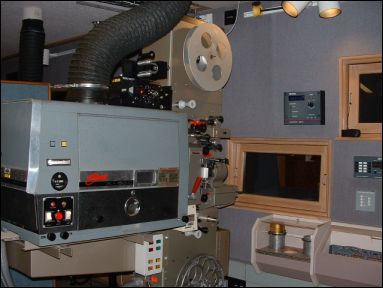
(one of a pair. I don't 'do' platters!)
This location also has a Kinoton 35/16mm proj.
They're all good machines, although I find the 35/70
a bit trickier to thread due to all the xtra rollers!
Posted by Steve Guttag (Member # 268) on 10-23-2014, 01:12 PM:
Hmmm...work at Dolby do you?
Posted by Jim Cassedy (Member # 4115) on 10-23-2014, 02:49 PM:
Yea, Steve. The Dolby screening room is one of several I work at.
In fact, I've been there so much lately I should just move a cot
into one of the audio booths & sleep there.
(hey- - it would sure be quiet! ![[Big Grin]](biggrin.gif) LoL)
LoL)
It's probably one of the best 'projection gigs' in San Francisco.
I also work at two other private screening rooms, one of them has the
other kinotons pictured & the 2nd one has a pair of double-system Centurys.
Posted by Fabian Schreyer (Member # 5120) on 10-23-2014, 04:47 PM:
What's that remote control above the porthole? Does it belong to a Dolby processor. Never seen one like this.
Posted by Dave Macaulay (Member # 813) on 10-23-2014, 06:04 PM:
I had a CP750 remote fader unit go bad, and it was changing CP750 formats when the knob was turned... so there is the capability to more fully remote control one via the remote fader connector but I've never heard of a true remote. Is that one?
Posted by Marcel Birgelen (Member # 6801) on 10-23-2014, 06:27 PM:
Since it seems to be the Dolby Screening Room, couldn't it be some kind of... never released prototype remote? ![[Smile]](smile.gif)
Posted by Sam D. Chavez (Member # 1841) on 10-23-2014, 07:31 PM:
Good guess Marcel!
That's actually a model 278 barcode reader intended to be a smart front end to automation from back in the late '80's. The idea was it would read barcode cues flashed onto the actual release prints. These could be scope, flat, curtain cue, end of show, ad infinitum. Looks pretty modern after all these years.
I selected the Strong X60 C's as they were the last Strong to have glass reflectors.
Posted by Jim Cassedy (Member # 4115) on 10-24-2014, 12:16 PM:
Sam beat me to answering your question, Marcel.
I didn't know what that unit was when I first started working that room either.
I had to do a little research on my own to find out what it was.
(I shouldda known I could have just asked Sam !) ![[Roll Eyes]](rolleyes.gif)
Here's a slightly better picture:
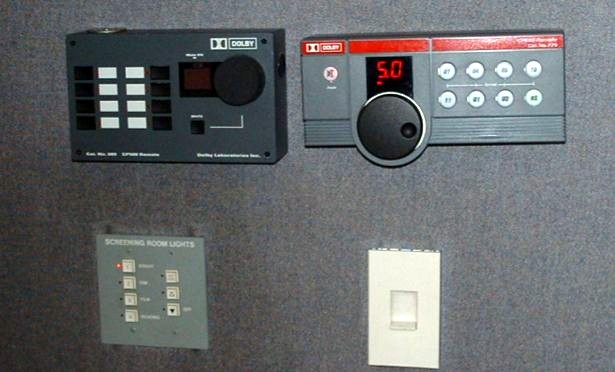
The other unit is (obviously) a CP650 remote.
Actually though, except for the 35/70 projectors, everything in that room
and all the auditorium functions (masking, lights, curtain) are controlled
via a desktop station and two i-pads. I don't don't think I've ever actually
turned a knob or pushed a button on any of the many processors they have
in their equipment racks. It's a nice system- - unless the wi-fi crashes !
(Which has only happened to me once & it was easy to get everything 'back' )
There are a wholebuncha pictures of the Dolby room in the Warehouse
section of this website. They were taken a number of years ago, so there's
been a lot of changes in equipment from when they were taken.
(The big BARCO in those pictures, for example, has been replaced by a 4K Christie)
Posted by Sam D. Chavez (Member # 1841) on 10-24-2014, 06:04 PM:
To be clear, I was talking about the box above the projection port, not the smaller box next to the 650 remote.
Posted by Leo Enticknap (Member # 534) on 10-24-2014, 06:55 PM:
quote: Jim Cassedy
Actually though, except for the 35/70 projectors, everything in that room and all the auditorium functions (masking, lights, curtain) are controlled via a desktop station and two i-pads.
I've got our AP20 and DSS200 running on VNC through wifi and an ancient but functional Android tablet - very useful, especially for setting volume levels during tech rehearsal screenings with filmmakers. I just let them tweak the level themselves from within the house to their taste, add about .2 or .3 to it on the night of the show if the house is quite full, and everyone is happy. No more running back and forth between the booth, and I can also take the tablet into the balcony or the main floor to confirm that the sound is OK in both.
The box on the left of the CP650 remote is a CP500 remote, isn't it?
Posted by Don Furr (Member # 1469) on 10-24-2014, 09:36 PM:
Yes....the box to the left is a CP500 remote.
Posted by Jim Cassedy (Member # 4115) on 10-25-2014, 12:53 AM:
quote: Sam D. Chavez
To be clear, I was talking about the box above the projection port,
not the smaller box next to the 650 remote.
D'oh! My fault. I was looking at some tiny thumbnail images when
I selected that picture and apparently clicked on the wrong one.
THIS is the correct image, which shows the box Sam described.
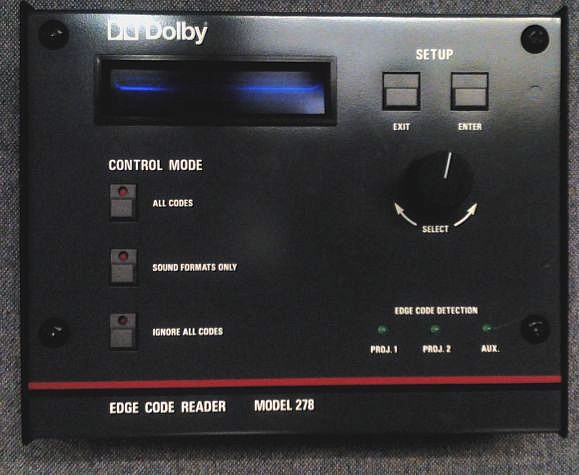
It's still connected to "something" or at least the wires are going somewhere.
Posted by Marcel Birgelen (Member # 6801) on 10-27-2014, 08:59 AM:
Yes indeed, that box, thank you. We all like to look at some obscure, probably obsolete hardware now and then, don't we?
Still looks quite modernish from close up, although the buttons are giving it away a bit. I've also never seen one of these before.
Sam, so the idea was that you could read barcodes from the actual print and the device (or rather the "controller" behind the device) would then program those cues automatically for this feature?
Posted by Mitchell Dvoskin (Member # 751) on 10-27-2014, 09:19 AM:
United Artists Eastern Theatres here in the USA experimented with bar code controlled automation back in the 1980's. You could control curtain/lights/masking/shutter/etc via the appropriate bar code. My memory of this is rather fuzzy, but originally they used bar code stickers on the print, but they were trying to get the studios to support the system by printing the bar code cues into the prints. Ultimate, the project was abandoned.
Posted by Leo Enticknap (Member # 534) on 10-27-2014, 12:06 PM:
I'm guessing that the ultimate goal was to achieve show automation without the projectionist having to faff around putting sticky labels on the print as part of the build-up process (with all the time and print wear that implies).
Posted by Carsten Kurz (Member # 5396) on 10-27-2014, 12:15 PM:
They should have added timecode capability to SRD tracks. DTS could have utilised theirs for automation as well. At the time these systems came out, the world was driving full speed into multiplexes and automatic operation.
- Carsten
Posted by Jim Cassedy (Member # 4115) on 10-27-2014, 03:38 PM:
In the "Automation" section of the FT website, there is some info on the UA
Barcode readers, including a page of barcodes you could print yourself
onto little stickylabelthingys.
Like Carsten, I too used to wonder why DTS didn't come out with some sort of
interface which you could program to open (or close) relays at a particular
time code point. I would have found something like that very useful.
Posted by Sam D. Chavez (Member # 1841) on 10-27-2014, 09:12 PM:
The UA system was in competition to the Dolby one. Dolby used fairly robust custom barcode vs UA's off the shelf can of peas type stickers. The basic problem with the UA system was the Symbol Technology reader was always mechanically scanning looking for a cue for the whole feature and the hardware would wear out pretty quickly.
The original germ of the idea was to identify SR vs A type tracks and then it grew into a much more elaborate reader with software. For instance the curtain cue would be at the start of credits and then a time offset would be programmed on that screen so curtain would close at the very end as it should.
The cues were read by a slot photo interruptor as the film passed by so there were no moving parts aside from the film. Dolby did issue pages of specific cues to prime the pump as it were while the labs adopted the bar code idea. The on film cues could used by everyone as a public utility.
Work on SR.D ultimately pushed the bar code project aside as it was clear that DTS and SDDS were being adopted by cinema owners. Bigger fish to fry is the best way to put it. DA10 came out soon after and it worked pretty flawlessly and good news after the CDS fiasco where the digital tracks could not be read reliably and no back up.
Posted by James P King (Member # 8560) on 10-29-2014, 09:30 AM:
Hi Dan,
Are the pair of FP30's still up for sale?
Thanks,
James
Powered by Infopop Corporation
UBB.classicTM
6.3.1.2