This is topic Inherent Vice 70mm in forum Film Handlers' Forum at Film-Tech Forum ARCHIVE.
To visit this topic, use this URL:
https://ft-forum.com/ft/cgi-bin/ubb/ultimatebb.cgi?ubb=get_topic;f=1;t=011758
Posted by Bobby Henderson (Member # 840) on 12-11-2014, 09:26 PM:
How many 70mm Datasat prints were made for Inherent Vice? Where are they playing? Just wondering. I only know about one Arclight theater in the Los Angeles area.
Posted by Mark Lensenmayer (Member # 134) on 12-12-2014, 07:43 AM:
Someone from Grand Lake said they were expecting one, but nothing confirmed.
It's very odd how quiet this 70mm release is compared to the huge amount of coverage with Intersteller.
Posted by Lyle Romer (Member # 1266) on 12-12-2014, 08:21 AM:
quote: Mark Lensenmayer
It's very odd how quiet this 70mm release is compared to the huge amount of coverage with Intersteller.
I think the odd thing is that this is getting a 70mm release at all. According to IMDB, it was shot on 35mm in flat. I can't see a 70mm blow up being that much better (if at all) in image quality than a 4K DLP (if they bothered to scan in 4k).
Posted by Bobby Henderson (Member # 840) on 12-12-2014, 08:31 AM:
This one kind of went into the "huh, why are they doing that" category. There's nothing very "70mm" about this movie at all. The movie was filmed in 35mm and framed for the 1.85:1 aspect ratio. Such blow-ups to 70mm were common back in the 1980's, but they were made mostly because the 70mm format was the only thing that had high quality 6-track surround sound.
A 5/70mm print will be brighter, more steady and typically better in overall quality than a 4/35mm print, especially the mass produced high speed ones. But even there, if we're just talking about a flat 1.85:1 35mm sourced movie, it might be just as good to show it in a 4K DCP.
There's at least one good thing about this: the 70mm print(s) will give at least one or more projectionists a little more practice handling 70mm.
![[Razz]](tongue.gif)
Posted by Mark Lensenmayer (Member # 134) on 12-12-2014, 11:51 AM:
As of 12/12/2014, Arclight Los Angeles has 2 70mm prints (one in the Dome). The other 4 locations are either Digital or 35mm.
Posted by Paul Gordon (Member # 3320) on 12-12-2014, 04:40 PM:
The film is playing on 70mm at the Varsity in Toronto starting xmas day.
Posted by Michael Coate (Member # 757) on 12-13-2014, 01:06 PM:
'Inherent Vice' Will Screen in 70mm in Select Theaters. But is Bigger Always Better?
quote:
'Inherent Vice' Will Screen in 70mm in Select Theaters. But is Bigger Always Better?
By Mike Celestino
Indiewire
December 4, 2014 at 12:24PM
The word is out that Paul Thomas Anderson's "Inherent Vice" will be screening in 70mm at select theaters. Below a Hollywood projectionist explains why films shot on smaller formats are occasionally blown up to 70mm.
"Bigger is better." Or at least that's how Thomas Hauerslev, chief editor of the passionately dedicated compendium website in70mm.com, responded when I asked him to describe the appeal of large-format filmmaking. "70mm has a very large negative area. Nearly 3.5 times as much compared to 35mm film… 70mm film is much sharper, which gives a wonderful illusion of reality."
My first experience with 70mm was seeing David Lean's "Lawrence of Arabia" at the Cinerama Dome in Los Angeles over a decade ago, and I can say without hyperbole that it was a glorious, life-changing experience. I had been going to the movies my whole life, but now it felt like I had finally seen a movie. And that played no small part in my pursuing a career as a projectionist.
Of course, "Lawrence of Arabia" was shot on 70mm (technically 65, as the extra five millimeters in width is accounted for by the space necessary to fit the soundtrack on the final print) and designed to be shown via the same medium. But what about movies that are shot on smaller formats, usually 35mm, and then blown up to 70 for exhibition? When I started hearing rumors that auteur filmmaker Paul Thomas Anderson's new comedic detective caper "Inherent Vice" would be going through this process, I couldn't help but wonder why. In my head it didn't make sense, like copying a DVD to a Blu-ray. You aren't going to gain any resolution; it's not possible. So what is to be gained in transferring an existing, perfectly viable 35mm image to a larger, non-native format? And how did this tradition get its start?
Interestingly enough, the impetus was not a visual one, but aural. "The big advantage was offering 6-channel stereophonic sound," said John Sittig, former head of projection for Pacific Theatres. "This is the very reason that 70mm blow-ups were made beginning in 1963 [with "The Cardinal"] and going into the 1990s [with the last regular first-run release being James Cameron's "Titanic" in the winter of 1997]. Until the introduction of Dolby optical stereo Type A in 1974, most theatres played [35mm] film in monaural single channel sound."
As you might guess, it has always been easier and cheaper to shoot on 35, but blowing up to 70 for limited, roadshow-style releases did offer its advantages beyond the upgrade in audio format. Hauerslev said that 70mm also provided "much more light on the screen, vastly better colors, and improved sharpness," in addition to "less visible scratches and dust because the film needs less magnification on the screen compared to 35mm film" and "a very steady image [that] fools the human brain to think this is a ‘window to the world' and not a movie screen."
So what put an end to 70mm blow-up prints as a go-to source of big-event moviegoing? According to Sittig, the same thing that brought about its initial popularity: sound. "'Star Wars' in 1977 really put Dolby stereo on the map, but it was the introduction of Dolby Digital [in 1992 with 'Batman Returns'], DTS ['Jurassic Park,' 1993], and Sony SDDS ['Last Action Hero,' also 1993] with 5.1 stereo that put an end to 70mm blow-ups. Ron Howard photographed "Far and Away" in 70mm in the '90s and there was an occasional limited 70mm blow-up like "Titanic," but very infrequently. Even "Interstellar" [shot both on 35mm and the horizontal-running ultra-high-resolution 70mm IMAX format] is working with only ten 70mm prints. Today very few theatres are equipped with 70mm projectors and have even fewer qualified projectionists to run them."
Paul Thomas Anderson is in a very small group of A-list filmmakers (including the likes of Quentin Tarantino and Christopher Nolan) who are currently digging in their heels in the tug-of-war battle against the digital revolution in movie production and distribution. His 2012 drama "The Master" was shot and released on 70mm film in the midst of an era when it seems like most directors and studios are all too willing to embrace a new, more convenient technology, and immediately abandon what they perceive as the obsolete and cumbersome old.
But PTA (as he's known to his fans) and his ilk also seem to get a visceral thrill out of going against the grain, even when it comes to utilizing the tools of filmmaking's past. "The Master" was shot in a 1.85:1 (or "flat") aspect ratio, which seems antithetical to the very idea of shooting on 70mm, the natural dimensions of which are a much wider 2.21:1. Anderson seemingly chose to shoot on a large format for the tremendous gain in resolution, but then opted to compose his frame by essentially cropping both sides of the image. This counterintuitive (and consequently, unique) practice is so rare that the only other example I could find was "Play Time," a 1967 film by the acclaimed French director Jacques Tati, which was shot on 70 at an aspect ratio of 1.70:1.
Whatever his intent, Paul Thomas Anderson apparently remains dedicated to prolonging the death throes of one of the 20th century's most popular and beloved forms of media. And hopefully, with the coming release of "Inherent Vice" on 70mm, as with "Interstellar," audiences will have an opportunity to reclaim and re-experience the feel of what Thomas Hauerslev refers to as "the Rolls Royce format of Cinema… it has to be seen to be understood."
A thorough list of all 70mm blow-up prints from 1963 to the present is available at http://www.in70mm.com/library/blow_up/index.htm . "Inherent Vice" will be released on 70mm in select theaters beginning Friday, December 12th.
Posted by Stephan Shelley (Member # 8587) on 12-13-2014, 02:45 PM:
I think it is only New York and LA this early. Grand Lake Oakland is expecting 5/70 of it in Jan. 2015. While some of The Master was shot on 65mm it was 1:85. Studio insisted on special 1:85 70mm plates.
Posted by Connor Wilson (Member # 6088) on 12-13-2014, 04:43 PM:
The DCP for Inherent Vice happens to be 2K, according to this letter from Deluxe's D-Cinema portal.
There is at least one credit in IMDb for something to do with "digital intermediate", and that is "digital intermediate producer" for Jason Pelham. Is it confirmed that Inherent Vice was finished in DI, or photochemically? Will it have both a DI and analog IP for the digital and film prints respectively, like The Master?
It would be pointless to see a 2K digital intermediate in 70mm. And why wouldn't Warner or PTA let the DCP be in 4K?
Even though it was only shot in 35mm flat, the 70mm trailer for Inherent Vice at Ziegfeld (before Interstellar) looked great. Compared to the softer digital previews that preceded the trailer, the blacks were blacker and it was overall sharper, even with its grain, in film rather than DLP. I wouldn't mind seeing a 70mm blow-up of a movie like this, given the proper care of the projectionist.
Posted by Mike Schulz (Member # 4297) on 12-14-2014, 04:56 AM:
They have only struck 3 prints so far. Arclight has 2 of them and the 3rd is up in Toronto. It is definitely being masked to 1.85 just like The Master so (in my opinion) it kinda defeats the purpose of a blow-up as there is no resolution gained since it was filmed on 35mm. At least a good portion of The Master was filmed on 65mm so although it was masked to 1.85, you still had the resolution gain and it looked great.
Posted by Edward Havens (Member # 4715) on 12-14-2014, 09:19 AM:
It goes to show how much of an ego certain filmmakers have, as well as the snobbery of some cineasts.
Posted by Steve Guttag (Member # 268) on 12-14-2014, 10:53 AM:
As someone who has handled MANY MANY 70mm as 35mm (or DCPs for that matter) print that originated in 35mm. It is a VERY rare case (think Ghostbusters) where I wouldn't take the 70mm print over the 35mm print. The exception are "EK" 35mm prints...those are drop-dead gorgeous. However, when one is talking about a release print and the typical quality of film projectors, the 70mm show, even with a 35mm original is going to look substantially better on all but the tiniest of screens. The 70mm IN suffers from the optical enlargement but the 70mm contact release print will be a more faithful dupe of the IN than the 35mm IN to the 35mm Release print. With each generation, you lose a bit so once you get it into the larger format, you slow that down. Then in the projection process, you loose less as you are no longer magnifying the problems of your projection system as much.
So yeah, I'll take a 70mm blow up of a 35mm original over a 35mm release print, just about every time.
In 2014, using the 70mm release format also will keep most of the "me too" people away who really don't do film a film show very well. it isn't sufficient to merely have 35mm equipment and never was. Most 35mm equipment does a mediocre job of showing it. it was built for a price-point and reliability and later, features to minimize labor costs without regard as to how it would affect performance.
Some 70mm machines suffered in this respect too but again, those problems are not magnified as much in 70mm
It is a viable reason to continue to release in 70mm in the digital era. It has the best chance to make the film show worth while. Naturally, I'd hope more people would shoot in the 5/65 format to make the most of it.
Posted by Terry Monohan (Member # 8285) on 12-14-2014, 11:07 AM:
With only 3 70mm prints made for this limited advance run why did the Pacific Arclight have to get 2 of them? One for the Cinerama Dome was enough, they needed to send the other to NYC. I think when It comes out in a few weeks you will see a few more 70mm prints out in the world. What a shame they did not do wide screen on this new blow up 70mm film. One cinema that probably won't get a new 70mm print is the theatre in Atlanta that wrecked a 70mm print a few months ago with the space film with bad projection people.
Posted by Mark Campbell (Member # 4411) on 12-14-2014, 11:10 AM:
So long as anyone wants to keep 70mm alive, and the craft of presenting 70mm alive, I am all for it and say more power to them. In this new age of unmasked flashy RPX/ETX/Liemax screens, tricking everyone into paying a surcharge and dumbing down expectations, it is nice to know there are filmmakers who actually care about good photography and presentation in properly equipped venues. I have seen many 35mm blowups (not to mention 65mm lensed) films over the years and nothing beats it when done properly. I don't think it is ego or snobbery at all. It is the ability of filmmaker and artist to leverage their status to present their film in the best possible manner because they actually care about their work.
Posted by Leo Enticknap (Member # 534) on 12-14-2014, 12:06 PM:
I was chatting to someone who has seen one of the Arclight's prints last week. He wasn't very impressed with it, noting that there were multiple lab splices in the middle of reels, and that the color timing looked clearly off in many of the scenes and shots.
My guess would be that the recent "film is cool" revival has resulted in FotoKem being seriously overworked, given that they are now, to my knowledge, the only remaining lab making 35mm and 70mm release prints in the US (incidentally, I've also just heard that Gulliver Arane in Paris, which AFAIK was the last remaining lab in Europe that still did 65/70, has just gone bankrupt), and that as a result, QC issues are cropping up in their prints. We've had the reel 8A-B DTS/Datasat issue with Interstellar, and the 35mm print of IV we had for AFI had a number of glitches, notably cue dots scribed in the wrong position and SR-D dropouts, too.
Posted by Jonathan Goeldner (Member # 4854) on 12-14-2014, 12:28 PM:
well aside from this release two other 70mm features are promised for 2015
- Quentin Tarantino's "The Hateful Eight"
- Terence Davies' "Sunset Song"
'Jurassic World' ? - I can dream can't I ![[Wink]](wink.gif)
with 4K creeping into 'home' theater faster than the commercial theaters [word is that 4K blurays will hit the market in the fourth quarter of 2015], why the hell is 4K DCP's a rare commodity?
Posted by Mike Schulz (Member # 4297) on 12-14-2014, 01:35 PM:
I attended a SMPTE meeting recently and the main presenter mentioned that we need to be really skeptical with the upcoming "4K" Bluray releases. Almost all current feature film post production is being master with a 2K DI workflow and the reason is data capacity and bandwidth. If you are using a 4K DI, the data storage space required raises astronomically and if you are rendering (VFX and especially fully animated features), the rendering time is also astronomically more which can delay post production and other problems.
Due to this, a very large percentage of "4K" releases will literally be up-scaled from a 2K master. Just food for thought for those of you who like to jump on bleeding edge tech bandwagons.
- I should also mention that this is strictly done in post production so they still might have a 4K source (or even 6K or 8K from a film scan) but they down-scale it to 2K for post, and then up-scale it back to 4K for release.
Posted by Marcel Birgelen (Member # 6801) on 12-15-2014, 02:28 AM:
With no confirmed prints for Europe, we're again out of luck here.
I think the only reason to go for a 70mm release, even if it's a 35mm blowup, is because anno 2014/2015 it's the only way to ensure it even has the chance to get a proper, high quality presentation on film.
Still, if you free your mind from nostalgia and look at it objectively... Those 70mm presentations will most likely not look much better than any decent 4K presentation, but at a much higher cost.
If 5/70mm is to have a future, the source material should really be (largely) shot on 65mm.
Posted by Thomas Hauerslev (Member # 566) on 12-15-2014, 03:22 AM:
It's odd in some way, that the Studio advert in LAT does not mention 70mm at all.
Posted by Bobby Henderson (Member # 840) on 12-15-2014, 11:00 AM:
I'm kind of surprised the Dallas-Fort Worth market didn't get one of those Inherent Vice prints. Brad's three 70mm setups aren't permanent, but something probably could have been worked out to get at least one print into the metroplex.
quote: Jonathan Goeldner
with 4K creeping into 'home' theater faster than the commercial theaters [word is that 4K blurays will hit the market in the fourth quarter of 2015], why the hell is 4K DCP's a rare commodity?
Two things: Money and 3D.
It's true 4K UHDTV sets are proliferating now at a surprisingly affordable rate. I bought a new 65" 1080p HDTV set a few months ago and now wish I would have waited. My girlfriend's daughter bought a Samsung 55" 4K TV for a little over $1500 and the same Sears store had a 65" 4K TV for $2200 -that's only a couple hundred more than I paid for my TV set.
More consumer devices are suppoting 4K video capture. Several smart phone models can do. GoPro cameras can capture 4K. Some new DSLR models offer it as well.
In movie production 4K is still kind of a rare thing, although it is starting to become more common. 2K is a whole lot cheaper to produce and store. Movies with 3D versions will almost always be limited to 2K because commercial movie theaters can't show 3D movies in 4K. Plus a 3D movie in 4K would have pretty tremendous bandwidth and storage requirements. Nevertheless, Hollywood studios will be under a whole lot of pressure to deliver since the next generation of digital projection systems will support 4K 3D.
quote: Mike Schulz
I attended a SMPTE meeting recently and the main presenter mentioned that we need to be really skeptical with the upcoming "4K" Bluray releases.
At the very least, consumer hardware is going to be hitting shelves by late 2015. There is a lot of pressure to make 4K Blu-ray players available. Current hard disc based 4K movie players are brand specific, limited in title selection and expensive. I'm under the impression Sony's 4K media players are limited to Sony studio product. When you buy a movie you have to download it -a huge download. Netflix is offering 4K streaming of certain titles like House of Cards. But you must have one hell of a fast connection to actually get the video stream in 4K. Blu-ray players with 4K capability will solve some of those problems.
The consumer electronics industry isn't going to hold back on 4K. They need to be able to sell "the next big thing." The market is saturated with standard 1080p TV sets with very little room for profit.
quote: Mike Schulz
Due to this, a very large percentage of "4K" releases will literally be up-scaled from a 2K master. Just food for thought for those of you who like to jump on bleeding edge tech bandwagons.
If this is actually happening on a lot of titles the movie studios are going to get found out about it. They already know various review sites often don't pull any punches. Some movie productions are maintaining 4K resolution all the way through the post production pipeline. Much of Gone Girl was actually shot in 6K. David Fincher and his crew used the extra image real estate to either adjust compositions, either cropping or down-sampling to 4K.
Basically the movies that are fake 4K are going to get compared to real 4K movies and not be treated kindly over it.
Posted by Steve Guttag (Member # 268) on 12-15-2014, 02:48 PM:
Wrt to 4K versus 70mm on 35mm source material (blow ups)...really? You can't tell a 35mm versus a 4K image? And then you can't really tell a 70mm image (even from 35mm source) from 4K? While the resolution is just about there, the color and definitely the contrast is not. Also, there are no Morie patterns on the screen.
And the case of the typical AMC/Regal 4K theatre...with the 70mm print, there would only be one image coming out of the port!
So yeah, I'll still take a 70mm blowup to a 4K DCP or 35mm release print...every time...the odds are just better on the outcome.
Posted by Brad Miller (Member # 2) on 12-15-2014, 04:52 PM:
They wanted a 6 week minimum booking for a 70mm print...at Christmas...on a small movie.
Had they released in January it would have happened, but not in December for that movie.
Posted by Steve Guttag (Member # 268) on 12-15-2014, 06:07 PM:
I can kind of understand that. It is a substantial investment for the print...and for the theatre, you get a bit of an exclusivity for a month.
Historically a 70mm title would have been worth a 6-week run, minimum!
Posted by Bobby Henderson (Member # 840) on 12-15-2014, 07:31 PM:
Maybe if the movie had been filmed in 5/65mm, and scored a little better with critics, it might have been worth a 6 week run.
Posted by Steve Guttag (Member # 268) on 12-16-2014, 06:37 AM:
Yeah but you are getting a rather lengthy exclusivity with it. I believe 4-weeks. Even a marginal movie will do well if the nearest theatre to you is hundreds of miles away. Unless you are totally out of market, you'll likely do better with that sort of deal than being one of hundreds if not over a 1000 theatres running a title of a "hit" movie.
Posted by Brad Miller (Member # 2) on 12-16-2014, 09:37 AM:
Again, it's the timing of it. The movie just isn't big enough in this day and age to warrant a 6 week run which for most of the existing 70mm first run theaters to tie up their largest auditorium for the entire holiday season.
I'm working on a way for the two Dallas SMG locations to be able to move the 70mm into a smaller (not small, just not the biggest house) which would have helped in this scenario.
But I thought I read Vice was playing in a digital auditorium at the 70mm complex in California. Is this the case? If so then the studio screwed up and should've made it a 70mm exclusive (not even 35mm like Nolan did) and only after a month let it go to other formats.
Posted by Bobby Henderson (Member # 840) on 12-16-2014, 10:30 AM:
Yeah, I can recall a few movie releases with exclusives in New York City where the movie was playing at only one theater in Manhattan and in 70mm Dolby mag before going wide to other theaters days or weeks later. This was usually done for movies released near the end of the year just in time to squeak under the wire for Oscar™ consideration.
Inherent Vice might have been a natural for that treatment. It would have allowed the expensive 70mm print to be hyped more in the ads (as has been done in the past).
Unfortunately the investor-driven nature of the movie business these days often dictates pushing a movie out to as many screens as possible, fast as possible. Get the theatrical run played out and over with ASAP and get on to the home video release platforms quickly to pay down loans and eliminate interest payments. Executives don't have very much patience for "platforming" a movie release from a handful of exclusive screens to adding more and more on a steady pace weeks later.
Inherent Vice may have had less trouble getting a 6 week 70mm exclusive if the movie had been released in January, April or late August, traditionally times when studios are clearing out a lot of crap product and it sucks to go to a movie theater. But I think the studio intended Inherent Vice to be in the running for various awards, hence the December release date.
Posted by Michael Coate (Member # 757) on 12-16-2014, 04:47 PM:
quote: Brad Miller
I thought I read Vice was playing in a digital auditorium at the 70mm complex in California. Is this the case?
Yes, it appears so. If the ArcLight's showtime breakdown is correct, "Inherent Vice" is playing on three screens: two in 70mm and one DCP. (One of the two 70mm presentations is in the Dome.)
Posted by Martin McCaffery (Member # 37) on 12-16-2014, 08:54 PM:
quote:
- Terence Davies' "Sunset Song"
Really? The combined grosses of every film he has ever made probably wouldn't pay for the prints. Beautiful filmmaker, but who did he sleep with to get a 70mm release?
Posted by Bobby Henderson (Member # 840) on 12-16-2014, 10:51 PM:
Apparently they're shooting Sunset Song in 5/65mm using the Arri 765 camera. An article in the Hollywood Reporter talked about the use of 65mm film to capture the Scottish landscape.
Posted by Thomas Hauerslev (Member # 566) on 12-18-2014, 04:18 AM:
Old news: http://www.in70mm.com/news/2014/sunset_song/index.htm
Posted by Michael Coate (Member # 757) on 12-19-2014, 12:24 PM:
I didn't see a studio-placed display ad in the Los Angeles Times for "Inherent Vice," but here's a cellphone shot of the ArcLight directory ad.
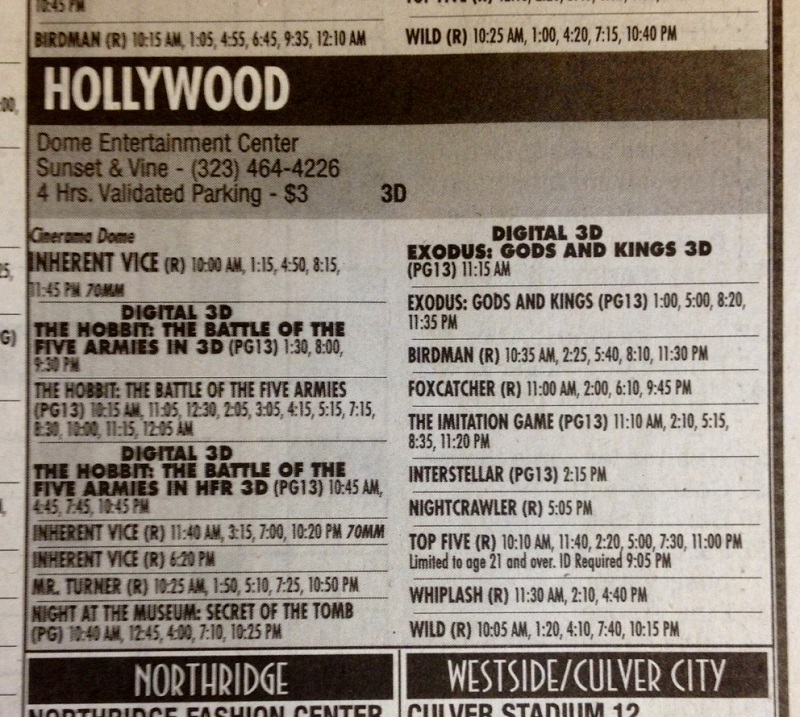
Posted by Adam Martin (Member # 641) on 12-19-2014, 03:48 PM:
I can park there in 3D? Cool. ![[Cool]](cool.gif)
Posted by Terry Lynn-Stevens (Member # 7349) on 12-25-2014, 11:32 AM:
A small ad is being run with the 70MM ad for Inherent Vice at the Cineplex Varsity.
Posted by Marcel Birgelen (Member # 6801) on 12-26-2014, 05:51 PM:
quote: Adam Martin
I can park there in 3D? Cool.
Wait until you try their 4D valet parking service. You'll get your car back BEFORE they parked it for you.
Posted by Jason Metcalfe (Member # 5739) on 01-06-2015, 03:40 PM:
We received the Arclight's print this morning sans DTS discs
Right now we're scheduled to show it for about 2 weeks but that may change depending on how ticket sales are
Posted by Leo Enticknap (Member # 534) on 01-06-2015, 06:53 PM:
I have ISOs of the DTS CDs, ripped when we had the movie in November. We had a 35mm print but I'm guessing that the discs are the same. If you'd like me to burn and mail you a set of discs, please email me off-list.
Posted by Stephan Shelley (Member # 8587) on 01-08-2015, 01:16 PM:
No 70mm print in Oakland CA, not even 35mm. Sounds like they just made the two 70mm prints.
Posted by Michael Coate (Member # 757) on 01-08-2015, 02:15 PM:
quote: Stephan Shelley
Sounds like they just made the two 70mm prints.
There are at least three 70mm prints.
Posted by Terry Lynn-Stevens (Member # 7349) on 01-08-2015, 03:09 PM:
Last day for the 70mm print in Toronto.
Posted by Stephan Shelley (Member # 8587) on 01-08-2015, 03:13 PM:
Third was Toronto?
Powered by Infopop Corporation
UBB.classicTM
6.3.1.2