This is topic 70mm formats 40,41,42,43 with CP-500 in forum Film Handlers' Forum at Film-Tech Forum ARCHIVE.
To visit this topic, use this URL:
https://ft-forum.com/ft/cgi-bin/ubb/ultimatebb.cgi?ubb=get_topic;f=1;t=011772
Posted by Zdenek Stepanek (Member # 8695) on 01-20-2015, 02:22 AM:
Hi
I´m a novice on this forum. My friend own famous cinema in czech republic with fully functional UM 70/35 projectors from Meopta.
http://in70mm.com/news/2014/panorama/uk/index.htm
My job is primarily IT/Computers, but in fact, i know every screw in this building. Today, I work on the sound.
Historically, in this cinema is czechoslovakian transistors power amplifier AKT from Tesla. It handle 6-track Todd-AO format - 6 full-range amplifiers and boxes. No Dolby at all...
We have also CP-500 with 6ch. analog input card and (maybe, i hope...) with daughterboard for installation 3x Dolby-A card. Outputs are typically modern 5.1 (L+R+C+Sw behind scene) and Left and Right surrond.
My question is how CP-500 with those arrangement can play 70mm formats:
40 - Todd-AO - 6 full-range channels
41 - Todd-AO+Dolby-A - 6 full-range channels with Dolby-A NR
42 - Baby Boom - Le (between L and C) and Re channels are two subwoofers, All channels with Dolby-A
43 - Stereo Surrond - Le and Re are used for one subwoofers and simultaneously for stereo surrounds.
My opinion is that CP-500 cannot handle format 40 and 41 because it have not Le and Re boxes behind screen.
My plan is for L/R/C/S use CP-500 (I duplicate S to Sr and Sl.) and add two separate amplifiers and boxes to play Le/Re separately without CP-500. It is good idea?
In case format 42 it propably can play it but with merging left and right baby-boom subwoofers into one.
And finally format 43 is absolutely without problems, because format 43 has same placement of channels as modern 5.1.
It is my view is correct?
What else could I set with this processor?
Posted by Steve Guttag (Member # 268) on 01-20-2015, 06:44 AM:
The CP500 (and CP650 or the CP65 for that matter)) are poor 70mm processors. You are correct that they don't handle format 40 or 41. While the CP500 does handle format 42 and 43 it can only do so with Dolby-A noise reduction. After the reissue of Lawrence of Arabia...the vast majority of 70mm releases were with SR noise reduction. So even Lawrence of Arabia would need proper SR on all tracks and the CP500 is incapable of it.
The only really good 70mm processor (ever) was the CP200. It can handle proper SR on all channels and decode most every format in release for the format.
Posted by Paul Gordon (Member # 3320) on 01-20-2015, 07:04 AM:
Steve,
To play SR though don't you need to pull all the Dolby A cards from the Cp-200 and replace them with SR ones? Six Cat 280T cards?
-paul
Posted by Steve Guttag (Member # 268) on 01-20-2015, 09:32 AM:
Yes, that is the most common way. It is also possible to put SR decoders in line with the preamp (or anywhere else in the signal path prior to any decoding of the surround/bass tracks).
Posted by Steve Kraus (Member # 476) on 01-20-2015, 09:49 AM:
The operative term being "proper SR." LOL
Posted by Steve Guttag (Member # 268) on 01-20-2015, 02:09 PM:
I don't believe that the CP500 would recognize 6-channels of CAT222 "SR". The 70mm version had at CAT222SR/A and two CAT222A for 6-channels of A and 2 channels of fake SR.
Posted by Zdenek Stepanek (Member # 8695) on 01-20-2015, 04:13 PM:
CP-500 have only one 222SR/A card by default (for 35mm optic) and with daughterboard it can have one 222SR/A and two 222A (same as those in CP-50/65).
I have simple stupid question. Do you have CP-200 for sell? For what? If no, i have no choice other than CP-500.
Posted by Steve Guttag (Member # 268) on 01-20-2015, 07:09 PM:
We don't but they are around. Sam Chavez may have one.
You may have to work with what you got. It also really depends on what films you really think you will need to run.
Posted by Marcel Birgelen (Member # 6801) on 01-21-2015, 07:48 PM:
I'm actually quite curious, what movies in format 40 or 41 did you recently play or are you considering to program?
Posted by Zdenek Stepanek (Member # 8695) on 01-22-2015, 06:36 AM:
Marcel, if you are "widescreener", you know what 70mm films they are in Europe. So those. At the moment I do not know what movies are in what formats, but I want to be prepared for all. Today there is nothing concrete, but if everything goes as planned, the European 70mm scene will be enriched with a new cinema that remains in the memory of 70mm fans.
Everyone, if you have any tips what is right way for me, i will be happy.
Im looking on ebay and i found:
CP-200 + Power supply:
http://www.ebay.com/itm/Dolby-Model-CP200-Cinema-Processor-Unit-Professional-Theater-Sound-Video-Audio-/171502602897
(But there is only processor unit, control unit missing.)
http://www.ebay.com/itm/DOLBY-PS1B-PS1-PS-1B-CP500-CP200-CP-200-500-CINEMA-PROCESSOR-POWER-SUPPLY-/360896275525
Rack with two 280T cards:
http://www.ebay.com/itm/Ultra-Stereo-SRM-10B-SRM-10-Noise-Reduction-Frame-Dolby-Cat-No-280T-DGSB-353-/200848978399
Is right idea that i may connect three of those units (with 6 cat-280T cards) between mag. preamps and CP-500? What is differencies between SRA-5 and SRM-10?
One very good cinema audio expert reccomend those SR units as good enhancement of CP-500. Or is possible to connect two those units for Le,Re,C,S and for L and R use 222SR/A card in CP-500?
Many thanks.
Posted by Thomas Hauerslev (Member # 566) on 01-22-2015, 08:08 AM:
"2OO1: A Space Odyssey" is full 6-track with Dolby NR
Posted by Zdenek Stepanek (Member # 8695) on 01-23-2015, 04:08 AM:
Thomas, please, how many 70mm prints in Europe has SR noise reduction? Are they any? I tried to find them, but unsuccessfully. I have print list from germany collector, but there is only Dolby-A notices.
Is there a way to use one 222SR/A card in CP-500 for SR noise reduction for L and R channel and left others channels without SR?
If the SR really needed my propably way is SRA-5 or SRM-10 with CP-500.
Edit: What you mean with "full 6-track with Dolby NR"? Dolby-A or SR?
Posted by Steve Kraus (Member # 476) on 01-23-2015, 08:16 AM:
When Cineplex Odeon ran Navy Pier IMAX in Chicago, long before the DMR blowups, they had a JJ in there for non IMAX shows.
They played the 70mm "2001" print Mark & I screened at the Virginia in Champaign, IL for an event called "Cyberfest" which was the inspiration for Ebertfest. It was mag with an unusual 5.1 configuration (supposedly approved by Stanley Kubrick---I presume designed for home media), in SR. We played it with a stack of 280T-equipped 364's as I recall. But Gary Meissner, then CO's usual independent tech in this area, now with Dolby, told me he got the CP500 to somehow do 6-channels of SR (fake SR). I do not recall the details.
Posted by Jerry Axelsson (Member # 3175) on 01-23-2015, 10:54 AM:
Zdenek,
I do not know how many 70mm prints with Dolby Stereo SR there are in Europe. But at the Swedish Film Institute we have 70mm prints in SR of:
INDIANA JONES AND THE LAST CRUSADE, FAR AND AWAY
Posted by Paul H. Rayton (Member # 1817) on 01-23-2015, 12:31 PM:
To reply to the question about "2001" and what type of Dolbyizing was applied: all prints made in or around 2001 were "SR" type NR. There had been no prints struck for some time, so the prints of that vintage are the most likely to possibly be available for exhibition.
At the time those prints were made, all of them were were made with the mag tracks; eventually most of those prints were starting to look kind of ragged and it's known that there were one or two quite recent prints with DTS, but those seem to be extremely limited in production and availability.
Posted by Steve Kraus (Member # 476) on 01-23-2015, 01:45 PM:
This was a case of Dolby misreading the market. 70mm mag with Dolby A is so good they didn't realize that folks spending huge amounts of money on a 70mm print would want anything less than the best possible NR.
Once SR came along no one is going to blow big money on a 70mm mag A print so in the SR era there was little point to a processor with limited 70mm capability (CP65, CP500) if it was only for A type.
Posted by Scott Norwood (Member # 30) on 01-23-2015, 03:08 PM:
On the "70mm sound formats" topic: I am tangentially involved with a local venue that is in the process of installing 70mm capability. One recent discovery there is that the CP200's default configuration for non-Dolby mag formats applies the Academy curve on playback, even though those tracks were not recorded this way. This can be fixed, but the out-of-the-box configuration is sub-optimal.
Someone really should write an updated manual for the CP200, incorporating all of the modifications and upgrades that one needs to make to it in order to install it in a truly modern sound system.
Posted by Zdenek Stepanek (Member # 8695) on 01-23-2015, 04:51 PM:
Hi friends, thansk you for live discussion.
May i have two questions?
1) What is "fake SR" in relation to CP-500?
2) Is possible to play only two channels with SR on 222SR/A and other channels without SR or with SRA-5 or SRM-10 (additive SR unit with two Cat 280T)?
I lookind in schema of CP 65 processor and Baby Boom channels is without any noise reduction and is put directly into subwoofer outupt.
Mean this that I need only one SRA-5 or SRM-10 unit?
Many thanks for replies.
Posted by Steve Guttag (Member # 268) on 01-23-2015, 05:52 PM:
Scott,
NO!!!
What the CP200 applies in format 40 (or 20) is a modified form of the Academy curve (much less aggressive). This IS what you want...you do NOT want it flat. I had this discussion with another person (of rather high caliber). The theory was that there wasn't any real definition for any per-emphasis on the mag formats.
What was not taken into consideration is that the theatres and equipment of the day in those theatres (including dub-stages) were not exactly flat. You are going to get attenuation through the screen and without any EQ or other B-Chain beyond the response of the speaker, you are going to have a rolled off response on both ends.
When the films were mixed, they would have HEARD that response and adjusted accordingly.
However, when you are using a CP200 (or any post-Dolby processor) you will have EQed the room to the "X" curve and provided a MUCH wider/flatter response. The pre-Dolby films were NOT MIXED for that and WILL sound excessively bright.
The partial filter will take the edge off a little (and not quite enough, in my opinion).
When we did the Colonial Williamsburg Visitor Center (about 10-years ago)...we had the unique opportunity to have identical back-to-back theatres running a soundtrack mixed in 1957 and played back on both a 1960s era sound system using 1957 speakers in a room that hasn't changed since it was put in 50 years prior. We also had a "Modern" set up using Panastereo CSP4600/CSP1200 system and one could listen back-to-back the exact same soundtrack. Furthermore, one could run pink noise (I used Teccon's reference film) and MEASURE in the theatre the response of the film with both the 1960s sound equipment and the modern equipment.
If you wanted to match what that film was mixed for (and remember that film only has to play in ONE THEATRE...EVER), you would apply a MORE aggressive roll off than what the CP200 will...in fact, it is darn near the Academy roll off used for Optical Mono.
In fact, we were able to "tune" the rolloff on the Panastereo's Mag Preamps (after some Ray Derrick Mods) to the point that from a response standpoint, the two rooms were pretty close to identical in characteristics. However, once all done, the clarity of the Pana side was night and day better. It was quieter and cleaner. But when it was originally played back "flat," it was nasty and shrill.
So go ahead, remove that diode you put on "Filter". If you look at the CAT109 schematic, you'll see the filter characteristic is different for Mag (pin 16) than for optical (half).
What other "tricks" are you interested in? I think I've done just about everything that can be done with/to a CP200 and maintain a few "tricked out" ones. It is my favorite processor of all time (still).
Posted by Steve Kraus (Member # 476) on 02-01-2015, 12:32 AM:
"Fake SR" refers to the SR one gets from a Cat.222 SR/A card which is not real SR like from a Cat.300, Cat.350, or Cat.280T.
Steve G. can explain it better as he's run tests.
Posted by Steve Guttag (Member # 268) on 02-01-2015, 03:57 AM:
The "SR" used in the CAT222 "SR"/A is NOT real SR. It is two cascaded Dolby-S chips that try to emulate SR. Dolby liked to claim that it was sufficient for optical sound due to optical's limited frequency response and dynamic range...the realities are it wasn't that great there either. With magnetic tracks, the frequency response and dynamic range were such that they would show the CAT222 SR/A's shortcomings even more.
Posted by Scott Norwood (Member # 30) on 02-01-2015, 08:23 AM:
Steve--thanks for the explanation. This is not my installation, but the technician who did it set up the filter-less format 40 as a separate format number, so they will still be able to play formats 40-45 normally. They have not actually screened a complete format 40 film yet (only some old test material), so it will be interesting to compare the two formats when they do.
They have DTS, too, of course, and will be able to screen both regular 5.1 DTS and the DTS equivalent of format 40. No CDS, though.
Posted by Steve Guttag (Member # 268) on 02-01-2015, 12:44 PM:
How did they choose to allow for DTS 6.0 versus 5.1 (rewiring the surrounds/Subwoofers into the 6.0)?
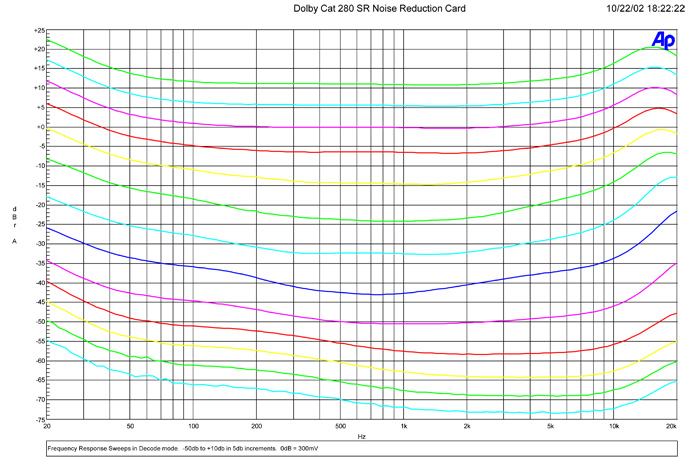
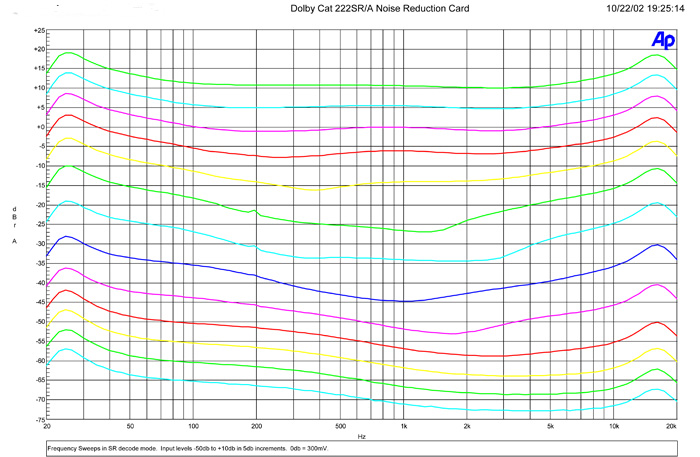
BTW...here is a comparison of the CAT280 response versus the CAT222 SR/A on the SR decode using a swept stimulus at different levels. While at first things may look "similar", they are way off at the extremes and at some levels in the middle too. More importantly, the CAT222 SR/A never sounded right for SR.
First the CAT280 response (we'll call it the reference)
And now the CAT222 SR/A
Posted by Louis Bornwasser (Member # 3063) on 02-06-2015, 06:05 PM:
Yes, analog got better just about the time the 222sra came out. Before 10k was about it. Later 16k was reasonable with a good led reader. They had to redesign the 108 cards as well; earlier ones had a roll off since "they'll never have analog over 10k."
Powered by Infopop Corporation
UBB.classicTM
6.3.1.2