This is topic TALKING PICTURE PROJECTION in forum Film Handlers' Forum at Film-Tech Forum ARCHIVE.
To visit this topic, use this URL:
https://ft-forum.com/ft/cgi-bin/ubb/ultimatebb.cgi?ubb=get_topic;f=1;t=011783
Posted by Bob Foreman (Member # 8708) on 02-10-2015, 07:55 AM:
Within the context of the Atlanta Fox Theatre in 1929.
http://backstagefox1929.blogspot.com/2014/03/part-iii-talking-picture-projection.html
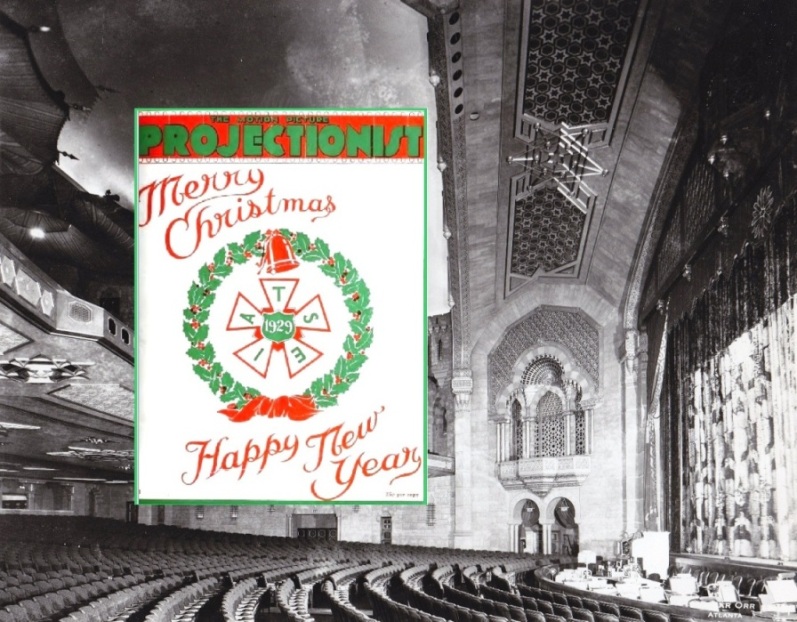
Posted by Mitchell Dvoskin (Member # 751) on 02-10-2015, 08:47 AM:
Very nice web site.
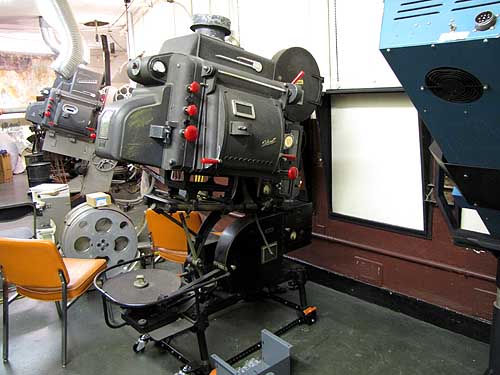
The picture of the Vitaphone disk storage cabinet is from the booth in the Landmark Loews Jersey in Jersey City, NJ. The cabinet is still there, along with a complete Simplex Standard with Vitaphone platter.
Posted by Steve Matz (Member # 1890) on 02-11-2015, 11:57 AM:
EXCELLENT! ![[thumbsup]](graemlins/thumbsup.gif)
Posted by Mark Gulbrandsen (Member # 72) on 02-11-2015, 01:10 PM:
Movies Talk? When did that happen....?
Apparently Mr. Kelly didn't forsee Grandeur, Magnascope or Todd-AO... but what the hey. $75,000.00 in those days? 70 K went to Western Electric and the rest went into projectors and lamps. Western Electric stuff was extremely expensive in those days... Makes the cost of Digital look pale by comparison.
75K in 1930 equals $1,016,202.03 in 2014 dollars.
Mark
Posted by Robert Koch (Member # 3728) on 02-11-2015, 04:00 PM:
Boy; I loved this. Especially all the ERPI stuff. Hall&COnnely High intensity lamps. I`d forgotten what they looked like, and the spare contact assembly which you cleaned and made ready for the next day.Those were the days. I sure thank those responsible for this. Terrific!
Posted by Leo Enticknap (Member # 534) on 02-11-2015, 05:15 PM:
quote: Mark Gulbrandsen
Apparently Mr. Kelly didn't forsee Grandeur, Magnascope or Todd-AO... but what the hey. $75,000.00 in those days? 70 K went to Western Electric and the rest went into projectors and lamps. Western Electric stuff was extremely expensive in those days... Makes the cost of Digital look pale by comparison.
But it shows that the same thing was happening with the conversion to sound as is happening with the conversion to digital, basically: the technology vendors are recouping their R & D investment by charging huge mark-ups on the hardware.
To be fair, the equipment in that booth would probably have been good for the next 20-25 years. Grandeur and Magnascope were very short lived. There may have been minor upgrades to the audio needed to accommodate push-pull and RCA duplex optical tracks, but basically they were all set until widescreen.
In relation to the Vitaphone stuff, I've often thought that it would be fun actually to try to recreate a sound-on-disc show, but it would be pretty difficult and expensive. You'd need to master new discs, which would either mean making new lacquer-master-stamper-playback discs from preservation masters of the audio, or accepting slight inauthenticity and using direct-cut acetates (though would an acetate withstand the very high tracking force of an authentic Vitaphone turntable and arm?). You'd also need a print of the movie with the reel lengths in the original release configuration to match the discs, which most prints deriving from archival restorations aren't.
Still, if any pair of projectors with turntables and preamps in working condition survives anywhere, it would still be fun to do. And it would be interesting, to check out the frequently made claims in the late '20s that sound-on-disc offered clearly superior playback sound quality, so much so that as a playback-in-the-theater system, it survived well into the mid-30s.
Posted by Mark Gulbrandsen (Member # 72) on 02-11-2015, 07:18 PM:
Exactly Leo,
But they did not recoup their costs except though ticket and concession sales and they had expensive ongoing fees with Western Electric until the Government broke that monopoly up. Sound was comparative way more expensive than digital to install. Norm Schneider's dad was a Western Electric technician back in those days and I remember him telling me it was a about hundred grand back then to outfit a 2500 seat house.
Mark
Posted by Leo Enticknap (Member # 534) on 02-12-2015, 08:58 AM:
quote: Mark Gulbrandsen
Sound was comparative way more expensive than digital to install.
Per auditorium, yes. But in 1929, your average suburban theater consisted of a single auditorium containing anywhere between 500 and 3,000 seats. Today, it's a 12-plex with between 150-300 seats in each house.
So if an individual theater location cost around a million (in today's money, adjusted for inflation) to equip for sound in the late 20s/early 30s, I'm guessing that's around the same as the cost for a comparable location for convert from 35mm to digital in the late 00/early teens.
Furthermore, the 1929 theater would almost instantly start to make significant operational savings, because it would no longer need the services of several musicians.
A detailed comparison study of the economics of the two conversions would make for a very interesting read (for me, at any rate!).
Posted by Mitchell Dvoskin (Member # 751) on 02-12-2015, 01:29 PM:
quote: Leo Enticknap
I've often thought that it would be fun actually to try to recreate a sound-on-disc show
In the early days of the Landmark Loews Jersey, long before I was involved, they actually did so in co-operation with The Vitaphone Project using original vintage disks. I believe it is the only time that the front shuttered Simplex Standard ever ran in modern times. The projector is still there although not currently connected.
Posted by Steve Matz (Member # 1890) on 02-13-2015, 10:14 PM:
Posted by Alan Plester (Member # 852) on 02-14-2015, 05:45 AM:
Thoroughly enjoyed every inch of this posting.
Posted by Leo Enticknap (Member # 534) on 02-14-2015, 11:35 AM:
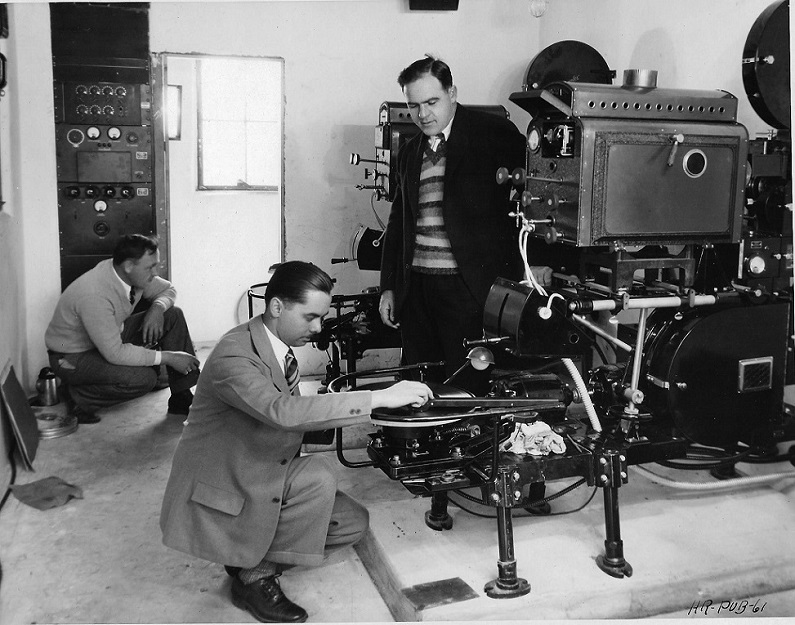
Note the concrete slab on which the projector chassis sits in Steve's pic - I'm guessing to absorb vibration and prevent the tonearm from jumping, causing loss of sync. The slabs must have added a ton or two to the floor loading requirement of the booth. If that was normal for SOD installations, no wonder it was a short-lived technology.
Mitchell - even with only one projector and turntable, I guess you could still put on a program of Vitaphone musical shorts. You'd have to be quick on the rethreading and recueing not to make the audience bored, though!
If it were me I'd be cagey about playing original, surviving release discs, because of their soft shellac/filler compound and the huge tracking forces of those arms (hence the reason the discs were only designed to withstand 20 playings before serious groove wear degraded the audio). Even if the content has already been digitized, there is always the possibility that better remastering could be done in the future, which you're giving up if you damage or destroy the disc in the meantime. I suppose if dozens of copies of a given side survive, there wouldn't be much risk in using the worst one, though.
For real authenticity, we'd have to wear three-piece suits while working the booth, too! And smoke, probably...
Posted by Steve Moore (Member # 4753) on 02-14-2015, 12:09 PM:
Thanks for posting that very good article/website.
I'm confused over one of the inserted pictures, I think the 4th from the top, which has the red box that says "vitaphone will thrill the world." The date says August 1926 and admission is 10 dollars. Was this a public event, as that must have been a fortune back then!!
Posted by Leo Enticknap (Member # 534) on 02-14-2015, 12:29 PM:
$133.75 in today's money, according to this. I'm guessing that's about what you would pay for the best seats in a West End or Broadway show today.
Posted by Stephan Shelley (Member # 8587) on 02-14-2015, 02:11 PM:
No smoking in the booth back then. Flammable nitrate film.
Posted by Robert Koch (Member # 3728) on 02-14-2015, 06:15 PM:
Rules were made to be broken, Stephan,I was a 2 pack a day person when I ran nitrate and so were a lot of my cohorts.
Posted by Martin McCaffery (Member # 37) on 02-14-2015, 09:52 PM:
I used to run backup at the AFI in the Kennedy Center when they had nitrate. The #1 guy always had a lit cigar in the booth. I think he took it out of his mouth for changeovers.
Posted by Steve Moore (Member # 4753) on 02-15-2015, 05:44 AM:
Handy link, that inflation calculator Leo. It's not quite as expensive then as i had presumed. Though it certainly was only for the wealthy I guess having the luxury of sound on an opening night!
Posted by Rick Raskin (Member # 1561) on 02-15-2015, 01:54 PM:
quote: Martin McCaffery
The #1 guy always had a lit cigar in the booth. I think he took it out of his mouth for changeovers.
I never saw Carl without that cigar.
BTW: He passed away several years ago.
Posted by Brad Miller (Member # 2) on 02-15-2015, 02:49 PM:
There's a cremation joke in here somewhere, but it might ruffle some people's feathers. ![[Razz]](tongue.gif)
Posted by Aubrey Jones (Member # 8725) on 02-15-2015, 05:12 PM:
Hello and thank you all for recently adding me. I was doing a documentary on The Crump Theatre in Columbus, Indiana and was hoping I could send a link for some of your experienced member to look at some of the equipment here. It seems there maybe some gem stuff in here? I love production and cameras but the movie house is the End User, laughing, I guess I found a new passion, vintage movie equipment and theaters, because that is the end payoff for all the other efforts. Thank you Aubrey Jones. http://www.silverstationvideo.com/the-crump-theatre/
Posted by Gordon McLeod (Member # 33) on 02-15-2015, 06:19 PM:
Last time I checked crematoria don't give discounts for burn victims sorry bad that joke was half baked ![[Smile]](smile.gif)
Posted by Leo Enticknap (Member # 534) on 02-15-2015, 07:59 PM:
Assuming it hasn't passed the autocatalytic point, nitrate is surprisingly difficult to ignite. I remember once disposing of a decomposing reel in an empty car park: I had to hold the lighter to it for a good 3-4 seconds before it actually caught. Once it did it went up like the Hindenburg, but the stuff is not like gasoline, where a tiny spark in the presence of a whiff of vapor is all it takes.
My earlier post was meant as a joke, but I'm not surprised that projectionists in the '30s and '40s smoked in the booth - in those days, everyone smoked pretty much everywhere, and actual film fires were extremely unusual. As with all safety-critical work, familiarity breeds contempt.
Posted by Jarod Reddig (Member # 6363) on 02-15-2015, 09:07 PM:
Really fascinating website! Very much appreciated and its nice to see how much detail was put into old movie palaces compared to the current run-of-the-mill cracker jack boxes being made.
Posted by Robert Koch (Member # 3728) on 03-04-2015, 04:57 PM:
Steve Matz:
Where in the world did you come up with the picture of the WE guys in the 3-piece suits. This is indeed how they dressed, T remember so well. The suits didnt do too well if they had to change or dismantle a 709 drive or change a 555 lst down on the deck. The dry cleaner had to be consulted.
Posted by Steve Matz (Member # 1890) on 03-05-2015, 01:21 AM:
Can't remember when/where I got that Photo Robert. I have a Ton of old Vintage Photos that cover the 20's 30's 40's. I liked the way people dressed in the 30's and 40's. Showed that they had some Class back then. Look at what the Kids wear to School now days, even the Girls Look like Bums ! ![[puke]](graemlins/puke.gif)
Posted by Bill Duelly (Member # 3612) on 03-05-2015, 05:46 PM:
That still is of comedy producer Hal Roach, standing, and i believe his head of sound, Elmer Raguse. From what i had seen of the picture before, it is a screening room on the lot, having just had the new sound equipment installed.
Posted by Louis Bornwasser (Member # 3063) on 03-05-2015, 07:39 PM:
I worked for the senior Norm Schneider in the 1970s when both of us were at Altec Service Corp. In 1926, a small cinema was charged $25k down and $25k per year lease/service. A large theatre was double. Multiply by 9.998 (OK by ten) to get today's dollars. Pricey. 10 cent ticket, short programs. You could have at least 7 full shows per day except on Sunday. The price included parts and labor on everything except lamp. rectifier and projector, which were mostly bullet-proof with real professional (and sometimes licensed) projectionists.
Posted by Florian Pausch (Member # 708) on 03-23-2015, 06:45 PM:
There is a WE Universal Base in running condition (incl. Pick Up) at the wonderful Stockport Plaza, near Manchester. Thirty years in the business, I had to go there to hear "Nadelton" for the first time...and yes, sound quality is marvelous!
Posted by Stephen Furley (Member # 1277) on 03-30-2015, 07:25 AM:
Matrices for 16 inch Vitaphone discs do still exist; I've seen a few, and they seemed to be in good condition. I wonder if any plant still has a press which could handle that size, and press a few replica disks. Could the Vitaphone turntables play vinyl, or would it be too soft?
Posted by Leo Enticknap (Member # 534) on 03-30-2015, 02:03 PM:
Thick (e.g. 200-gram) vinyl would probably work, keeping in mind that Vitaphone distribution discs used a much softer compound (more shellac and less filler) than 78s sold to consumers did anyway, to minimize surface noise.
Reducing the tracking force on a Vitaphone arm probably wouldn't be too difficult, too, although with steel needles you probably need it pretty high to prevent jumping. This may have been another reason why Vitaphone went for a soft compound and high tracking force (deciding to live with the obvious gotcha, that the records only lasted for a couple of dozen playings per side before wearing out) approach, too, given that if the needle jumps midway through a reel, then basically you're buggered: you've either got to live with the loss of sync for the remainder of that reel, skip the rest of the reel and change over immediately, or stop, rewind and rethread.
Posted by Paul Shuttleworth (Member # 9057) on 09-25-2015, 09:35 AM:
Hi there,
We have played the Vitaphone with vinyl.
It gave high fidelity sound, unfortunately the record got ruined.
Projectionist, Stockport Plaza
Powered by Infopop Corporation
UBB.classicTM
6.3.1.2