This is topic Question about voltage converters. in forum Film Handlers' Forum at Film-Tech Forum ARCHIVE.
To visit this topic, use this URL:
https://ft-forum.com/ft/cgi-bin/ubb/ultimatebb.cgi?ubb=get_topic;f=1;t=011812
Posted by Brian Darwas (Member # 8582) on 04-19-2015, 07:25 AM:
Hey guys, I have a pair of 35mm portable machines that run on 220v. I have 220v in my house and everything is fine on that front. I was thinking of taking them outside to run some movies, in lieu of using an extremely long (very looong) extension chord, could I effectively use a 110 to 220 voltage converter?
Are there any pros or cons that I should be aware of?
Thanks.
Posted by Scott Norwood (Member # 30) on 04-19-2015, 08:34 AM:
Maybe.
You will need a tranformer that provides sufficient wattage to operate the machines.
There should be a data plate somewhere on the unit that lists how many amps are required. Watts = volts * amps (approximately). A standard 15 amp 120v circuit is good for a maximum of 1800 watts, and you really don't want to draw more than 1600 or so if you want to avoid heating up the wiring (dangerous) and possibly blowing fuses (dangerous and annoying to your audience). There will be some loss from a step-up transformer as well, even if the transformer is rated for the wattage that you need.
Note that a "really long" extension cord will result in some voltage drop as well (less if you use a very heavy gauge extension cord).
You might want to look into renting a small "blimped" (silent) generator, depending on what you find out.
Posted by Brian Darwas (Member # 8582) on 04-19-2015, 08:59 AM:
Hey Scott, the rectifier has two 6A fuses and one 12A fuse (both have engraved plates with the amperage on it).
The projectors both run a 1000W xenon lamp, and both connect to the same rectifier. The motors and fans in the lamp house run on 110v (I checked them in the past with a multi meter when I had ideas of changing the lamp houses to get everything to run off of 110v).
I'm new to a lot of this stuff. Is the 220v just used to strike the lamps, then everything runs on 110v?
Posted by Dave Macaulay (Member # 813) on 04-19-2015, 10:11 AM:
There is no "120V" power system distribution in the US that I know of. You have either 240V single phase or 208V three phase anywhere that has 120V outlets: the 240 is split in half with neutral as 0v, or the 3-phase is "split in three" (not quite that simple).
Thus, from any "120V" distribution panel you can easily access 240V or 208V power (depending on if it's single or three phase).
At the panel the loads are set up so that the two or three 120V feeds are balanced: the plugs won't all be on the same leg - that means you can McGuyver up a 208/240V source by plugging into two outlets and get 208/240V between the black "hot" wires. You have to find outlets that are on different legs of course! Kitchen duplex outlets, for example, usually have the upper and lower sockets on different legs so one can plug a 1500W toaster in one and a 1500W kettle in the other without blowing a fuse. Otherwise, an outlet on the other side of a room or in the next room should be on a different leg. Some newer installations will refuse to allow this chicanery, though: the individual breakers or even the whole panel may shut off.
What amp rating is the circuit you have in your home? Since house wire is usually 14ga minimum, you probably have a 15A 240V circuit for 3600W max (that would let you run both 1kW lamps for changeovers). If you use a step-up transformer you will only have the same 15A available at 120V - 1800W. This doesn't change at 240V: you will have 7.5A max for the same 1800W, less the parasitic transformer load. Not enough for two 1kW lamps! You would need to find a 30A 120V feed to equal the 15A/240V circuit at home. Plus - a 3000W transformer won't be cheap. An autotransformer will be cheapest and lightest but still $$$ and probably weigh 50lb+. An isolation transformer (not necessary) will be much more costly and weighty.
I suggest doing the McGuyver approach with a couple of extension cords and some wire splices - if nobody official is looking and it's a private showing. If it's more public or in a public facility you need to arrange for a proper 208/240V feed set up by a licensed electrician.
The first method violates lots of electrical codes and invites crippling liability claims if anything goes wrong and the place burns down or patrons are injured.
Posted by Brian Darwas (Member # 8582) on 04-19-2015, 10:33 AM:
Dave, you're correct. I have two 110v (or 120v, since they're somewhere in between) lines that come into my box, one on each side. My 220v line takes each 110v and runs it through a double pole breaker, then through two 15A fuses (one for each line) and onto the 220v outlet.
So that would be single phase.
This was already in the house for an old air conditioner, and I started using it for a welder (before running the welder I had an electrican friend take a look at everything to make sure it was legit).
I could run a 220v outlet to my yard area, but I was looking for another solution that might allow me to take the projectors somewhere else that might not have 220v, or the option the plug into the separate 110v circuits.
My worries with the "MacGuyver" method is if only one of the circuits trips, but the other doesn't. I'm not sure what problems that would cause.
Posted by Rick Raskin (Member # 1561) on 04-19-2015, 12:35 PM:
Something like this might work for you:
Step-up transformer
I think a transformer would be the best and safest way to go rather than trying to rube-dube a solution.
Posted by Randy Stankey (Member # 64) on 04-19-2015, 01:58 PM:
How far is "far?"
If it is not "too far" I would install a satellite service panel at the location with the caveat of making sure the wire/cable is properly sized and rated.
If is not "really far" I would use a step-up transformer at the service point and a step-down transformer at the location, again with proper size/rating cable in between.
If it is "really far" I would either install new service at the location (properly sized/rated) or, fail that, get a generator.
I haven't got a problem with "MacGuyver-ing" a solution for temporary set-ups but I have seen too many of those "temporary" solutions become "temporarily permanent" solutions. Then, down the road, something goes wrong and people stand around scratching their heads, wondering why their house burned down,
That happened to me, twice, when I was a kid. My dad installed those "temporary" solutions that became "temporarily permanent" and almost burned our house down.
Consequently, I don't sleep very well with the thought in the back of my mind that something could go wrong and burn the house down. Maybe I'm a "high anxiety" type but, in my case, I feel like it is justified.
Posted by Jim Cassedy (Member # 4115) on 04-19-2015, 04:28 PM:
I had to set up something like this several years ago for a film festival, where allI had
was 120Volt service and the projectors available needed 220.
Having worked on a lot of film sets in my past, I knew it was possible to do a tie in
to the main service box.
Even though I probably could have done it myself, I decided to work through a professional
stage lighting company, who had the proper equipment and also sent a licensed tech
to do the acual install. As Randy implied, doing this improperly can be both an electrical
and fire safety hazard. Having it done 'the riight way' allowed me to sleep better
at night,
and also releived me of liablility in the event something did happen.
Posted by Brian Darwas (Member # 8582) on 04-19-2015, 04:46 PM:
Oh, I'd hate to get into running another line outside. It's about a 150 foot run, and I'd have to dig and bury the line under the ground, which I don't feel like doing. . . but I might cause it'll be cool to watch stuff out in the yard at night.
If I do get into doing that I'll have my buddy who's a licensed electrician lend a hand so I know it's all up to code, etc. . . and nobody will need to knock me away from the fuse box with a stick.
There's a 110v outlet out there already, so I was hoping that I could just plug a converter into there and get off easy.
Posted by Dave Macaulay (Member # 813) on 04-19-2015, 04:50 PM:
That linked transformer might pass 3kW down from 220 (14A circuits are fairly common in Europe) but there's no way in hell it will do it from 110. There's no magic spell to pull 3kW out of a normal 15A/110V U-ground socket and the pictured power cord would melt if you somehow managed that.
Just seeing the ad calling it 110 says "morons" to me: an electrical equipment supplier should have a clue. The standard supply voltage here is usually called "120" but is nominally 117V with a few volts tolerance.
Posted by Brian Darwas (Member # 8582) on 04-19-2015, 05:08 PM:
In The U.S. people seem to use 110v and 120v interchangeably (well, the laymen). I'm guilty of it myself. We probably stopped using 110v sometime in the 1940's. . . but you're right, a professional supplier should know better.
Posted by Randy Stankey (Member # 64) on 04-19-2015, 05:17 PM:
One of my dad's infamous "temporarily permanent" electrical runs was for the swimming pool, outside. It was probably a couple hundred feet from the house, by wire.
We needed electrical outlets for the swimming pool filter, lights and convenience. So he ran just regular, old Romex from the panel in the basement, out the basement window and strung it from tree branches. He used a regular, old box, two breakers and a couple of outdoor outlets. The whole thing was in a plywood box, nailed to a pole by the side of the pool.
That setup lasted more than ten years without any problems until we took the pool down. That was a 16x32 ft. Kayak above-ground pool.
Us kids never thought twice about it at the time although, I know that more than one person who looked at it just shook their heads and walked away. ![[Wink]](wink.gif)
So... THEORETICALLY... I suppose you could just get some 3-conductor, gray, underground Romex of the right guage and, as Dad would say, "Run a line out there," but, to be honest, I'd be thinking of a better way to do it if it was my house.
Posted by Scott Norwood (Member # 30) on 04-19-2015, 05:34 PM:
On the topic of delivery voltage, this seems to vary by time of day and season of year, too.
This is the input voltage to a UPS in my apartment for the last year:
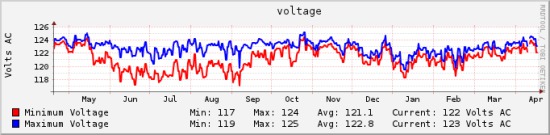
The variation between the high and low input voltage seems to increase over the summer for some reason and becomes more tightly regulated in the winter. No idea why. The average is closer to 123 than 120, though.
Posted by Marcel Birgelen (Member # 6801) on 04-19-2015, 05:42 PM:
So, those machines take 220V single phase, but are perfectly happy with the 60Hz?
Posted by Brian Darwas (Member # 8582) on 04-19-2015, 05:50 PM:
Mike, the machines can run on both 50hz and 60hz with different size pulleys. In The U.S. The pulleys are a bit smaller since the motor is running a bit faster.
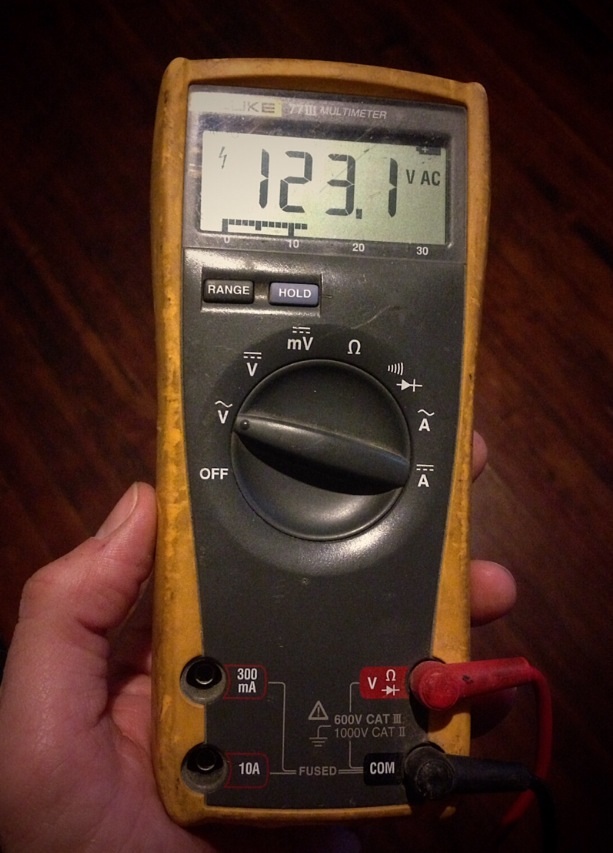
- Scott I just plugged a multi meter into an outlet in my house and came up with 123v.
Posted by Steve Kraus (Member # 476) on 04-19-2015, 10:29 PM:
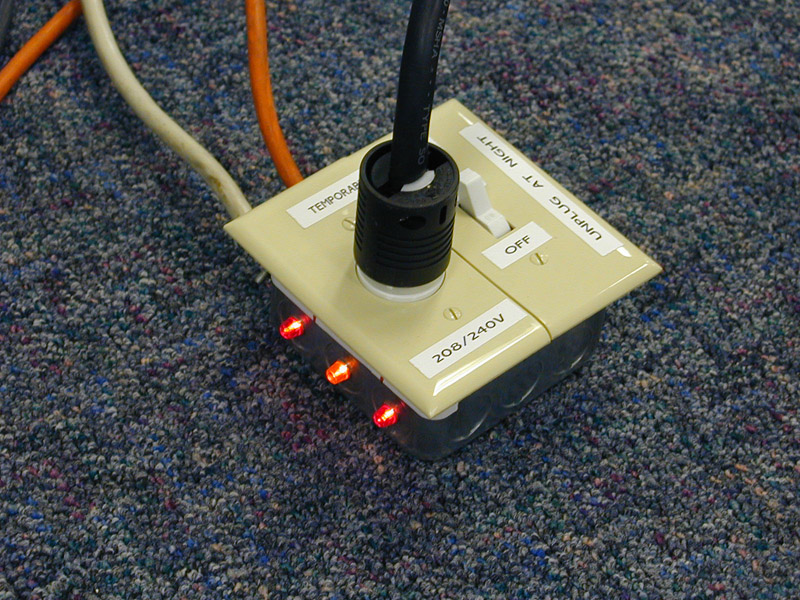
I created this to use for a few days until a proper outlet was installed on a dailies job. This is just for the lamp rectifier.
Those are two ordinary 120V line cords. The pilot lights indicate power on each cord with the third indicating the cords were properly plugged into outlets on different phases (or opposite sides of the 120/240 source in a single phase situation). If plugged into the same phase, the two input pilots would light but not the third. The switch is double pole since there are two hots to be interrupted. It's a kludge to be sure but I tried to make it as safe as possible.
Something like this could work with a pair of long 120V extension cables (especially if you have to go a long way to find an outlet on a different phase) OR with the kludge box near the outlets and a long 208/240V extension (which you might make up yourself).
Posted by Richard Fowler (Member # 893) on 04-20-2015, 01:12 AM:
Your power supply requires 12 ampere at 220VAC to run reliably….so the step up transformer noted would not have enough power due to being limited by the input.
Steve's type of box is used in some video rental situations with professionals being cautious regarding usage. Long extension cord runs will have to be factored that there will be some line voltage drop.
Posted by Marcel Birgelen (Member # 6801) on 04-20-2015, 02:43 AM:
quote: Brian Darwas
Mike, the machines can run on both 50hz and 60hz with different size pulleys. In The U.S. The pulleys are a bit smaller since the motor is running a bit faster.
I'm not sure if you were referring to me, but this answers my question anyway.
quote: Richard Fowler
Steve's type of box is used in some video rental situations with professionals being cautious regarding usage. Long extension cord runs will have to be factored that there will be some line voltage drop.
I guess you put the box as close to your 110V sources as possible. With 220V, the loss is already better manageable if using a wire of sufficient gauge. But it would be interesting to know how long such an extension cord would need to be.
Posted by Louis Bornwasser (Member # 3063) on 04-20-2015, 06:51 AM:
Louisville area runs about 127 volts. Low of 123. Southern Indiana runs a low of 127 and a high of 135 (near generating plant.)
Posted by Scott Norwood (Member # 30) on 04-20-2015, 08:23 AM:
135? Wow. I suppose that light bulbs don't last very long there, even if people in that area are using 130v bulbs.
Posted by Brian Darwas (Member # 8582) on 04-20-2015, 10:36 AM:
- Marcel, I was referring to you. I was posting from my phone and my brain somehow read your name as Michael, my apologies.
- Steve Kraus, that box you built looks good, might be just what I need. The one thing I have to ask is how do you make the third light illuminate only when plugged into opposing phases of power?
Thanks.
Posted by Steve Kraus (Member # 476) on 04-20-2015, 01:55 PM:
The two basic indicators were connected across each input's hot and neutral. The third one is connected across the two input's hots. If you have both input indicators lit but not the third, your cords are both connected to the same phase. Move one.
Indicators like that are usually good for up to 240V but just to be safe I put two in series for the 208/240 indicator and left one inside the box.
Be aware that this is not to code and strange, potentially dangerous things can happen. If one input line is live, the switch is on, and the load (the lamphouse) is on, the other (unplugged) cord will have 120V present on its "hot" prong. That's dangerous.
If one line is live, and the other is plugged into an outlet whose breaker is off but has various other loads on the same circuit, your load may be exposed to 120V instead of 208/240 as the other loads on that circuit pass the current.
Used properly for a temporary situation, it's fine. I disclaim any responsibility! Get someone with electrical knowledge to build and advise.
Posted by Brian Darwas (Member # 8582) on 04-20-2015, 02:31 PM:
Thanks Steve, I actually have two good friends that are licensed electricans. I'll run this idea by them and see what they say, or think about it. they might have some ideas of their own to add, or yell and tell me not to do it, lol.
Is it possible to have a fuse that trips both circuts if one circut loses power?
I know I'm dragging this out a bit, but some good "do's" and "don't's" have come up.
Posted by Marcel Birgelen (Member # 6801) on 04-20-2015, 06:19 PM:
That's not really how a fuse works.
You could probably come up with a circuit that cuts the other input and the output if not both inputs are present, but probably not something off the shelf.
quote: Louis Bornwasser
Louisville area runs about 127 volts. Low of 123. Southern Indiana runs a low of 127 and a high of 135 (near generating plant.)
I don't really understand why the voltage near a generating plant would be higher in a complex, synchronized grid. Isn't your local grid voltage more a thing of local regulation and practices of your utility, combined with the distance to the nearest transformer?
Also, a typical power plant has nowhere near 100% availability.
Posted by Brian Darwas (Member # 8582) on 04-20-2015, 07:01 PM:
Sorry, shouldn't have said fuse, lol. A fuse would have to be overloaded, then burnt out.
Could I over do it and have two solenoids (or relays) that are powered from the opposite circut? This way if one circut loses power it automatically cuts the power to the other circut?
I'll probably just stick with keeping these indoors. Maybe I can find a 120v lamphouse. Everything else runs on 120v except for the lamp.
Posted by Louis Bornwasser (Member # 3063) on 04-21-2015, 08:01 AM:
Marcel: I know. I thought so as well. I can tell you that for 50 years the old 110 volt Simplex mono sound system ran very hot and had more troubles than any other 50 systems until I put the buck/boost transformer on it. Instant cure. Marquee bulbs failed at 125 per week. I moved to 140 volt bulbs.
Posted by Scott Norwood (Member # 30) on 04-21-2015, 09:00 AM:
They make 140v bulbs?
Question on Steve's device: wouldn't this trip a GFCI outlet?
Posted by Steve Kraus (Member # 476) on 04-21-2015, 03:15 PM:
Yes, I suppose one could have relays on both inputs with 120V coils wired between the opposite side and neutral.
Yes, Scott. I never tried it but it certainly should trip because they compare current going out the hot to current coming back on the neutral. When they are not in balance it means current is leaving the hot somewhere and rejoining the system where neutral is grounded at the breaker panel or someplace like that and possibly doing so because someone's body is in contact with both the hot side and earth.
Posted by Dave Macaulay (Member # 813) on 04-24-2015, 09:06 PM:
Just use a "double: breaker made for 208/240 load circuits - if one leg overloads it also pulls the other one open. It used to be common to see two breakers tied together with a wire, they had holes in the handles for that. Now disallowed and new breakers do not have the holes. The panel mount breakers on Strong consoles are easy to mount in a box and do have the holes.
140V bulbs are often used in rural areas, sometimes even called "farm bulbs" - the long distribution runs have less stable voltage than dense urban grids.
If your voltage is unusually high or low all the time, contact the utility and have it changed. I think +/- 8% is usually the limit. It's a simple fix, the step-down transformers all have taps that can be changed in a few minutes.
Powered by Infopop Corporation
UBB.classicTM
6.3.1.2