This is topic Digital Projection-The Early Years in forum Film Handlers' Forum at Film-Tech Forum ARCHIVE.
To visit this topic, use this URL:
https://ft-forum.com/ft/cgi-bin/ubb/ultimatebb.cgi?ubb=get_topic;f=1;t=011817
Posted by Martin McCaffery (Member # 37) on 04-27-2015, 11:01 AM:
from Motography, February 27, 1915
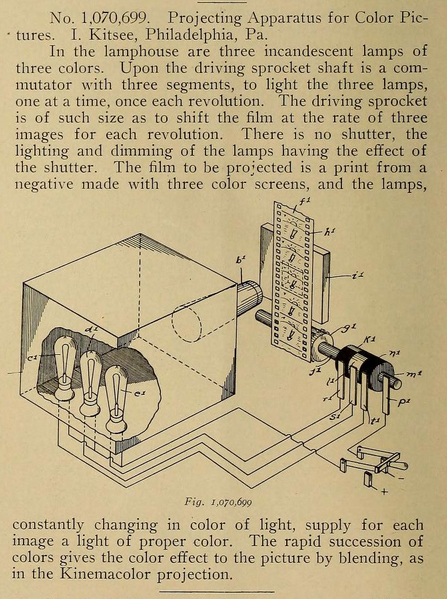
Ok, not quite digital, but on the right track
![[Wink]](wink.gif)
Posted by Justin Hamaker (Member # 2165) on 04-27-2015, 01:42 PM:
Seems to me that the lack of a shutter would cause this design to fail. The incandescent lamps would not be able to dim/illuminate at a fast enough rate to work the same as a shutter, or to allow the proper lighting of each color.
Posted by Leo Enticknap (Member # 534) on 04-27-2015, 02:31 PM:
Lee de Forest had the same problem with optical sound recording - the changes in intensity of the filament just weren't quick enough in response to the input signal - and basically hit a brick wall until Case came along with the AEO-light.
The ironic thing is that with LEDs, this arrangement could probably now be made to work.
Posted by Jim Cassedy (Member # 4115) on 04-27-2015, 06:49 PM:
In browsing through a number of old cinema-tech magazines & patents, it seems that
for a many years, beginning in the late 1900's, engineers were searching for a way to
build a 'shutterless' or 'continuous motion' projector. Many different designs were
tried using various combinations of moving mirrors, prisms & lenses, with varying
degrees of success. All of them suffered from extreme mechanical complexity,and loss
of light. The only practical shutterless machine I'm aware of was the German Mechau.
Strobe lights didn't come along till the early 30's. Experiments using strobes as a light
source were tried, but strobes, especially the early ones, just didn't have the light
output or 'recovery time' to put out a picture anything more than a couple of feet wide.
I believe there was at least one shutterless telecine projector made either in
the late 50's or early 60's that used a strobe (I think it was a GE 'synchrolight')
but someone here probably knows more about that than I do.
I do recall seeing a 'retired' one once at an old TV station some years back.
Posted by Louis Bornwasser (Member # 3063) on 04-27-2015, 07:10 PM:
You are correct, Jim. The GE used a Simplex base. Also don't forget the Norelco, based on the FP-20.
Posted by Leo Enticknap (Member # 534) on 04-27-2015, 07:14 PM:
There was also the "video Steenbeck", which consisted of a Steenbeck flatbed viewing/editing table with a CRT TV camera mounted in place of the rear-projection screen, with the camera's scanning being synced to the rotation of the prism somehow. The tapes they made were not bad, and it was the only telecine arrangement I know of that was available in the '70s and '80s that didn't cost megabucks but which also allowed transfers at frame rates other than 25 and 29.97. The main drawback was that contrast/gamma/color adjustment wasn't possible on an individual shot basis and so they were only any use for making quick-and-dirty reference viewing copies of film reels: its output was not of an acceptable quality for broadcast.
Posted by Carsten Kurz (Member # 5396) on 04-27-2015, 08:51 PM:
Philips built the SPP800 puls lamps for shutter free projection with the FP20S. And they had the puls light FP2 already back in the 30s. Yes, it is certainly easier now to do that with LEDs...
- Carsten
Posted by Emiel De Jong (Member # 4225) on 04-28-2015, 01:50 AM:
Small correction there: the FP2 had a continuously burning high-pressure mercury lamp, and a shutter...
Posted by Jack Theakston (Member # 4484) on 04-30-2015, 03:58 PM:
quote: Leo Enticknap
There was also the "video Steenbeck", which consisted of a Steenbeck flatbed viewing/editing table with a CRT TV camera mounted in place of the rear-projection screen, with the camera's scanning being synced to the rotation of the prism somehow.
There was, in fact, a broadcast-acceptable version of this that was used at the BBC in the '80s called the Polygon. It's what Kevin Brownlow utilized for his documentaries "Hollywood" and "Unknown Chaplin."
Posted by Jeff Taylor (Member # 443) on 04-30-2015, 04:21 PM:
I've seen articles on a shutterless 16mm JAN the military came up with years ago using an outboard-mounted xenon configuration. That thing must have chewed up a lamp's electrodes firing 24xps!
Posted by Monte L Fullmer (Member # 2797) on 05-02-2015, 05:16 PM:
Wouldn't one want the strobe to flash 48 p/sec to eliminate visible pulsing if no shutter was used?
Powered by Infopop Corporation
UBB.classicTM
6.3.1.2