This is topic Harper Film Projection System in forum Film Handlers' Forum at Film-Tech Forum ARCHIVE.
To visit this topic, use this URL:
https://ft-forum.com/ft/cgi-bin/ubb/ultimatebb.cgi?ubb=get_topic;f=1;t=011830
Posted by Brad Miller (Member # 2) on 05-23-2015, 10:51 PM:
Interesting ebay item #181744735829
quote:
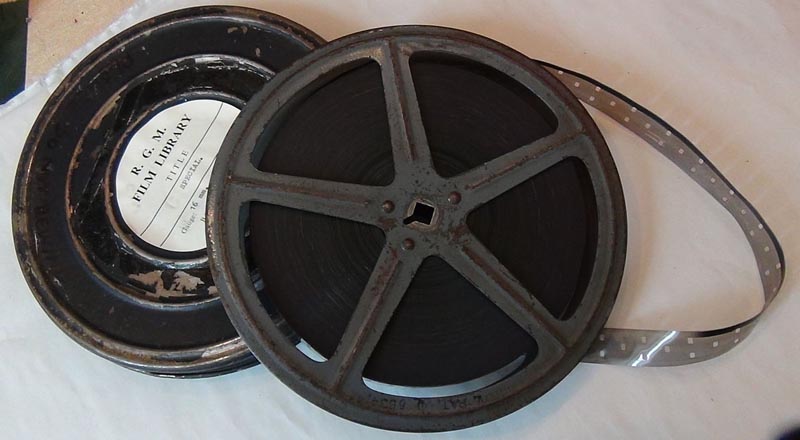
This is a reel of approx 300 ft of special format 16mm film, being sequences from the 1946 British musical feature production The Lisbon Story.
The Harper Film Projection System was never commercially introduced, and equipment is rare or perhaps no longer existing. This film will not run on a normal 16mm projector.
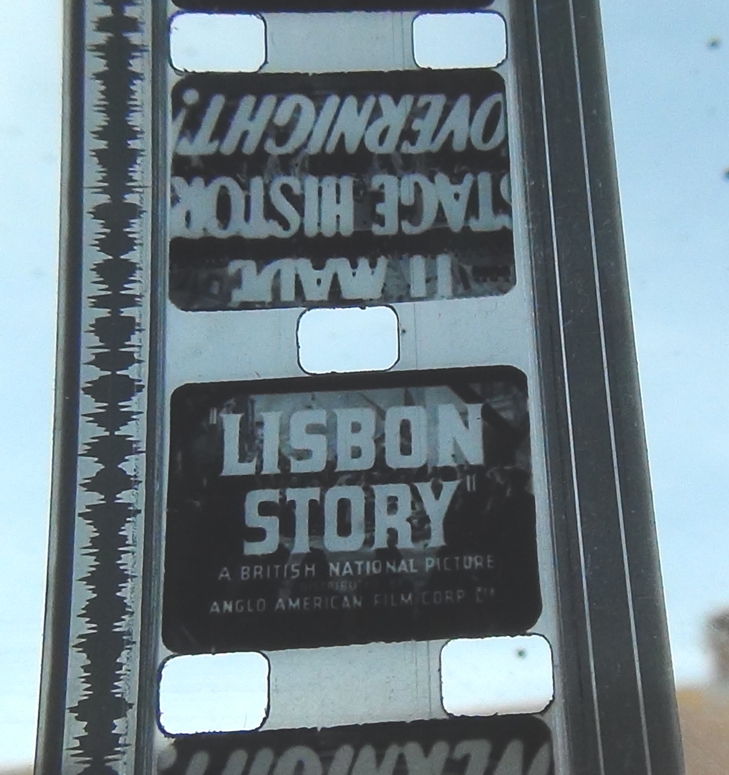
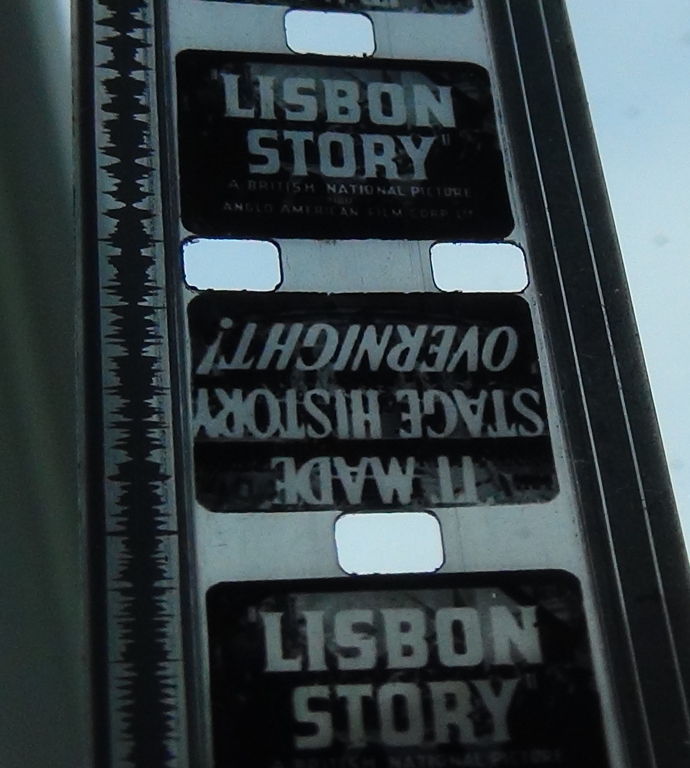
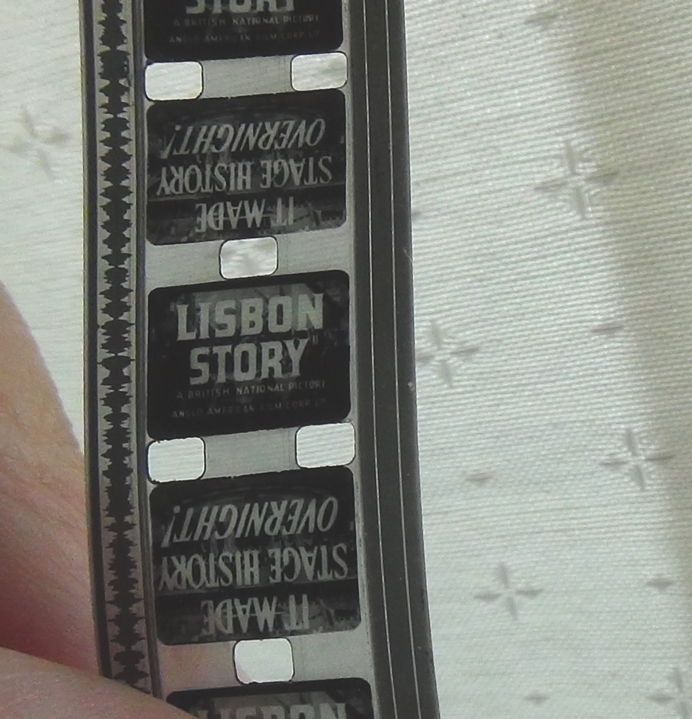
‘Martin Harper, of the Miles Aircraft Company of Woodley, Reading, Berkshire, reasoned that the quality of 16mm Sound on film would be considerably improved if 35mm sound tracks could be directly contact printed, full size, on to 16mm picture prints, and then run, during projection at the correct linear speed for 35mm sound tracks of 18" per second … [which] left the problem of how to marry the 16mm picture speed of 72" per second with the 35mm sound track speed of 18" per second on the one strip of 16mm film. Harper's solution to this problem was to design a special dual purpose film printer for which he obtained a British Patent, applied for on January 4th 1938. To achieve his aim the area available on 16mm had to be reallocated. Edge perforations were no longer used. 3mm each side of the film were reserved for sound tracks leaving 10mm in the centre for the width of the 16mm picture frame. [Originally with two perforations per frame], at a later stage this format was modified slightly to accommodate a third centrally placed sprocket hole, apparently to ease the strain on the film now traveling at the higher speed of 18" per second.’
Conventional films were printed on alternate frame spaces (one set of pictures ‘upside down’ in relation to the other set), with two frames pulled down at each claw stroke on projection. When a reel was finished, it was simply replaced on the feed arm and threaded again. On the second run-through, the alternate pictures of the new scene (and the second soundtrack) were projected.
‘The sole function of the printer and projectors was to reproduce existing 35mm films onto the 16mm gauge with enhanced quality of sound reproduction.’ (Alan Lott) It is not known how many Harper projectors were made or what happened to them. It can now be seen that clever as it was the Harper system was the product of misplaced ingenuity and effort.
Posted by Leo Enticknap (Member # 534) on 05-25-2015, 06:52 PM:
So Harper hated the audio on conventional 16mm so much that he was prepared to reduce the size of the image significantly, just in order to contact print a 35mm soundtrack on it?
Given the dynamic range of the amps and speakers typically used in portable/non-theatre scenarios (classrooms, meeting halls and the like) in the mid-1940s, it would probably have been impossible to hear any improvement anyway. But I'm sure you would have seen the bigger dirt, scratches and grain from the smaller frame size without any trouble. And as with the center perforations on 9.5, even slight perforation damage would be visible in the picture area.
And what happens if you want to show a feature length movie using changeovers on this system? Reel 2 is reel 1 running in reverse, so you've still got to stop to rethread, unless you print reels 1 & 3, 2 & 4 etc., together.
Posted by Jim Cassedy (Member # 4115) on 05-25-2015, 07:32 PM:
I'm guessing he not only had to design a special printer, but also a custom perforator.
(and possibly even a slitter, if he was buying bulk film in wider rolls)
Posted by Stephen Furley (Member # 1277) on 05-26-2015, 03:39 AM:
There's a decimal point missing in the description; the 16 mm speed should be 7.2 inches per second, not 72.
It's a cleaver idea, but hardly surprising that it didn't catch on.
Didn't I once see something similar to this on 35 mm, just to avoid rewinding?
Centre perforations were also used on some early 17.5 mm formats. Double centre perforations, on 9.5 mm stock were used for the Pathé Duplex widescreen where half the width was exposed horizontally then turned around to expose the other half, then slit to produce two 4.75 mm strips in a similar way to the original 8 mm format.
Posted by Rick Raskin (Member # 1561) on 05-26-2015, 06:29 AM:
It sold for 161 GBP (approximately 250 USD)
Posted by Jeff Taylor (Member # 443) on 05-26-2015, 10:22 AM:
One can only assume that he must have intended to use a true intermittent--can you imagine the claw system you'd need for a pull-down with that combination of sprockets? And despite the fact we've already established it to be impractical, there's the issue of what a pulled sprocket would look like on the screen given where they're located!
Posted by Fredrik Sandstrom (Member # 8171) on 05-29-2015, 01:51 AM:
quote: Leo Enticknap
So Harper hated the audio on conventional 16mm so much that he was prepared to reduce the size of the image significantly, just in order to contact print a 35mm soundtrack on it?
No, the image is the same size as on standard 16mm film. 10mm wide.
Posted by Steve Matz (Member # 1890) on 06-01-2015, 06:17 PM:
Interesting perforation location;The image was probably pretty steady. I still have always wondered when Super 8 came on the scene;I assumed that Super 16 would follow the same type perforation and larger image format but all they did was widen the conventional 16mm frame into the optical track. I'm guessing the reason was there was so much conventional 16mm material already in existence,it would cost a fortune to convert to a new format aside from having to Mfger a new style Projector.
I wish sound technology would have arrived earlier so that 16mm sound prints would have double perforations like 16mm silent film was. The sound track could have been in between the perforations similar to Dolby Digital. Even though my Eastman 30 has an 8 star Geneva Type movement and the image is rock steady on most prints your still dealing with your intermittent sprocket only having teeth on one side. If it was double perforated like 35mm film you would have a super rock steady image even on screen widths larger than 30ft wide. Too late to do anything about it now ... ![[beer]](graemlins/beer.gif)
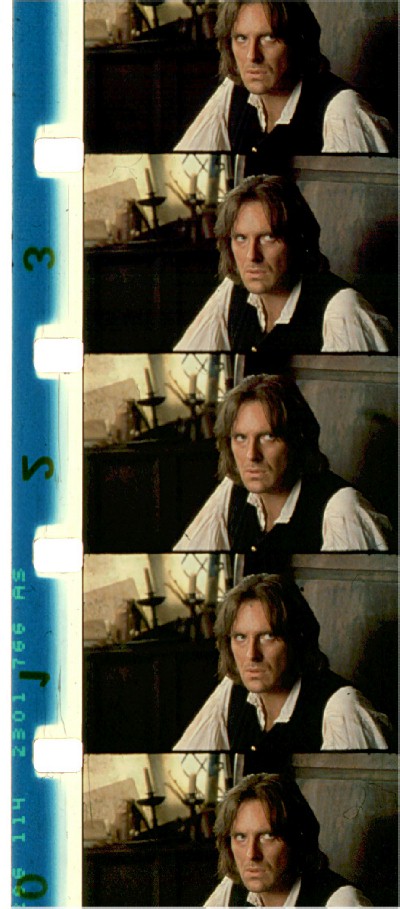
Super 16mm Frame
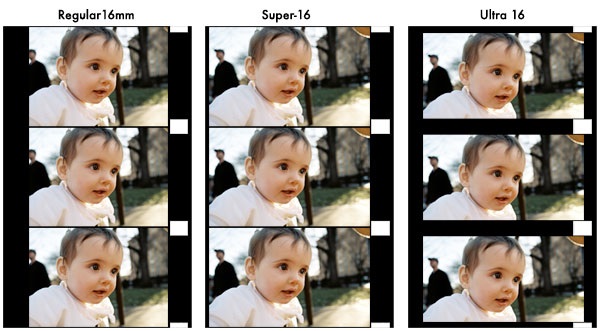
There have been a number of Film Formats tried at one time in Cinema through the Century. Here's one that really didn't take off either ...
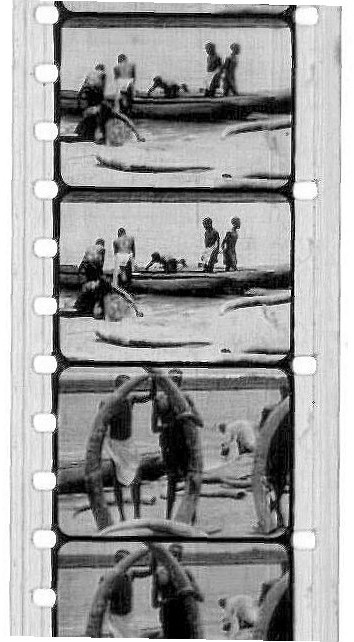
28mm Film Frame - 19mm x 14mm 20.5 FPS
Posted by Leo Enticknap (Member # 534) on 06-03-2015, 12:19 AM:
How can the frame be the same width as normal 16 if it has a 35mm soundtrack contact printed on it? A 16mm optical soundtrack is 1.473mm in width - a 35mm is 2.9 (rough figures obtained by Googling for diagrams). Therefore, with two 35mm tracks on either side of a 16mm print, the image has got to be smaller than it would be on a print with a conventional 16mm track, hasn't it?
Posted by Fredrik Sandstrom (Member # 8171) on 06-03-2015, 03:41 AM:
Technical specs for 16mm film (taken from Wikipedia without references, but seems right from measuring actual film):
- camera aperture: 10.26 by 7.49 mm (0.404 by 0.295 in)
- projector aperture (full 1.33): 9.60 by 7.01 mm (0.378 by 0.276 in)
16mm - 3mm - 3mm = 10mm
I.e. 3mm soundtracks on both sides leaves exactly the 10mm that we need for the image.
Posted by Mitchell Dvoskin (Member # 751) on 06-03-2015, 09:06 AM:
As far as I know, 28mm was never a cinema format. It was intended for home use only. The film stock was safety film from day one. The reason Pathé went with 28mm was partially to get around the Edison patents on 35mm, and partially to prevent home users from running 35mm nitrate stock.
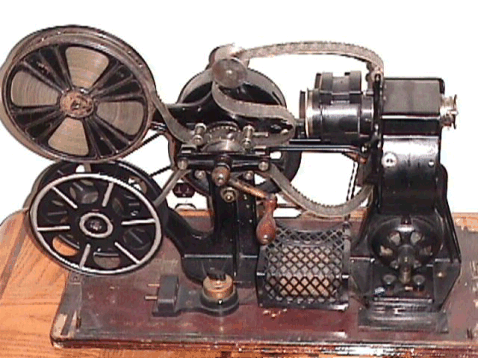
My Pathé KOK 28mm projector:
My Pathé 17mm sound projector (not yet restored):
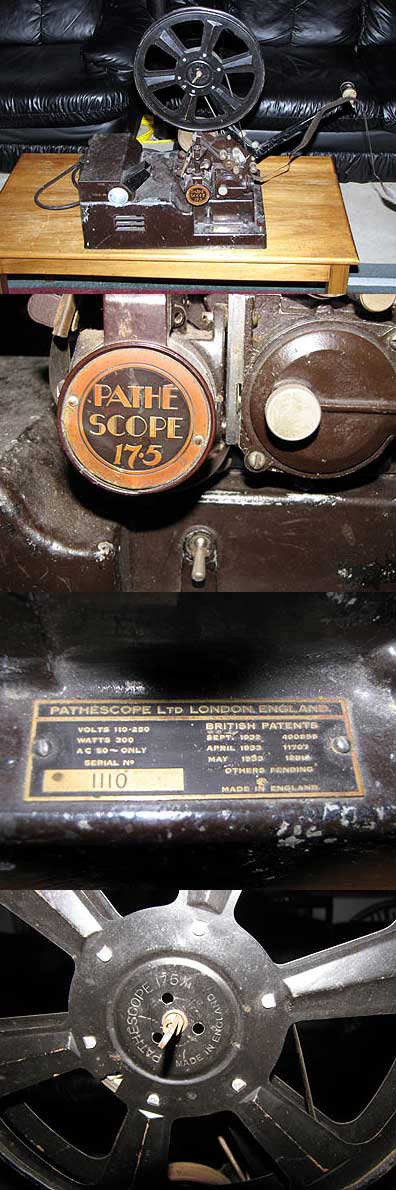
Posted by Stephen Furley (Member # 1277) on 06-03-2015, 11:37 AM:
Steve, 28 mm was quite successful in its day, at least in Europe, I don't know about over there. It didn't last very long, it was introduced in 1912 and the introduction of 16 mm by Kodak pretty much killed it stone dead. The couple of 28 mm prints which I've seen were of high quality, as were the early 9.5 mm notched Pathé prints which I've seen.
I've heard claims both ways as to whether a 28 mm camera was ever produced, but no firm evidence either way.
I've also seen a short length of 28 mm negative at a lecture at MOMI in London. It didn't have the strange perforation system that the prints used, but had three (two and two halfs) on both edges. The prints were safety (diacetate), but the negative I saw was nitrate.
I didn't know that you had a KOK Mitchell. Is that a mains input on it, and if so, is it original? The only one I've seen had a dynamo belt driven from the pain handle for the lamp, but had been converted to use a transformer at some time in its life.
Posted by Mitchell Dvoskin (Member # 751) on 06-03-2015, 11:46 AM:
> Is that a mains input on it, and if so, is it original?
I believe so, but don't know for sure. I have the old cloth wrapped power cable (not pictured) that is certainly period. It will work with either the dynamo or line current. My KOK was manufactured specifically for the American market and imported into the USA by Pathé from France.
Posted by Marcus Johnson (Member # 8704) on 06-03-2015, 12:40 PM:
I've heard claims both ways as to whether a 28 mm camera was ever produced, but no firm evidence either way.
There were, here's a story about a collection of 28mm home movies that was found in Maine a few years ago:
http://oldfilm.org/content/reviving-and-preserving-alexander-forbess-28mm-home-movies
Powered by Infopop Corporation
UBB.classicTM
6.3.1.2