This is topic Proper Foot Lamberts For Projection in forum Film Handlers' Forum at Film-Tech Forum ARCHIVE.
To visit this topic, use this URL:
https://ft-forum.com/ft/cgi-bin/ubb/ultimatebb.cgi?ubb=get_topic;f=1;t=011833
Posted by Mitchell Dvoskin (Member # 751) on 05-29-2015, 09:56 AM:
What is the recommended foot lamberts for:
35mm
Digital 2D
Digital 3D
I know that with enough searching various thread in various sub forums I can find the answers, but it would be of great help to me now and probably other people in the future to have this information together in one one spot.
Posted by Pete Naples (Member # 761) on 05-29-2015, 10:25 AM:
35mm - 16fl
2D Digital - 14fl
3D Digital - as much as you can squeeze out before it ghosts horribly! Usually 3.5-55fl seems to be about the norm.
Posted by Dave Macaulay (Member # 813) on 05-29-2015, 11:35 AM:
55! Wow some 3D setup you have there!
The spec for 3D (MI, RealD, Dolby) is supposedly 6ft-L through all filters. That is achievable with a RealD XL, the MI Horizon, or a dual projector solution. It's rather rare with switching glasses or Dolby 3D on a single projector.
Most 3D movies have come with versions timed for 6ft-L and for 3ft-L since there are a lot of 3D setups that get only around 3. Generally brighter is better, but crosstalk becomes more visible as the image gets brighter.
As a rule, if you can get 6 ft-L with Dolby 3D, a RealD Z-Screen, a shutter glass system, or an MI wheel system... the 2D image is going to be way too bright - xenon lamps just don't allow the power adjustment range to accommodate putting out that much 3D light and a low enough power level for 16ft-L in 2D.
If you have a Barco projector and plenty of cash you can buy a second lamphouse, and have different lamps for 2D and 3D - but I only know of one site that's done that.
Posted by Steve Guttag (Member # 268) on 05-29-2015, 01:39 PM:
The official 3D "normal" is 4.5fL +/- 1fL.
There are now various "Max Bright" and the like higher 3D levels, including 6 and 7fL that I've personally seen.
As for Dolby 3D, many of ours are good to 7fL on single projector systems.
Many of our Dolby 3D systems (most actually) do switch lamp/lamphouses between 2D/3D.
One has to be careful on the 3D light spec with silver screens though...while a silver screen system like RealD will boast about being able to hit that 7fL in the CENTER...it will be less than 1fL in the corners. Conversely, a Dolby 3D system putting out say 5fL in the center will be closer to 2-3fL in the corners...you actually have more light over a greater area of the screen with the white-screen systems (Dolby and XpanD). With lasers, Dolby 3D should shoot up to more than double their current brightness since the filter wheel can be eliminated. However, the 6P systems are still a moving target.
So back to the OT...while 2D is well defined for both film and digital (and note, in both cases, it is not just the center target, the brightness is defined across the entire screen), for 3D...it is evolving with an absolute low-end center of 3.5fL.
Posted by Mark Gulbrandsen (Member # 72) on 05-29-2015, 08:05 PM:
I agree with Pete... As high as you can go in 3-D before the onset of ghosting.
Mark
Posted by Stephan Shelley (Member # 8587) on 05-29-2015, 09:50 PM:
Steve what sort of screen are you using on the Dolby 3D at 7 ft-L?
Posted by Steve Guttag (Member # 268) on 05-29-2015, 10:11 PM:
Depends on the room...anywhere from a Stewart Snomatte 100 (small screening room with 6KW lamp for 3D) to a conventional theatre with a 1.8 gain (MDI and one with a Hurley Super-Glo with anamorphic for Scope) white (some curved, some not as much and some with anamorphics and some without).
Now where either curving the screen or going to a higher gain was not in the best interest of the room, I just target the lower spec. I have one room where the best I figured i could maintain is about 3.9fL on a 1.3 gain flat white screen even with a 6K lamp and anamorphic for scope. It actually looks pretty good and far better than a silver screen system running upwards of 5+ fL because it is much more even.
Posted by Mark Gulbrandsen (Member # 72) on 05-30-2015, 08:44 AM:
Um Steve.... 1.3 gain screen? It's very likely going to be 1.1 gain by the end of the first year it's hung. And steadily down from there over the following seventh years as the surface oxidizes and crud coats it. I'd tend to be way more conservative than figuring from the gain of a brand new surface to begin with. I'd be more inclined to calculate at 1.0 gain because it's going to sit at that spec for quite a long time.
Mark
Posted by Steve Guttag (Member # 268) on 05-30-2015, 09:34 AM:
Um Mark...I measure the screens in these particular rooms annually...and they are holding their gain quite nicely (well 2 out of 3). Stewarts don't degrade like others and it all really comes down to environments. Does your HVAC use the screen as a gigantic return air filter? Do you have a curtain? These all factor into the life of the screen.
Again, I've never measured a Stewart that wasn't spot on...but for the price they charge, they ought to be right. Also, the rooms that will pay for a Stewart are more likely have an environment that will keep it good.
That said, even in a "typical" theatre environment, I've had some decent longevity. But it does all depend on the HVAC design and the customer base.
Here is a pearl screen after 6+years. Curved for optimal light reflection back to the audience seating area.
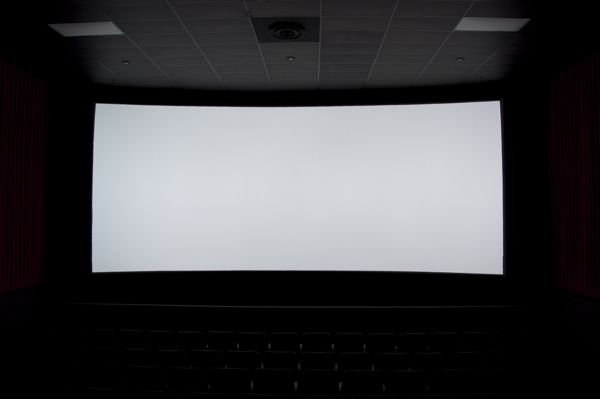
Even off axis, the uniformity of light still is outstanding.
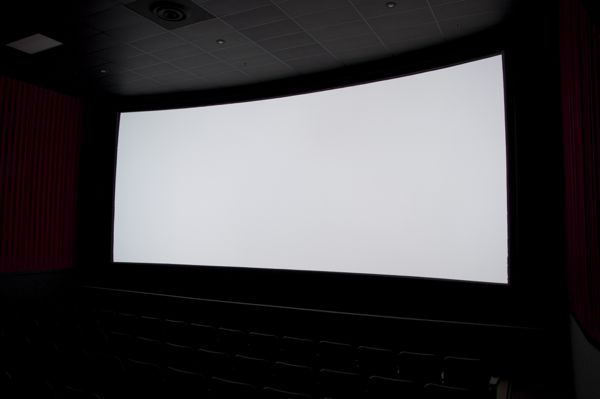
And with a picture (target):

The gain on that screen was about 1.5 back in mid 2011 when the pictures were taken. Most pearls are in the 1.5-1.8 range to begin with (that was back before we could choose specific gains for conventional cinema screens and even those are a bit all over the place...the gain specified is "nominal."
Below are the light levels of the straight on image above (and they remain uniform from the side...just lower).
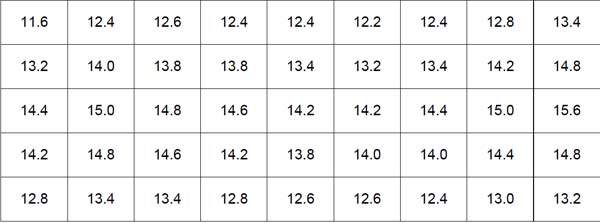
A quick tweak of the cold mirror and light shift to the right was centered. Time was tight and I was there on that day primarily to record various light levels on various screen shapes/gains more than to optimize them...that came later. There were Silver and White screen auditoriums that were mirrors of each other so I could see/measure how a white, versus silver, deeper curve, versus shallow curve...etc. For me, it was quite educational.
Compare that to a flat Stewart Ultramatte130 8-years into its life (in a curtained theatre, screen does not act like a filter for the theatre).
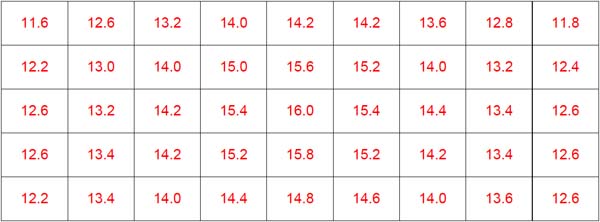
That screen now runs Dolby 3D with a target of 3.8fL on Scope (with anamorphic) and a 6KW lamp. It is about a 42'-wide image.
Posted by Pete Naples (Member # 761) on 05-30-2015, 12:31 PM:
Just for Dave, here's the missing "." ![[Wink]](wink.gif)
Powered by Infopop Corporation
UBB.classicTM
6.3.1.2