This is topic Orc 1000 questions in forum Film Handlers' Forum at Film-Tech Forum ARCHIVE.
To visit this topic, use this URL:
https://ft-forum.com/ft/cgi-bin/ubb/ultimatebb.cgi?ubb=get_topic;f=1;t=011835
Posted by Erik Lallucci (Member # 7490) on 06-01-2015, 05:52 PM:
I'll be picking up an ORC 1000 lamp house soon and have a couple of questions about it. As I understand from reading other posts, it is rated for a 700w bulb. I have a new 750 that I would probably install if that would work?
Also. I am reading it doesn't have a switch to keep the fan running after the lamp is turned off? That seems like a really poor design if that is the case. I always run the fan for at least ten minutes on any xenon to prolong its life.
Has anyone created a three way switch. Off , fan , lamp? Or separate switches on the unit?
Any advice on these units is well appreciated.
Thanks. Erik
Posted by Steve Kraus (Member # 476) on 06-01-2015, 07:26 PM:
If it's physically the same bulb as the 700 it should be fine.
The OSRAM version of the 700 would be XBO700W/HS-OFR. There is a screw end plus a couple of points sticking out where one can use the slots in the rigid plastic safety shield to screw it in without putting any stress on the bulb itself. (Not sure if that is standard on all brands.)
When I worked at a post production center with several screening rooms we had a number of these lamphouses but they were buying the 1000W version of the bulb but as this lamphouse would trip out over 40A, the bulbs would develop arc waver (seen as flicker on screen) later in life and had to be changed prematurely. Switching to 700's cured that. I don't think 750 is that much of a difference to be a problem. In our case, when we changed to different lamphouses in our larger room, we had a ready supply of half-used 1K bulbs which no longer wavered once sufficient current could be applied.
Posted by Erik Lallucci (Member # 7490) on 06-01-2015, 07:37 PM:
Thanks Steve. I appreciate the info.
Posted by Louis Bornwasser (Member # 3063) on 06-01-2015, 09:32 PM:
The fan is 120 volts. Cut it loose and wire it across the incoming line so that it will always be on.
ORC had a semi-fraudulent labelling system: Model 1000 ran 700 watts; Model 1600 ran 1000 watts, Model 2000 ran 1600 watts; Model 2500 ran 2000 watts; Model 3000 ran 2500 watts; Model 4000 ran 3000 watts; Model 6000 ran 4000 watts. Easy to snow a non technical owner who wanted a big lamp for cheap money.
Posted by John Eickhof (Member # 323) on 06-01-2015, 09:54 PM:
depending on where it lived there is a good possibility that the factory mod was made to it providing a separate fan switch. I applied the mod to dozens of them in the 1970s. Louis is correct, as long as the lamp is a 700 or 750 W/HS type it should fit. You can also use an HS=C with anode cable too just remove the existing anode lead. make sure the cable is clear of any metal or it will arc out when the igniter is energized.
Posted by Erik Lallucci (Member # 7490) on 06-02-2015, 05:57 AM:
Always helpful information here, thanks guys!
Posted by Mitchell Dvoskin (Member # 751) on 06-02-2015, 09:10 AM:
> I am reading it doesn't have a switch to keep the fan running after the lamp is turned off?
I modified a few of these over the years so the fan stayed on as John Eickhof suggests. I also drilled through the back to add a toggle switch to turn off the fan.
The easier method is when you turn off the lamp, pop the fuse holder cover on the back which will disable the igniter and then turn it back on to restart the fan.
Posted by Sean Weitzel (Member # 244) on 06-02-2015, 12:14 PM:
If the control boards inside haven't been recently re-capped you might want to consider doing that as the intense heat tends to cook the boards over time. Mine wasn't reliably igniting and recapping the control board cured it.
Posted by Mark Gulbrandsen (Member # 72) on 06-03-2015, 02:48 PM:
What Sean said. And installing 85 amp stud mount diodes also makes them totally reliable. The originals were only like 35 amp. Do the blocking diode too.
Mark
Posted by John Eickhof (Member # 323) on 06-03-2015, 07:25 PM:
If the SCR board has a single SCR on it it needs to be replaced with the later board with two SCRs and if you want more than 40 amps you will need to replace the press in SCRS with higher capacity types. (Originals were only 35 amp rating) Good luck finding them! All lamp current runs through the SCRs and the #10 lead wires so be careful!
Posted by Paul Gordon (Member # 3320) on 06-04-2015, 05:46 AM:
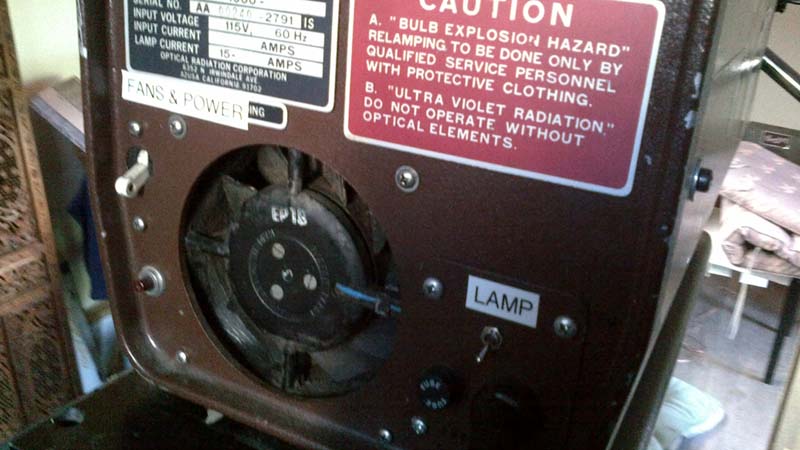
I had to get mine recapped this year as the bulb would not strike. I do have an extra switch to turn the bulb off but leave the fans on, see picture.
Posted by Steve Kraus (Member # 476) on 06-05-2015, 02:34 AM:
Weren't there at least two version of that board, with either a triac or dual SCRs?
I don't know that higher rated SCRs (or triac) is going to get you over 40A lamp current. Are you sure about that? They are on the primary side so if they are rated at 35A, that's plenty. Remember the whole thing will run on a 20A outlet.
Posted by Steve Guttag (Member # 268) on 06-05-2015, 07:06 AM:
Come on people...you have a long way to go before you get up to all 1000 questions about ORC that this thread boasted!
Posted by Erik Lallucci (Member # 7490) on 06-05-2015, 08:18 PM:
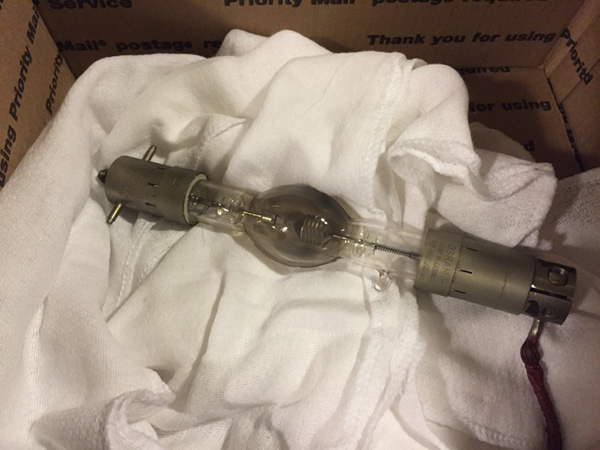
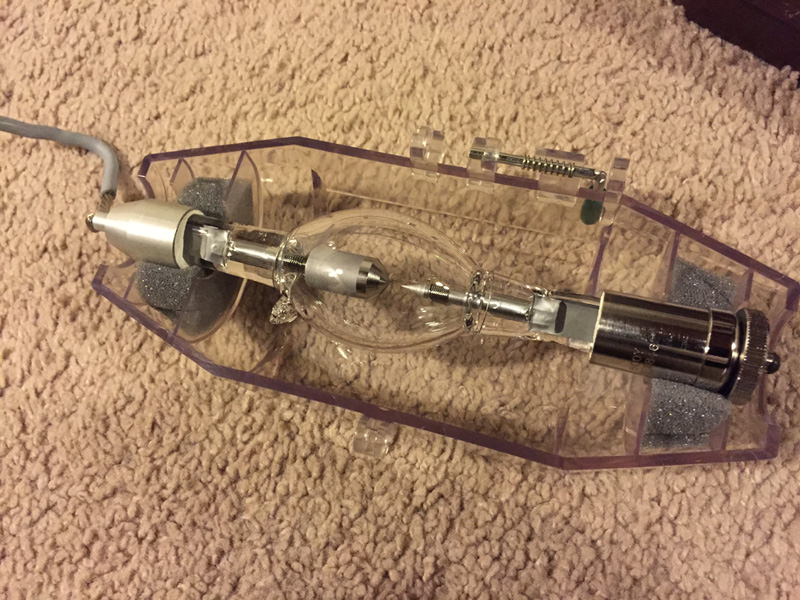
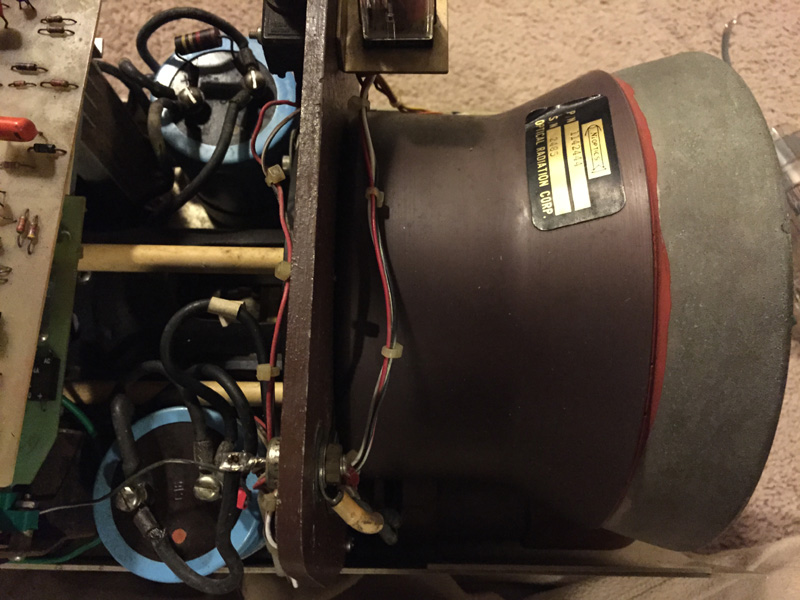
Again, thank you all for the info on this. I just picked up the lamphouse and I see that it was installed with a 1000w ORCON xenon that looks way past it life. I am just concerned I may have the wrong 750 watt bulb? I have a spare USHIO uxl 800y 750w on hand.
Thanks
Posted by Dave Macaulay (Member # 813) on 06-09-2015, 08:23 PM:
Yes, that is the wrong lamp. It doubt that it will fit. Even if the thread is the same (unlikely) and you can figure some way to tighten it (the original lamp case is a plastic tube that engages those pins and is used as a wrench), in the image it looks like the distance from cathode base to arc gap looks different. The cable is no problem if it reaches to what the ORC cable clamp attaches to.
Posted by Ed Inman (Member # 2583) on 06-15-2015, 10:42 PM:
As for running the fan independently on an ORC 1000 I believe if you temporarily remove the fuse down by the main power cable you can turn the main back on and the fan will run to cool down the unit without firing the lamp.
Posted by Erik Lallucci (Member # 7490) on 07-06-2015, 07:35 PM:
Thanks for all the help on this everyone. I was able to locate a LTIX-700W-HS (700 watt lamp) and installed it.
Before I fire it up I want to make sure I have the fuses correct and the amperage correct. Since this lamp is rated a 37a I am assuming I want to start it set around 37? As for the fuses, the manual specs are a little confusing. I have gathered that it takes a .5 and a 20 amp fuse, but I could be wrong and not sure which one is which? Since this is my first run with the orc 1000, I want to make sure I am doing things correctly.
Thanks for all the help.
Posted by Bill Duelly (Member # 3612) on 07-10-2015, 03:52 PM:
On my unit, the fuse by the on/off switch is: 1/4 Amp - 250 V
Posted by Steve McAndrew (Member # 8865) on 01-18-2016, 02:01 PM:
Does anyone have any more information about the addition of a lamp on/off switch. As others have mentioned, removing the fuse will prevent the lamp striking. Is the switch just added in series with the fuse holder or is there more to it?
Thanks for your help
Posted by Mark Gulbrandsen (Member # 72) on 01-20-2016, 03:29 PM:
Throw the switch and run the first time you "fire" that up. ![[Eek!]](eek.gif)
Posted by Mitchell Dvoskin (Member # 751) on 01-25-2016, 08:01 AM:
> Does anyone have any more information about the addition of a lamp on/off switch.
If your goal is to keep the fan on to cool the bulb after it is turned off, that would be the hard way to do it.
I can not speak to all versions of the ORC1000, but the few I have worked on have a 110v AC fan. You really want to rewire the fan onto it's own switch fed directly from the AC, tapped in after the fuse and before the main switch.
Posted by Jim Henk (Member # 3628) on 01-26-2016, 09:02 PM:
So I guess this brings up a question.
Orcon designed the system to shut the fan off with the bulb. Did they ever say that there might be a design reason for that? Might they have counted on an overhead main exhaust fan being on for another 20 minutes or so? Maybe something about the housing that they felt the bulb might be harmed somehow by too much close-quarter rapid cooling after the bulb being freshly turned off?
I dunno. I'm just askin'...
Posted by Tony Bandiera Jr (Member # 2365) on 01-27-2016, 06:07 PM:
The ORC 1000 was (supposedly) originally designed as a "searchlight" for military vehicles. So the fan off spec may be from the original mil spec...or maybe it is because ORC wasn't the sharpest outfit when it came to design. ![[Razz]](tongue.gif)
Posted by Louis Bornwasser (Member # 3063) on 01-28-2016, 08:26 AM:
Mounted below the cannon on large Army tank. I cannot believe they had any level of reliability. Best to be working for the enemy.
Posted by Gordon McLeod (Member # 33) on 01-28-2016, 09:30 AM:
I understood it was first designed for use on 16mm advertising loop projectors that ran unattended at fairs and trade shows
Posted by Mitchell Dvoskin (Member # 751) on 01-28-2016, 09:33 AM:
The Optical Radiation Corporation (later Xetron) was located about 20 miles from my home at that time in Cedar Knolls NJ. I co-owned a few theatres back then, and they would sell me equipment and supplies directly. I spoke with the support staff in person on several occasions. I'm not sure where the "spotlight" urban myth came from, but the ORC1000 was designed for small automated theatres that were popping up at the time. The reason they told me for shutting down the fan with the bulb is that they felt that at 1000 watts or less, the bulb did not need cooling after it was shut off. What they forgot is that by putting the solid state components for the power supply inside the lamphouse, they would need cooling. Solid state components tend not to like to go from extremes of heat to cool, and tend to fail more frequently when they do.
Posted by Gordon McLeod (Member # 33) on 01-28-2016, 10:25 AM:
FYI ORC did design and build search lights for the military
The cermax line of encapsulated lamps were originally for aircraft search light (which is why they are still available
They also developed the original Skytracker which had multiple heads mounted on a motorized plate that panned and light up the sky for events
(Strong continues to make them) as does Phoebus and LP Associates
Posted by John Eickhof (Member # 323) on 01-28-2016, 09:22 PM:
ORC first built the X2500 a 1600 watt xenon spotlight for use on Army gunships (helicopters) during the late 1960s. The lamphouse was quite compact with selsyn motors controlling aim via joysticks. It used a seperate 400Hz power supply to power the lamp and a solenoid dowser. The M-1000 was designed for 16mm film projection and the story has it one was placed behind a 35mm projector and decent (for the time) light was produced. Ron Offerman was a salesman demonstrating the M-1000 in 1970 in Sioux City, he reported that the M-1000 may be suitable to replace a 1KW carbon arc lamp. ORC removed the two piece dichroic heat filters from the nose and installed a dichroic beam spreader to make the beam suitable for 35mm and they were off and running. They also built in the power supply initially for compactness. I installed 2 of the first M-1000s for 35mm at a theatre I worked at in Lake Tahoe, ( model was XM-1000 serials 024 & 025) they were sold by John Dalk of NTS in San Francisco. The early ones had a small 4" intake and exhaust fans and according to the installation instructions they did not require external exhaust! Well, after many fried triac boards and diodes, ORC sent out a fan retrofit to install a 6" exhaust fan on top and a high volume 4" fan on the intake, a few months later, they replaced the original triac board with a dual scr board and recommended external exhaust. We were running 2000ft reels with changeovers, the early bulbs were terrible! Igniting every 18 minutes raised hell and bulb failures were many! So we added exhaust and would light the lamps and leave them on for the duration of the show using the dowsers. Finally a few years later we installed 6000ft reels and lit the lamps for each reel, plus the quality of the bulbs increased. ORC then revised the X-2500 to the X2500C and with a 220V 60Hz single phase power supply, thousands were sold, the X2500C won an academy award for the new xenon lamp design.Plus, all there was in the lamphouse was a cooling fan and the igniter thus saving the power supply from all the heat. Ironically, they kept the reflector location the same requiring a beam spreader! NTS sold thousands and they were also used in the Jerry Lewis Theatres in a Simplex package from NTS. We ended up with them in all 4 of the Northshore Theatres. It didn't take me long to become a self taught expert in the damned things! I have an early XM-1000 and a X-2500 in my museum collection. Not to mention the early ORC manuals that were inept to put it mildly!
Posted by Mark Gulbrandsen (Member # 72) on 01-30-2016, 07:36 PM:
Once when I was at ORC I saw them building CHP Helicopter Search Lights. Those were very interesting. Also fully remote controllable, but very compact. The supply was 400hz switching type and this was in the mid 1980's. Pretty high tech for ORC even then.
Mark
Posted by Louis Bornwasser (Member # 3063) on 02-02-2016, 09:47 PM:
Interesting. The 1600 watt bulb will run directly off ship power: 28 vdc.
Posted by John Eickhof (Member # 323) on 02-02-2016, 10:11 PM:
Louis, You may be spot on! The 400Hz may have been for the igniter circuit? And if you look at how over-regulated all of ORCs early power supplies were, they may have indeed regulated the ship's own high current 28 volts to the lamp, this would explain the simplicity of the little lamphouse. The lamp I have is a X2500 with a 220V 1ph 60Hz supply that has a multitude of regulator transistors in it with an elaborate control board circuit and it is badged 'CINE X35' the same with my early XM-1000. Around 1971 they badged them with the typical silver 'ORC' badge. About the same time they moved their mfg facilities from Monrovia to Azusa California.
Posted by Mark Gulbrandsen (Member # 72) on 02-02-2016, 10:28 PM:
That lamp on the bottom is length reversed from the lamp on top. It may well screw in place and the positive lead connect to the ignitor but it probably isn't going to ever come into proper focus...
Mark
Posted by John Eickhof (Member # 323) on 02-03-2016, 09:12 AM:
What are you referring to Mark? The lamps I am talking about are identical as for bulb placement and polarity with the anode forward or away from the reflector. The only reversed lamps I know of are used in the xenon super troupers. The ORC aircraft spots used a very thick beam alignment lens with a dichroic coating around the outer 20% of the lens circumference this lens made the beam of light spread at approx 2-3 degrees so the effective length of the beam was 300-500 feet.
Posted by Jim Henk (Member # 3628) on 02-03-2016, 03:16 PM:
If they were used in aircraft and helicopters, how did they keep from popping left and right with all that vibration? I mean they pop in booths in lamp houses that are completely stationary. And it's not like replacing them is as cheap as a $1.29 screw-in incandescent bulb. I'd think that xenon bulb costs would add up real quick. Not to mention having to replace them conceivably in-flight. Now there's a thought to give you nightmares.
Posted by Gordon McLeod (Member # 33) on 02-03-2016, 03:25 PM:
The original HS lamps were designed to be very rugged and no incandescent lap would be focus-able or as powerfull as the small xenons in search light applications
Posted by Randy Stankey (Member # 64) on 02-03-2016, 06:41 PM:
They make xenon type headlights for cars. Although it's not exactly the same thing, it is similar. My point is proof of concept. If they can make a headlight for a car that doesn't self destruct from shock or vibration, they can probably make one that can be used as a searchlight on a military vehicle.
Powered by Infopop Corporation
UBB.classicTM
6.3.1.2