This is topic Rerelease mono soundtracks in format 02? in forum Film Handlers' Forum at Film-Tech Forum ARCHIVE.
To visit this topic, use this URL:
https://ft-forum.com/ft/cgi-bin/ubb/ultimatebb.cgi?ubb=get_topic;f=1;t=011848
Posted by Leo Enticknap (Member # 534) on 06-22-2015, 12:13 AM:
Just shown a print of Voici le temps des assassins (given the US title Deadlier than the Male for some reason!). It's on OrWo stock, so I can't give you a year of manufacture (info not on edge marks), but it looks, feels and smells 1980s to me.
Anyways, on the head of every reel there is a sticker that says "This soundtrack has Dolby NR" (with the double-D logo on it). The track looks like a perfectly ordinary, dual bilateral variable area one to me.
Do these labels suggest that it should be played in format 02? Does anyone know of mono movies from the '50s being remastered and re-released in the '80s with a mono track encoded with A-type noise reduction? If so, that's a new one on me. I'd always believed that there were only a tiny number of late '60s and early '70s shows that were actually encoded for 02 playback, though in our CP200 house I sometimes use 02 to soften the noise on very poor VD and unilateral VA tracks that basically have a noise to signal ratio rather than the other way round!
Posted by Marcel Birgelen (Member # 6801) on 06-22-2015, 12:55 AM:
So, you played it in Format 02? How did it sound?
I'm not sure how you could visually see the difference between a "perfectly ordinary, dual bilateral variable area" soundtrack and one encoded in Dolby A. ![[Wink]](wink.gif)
Also, playing variable density and unilateral soundtracks as Format 02 to "abuse" the NR is new for me, but I guess "modern" decoders lack the right tools out of the box to handle those kind of prints "properly" anyway. You would want a mode with lots of noise reduction but not the Dolby NR expansion part being active.
Posted by Leo Enticknap (Member # 534) on 06-22-2015, 01:06 AM:
I played this one 01 because it wasn't in our CP200 house - it was through a CP650, which can't do 02 (AFAIK).
quote: Marcel Birgelen
I'm not sure how you could visually see the difference between a "perfectly ordinary, dual bilateral variable area" soundtrack and one encoded in Dolby A.
You couldn't. I was looking for any evidence of SVA, which would suggest strongly that the track had been Dolby-ized. But as you point out, there is no way to tell visually if a mono, bilateral VA signal is Dolby NR-encoded or not, just as there is no way to tell visually if a SVA track is A-type, SR or an aftermarket imitation of one or the other (e.g. Ultra Stereo or DTS Stereo, though I did once show an Indian print that had stereo unilateral tracks on it, which we can be pretty sure were not the work of Dolby Labs!).
I am aware that using 02 on older tracks is not recommended practice, but in some cases and to my subjective hearing, it can help. I always have a comparative listen between 01 and 02 first before deciding to use 02 with an audience in the house.
Posted by Marcel Birgelen (Member # 6801) on 06-22-2015, 02:33 AM:
The CP-650 indeed doesn't support Format 02. It clearly wasn't designed with repertoire titles in mind. It does 04 though (Dolby A Stereo + surround), but I'm not sure what the end result would be, playing a 02 track as 04 on a CP-650, probably not something to look forward to.
I never understood why Dolby didn't mandate clear markers for their analog audio formats on the prints itself. We all know accompanying letters, markings on leaders, stickers, etc. will get lost over time. With SRD, they even found a way to incorporate their Double-D logo between every sprocket hole.
Posted by Fredrik Sandstrom (Member # 8171) on 06-22-2015, 03:35 AM:
My understanding is that it's perfectly appropriate to play back 02 material in format 04. If the tracks are identical, everything will be directed to center. If you're worried about sound leaking to other speakers, you can turn off the amps for left, right and surround.
Posted by Marcel Birgelen (Member # 6801) on 06-22-2015, 04:29 AM:
That would be my primary concern, not even so much L+F, because that would probably be bearable, but primarily the surrounds, which would probably be a whole lot more distracting.
Yeah, you could kill the amps as a "workaround". But not really automation-friendly anyway, especially if you're running a pre-show.
Posted by Jim Cassedy (Member # 4115) on 06-22-2015, 09:48 AM:
quote: Marcel Birgelen
I never understood why Dolby didn't mandate clear markers for their analog audio formats on the prints itself.
They used to do this back in the "early days" of Dolby film sound. In the
1970's they began clearly marking Dolby Stereo prints such as in this example:
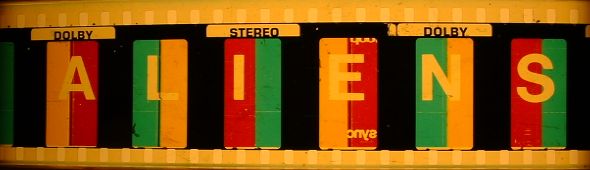
I seem to recall some later prints being marked as TYPE -A or MONO. The
practice continued through the late 80's or early 90's. I'm not sure why
they (the labs? Dolby?) discontinued doing it.
Since I often run a lot of old or archival prints in my work, having a clear
idea of the sound formats would oten be very helpful. I've usually had to
resort to looking up the sound format on IMDB, which is often inaccurate,
or going to one of my contacts at Dolby & have them check their records.
Yes, sometimes when a film is 'restored' the sound tracks are re-recorded
in whatever noise reduction format is the 'standard' at the time of restoration.
But if it's simply a re-prining they often use the original track negative which
of course then retains the original release sound format. So you really have to
figure out if the print you're dealing with is an original release print, a
re-printing, a re-release or a restoration. A strong knowledge or film sound
format history or a good reference book on the topic can be a big help!
Posted by Gordon McLeod (Member # 33) on 06-22-2015, 10:00 AM:
One can use the Cat43 with a cat22 card to cleanup soundtracks that are noisy
In fact the original Dolby mono systems had a cleanup mode built in
Posted by Leo Enticknap (Member # 534) on 06-22-2015, 11:51 AM:
quote: Jim Cassedy
Yes, sometimes when a film is 'restored' the sound tracks are re-recorded in whatever noise reduction format is the 'standard' at the time of restoration.
That was what I was wondering about. The picture footage I looked at on the bench had evidence of at least two duplication stages on the edges of the print itself, includng a hard matte and frame pin markings from a Debrie Matipo - a slow, step contact printer that by the 1980s was only being used by archives and labs trying to duplicate elements that had serious defects (usually perf damage and/or shrunk). So this looked to me like more than just a new print from an IN that dated from the original release, but possibly less than what we would now consider a full-scale restoration. In short, it is typical of the sort of "duplication for preservation" that the big European archives did from the '70s to the early '00s.
That got me wondering if a similar approach had been taken with the audio, hence the Dolby stickers on the leaders. The opening credits state Westrex audio, which in 1956 would have meant that the final mix track neg would have been VD. Therefore, I'm wondering if they did something like play run an original, slightly shrunken final mix neg through an A-type noise reduction module at a fractionally slow speed to create the audio that was on the print I showed.
Posted by Steve Guttag (Member # 268) on 06-22-2015, 12:28 PM:
And then there is Woody Allen...the last bastion of "Mono" ... He did have Dolby SR and Mono (and recommended turning off all of the amps except Center to ensure the 2:4 decoder wouldn't put extra stuff out). He carried on into digital with it.
Posted by Jim Cassedy (Member # 4115) on 06-22-2015, 02:25 PM:
quote: Gordon McLeod
In fact the original Dolby mono systems had a cleanup mode built in
One of the screening rooms I regularly work at (not the one at Dolby, where
I work most of the time) still has one of the original Dolby 364 (mono only)
processors in the rack. I think these came out around 1973/1974.
I've never taken the cover off to see what's inside, but it has 3 modes:
1) "Dolby Film" - For Dolby type "A", no filter in circuit.
2) "New Print/Non Dolby" - Standard "Academy Curve" - no noise reduction.
3) "Clean Up" - For old/noisy prints. Academy curve plus 6db of "clean up noise
reduction", whatever that was.
There is a 4th mode, called "service" which was basically a bypass mode.
These show up, reasonably priced, on e-bay occasionally. Next time I see one
it might be fun, or possibly even useful, for me to buy one and try it out.
Posted by Christos Mitsakis (Member # 143) on 06-22-2015, 04:36 PM:
Jim, if I remember correctly it was Steve Guttag who provided this in the warehouse here.
C.
Posted by Steve Guttag (Member # 268) on 06-22-2015, 04:52 PM:
Simpler times were they.
Posted by Scott Norwood (Member # 30) on 06-22-2015, 08:09 PM:
Does the "clean up" format actually work? If so, I wish that Dolby had continued that feature to the present.
"Night of the Hunter" was reissued in format 02 somewhere along the way. That is the only such title that I can think of at the moment.
I am not sure how much of an advantage would be gained by re-recording a mono track to Dolby mono, unless really good mag printermasters exist for the film in question.
Posted by Steve Guttag (Member # 268) on 06-22-2015, 09:45 PM:
Dolby actually did continue it into the SR days too.
Look up the CAT43 which basically allowed one to use the A-type noise reduction as a single ended device with controls over the expanders in each range.
The CAT430 continued this plan into the SR world.
Posted by Louis Bornwasser (Member # 3063) on 06-23-2015, 02:45 PM:
I also have that sales flyer in my file. Stapled to it is a business card for Morley Kahn and Dolby with only New York addresses. This is before the move to San Fran. Only employee to make the move besides Ioan Allen was Stacey Rehm. (Then, of course, there was George Finkhousen.)
Posted by Leo Enticknap (Member # 534) on 07-22-2015, 02:16 AM:
quote: Scott Norwood
"Night of the Hunter" was reissued in format 02 somewhere along the way. That is the only such title that I can think of at the moment.
So there definitely was at least one - that's interesting to know ; thanks.
Posted by Jack Theakston (Member # 4484) on 07-22-2015, 06:10 PM:
quote: Scott Norwood
I am not sure how much of an advantage would be gained by re-recording a mono track to Dolby mono, unless really good mag printermasters exist for the film in question.
This is sometime the case. For example, Warners has some of MGM's push-pull tracks and stems, so a mixdown to mono/Dolby has its advantages.
Powered by Infopop Corporation
UBB.classicTM
6.3.1.2