This is topic 1964 World's Fair Projectionists in forum Film Handlers' Forum at Film-Tech Forum ARCHIVE.
To visit this topic, use this URL:
https://ft-forum.com/ft/cgi-bin/ubb/ultimatebb.cgi?ubb=get_topic;f=1;t=011849
Posted by Amy Gallick (Member # 8895) on 06-23-2015, 09:01 AM:
Just a long shot here --
I have been asking around to see if there are any projectionists who may have worked at the 1964 World's Fair in NYC still around. I realize they'd be up there in years, but am looking for some information specifically regarding the IBM Pavilion. Reevesound, with Boyce Nemec as president, was the contractor for the projection. I have located Boyce's papers, but wanted to see if anyone who may have memories (accurate or faulty) could be located.
Thanks!
Posted by Louis Bornwasser (Member # 3063) on 06-23-2015, 02:37 PM:
I did some studio work for Boyce and have some knowledge of that era from discussion.
That man could cut a wicked aperture plate: scope, flat, and 70mm times 2 in 20 minutes. Used a jack knife and only filed when nearly complete. I did the optical set up which he hated. He cut the plates. We were working at the old Cine Capri in Phoenix.
I was a sophomore in High school in 1964.
Posted by Martin Brooks (Member # 1269) on 06-23-2015, 09:53 PM:
I remember that exhibit fairly well. I was never in the projection booth, but it was a multi-image, multi-screen projection, probably using punched paper tape to control the projectors, possibly using equipment from AVL (Audio Visual Laboratories), which I believe has been defunct for some years. AVL had several competitors, so it could have been their equipment as well. (I can no longer remember their names).
The MCs would lip-sync the narration. I didn't realize that until the second time I saw it when a different MC had exactly the same voice.
The seating area was the bottom part of the IBM egg. It would drop down to let people leave and enter and then it would rise into the egg for the show.
I loved that exhibit - one of my favorite from the fair. I was in junior high school at the time.
I used AVL equipment for corporate multi-image presentations from 1978 to around 1986. It was very popular before the advent of computer imaging and projection. It was common to run 15 to 30 slide projectors in stacks of 3, sometimes with one stack partly overlapping another stack. For most of my work, which was less complex, we frequently ran 3 stacks of 3 projectors, non overlapping, which gave us a widescreen presentation at an almost 4.5:1 AR. Once the programming units adopted computer technology, they got quite sophisticated and became really easy to program. And you could skip the tape ahead and the projectors would automatically catch-up.
It's hard to believe that Powerpoint and low-res images replaced these multi-image shows which were frequently quite creative and impressive, although sometimes also tacky (lots of glowing logos).
Posted by Scott Norwood (Member # 30) on 06-24-2015, 08:37 AM:
I am a big fan of multi-image slide shows. These were big in museum installations in the 1980s and the concept is still used in some planetarium shows today. Here is a neat AVL demo:
https://www.youtube.com/watch?v=tSf7BFnObmc
Whoever videotaped this set up the video camera to show the slide projectors as well, so one can see how the effects were programmed.
The demo makes some good points--it is easier to change a slide or two than to re-edit a film or videotape, and the quality of a slide show is much higher than 1980s video or 16mm film.
Posted by Amy Gallick (Member # 8895) on 06-24-2015, 10:31 AM:
Thank you for this great information, everyone. I am working on preserving the 1964 version of the Eames multi-screen film that showed in the Pavilion. Martin, the things you mention confirm most of the research I've done. It is helpful to have yet another confirmation of lip-synch as even some who worked there said it was not the case (but I have other evidence it was, at least in 1965).
I'm not sure if you can send private messages on this forum (I'm obviously new) but please feel free to send me any memories or stories if it is possible.
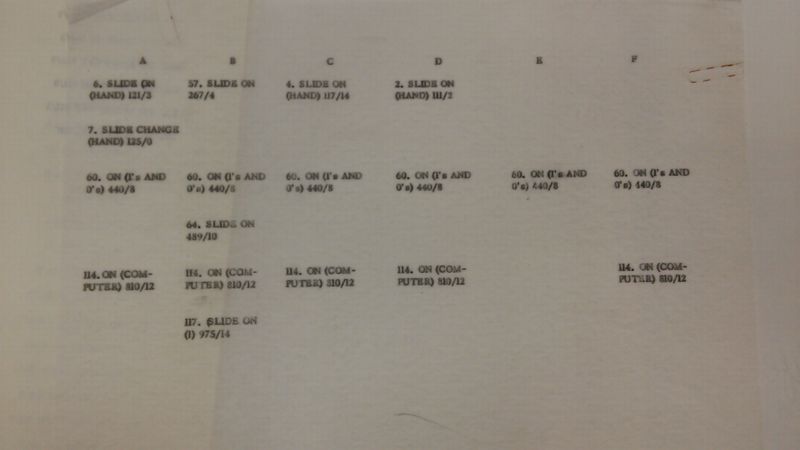
Also, does this type of slides timing sheet make sense to anyone? I cannot yet locate the original slides, but if I do I would like to know exactly where they belonged in the show. I know the letters are the screens (the films were numbered, the slides were lettered), but can't quite figure out what the rest means.
Posted by David Buckley (Member # 2600) on 06-24-2015, 05:58 PM:
quote: Scott Norwood
Here is a neat AVL demo
Really enjoyed that.
I was in the UK for the heyday of that stuff, and the manufacturer of choice there was ElectroSonic. Worked with lots of their kit. The big annoyance was that whereas the Ektagraphic for the US market had integrated dimming, but the UK equivalent (S-AV2000) did not, so needed an external dimmer. More annoying, Ektagraphics can happily run on 240V, so it wasn't a different voltage issue! Grrr! Effing Kodak.
The last multislide I saw was at the Antarctic Centre in Christchurch probably a decade back, wayback machine reminds me they once said Enter this spell-binding 14-min audio visual show, a "never to be forgotten" experience! The spine-tingling images and moving sounds create a hushed atmosphere where you are visually transported to Antarctica. Now all gone.
I miss slides... And still have a couple of Ektagraphics, just in case...
Posted by Buck Wilson (Member # 5885) on 06-25-2015, 07:44 AM:
I had no idea this was ever a thing! I love learning about stuff like this.
Scott, that video demo is hands down the coolest video I've watched in months.
What a fantastic idea! I now have a new-found appreciation and respect for slide projectors. I do have a half dozen of them too that I tossed in storage a few years back "just because" but threw so many older ones away.
Posted by Jarod Reddig (Member # 6363) on 07-08-2015, 08:42 PM:
Buck you and me both! I knew about slideshows but never multi-stacked ones. Very very cool!!
Posted by Kenneth Wuepper (Member # 1174) on 07-08-2015, 09:28 PM:
Until recently, when digital projection became more cost effective, Bronner's Christmas Wonderland in Frankenmuth Michigan had a multi media show consisting of 4 slide projectors in dissolve mode along with a 16mm sound film projection. The entire system was controlled from a track on a reel to reel 1/4 inch tape recording. The audiences were in awe of the resulting show.
Posted by Jarod Reddig (Member # 6363) on 07-08-2015, 09:34 PM:
Sounds very cool Kenneth! Also Scott thanks for posting that video.
Posted by Gordon McLeod (Member # 33) on 07-09-2015, 10:53 AM:
Back in the 70's Kodak used to produce a multi slide presentation that they toured around it used 12 xenon slide projectors with mechanical disolve and a Paget marc300 projector on a pivot base that was moved to different places on the screen
Posted by Martin McCaffery (Member # 37) on 07-09-2015, 10:58 AM:
Trade shows were very big into the multi-stack slides. The problem was when they decided to change the order of something during rehearsals they could be paying an entire crew overtime to wait while they went through a few hundred/thousand slides one by one. Some of my most lucrative days when I worked in DC. ![[Wink]](wink.gif)
Posted by Martin Brooks (Member # 1269) on 07-20-2015, 04:38 PM:
Amy - your email address is blocked, but if you send me your email address (to mbrooks@nyintermedia.com), I'll send you some info I have.
Posted by Martin Brooks (Member # 1269) on 07-21-2015, 09:29 AM:
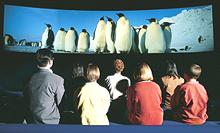
For those of you who are just discovering this, that YouTube video actually represented one of the simplest forms of the presentation: 3 projectors in one stack. Many corporate shows were 3 projectors x 5 stacks and some even incorporated 30 projectors, usually with some overlap. That image posted above of the penguins looks to me to be a 3 projector x 3 stacks show. In the most sophisticated shows, designers were accomplishing animation (albeit at relatively low frame rates). In shows like that, all the projectors constantly moving would sound like machine guns going off in the projection booth.
The thing that was great about it was because it was mostly done with 35mm slides, the resolution was quite high. You could also control a movie projector, even remotely changing film speed and advancing or reversing the film as little as one frame at a time.
Among many other shows, I once produced a corporate presentation that was a satire of "Raiders of the Lost Ark" called "Readers of the Great Books" and when microcomputers were first being adopted in the corporate world, a satire on "A Christmas Carol" called "A Technology Carol" where Scrooge wouldn't let Bob Cratchit have technology. And of course, technology helps cure Tiny Tim. This was all accomplished using multi-image. Video would have been far too expensive to shoot in those days and there would have been a problem presenting video to large groups back then anyway. That would change just a few years later. And when it did and when people switched to inferior computer presentations, all of these companies making this slide control equipment went out of business.
Originally, the devices worked in real time. You'd playback the audio and as you watched the show, if you wanted a 3 second dissolve at a certain point, you'd press that specific button and it would put a pulse on the tape to accomplish that - different pulses for different dissolves or cuts. But as computer tech was implemented, you used a simple programming language instead. So you'd setup all the transitions in advance and as the show played, you'd just press the Enter key and it would execute whatever you set up at that point. Once you did that, it would lock that series of commands to that timecode. They eventually implemented technology where you could start the audio at any point and the projectors would automatically catch up.
It wasn't all perfect though: slides would sometimes get stuck if you didn't use glass mounts, bulbs would blow during shows and before they implemented the tech where projectors could "catch up", shows would go out of sync. Also, in order for animation to work properly, the projectors had to be precisely aligned. There were alignment slides for that purpose and the projectors were held onto the stands with strong springs. In the early days (before my time), which used punched paper tape, the tape would often break.
Posted by Frank Angel (Member # 248) on 08-01-2015, 06:52 PM:
I have been searching for years for information about a multi-slide show I saw at Texas A&M when I worked at the Campus Theatre right across the road in College Station TX. It was a show that had a stacked setup, I believe it was three across by two tiers. It was a show about Texas and highlighted A&M of course. The thing that made it unique and why it was of such interested to me, was that it was stereoscopic -- polaroid 3D. So there were twelve projectors instead of six. It was a great presentation, but I have no recollection of who produced it, if it was something the university did or an outside production that just came in and used the school's auditorium. It did this thing where there would be multiple images most of the time, but then for impact, they would stitch images so the whole screen was one big image. The alignment must have been a bitch given they also had to keep the stereo pairs correctly aligned as well. The soundtrack was in stereo too and was pretty impressive, what I can remember of it, which isn't too much; this was back in 1966-67.
Powered by Infopop Corporation
UBB.classicTM
6.3.1.2