This is topic West Side Squeezed in forum Film Handlers' Forum at Film-Tech Forum ARCHIVE.
To visit this topic, use this URL:
https://ft-forum.com/ft/cgi-bin/ubb/ultimatebb.cgi?ubb=get_topic;f=1;t=011859
Posted by Terry Monohan (Member # 8285) on 07-19-2015, 11:07 PM:
My friend Jack Tillmany wrote me tonight about the big problem at this past Friday night showing (7/17) at the big Paramount Theatre in Oakland CA. Every few months they run classic film night with 35mm movies along with shorts and cartoons and the organ. Well on Friday night they showed a scope 35mm print of West Side Story. My friends who saw the print said everyone on the screen looked tall and thin. I think the projection person forgot to put on the correct CinemaScope® or Panavision® lens. Did anyone complain? People said the whole movie played that way. Did anyone complain, I don't think so! If I was there yes I'd get my money back. Next time I talk to my friends I'll have to ask them If they even heard a stereo sound track? They probably ran in plain mono sound.
Posted by Leo Enticknap (Member # 534) on 07-19-2015, 11:49 PM:
Tall and thin would suggest that an anamorphic print was projected with a "flat" lens, certainly.
Does this house still run film regularly? I find it strange that whoever played this print was competent enough to thread up and run film projectors, but not to put the correct lens in.
Posted by Sean Goodrich (Member # 475) on 07-20-2015, 12:56 PM:
It's been a few years since I played this in 35, but I think it had a mono soundtrack.
But if the operator couldn't tell the difference between flat and scope, there's no reason to think he would have the processor set to mono.
I'm sure it sounded lovely with the Stereo SR button pressed.
Posted by Bobby Henderson (Member # 840) on 07-20-2015, 01:15 PM:
quote:
I think the projection person forgot to put on the correct CinemaScope® or Panavision® lens. Did anyone complain? People said the whole movie played that way. Did anyone complain, I don't think so!
The audience members may have had their faces too buried into their mobile phones to notice the problem.
![[Razz]](tongue.gif)
Posted by Leo Enticknap (Member # 534) on 07-20-2015, 02:02 PM:
There were certainly 35mm prints of the most recent reissue/restoration that had a DTS timecode on them, and for which you could use the same CDs as for the 70mm version. What the analog audio track was (i.e. whether mono or SVA, and if the latter, what flavor of SVA), I can't remember.
Posted by Jim Cassedy (Member # 4115) on 07-20-2015, 02:40 PM:
quote: Leo Enticknap
Does this house still run film regularly? I find it strange that whoever played this print was competent enough to thread up and run film projectors, but not to put the correct lens in.
The Oakland Paramount is now mostly a live performance venue, however, they
still run film on an irregular regular basis.
I've actually worked that booth once.
I know who the regular projectionist is, and I can't imagine him making
a mistake like that. Even the back-up projectionists have to have a
somewhat above average level of projection skills, since The Paramount is
an old-style carbon-arc changeover booth, with NO automation which requires
an extreme ability to multi-task to get a show on screen.
There are multiple manual dimmers for stage & house lights, two curtains, etc.
(Back in it's heyday, due to union rules, the projectionist even had to operate
the organ elevator. The organist had "up" & 'down' buttons on his console,
but all it did was flash a couple of signal lights in the booth.)
That being said- - I have attended a couple of poorly screened shows there
myself, when the regular projectionist was not working. I once sat through
almost half a reel of "Abbott & Costello Meet Frankenstein" that was mis-
framed after a change-over. I kept waiting, thinking to myself "he's GOT
to notice this". Finially, just as I was about to get up and complain,
(or personally march upstairs and frame the damn thing myself) the framing
was corrected. I happened know for sure 'the regular guy' was off that nite.
As for the audio processor, the last time I was in that booth, there was
NO audio processor. Sound was still handled by an early 1950's vintage
Simplex vacuum tube amplifier system, which was installed for mag sound.
(see photo link)
Westside Story was released in stereophonic sound, but only on 35 and 70mm
roadshow prints. Since I doubt they got their hands on a vintage 35mm IB-Tech
multi-track magnetic sound print, the sound Friday nite was most likely mono.
The projectors are Simplex XL's (with old mag penthouses still in place)
and bigfriggin Strong carbon arc lamphouses. (The Paramount seats 3000)
If you're curious, there are some excellent pictures of The Paramount's
booth, taken in 2008 here in the FT Warehouse. Here's an overall view:
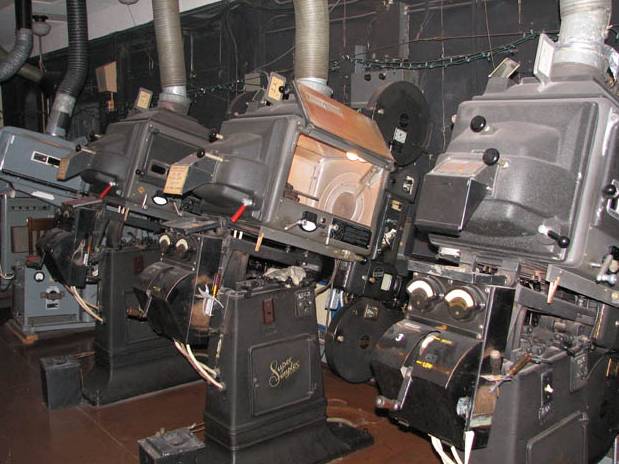
(FT Photo by Paul Michaels) Link To Paramount Pix Page
I worked a booth like this for many years. Definitely not for 'amateurs'
or the faint-of-heart! (Take a look at the "operators control panel" photo !)
Posted by Leo Enticknap (Member # 534) on 07-20-2015, 07:25 PM:
Which makes Terry's report all the more strange. I can't imagine how anyone would be capable of putting a show on the sheet in that booth but not of selecting the right lenses and plates.
Posted by Scott Norwood (Member # 30) on 07-20-2015, 07:31 PM:
Wow, what a gorgeous theatre.
The booth reminds me a bit of the one at the Providence Performing Arts Center ("PPAC"), the former Loews State in Providence, RI. They show film very rarely, although the same booth is used by the followspot operators for their regular live stage performances.
As for the original issue: my only thoughts might be that the lenses were stored in some oddball location that could not be located or that the stagehands configured the screen and masking for Academy and were unable to change it to scope. Or, possibly, the screen had to be moved to a different lineset and the existing lenses were the wrong focal length. Not that any of these possibilities would excuse running a show like that, though.
Posted by Sam D. Chavez (Member # 1841) on 07-20-2015, 08:17 PM:
This is a highly modified CP50 to take 3 35mm projectors and the 16mm Eastman. Lonny Jennings fine work. It is capable of Stereo minus surrounds.
I'm looking into who was working this show as it's in my IA local's juristriction.
Posted by Terry Monohan (Member # 8285) on 07-20-2015, 09:09 PM:
Someone told me that the 35mm print delivered to the Paramount Theatre for Friday's West Side Story showing was a very old worn scratched print that was even missing a reel plus the cues were in the wrong spot? The poor projection guy had enough problems keeping It going on the two projectors. May have been some strange format print that even a scope lens did not help It? When they run a true Cinemascope® 35mm print at the Paramount they don't seem to run It as wide as It needs to be shown like in the old days when they ran wide screen on the big wide screen at the Fox West Coast Paramount Theatre Oakland CA.
Posted by Sam D. Chavez (Member # 1841) on 07-20-2015, 11:38 PM:
The scope lenses probably go back to the '50's so they work the same way they always did. They are not adjustable like the Panatar's so that is not the problem.
There are only two possible aspect ratios for West Side Story; 2:35 and 2:55. Either way the expansion ratio of the lens is 2:1.
I believe the scope image is cropped, same as it ever was at something like 2:1. I have not done work there recently but have been all around it. Also, set up and ran a double system show of "Star is Born" 1954 version.
Posted by Steve Matz (Member # 1890) on 07-21-2015, 01:45 AM:
JIM,From your photo I recognize the Far left Projector as an EASTMAN 25 16mm with Carbon Arc Lamphouse. I had that same Lamp and Rectifier. They were made especially for Kodak by Strong. Apparently this Theater still shows 16mm once in a while...
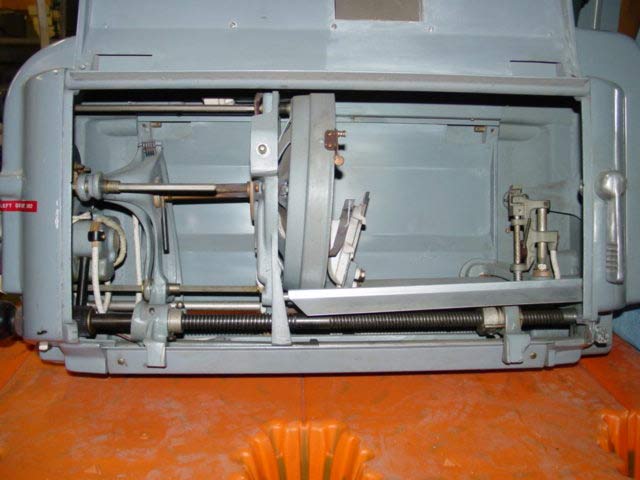
EASTMAN/STRONG CARBON ARC (EASTMAN 25A)
Posted by Martin Brooks (Member # 1269) on 07-21-2015, 09:37 AM:
quote: Sam D. Chavez
There are only two possible aspect ratios for West Side Story; 2:35 and 2:55. Either way the expansion ratio of the lens is 2:1.
I've never heard of a 2.55 version of West Side Story. It was shot in Super Panavision 70 (2.2:1). 35mm anamorphic prints would have been 2.35:1.
Posted by Sam D. Chavez (Member # 1841) on 07-21-2015, 09:50 AM:
I was talking in theory only. I do have a print of Woodstock that's mag only and I'd never heard of that until I saw it for myself. It was not 2:55 though, just a blank optical track.
Posted by Michael Cornish (Member # 6529) on 07-21-2015, 06:05 PM:
Carbon Ach projectors.....When projectionist were real people.
Especially when you had a projector go down......
Posted by Terry Monohan (Member # 8285) on 07-21-2015, 06:16 PM:
Turns out the bad West Side Story 35mm print used last Friday at the Paramount Oakland came from the UCLA Film Archive and was marked 2:20. They did run a scope lens I have been told now. The movie had been plattered. So many of my friends still say It did not look like a scope showing on the screen? Hope you can find out what happened Sam.
Posted by Sam D. Chavez (Member # 1841) on 07-21-2015, 06:44 PM:
Can't speak for the print but checked and it was the usual experienced operator and the scope lenses was indeed used.
So, I'm out of this discussion as everything else is subjective.
Posted by Claude S. Ayakawa (Member # 1401) on 07-21-2015, 07:45 PM:
Wasn't the 2.55 ratio used on prints that only had four tracks of mag stereo?
-Claude
Posted by Leo Enticknap (Member # 534) on 07-22-2015, 01:16 AM:
quote: Terry Monohan (my emphasis)
Turns out the bad West Side Story 35mm print used last Friday at the Paramount Oakland came from the UCLA Film Archive and was marked 2:20. They did run a scope lens I have been told now. The movie had been plattered
.
What?! UCLA absolutely forbid cutting the heads and tails of their prints. This is one of the conditions of the standard print rental agreement they make you sign. A close friend of mine who used to work there (but who sadly died a couple of years ago, and so I can't follow up with him) told me that for a very small number of extremely popular titles, they have an "A print" (pristine, must not be cut and only sent to a very small number of venues they have built up a lot of trust with) and a "B print" that they may, under unusual circumstances and if there is a very powerful cultural case for it, allow to be plattered.
So I'd guess that if this show was run from a platter, it used their B-print of West Side Story, probably acquired at the end of the distribution run after the last major rerelease (i.e. not made by the archive itself from preservation elements). If they cut and plattered the A-print, then that'll be the last time that venue shows a UCLA print.
Posted by Terry Monohan (Member # 8285) on 07-22-2015, 09:58 AM:
The Paramount Theatre Oakland CA does not use the platter system. They use two 35mm projectors for changeover. The West Side Story print they got was used on a platter at some other theatre before they got the film. Must have been a B 35mm print and was very cut up. As a kid I went to the Paramount many times and the huge wide semi curved CinemaScope® screen went all the way to the edge of the stage, this was in the 50's and 69's.The curtain had a black strioe down the center and they used it for side masking. The fly up screen they use now when they show films is way smaller and not as wide today.
Posted by Martin Brooks (Member # 1269) on 07-22-2015, 10:01 AM:
quote: Sam D. Chavez
I do have a print of Woodstock that's mag only and I'd never heard of that until I saw it for myself. It was not 2:55 though, just a blank optical track.
Woodstock is a whole topic unto itself. My recollection is that I saw Woodstock in 70mm 6-track (discrete) at the Trans-Lux West theatre in Manhattan (Broadway and 49th Street). I remember the Altec A7s sitting in the aisles(!) for the surrounds. The mix that I remember had all the stage announcements coming through the surrounds, even if that didn't quite make literal sense. It also played at the Trans-Lux East in 35mm 4-track mag. Michael Coate says there's no evidence that Woodstock ever played in 70mm in NYC. I've checked all the newspaper ads of the day in the NY Times, Village Voice, Daily News and NY Post and there's no indication as to format at all.
So while I remember specifically choosing to see it in that theater because it was playing in 70mm, I don't know how I would have known that since it wasn't advertised as such and even though my father had an office right next door, I had no reason to be in midtown, so I probably wouldn't have known it even if it was displayed on the marquee. I've also tried to find an image of the marquee on the web since I figured some tourist must have photographed it, but to no avail.
I saw the film again decades later at the Museum of the Moving Image but the impression I got was that the mix was completely different. Same for the Blu-ray.
Posted by Scott Norwood (Member # 30) on 07-22-2015, 10:15 AM:
Hmmm...weird about the WSS screening, but it doesn't surprise me that there is a good explanation for it. I could see the wrong-lens thing happening at a multiplex screening, but it seemed pretty unlikely to happen in a prestige venue like that theatre.
Someone probably should have mentioned the print issue before the screening, though. Audiences are generally willing to accept things like this as long as they know that the venue knows about the problem, did not cause the problem, and could not have prevented the problem from happening. An advance apology would have gone a long way.
Posted by Mark Ogden (Member # 43) on 07-22-2015, 10:40 AM:
OK, someone 'splain something to me.
If the 35mm print of West Side Story, a Super Panavision 70 title, is marked as 2:20 as this one was said to be, then wouldn't that make it a non-anamorphic reduction print from the spherical 65mm. source? And as such, if you ran it through a scope lens, wouldn't the resulting image be stretched horizontally, with fat and squat images? I mean, a 35mm scope print of a 65mm title is still 2.35, right?
So confused . . .
Posted by Stephen Furley (Member # 1277) on 07-22-2015, 11:09 AM:
Well, I haven't seen the print, and so cannot be sure, but my guess would be that it's a 35 mm anamorphic print from a 35 mm interneg made from a 65 mm interpos, and the print has narrow black bars on the left and right edges to reduce the image aspect ratio to 2.2:1. This would make better use of the 35 mm frame area than letterboxing the 2.2:1 image within a spherical 35 mm frame.
Every anamorphic film process which I have ever seen uses an anamorphic squeeze ratio of between 1.25:1 and 2:1. If this print was shown with anamorphic lenses, and everything still looked tall and thin then that would seem to suggest that either the print had a squeeze ratio of more than 2:1, which I've never seen, has anybody else? Or alternatively that lenses with an anamorphic ratio of less than 2:1 were used, or variable ones set to a ratio of less than 2:1. All of these possibilities seem unlikely though.
Posted by Jim Cassedy (Member # 4115) on 07-22-2015, 11:35 AM:
quote: Steve Matz
JIM,From your photo I recognize the Far left Projector as an EASTMAN 25
16mm with Carbon Arc Lamphouse.
At the risk of nit-picking, it's not "my" photo. I credited the source in my post.
I've taken, and posted some great photos- - but that wasn't one of them!
However, you are right- - there is nice a PAIR of well maintained
16mm Eastman Arc projectors in that booth. This photo IS mine:
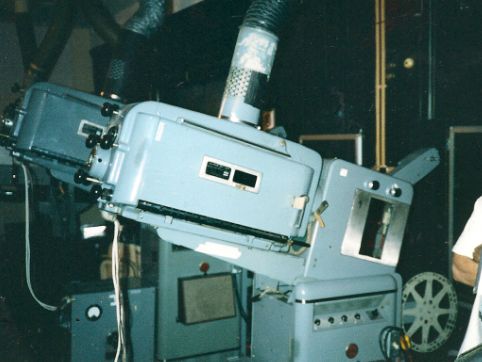
(Actually, it was taken by my friend Daniella, but that's MY elbow! )
I also want to chime in about the print- - as others have pointed out,
UCLA usually expressly prohibits plattering. I recall having to sometimes
sign an agreement not to do so as part of the print rental contract.
But, I have gotten a few prints from them that have obviously been
plattered at some point in their lives.
And, West Side Story certainly wasn't plattered at the Paramount, since
they have enough sense there to have never installed platters. .
(I don't know where they'd put them- - the booth is already crowded with
3 35mm, 2 16mm, and even a spotlight, I think.)
Its been at least 7 or 8 years since I've been in that booth, and I don't
recall there being enough space up there to shove a platter in unless
they took out one of the 35mm projectors, & I know they haven't done that!
Trivia:
I had one festival promoter who could never get the name of the UCLA Film
Library correct. In conversations and even e-mails, he would often refer
to it as the "ACLU Film Library" But, I'm sure they have some interesting
titles too. (Make your own jokes about that)
I also often got a good laugh out of the many mis-spellings on the shipping
cases & leaders of the UCLA prints. Obviously these were film students-
and not English majors! ![[Smile]](smile.gif)
Posted by Leo Enticknap (Member # 534) on 07-22-2015, 11:51 AM:
Sorry - I misunderstood Terry's post, believing him to have said that the Paramount plattered it.
On the contrary, the place is so anti-platter that it's even equipped for 16mm changeovers!
I don't believe that I've ever worked in a booth that can offer that! If I were designing my dream booth from a large, empty room with some windows on one side, I'd have a pair of Norelco AAIIs, and another pair of FP38-ESes. I'd equip the Norelcos with white light optical readers and DTS 70 pickups and use them for 70mm, plus 35mm silver dye track prints and sub-24fps silent prints (because the very fast rotating shutter enables low frame rates with almost no flicker). The FP38-ESes would be for 16mm, and have red readers with 35mm with hi-magenta and cyan dye tracks, plus 35mm DTS pickups.
Even if the equipment could be assembled, there aren't many booths around that could accommodate that (for one thing you'd need five sets of projection and viewing ports, assuming that you'd have a digital projector as well). But still, it's nice to dream!
Posted by Stephan Shelley (Member # 8587) on 07-22-2015, 08:01 PM:
While the screen at the Paramount is no longer curved it is as big as it can get. Scope is a 50' image while the stage is closer to 60' wide. The valance at the top scallops down more on the sides. So much so that it would get into the image if the screen was wider. It drops to a lower level lower than the current screen is high beyond where the screen currently ends.As it is one has to be very careful filing aperture plates as a little over on the top at the sides and you are on the silver valance. New scope lenses and new aperture plates were installed about 10 years ago. The scope ratio is about 2.35 to 1.
Posted by Manny Knowles (Member # 1171) on 07-23-2015, 04:19 PM:
Ask yourselves: What's the more likely scenario?
(a) The persistence of a faulty repertory print of WEST SIDE STORY from UCLA that was double-squeezed, so that it still appeared squeezed even with an anamorphic lens in place; or
(b) An out-of-practice projectionist screwed up.
Posted by Stephan Shelley (Member # 8587) on 07-23-2015, 04:44 PM:
The projectionist has worked there for 15 years and is not out of practice. It is after all a reel to reel carbon arc booth. They do a rehearsal with the stagehands when the set up the screen. It would have been caught then. No changeovers were missed and the lamps did not go out. Hardly out of practice.
BTW no reels were missing it is just that reels 8 & 9 were stacked together on one reel. The print came that way.
Posted by Mark Ogden (Member # 43) on 07-23-2015, 06:11 PM:
quote: Manny Knowles
Ask yourselves: What's the more likely scenario?
(a) The persistence of a faulty repertory print of WEST SIDE STORY from UCLA that was double-squeezed, so that it still appeared squeezed even with an anamorphic lens in place; or
(b) An out-of-practice projectionist screwed up.
Since nothing about this thread makes any sense whatsoever, and without another independent confirmation that this happened, I'd like to suggest:
(c) The original poster was misinformed, got his stories mixed-up, or was just trying to stir things up.
Posted by Stephen Furley (Member # 1277) on 07-25-2015, 12:35 PM:
Can anybody confirm that the image on screen actually was squeezed? Could it possibly be that somebody who is used to seeing 2.35/2.39:1 'Scope prints saw the 2.2:1 image, noticed that it was narrower, and concluded that the image on screen must be squeezed, when in fact it wasn't?
Posted by Terry Monohan (Member # 8285) on 07-25-2015, 01:02 PM:
I had three different people tell me that saw the movie at Oakland's Paramount that It did not look like a wide screen print to them and things looked a little tall and thin. I think they were use to seeing this movie in a super wide screen version 70mm / 35mm Panavision letterbox TV type showing and It was a little more square then wide. I don't think most people complained unless they were movie tech types. But many did complain about about the bad condition of the 35mm print on loan. I was not at the theatre to see first hand. I am trying to find a few more people that can give us more input that saw the show.
Posted by Stephen Furley (Member # 1277) on 07-25-2015, 02:12 PM:
Early in this thread it was suggested that the film had been run without an anamorphic lens. Assuming that it was a squeezed print I do not think this is possible, simply because the problem would be so obvious that nobody who saw it could possibly be in any doubt that something was badly wrong, and we wouldn't be having this discussion.
That leaves two possibilities, that the film was shown at the correct ratio, or it was shown slightly squeezed. I didn't see the film, so I cannot say which was the case, but I think the former is a possibility worth considering,
It is extremely easy to fool the brain into thinking that it's seeing something which it is not. The cinema where I project is equipped for both film and digital. 1.85 is the same size on both, but 1.66 is not. On film these two ratios share the same lenses, so that on digital when changing from 1.85 to 1.66 the sides come in,while on film the top goes up. On film, 1.66 is actually our largest picture size. On digital 1.66 looks like 1.66. With film, if I hold up a 1.66 plate it looks like 1.66. If I put it in a projector and look at the light on the port glass it looks like 1.66, but if I look at it on screen it doesn't. I've measured the image on screen, and it is 1.66, but however hard I try I cannot convince my brain of this fact, it always looks squarer than it is. I've even thought that it looked slightly squeezed, which it's not, the lens is spherical, and the same as used for 1.85. The plates are correct, checked with a 35-PA loop. The image on screen is 1.66, my brain is playing tricks on me, possibly something to do with the greater image height with film at this ratio. It would be interesting to try superimposing 1.66 images on screen from both film and digital and see if this breaks the illusion.
I can't help wondering if something similar was happening with the 2.2:1 image with this film.
The condition of the print of course is a different matter altogether.
Posted by Gordon McLeod (Member # 33) on 07-27-2015, 01:23 PM:
Just a thought they don't by chance use variable prismatic anamorphs in many old theatres I often saw that they were set to leave a little bit of squeeze in the image so it wouldn't look like a postage stamp in a narrow proscenium arch
Posted by Sam D. Chavez (Member # 1841) on 07-27-2015, 03:22 PM:
Nope. Regular fixed scope lens. Maybe the severe for todays cinemas keystone?
Posted by Frank Angel (Member # 248) on 07-29-2015, 12:15 AM:
Audiences are notorious for not being able to accurately describe anomalies in both picture and sound and the words they use will be confusing to the technie who uses very specific words to describe tech malfunctions, although, tall and skinny certainly seems straight forward enough to suggest an anamorphic print not being corrected by a 2x scope lens.
I have never seen a print of WSS that was pillar-boxed at 2.2:1 and as has been said, even if it were, it would STILL have been necessary to use a 2x anamorphot. As also has been said, the most incompetent projectionist would hit the screen with a scope picture that was uncorrected and immediately shut everything down, UNLESS they knew before had that (and here is the scenario I find the most plausible) that they simple had the scope lenses socked away somewhere and they guy with the key or the knowledge as to where they were was no where to be found. If that IS the case, then shame on them for not informing the audience that they are sorry but explaining the situation and let them decide if they want to watch it under those conditions. Hey, I ran WSS in the park and it rained and we asked it the audience wanted us to keep running it, and they said yes; people love that movie so such that they sat in the rain for 2 & half hours. I once got a beautiful, pristine, right-out-of-the-wash-bath print of EUROPA, EUROPA ran the first real only to discover it was SO new that it had not been subtitled. I stopped the show and asked them if they wanted us to continue and almost unanimously they said yes. Only a handful left. I could be this was announced and a few people didn't get the word for some reason, or didn't understand it.
The prints that I have seen of WWS were either old enough to have mag sound or straight mono. Anything with digital would also have a DTS code AND Dolby SRD.
As for that GORGEOUS Paramount booth -- I can't imagine that anyone associated with it, even a so called "B" operator, would be oblivious to unstretched image and how to correct it, IF it were correctable.
And yah, first thing I noticed in that picture were the TWO Eastman 25Bs -- gotta LOVE those babies -- the Lamborgini of 16mm projectors! And yes, WE had TWO of them in TWO of our theatres when I got here, but only the 16mm machines, no 35mm...in a 2500 seat house! So when I came on board in 1970, I reluctantly had to pull one of the Eastmans out, move the other one to the far end of the booth and cut new ports for it. Modified it to play long-play reels. In place of the 25Bs, I put in two spanking newly refurbished XLs where the Eastmans had been. They were refurbished by a brilliant tech/projectionst, Bruce Sanders who unfortunately just passed away a few months ago (RIP). The rest of the equipment including Peerless Lamphouses came from the great Star Cinema in NY owned by the late Saul Tanney and now his son still running the business, Steve Tanney. This booth also has a SuperTrouper Followspot (same lamphouse as the Eastman, BTW). It is a TIGHT booth. Would have given anything to be able to put in 70mm, but they wouldn't let me. I was lucky enough to convince them that we HAD to have 4trk mag (told them modern 35mm professional film needed 4trk mag in order to hear any sound at all).
Powered by Infopop Corporation
UBB.classicTM
6.3.1.2