This is topic Changing oil in first generation Devry in forum Film Handlers' Forum at Film-Tech Forum ARCHIVE.
To visit this topic, use this URL:
https://ft-forum.com/ft/cgi-bin/ubb/ultimatebb.cgi?ubb=get_topic;f=1;t=011881
Posted by Jacob Delaney (Member # 8629) on 10-03-2015, 03:22 PM:
I've got an old beat up Devry 35mm projector with a SN of 150 (not sure what model it is) and I'm trying to figure out how to properly change the oil of its intermittent.
I have been able to take it apart slightly and let some oil drain but I really don't think that's a good idea.
Here's what it looks like
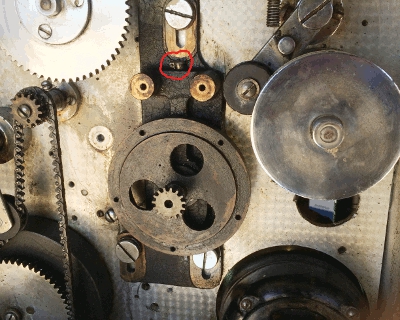
I circled where the oil cap is but the only way to get oil out of it is to take the whole thing apart and shake it upside down and even that doesn't get the oil out of there.
Also, it's impossible to see how much oil is in there because there's no oil window.
Posted by Robert Koch (Member # 3728) on 10-05-2015, 10:21 PM:
You have shown the wrong side of this insult to engineering. Most of these had a cheaply made imitation of a Simplex movement. You should take the lower screw out of the movement on the film side and let it drain overnite this, providing some moron hasnt filled it with sae 90 or something like cup grease
My advice to you, find the nearest body of water close to your residence and throw this damn thing in it..
g
Posted by Jacob Delaney (Member # 8629) on 10-05-2015, 10:33 PM:
Robert, I only got this projector to mess with. I have a newer Devry modified by Kodak for dailies and a Wenzel. Both of those use Simplex intermittents.
I was able to take the bottom party off from the screws down there but since so little came out I'll try and leave it open overnight like you said. Thanks
Here's the operators side:
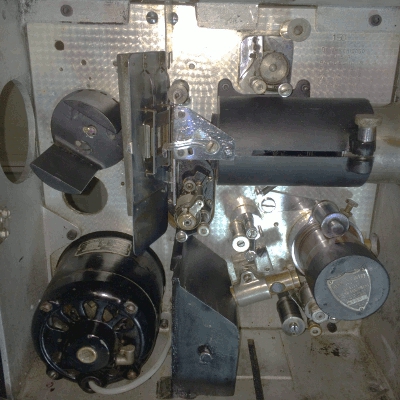
The outer casting looks like cheese or plaster wall ![[Razz]](tongue.gif)
Posted by Steve Kraus (Member # 476) on 10-06-2015, 08:46 PM:
I never did figure out how the DeVrys knew I was running a loop so it could quickly shred them while running an actual reel was okay.
Posted by Leo Enticknap (Member # 534) on 10-07-2015, 03:15 PM:
quote: Robert Koch
You have shown the wrong side of this insult to engineering.
Compared to a Monee or a Spectra, it's a paragon of industrial archeology.
quote: Robert Koch
My advice to you, find the nearest body of water close to your residence and throw this damn thing in it..
Given the drought in the Inland Empire, that would probably mean a trip to Santa Monica. And the chassis is probably made of such thin and cheap steel that the chances are that it would float.
Posted by Mark Gulbrandsen (Member # 72) on 10-10-2015, 04:23 PM:
Dailies? No one runs filum dailies any more... I guess that's why you have it then.
Posted by Robert Koch (Member # 3728) on 10-11-2015, 10:23 PM:
Steve Krause:
Ive been there; why do you think I have the hatred of these damn things. The navy cost the taxpayer, during the war, a bundle, thanks to a clandestine meeting between a navy purchasing agent and some Devry sob who paid this navy bastard plenty.
sob
Posted by Jacob Delaney (Member # 8629) on 10-12-2015, 01:14 AM:
Mark, Kodak modified them in the late 50s and early 60s I think. It features a magnetic interlock as well as optical sound. It also has a xenon color filter for the tungsten lamp. all of it is on a cart type base that you can easily cart around. The whole thing weighs about 250 pounds.
Posted by Monte L Fullmer (Member # 2797) on 10-12-2015, 03:02 AM:
Thought the Ballantyne PRO 35 was the desired candidate to anchor a boat down to keep it from drifting away... and their INT assemblies were the absolute pits to work on!
I trust that Jacob had never had the privilege to operate and maintain such a device.
Posted by Frank Bolkovac (Member # 6201) on 10-12-2015, 08:42 AM:
Could of been a Christie that he has....
Posted by Mark Gulbrandsen (Member # 72) on 10-12-2015, 12:39 PM:
And who knows what lube to put in that movement? If it's a hardened star and cam running in cast iron bushings then a light projector oil. I
If they are soft steel star and cam like Brenkert then things may need to be very different from the norm so you don't ruin the internal parts. Motiograph for instance used grease in their movements.
I will take a Christie any day over most projectors! If they are maintained properly they actually need very, very little maintenance.
Mark
Posted by Jacob Delaney (Member # 8629) on 10-12-2015, 01:21 PM:
I thought Ballantyne PRO 35s were used at Disney? All of their other film equipment like their loop boxes (whatever they were called) were custom made for attractions I think.
The oil that came out of it was watery and very dirty so I was just going to put Simplex oil or 10w non detergent compressor/hydraulic in it, but who knows if what was in there was correct.
I almost got a PRO 35 a couple years ago but thanks to this forum I found out they were no good ![[Smile]](smile.gif)
Posted by Jim Cassedy (Member # 4115) on 10-12-2015, 04:22 PM:
I had one of those DeVry's many years ago.
It was noisy, the image a bit unsteady and not that gentle on film.
I never considered the projector itself to be a 'boat anchor' (and I had
actually had a boat back then) but I definitely would use that term to
describe the DeVry amplifer!
It was built like a tank- - with a couple of huge, heavy power and output
transformers, plus some big heavy iron inductors. Vacuum tubes, of course.
( 5U4, 6L6's and a couple of others.) But mostly, I remember it was very
HEAVY and it put out enough BTU's to heat a small room.
I recently came across some patent documents which showed a Bell Labs
patent application from 1928 for a 35mm "portable talking picture projector",
and from the drawings, it looked remarkably like a clone of the DeVry.
(Or maybe DeVry cloned theirs form Bell's)
Posted by Jacob Delaney (Member # 8629) on 10-12-2015, 05:37 PM:
Is this the same one you're talking about?
"Model 389 power amplifier 75 watts"

The other half is a controller for sound, treble, bass, and mag/optical/mike.
It worked a little bit when I first got it but it just slowly faded away until no sound came out of it. I noticed a resistor was fried and some of the capacitor's labels fell off so I couldn't fix it and replaced it with a CP-55 and a spare QSC 1400.
Posted by Sam D. Chavez (Member # 1841) on 10-12-2015, 06:39 PM:
quote: Mark Gulbrandsen
I will take a Christie any day over most projectors! If they are maintained properly they actually need very, very little maintenance.
Mark, sounds like an oxymoron here. If maintained properly....
Besides this is Christie film projector. Really?
Posted by Mark Gulbrandsen (Member # 72) on 10-12-2015, 07:30 PM:
Sam,
Yea, once you replaced the crappy factory ball bearings with good rubber sealed bearings they are uber reliable as well as nice and quiet. The very last belt kits Christie sold for the P-35GP also fixed all it's flutter issues. Owners of them got to enjoy this smooth running projector for about the last six or seven years before converting to digital. Incidentally, the belts with those kits also lasted the remainder of the life of the projectors. Cine-X35 came with those style belts from the beginning...
Mark
Posted by Sam D. Chavez (Member # 1841) on 10-12-2015, 07:53 PM:
You gotta admit it's a funny way to put it.
It only took from 1980 to about 2000 and countless revisions to get it close to good.
All history now.
Posted by Steve Kraus (Member # 476) on 10-12-2015, 08:08 PM:
I never did figure out why they had such small shutters, as though the bare minimum to block the light beam (and not always successfully). There's a reason other projectors have shutters the size they do and it's to minimize the transition time from on to off and off to on, as that must come from time the light could otherwise be on assuming you don't want travel ghost. A perfect shutter would instantly and totally block the light just the instant before the film starts to move and unblock just as the film stops. The closer you are to that the brighter your picture. Christie did eventually go with a one blade 2X shutter which helps but still, a large shutter can do that too.
Posted by Sam D. Chavez (Member # 1841) on 10-12-2015, 09:21 PM:
This projector had a very humble start as a custom hollywood home screening room projector. I believe it was a Charlie Ajar design. He was very popular and thus had a ready home screening room market.
It needed to be compact first of all and was made largely from fairly standard parts from catalogs, an example was the Boston gearbox selected. The mounting selected dictated the distance away from the aperture and that's all she wrote; stuck with this limitation forever.
This design was bought by Christie and then the larger lamphouses in commercial cinemas soon revealed the limitations of the gearboxes so the design was changed to a belt drive shutter and eventually a double speed one wing shutter.
Many, many, many revisions later until just about every part in the machine was redesigned and you had a reasonable projector.
But it kept Christie in the market until it was time to be replaced by D Cinema machines from Christie and others.
Posted by Mark Gulbrandsen (Member # 72) on 10-12-2015, 10:10 PM:
I agree it's hilarious they got it right just a half dozen years before the end. When I was at Claco I had about 60 of them to maintain. The bearings and then the belt kits did the most good for them. Except for an occasional C/O coil or motor they were relatively trouble free once fixed properly. People also had a bad habit of over tightening the belts. This led to a high wear rate for the aluminum pulleys and the belts. The last pulley kit was made from all self lubricating plastic of some sort, amazing stuff as they all lasted the remainder of the time everyone ran film. I installed a prototype belt kit at Jackson Hole after Clint Eastwood complained about flutter in the sound. When the kit arrived I had a good laugh at all the plastic stuff. But as I learned, never underestimate plastic! Eventually I pulled all but one locations worth of Christie's out during conversions. Many of them still sit in the booths.
Posted by Jacob Delaney (Member # 8629) on 10-16-2015, 03:23 PM:
Since I have to open the intermittent part way for the oil to drain, I decided to just take it apart and look inside.
It took a total of seven screws to open it up (add four for taking it out of the projector).
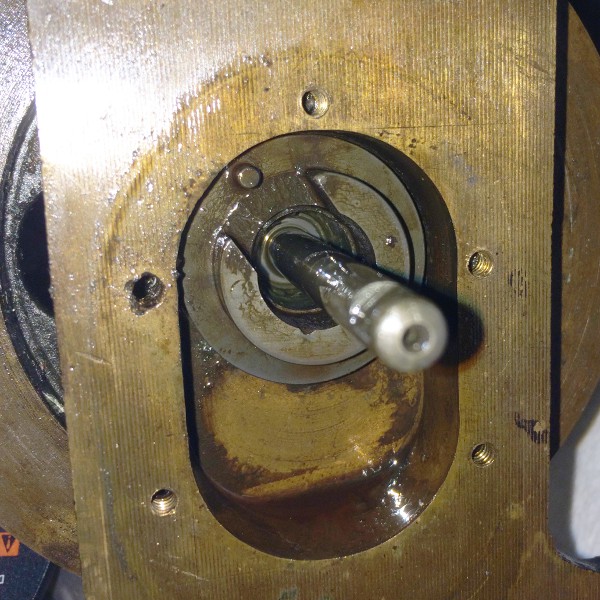
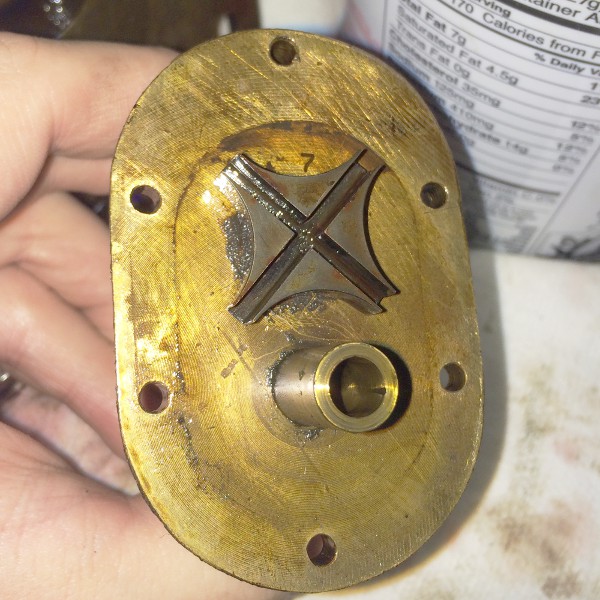
This is how dirty it looks after already changing the oil.
I'm going to just put in 10w motor oil in it after I clean it up and if it seizes or whatever then I'll just throw it out. I'm not planning to run anything special on it anyway.
Posted by Jim Cassedy (Member # 4115) on 10-17-2015, 12:55 PM:
quote: Jacob Delaney
Is this the same one you're talking about?
"Model 389 power amplifier 75 watts"
No. The boat-anchor DeVry Amp I had was this one:
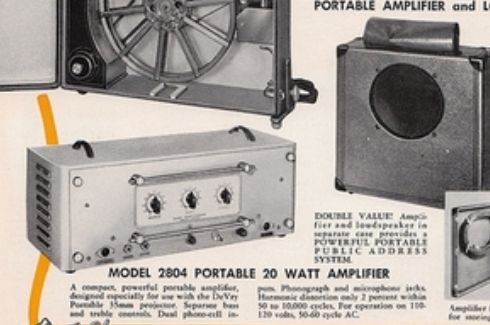
The chassis must have been made out of lead. It was VERY heavy.
Posted by Mark Gulbrandsen (Member # 72) on 10-17-2015, 03:09 PM:
Do NOT use regular non detergent motor oil!! That is the surest way to ruin it.... Straight 10 weight might work just fine as it was probably a pretty common oil back in the day. Most auto parts stores have it. Or an equivelent Shell Rottella oil.
Mark
Posted by Jacob Delaney (Member # 8629) on 10-17-2015, 08:32 PM:
I thought non detergent was good for projectors? I got 12 quarts of Accel SAE 10 motor oil. The description says:
quote:
A good straight mineral engine lubricant refined by modern methods for older cars and trucks which are operated under mild service conditions.
Non-Detergent SAE 10 Motor Oil is a pure, petroleum based oil with no additives. It helps prevent rust and wear by providing a lubricating film on engine parts. For use in many air compressor applications.
Are you saying I should get normal detergent oil or did you think I had the standard 10-30w?
Posted by Gordon McLeod (Member # 33) on 10-22-2015, 11:39 AM:
Projectors don't like detergent based oil
most likely they used SAE20 in that machine as that was the common standard oil in the Siper The E7 and the Century C in the early days
Posted by Mark Gulbrandsen (Member # 72) on 10-22-2015, 12:35 PM:
SAE 20 weight was used in Century's. Simplex oil was about 9 weight. Simplex's do not have as large of an oil spiral on the shafts as do Century's. I had a customer ruin a Super some years back by running SAE 20 weight in the movement and projector oil cups. Then I had the customer that used sewing machine oil in his X-L because he said the dealer charged too much for a quart of the correct stuff... ![[Eek!]](eek.gif) That rebuild cost him a bunch!
That rebuild cost him a bunch!
Mark
Posted by Paul Dorobialski (Member # 7536) on 10-22-2015, 04:31 PM:
Back in the 1980's I inherited the Educator model Devry.1000 ft take up. No magazine so I outfitted a 2000 ft spyider to the top. I didn't use the amplifier, but did sell the pair of #50 tubes that came with it. I have still the small cans of Devry oil for the projector. The last film I played on it before the motor went up in smoke was a Pixar short call Knick Knack. I got atleast 5 good years out of the projector. A projector collector in Aurora IL bought from me and he has it now.
Posted by Gordon McLeod (Member # 33) on 10-22-2015, 06:30 PM:
The original standard simplex book stated SAE20
the XL originally was a Cappella oil approximately SAE10
Posted by Paul Dorobialski (Member # 7536) on 10-23-2015, 07:23 PM:
I have some sealed cans of Strong Simplex projector oil I would part with, plus some Strong Simplex sound head oil, too.
Posted by Tony Bandiera Jr (Member # 2365) on 10-25-2015, 10:55 AM:
quote: Sam Chavez
This projector had a very humble start as a custom hollywood home screening room projector. I believe it was a Charlie Ajar design. He was very popular and thus had a ready home screening room market.
It needed to be compact first of all and was made largely from fairly standard parts from catalogs, an example was the Boston gearbox selected. The mounting selected dictated the distance away from the aperture and that's all she wrote; stuck with this limitation forever.
This design was bought by Christie and then the larger lamphouses in commercial cinemas soon revealed the limitations of the gearboxes so the design was changed to a belt drive shutter and eventually a double speed one wing shutter.
Sam is spot on. The original design was indeed done by Charlie Ajar. I worked for him at his shop in North Hollywood (Universal Projector). The earliest versions he made had the Lavezzi Super Simplex style intermittent in them, and a horrible motor that often needed to get a spin to start. Original gate and trap assembly was similar to a Super as well.
Later versions got a better motor and the Ultramittent.
Lamphouses were available as an incandescent style with a slide projector bulb (which was only good for 25 hours and would always fail before a changeover), the horrid Kniesley (sp?) 500w xenon and then, a terrific L.P. Assoc. 500w xenon with a magnetic rectifier designed to run off any standard 120v receptacle. (I only drew about 11 amps at full power.) I think member Jim Henk on here has the LP lamphouse I sold to him a few years ago...
The other market Charlie had for these machines was for location work for dailies. He had custom shipping cases made for the projector/lamp, base and a small mono sound system (using preamp and eq/VCA cards custom designed by USL if memory serves) and a Crown DC75 amp. The sound pickup had a trick sliding assembly to select a mono solar cell or a single track mag head.
I ran one of those for the dailies on an 80's comedy called "Surrender" Surrender cast and crew credits list and ran several of the home screening rooms as well. A job I did last year (upgrade to digital) had TWO of the older version projectors that I assembled being removed.....I tried to get one of them from the client but they wanted them for display purposes.
Charlie became pretty well-off from his deal with Christie....his idea of pocket change was always about $20,000.00 or so....
Another fun thing about working for Charlie was that he was quite a character. Many famous names in the industry had some goofy variation of their real name, which Charlie would say to their face without hesitation. He was also a very good machinist..he used to call himself "Micrometer eye".
I very foolishly challenged him on that last one...a studio wanted a custom Simplex XL plate cut to a very non-standard size...I bet Charlie lunch at the Palms Restaurant that he couldn't get the plate to within .005" in either dimension, and he couldn't measure it at all till he was done...he got the horizontal spot-on and the vertical was off by .0015".
That lunch for us cost me a full week's pay and then some. ![[Big Grin]](biggrin.gif) But it was worth it, I got a lot of great experience from working for Charlie (and a lot of laughs too.)
But it was worth it, I got a lot of great experience from working for Charlie (and a lot of laughs too.)
Powered by Infopop Corporation
UBB.classicTM
6.3.1.2