This is topic Batman vs superman in 70mm in forum Film Handlers' Forum at Film-Tech Forum ARCHIVE.
To visit this topic, use this URL:
https://ft-forum.com/ft/cgi-bin/ubb/ultimatebb.cgi?ubb=get_topic;f=1;t=011934
Posted by David J Hilsgen (Member # 2614) on 01-17-2016, 06:38 PM:
Warners called this week to re confirm that we have 70 capability so we will see what happens.
Posted by Tyler Purcell (Member # 9213) on 01-17-2016, 06:43 PM:
It's a different world from Hateful Eight because I'm sure Batman vs Superman will be finished digitally and scanned back to film. So unless they finish in 8k, (which is doubtful) there really isn't any reason to bother making 70mm prints. I could see a 35mm release, but Force Awakens was pretty poor in 35mm. It looked very digital compared to Hateful Eight.
The next big photochemical 70mm films will probably be whatever Nolan and PT Anderson are planning to shoot in 2016.
Posted by Buck Wilson (Member # 5885) on 01-17-2016, 07:14 PM:
I am very much liking this trend.
Posted by Mark Gulbrandsen (Member # 72) on 01-17-2016, 09:11 PM:
Just not liking the movie. Just more comic book crap and its mainly digital effects anyway.
Mark
Posted by Mike Blakesley (Member # 26) on 01-17-2016, 09:17 PM:
After seeing the mostly-practical efx in the Star Wars movie I was stunned by how phony and fakey the explosions, car wrecks, environmental disasters and other nonsense looked in virtually every action movie trailer that played with that film. Batman/Superman, AntMan, Deadpool, Captain America. They all look terrible in comparison.
Posted by Chris Haller (Member # 9206) on 01-17-2016, 09:35 PM:
quote: Tyler Purcell
So unless they finish in 8k, (which is doubtful) there really isn't any reason to bother making 70mm prints.
The major digital effect sequences in Interstellar were film-outted at 6K for IMAX 15/70, and the results held up surprisingly well next to all of the photochemically processed footage. As long as they don't do a large amount of processing to make it look artificially sharpened like a lot of modern film productions, and don't do anything stupid like 2K effects upscaling, I imagine a 4K or 6K finish might look pretty nice on 70mm film. I don't know, maybe I'm just talking crazy.
Posted by Tyler Purcell (Member # 9213) on 01-17-2016, 10:21 PM:
Yep, and I doubt anyone cares besides Nolan.
Posted by Scott Norwood (Member # 30) on 01-18-2016, 07:46 AM:
Honestly, it is probably a marketing issue, as much as anything. The public has responded to the H8 "roadshow" screenings, and Warners is probably trying to cash in on some of that publicity, regardless of the technical merits.
I like film and I like 70mm, so I hope that they do it, anyway.
Posted by Bill Brandenstein (Member # 7758) on 01-19-2016, 11:08 PM:
Seeing how disappointing the image quality of "Force Awakens" was in laser Imax due to its 2K resolution, as I've said elsewhere, I'm ready to be done with Imax. And that's on the same screen that did 15/70 Interstellar, and yes, those 6K effect sequences really did look amazing from film and held up well against natural film sequences.
So 70mm from a 4K DI? I'd be interested in that. A shootout against 4K laser projection could be very, very interesting indeed. 2K? Nothing special. Tyler, the filmgoing public may be stupid and uninformed for the most part, but some of us really DO care.
Posted by Aaron Garman (Member # 1653) on 01-20-2016, 12:12 AM:
Force Awakens looked great in 15/70, which I am assuming was from the 4K digital intermediate. If they do this right, Batman v. Superman, being a 4K DI, could look pretty darn good still since all the footage was captured on film. According to IMDB:
quote:
Cinematographic Process Digital Intermediate (4K) (master format)
IMAX (source format) (some scenes)
Panavision (anamorphic) (source format)
Panavision Super 70 (source format) (some shots)
Super 16 (source format) (some shots)
I'll pay to see it. Sad thing is, a lot of those 70 setups were in smaller rooms. ![[Frown]](frown.gif)
Posted by Bill Brandenstein (Member # 7758) on 01-20-2016, 01:04 AM:
Aaron, a Disney employee confirmed to me that the Force Awakens DI was 2K due to time and budget constraints (excuse given) to get the movie finished before the end of the year. Yeah, like budget's a problem. Anyway. So the Imax 15/70 release was 2K to DMR except the brief legit 15/70 sequence. Still, I'm sure it looked sweet and wish I could see it there also.
Posted by Buck Wilson (Member # 5885) on 01-20-2016, 01:15 AM:
quote: Bill Brandenstein
a Disney employee confirmed to me that the Force Awakens DI was 2K due to time and budget constraints (excuse given) to get the movie finished before the end of the year.
What a crock of shit.
Posted by Aaron Garman (Member # 1653) on 01-20-2016, 02:19 PM:
That's interesting. Budget constraint on a film that was poised to make billions, and did? You would also think that they would have to have decided to do 2K or 4K digital intermediate pretty early on, and how could that have been a last minute decision? I know the DCPs were all 2K, but the master itself? I'm still a skeptic.
Posted by Bill Brandenstein (Member # 7758) on 01-20-2016, 10:13 PM:
I hear ya. Seems completely irresponsible in light of the situation. Untenable in light of Abrams' enthusiasm for film quality. But there is no hiding the fact that the Imax 3D 4K laser projector was putting 2K on the screen. Maybe the 3D conversion was the straw that broke this camel's back - not an unlikely cause for a quandary.
Personally I thought the 3D was decent and tasteful, but would've taken 4K over 3D.
Posted by John Wilson (Member # 269) on 01-22-2016, 01:48 AM:
Didn't Warners release that crapfest of 3D called Clash Of The Titans hot on the heels of Avatar to cash in?
Now they want to cash in on the 7Omm success of H8?
Be afraid...
Posted by Eric Richard (Member # 8635) on 01-23-2016, 07:42 PM:
Has there been talk of a 70mm release of Independence Day: Resurgence" also?
Posted by Lyle Romer (Member # 1266) on 01-23-2016, 09:43 PM:
quote: Eric Richard
Has there been talk of a 70mm release of Independence Day: Resurgence" also?
Why bother. It was shot digitally with a 4k digital intermediate. Assuming they release in 4k, just see it in 4k and you'll have all the possible resolution.
Posted by Stephan Shelley (Member # 8587) on 01-24-2016, 12:33 AM:
Warner's has contacted the Grand Lake about running this in 70mm.
Posted by Steve Guttag (Member # 268) on 01-24-2016, 09:14 AM:
Is there to be no 3D? (Here's hoping). 3D seems to be the crusher of 4K releases.
Posted by Matt Russell (Member # 8989) on 01-24-2016, 10:41 AM:
quote: Steve Guttag
Is there to be no 3D? (Here's hoping). 3D seems to be the crusher of 4K releases.
Unfortunately, Batman v. Superman is gonna be released in 3D (as well as IMAX 3D) . I'd take 4K over 3D any day.
Posted by Steve Guttag (Member # 268) on 01-24-2016, 12:49 PM:
The post just above was relating to Independence Day. I hear that Batman v Superman will have 70mm prints so it may be that the 70mm will be the highest resolution if the DCPs are dumbed down to 2K DIs. If they strike 70mm prints off of 2K DIs, I agree with the "what's the point" mentality.
Posted by Mike Heenan (Member # 392) on 01-24-2016, 05:42 PM:
I'm all for it as long as it leads to more 70mm production and eventually projection. As long as it's profitable for them, I don't see why studios can't exploit yet another buzzword marketing term.
Posted by Ari Leedsw (Member # 9336) on 02-20-2016, 09:43 AM:
Lyle, agreed!
Besides color space, possibly, a 70mm print of a 4K film is a waste of money on the film!
A 35mm print can hold over 4K, so a 70/5 can easily hold 6, 7, even 8K if it is a second-generation copy. IMAX 70/15 can hold 12K, easily.
Posted by Brad Miller (Member # 2) on 02-20-2016, 10:21 AM:
Remember though when you are doing calculations a few things...
Is the 35mm print straight off the original negative, or is it from a dupe negative? There is resolution loss with the dupe of course.
What kind of printer was it made on? As an excellent example, back in the old days it wasn't uncommon for me to have 2 prints of the same movie, one from Deluxe in LA and one from Deluxe in Canada. The LA print was ALWAYS and without fail vastly superior, even though both were from an equivalent dupe negative.
What projector is the print being ran on? Even a tiny bounce in the image will cost you resolution.
What kind of lamphouse, size of bulb, cooling and heat filters are in place? Again, that can cost you resolution.
What kind of lenses are being used? If anamorphic, did the installing technician actually adjust the astigmatism through the lens, or did he set it based upon the numbers on the anamorphic? That can cost you major resolution.
This sort of thing goes on and on.
Posted by Ari Leedsw (Member # 9336) on 02-20-2016, 11:05 AM:
You are assuming the worst case in each step of the 35mm process.
Let's not forget that the 2K file is going through a lens (which costs significant resolution) in DLP, and that lens is not always in focus.
In the modern era, 35mm limited releases are 2nd generation, from 4K scans.
If we are talking about a 70mm release, it's a second generation copy of a 70mm intermediate (or is it 65mm? I forget if the intermediates jump up or only the prints).
I would assume that "H8ful Eight" is a good example of the workflow. What did the digital effects output to? 6K? 8K?
That film was all cut negative, with the digital effects being output on a film recorder. The whole thing didn't go through the scanner.
There was even a negative scratch in one place, if I recall correctly.
I did not think that I would ever see one of those again. Was sure the very slight one in "Dark Knight Rises" was the final one.
The advantage of low print volumes is that it ELIMINATES the need for 4 generations of copying, as the wear is very slight with only a few prints.
I am not certain why one lab would always produce better prints than another. It comes down to the technician and the tolerances, and how closely they are being adhered to.
It is nice to see the LAD patches not being wildly off the mark anymore.
Posted by Mark Ogden (Member # 43) on 02-20-2016, 12:57 PM:
quote: Ari Leedsw
You are assuming the worst case in each step of the 35mm process.
No he's not, really.
A Kodak Vision series camera negative that is properly exposed will have, as you say, 4k worth of resolvable information, maybe a smidgen over. A first state fine-grain interpositive about the same. Anything beyond that, an internegative or, god forbid, a release print, not a chance, even if carefully made. This is why many studio home video divisions won't do a 4K scan from anything farther removed than the interpositive. Ever seen a 4K scan from a release print? I have. Looks like a VHS tape.
Posted by Ari Leedsw (Member # 9336) on 02-20-2016, 01:08 PM:
YEAH really. If they didn't go with cheap and established infrastructure, they would be laser-recording straight onto the print stock, which can probably hold 5 or 6K.
Take the amount of money put into DLP research and put it into a film recorder.
They're using technology that's essentially from the 1970s and it's still better than what they call "IMAX" today.
Print stock has a speed of about 5 or 6. The slowest negative film (50) far grainier, resolves more than 4K.
The whole reason they went to four generations of copying (it used to be just two) was because they got greedy/lazy and started churning out thousands of prints, and let quality control standards become non-existent.
This high-volume, low standard operation no longer exists.
Contact printing film is about as low-tech as you can get, shining a colored light through a piece of film in contact with another piece of film.
Simple and incredibly hard to screw up.
Processing, not so simple. :-D
EDIT: Are you seriously trying to like a 35mm release print to 360i?
I HAVE scanned 35mm release prints, with scanners designed to punch through the high blacks of slides/positive film, and, I assure you, it resolves more than a half megapixel.
The only limiting thing with 2383 print stock is the dynamic range. What you see is what you get, and there is not really any hidden information, so if the printing is too dark or too light, information isn't there, it's lost.
That's on the labs though. A properly-timed print has 5-6 stops of range and looks very nice indeed.
"Showprints" are 35mm prints from the camera negative, and they look just as good as any intermediate. The limitation is on the scans, not so much on the film itself, but again, with the high contrast, there isn't as much range on a print as on a low-contrast intermediate.
Kodak used to make a low-contrast print film for TV transfers/scans back in the day.
Posted by Mark Ogden (Member # 43) on 02-20-2016, 02:04 PM:
quote: Ari Leedsw
EDIT: Are you seriously trying to like a 35mm release print to 360i?
I am saying a 4K scan of a standard high-speed release print looks unacceptably bad for distribution because there is not enough resolvable information on same, and in my experience it winds up looking like a mess, and that is why you'll never see one issued by any studio that cares about its product.
Posted by Ari Leedsw (Member # 9336) on 02-20-2016, 02:10 PM:
So a 35mm print, at $2,500 to print and distribute shows a LACK OF CONCERN by the studio for the theatrical experience?
Don't you consider that a little hyperbolic?
As I indicated above, the issue with prints is SCANNER DEFICIENCY for the most part, although I admit, due to the high contrast, there are only 5-6 stops of latitude between bring and dark.
A lower-contrast material, like the camera negative, or even an intermediate, holds far more range.
But strictly speaking, as it pertains to resolution, print film resolves HIGHER line pairs / millimeter than any negative film does.
There is some loss from copying, sure, but this is basically the same material as you get with a photographic print, coated onto film. It is very very slow and therefore very very fine-grained.
Easily over 5,000 lines of native resolution can be written onto it.
And yet somehow 2K DCIs are "caring about the customer" and this is not?
Posted by Tyler Purcell (Member # 9213) on 02-22-2016, 01:42 AM:
There have been many studies about print resolution done, some of them even by Kodak.
Full gate 4 perf Super 35mm 50D camera negative is around 5k worth of perceivable resolution. Since MOST films don't shoot 50D and an even greater amount shoot 3 perf or 2 perf, most 35mm camera negative is LESS THAN 4k of perceivable resolution.
The moment you digitize film, you're basically throwing away a substantial amount of data. Yes scanners are pretty darn good today, but it's impossible to grab each record (RGB) separately for complete manipulation and then put them back to film again OR project properly. In fact, CMOS imagers no matter what even in RAW, still have less Red and Blue data per pixel then motion picture film does. You'd have to use three imagers with a beam splitter and nobody really does that, single imagers with a Bayer pattern is good enough. So the mere idea of digitizing and scanning back to film for theatrical presentation is kind of silly. You're loosing substantial quality by doing so and you still run through the same problems as a photochemical finish.
To make a 35mm print of anything with audio and color, you need to make a duplicate of the negative which is an interpositive. This is the new "master" of the film and from that interpositive, you will color time to an internegative. The soundtrack will be added to the internegative and it's what you use to strike prints with. So before you even strike a print, you're at 3rd generation. Then most companies will make a duplicate of the internegative to strike prints from because it's pretty much your new master. So most prints are 4th or 5th generation.
The studies I've seen, put theatrical prints through the standard workflow at around 750 vertical lines of perceivable resolution. Prints struck DIRECTLY OFF THE CAMERA NEGATIVE are still only around 1500 vertical lines. These tests were done by shooting a test pattern and projecting a still image of that pattern through a low-intensity projector and eventually running a loop through a 35mm projector. The white paper is pretty conclusive and even though it uses older stocks then we have today, it's pretty damning in regards to 35mm being lower resolution then MOST digital projection.
Now, if you shoot an entire film in full gate anamorphic at 50D and strike a limited amount of release prints off the internegative, you will probably get a bit higher resolution because you started so high in the first place. Optical blow-up's to 70mm are also going to deliver more resolution as well. Films like "The Master" and "interstellar" which were both mixes of 35/70, looked really good on 70mm. To my eye, they looked better then standard digital projection by far, mostly because the color pallet is so rich on photochemically finished films, something we've come to forget with digital which flattens everything.
With all that said, if this whole thing about Superman v Batman being released in 70mm is true, they are absolutely going to strike an internegative from a computer laser out from the final master. The likelihood they finish the film in 4k is slim but possible. My guess is they will because there is no reason to print 2k 70mm what a waste. With that being said, if this whole thing goes through, it could still be a massive disappointment. I saw 'The Force Awakens" on 35mm and it looked horrible. It looked like they scanned out the digital file and said screw it, that's fine. It was missing any and all contrast. Plus, some shots were blown out on the film, but looked fine digital, which is clearly a problem with the film-out. This is why I'm concerned about yet another "heavy digitally manipulated" movie being scanned out to film, I mean what's the point? Nobody gets the idea that photochemical finish is what makes these movies look so great, it's not the simple fact they're shot and projected on film, that's only a SMALL part. The idea that computers were not involved, really makes them look amazing. Even with Interstellar, the film was finished photochemically. The special effects were done in 8k (very rare) and scanned back to film at the same resolution, so the quality was second to none.
Unfortunately no matter what we do as filmmakers or theater owners, the cinema is dying. Gimmicks like Laser projection, ATMOS audio and 3D/4D are the final straws to get people into the seats. There isn't much more that hasn't been tried and theaters are running out of time as they spent millions constantly upgrading their new technology to keep them current. We pay more today for entertainment then we have in all of cinema history! Yet, the studio's haven't woken up to the fact, they're not truly offering anything special at the cinema. Content in most cases is worse then pay television (HBO/Cinemax) and Web (Netflix/Amazon). Theater content turns around so quickly to video, it's almost irrelevant it had a theatrical run. Most people wait for home release and likewise, the theaters loose quite a bit of business. Sure 2015 was a record breaking year for profits, but that's because we had a few huge franchise films and they were all in 3D for $20+ a ticket. What needs to happen is the cinema needs to turn back into a special place to watch content you can't see at home. Motion picture film is part of that solution because you can't watch a 35 or 70mm print at home. Plus, dramatic/creative/artistic projects shot on celluloid should be projected on celluloid and have limited runs to draw audiences. Studio's should start making more 10M films and road-showing them across the country for limited release only. Make the cinema an experience that can't be seen at home. If you wish to see the movie ever, you've gotta come onto the roadshow. These are things that will help draw people back to the cinema, but without them, we are literally seeing the death of cinema right in front of our eyes, which is very sad.
Posted by Ari Leedsw (Member # 9336) on 02-22-2016, 09:58 AM:
1500 vertical lines translates to 2,775 horizontal, about 2.6K, so even more than I stated, about 2,500.
I did not know 5203 (Kodak Vision2 50D) resolved 5,000 (+ binary whatever) lines. That's even better than I thought.
For one, "Pulp Fiction," the equivalent of the day, 5245.
Also every daylight exterior scene in general shot on film, unless they're shooting on fast stock, with massive neutral density filtration (remember the exposure is only 1/45 second, very long in stills terms) for effect.
Until the early 1980s, granted the film was grainier, all films were shot on 100-speed or slower film, again very fine-grained.
More detailed response to follow when I have a moment.
Posted by Bobby Henderson (Member # 840) on 02-22-2016, 10:40 AM:
quote: Ari Leedsw
YEAH really. If they didn't go with cheap and established infrastructure, they would be laser-recording straight onto the print stock, which can probably hold 5 or 6K.
Laser film recorders don't work fast enough to crank out 35mm release prints, certainly not at 16-bit per channel 4K, much less 5K or 6K. Time and cost would make the quantity of prints very limited.
With most movies being shot with video cameras between 2K and 4K resolution and "color timed" via digital intermediate there's no point in outputting to film anyway other than for archival purposes. A 35mm laser recorded print wouldn't show anything more than what would be on a hard disc DCP. Sound would be of lesser quality (lossy DD or DTS).
The only advantage a 35mm laser recorded print could possibly show is a better quality anamorphic 'scope image, but that would only happen if such a higher resolution image was maintained in post production, which isn't the case. It's often shot as cropped Techniscope junk right in the camera. If anamorphics are used in camera the footage gets knocked down to Techniscope quality right after it leaves the camera.
quote: Tyler Purcell
Unfortunately no matter what we do as filmmakers or theater owners, the cinema is dying. Gimmicks like Laser projection, ATMOS audio and 3D/4D are the final straws to get people into the seats. There isn't much more that hasn't been tried and theaters are running out of time as they spent millions constantly upgrading their new technology to keep them current.
Unless some revolutionary breakthrough takes place to make laser projectors far less expensive they're never going to be installed in more than a few theaters. The cost of Dolby Cinema and IMAX with Laser installations are staggering.
Immersive surround formats like Dolby Atmos can bring a lot to the movie-going experience and deliver something that can't be matched in home theater without a hell of a lot of cost and complication. Unfortunately properly configured Dolby Atmos systems are very costly to purchase and install. Even if Dolby sold the CP-850 cinema processor for a far more affordable price, like say several thousand dollars rather than $30,000 or more, the theater operator would still have to spend a ton of money on lots of amplifiers and more powerful speakers. Not many cinemas are installing Atmos because of this. Complicating matters further, Hollywood still isn't changing how it makes sound mixes for feature movies. The sound mix is practically the last thing produced and it's done just at the last damned minute. If a lush, complex "3D" sound mix is desired the freaking sound designers are going to need more time to put that stuff together.
Next-gen immersive surround has hit a plateau and is going to go no farther until two critical things happen: 1.: Dolby and various manufacturers of speakers and amplifiers can figure out a way to reduce the costs of these systems, 2: movie studios change their production and post-production work flow to manage sound design as more than a last minute after thought.
I'm not optimistic about sound production to get more time to create more elaborate mixes. If anything media company stock investors are pushing tighter production deadlines. This is one of the reasons why we get some of the crappy looking CGI effects and other fake looking crap in movies. Churn and burn.
4K UHDTV sets are well on their way to becoming standard in electronics stores. 1080p TV sets have already been shoved aside in the high and mid range price categories. Over the next few years we'll see HDR capability become standard in TV sets. Meanwhile commercial theaters will be stuck with a very high cost upgrading projectors to keep up with what's happening in the consumer electronics space.
Commercial theaters have to do something to stay ahead of home theater. If they can't do it with technology they have to make up for it with style, service and showmanship.
quote: Tyler Purcell
Yet, the studio's haven't woken up to the fact, they're not truly offering anything special at the cinema. Content in most cases is worse then pay television (HBO/Cinemax) and Web (Netflix/Amazon). Theater content turns around so quickly to video, it's almost irrelevant it had a theatrical run. Most people wait for home release and likewise, the theaters loose quite a bit of business.
This is really the bigger, more fatal in the long term problem for traditional theatrical movies. Many Hollywood movies are bland, safe, predictable and just very formulaic. The Save the Cat! method has made many big studio movies okay yet forgettable. I see them once and I'm done. No need to watch it again, much less buy a copy of it. This is contributing to an overall decline in home video sales. Studios are screwing themselves further by pushing "Digital HD" over physical media. Why bother buying a virtual copy of a movie that's going to hog hard drive space when you can watch the same thing for next to nothing on Netflix or Amazon Prime in another month or two?
Premium cable TV shows and series definitely have a lot more creative freedom to take chances, do unpredictable and even upsetting things with main characters and make a lot more edgy content. They may not have the huge production and advertising budgets of feature movies, but
quote: Tyler Purcell
What needs to happen is the cinema needs to turn back into a special place to watch content you can't see at home. Motion picture film is part of that solution because you can't watch a 35 or 70mm print at home. Plus, dramatic/creative/artistic projects shot on celluloid should be projected on celluloid and have limited runs to draw audiences. Studio's should start making more 10M films and road-showing them across the country for limited release only.
Unfortunately the funding model for movie productions does not support this approach. If anything the bean counters at global media companies who own the movie studios want movies produced and distributed in an ever faster cycle. They have a single minded pursuit of gaming positive cash flow numbers to boost profit. Nothing else matters. Lots of money gets borrowed to fund movie productions. And even if it's the studio's own money they don't want that to be tied up in a movie production any longer than it has to be.
Ultimately the movie industry and movie theaters will live or die based on what the public wants. I think movie studios and media companies are very much taking customers for granted as if they're just going to keep going to theaters regardless of movie quality or ticket prices. There's a real danger in that because we're getting into uncharted territory. It won't be long before most people in America have access to huge 4K TV sets and have Internet connections fast enough to stream 4K content. There's no doubt TV shows will figure in big with viewer habits. The big question is whether they'll get very fickle Hollywood movies and theaters at that time, thinking watching a TV show at home is a better value.
Posted by Ari Leedsw (Member # 9336) on 02-22-2016, 11:57 AM:
"Time and cost would make the quantity of prints very limited."
Seems like it's the ideal timing then ;-)
Your point is well taken though. I'm aware of the data and exposure bottleneck, but boy, things would sure be different if they didn't view film as a liability and take every conceivable step to try to KILL IT, wouldn't they?
Instead of the laser LieMax BS, they could make some real improvements to prints, and actual theatrical quality in an era of better and better television.
Pretty bass-ackwards when Star Wars in the theatres is 1/4 the quality you get at home, if you catch my drift.
Posted by Mike Blakesley (Member # 26) on 02-22-2016, 12:22 PM:
quote: Tyler Purcell
Studio's should start making more 10M films and road-showing them across the country for limited release only. Make the cinema an experience that can't be seen at home. If you wish to see the movie ever, you've gotta come onto the roadshow.
Hmm, limited release, roadshow only. Thanks a lot, you just cut out about 90% of the theaters in the country including mine.
People should stop dreaming about "theatrical only" content. While that would be a wonderful thing, it'll never happen. When a movie costs $200 million to make, the studio needs to get all the money back they can, and that means they need the home-video, network, airline, etc. revenue. But the most important thing is the wide theatrical release that drives all the sales down the road.
If the studios want to do something to "save" the cinema industry, they need to lengthen the window. That's literally the best and only thing that would really work long-term. I would even be willing to pay a little more film rent which could be put into the "post theatrical video ad campaign," since the studios would have to re-promote their movies more for video if the window was longer. Maybe it could be 1% for every month past the 90-day window.
quote: Tyler Purcell
Make the cinema an experience that can't be seen at home.
Theaters already provide something that you can never get at home: A 30-to-80 foot wide picture in a huge room with huge sound, with a lot of other people all concentrating on the same movie. People in the theater vs home debate are always forgetting that the movie itself isn't the entire experience. There are a lot of elements to it. When all goes well, it can never be duplicated in the home, just like a rock concert can't be duplicated in the home. As theater owners we are responsible for making sure the experience is the best possible. Some operators are better at that than others.
Posted by Ari Leedsw (Member # 9336) on 02-22-2016, 12:34 PM:
So how big they blow it up is all that matters, regardless of WHAT?
I expect that from Cinemark assholes. You're an independent operator?
Not having 4K at this point is absurd. You're literally showing a worse product than what the viewer can own, at home. That's at parity, too, not really anything better.
Posted by Mike Blakesley (Member # 26) on 02-22-2016, 01:27 PM:
We have a 30' screen, so we wouldn't really benefit much from 4K here because nobody would be able to tell the difference. As it is, I have never had one person ask me if we have 4K or not. A lot of people are surprised when I tell them we're no longer showing film, because we always had a very good picture with film (unless we got a bad print).
When we upgrade to a new projector in a few years, it will undoubtedly be 4K or whatever is best at that time. If you were an owner you would understand that an exhibitor, especially a small one, can't be expected to invest in every new innovation that comes along; you have to wait until (a) you need it or (b) you can afford it.
Posted by Ari Leedsw (Member # 9336) on 02-22-2016, 01:42 PM:
No, that I completely understand.
People don't know 4K and 2K generally, no, but you'd better believe they've been "educated" by TV ads as to UHD, HD terminology.
I guess I'm lucky as I have access to 16mm,35mm, 70mm, and 4K. LOL, and I could lug an 8mm projector up there too, I guess.
Posted by Tyler Purcell (Member # 9213) on 02-22-2016, 01:58 PM:
Bobby: I agree with much of what you said.
The problem with ATMOS is that the system isn't tambour matched. Each speaker has a different frequency response and that is off-putting. Plus, as everyone knows, soundtracks are made in post, so all the mixers do is pan from front to back, left to right, rather then use multiple mic's on location to re-create the feeling you're actually there. Honestly, ATMOS is a pain for the mixers and as you pointed out, they don't have the time to deal with it.
I don't personally think UHD will add very much to this problem. The big hit was the conversion from 4:3 standard definition to 16:9 high definition. From now on, even if the resolution increases tremendously, I don't think we'll see technology taking away much more audience then it already has. Ticket prices are the deciding factor now and they are only going to increase.
Christie and Barco laser projectors are dropping in price VERY fast. We should see them become more radially available in the next year or two. The problem is, a lot of theater companies lease projectors for long terms. So they can't break the lease and that causes a huge problem with upgrades. This could be why the roll-out of 4k projectors has taken such a long time and why MOST bigger theaters are still 2k, where the smaller theaters have migrated to 4k already because they can out-right buy anything they can afford since they don't have to outfit 100's of screens at once. We do have ONE decent theater chain in So Cal called "Arclight Cinemas" and they are all 4k projectors.
The film industry is slowly waking up to these problems, but they seem to be combating them with bigger productions rather then more content. They throw ALL their eggs into one basket and as you said, it turns out boring/flat content. I do think people will eventually stop going and the production companies will have to change their tune.
Mike:
My concept is constantly roving roadshows. So all theaters will constantly have new content. Today part of the biggest problem is content sits for weeks/months with very few people in the seat. Imagine theaters/every screening totally full because the content will only be around for two weeks before it's replaced by another film. It's a model that has worked in the past and can work in the future if done properly. Plus, if a lot of people used this distribution method, we'd see cheaper content, lower ticket prices, driving more people to the theaters. It's a win-win for the production companies especially on lower-cost content.
Posted by Bobby Henderson (Member # 840) on 02-22-2016, 01:59 PM:
quote: Bobby Henderson
Premium cable TV shows and series definitely have a lot more creative freedom to take chances, do unpredictable and even upsetting things with main characters and make a lot more edgy content. They may not have the huge production and advertising budgets of feature movies, but
That sentence didn't get finished. Following the "but" I meant to say TV productions have the luxury of more running time, splitting a story into multiple parts, a mini-series or even an entire series. Hollywood movies get stuck having to satisfy certain story items on the check list and then hurry to wrap up things, typically nice and happy. This contributes to the paint by numbers feeling of many movies.
Since TV has more luxury in how to handle time and more freedom to do what it will with characters TV shows often have more OMG! moments in them than conventional movies. Premium cable TV shows have another luxury in being able to show stronger levels of adult content, stuff that would get a NC-17 rating in a Hollywood studio movie.
quote: Ari Leedsw
Your point is well taken though. I'm aware of the data and exposure bottleneck, but boy, things would sure be different if they didn't view film as a liability and take every conceivable step to try to KILL IT, wouldn't they?
The decision makers in the movie industry don't care in the slightest about film or digital. They only care about what will make them more money and more of it faster and faster and faster. Filmmaking heritage means nothing to those people. They certainly don't care about improving the movie-going experience. Talk of increasing the theatrical release window will go nowhere with those bean counters.
The movie moguls actually look at movie theaters as an inconvenience they have to tolerate. They're looking for ways to get around the theatrical model -go direct to video yet still make all the same amount of money, if not more. Some of those guys don't realize there literally would be no movie industry without commercial movie theaters. The whole product model collapses without theaters. They don't have that big picture view, so they push for cheaper and faster as production models -using "digital" as a cornerstone of the cheaper-faster process.
In the end a certain level of same-ness is washing over both TV and movie productions in how they look. They're using the same camera systems, production techniques, digital back lot methods, the same post production work flows, etc. The 2 hour feature movie has a bigger production and advertising budget, but often a more bland, safe and lame script.
quote: Tyler Purcell
The problem with ATMOS is that the system isn't tambour matched. Each speaker has a different frequency response and that is off-putting.
I don't know of any movie theater sound systems that have stage speakers and surrounds that are perfectly timbre matched. They're completely different kinds of speaker systems. But with good enough quality sound gear combined with someone who knows how to properly tune the system any ordinary 5.1 system or Atmos system can sound great. Atmos does have an advantage of incorporating subwoofers into the surround field, but not every theater with Atmos has those installed.
That's really the biggest problem with Atmos on the hardware front, theaters can go all over the place in configuring it. One system may be a full tilt maxed out setup that will blow away listeners while another is effectively only a 9.1 system with next to nothing in terms of object panning capability.
quote: Tyler Purcell
Plus, as everyone knows, soundtracks are made in post, so all the mixers do is pan from front to back, left to right, rather then use multiple mic's on location to re-create the feeling you're actually there. Honestly, ATMOS is a pain for the mixers and as you pointed out, they don't have the time to deal with it.
Production audio on set is indeed usually just mono boom mic audio to record dialog. They may separately mic other audio on set. Much of it is just for reference to get replaced later by ADR, foley, etc.
Still, editing surround isn't quite as crude as you describe. ProTools has some powerful tools to let audio editors move and position sound objects more precisely in creating conventional 5.1 or 7.1 mixes. Atmos just expands that 2D space into a cubic 3D zone and is able to address specific speakers more precisely. But it takes more time and work to properly flesh out a really good Atmos mix. Unfortunately a lot of Atmos mixes don't sound much different than regular 7.1.
quote: Tyler Purcell
I don't personally think UHD will add very much to this problem. The big hit was the conversion from 4:3 standard definition to 16:9 high definition. From now on, even if the resolution increases tremendously, I don't think we'll see technology taking away much more audience then it already has.
The movie industry has already been surviving in a market where only a fraction of the general public visits movie theaters often. There's lots of people who just don't go to the theater at all. All it takes for commercial theaters to get in deep trouble is losing a significant chunk of that core, frequent viewer market. Any number of things could turn them off, be it lame content or ticket & concession prices that finally get too big to stomach. The movie theater going demographic trends young. Millenials, Generation Y, whatever you want to call them, can be a very fickle, very unpredictable bunch. A lot of older people have already been staying at home.
In past decades movie theaters had a very clear advantage over home viewing in that the picture quality was not only bigger, but it was a lot better too. HDTV narrowed much of that quality gap. Now 4K is set to become common place in the home while a lot of commercial movie theaters are stuck with 2K. I don't know how much of an impact that will make on the movie theater business, but it at least warrants some serious concern. It's foolhardy to look at technological improvements as if they'll have no impact on the business model.
Posted by Ari Leedsw (Member # 9336) on 02-22-2016, 03:28 PM:
Well, the decision makers in the industry don't want to pay the 10% more for film. That's why they want it to die.
I'm not saying that they are artistes, or that there's anything more to it than that.
It mostly comes down to tragically-short-term thinking that has been endemic in this industry since the pre-TV days of nitrate film bonfires.
Posted by Mike Blakesley (Member # 26) on 02-22-2016, 04:11 PM:
I think film costs way more than 10% more than digital, when you figure in shipping and production costs. We've heard that the duplicating houses (Technicolor/Deluxe) have ridiculously high rates for copying movies onto hard drives, because they need to keep that cash flowing too. I'm somewhat surprised studios haven't created their own copying/distribution arms. Maybe they will at some point.
quote: Tyler Purcell
Imagine theaters/every screening totally full because the content will only be around for two weeks before it's replaced by another film. It's a model that has worked in the past and can work in the future if done properly.
For years I have been griping to anyone who would listen that the two or three or four week minimums the studios require for all new movies are bad for small and medium sized towns. As it is, we're required to go two or more weeks for any new release, so that means about 80% of movies don't play here on the break because they wouldn't have enough "legs" for our small town. If we could play the "lesser" new movies for ONE week, every movie we play would be on the break and I would very happily pay the higher film rent. We would make more and they would make more. And more people would be happy with our bookings. Win-win-win.
Instead they're content to make us wait for a month to get a one-week booking for a lower-performing movie. This gives us half (or less) of the crowd we would have gotten on the break. OR they insist on 2 or 3 weeks and let us play to a mostly-empty house for the last week when we could be playing somebody else's new movie.
Posted by Ari Leedsw (Member # 9336) on 02-22-2016, 04:16 PM:
For theatres, yes, more, although the lifespan of digital projectors remains to be seen.
That was overall for studios for a theatrical run. When you compare to the cost of advertising, $2500/print is trivial.
Posted by Tyler Purcell (Member # 9213) on 02-22-2016, 05:17 PM:
IDK where ya'll are getting the $2500/print cost.
I've made a lot of 35mm prints and they're usually 1500/1600 for a 6 reel'er.
Anyway..
Bobby; I do film production so I know some of the issues related to audio recording. Most recordists don't bother collecting "room tone" and if they DID, they'd do it with a single channel or stereo mic configuration. What they SHOULD be doing is using a 6 mic pickup and going out to record location sounds for each scene (foley) work using that rig. The problem is, nobody does it! I'm fluent in protools and have mixed several productions, we always cheat the whole way through using stereo or even mono sources and create faux stereo for many mono originals, then put phase shifts and delays on them for the side and rear channels. The whole thing is silly because anyone in the post production industry can hear what they do in the mix and it's just silly. They really don't have the time to do it right these days, aside from a few smaller productions who maybe want it to sound amazing, but can't afford to do an ATMOS mix. Funny enough a lot of people HATED Interstellar's mix, but I felt they did a good job with it. So far I have yet to hear an ATMOS mix that sounded any good. In fact, most of them are lacking the dynamics we've come so accustom to.
In terms of my UHD comment. When you look at the demographics of movie goers, you see a direct trend that connects to people with some sort of decent income. These kinds of people are what keeps the industry floating today and they're the same people buying UHD TV's and content. Most of them care more about seeing something first run, then the prices they pay. So sure, technology has made an impact, but that big hit is over. Even if the theaters raised the price to $25/seat, I think the profits would still be high like they were in 2015 and honestly, that's all they care about.
Unfortunately it's an unsustainable future and raising ticket prices won't help anything. Making epic films like stage plays which are very unique, long and more then just entertainment, that model maybe the only solution we have to saving the industry. Yes it will be bad for theaters, but this current model is the death of theaters. Constantly having to upgrade to keep customers happy. High rental costs on properties and of course marketing cost more today then ever. So the whole theater industry is unfortunately dying on the vine. Unless someone comes up with an alternative model, it's going to die. In fact, the model of direct to VOD I think will reign supreme in the future because even though pirating is out of control, there are still enough people who don't know how to pirate and people would rather spend less money/watch at home anyway. The only real solution to pirating is lower prices and more people watching. That will combat it head on and it takes a HUGE property like a Marvel film to test the waters. Whatever studio is willing to take that risk, will certainly either be successful OR flounder. I personally think, there will be nothing but success from that business model. $12/ticket and you don't have to leave your home.
Posted by Ari Leedsw (Member # 9336) on 02-22-2016, 05:21 PM:
It's something like $250 for 2,000' of 2383 (Vision Print stock) right?
Sure the big labs had volume deals, but there's the cost of exposing, processing, cutting, packaging, and shipping.
And this was when the volume was 2,000 per title for major releases. That's obviously not there anymore, so there's still the setup cost, labor cost.
How many reels is the average flick anymore?
Posted by Tyler Purcell (Member # 9213) on 02-22-2016, 05:33 PM:
Yea, I mean it's true that in the last two years, things have changed tremendously. $250/2000ft sounds about right actually. Honestly, I always had a deal with the lab anyway, so who knows retail price. All I was saying is that costs aren't TOO crazy if the high speed machines still existed.
Posted by Ari Leedsw (Member # 9336) on 02-22-2016, 05:36 PM:
I didn't pull that number out of thin air, though, despite the habit of some others here to resort to nonsense like that.
I *think* it's $250 for a 2,000. That was five years ago now.
Keep in mind, when the print volumes plumet, you are still paying for a printing negative, too, so dividing that by a dozen instead of two thousand factors in too.
Not sure how many cents a foot the actual costs are for printing and processing.
The lab's cost has gotta be at least 5 or 6 cents a foot for that.
And then what does it cost every time it is shipped? I'm taking into account the cost of the can and three or four transits to and from the theatre in my figures, as well.
EDIT: http://motion.kodak.com/KodakGCG/uploadedfiles/motion/Kodak_Motion_Picture_Products_Price_Catalog_US_Prices_April_2015_ V4.pdf
Current price for 2,000 feet (22 min.) $292.14, and that has to be shipped every time for a not-insignificant amount, even with media mail or ground. . .
With the paltry amount of 304,000 feet or more (57.575757. . . mi.) $0.1427/ft. is the volume price.
Posted by Mark Lensenmayer (Member # 134) on 02-23-2016, 12:59 PM:
Is there any confirmed availability of 70mm prints? I haven't seen any information other than some speculation and calls about equipment from Warner.
Posted by Stephan Shelley (Member # 8587) on 02-25-2016, 07:13 PM:
Grand Lake in Oakland CA just got confirmation on Batman vs Superman in 70mm.
Posted by Brad Miller (Member # 2) on 02-25-2016, 09:00 PM:
LOOK Cinemas in Dallas TX is confirmed.
Posted by David J Hilsgen (Member # 2614) on 02-26-2016, 03:02 AM:
Willow Creek in Plymouth,MN is confirmed.
Posted by Bobby Henderson (Member # 840) on 02-26-2016, 12:00 PM:
Obviously the sound mix on 5/70mm would be Datasat 5.1. Some d-cinema theaters will be playing this movie in Dolby Atmos. It's too bad they can't sync Atmos up with 5/70mm using the Datasat time code. Of course, one really needs an Atmos mix worth playing in Atmos to make this worth the trouble; many Atmos mixes are Atmos in name only, sounding not much different than 5.1 or 7.1.
I'm wondering if any IMAX 15/70mm prints will be issued. The movie was shot with a hodge podge variety of cameras. According to IMDB: Arri Alexa, Arri 16mm & 35mm film cameras, Panavision 35mm & 65mm film cameras, IMAX 15/65mm film cameras and even a freaking GoPro Hero 4. For all I know someone could have sneaked in some iPhone footage as well.
Supposedly the movie was rendered in 4K, but since there is a 3D version for d-cinema it's a good bet theaters will just be getting a 2K version of it. I just wonder what source(s) would be used for the 5/70mm version and 15/70mm version if any real IMAX prints are made.
Posted by David J Hilsgen (Member # 2614) on 02-27-2016, 03:58 AM:
Does anybody know if the dts track will be on a disc or memory stick, i heard hateful was on a stick ,if it is a stick i have to reconfigure my set up. right now i have 2 readers & a dts 6d & a xd10 with a auto change over board at this point i don't know if having 2 xd10 would control that board like the 6d does on my current set up the 6d is the dominant player?
Posted by Stephen Brown (Member # 292) on 02-27-2016, 05:34 AM:
Apparently IMAX at Sydneys Darling Harbour will be getting a 15/70 print
Link to Sydney IMAX Page
quote:
BATMAN VS SUPERMAN: DAWN OF JUSTICE
RELEASE: 24 Mar 2016 RUNTIME: TBCRATING: CTC - Check the Classification
EXPERIENCE IT IN IMAX 1570 FILM
This is a 2D film presentation with select scenes in full screen IMAX.
Stadium style seating for 500 people puts you in the heart of the action.
15,000 watts of digital surround sound will complement images of the highest quality.
Extraordinary clarity and scale make this a uniquely immersive cinema experience.
Posted by Brad Miller (Member # 2) on 02-27-2016, 12:10 PM:
David - I'm pretty sure the only reason most of the Hateful Eight soundtracks were sent out on USB drives was because BLSI had a bunch of XD20 units that don't have a built-in CD-ROM. Since most were XD10 or XD20s, it just made sense to do USB distribution.
That being said I had one that would not load from USB, so I just re-authored a pair of discs myself. It's really easy. Look at this tips page written many years ago. It's basically the same thing.
Just author one disc with the dts.exe from another semi-recent movie (don't go pulling one from Jurassic Park discs) and put it in the root directory. Then create a folder called DTS also in the root directory. Then put as many audio files in that DTS directory as possible until you are about to run out of room on the disc. Repeat for the "B" disc, but obviously don't duplicate reels. It doesn't matter which disc has which reels on it.
If your dts players have DVD drawers in them, you can also simply author the entire thing to one DVD-R instead of two CD-Rs.
Posted by Scott Norwood (Member # 30) on 02-27-2016, 12:53 PM:
We got both flash drives and disks for H8. This was for an existing 70mm install, though, not one of the Weinstein/BL&S setups.
Posted by Stephan Shelley (Member # 8587) on 02-27-2016, 01:13 PM:
I tried using the thumb drive in several XD10s with no luck. They sent disks as well which worked fine.
Posted by Leo Enticknap (Member # 534) on 02-27-2016, 06:21 PM:
I was able to ingest the H8 audio into a 10 via USB, but the menu navigation needed to get to that option wasn't obvious or intuitive. There was a text file on the USB stick we received with instructions, which worked for me.
Posted by Stephan Shelley (Member # 8587) on 02-27-2016, 06:58 PM:
Print is still here so I checked and it was I hadn't found the load from usb in the menu. Very slow loading compared to the disks.
Posted by David J Hilsgen (Member # 2614) on 02-27-2016, 07:31 PM:
Thanks for the DTS info Brad,Stephan,Leo.Anybody know how many 70 prints are going to be made.
Posted by Brad Miller (Member # 2) on 02-28-2016, 02:20 AM:
David - since none of the Weinstein 70mm gear is apparently being utilized, my guess is 10 or 12 (in the US).
Posted by Eric Carter (Member # 1392) on 02-29-2016, 04:20 PM:
The Seattle Cinerama will be showing BATMAN vs. SUPERMAN in 70mm from March 25 - 31. Then they will revert to their laser DCP and Dolby Atmos presentation from April 1 - 14. There will be 10 70mm venues nationwide.
After that they will show THE HATEFUL EIGHT in 70mm from April 15 - 21. Tix are on sale now.
Posted by Brad Miller (Member # 2) on 02-29-2016, 05:15 PM:
Studio Movie Grill Royal (Dallas, TX) confirmed.
Posted by Daniel Schulz (Member # 1881) on 02-29-2016, 09:03 PM:
quote: Aaron Garman
That's interesting. Budget constraint on a film that was poised to make billions, and did? You would also think that they would have to have decided to do 2K or 4K digital intermediate pretty early on, and how could that have been a last minute decision? I know the DCPs were all 2K, but the master itself? I'm still a skeptic.
My understanding of the situation (not just with The Force Awakens, but most films) is that it's the cost and rendering time of VFX in 4K that is the real limitation. Even with the help of Moore's Law, the computational requirements for 4K rendering, especially on the types of schedules that most movies are on, are prohibitive. In many cases, even with an unlimited budget, it's simply not feasible to produce all of the VFX in 4K within the limitations of the post production schedule in order to have a 4K DI.
Posted by Bobby Henderson (Member # 840) on 02-29-2016, 09:50 PM:
My thinking about 4K and visual effects is they're trumping off 4K in favor of 3D. If not that, then it's over 2K always being at least 4 times faster and cheaper than 4K.
Modern computer systems are many times more powerful than those of the early 2000's when the first 4K digital intermediates of new Hollywood studio movies were being rendered. IMHO, the real problem is the money people. If you tell them modern technology can render a 4K scene 200% faster than it could 3 years ago the money guys will come back an say that means a 2K scene could be rendered 800% faster. It's all about being cheap. Put more money in some douchebag's pocket and not so much on the screen.
Not that it matters. I probably won't watch the HDTV resolution movie more than once anyway.
![[Roll Eyes]](rolleyes.gif)
Posted by David J Hilsgen (Member # 2614) on 03-05-2016, 12:11 AM:
Found out today sound track will be on disc, not memory stick & the print might come on cores
Posted by Stephan Shelley (Member # 8587) on 03-05-2016, 12:54 AM:
Got a call from Warner's today asking about getting it on cores. I don't have a 70mm split reel so they will put it on reels for me.
Posted by David J Hilsgen (Member # 2614) on 03-05-2016, 01:49 AM:
I built one out of a 35mm one 30yrs ago
Posted by Jim Cassedy (Member # 4115) on 03-05-2016, 11:24 AM:
quote: Stephan Shelley
I don't have a 70mm split reel
Does anybody even MAKE 70mm split reels anymore?
I did some quick searching and couldn't find a source, but
maybe I just didn't look hard enough.
Posted by Stephan Shelley (Member # 8587) on 03-05-2016, 11:57 AM:
Looks like Goldberg Brothers still will make them on request:
http://goldbergbrothers.com/movie-theater-products/projection-booth-equipment/reels/
Posted by Steve Guttag (Member # 268) on 03-05-2016, 03:56 PM:
No problem getting 70mm split reels. Definitely from Goldberg but I suspect other suppliers might also have them like Hollywood Film Company.
Posted by Daniel Schulz (Member # 1881) on 03-07-2016, 04:18 AM:
Just an interesting bit of trivia for people keeping score on film sound history - this will mark the first release of a movie on film with Datasat Digital Sound in the post-DTS/Datasat era. Arrangements have been made for the feature to be released, even though Datasat is no longer officially in the sound-for-film business.
I'm thrilled that it's happening, but it's also bittersweet for me, as this will mark the first high-profile 5/70 release that I'm not involved with in over a decade.
Posted by Leo Enticknap (Member # 534) on 03-07-2016, 03:13 PM:
So is Datasat still mastering the audio and/or creating the timecode negative, or is FotoKem now doing the entire process? In any case, it's good to know that it will still be possible to make DTS/Datasat audio and timecodes for 5/70 releases.
Posted by Daniel Schulz (Member # 1881) on 03-07-2016, 04:28 PM:
Datasat has licensed the timecode track creation and disc mastering to a company called Inventure Studios. You may not know that name, but Inventure is run by a gentleman who used to manage the optical sound business for NT Audio, which in the heyday of film shot the vast majority of OSTNs for Hollywood. Inventure also has in its employ the former DTS/Datasat engineer who built and maintained the camera for shooting 70mm track. So, the process is in good hands. ![[Smile]](smile.gif)
Posted by Steve Kraus (Member # 476) on 03-08-2016, 11:16 AM:
Could they make a generic set of TC negatives, each longer than the longest possible 70mm reel, which the lab could then use if someone wanted to make just a few 70mm prints? Naturally, without unique title information the matching disks / data could play with any 70mm print that used these negatives but hopefully anyone running 70mm nowadays would have the sense to play the correct track.
PS: For those who don't know, the timecode negatives for 70mm prints are actually 35mm.
Posted by David J Hilsgen (Member # 2614) on 03-08-2016, 06:15 PM:
After digging my 70 split reel out ,i realized its only a 16". ordered a 23 3/4" w/ 1/2 hub from Goldberg today thru Brightstar here in mpls ,they said i will have it, at the end of the week.i didn't check hollywood film co
Posted by Mark Campbell (Member # 4411) on 03-08-2016, 06:55 PM:
Why only a 1 week engagement?
Posted by Tim Androes (Member # 9010) on 03-09-2016, 04:20 PM:
judging by ticket sales a week might be too much
Posted by Mark Campbell (Member # 4411) on 03-09-2016, 06:07 PM:
Probably right. Sadly as a fan of 70mm, this film just has no appeal to me. Even the preview is painful to watch.
Posted by Tyler Purcell (Member # 9213) on 03-11-2016, 04:11 PM:
Mark; I feel the same way. Even Hateful Eight wasn't content I was interested in.
Posted by Tim Androes (Member # 9010) on 03-12-2016, 10:20 PM:
on the other hand, i have to give them props because they are willing to run it for at least a week. maybe they saw some good numbers from our area on H8 and decided there would be enough interest. plus they are giving H8 another run when they aren't burdened by SW7.
Posted by Bill Brandenstein (Member # 7758) on 03-15-2016, 07:14 PM:
Fandango is ticketing for Arclight Hollywood and Arclight Sherman Oaks for 70mm screenings. It isn't the Dome, however, since it will be showing B vs S in laser 3D.
Posted by David J Hilsgen (Member # 2614) on 03-18-2016, 04:00 AM:
Anybody have a opinion on those 70 dts readers, on ebay offered by mte, that are made from a modified 35 reader. i share readers with the heights theatre but when i'm running batman he has a play date of vertigo on the 14th of april. so we decided to buy the new ones listed on ebay he had 10 listed, so we made the purchase so then he came back yesterday saying he only had 1 ,otherwise we will run off, of one reader ,for a couple days. maybe we will get the one from mte.or does know any body know were some are for sale , we contacted BLS but didn't here any thing back
Posted by Brad Miller (Member # 2) on 03-18-2016, 12:02 PM:
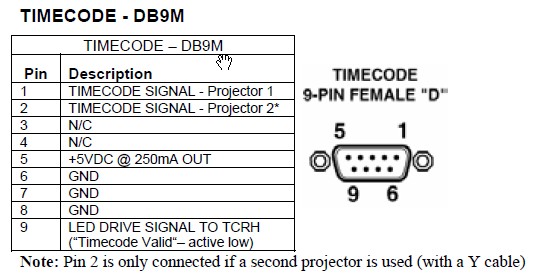
David, the odds of a reader dying suddenly are extremely slim. I would recommend you consider making a special "Y" cable so one reader can feed both dts players. If something is going to fail during a show, it will be the dts player itself. The cable itself only needs to be a foot long and connects at the dual player end of a single timecode cable.
Note for forum archive purposes, this pinout below is for platter installs only, not changeover.
Y JOIN DB9F (attached to end of existing timecode cable which runs to reader)
Pin 1 to 1
Pin 5 to 5
Pin 6 to 6
Pin 7 to 7
Pin 8 to 8
Pin 9 to 9
DB9M to player #1
Pin 1 to 1
Pin 5 to 5
Pin 6 to 6
Pin 7 to 7
Pin 8 to 8
Pin 9 to 9
DB9M to player #2
Pin 1 to 1
Pin 6 to 6
Posted by Leo Enticknap (Member # 534) on 03-18-2016, 08:45 PM:
Notch up another one who has just had a query from Warners about our 70mm capability.
Posted by David J Hilsgen (Member # 2614) on 03-21-2016, 12:22 AM:
Thanks for the help Brad ,i'm still going to run a 2nd reader, during interstellar i had a reader drop out 3 different times. but if i don't find a 2nd reader, i'll see how it goes for a couple days with just one. I'm going to make the y cord if the heights don't have one.If any one has a 70 reader for sale let me know.
Posted by Brad Miller (Member # 2) on 03-21-2016, 02:01 PM:
Interstellar had missing timecode at the end of reel 7, so everyone's timecode dropped there. If you had the latest XD10/XD20 firmware though, it could just barely roll through it without dropping audio.
That being said, if you are seeing the timecode drop for any more than a flash, you have payout tension issues on your platter.
Posted by Scott Norwood (Member # 30) on 03-21-2016, 02:09 PM:
For those using two players, how does the "changeover" from player 1 to player 2 happen if player 1 fails mid-show?
And how often do the players fail, anyway? We had Hateful Eight for over a month of daily screenings with one player (XD20) and two readers (changeover house) and had zero sound issues. The player was never rebooted during the run (I was somewhat paranoid about the hard disk failing).
Posted by Jim Cassedy (Member # 4115) on 03-21-2016, 03:41 PM:
In I-don't-remember-how-many-years of running DTS in 8
auditoriums, I NEVER had a reader fail, so I personally think
that, given the odds, a 2nd one is somewhat superfluous.
On the other hand- - I've had a couple of drive and power
supply failures during that same period of time. But never
the actual reader thingy.
Posted by Mark Lensenmayer (Member # 134) on 03-21-2016, 07:08 PM:
in70mm has posted this list of 5/70 engagements for Batman vs Superman:
USA 70MM 5/70
• Grand Lake, Oakland, CA
• Willow Creek in Plymouth, MN
• LOOK Cinemas in Dallas TX
• Seattle Cinerama, WA
• Studio Movie Grill Royal, Dallas, TX
• Arclight, Hollywood, CA
• Arclight, Sherman Oaks, CA
• Arclight, La Jolla, CA
• City Cinemas 1,2,3, NYC
Posted by David J Hilsgen (Member # 2614) on 03-22-2016, 06:58 PM:
Got my 70 B VS S print came in big box on a wood pallet w/ the cans inside ,it had the disc & memory stick for the audio.
Posted by Stephan Shelley (Member # 8587) on 03-23-2016, 04:08 PM:
70 mm print arrived at Grand Lake yesterday on reels in cans. Sound on disk and stick. Reel numbers and title are NOT printed in leaders or tails. Hope that the guys at FotoKem put the right label on the correct reel.
Posted by Fabian Schreyer (Member # 5120) on 03-23-2016, 08:09 PM:
quote: Leo Enticknap
I was able to ingest the H8 audio into a 10 via USB, but the menu navigation needed to get to that option wasn't obvious or intuitive. There was a text file on the USB stick we received with instructions, which worked for me.
As people report again that there also USB sticks around: Do you remember how exactly you were able to ingest audio on an XD10 via USB?
I tried this several times on an XD10 with the latest firmware on it but I had no success. Also it is probably worth to mention that the XD10 only has USB 1.1.
Posted by Stephan Shelley (Member # 8587) on 03-23-2016, 08:21 PM:
Hit enter>playback hit enter, 4th or 5th item down in playback menu is load from USB. Select that with the stick in and away it goes.
Posted by Jim Cassedy (Member # 4115) on 03-23-2016, 08:31 PM:
quote: Fabian Schreyer
Do you remember how exactly you were able to ingest audio on an XD10 via USB?
I managed to fumble around and figure it out for myself. It wasn't
until after I did that that I realized there was a text file of instructions
on the USB stick along with the audio. D'oh!
If I recall, one of the key things was to NOT insert the USB stick until
AFTER the 1st two steps. I don't think it worked if you started the
process with the USB drive already inserted. But I could be wrong.
(and possibly was, according to Stephan's post below)
Just follow the instructions exactly as written below.
(Sorry for the ALL CAPS - - But this is how the text was formatted
on the USB stik file it was copied from)
XD10
SELECT ENTER BUTTON, THEN PLAYBACK, SELECT ENTER BUTTON AGAIN.
USE DOWN ARROW BUTTON TO SELECT "LOAD FROM USB"
INSERT USB AND SELECT ENTER BUTTON
**DOWNLOAD WILL TAKE A FEW MINUTES, PROGRESS SHOULD BE DISPLAYED
WHEN DOWNLOAD IS COMPLETE IT WILL STATE DOWNLOAD IS FINISHED.
SELECT OK/ENTER TO REMOVE DRIVE.
VERIFY CONTENT HAS BEEN LOADED BY GOING TO THE MENU,
SELECT PLAYBACK, ENTER, THEN SCROLL DOWN TO CONTENTS
XD20
SELECT ENTER BUTTON, THEN PLAYBACK, SELECT ENTER BUTTON AGAIN.
USE DOWN ARROW BUTTON TO SELECT "LOAD FROM USB"
INSERT USB AND SELECT ENTER BUTTON
**DOWNLOAD WILL TAKE A FEW MINUTES, PROGRESS SHOULD BE DISPLAYED
WHEN DOWNLOAD IS COMPLETE IT WILL STATE DOWNLOAD IS FINISHED.
SELECT OK/ENTER TO REMOVE DRIVE
VERIFY CONTENT HAS BEEN LOADED BY GOING TO THE MENU,
SELECT PLAYBACK, ENTER, THEN SCROLL DOWN TO CONTENTS
<They look identical to me, but this was what they sent<
Disclaimer:
The DTS unit I was using was supplied by BLS and I didn't take note of the
software version it was running on. So the above instructions may, or may
not, work with your player. But I don't think you'll hurt anything by trying. . . . ]
Posted by Stephan Shelley (Member # 8587) on 03-23-2016, 08:44 PM:
Worked fine for me with the stick in with the XD10. Did not know myself till reading the instructions after the fact.
Posted by Manny Knowles (Member # 1171) on 03-24-2016, 04:02 PM:
quote: Steve Kraus
Could they make a generic set of TC negatives, each longer than the longest possible 70mm reel, which the lab could then use if someone wanted to make just a few 70mm prints? Naturally, without unique title information the matching disks / data could play with any 70mm print that used these negatives but hopefully anyone running 70mm nowadays would have the sense to play the correct track.
This is how DTS on 16mm is handled. There's only one negative. One serial number for all of them.
I learned this first-hand during setup for a screening of some student shorts at the DGA. A few of the titles were on 16mm with DTS sound. We loaded them into the XD-10 and then listened, astonished, that they all played the soundtrack of the last one we had loaded. I guess each one over-wrote the previous one loaded.
Rest assured, this was discovered during testing, not during the actual show. I'm pretty thorough about pre-flight testing.
For the actual show, IIRC, we ended up deleting whatever we had loaded on the hard drive, and ran each short directly from its CD-ROM, to ensure that we were in control over which soundtrack got played back.
It worked out fine. But, I must say, it was a little alarming to discover this "gotcha" on the day of a show.
Posted by Monte L Fullmer (Member # 2797) on 03-24-2016, 08:01 PM:
Feel bad for those folks waiting to see an excellent 70mm presentation to where it looks like it was shot in 16mm...so damned grainy in a lot of scenes, plus the procedure of abandoning the usage of camera dollys isn't allowed anymore - so much handheld camera work where the steady picture isn't allowed.
-Monte
Posted by David J Hilsgen (Member # 2614) on 03-25-2016, 03:47 AM:
I've got a head scratcher going on, which i thought i had solved my set up is a DTS 6D & XD10 w/ 2 readers & a board that will switch between the 2 players. when it got to R 8 on my 1st show my 15year old reader dropped out & the 6D stopped & it switched over to the XD10 & the new reader that we just bought. it got me thru the show. checked it between shows, started the next show ,that reader still didn't come on ,so i grabbed another 6D hooked it up, just the time code cable & the reader came back on & the player kicked on, ok i thought problem solved,when it got to R-8 cut out again. after the show i ran a test trailer that worked fine, maybe something with the time code, were the new reader can tolerated it, looked at it couldn't see any thing different between R-7 & R-8 code. anybody else running 6D player?
Posted by Bobby Henderson (Member # 840) on 03-25-2016, 10:11 AM:
quote: Steve Kraus
Could they make a generic set of TC negatives, each longer than the longest possible 70mm reel, which the lab could then use if someone wanted to make just a few 70mm prints?
quote: Manny Knowles
This is how DTS on 16mm is handled. There's only one negative. One serial number for all of them.
When DTS was first launched in 1993 the 35mm time code was generic, just reel and frame numbers. They had to change the 35mm time code data to include film ID. Some theaters were trying to play Heart and Souls but forgot about Jurassic Park discs still in the DTS players. I don't know if DTS had the issue fixed by the time Hard Target, the 3rd DTS movie, was released.
quote: Monte L Fullmer
Feel bad for those folks waiting to see an excellent 70mm presentation to where it looks like it was shot in 16mm...so damned grainy in a lot of scenes, plus the procedure of abandoning the usage of camera dollys isn't allowed anymore - so much handheld camera work where the steady picture isn't allowed.
I'll repeat a theory of mine regarding ShakeyCam™: I think the hand held stuff is done to cover up flaws in production design and CGI quality. If you have a nice, smooth dolly shot that's held on screen for more than 18 frames the viewer will have some time to notice the level of detail in the scene. The sets, wardrobe, lighting and any composited CGI effects will all have to be well done. If the imagery is a bunch of rapid cuts from one shaky whirrly blurry shot to the next the viewer won't be able to focus on much of anything. This kind of production style can hide a lot of crappy short cuts used to save time or money. ShakeyCam™ can let a "filmmaker" quickly bullshit his way through a scene.
The reviews of Batman v Superman: Dawn of Justice are not good, but some are funny. Eric Snider said the movie is "like putting your head in a beehive for two and half hours." The movie has a 30% score at Rotten Tomatoes.
Posted by Terry Monohan (Member # 8285) on 03-25-2016, 04:44 PM:
Will anyone in the USA be showing a 70mm film print in 3-D???Have 2 70mm film projector platters going at the same time R/L?
Posted by Mike Blakesley (Member # 26) on 03-25-2016, 06:28 PM:
quote: Bobby Henderson
I'll repeat a theory of mine regarding ShakeyCam™: I think the hand held stuff is done to cover up flaws in production design and CGI quality.
I'll bet that starts with the 'style' of the director. Combining that with the set designers and bean counters -- they may reduce the level of detail BECAUSE they know he's a ShakeyCam™ director. Why spend money on expensive details when nobody will ever be able to see them?
Posted by David J Hilsgen (Member # 2614) on 03-26-2016, 01:41 PM:
I figured out my problem, my 6d player didn't have enough voltage to drive the led on my reader.
Posted by Stephan Shelley (Member # 8587) on 03-26-2016, 03:00 PM:
David,
Depending what generation timecode reader the LED voltage is adjustable on the timecode reader. Starting on PDF page 261 of this manual in the warehouse is the instructions for setting it:
http://www.film-tech.com/warehouse/manuals/DTS_XD10_v2.1.pdf
It is the same for using a 6D.
Posted by Brad Miller (Member # 2) on 03-26-2016, 04:06 PM:
This is also why when dts players will not be used for a length of time (say for example, from the end of the Interstellar booking to the beginning of Batman vs Superman booking) the players should be powered OFF. Otherwise the LEDs will burn up an entire year's worth of life just sitting there.
Same for Christie platters.
Posted by Stephan Shelley (Member # 8587) on 03-26-2016, 05:06 PM:
For the same reasons optical sound readers and Dolby digital readers should be turned off as well. Turning off the video powered LED Dolby digital readers such as the BACP and Dolby cat 702 readers can be a bit tricky. If using an external DA20 turn it off. But if plugged into a CP500 or CP650 and they are used all the time for other sound uses you either have to install a switch to turn off the a LED or unplug the video cable(s) ONLY with the processor turned OFF! Do not hot plug the video cables. You will damage the processor's SRD unit.
Posted by Steve Guttag (Member # 268) on 03-26-2016, 06:24 PM:
It is possible to put a switch on the LED in a BACP reader. It has been a while but as I recall, there is a Molex KK type plug on the board that has the LED power on it...merely break the circuit there. I seem to recall mounting a switch through one of the holes on the top of the reader so one had an on/off switch.
Posted by David J Hilsgen (Member # 2614) on 03-26-2016, 08:59 PM:
I knew about the led adjustment, but the player wasn't kicking enough over, as soon as i connected the other player led got brighter,I'm sure they were off at the heights, were i borrowed the one from ,he run digital most of the time,but it was made in 2000 15yrs old. we went out & bought one off of ebay that came from the manufacturer for datastat, then we also just bought one from MTE on ebay they take 35mm ones & put the spacers in to make them into 70mm, hopefully they work well.now we will have our to readers. I just like having 2 reader it saved the show for me, a few times. Is that supply for the reader, led on that time code card in a 6d,thanks for your help.
Posted by Tyler Purcell (Member # 9213) on 03-27-2016, 01:38 AM:
Little report on my viewing of Batman v Superman tonight. I must say, the guys at Arclight Hollywood know their stuff. I have NEVER seen bad projection there and tonight was no different. Absolutely 100% stunning 5/70 projection. The print was flawless, not a single scratch and the rare speck of dirt. Focus was perfect, no registration problems and even the splices had no dirt leading up to or after. I mean, this is how movies SHOULD be presented and it really shows you how bad other projectionists are in how they treat prints. This is not rocket science, but it can go wrong very fast if you're not careful.
In terms of the movie? Well, it wasn't really worth watching. Ya know, it's one of those silly films that doesn't mean anything. I went for the sheer pleasure of not seeing something projected in digital mess. Maybe worth while for "film" fan's, otherwise it's absolutely a skip.
Posted by Rachael Barbash (Member # 5158) on 04-02-2016, 11:00 AM:
Wondering if anyone here played this. We just got our print in from Seattle - an 11am delivery for an 8pm show - and it's combination locked. Being Saturday, no one will get back to us. Does anyone here have the combo? I'm just kinda hoping here that each print didn't have an individual combination but I'm in a panic so I thought I'd ask anyway.
Posted by Brad Miller (Member # 2) on 04-02-2016, 11:12 AM:
Seattle Cinerama only played it for one week? I thought it was a 2 week minimum. And you didn't start playing it last night?
Posted by Rachael Barbash (Member # 5158) on 04-02-2016, 11:24 AM:
Their last show was Thursday night then they shipped it our way. Actually our studio rep just contacted us with the code and it opens up every canister BUT THE FIRST. Now he's cussing over the phone because he thinks the lock got damaged in transit.
Our first show is tonight at 8, probably because of the shipping time.
UGH.
*edit* "Try hammering it open" they said about the first canister. That worked. I'm annoyed but it's open. Sigh.
Posted by Stephan Shelley (Member # 8587) on 04-02-2016, 12:45 PM:
Seattle is playing it one week 70mm and 1 week laser digital Atmos sound. 2 weeks total just not 2 weeks 70mm.
Had one can of Interstellar that the lock would not open. Got some bolt cutters to open it with the studios permission.
Posted by David J Hilsgen (Member # 2614) on 04-02-2016, 01:27 PM:
They told me 4 week minimum cuz i was going to open my drive in with it & I passed, instead i waited 2 weeks now i'm opening on april 8 along w/ star wars & only have to run it a week. plus i'm just a weekend operation. i would think the 70mm would carry at least 4 weeks
Posted by Terry Monohan (Member # 8285) on 04-03-2016, 12:59 PM:
Just watched the 70mm film at Oakland CA's Fox Grand Lake Theatre last night. Stephan the projection man has done a great job as the print is still in great shape, no lines or scratches. The stereo split surround sound at the Grand Lake is very good on the Batman 70mm film. The Wurlitzer organ was played by Robert before the pre show. So nice that they start with DCP previews with the masking closed then open to the full large 70mm screen for the main movie. This is the only 70mm Batman/Super playing in the SF area but I hear the Imax in San Jose has It also in 70mm. This was a big week for 70mm in the SF area as the Castro showed the 70mm roadshow version of Hateful 8 with intermission ect on Fri/Sat and today Sunday 4/3 The SF Castro is playing a combo 70mm bill of The Master along with Inherent Vice on 70mm film. It's so nice to see these 70mm film prints in a large cinema with a giant screen and good sound to match in the San Francisco area.
Posted by Brad Miller (Member # 2) on 04-04-2016, 12:06 AM:
Times sure have changed. Used to bragging rights were for prints running more than half a year. Then towards the digital takeover point 3 months became the bragging point.
Nowadays people seem all excited with comments such as "we are 3 days into the run and not a scratch yet!"
If someone can't run a print for a measly 2 weeks without putting a scratch or collecting dirt, then they really, really, really suck at their job.
Posted by Tyler Purcell (Member # 9213) on 04-04-2016, 01:31 AM:
I agree Brad, especially a 70mm print. I remember seeing films several months old on 35mm and there being barley a scratch or piece of dirt. I don't understand why projectionists treat film so badly today.
Posted by Eric Carter (Member # 1392) on 04-07-2016, 05:33 PM:
Regarding the Seattle Cinerama run of BvS, it's actually three weeks total (1 week 70mm, 2 weeks 6p laser/Atmos). Then 1 week of THE HATEFUL EIGHT in 70mm, followed by two weeks of THE HUNTSMAN: WINTER'S WAR, followed by CAPTAIN AMERICA.
Posted by Buck Wilson (Member # 5885) on 04-07-2016, 07:51 PM:
quote: Tyler Purcell
I agree Brad, especially a 70mm print. I remember seeing films several months old on 35mm and there being barley a scratch or piece of dirt. I don't understand why projectionists treat film so badly today.
I doubt anyone is doing it on purpose. Now that film isn't being run daily, chances for damage go up as the better projectionists leave or get way out of practice, and the equipment becomes less familiar, and more dusty.
Not that any of this is a valid excuse, but I think it's worth noting it's likely all accidental and just the way it will be unless something big changes.
Posted by Bill Brandenstein (Member # 7758) on 04-09-2016, 10:48 PM:
Arclight Hollywood and Sherman Oaks pulled BvS in 70mm after two weeks.
Posted by Brad Miller (Member # 2) on 04-10-2016, 12:23 AM:
We are still playing them at both Dallas locations.
Posted by Stephan Shelley (Member # 8587) on 04-10-2016, 12:35 AM:
Grand Lake is through Wed. 4/13.
Posted by David J Hilsgen (Member # 2614) on 04-10-2016, 06:03 PM:
We are also still playing it, at willow creek plymouth, mn .looks like we are holding for another week
Posted by David J Hilsgen (Member # 2614) on 04-13-2016, 03:34 AM:
Who else is still playing it, starting friday .i checked everybody sites didn't see it.
Posted by Brad Miller (Member # 2) on 04-13-2016, 10:42 AM:
LOOK cinemas and Studio Movie Grill are dropping it on Thursday in Dallas.
Posted by John Wilson (Member # 269) on 04-15-2016, 01:13 AM:
Is it playing anywhere where there is also a DCP? What sort of difference to the take is it making? Does it do better / worse / no difference?
Posted by David J Hilsgen (Member # 2614) on 04-17-2016, 05:03 PM:
Up to last week, we were playing both & the 70 always out grossed the dcp
Posted by David J Hilsgen (Member # 2614) on 04-18-2016, 02:48 PM:
We are holding for another week ,so now till 4/28 maybe more.
Posted by David J Hilsgen (Member # 2614) on 04-25-2016, 04:29 PM:
We are dropping B v S on 4/28. it was a 5 week run for us, about 118 passes thru the projector & it still looks great.it was half of what interstellar did, that ran for 10 weeks, 226 passes thru the projector.
Powered by Infopop Corporation
UBB.classicTM
6.3.1.2