This is topic Connect Dolby DA20 to Datasat AP20 w. H338 in forum Film Handlers' Forum at Film-Tech Forum ARCHIVE.
To visit this topic, use this URL:
https://ft-forum.com/ft/cgi-bin/ubb/ultimatebb.cgi?ubb=get_topic;f=1;t=011956
Posted by Sascha F. Roll (Member # 9043) on 03-09-2016, 08:50 PM:
Due to some upcoming 35mm screenings of 1990s / 2000s movies with Digital Soundtracks I am "re-installing" DTS/SRD playback capability to one of the sites I'm looking after.
The setup is:
2x FP30D 35mm with Reverse Scan and 1x Sony SRX-R510, all feed into an AP20 unit, Optical Sound via optional H338 Card in the AP20.
Now, has anyone of you already connected a Dolby DA20 / DTS6D in a similiar setup?
Audio-wise it's easy going, feeding the analogue output into the AP20 8 Channel Input. (Okay, the DA20 has unbalanced outputs, the AP20 input expects balanced audio, but that shouldn't be so much a problem)
What really bothers me is how to connect all the Automation stuff, Format Fallback ect.
My idea was to ask here before starting from scratch.
Greetings from Berlin,
Sascha
(PS: Yes, it would be a lot easier to take one of the CP-65 / CP-500 / DTS6AD out of storage and use those for all the 35mm formats and feed them into the AP20. But as the SRD/DTD installation should be "plug and play" and easily be removed and transported to another location I want to keep the existing system as it is...)
Posted by Marco Giustini (Member # 4544) on 03-10-2016, 11:31 AM:
Never done myself but you should just need to patch the digital and analogue pulse of the DA20 to the AP20. However, the DA20 also receives a feedback from the sound processor so it knows which format is currently selected - hence it does not try to go to SRD if SR is manually selected I reckon.
I don't feel that that would be really necessary but if you really wanted you should be able to use the great automation ability of the AP20 to simulate that - that is, close a contact when a specific format is selected.
My only concern may be the time needed to switch between formats, no idea how noticeable the SRD/SR switch is going to be.
Posted by Sascha F. Roll (Member # 9043) on 03-11-2016, 06:43 PM:
Well, that was easier than expected.
- On the "DA20 Sense Control" use Pins 3 (SR), 5 (SRD) and 12 (GND)
(And Pin 25 for C/O Status in my case, as this is a C/O setup)
- Connect Pins 3, 5 and GND to the GPIO Connector on the AP20
(In my case Pin5 was connected to "GPIO2" and Pin3 to "GPIO3")
- Create the following Events:
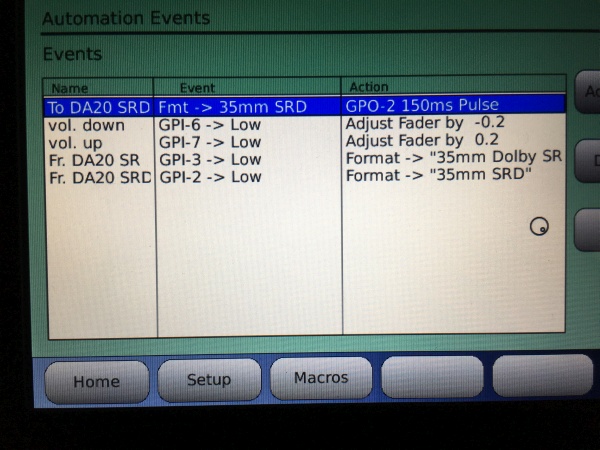
- Change "Cinema Processor Type" to "CP45/65/500 Auto Digital" (#2 on the Rotary Switch) or (my preferred setting) "CP45/65/500 Auto Digital Disabled" (#6)
- Voila, that's it. Fallback SRD->SR works flawlessly, DA20 is in "Digital Mode" only if one changes the Format on the AP20 to the SRD-Preset (Analog 8 CH Input), so one has the full control wheter to play the optical or the digital soundtrack.
SRD Sound Quality is great - just no comparison to the shitty Sound of the CP-500 which was installed before.
Posted by System Notices (Member # 2357) on 08-07-2019, 08:23 AM:
It has been 1243 days since the last post.
Posted by Geoff Newitt (Member # 6663) on 08-07-2019, 08:23 AM:
Apologies for reviving an old thread, however I have recently added a DA20 to an AP25/H338 setup, broadly as described here, and I have a problem: - while switching from SR to SRD is instantaneous, there is an appreciable sound drop-out (maybe 200ms) should the sound fall back to SR.
I have been in conversation with Datasat - who have been very helpful - but thought I might check in here while awaiting further advice.
Their most recent suggestion was to look at Global Audio Delays for each format - but they were already set to 0ms across the board. Apart from tinkering slightly aimlessly, I don't quite know what else to try!
Suggestions gratefully received.
Posted by Marcel Birgelen (Member # 6801) on 08-07-2019, 09:23 AM:
I'm afraid this kind of delay is expected in such a setup. I know that a Dolby setup may fail-over a bit more gracefully, but I guess that's just about the time the DA25 needs to switch between inputs.
Do you have so many dropouts that this becomes a real problem?
A fail-over between Analog Digital and a recovery is always noticeable for the trained ear. You lose a lot of dynamic range and potentially a lot of surround if you fail-over from digital to analog sound.
Posted by Paul Finn (Member # 10726) on 08-07-2019, 12:07 PM:
Dolby (CP65) and DTS (DTS-6AD) cinema processors are simultaneously reading the film analog sound tracks when outputting the digital source audio such as from a DA20 or DTS-6D. This is also true for the CP650. The electronic switch from digital to analog sound can be almost instantaneous and not detectable during the buffered audio run out time after the digital processor detects loss of digital-DD or time code-DTS. As Marcel points out, a trained listener can realize the audio source difference.
I'm not familiar with the AP25, but wonder if it is also, or not, reading the film analog sound tracks when probably in an "external analog input" source operating format? Are the analog sound heads in the projectors fully operational and being read by the AP25 for instantaneous electronic switching for fail over operation?
Paul Finn
Posted by Steve Guttag (Member # 268) on 08-07-2019, 12:13 PM:
I'm not familiar with the particulars of the AP20/AP25 but a problem one will have with the switch over is if one is using a standard contact closure input is that the engineer that designed it had to put some form of "debounce" circuit into it so that it will track well with things like switches and relays. This will put a delay into it.
For the CP65, Dolby put came up with the CAT410 that essentially lowered the time constant on the CAT443 card for the switch to SR since it was being control by a logic device and not a mechanical component with "bounce." And that is what would need to be done on the AP20. However, I suspect it won't be quite that easy.
200msec seems quite reasonable for a debounce. Now, if they are debouncing in software, they could alter it there.
Posted by Geoff Newitt (Member # 6663) on 08-08-2019, 05:29 AM:
Thanks for the replies.
I wonder if Steve is onto something with his comment about debouncing in software - if you don't associate SR with the SRD input correctly, switching up to SRD is noticeably slower; it almost feels as though the unit 'knows' it has to switch quickly to SRD, but hasn't made the same association with the switch from SRD to SR - which could be related to the debounce. But this made me wonder if I'd missed something obvious in the set-up. If so, it's going to take a fresh pair of eyes to see it!
Posted by Carsten Kurz (Member # 5396) on 08-08-2019, 07:07 AM:
While I am a huge fan of the AP20/AP25, I don't think it is possible to achieve a seamless switchover/fallback internally. Simply because, it involves a full preset change on the AP20/25, loading and applying routing, filter coefficients, etc. You may have another look at the crossfade settings for both formats involved, and especially at the 'Digital Soundtrack input' setting under 'Film Setup' if you haven't already, but, I am afraid, 200ms may probably be the best you can get. The only option you have is to use an analog CP like a CP65 inbetween, so the AP20/25 can stay in analog ext format for both SR and SRD, and let the CP65 handle the fallback (all CP65 EQs flat). That's the way we do it. Yes, the H338 is useless then.
- Carsten
Posted by Paul Finn (Member # 10726) on 08-09-2019, 09:07 AM:
In the case for having a seamless changeover in either direction between the digital and analog sound sources, that is worth noting here and has not been mentioned, is the need to have the audio channels synchronized to the exact same dialog/music point in the film. The DTS-6AD has an excellent set-up step for this which outputs both sources simultaneously. That allows for adjustment of the processor time code input data until the audio in both channels is in perfect synchronization.
Paul Finn