This is topic Projecting 3-D in 1953 in forum Film Handlers' Forum at Film-Tech Forum ARCHIVE.
To visit this topic, use this URL:
https://ft-forum.com/ft/cgi-bin/ubb/ultimatebb.cgi?ubb=get_topic;f=1;t=011967
Posted by Robert Furmanek (Member # 7026) on 03-30-2016, 03:46 PM:
The next time you watch a vintage 3-D film on Blu-ray and simply insert the disc and hit play, think about how 3-D films were projected in theaters sixty-three years ago.
As Jack Theakston wrote in his excellent article, WHAT KILLED 3-D?: "Projecting dual-strip 3-D is a science. I draw the line between an "art" and a "science" because for all practical purposes, a science is based on rigid fact and standard, whereas "art" utilizes talent and imagination. In order for a dual-strip 35mm presentation to work correctly, standards must be applied and adhered to at every performance."
http://www.3dfilmarchive.com/what-killed-3D
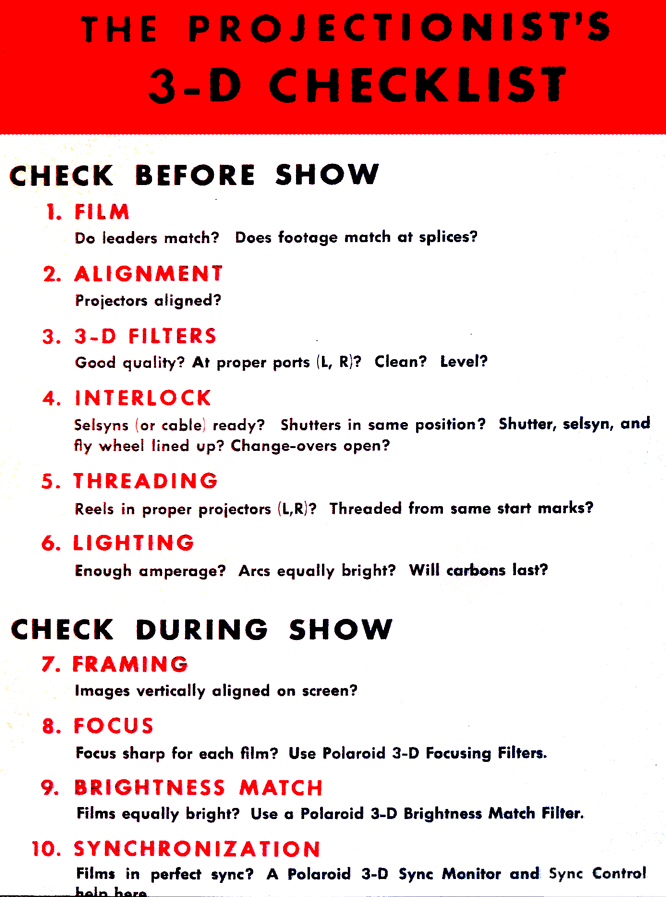
Posted by Leo Enticknap (Member # 534) on 03-30-2016, 04:23 PM:
This sort of checklist would have been familiar to a projectionist in 1953 who was coming to the end of his (or just possibly, her) career and had been around for the transition to sound. Here is one from the 1920s:
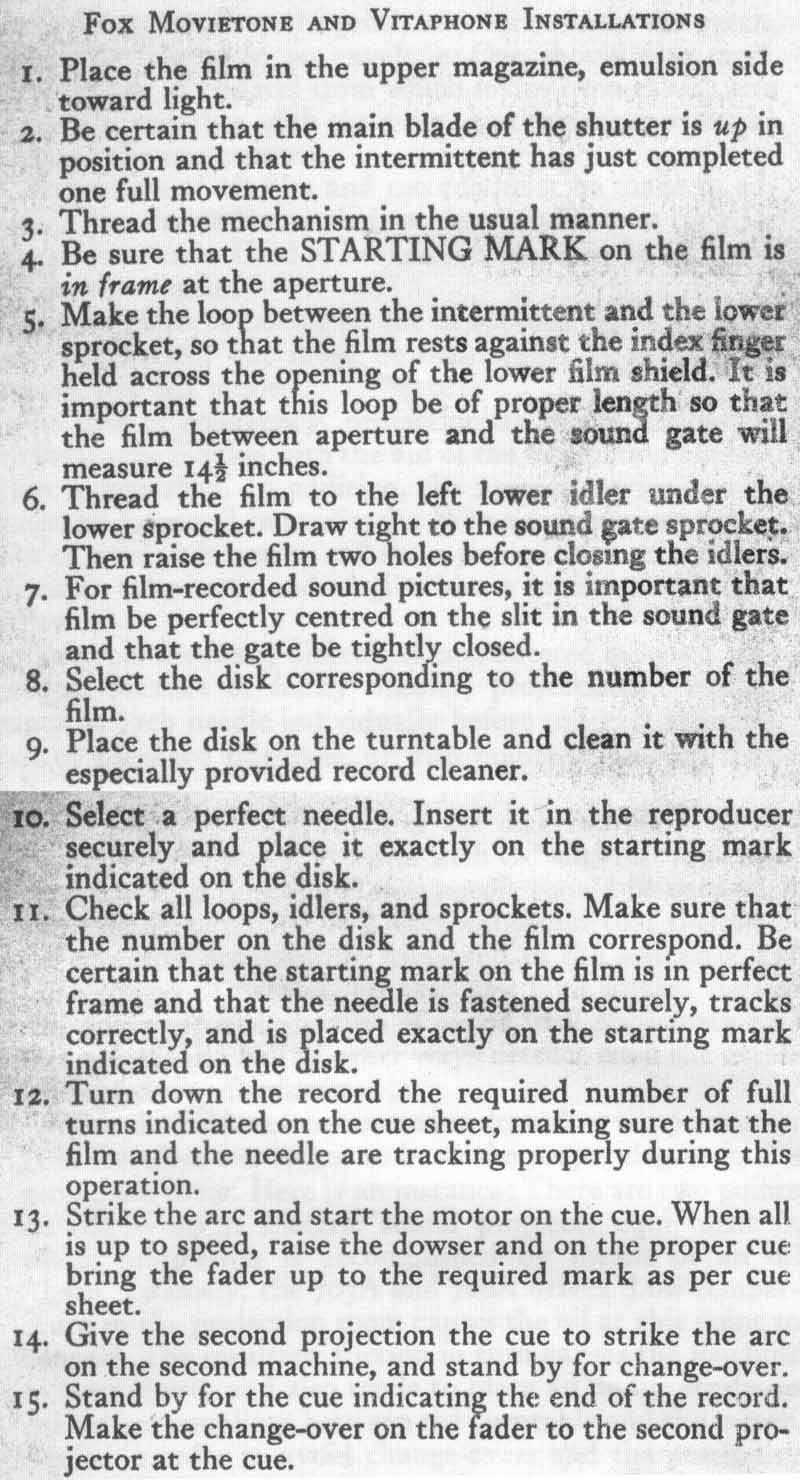
Interesting that this assumes that there is no automated changeover shutter - the changeover has to be accomplished by manual douser operation by a projectionist at each machine. What with the audio as well, it's not hard to understand why a booth in those days required 3-4 projectionists to put on a show.
Posted by Robert Furmanek (Member # 7026) on 03-30-2016, 04:39 PM:
That's a terrific document Leo, thanks for sharing!
Posted by Claude S. Ayakawa (Member # 1401) on 03-30-2016, 05:16 PM:
I must have been fortunate because all the 3D shows I saw in the fifties were flawless and I saw a lot at the Liberty Theatre in Honolulu and the Pearl City Theatre near where I lived. They were all perfectly projected because I did not get eye strain or headaches or any other kinds of discomfort many people had complained about after viewing 3D films in the fifties.
-Claude
Posted by Justin Hamaker (Member # 2165) on 03-30-2016, 11:27 PM:
Reading that it sounds like there were separate prints for L and R. Is that correct? It doesn't seem like it would be because you would have to have an intermission between every reel.
Posted by Stephan Shelley (Member # 8587) on 03-30-2016, 11:35 PM:
It was one reel left eye one reel right. This is where 6'000 reels were introduced. Prints were shipped on 6'000 reels in canisters much like 70mm canisters. Two 6'000 reels in each canister. Normally just one intermission. I ran some of this stuff in the 80s. Kiss Me Kate, Dial M for Murder several time, It Came from Outer Space, the two 3 Stooges shorts in 3D. This is with carbon arc lamps. The first reel of Dial M took a full positive trim. You need the full travel if not you lost your light before the end of the reel.
Posted by Robert Furmanek (Member # 7026) on 03-31-2016, 08:40 AM:
The prints were shipped on four 23 or 24-inch reels. Parts one and two left and right side.
Every feature had a built-in intermission point around the 50 minute mark. Part two of the movie was usually 30 to 40 minutes and any shorts, cartoons or trailers were added after the feature.
There's a picture of an original left side shipper and single reel near the bottom of this page: http://www.3dfilmarchive.com/gog
Each side with two reels and shipper was 75 pounds so you had 150 pounds for shipping each 3-D feature. Imagine lugging those up to the booth of the old palaces!
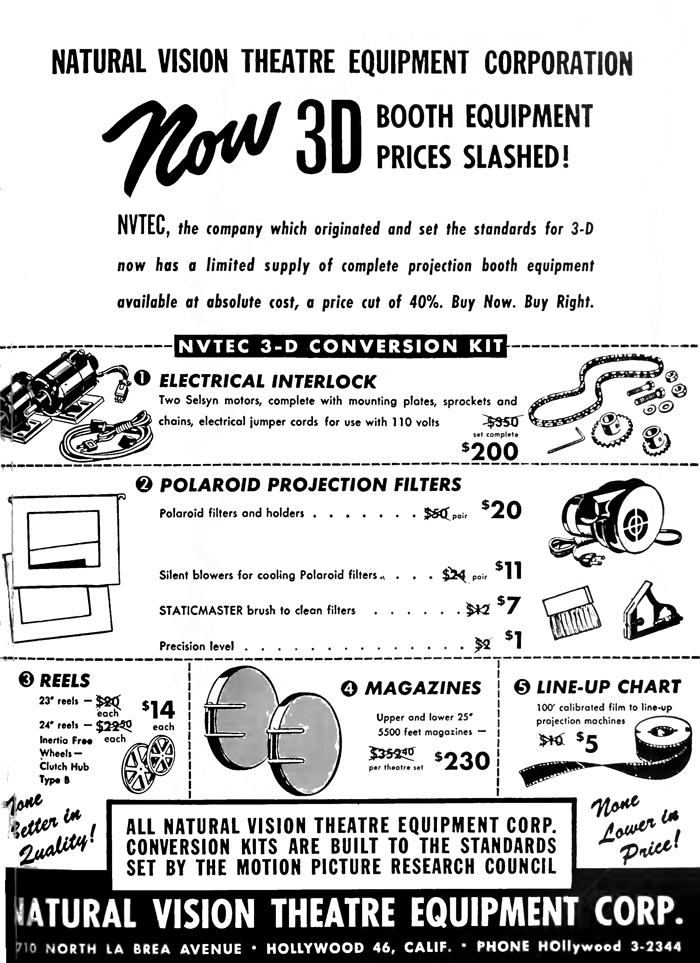
Posted by Steve Kraus (Member # 476) on 03-31-2016, 10:01 AM:
Inflation adjusted from 1952:
$200 --> $1858
$230 --> $2137
$14 --> $130
$5 --> $46
Posted by Frank Bolkovac (Member # 6201) on 03-31-2016, 10:26 AM:
In some of the bigger theaters in major cities, to bypass intermission, they had four projectors and made change-over from two machines too two machines.
Posted by Jim Cassedy (Member # 4115) on 03-31-2016, 12:38 PM:
Like Stephan, I projected a bunch of dual-projector 3D stuff for a couple
of 3D festivals or revivals in the late 70's & early 80's.
For at least one of them, I was even running double-system sound, so
I had to deal with 2projectors and a sound-track follower.
- - and carbon arcs! It took some skill, but it wasn't impossible, to get
both lamps burning at the same intensity & color temperature. But if
you knew what your were doing you got through it OK.
quote:
shipper was 75 pounds so you had 150 pounds for shipping each
3-D feature. Imagine lugging those up to the booth of the old palaces!
Back in
the 50's and even into the 70's when I was doing the shows I
mentioned above, it was a 'union job' so I didn't have to worry about
getting films up to the booth since the contract forbade the operator
from actually carrying film cans. ( ! )
(Although that doesn't invalidate your point- - they WERE heavy- -
no matter who got stuck lugging them upstairs)
I had a DejaVu moment on this last fall when the theater I was at
had to hire professional movers to get the 70mm Hateful 8 print up
3 floors the booth. I certainly couldn't do it, and either company policy
or child labor laws or somesuch nonsense kept the regular floor-staff
theater critters from doing it.
Posted by Robert Furmanek (Member # 7026) on 03-31-2016, 12:53 PM:
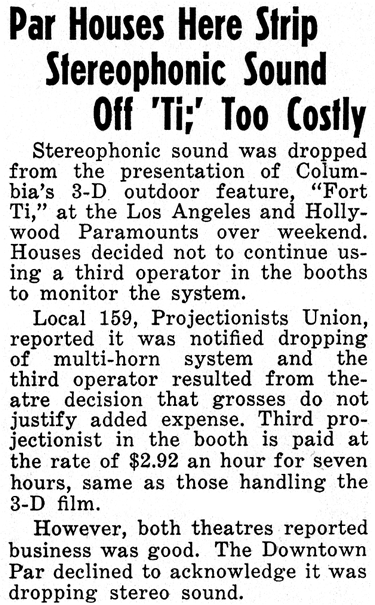
The Unions demanded two operators in the booth for 3-D in 1953 and if they were running interlock mag for stereo, a third operator. That caused many problems and at least one circuit in LA dropped the stereophonic sound rather than pay for a third man.
Posted by Rick Raskin (Member # 1561) on 03-31-2016, 04:37 PM:
Amazing. When I was in the Union one guy could operate twin theaters as long as they had 6000 ft. reels. Carbon arcs were prevalent back then although some houses had xenon. Some booths still had the 3D interlock. The only times I worked with another operator was for nitrate, 70mm or a triple.
Posted by Ted Uzzle (Member # 9135) on 04-14-2016, 01:21 AM:
When I went off to college in 1967, I brought a Stereo Realist camera with me, and 3D still photography was my hobby for years. Working my way through college as a projectionist, and for some years after, I never projected a 3D movie. Never seen one, either! --Although there are some shots in "Dial M for Murder" that scream: 3D effect (crane shots over Ray Milland's head, looking down). Anaglyph DVDs, such as "Final Destination 4," coming with the colored glasses, don't work for my tired old eyes. Gotta get my butt in gear, out to IMAX on Navy Pier.
Posted by Jack Ondracek (Member # 1466) on 04-14-2016, 09:29 AM:
quote: Rick Raskin
Amazing. When I was in the Union one guy could operate twin theaters as long as they had 6000 ft. reels.
I just dealt with the leading edge of the 2-D side of this. For awhile in the mid-70s, I worked at a twin for the Seattle local... two booths, over-the-roof walkway between them, 6,000 ft reels, automated Eprad Co-Operator changeovers. We never had much trouble with the setup, though we didn't always know what was going in the other booth. I rigged a couple of doorbells to the Co-Operators to fix that. two "dings" to indicate the other booth was going into changeover, and continuous "ding-dong" to indicate an alarm.
(Drastically testing the limits of my memory here...) When the Seattle Cinerama opened in '62, I think I remember being impressed that a 3-strip show required a master control operator, one operator for each of the 3 projectors, another for the sound unit and, for reasons I don't know, a stage hand down front... all union guys from Local 15 and 154.
Posted by Steve Guttag (Member # 268) on 04-14-2016, 07:43 PM:
Ted Uzzle of Altec and Theatre Application Notes (TAN) fame?
Posted by Louis Bornwasser (Member # 3063) on 04-17-2016, 02:54 PM:
Has to be. Time Management also.
Posted by Ted Uzzle (Member # 9135) on 04-18-2016, 11:32 PM:
Steve Guttag, yes, I was at Altec Lansing 1980-1990, edited Sound & Video Contractor magazine 1990-1996, director of instruction for the National Systems Contractor's Association 1996-2001, and on the Audio Arts and Acoustics faculty at Columbia College Chicago 2001 to the present. I teach mostly electronic theory, acoustical theory (I'm a theory guy), history, art of troubleshooting, and project management. I hope you all might be interested in specific threads on those topics.
Fame, you ask: fame, sir? My fame is a magic mystery spell, gives a ride for 2-n-a-quarter on the EL.
Louis Bornwasser: I remember you most vividly from when Altec Lansing promised you something and failed spectacularly to deliver. Ja'nine Masten came into my Altec office with a gas can (empty or not, I don't know) and threatened me with immolation if I didn't help you.
I don't even remember how it came out. Maybe today I boast, I'm still not toast.
Posted by Sam D. Chavez (Member # 1841) on 04-19-2016, 03:34 PM:
Welcome to our world Ted. I remember you vividly as you say. Suspenders and all. Janine too. Do you still have the all A4 speaker layout?
Hoe to see you on the forums more often.
Posted by Ted Uzzle (Member # 9135) on 04-20-2016, 12:26 AM:
Wield that hoe, chippin' weeds, aim it so nobody bleeds.
Sorry my appearance hijacked this thread on 3D. Promise: I'll start new threads others can hijack.
In Boston in the 1970's my stereoscopic photography hobby was so virulent I stuck Stereo Realist viewers into the faces of my friends, urging, "Look at this! Look at THIS!" Finally a friend, actually a business partner, told me he had a glass eye. Well, what do you say to that? You never stick a stereoscopic viewer in his face again. Maybe he doesn't have a glass eye and achieved his purpose. Okay either way.
Posted by Stephen Furley (Member # 1277) on 04-21-2016, 04:41 AM:
quote: Stephan Shelley
It was one reel left eye one reel right. This is where 6'000 reels were introduced.
The vast majority of theatres ran it this way; fortunately, triacetate stock had recently become available. However, there were a few places which ran changeovers on four projectors. Here in the UK I believe the Regal, Edmonton and the State, Grays did so. The Regal is long gone, the state still stands, but is long closed. I don't know why they did this; maybe there just wasn't the height available to fit in the larger spoolboxes. or maybe they couldn't take carbons long enough for that much film.
Powered by Infopop Corporation
UBB.classicTM
6.3.1.2