This is topic Service manual for Kinoton DA soundhead in forum Film Handlers' Forum at Film-Tech Forum ARCHIVE.
To visit this topic, use this URL:
https://ft-forum.com/ft/cgi-bin/ubb/ultimatebb.cgi?ubb=get_topic;f=1;t=011970
Posted by Fabian Schreyer (Member # 5120) on 04-03-2016, 12:47 PM:
Does anyone have a service manual for the Kinoton DA soundhead?
This is the rare pre reverse-scan era combined digital and analogue soundhead that Kinoton was selling for some time.
Also if you can not supply a manual I still would be interested in the fact if one ever existed.
Posted by Steve Guttag (Member # 268) on 04-04-2016, 06:18 AM:
Kinoton does/did have an "RSSD" service manual. Plus it's set up was described in the various projector manuals.
Try contacting Kinoton Digital Solutions. They have control over all of the legacy documentation.
Posted by Fabian Schreyer (Member # 5120) on 04-04-2016, 01:52 PM:
Thanks, I will be trying to contact them. What does the term "RSSD" stand for?
Posted by Steve Guttag (Member # 268) on 04-04-2016, 03:47 PM:
Reverse Scan Sound Device
Posted by Stephan Shelley (Member # 8587) on 04-06-2016, 06:03 PM:
For which projector. I have the manual such as it is for the one used to upgrade the AA/DP70.
Posted by Fabian Schreyer (Member # 5120) on 04-06-2016, 06:23 PM:
I would gladly take the manual for any projector.
But as I have mentioned in the beginning: I am not looking for a manual for the common reverse-scan soundhead. I am looking for a manual for the early combined analog and digital soundhead that Kinoton sold in a low quantity here in Germany. I have no idea if this device ever made it to the US.
I will take a photo of it tomorrow.
Regarding Kinoton: I tried contacting them a few days ago on a diffrent matter, but no answer so far. I think since the conversion to Kinoton Digital Solutions they focus on other things than vintage manuals.
Posted by Steve Guttag (Member # 268) on 04-07-2016, 05:49 AM:
If you are granted permission via "my.kinoton" you will have access to downloading the film manuals. They are available in German as well as other languages.
Note, I'm not aware of an "early version" of the RSSD. There are a few versions but for combination of Dolby Digital and analog with LEDs...there is the standard RSSD that is used on all FP20-FP50. There is a very special "changeover version" that came out VERY late (2010 maybe) that has a mass-reduced drum, different LED bracket and allows the pinch roller to contact on both inboard and outboard sides, special versions for the DP70 and the DP75 but those are effectively upside down RSSDs with mounting brackets to suit the particular projector. There is also the studio variant of RSSD that is identical to the standard one but has a damped tension roller above the drum (studios typically reverse so there needed to be a means to dampen the action of the reverse sprocket before the soundhead and the feed sprocket below the soundhead) and it had a magnetically coupled flywheel so during reverse operation, the flywheel disengaged. Also, if the speed of the drum and flywheel didn't match, it would disengage. Thus, when the projector was coming up to speed, the flywheel would disengage while a flywheel accelerator motor would spin the flywheel up to speed...when the two matched, it would engage. It was actually pretty awesome.
There have been other options to it for archival houses like the ability to adjust the lateral position of the guide roller to allow for shrinkage...it had a vernier to allow one to precisely restore to to dead center.
Not all of these variants are detailed in the manuals but most are.
Posted by Sam D. Chavez (Member # 1841) on 04-07-2016, 09:38 AM:
quote: Steve Guttag
Thus, when the projector was coming up to speed, the flywheel would disengage while a flywheel accelerator motor would spin the flywheel up to speed...when the two matched, it would engage. It was actually pretty awesome.
I never knock Kinoton products but the idea to accurate the sound drum was used on Telecines; RCA TP66 comes to mind. They had to be up to speed almost immediately as they were on the air and switching between sources during the news mostly.
Posted by Steve Guttag (Member # 268) on 04-08-2016, 01:41 AM:
I didn't mean to imply that Kinoton invented the concept of a flywheel accelerator...just that the studio soundhead had it. It is a variant depicted in the soundhead service manual.
Posted by Fabian Schreyer (Member # 5120) on 04-16-2016, 07:05 PM:
It took me some time, but finally I managed to get the device out of storage and take some photos.
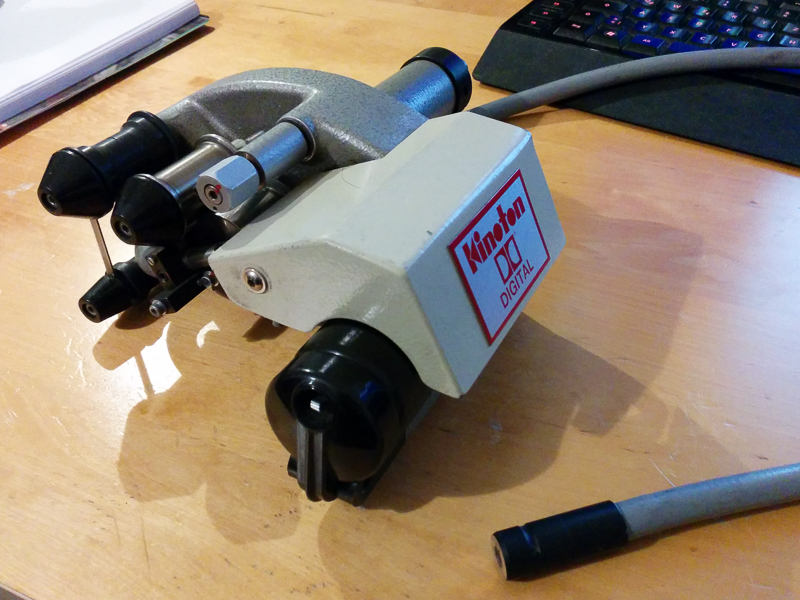
This is (probably) the first combined soundhead Kinoton ever built. Also on this picture you see the grey flexible light conducting rod which connects to the lamp on the board that comes with this device.
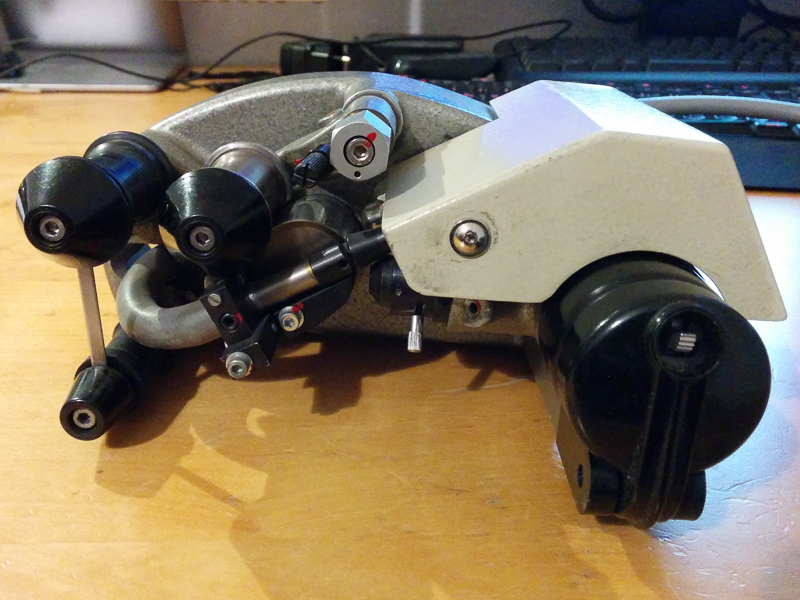
Another view from the front. Here you can see that the analogue optics differ from those typically supplied with classic Kinoton/Philips soundheads.
Posted by Steve Guttag (Member # 268) on 04-16-2016, 09:08 PM:
Wow...yes, I haven't seen one of those. But it makes sense, we had such things from Component Engineering back in the early days of Dolby Digital. I'm almost positive that KDS doesn't have a manual for that one on their download site.
I'm guessing there is an "EPT" or like slide projector style lamp that sits pointing into the light pipe with an UV filter in front of it.
Posted by Sam D. Chavez (Member # 1841) on 04-17-2016, 11:35 AM:
Looks like the original and analog optics and light source are still being used and as Steve says, a light pipe leading to the lens and CCD board beneath the cover.
I wonder how many of this version were made?
Posted by Fabian Schreyer (Member # 5120) on 04-17-2016, 05:19 PM:
quote: Steve Guttag
I'm guessing there is an "EPT" or like slide projector style lamp that sits pointing into the light pipe with an UV filter in front of it.
You are guessing right on that. When I find some time I will take and upload a photo of the board that comes with it.
quote: Sam D. Chavez
Looks like the original and analog optics and light source are still being used and as Steve says, a light pipe leading to the lens and CCD board beneath the cover.
Well, the analogue optics differ a bit from those I know. While most of them have a silver finish, this one is black. It looks like it is a completely diffrent mechanical design. Also note the adjustable silver focus pin.
I also think it's interesting that this device features a massive sounddrum (like the later reverse scan device).
quote: Sam D. Chavez
I wonder how many of this version were made?
This one is missing it's bottom serial number plate, but I have another one of these (which sadly is incomplete) that has a two-digit serial number.
Powered by Infopop Corporation
UBB.classicTM
6.3.1.2