This is topic Sound and acoustics in forum Film Handlers' Forum at Film-Tech Forum ARCHIVE.
To visit this topic, use this URL:
https://ft-forum.com/ft/cgi-bin/ubb/ultimatebb.cgi?ubb=get_topic;f=1;t=011987
Posted by Ted Uzzle (Member # 9135) on 04-29-2016, 02:09 AM:
Might we not benefit from a new forum dedicated to sound, acoustics, and noise control? Whether film, digital, home theater: sound behaves the same.
This is my wheelhouse. I think I can bring in experts to help solve problems of all audio and noise-control acoustics. Anybody want? If not, that's okay too.
Posted by Ken Lackner (Member # 1002) on 04-29-2016, 09:18 AM:
I second this request. For one thing, it would be nice to group all audio topics together in one place. Additionally, sometimes an audio topic could apply to both film and digital. If it's a solar cell issue, it's clearly film. If it's an AES channel mapping issue, it's clearly digital. But if it's a B-chain issue, it's probably format-independent. So do you post it in FHF, or the Digital forum? Why not have a forum dedicated to audio?
Posted by Gordon McLeod (Member # 33) on 04-29-2016, 10:37 AM:
good idea
Posted by Louis Bornwasser (Member # 3063) on 05-01-2016, 09:55 AM:
Ioan Allen's excellent booklet for architects is a great place to start if you are building new. Thx was a direct copy of the Western Electric Blue Book from the 1930s. Nothing new under the sun; just an unwillingness to pay attention and get something proper built. (If fact, thx and blue book are sequentially the same, paragraph for paragraph with a good deal of updating.)
Posted by Dave Macaulay (Member # 813) on 05-01-2016, 02:40 PM:
Architects seem to despise following someone else's recommendations. I've seen lots of innovative accoustic "solutions" that just didn't work.
Build walls as solidly as possible, isolated double walls with absorption between them are really needed between rooms. Add absorption on the walls to get the reverb time down and give some intelligibility to dialog. Put in enough speakers and power. It isn't rocket science.
Putting each room and its walls on a floating floor slab is really nice (THX screening room spec) but I doubt if any commercial cinema is built that way.
Posted by Harold Hallikainen (Member # 5405) on 05-01-2016, 05:00 PM:
This is an interesting subject area. I'm on several SMPTE standards committees on cinema sound systems. Here are some topics for discussion:
1. What audio analysis method do you use in setting up equalization? RTA, Impulse Response, other?
2. How many microphones do you use in the audio analysis?
3. Do you use graphic (typically 1/3 octave) with shelving filters, parametric, finite impulse response, or other filters for equalization?
4. Do you use automatic equalization systems in sound processors? Why or why not?
5. How often do you do a "maintenance check" of equalization? What do you typically find has changed during such a check, if anything?
6. In adjusting equalization, do you adjust "to the line" of SMPTE 202, or use minimum filtering that stays within the limits of SMPTE 202, or some other method?
7. How do you set SPL? Methods include C-weighted with full band pink noise, 1/3 octave RTA between 500Hz and 2kHz. Others?
8. What fader level are you generally playing movies at?
Harold
Posted by Rick Raskin (Member # 1561) on 05-01-2016, 05:25 PM:
The AFI theater that used to be at the Kennedy Center in DC had car hoods mounted on the right side wall to cut echo. That was a cinder block wall that backed up to the stage of the Eisenhower Theater.
Posted by Mark Gulbrandsen (Member # 72) on 05-01-2016, 08:36 PM:
I thnk it's a great idea to have a sound section on here, the sound section could be further divided up into different areas.... This may attract more industry people too.
Mark
Posted by Mike Blakesley (Member # 26) on 05-01-2016, 08:38 PM:
I also think it's a good idea. Sound topics can get lost among the other things.
Posted by Frank Cox (Member # 6258) on 05-01-2016, 08:42 PM:
Everyone seems to agree that it's a sound idea. ![[Smile]](smile.gif)
Posted by Buck Wilson (Member # 5885) on 05-02-2016, 12:34 AM:
^^^^HAAAAAAAAA!
quote: Dave Macaulay
Putting each room and its walls on a floating floor slab is really nice (THX screening room spec) but I doubt if any commercial cinema is built that way.
Great, another spec to add to my mental "future dream theater". I honestly hadn't ever heard of this idea.
Posted by Jerry Axelsson (Member # 3175) on 05-02-2016, 01:07 AM:
I know of several commercial cinemas in Sweden which are built on a floating floor. A room within a room.
Posted by Frank Angel (Member # 248) on 05-02-2016, 01:22 AM:
These are to reduce bleed-thru to the adjacent theatres and the reverse...to stop sound transferring to neighboring rooms, yes? Good idea, but a COSTLY one. Here in the US, exhibition doesn't seem all that concerned about patrons watching JUNGLE BOOK from hearing the explosions from the theatre next door screen running CAPTAIN AMERICA. They seem to think patrons don't really need 100% isolation. Theatre owners will invest a nice chunk of change in expanding the concessions counter, but invest in a floating isolation screening room....not so much.
Posted by Marco Giustini (Member # 4544) on 05-02-2016, 05:06 AM:
quote: Harold Hallikainen
7. How do you set SPL? Methods include C-weighted with full band pink noise, 1/3 octave RTA between 500Hz and 2kHz. Others?
I've been doing levels also looking at the RTA response when the curve is not very good - some uncorrectable frequencies or simply speakers which wouldn't go very low - as the SPL reading may just give an inaccurate value trying to compensate for the anomalies. In fact, the same applies to the LFE.
Glad to know it is something recognised in the industry, I did not know.
Posted by Steve Guttag (Member # 268) on 05-02-2016, 01:06 PM:
You don't need to float the whole theatre like at Dolby's screening room in a typical theatre. What you should do, and it isn't too expensive, is to cut the slab and put in an expansion joint.
Sound travels through solids better than air so if you can not have any continuous walls/floor between theatres, you are going to improve (reduce) the sound transfer between them.
Posted by Mark Gulbrandsen (Member # 72) on 05-02-2016, 08:01 PM:
Exactly, In the 1980's I had a customer in Wisconsin that liked to experiment. We finally ended up with individual roof decks, floors that were not attached to the walls and had expansion joints, and at least several "S" turns in the HVAC duct and floating roof units. All this combined could usually produce ~NC-28.
Mark
Posted by Ted Uzzle (Member # 9135) on 05-03-2016, 12:57 AM:
And so, we're off to the races!
The problem of sound transmission from auditorium to auditorium has engaged me since the 1970's, when everybody was building walls down the middle aisle to convert to twins (or two walls, for triples). But, the first rule of troubleshooting is, don't try to fix it until you know what's wrong. There are three ways sound gets from one room to another: structure-borne vibration, panel re-radiation, and flanking paths. You need to know which it is before you initiate a solution.
Structure-borne. Wow. Floating floors? Room-in-a-room? That's as costly as adding a second story onto your house. Well, okay, if the problem were a tap-dance studio on the second floor above a cinema. In real cinemas the problem is a vibrating loudspeaker cabinet attached to the structure somehow, even if only sitting on the floor. Here's what I'd do: set the loudspeaker on springs, or suspend a surround loudspeaker from springs. Not the springs you get from a hardware store, the kind you get from a vibration-damping company. You tell them the mass (weight) of the loudspeaker, they calculate the spring compliance needed for the system to resonate at a subsonic frequency, then make and ship them to you. The loudspeakers still set the structure in vibration, but nobody can hear it. The audible frequencies are dissipated as heat in the internal friction of the spring movement. A multiplex can be retrofitted in one day.
(These systems can be more complicated than steel coil springs, and often include dissipative elements of neoprene or butyl rubber, to widen the quality factor of the band-pass filter. If you know the physics and want to do homebrew, Amazon has automotive coil springs for $44 the pair. The formulas take about 20 minutes on a pocket calculator.)
These companies do this for virtually every big rooftop air-conditioning unit in places of public assembly. Got a huge rooftop unit? Climb up and go roofwalking. See how the units are connected to the roof. Usually the spring will be internal to the unit; bring a screwdriver to remove the side panel next to the leg. The air-conditioning industry understands vibration damping. We haven't twigged to it yet.
Don't implement this, however, until you have tested and eliminated panel re-radiation and flanking paths, which are far more likely the cause of the problem.
Yup, we're underway. I'm so energized. Let's hear your ideas, war stories, and solutions.
Posted by Louis Bornwasser (Member # 3063) on 05-03-2016, 08:28 AM:
1974. Customer said I had the job IF I could fix his problem. He located on the ground floor with a tennis court above. The offices next door had horrible noise that was the sound of tennis balls. I brought in an acoustic engineer. The frequency was isolated and a ceiling was designed to stop the sound. The ceiling had lead sheet in it to impart a mass. This was hung using vibration dampers: expensive.
That theatre is still open; 8 screens in Louisville KY: The Village 8. We did not do the lobby or bathrooms. Quiet, though in the cinemas. Also did staggered stud walls with massive thicknesses of drywall on both sides. Only sound leakage is sub-bass due to the one piece floor.
Posted by Christopher Lani (Member # 7952) on 05-03-2016, 11:35 PM:
I think this would be an excellent idea !
Posted by Ted Uzzle (Member # 9135) on 05-04-2016, 01:49 AM:
Oh, Louis Bornwasser, you've been around the block a few times, I wish I could bring you to Columbia College Chicago to co-teach with me a couple of courses in architectural acoustics and noise control. My theory, your practice, we'd conquer everything!
Posted by Louis Bornwasser (Member # 3063) on 05-04-2016, 08:04 AM:
Remember, Ted, this was the dark ages before thx and Dolby educated us some.
Posted by Steve Guttag (Member # 268) on 05-04-2016, 10:52 AM:
Alright Mr. Uzzle...I've been waiting to bust your...uh ask you about this high-tech spiffy graph you created for the Altec TAN-7
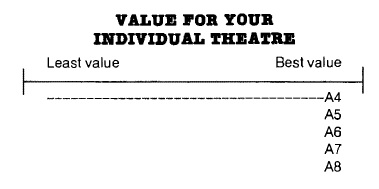
In particular, I refer you to the A8 in the graph above. Now I realize that throughout the discussion, the A8 was noted for being inefficient, least power handing, most restrictive (except on size behind the screen...its ONLY redeeming value), yet in the conclusion graph above...it sits alongside worthy Altec speakers like the A4-A7. Did you have to swallow hard and tow the company line to put A8 in the high value column?
![[Razz]](tongue.gif)
Posted by Louis Bornwasser (Member # 3063) on 05-04-2016, 01:04 PM:
Ahh! But that was low so many years ago. (Steve is right, though.)
Posted by Steve Guttag (Member # 268) on 05-04-2016, 03:16 PM:
While I've always liked the Altec Sound and have installed A5s and A4s in the not-too-distant past (A5s more than A4s), I recognized that A8 for what it was...a VERY shallow speaker that allowed you access to the diaphragm from the top (later design) and side mounted crossover since you likely couldn't get behind the thing. I get all of that. But sound wise, it was not Altec's finest moment. Then again, I dislike MOST of the shallow speakers I've had to deal with.
Truth be told, I'm not the biggest A7 fan out there either...the HF/LF sections just seem like such a mismatch in a theatre. Whereas I like the A5/MRII594 and I've even done them with the full sized MR94:
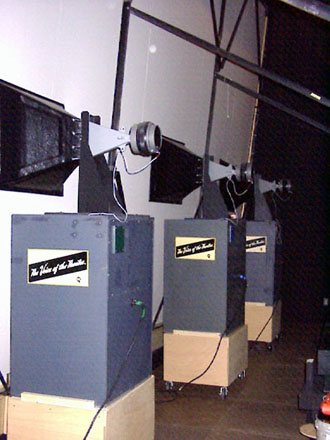
I've never met an A7-500 system I particularly liked in a theatre application. Maybe for surrounds but for surrounds, the ultimate speaker was the 604/620.
Posted by Ted Uzzle (Member # 9135) on 05-05-2016, 10:03 PM:
Yup, I wrote that. I forgot it entirely, had to dig it out of my closet, but I wrote that. I did.
How clever of you to post that fragment.
You didn't post the graph of "price."
You didn't post the graph of "depth required behind the screen."
You didn't post the graph of "coverage patterns available."
You didn't post the graph of "electrical power required."
You didn't post the graph of "electrical power handling."
You didn't post the graph of "maximum acoustic output."
You didn't post the graph of "size of theatre satisfactorily filled."
Any of that information useful?
The last graphic meant, each of these is the best for its individual use. I believed that then. I don't know about it now, because I haven't heard all the new cinema loudspeakers. Have you?
Posted by Steve Guttag (Member # 268) on 05-06-2016, 08:02 AM:
No...in my post above...I did mention that you had noted its short comings throughout the paper. Without saying it was bad, you just made it seem merely restrictive and suitable to smaller rooms when, in fact, it doesn't sound particularly good in any sized room. Hence, it isn't really a good value. What the A8 does/did was FIT behind screens where one had foot or so of depth in an era where speakers were typically 18"-48" deep. I don't consider it good value but pretty much one's only choice (back then).
Did you really think it sounded good or representative of Altec?
Posted by Mark Gulbrandsen (Member # 72) on 05-06-2016, 08:35 AM:
Pretty awful speaker actually. I have a site with three rooms of them and we have been replacing them room by room with small QSC systems and gained much improved sound reproduction and better high frequency coverage. There is no comparison to those Altecs and even the tiny SC-1150 or the SC-2150.
Posted by Louis Bornwasser (Member # 3063) on 05-07-2016, 09:18 PM:
OK guys, I agree that it was pitiful. Ted was a marketer, not the designer. He had a job to do. I would rather have him here as a contributor than to lose him because I don't like the a8. (I'll never buy an Audi A8, partly because of it..!!!)
Posted by Ted Uzzle (Member # 9135) on 05-08-2016, 10:23 PM:
The A8 stank like shit. Lowest value in the VOTT line. Did I not say that? Right out? You charge me for saying that? It was designed, produced, and sold before I ever got to Altec Lansing.
For those fools who thought a rubber loudspeaker could go into 18" behind a screen. You can verify this yourself, since you have materials from 30 years ago.You never met a theater-owner who engaged in magical thinking?
I say I'm not a marketer because I never got one single penny commission on sales. Never in my entire freaky life (and much of it was freaky), did my pay depend on sales. Not one penny. I drove the acoustic engineering lab, and then the electronic lab.
If this offends anybody, I'm, sorry,I never meant offense. But, FU!/
Posted by Sam D. Chavez (Member # 1841) on 05-09-2016, 01:02 AM:
Tough crowd, eh?
Posted by Ted Uzzle (Member # 9135) on 05-09-2016, 05:30 AM:
Sam Chavez: You never faced down a college tenure committee, none of whom ever actually ever held a job in audio, and who resent anyone who actually did. THAT'S a tough room.
Posted by Steve Guttag (Member # 268) on 05-09-2016, 06:55 AM:
Calm down...no need to get too rilled. I was having fun on this one. I was merely pointing out the inconsistency of everything that was in that paper with respect to the final graph (conclusion). Anyone that lived/installed sound systems in that era knew exactly what the A8 was and were its standing was with respect to the rest of the VOT line. You won't find a bigger proponent of the Altec A4 and A5 here and I maintain that the Mantaray line of CD horns to be the best in class (both the larger and medium sized horns). I was never a big fan of the multicell (sonically) but respect that in their era of almost no power, they could cover VERY large areas. I've used them for outdoor screenings.
Posted by Louis Bornwasser (Member # 3063) on 05-09-2016, 08:21 PM:
Speakers aside. I like Ted Uzzle. We are used to fighting like this; perhaps he is not.
Posted by Mike Blakesley (Member # 26) on 05-09-2016, 08:52 PM:
Maybe there needs to be a "new member warning."
WARNING: Film-Techers tend to have strong opinions and are not timid about speaking their mind, especially when it comes to differing technologies or brand names. Our advice is to grow a thick skin, don't be afraid to speak YOUR mind, but don't get all butt-hurt if people don't immediately agree with you. Above all, have a sense of humor.
Posted by Carsten Kurz (Member # 5396) on 05-10-2016, 08:27 PM:
From what I read above, I think Ted is far from being pissed.
- Carsten
Posted by Ted Uzzle (Member # 9135) on 05-13-2016, 08:59 PM:
Now finals week at the college is finished, I've time to keep up with my favorite websites. Commencement is tomorrow noon, and the college definitely takes names and knocks heads for faculty attendance.
Re-reading this thread I'm ashamed at how condescending,smug,and thin-skinned I sound. Never meant that, believe it or not.
You need a sound-and-acoustics forum. Create it, and, if you wish, if it's a condition, I promise not to post there for the next year.
Powered by Infopop Corporation
UBB.classicTM
6.3.1.2