This is topic Drive-In - FM transmission coverage issues in forum Film Handlers' Forum at Film-Tech Forum ARCHIVE.
To visit this topic, use this URL:
https://ft-forum.com/ft/cgi-bin/ubb/ultimatebb.cgi?ubb=get_topic;f=1;t=012015
Posted by Monte L Fullmer (Member # 2797) on 07-04-2016, 01:41 AM:
(Sorry, posted this in the wrong forum. Wanted this posted in the Digital forum. Please move this post to the correct forum, if needed.)
Need a little help and advice if possible on this issue:
I take care of a drive-in in our area where we have some FM broadcast coverage issues.
Some portions of the field receives the signal with no issues, and some areas, the signal comes in rather sketchy, or none at all. We have a side yard that carries the overflow and also experience broadcast issues.
The field is a gradual downward sloped field with the two story building located on the top of the sloped field.
Booth is located on the second floor with the broadcast antenna, which is only three feet high, being mounted on the front edge of the building and above the port window.
Sound from the JSD60 feeds the transmitter.
Are we looking at either an antenna issue, or an additional transmitter?
Please, any tips, suggestions and advice would help us move forward with this issue.
Thx again -- Monte
Posted by Jack Ondracek (Member # 1466) on 07-04-2016, 05:50 AM:
Hi, Monte.
Coverage problems at a drive-in usually fall into a very few categories. Power output, transmitter type, antenna type and location/power of other stations on your chosen frequency. It would help if you'd expand a bit on that.
For example: In an area where 87.9 is quiet, I've seen drive-ins cover their fields well with less than 1/10 watt. On the other hand, some theatres try to burn a hole in another station's (licensed) coverage, and that can take 4 or 5 watts to accomplish without some of the problems you're describing.
Without knowing if the transmitter/antenna you do have is right for your place, I can say that you aren't looking at additional transmitters. Synchronization of on-carrier signals is a technique that even the largest broadcasters find hard to pull off.
Posted by Dave Macaulay (Member # 813) on 07-04-2016, 08:33 AM:
What symptoms do "rather sketchy, or none at all" present? Is this a new problem or was the signal reception always poor?
Tune a radio (a cheap radio without muting!) to your frequency with the transmitter off. Do you hear confusing random-ish noise (distant stations superimposed - unless you're way far from civilization you will probably hear some bits of transmission on all 100 frequencies), or can you pick up a station clearly?
As Jack said, getting enough RF signal to override a competing signal can take lots of power. Obviously you didn't pick your local FM station's frequency but stations come and go regularly, maybe a new one is stepping on your signal. Overcoming outside signals means you will need a higher power transmitter, higher gain antenna ... or must move to a different "quieter" frequency. If you're in one bad location halfway between two powerful stations sharing the frequency the signal will be strong but confused, fading between them randomly: that may sound like a clear channel but actually the signals could be impossible to override with a low power transmitter.
If you hear only white noise or weak distant stations on the radio test above, I suspect you have a transmitter or antenna problem, drive-in transmitters are designed to cover the lot properly. Animals and weather can damage the feedline and antenna. Transmitters fail. Feedline coax must be the correct impedance... I've seen this wrong and it really smacks down radiated power.
Some transmitters have adjustable power output, try changing that if you have it? Like amp gain controls, a dirty one can cause lost signal.
Changing output power or frequency may violate the terms of any transmitter license required in your area so tread carefully!
Who installed the system?
You can unpack a transmitter, cable, and antenna, plug it all together... and get an acceptable result. Or not. To check it's working correctly and optimize signal strength you need equipment that's not worth buying just to set up one transmitter. Find your local amateur radio store (or an experienced ham operator) and ask them to have a look. It isn't hard to check all components are working properly and to tune the antenna for maximum power radiation when you have the necessary instruments.
Posted by Mark Gulbrandsen (Member # 72) on 07-04-2016, 09:17 AM:
Really need to know more here Monte. Antenna type, age, and type of transmitter and power output. How big is the drive in?
Mark
Posted by Louis Bornwasser (Member # 3063) on 07-05-2016, 06:32 PM:
As you know, to be legal, you also need to be weak. I have used 1 watt (illegal) systems but with a twist. I install the antenna upside down along the bottom of the first floor. The big signal covers the drive in, BUT the low height means that it doesn't travel too far.
It is possible to reduce the power with adjustment or pads in the antenna line. Typically 8-10 db.
The goal is to cover the drive in well, but to keep the signal very local. Not only are you going to have fewer unhappy neighbors, but less likelihood of the FCC bothering you.
I assume you avoid an occupied frequency, since you are both better off that way.
Posted by Lindsay Morris (Member # 1430) on 07-06-2016, 04:57 AM:
In my retirement I look after a community run country drive in with a NEC 1600C & FM transmitter.
In the past on 0.5W the coverage was VG.... way beyond the DI field area but being in a rural location the FM bands there are virtually NOT used with only 2 FM stations in the area.
The DI started to get complaints exactly as Monte had outlined & even though the FM TX digital readout showed it was transmitting @0.5W it was awful. Stepping the power up...according to the inbuilt display made NO difference to the coverage.
Thus the next trip I borrowed a SWR meter from a radio ham friend
& with that inline it showed nothing going up the feeder. Feeder checked out OK as did the antenna. Winding the power up to 15W also produced NOTHING on the SWR meter & made NO difference to the coverage. Then resorted to wiring a 2W torch globe into a suitable connector & plugged that in & at the 0.5W setting it did not even glow. At 5W nuffin and @ 15W still nuffin...it should have blown the globe & the TX should have shutdown on hi reflected power.
Deduction was that the power amp in the TX was dead & all we were getting was miserable bit of leakage thru from the exciter.
New FM TX on order as the FM Muser had carked itself.
Suggest that you wire a 2W torch globe across a suitable connector & insert that into the TX output socket & see IF it glows...at 0.5W it should JUST glow dimly..IF you can jack the power up to 2W it should be nice & bright...it is then simply a neat dummy load & TX will be happy with that load.
IF that checks out then as Dave suggests you just might have co channel interference which you can only get around by finding a suitable quiet FM frequency & switching to that. NOT hard at all with modern FM transmitters as with most its just a matter of button pushing after deciphering the Chinglish instructions..... being the hardest bit ![[Big Grin]](biggrin.gif)
Rather like the JSD60 being a quite versatile processor once I worked out how to get into the menus and change things as needed AND remembered to SAVE the bloody changes.
![[Roll Eyes]](rolleyes.gif)
Lindsay
Posted by Mark Gulbrandsen (Member # 72) on 07-06-2016, 08:58 AM:
I tend to stick to using 1 watt BW Broadcast transmitters in drive ins. They have a handy digital power output meter as well as reflected power meter, so there is no need to buy an swr meter at all. Best feature is the fully adjustable power output level so you can set it up for only as much power as you needy need. With a decent antenna that offers at least some gain I typically set power output at a quarter of a watt and have excellent coverage. The sound quality of their transmitters also can't be beat. Other transmitters such as Ramsey or the Chinese transmitters just don't even begin to stack up to the BW stuff. Oh, and they are also pretty easy to repair being all modular,
Mark
Posted by Tim Sherman (Member # 569) on 07-06-2016, 11:01 AM:
quote:
I tend to stick to using 1 watt BW Broadcast transmitters in drive ins. Best feature is the fully adjustable power output level so you can set it up for only as much power as you needy need. With a decent antenna that offers at least some gain I typically set power output at a quarter of a watt and have excellent coverage.
I don't believe they even make the tx1 any longer. The tx5 is the current go to option. Also many of the tx1 were not power output adjustable, unless it was a pretty old unit. They were set at 1 watt because it used the 1 watt exciter to feed the output. On any model above that the exciter feeds an amplifier, and the amplifier is what is adjustable all the way down to .05 watt. In my opinion 1 watt seems like too much power to feed a drive-in unless you are really fighting another station or have a bad antenna.
Posted by Tony Bandiera Jr (Member # 2365) on 07-06-2016, 11:13 AM:
All pretty good advice above but I think you all are missing the key issue I see:
quote:
The field is a gradual downward sloped field with the two story building located on the top of the sloped field.
Booth is located on the second floor with the broadcast antenna, which is only three feet high, being mounted on the front edge of the building and above the port window.
ANY part of the field in the "shadow" of the building WILL see a severely reduced signal strength as the building WILL attenuate the signal.
The solution here could well be as simple as moving the antenna up to the roof and high enough to have a clear line-of-sight over the entire field area.
The existing antenna location may have been adequate when first installed, especially if there were no competing commercial stations at that time. But as the transmitter ages (and possibly lost some output power) and other stations came online the combination of the two could have created this problem.
I would try relocating the antenna first (and in the process checking the condition of the cable and all connections, especially the outside ones.)
Posted by Scott Norwood (Member # 30) on 07-06-2016, 11:34 AM:
So, how much transmitter power does the typical drive-in use?
I have one of the 25mW Ramsey FM-100 kits that I assembled a year or so ago for my own amusement and which covers a few city blocks' radius with a simple dipole antenna mounted indoors. And this is in a fairly "busy" RF area. Does the average drive-in theatre really need much more power than that?
Posted by Jack Ondracek (Member # 1466) on 07-06-2016, 12:32 PM:
Usually not, Scott. It really depends on what else is out there. If the channel you select has nothing on it, you can get by with a very small signal. If you decide to "share" a channel, your power needs go up quickly, even if the signal you're trying to overcome is low power and far away.
I once saw an older drive-in get by with a test bench signal generator and a Radio Shack antenna booster, hooked up in reverse to a TV antenna. Not much power there, but it covered the field pretty well.
I think the issue is more a matter of equipment quality. Most of the really low-powered gear out there is "lightly built" (read: 'cheap'), and support is nonexistent. I'd be reluctant to risk a busy night on that kind of equipment. BW Broadcast is pretty good stuff, though possibly on the fringe of what some drive-in operators would consider "expensive". If you're looking for reliability, support and a healthy installed base, it's one of the best choices out there. Also, as Tim mentioned, the power can be drastically reduced, even though it does have 5 watts available. Any drive-in that might consider using that kind of horsepower would either have serious antenna problems or an FCC death wish.
Tony brings up a good point about trying to relocate the antenna, though I don't see shadowing as being much of a problem in a small area. Still, it's worth a try and doesn't cost as much as the other options.
Posted by Monte L Fullmer (Member # 2797) on 07-06-2016, 06:42 PM:
quote: Tony Bandiera Jr
The existing antenna location may have been adequate when first installed, especially if there were no competing commercial stations at that time. But as the transmitter ages (and possibly lost some output power) and other stations came online the combination of the two could have created this problem.
Got some tips from a radio operator in the area:
First off: bet this transmitter needs to be tuned for the yard since it prob hasn't been done in ages along with more FM stations coming up online in this area.
Showed him a pic of the antenna. He mentions that its an omnidirectional type which is fine for the field. Granted, it's not high enough to have a direct line shot to the side fields.
The transmitter was designed for just one yard only. This drive in was split into three fields, but for now, just the middle yard is used while on busy weekends, one side yard is also used since it has a good view to the center screen.
He also mention to boost up the MOD just slightly and to check to see if my audio is barely lighting up the overload lights.
Big thing that the freq is between two power stations.
We're using 105.5 and I have powerful stations on each side being, 105.1 and 105.9 .
Looks like if I can find weaker stations down below 90.1, I can use this and overpower the weaker ones with the MOD increase.
Have to do this at nighttime to get away from the sun's interference.
This is the Terrace Dr-In in Caldwell - a three screen location with just the center screen being used as present. In the future, we're planning on getting the other two side screens lit, hopefully for next season.
thx - Monte
Posted by Lindsay Morris (Member # 1430) on 07-06-2016, 07:59 PM:
Another thing to ponder is that many modern cars have the antennas built into the front windscreen & with that facing the screen & the TX behind them their own car body tends to shield the transmitting tenna.
A rough rule of thumb is that IF you cannot SEE the antenna from where your car is located you will have reduced signal often relying upon reflections from other vehicles about to provide enough signal to keep the receiver from muting.
In Monte's case he may well have enough splatter from adjacent higher powered carriers either side fooling the AGR in the car receivers such that they wind the gain DOWN. So shifting to another slot with less high power channels adjacent may well be the easiest fix.
In many cases its a case of trial & error.
One also cannot entirely rely upon the inbuilt measuring gear in some of these TX units & often as I found an external meter was needed to prove that the TX was crook...it showed that it was transmitting whatever one set the power level to but in fact that was a huge porky. According to the radio ham I borrowed the SWR meter from that is not uncommon amongst many of the newer compact TX units...the micro processor "thinks" it has cranked the power up or down & displays as such but fails internally to do anything. In my case I smelt rat as the SWR internal display showed NOTHING.
Posted by Jack Ondracek (Member # 1466) on 07-06-2016, 09:24 PM:
Hi, Monte.
My daughter and I almost made a trip over there last year. We were in town, rebuilding a commercial transmitter site in the Notus area. Wound up looking at the Parma drive-in instead.
I'd just start by moving the antenna around. That was probably the most practical first suggestion. While you're at it, make sure all connections are clean, tight and moisture free. Corrosion could be the cause of all of this. Given what I've seen of your winters, it could very well be your whole problem.
You can't "tune a transmitter" to anything but its antenna. It matches it or it doesn't. It can't be "tuned to the yard" any more than you could tune one of your local commercial transmitters to its city of license. There's no such thing.
Mod levels won't make a bit of difference in your case. This isn't a 100,000 watt station... you need to think less like a commercial setup and more like Mr. Microphone. With what you're working with, you can't overpower anything by raising modulation levels on your FM transmitter. However, you can raise distortion in your own audio by doing so.
Come to think of it... just turn your audio completely OFF. If your coverage is even over the field and you're not dealing with external interference, your radio will stay quiet, with no static as you move around. Get a good, quiet carrier throughout and the audio part will be fine.
Hopefully, you have some kind of automatic gain circuitry in your system. There's way too much dynamic range in digital audio to run from the projector straight through the transmitter.
Speaking of which, it would really help if you'd post what kind of transmitter you have & its power level.
An omni antenna is fine, but again, we need to know what kind it is. Some have gain built into them (like the Comet)... some don't. This will help determine what you should be getting from what available power you have.
Those adjacent stations could be causing you some trouble, but probably not complete devastation. Getting away from them is a good idea.
If the sun is doing anything but improving your tan, you have serious technical problems there.
Lindsay is correct about not putting too much trust in the internal metering... unless it's a known brand, like the BW Broadcast stuff. I rely on external test equipment in all of my commercial work and use the transmitter's internal metering only to validate what I think I already know. It can indicate that the transmitter is happy with its load and give you some idea of modulation levels (an overload light???). Beyond that, I wouldn't put too much stock in it..
Posted by Monte L Fullmer (Member # 2797) on 07-07-2016, 03:38 AM:

Transmitter: FM Micro Systems
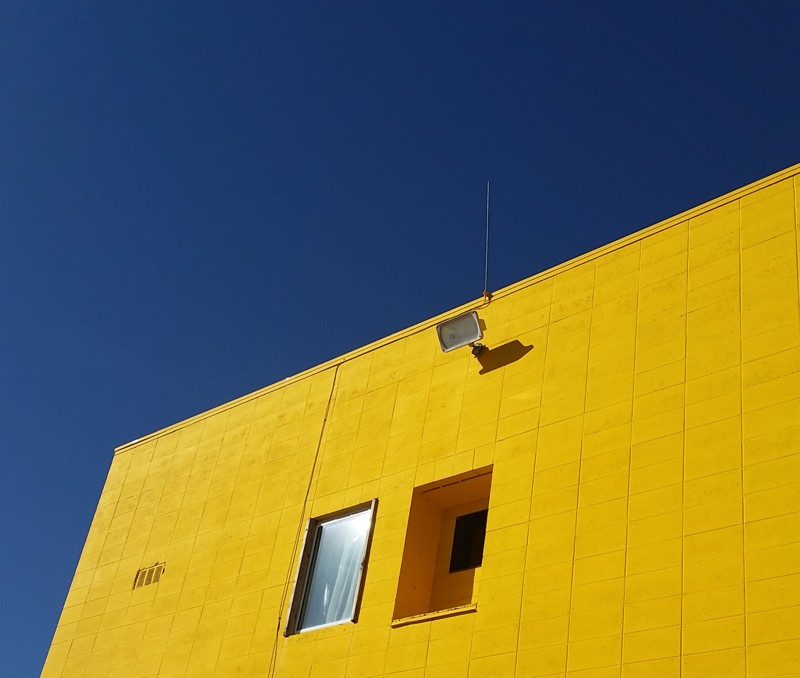
Antenna placement on top of the building.
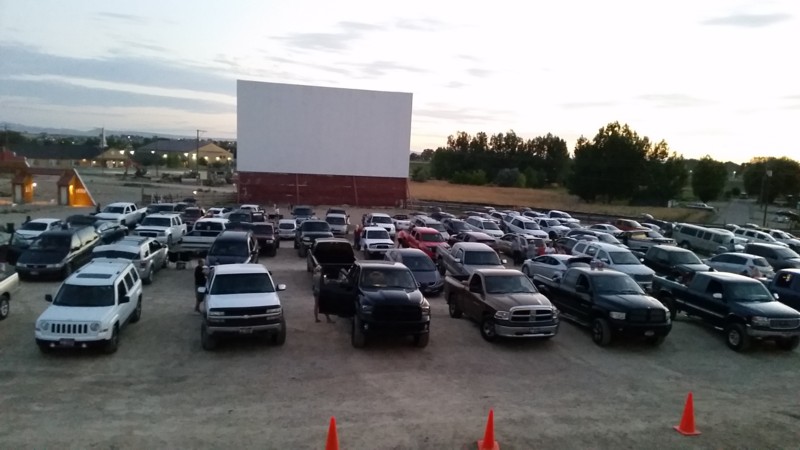
Main yard image. The weak areas are towards the front and right of screen.
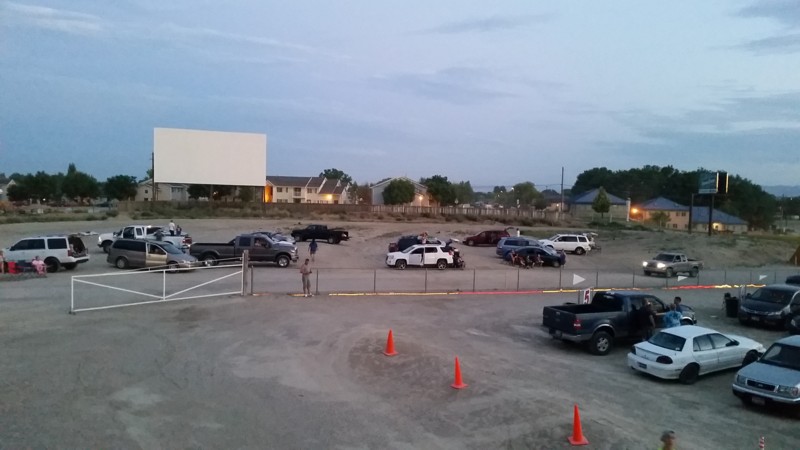
East (overflow) yard . One of the yards that will be regraded to face the east screen when we are ready to light this screen. This yard also has weak area issues with our FM.
We also have a west yard and screen that is also on the list to be lit, hopefully next season. East screen is 65 ft wide with a 412 ft throw. West screen is 75 wide with a 385 ft throw.
Hope this can be useful with my issues.
Thx all - Monte
Posted by Tim Sherman (Member # 569) on 07-07-2016, 05:35 AM:
Well that transmitter is at least part of the problem i would say. That unit is probably from the late 1990s. And if i'm not mistaken technically isn't a FM transmitter. I believe it is actually a cable tv rf modulator and runs a 75 ohm antenna, that thing was very low power when it was new and was also re-branded so many times for different companies. I used to run 2 of them.
Get rid of it and put in a BW Broadcast tx5 and a matching antenna. Do not use your current antenna as it is 75ohm and most if not all commercial transmitters are 50ohm. not only will you cover your field with ease you will also have an amazing increase in sound quality.
Posted by Jack Ondracek (Member # 1466) on 07-07-2016, 05:38 AM:
Monte, you have a fairly low-power system there. Those modulators were originally intended for inserting FM stations in cable systems. Yours could possibly manage as much as 100mW (1/10 watt), but there's no way to tell if it's actually doing that without measuring it there. It could be much less.
From your pictures, it doesn't look like antenna placement is the problem.
If this thing ever did work well and the modulator hasn't conked out, I'd still have a look at the coax and antenna connections. If they're OK, then I'd try moving the frequency. Your FM band is really full there, but at the bottom of the dial is 88.1 (K201EO). It's putting out only 10 watts and its main contour just barely touches the northeast corner of Boise, some 20 miles from your drive-in. Try moving your transmitter to 88.3 & see what you get. On the dial, it's close to the translator, but farther away from KOAY, which has more power on 88.7. If your problem is proximity to other stations, this might help.
If none of that works, then I think you're a candidate for a new transmitter and antenna.
Posted by David Buckley (Member # 2600) on 07-07-2016, 08:55 AM:
Although I'm far from an expert in this area, I know a bit about this stuff as I do tech support for a community radio station with a 2KW EIRP transmitter on a small mountain, which covers a fairly large area.
quote: Monte L Fullmer
Some portions of the field receives the signal with no issues, and some areas, the signal comes in rather sketchy, or none at all. We have a side yard that carries the overflow and also experience broadcast issues.
"Sketchy" to me sounds like insufficient signal strength. For FM to work well, the signal level at the receiver has to be sufficient to ensure the receiver is "fully quieting", once this signal level is reached then the amplitude modulations caused by stuff like car moving, people walking in front of the antenna etc do not cause the signal level to drop, and the audio to become scratchy. Theres a number that it is considered one has to reach to get acceptable performance, and that is 66 dBuV/M. There are tools that given the parameters can calculate the coverage. But for a problem the size a field, the coverage prediction tools are a bit of a sledgehammer to crack a nut.
The Inverse square law applies to the signal propgated from transmitting antenna, and - all things being equal - as the distance from the transmit antenna to your receiver increases, the signal strength drops. As some of your receivers are close, and others are relatively far, the drop-off is quite pronounced that close in.
Solutions: The obvious is more transmitter power, with the caveat that any time anyone transmits anything anywhere there may be legal implications and licensing to deal with, don't know how your rules work in the USA. Less obvious, a directional antenna to take the same transmitter power and "shape" it in a specific way, so that the effective power (EIRP) goes up in the direction you need it to, whilst reducing radiation in directions you don't require it.
Given you've got a transmitter the local folk regard as dodgy, then a new transmitter is the obvious solution.
Mark's already mentioned BW broadcast; their current range of transmitters, the V2s, also have on-board processing; Jack mentioned that the dynamic range of digital cinema is far too wide for FM radio to handle sensibly, and so this is a perfect one box solution. You can easily spend far more than the price of a low power transmitter on a processor, and especially if you want a big brand processor like an Optimod.
Sadly BW no longer seem to do "small" transmitters, the TX50 being the smallest, but it turns down to 5W; If 5W is still too much power, then a simple resistive dropper will reduce it still further.
Make sure the antenna - whatever it is - is impedance matched to the transmitter, which, unless you want to spend more time tuning antennas than showing movies, means a 50R antenna.
The transmitter (as is any half-decent FM transmitter) is stereo; to take advantage of this for the best audio to the vehicle, you'll need to arrange a stereo + centre feed to the TX from cinema audio system. Of course, dome folks will have their stereo backwards, so the screen movement will be opposite the audio...
Posted by Jack Ondracek (Member # 1466) on 07-07-2016, 10:57 AM:
Hi, David. Are you sure about the TX5 being discontinued? I still see it on their web site, and the major US distributor has it on theirs as well.
Posted by Dave Macaulay (Member # 813) on 07-07-2016, 04:54 PM:
I've never come across a BW, here in Canada I only see Decade transmitters. Made in Canada - at least the last one I inspected didn't say China...
These seem very reliable and with the USD strong they're cheaper than BW as well.
Posted by David Buckley (Member # 2600) on 07-07-2016, 05:49 PM:
quote: Jack Ondracek
Hi, David. Are you sure about the TX5 being discontinued?
My bad Jack; there is a TX5 V2, webpage. I was sure it had been killed off, turns out I've remembered it wrong. Sometimes, its good to be wrong ![[Smile]](smile.gif)
This looks the perfect solution for a drive-in, power level is variable from 0.05W (ie 50mW) to 5W, and its got the integrated audio processing the rest of the V2 series has.
quote: Dave Macaulay
I've never come across a BW, here in Canada
That's odd; they are available all over the world, even here in New Zealand. I wonder if Canada has some regulatory weirdness that BW kit is not certified for. You could order online from Broadcast Warehouse, they ship all over the world.
quote: Dave Macaulay
I only see Decade transmitters
Never come across these, but I note they don't have an integrated audio processor, which is the big win with the BW V2 series. Add a quarter-decent external processor, at over a grand, and suddenly the BW V2 kit looks very value priced
Posted by Gordon McLeod (Member # 33) on 07-07-2016, 06:31 PM:
Since i dont see a DOC sertification any one in Canada that ran one wouold be subject if caught to massive fines that start at 6 zeros for operating a transmitter outside of DOC regulations
Currently the only legal one in Canada is the Decade
Posted by Jack Ondracek (Member # 1466) on 07-07-2016, 07:10 PM:
quote: Gordon McLeod
Currently the only legal one in Canada is the Decade
Last I checked, and it was a while back, the Decade transmitter was solid, but a bit expensive for the value received. the BW gear now includes a raft of internal features... many of which might not be useful to a drive-in, but I put a lot of these in US translator installations. The processor is a bit lightweight, but certainly suitable for a drive-in. It will also auto-shutoff after so many minutes with no audio. It also has a built-in web interface, which makes any adjustments easy.
For the price, the Decade models I last looked at had none of this. A solid exciter... but not much else. I did check the web site and, after paying $1,600 for their most-comparable transmitter (but only 1.8 watts), you'd need to add some kind of processor/limiter for an effective drive-in box. That'd put it in the $2,000+ range. The UK price (from their site) for the TX-5 V2 is $1,500, fully loaded.
Gordon, If you're following US and Canadian legalities, the only Decade box that an unlicensed Canadian drive-in (or US one, for that matter) could legally use would be their MS-100. The power level of that product is so limited that you probably couldn't get to the screen with its signal. It claims 150 feet for the Canadian power level, which is more than what's allowed by FCC part 15. In order to comply, I think you're also required to use the box's internal antenna.
Posted by Mark Gulbrandsen (Member # 72) on 07-07-2016, 10:41 PM:
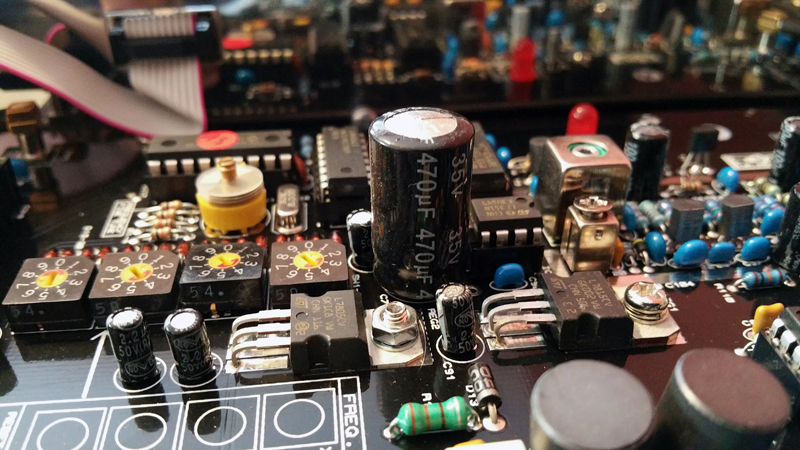
Yes, I did use a TX-5 last summer at an install in Eastern Utah. Its still set at .25 watts though. I have lots of TX-1's running and they have been pretty reliable. Only issue has been a non-polarized feedback capacitor in the PLL feedback loop that fails. Replacing the caps gets em going again.
Mark
Posted by Mark Gulbrandsen (Member # 72) on 07-08-2016, 12:41 PM:
TX-5 is still on the BW Web site so is obviously currently made. The current one is the TX-5 V2 which is the one I installed last summer in Eastern Utah. In the past I have always had to wait for one to be built as none of their transmitters are actually stocked, so don't expect to get one in a big hurray unless they just happen to have one laying around. A month wait is typical.
TX-5V2
Best thing about the V2 transmitters is the remote app. I have this app running on all my V-2 transmitters on the booth computer.
Remote Access App Demo
Posted by Tim Sherman (Member # 569) on 07-08-2016, 02:12 PM:
Never had a problem getting the TX5 V2 I have had them sent overnight as well. I also know of someone who just ordered one about a month ago and received it right away. Broadcast Warehouse even has a "Drive-In Movie Package"
http://www.broadcastwarehouse.com/drive-in-movie-package/40/package
Posted by David Buckley (Member # 2600) on 07-08-2016, 06:40 PM:
quote: Tim Sherman
Broadcast Warehouse even has a "Drive-In Movie Package"
Very cool. How can a drive-in go wrong with this?
Posted by Louis Bornwasser (Member # 3063) on 07-08-2016, 09:55 PM:
Remember, guys, mount the antenna LOW. You are illegal on power. Keep it low; it will cover the drive in. You don't need 5 miles.
Posted by James Westbrook (Member # 3690) on 07-09-2016, 11:41 AM:
A few neighborhood Christmas light shows synchronized to music violate the FCC every year. I drove through one a couple of Christmas' ago and still picked up the music a mile away after leaving...
Posted by Tony Bandiera Jr (Member # 2365) on 07-09-2016, 12:38 PM:
Without going into politics, I will state that the FCC is simply out of its league and rarely if ever does anything about low power ( < 10 watt) FM transmissions. As was said many Xmas light shows violate the rules and there are many FM transmitters in the 1-5 watt range available on Amazon and other sites at very low cost (with very low audio quality and reliability to match in many cases.)
When I was living in Los Angeles it was a common thing for the FM (and sometimes AM) band to be stuffed with many stations, most of which were obviously not licensed commercial operators. Out here in Idaho there are some FM operations that are evidently not licensed also.
I agree with Louis that regardless of your transmitter's power, keep the antenna low enough to cover your intended area with a little spill over to counteract any adverse temporary conditions. This works well with FM ..AM is another story as skip can make even a low power signal audible for many miles.
Avoid sandwiching between two close frequency commercial stations whenever possible..it will avoid a lot of headaches for you as the operator and the people trying to pick up your audio (as a LOT of car radios these days have absolutely horrible FM sensitivity and selectivity).
Back to Monte's situation..his antenna is a simple monopole design...not too efficient really. Great for reception but bad for transmission.
I have built a few of the Ramsey kits (with a few mods to get rid of hum and improve audio quality) for motocross tracks...even at the legal FCC power they put out I got great results because I made a 1/4 wave antenna with four ground plane radials for them. (All rods 1/4" solid aluminum stock with a 4" dia. by 1" thick solid aluminum base.)
At the legal power level and with a 20' average mounting height, I got excellent coverage to about 1/2 mile in most cases, and at one track I had a signal (with a bit of flutter and noise) within 1 full mile of the track.
So in Montes' case I suggest he try a better antenna mounted to just clear the top of the roof (same location as the existing one would do fine) before spending $1,500 on a new transmitter. ![[Wink]](wink.gif)
Posted by Mark Gulbrandsen (Member # 72) on 07-09-2016, 12:39 PM:
quote: Tim Sherman
Never had a problem getting the TX5 V2 I have had them sent overnight as well.
I used to get TX-1's pretty quickly but I never had any luck getting TX-5's that fast. Didn't matter much as the installs were almost always planned a couple months ahead because of DLP delivers and I keep a spare Japanese Micro FM transmitter here in the shop in case a customer goes down. The larger drive ins I have installed have back up BW Transmitters, generally two TX-5's.
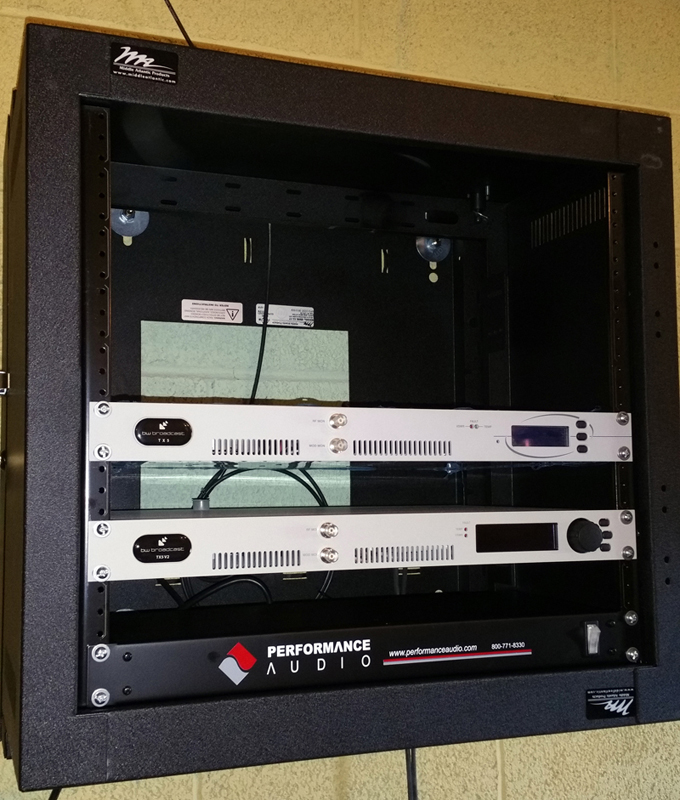
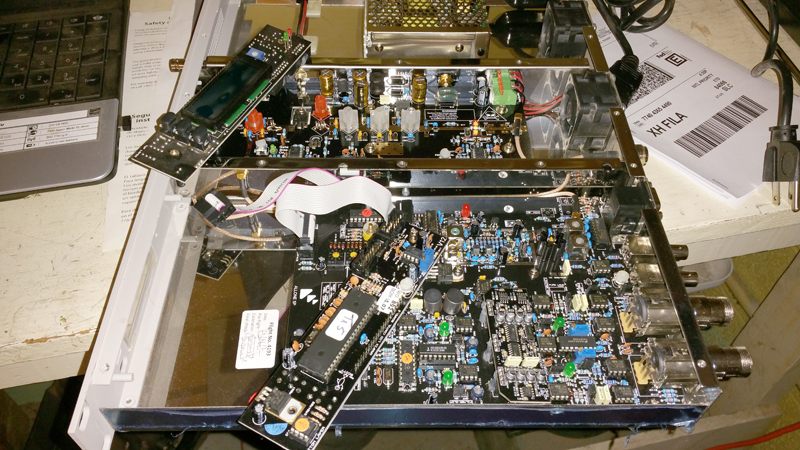
Another common issue with TX-1's and TX-5's is the failure of the front panel LCD. The currently used replacement LCD'sdon't seem failure prone... This customer didn't even know his LCD was bad until the feedback capacitor in the PLL failed and the transmitter went down.
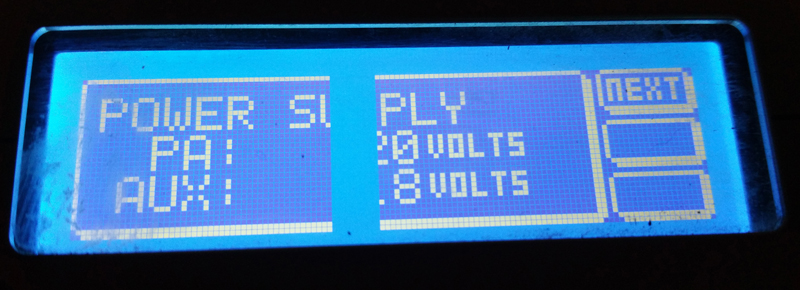
Its easy to replace but not particularly cheap!
Posted by Monte L Fullmer (Member # 2797) on 07-09-2016, 10:48 PM:
Did the quick fix for now. Redid the freq down to a lower one and cured the issue for present.
Thx for all the help..Monte
Posted by Martin Brooks (Member # 1269) on 07-19-2016, 04:58 PM:
The FCC is not doing much in the way of enforcement. Their budget has been cut back and there is almost no activity trying to shut down pirate radio operators. If that's not a priority for them, they're not going to care about a drive-in that's broadcasting on a frequency that no local station uses.
Powered by Infopop Corporation
UBB.classicTM
6.3.1.2