This is topic Hollywood’s Historic Egyptian Theatre Undergoes Retrofit For “Rare” 35mm Nitrate Film in forum Film Handlers' Forum at Film-Tech Forum ARCHIVE.
To visit this topic, use this URL:
https://ft-forum.com/ft/cgi-bin/ubb/ultimatebb.cgi?ubb=get_topic;f=1;t=012029
Posted by Paul Mayer (Member # 355) on 07-27-2016, 11:35 AM:
I seem to recall that this theater had, at least temporarily, nitrate capability installed back in 2000/2001 for a nitrate festival they were running. Looks like now they will have nitrate capability as a permanent feature in their new booth.
From American Cinematographer and Deadline Hollywood:
quote:
Hollywood’s Historic Egyptian Theatre Undergoes Retrofit For “Rare” 35mm Nitrate Film Projection
By Greg Evans
July 26, 2016
Hollywood’s Egyptian Theatre will soon have the capability to screen “rare and fragile” 35mm nitrate film prints thanks to a film preservation project undertaken by The Film Foundation, the Hollywood Foreign Press Association, and Turner Classic Movies, in conjunction with the American Cinematheque.
“When I was told that one of the most beautiful movie theaters in the country could be retrofitted for nitrate projection, I was overjoyed, moved, and excited by the potential,” said Martin Scorsese, founder and chair of The Film Foundation. “I hope that this is the beginning of a trend.”
Cellulose nitrate was the standard film stock in commercial use prior to 1951. Though beloved by buffs for its vivid image quality, cellulose nitrate is flammable and was replaced by cellulose acetate safety film. Though old nitrate prints survive in controlled vault environments, few theaters are equipped to screen them.
Scorsese praised the stock for its “luminosity and a richness that was never quite matched by the safer stocks that followed or their digital reproductions.”
Rick Nicita, chairman of American Cinematheque, which owns the 1922 Egyptian, said the project will enable the theater “to show every film format possible. A state-of-the-art digital projector will sit side-by-side with our 35mm/70mm machines – representing the rich history of cinema, as well as the future of the art form.” The new nitrate-safe projection booth at the Egyptian, designed by BAR Architects, has begun construction, with the retrofit scheduled for completion in fall of 2016.
“Needless to say,” said Scorsese, “I’m eager for the completion of the necessary work so that I can see those glorious images projected in that one-of-a-kind theater.”
Posted by Leo Enticknap (Member # 534) on 07-27-2016, 11:50 AM:
NFPA 40 was significantly revised in 2007 to toughen up the rules for any facility where nitrate is stored and used, with the result that the Egyptian's booth was no longer nitrate legal. Making it legal per the 2007 version would simply not have been possible (it basically calls for a nuclear bunker-type facility, something which the UCLA folks at Santa Clarita must now be very grateful for, given the fire that is taking place around them), but the code was revised again this year. In the 2016 version, the requirements for theaters aren't as stringent as those for archive facilities, reflecting the fact that a projection booth containing 6 reels of nitrate is less of an inherent danger than an archive vault containing 600,000. The 2007 NFPA 40 made no distinction between the two. Without that revision to the code, we simply could not be doing this.
Mainly what is being done is to upgrade the walls of the booth for enhanced fire resistance, and upgrade the HVAC in the booth in order to isolate its air supply from the rest of the building. The schedule is for the booth to be handed back to us for re-installation of equipment in late August (absolutely everything had to be taken out, Norelco AAIIs included!), and for us to be back up and running for Cinecon. In the meantime, we're playing DCPs from a loaner Barco 32B perched on the balcony.
Posted by Scott Norwood (Member # 30) on 07-27-2016, 03:58 PM:
Interesting. They definitely projected nitrate films at the Egyptian in 2000 for the Technicolor Festival. I was there and had a great time. Jeff Joseph would have more information on what was done to the booth. I believe that they had three operators and a fireman in the booth for those screenings. Fortunately, there were no issues.
It is interesting to see the increased attention that is being paid to nitrate screenings. The Eastman House museum in Rochester, NY. has done a nitrate weekend for two years in a row, with good attendance both years (I went the first year, but was unavailable this year). They have another nitrate weekend scheduled for next spring.
Nitrate looks gorgeous, and it makes me happy to know that more people will get to see it projected in venues that are properly equipped to show it.
Posted by Monte L Fullmer (Member # 2797) on 07-27-2016, 07:41 PM:
quote:
Nitrate looks gorgeous,...... and more people will get to see it projected in venues that are properly equipped to show it.
How, have to be a newbie in this department on this: Even though I started projecting in 1969 at a drive in, we did have a 10 min B/W, nitrate clock reel we would use towards the end of the season.
It looked good on the screen and had no issues with running this flammable stock, outside of keeping the extinguisher close by since I was using 11mm carbons in an Ashcraft Corelite lamphouse.
Afterwards, worked in indoor houses where I did project B/W acetate safety prints, and to my eyes, these B/W features looked real good by themselves.
Thus, the simple question would be: what is the presentation differences between a Nitrate and Safety print?
thx-Monte
Posted by Scott Norwood (Member # 30) on 07-27-2016, 08:07 PM:
quote: Monte L Fullmer
Thus, the simple question would be: what is the presentation differences between a Nitrate and Safety print?
For me, it is the clarity of the base material. For example, a shot of a woman wearing a white dress will "pop" on screen in a nitrate print, whereas the same shot might look a bit dull on a safety print, where "clear" film is somewhat less than clear. Actually, DLP has some of the same qualities as nitrate, since "white" really shows up as "white" on screen.
Also, there are some non-nitrate-specific characteristics of these prints as well, such as the silver content of the the film, prints made from camera negatives, and generally high quality lab work.
Perhaps others can comment further on the nitrate look.
Posted by Monte L Fullmer (Member # 2797) on 07-29-2016, 08:10 PM:
Did they use wet gate printing, contact printing, or similar from the transfer to the positive stock?
I can see wet gate printing be the more optimal.
thx -Monte
Posted by Simon Wyss (Member # 6218) on 08-01-2016, 01:22 AM:
Better clarity with nitrate base compared to acetate base is plain nonsense. Scorsese mixes up memories which have to do with how silents were processed and handled in contrast to 1) sound film and 2) machine processing. Until the last fresh nitrate-base prints had rolled over screens, xenon-arc light began to replace carbon-arc light and there lies one of the differences.
Nothing changed with the gelatine that embeds the picture and it is still today possible to produce prints as beautiful and “rich” as in 1920 on polyester-base stock. Taking lenses have changed, lighting has changed even more, and some laboratory practices, too.
Nothing against the initiative, on the contrary, I applaud this, but good cinema photography is independent of the 0.05 log difference in density between nitrate and triacetate bases. If at all, one should consider the refractive index of base materials where PETP has one of 1.64 besides cellulose triacetate and cellulose nitrate, both 1.48. But even that doesn’t make a difference.
Crispness and stuff that’s being talked about happens about the silver on the film. Old negative stocks had thicker layers, more silver, were exposed and developed to more density. Prints used to be made in different versions, a bit lighter for large screen presentation or a tad denser for smaller screens. Tessar-type lenses were often used, stopped down to f/5.6 and more, if possible. Petzval projection lenses of relatively longer focal length were in use. The main point is the light source, again. A print has two looks when projected with high-intensity carbon arcs and xenon arcs.
Posted by Tom Ruff (Member # 6153) on 08-01-2016, 01:31 AM:
Just curious. The 2000 seat 1930 theater that I work in in downtown Los Angeles still has the working steel shutters on the front wall in front of all of the ports, the projectors still have magazines with fire traps and the booth has a separate ventilation system. the booth has two exit doors with the pull in case of fire rings at each one. The buildup bench has separate steel enclosures for each reel. What has changed in the rules since 1930?
Posted by Monte L Fullmer (Member # 2797) on 08-01-2016, 02:43 AM:
quote: Simon Wyss
xenon-arc light began to replace carbon-arc light and there lies one of the differences.
Which this is easy verification for me: Go back 35 yrs to 1981 - Raiders of the Lost Ark.
Experienced this at the Villa in SLC in 70mm.
Booth had JJ's with Ashcraft Super Corelites and 11mm positive rotator carbons.
Wonderful bright picture with an even field of light
Move up to 1984 Temple of Doom at the same location: Ashcrafts were pulled for two Xetron lamphouses running 4K lamps and still firing behind the JJ's.
Picture quality took a nose dive. Image lost a lot of clarity, contrast and brightness, plus corners were slightly dark than the center of the image, like the reflector focus wasn't set to par.
Agree: carbon arc light prob will make this nitrate event worthwhile.
-Monte
Posted by Mark Ogden (Member # 43) on 08-01-2016, 06:36 AM:
quote: Tom Ruff
What has changed in the rules since 1930?
What is the physical position of the booth to the rest of the structure? In the early day of cinema, the rear wall of the booth (the "blow-out wall" it was called) was required to both face the street and be structurally weaker than the rest of the building. The idea was that in the event of a fire or explosion, the rear wall would buckle and vent the flames out to the air, as opposed to the auditorium. This is why most theaters of the era had the booths high and in the absolute back of the balcony. When this got dropped as a building code (and whether it was true in all municipalities) I have no idea, but I've seen that design in theaters constructed as late as the 1950s.
Posted by Steve Guttag (Member # 268) on 08-01-2016, 07:21 AM:
I've seen nitrate projected off of xenon, carbon and even incandescent and it ALWAYS seems to look better. Regardless if it is color or B&W. So I think the reason isn't the light source. I can believe that the high silver content has something to do with it It just has a very rich look about it. It would not surprise me if the reason is not any single one thing but the cumulation of everything about how the nitrate prints were made.
Generally speaking, people tend to prefer the look of nitrate prints, once they see them.
I do agree that carbon arc is a better light source than xenon for attaining the full spectrum of light and it is smoother but that isn't necessarily the look of nitrate. The vast majority of the nitrate I've seen was projected xenon.
Posted by Rick Raskin (Member # 1561) on 08-01-2016, 04:21 PM:
I do remember a sign on the Norelco fire trap to use red fire trap rollers when running nitrate film. I never ran nitrate on one though.
I agree the look of nitrate to me was preferable to acetate, especially with color film. I have seen cartoons projected from nitrate and the colors seemed much richer.
We used to have a venue at L'Enfant Plaza that had JJs and if I remember correctly, CoreLites. AFI had their theatre there before their move to the Kennedy Center (they are at the Silver now) and regularly projected nitrate.
Posted by Leo Enticknap (Member # 534) on 08-01-2016, 04:57 PM:
quote: Tom Ruff
What has changed in the rules since 1930?
NFPA 40 would give you the chapter and verse (although looking up precisely what the rules were in 1930 would be a bit more of a research challenge), but essentially, and at a guess:
1 - The volume of nitrate you're allowed to store in the booth at any one time;
2 - The requirement for an automated fire alarm/suppression system with specific functions (e.g. triggered by smoke and rate-of-rise heat detectors in the booth, automated call to fire department, alert other parts of the building, etc. etc.);
3 - The time requirement that a booth has to contain any fire without any fumes being able to escape;
4 - Various electrical and systems insulation requirements.
But, IMHO, the issue here is not so much one of rules, but of culture. In 1930 nitrocellulose was an everyday substance, in widespread use. Just as anyone working in a gas station today has received training and uses it in minimizing the risk of accidental ignition, so did all projectionists in 1930 on how to prevent the accidental ignition of nitrate and manage the danger if it did happen. Only a tiny handful of film archivists, collectors, and workers in cinematheque-type venues have ever handled the stuff today, and public knowledge of fatal accidents such as the Glen Cinema fire and the Cleveland Clinic fire* is almost non-existent. Any competent projectionist working in 1930 would have known all about them.
So for a theater such as mine, which is preparing to show nitrate for the first time since the early '00s, and for the first time regularly since around 1950, we're having to educate ourselves from the ground up.
* This is one that is worth taking very careful note of. The fire killed 123, but caused only minor damage to the property. Nitric acid fumes were the reason why. The fumes from around 100 feet of burning 35mm are enough to kill you if inhaled - the inflammation in your windpipe caused by the acid will asphyxiate you. That's why the direct exit from the booth to fresh air is so important - you need to be able to exit the building in the time that you can hold your breath.
Posted by Steve Guttag (Member # 268) on 08-02-2016, 06:39 AM:
Absolutely, One must be able to exit either way from a booth too. My most recent Nitrate booth was at the Library of Congress Culpeper facility.
Here is the one that gets me. At the time of when it was designed and went in, NFPA40 stated that the film cannot be shielded from the sprinkler system. What that means is that if you put your film in a film cabinet, then you also must have a sprinkler head in there. Otherwise, it is to be out in the open (within the restrictions of how many feet can be in the booth at one time) and under the sprinkler heads.
Posted by Dustin Mitchell (Member # 372) on 08-02-2016, 10:02 AM:
Doesn't nitrate produce oxygen as it burns, fueling the fire in the process. I seem to recall someone posting a video here of a chunk of nitrate film burning under water.
Posted by Richard P. May (Member # 3598) on 08-02-2016, 10:17 AM:
Regarding the look of nitrate prints vs acetate:
Almost all color prints made during the nitrate days were Technicolor dye-transfer (IB) process. There was a notable difference in color quality between this and Eastman Color, which succeeded it in the '50s.
Comparison between a nitrate and safety print must include other factors, such as the above for color, and for B/W was the print from original negative, what lab made it, projection equipment where it is being viewed, and more.
The only way to make a true comparison would be to make a print on each type stock from the same element, process in the same lab, and project in the saame theater.
I suppose this argument has been going on for the last 60 years, so no point beating it to death again.
Posted by Steve Guttag (Member # 268) on 08-02-2016, 11:50 AM:
quote: Dustin Mitchell
Doesn't nitrate produce oxygen as it burns, fueling the fire in the process. I seem to recall someone posting a video here of a chunk of nitrate film burning under water.
Yes it does. So why sprinkle? Or why ensure it is not shielded from the sprinklers? To keep additional material from catching fire. Part of what the sprinkler system is doing is keeping the temperatures down when it goes off.
There was one point I heard a discussion (maybe read it in a book) that sprinklers were more effective at extinguishing a nitrate fire than submersion in water since, as you noted, merely putting it IN water wouldn't suffocate it but that the sprinkler would have a better chance at cooling it. Naturally, I've never tried either and would think that the best defense is a good offense (don't let it catch fire in the first place).
I think nitrate gets a bad reputation for being dangerous/unstable due to some key examples. But with well stored films, it really isn't really isn't all that unstable. Just like with electricity, one needs to pay it the respect it deserves and take appropriate precautions. If you think about it, it is pretty easy to electrocute oneself on the typical USA "Edison" outlet (compare that to the "Schuko" type plug/receptacle used in some countries).
Then there is the whole risk/benefit thing. Some people will appreciate seeing a movie in its original form with as good a copy that exists while most just want to see a movie in any for, if at all.
Posted by Leo Enticknap (Member # 534) on 08-03-2016, 11:38 AM:
quote: Richard P. May
Almost all color prints made during the nitrate days were Technicolor dye-transfer (IB) process. There was a notable difference in color quality between this and Eastman Color, which succeeded it in the '50s.
And also, not all IB prints are made equal. They range from astonishingly sharp, saturated and detailed - could almost be from an 8K DI printed onto 2393 - to fuzzy, misregistered, pale dyes and unwatchable. While at film archiving school we were shown a reel from an original release print the BFI's collection of the 1942 Jungle Book - it was terrible. The curator explained that it was known in the trade as a "north of Watford" (roughly equivalent to flyover state in the US) print, i.e. designated to play in the cheaper houses in the provinces, where the audience (it was believed) would be less discerning.
I actually hope that we get to show some of these when we start nitrate screenings, if only to bust the myth that all nitrate prints look beautiful.
quote: Ricahrd P. May
Comparison between a nitrate and safety print must include other factors, such as the above for color, and for B/W was the print from original negative, what lab made it, projection equipment where it is being viewed, and more.
Absolutely. A retired Kodak scientist I know recently emailed me, wondering if 1302 and 5302 at the time of the transition used exactly the same emulsion, and where we would have to look to clear that point up. If they did, this would bust the "more silver in nitrate" belief, and demonstrate conclusively that if there is any subjective difference in the way the two look in projection, it's down to the base.
quote: Richard P. May
The only way to make a true comparison would be to make a print on each type stock from the same element, process in the same lab, and project in the saame theater.
As nitrate base is not made anymore and neither are the release print emulsions in use at the time of the transition, to do this, you'd need to find a reel of the same content on both 1302 and 5302, made at about the same time, and that would mean a lot of searching in archives. If you could find them, though, a side-by-side projection test would be very, very interesting to see.
We know that there was certainly a big difference between the 1301 and 1302 (introduced in 1942) emulsions: 1302 was a lot slower and fine-grained, and shipped with instructions that printer lights might have to be upgraded. I do wonder if that had something to do with the "silvery" myth. If, as some believe, 5302 had reduced silver content in the emulsion in order to keep the per-foot list price down, that would explain a lot.
Another complicating factor is that all the surviving nitrate release prints in existence are at least 65 years old. Even among prints that have been stored cool and dry for most of their life and are still considered to be in an acceptable condition for projection, the optical properties of the base and emulsion will have shifted, at least a bit.
Posted by Randy Stankey (Member # 64) on 08-03-2016, 12:51 PM:
You know, with all the technology we have, now, that didn't exist, back in the days of nitrate film, it seems to me that projecting nitrate film should be much safer.
It ought to be relatively simple to create a projector with fire sensors, monitored by electronic control systems that could stop the machine if a fire is detected or even prevent a fire in the first place. If, in the unlikely event, there is a fire, special ventilation systems could activate to draw out noxious fumes before they have a chance to harm anybody.
With all the technology we have, it ought to be almost trivial for a trained operator to project nitrate film safely.
Posted by Mitchell Dvoskin (Member # 751) on 08-03-2016, 01:05 PM:
Back in the early 1990's, I was a guest at a private showing of a nitrate print of Alfred Hitchcock's Foreign Correspondent at a local theatre. They ran it on a platter, on a projector that did not have any fire containment rollers, in a booth that did not have any fire shutters on the projection ports. I still remember telling the theatre owner how dangerous this was, and checking that the auditorium front emergency exits were not locked so that I could get out without passing by the projection room.
Fortunately, nothing bad happened. The theatre had a silver screen for 3D, and the nitrate print absolutely sparkled. That was the first and only time I have seen nitrate projected in a theatre environment.
Posted by Steve Guttag (Member # 268) on 08-03-2016, 02:12 PM:
Oddly enough...I've heard the argument that running on a platter is safer in a sense that one has significantly more time to break the film before the fire reaches the roll. That said, if you are not fast enough, the potential "fuel" is much higher. Now, if the platter were moved to the "rewind room" and film choppers were placed on the entrance/exit of the film path such that in case of fire...chomp...the odds of a bad fire would be significantly reduced.
BTW... I too have seen nitrate projected off of a platter (many times, in fact). It isn't something I would do myself or recommend. Note too, I'm sure any fire insurance that they had would be void if the cause was nitrate film.
Posted by Brad Miller (Member # 2) on 08-03-2016, 04:36 PM:
quote: Leo Enticknap
And also, not all IB prints are made equal. They range from astonishingly sharp, saturated and detailed - could almost be from an 8K DI printed onto 2393 - to fuzzy, misregistered, pale dyes and unwatchable.
I actually hope that we get to show some of these when we start nitrate screenings, if only to bust the myth that all nitrate prints look beautiful.
You know Leo, there are lots of lenses on ebay that will give you that look you seek. ![[Razz]](tongue.gif)
quote: Steve Guttag
Oddly enough...I've heard the argument that running on a platter is safer in a sense that one has significantly more time to break the film before the fire reaches the roll. That said, if you are not fast enough, the potential "fuel" is much higher. Now, if the platter were moved to the "rewind room" and film choppers were placed on the entrance/exit of the film path such that in case of fire...chomp...the odds of a bad fire would be significantly reduced.
You are quoting my idea. But for clarity it doesn't HAVE to be from a platter. (It could be from a tower or double MUT.) It just HAS to be from a solid cement room with an adjoining booth wall. (Obviously the booth should still be built to basic nitrate specs.)
If actual reels were used instead of a platter though, they would have to run through a failsafe inside the film room, because once tension was lost, that failsafe would need to cut power instantly to that takeup reel's motor. (This would all be for nothing if the film caught fire killing tension, somehow the automatic chopper failed, and then the spinning takeup reel tried to yank burning film into the film room.)
For the purposes of my nitrate booth concept, it would be advantageous if the "film room" also had a viewing port to the screen as well as a door to get into the booth AND to get out of the film room into the auditorium or some other type of exit.
The basic concept is simple. Have yourself about 15 feet of "film flying" space between the projector and two tiny holes in the wall where the film passes to and from the "film room". These two tiny holes should have fire rollers on them.
Install "choppers" on the "film room" side of the wall on both feed and takeup routes to chop the film if tension is lost. Tie them together as well, so if one chops, they both chop. We want the choppers in the "film room", not in the booth, as if a fire breaks out, tension will drop and gravity will pull the half dozen frames within the wall into the booth for burning.
When the choppers go off, also some massive exhaust fans need to be automated to kick on to suck the air right out of the booth. At this point you just let it totally burn out that 30 or so feet of film. Don't even enter the booth!
Now in no way should the projectionist even need to be IN the booth at all! Simply install remote framing and remote focus controls on the projector and put your controls for everything right there in the film room. The projectionist can watch the show, make any adjustments as may be needed AND if by some chance any of the automated nitrate measures should fail, he could literally cut the film himself from inside that safe room and throw a bank of switches parallel wired with the automation into the emergency position (motor off/lamp off/forced exhaust on/anything else desired) and then turn and exit the film room for his own triple safety. Keep in mind even these "manual emergency override" switches is maybe 10 seconds of effort while the projectionist is safely in a totally separate fireproof room more than 15 feet to the projector. At that point he has left the room and is leaving the building and has never even been in potential harm's way.
Other items could be integrated as well would be things such as an IP or video camera on the projector's gate. Why? If the monitor was placed next to the viewing window into the auditorium, if the film caught fire it would turn that image on screen into a big flash of light (benefits of manual exposure) and that would pull this eyes away from the theater screen within about a second of the fire igniting. If desired even things like flame sensors and so forth could be integrated to double, triple, or quadruple the safety level already achieved if desired.
The worst idea in my mind is to have the reel of nitrate film right there on top of the projector. Seriously, inches from where the fire would break out is just silly in my opinion. And just how much time from the point of ignition does the projectionist have to reach in there and try to cut the film? Really??? With a system setup my way, running nitrate could be 100% safe to not only the audience, but also the projectionist.
If I was building a nitrate safe booth for Mr. Guttag, I would have to do it a little differently though. I would have one booth with 2 projectors, each fed by a separate film room on each side of the booth. All odd reels (leaders and all) would be spliced to one large reel (or plattered) and all even reels (again, leaders and all) would be spliced to a second large reel (or second platter in the other film room).
The show would then run just like a regular changeover show, just without the reloading. Yes this would require some custom automation to properly cue up the next reel on the roll, but I've been doing that fully automated and frame-accurate in my private screening room for some time.
So Leo, let me know if you want a "Film-Tech nitrate-safe" booth and automation system out there at the Egyptian. ![[thumbsup]](graemlins/thumbsup.gif)
Posted by Mark Ogden (Member # 43) on 08-04-2016, 09:29 AM:
America's most dangerous film festival: The Eastman House Nitrate Picture Show (ater a :15 sec word from their sponsor).
Posted by Randy Stankey (Member # 64) on 08-04-2016, 10:41 AM:
Brad's idea is great but I think it's overkill.
No reason to build a separate room for film payout/rewind. I don't see why you couldn't have a freestanding film cabinet along the lines of a Double MUT that's built inside a fireproof, metal cabinet. Something along the lines of a fireproof gun safe, except built for film.
If you did it Brad's way, most existing theaters wouldn't be able to retrofit for nitrate. A film cabinet is something that could be installed in an existing theater for use by trained operators.
Secondly, I'd make it so the room is kept under negative air pressure at all times, like the way do it a chemistry laboratory. There could be louvers along the perimeter of the room to bring in fresh air and fume hoods over the projector stations. Of course, there would be fire dampers, shutters on the projection ports and alarm systems and all that.
It is possible...expensive but possible...to refit an existing booth with exhaust, alarm and fire safety systems but it's nearly impossible to build a fireproof room in an existing theater. That's something that probably can only be done with new construction.
Posted by Simon Wyss (Member # 6218) on 08-05-2016, 02:53 AM:
Very good initiative with George Eastman Museum. Kodak CEO Jeff Clarke keeps saying that the motion picture film was invented by Kodak. That’s a lie. The flexible photographic film was invented by Rev. Hannibal Goodwin in 1887. Eastman, with the aid of the young chemist Reichenbach, began making film in 1889 in spite of Goodwin’s patent application. The patent, issued 1898, was valid and Eastman fined. Neither did Edison invent anything concerning motion pictures. If at all, it was his employee Will Dickson, and Dickson copied as well. It was Edison himself who instructed Dickson about what he had seen with Georges Démény in France: perforation, intermittent motion of a ribbon, much larger images. The rest was bought or stolen.
Two things I don’t agree with in that video:
1) Nitrate prints are not more sparkly or have better image quality in general.
2) Cellulose nitrate does not produce oxygen, it contains it. The oxygen is chemically compounded. Expression becomes more and more fuzzy and erroneous these days and I’m saying that for general.
Of course, cinematographic photography has fundamentally changed since the late 1950s. The dreamy aspect of movies has become obsolete, just about the way their original instantaneous or bold aspect was given up after 1914. To me the lowest point of cinematography was reached when the connection with the computer was made.
No photochemical film can be restored by other means than photochemistry and reprographic techniques. If film pictures are scanned, the entity of materials and images is given up. Not that it goes lost, it is abandoned.
There are films* on the market with a resolving power of up to 5,000 line pairs per millimeter (127,000 per inch). One has only to insure that good contact is established between the two films during exposure. Too little is done in this direction and too much digitally.
One can use the computer and software but then the paying and viewing public must be told most clearly that the content is only a binary-numerical derivative of a photographic object. Or computer data gained from (several) photochemical film strips. I am very sensitive to fraud. The computer world goes too lightly over a culture, starting from an abstract idea, which isn’t bad per se, but then have not the least filial piety.
I had no idea of what work with an ancient motion-picture printer means until I bought an old Matipo and put it into service in 2001. It takes not more than 2½ foot of film ahead of content for lacing the Debrie printer. After the last frame you can halt the apparatus and cut the raw stock with an additional foot or so. No other printer allows to keep waste that low.
______________________
*Black and white
Posted by Alan Gouger (Member # 543) on 08-05-2016, 05:07 AM:
https://www.facebook.com/VICE/videos/1143533402369964/
Posted by Steve Guttag (Member # 268) on 08-05-2016, 07:09 AM:
Randy...so IF your film caught fire in your "cabinet," then what happens? Note in Brad's description, the room is a cement bunker (hence my choice of a "rewind room" which were cement bunkers. If you are going to put 12,000 feet of nitrate in one place, that is how much fuel you are putting into the system. Your cabinet would need to be able to contain the fire until it burns out. An advantage of the greater distance between the projector and film transport is the greater likelihood of stopping the fire before it gets to the fuel. And advantage of a dual projector changeover system is that you also limit the potential fuel.
Posted by Leo Enticknap (Member # 534) on 11-08-2016, 02:31 PM:
We played our first nitrate show last night following the booth upgrades (which actually aren't totally finished, but most of the work is now done and we are now nitrate legal). Thought you might like to see some pics...
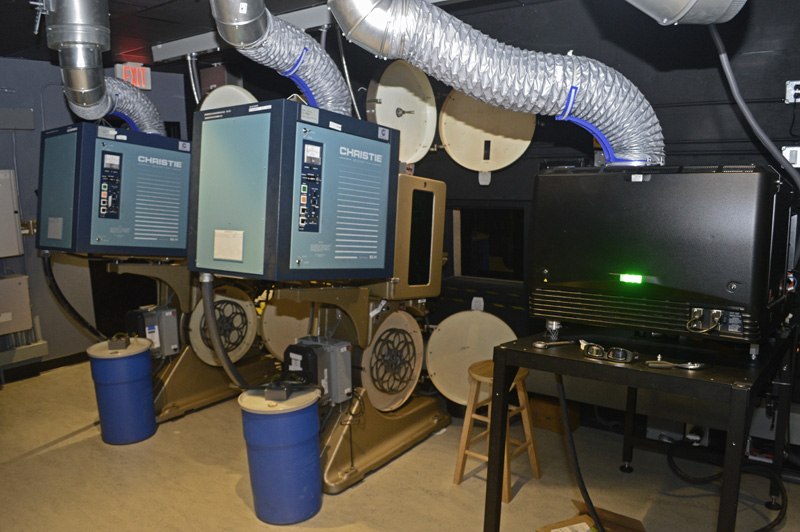
The "business end" of the refurbished booth, showing the two Norelco AAII (Philips DP70) projectors, with Christie lamphouses, and a Barco DP4K-32B digital projector. This is going to be replaced by a Barco 30L laser projector in a couple of weeks' time. Note the liquid cooling reservoirs below the film projectors: a very useful thing to have when playing nitrate prints. Even with the 6kW bulbs firing light through the film, the gate backplates feel cool to touch. The rectifiers are in a room directly below the booth.
We had to remove the SR-D, DTS and SDDS penthouse readers to get the nitrate magazines on. We are still trying to figure out a way to have both in place permanently, that will possibly involve building some sort of a blimp for the digital readers. For the meantime, they will have to be swapped on and off whenever we transition between nitrate shows and ones that need digital optical audio.
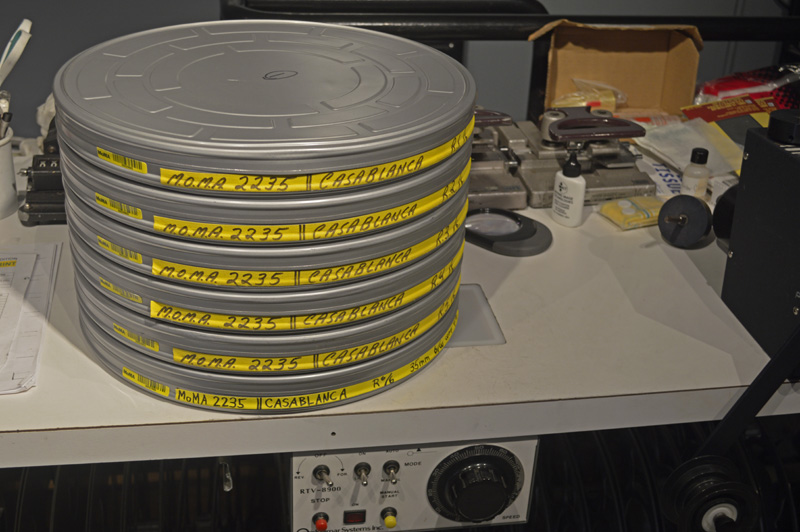
The print, as received from The Museum of Modern Art, via the Academy Film Archive. The plan is for all the nitrate prints we play to be shipped to the Academy initially shuttled to and from us from there, as their facility on Vine Street has proper cool, dry and safe storage, but we don't (apart from cabinets that will only hold a couple of feature prints).
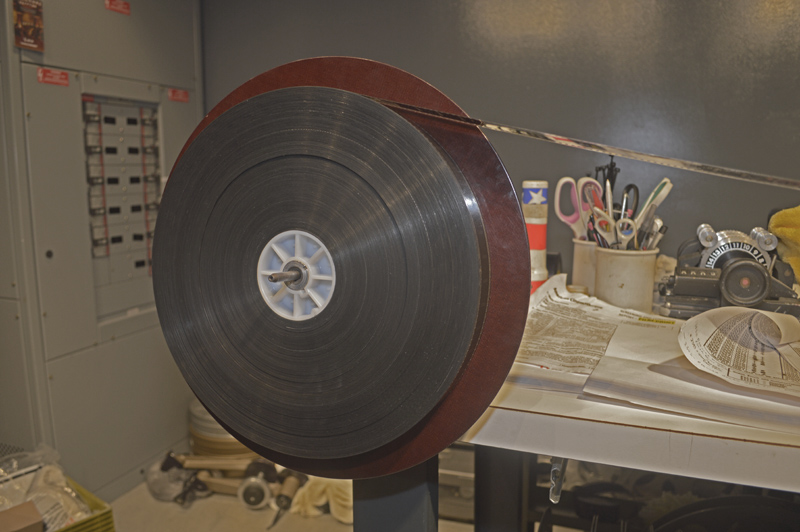
Inspecting reel 1. Note the very slight deformation of the film pack: this is characteristic of slight shrinkage. MoMA's report states that this print is an average of 1.5% shrunk: the CS sprocket teeth on our Norelcos can cope with up to 2% (ish) without any risk of perforation damage.
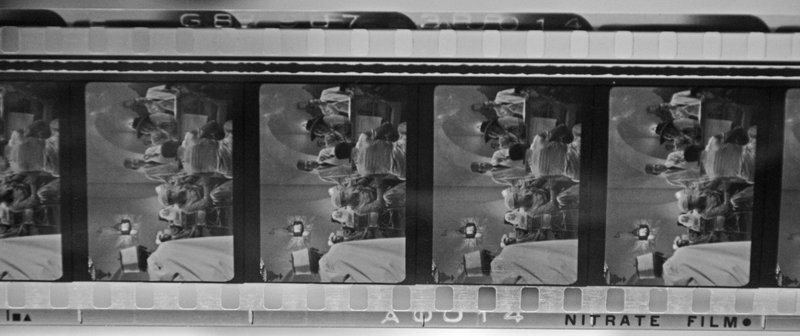
Positive edge code with nitrate identification and a date code on the extreme left. This date code is for 1947, indicating that this print is from a rerelease five years after the movie first came out. Note also the hard matte: with shrunken stock, you have to keep a very close eye on the framing, to avoid a frame line creeping into the projected image, because the shrinkage will not be even throughout the print, or even one reel. Unlike with most modern prints, framing is not a "set and forget" item with hard matted prints of this age.
Note also the RCA Duplex audio track: two unilateral tracks, but a negative image of a typical variable area track, and the bias lines are on the outside. These sound astonishingly good on nitrate - probably the best pre-Dolby optical audio system ever devised, IMHO.
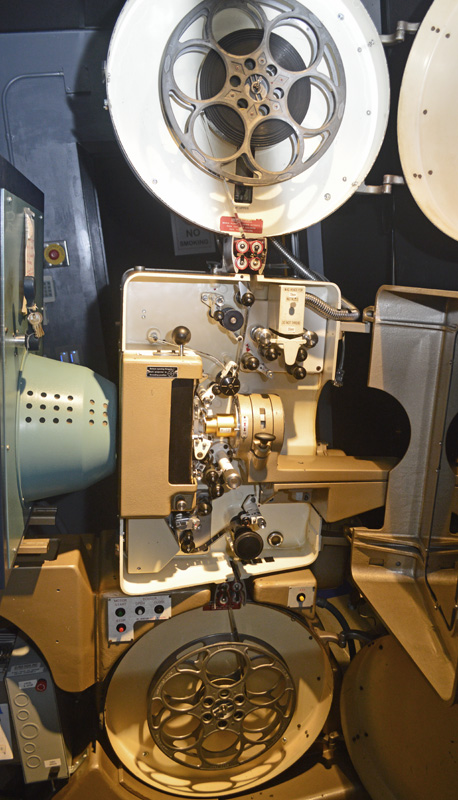
A reel threaded, but not quite ready to roll.
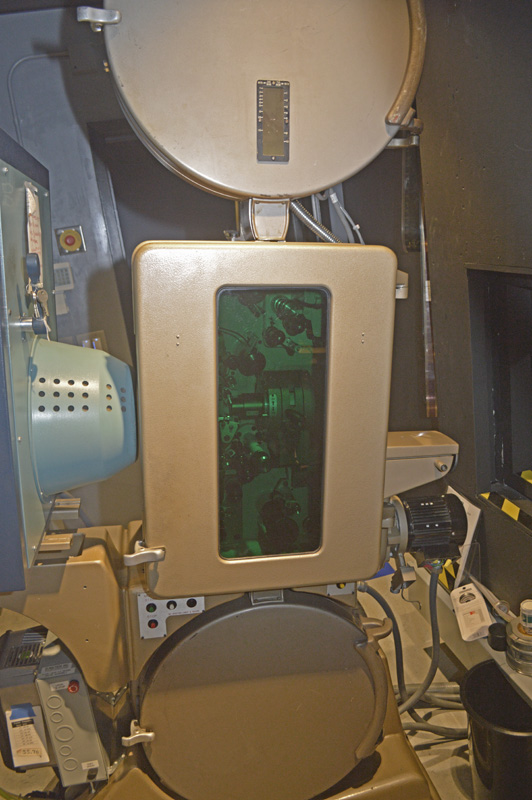
Now it's ready to roll! The magazines and mechanism cover must remain closed while nitrate is running with the lamp on. Even though it'll put some extra strikes on the bulb, we keep the lamp off during threading and until about a minute before each changeover, as an extra precaution. If the lamp were on, nitrate film was threaded and waiting to roll and then the liquid cooling pump failed, I wouldn't want to be next to that machine at the time.
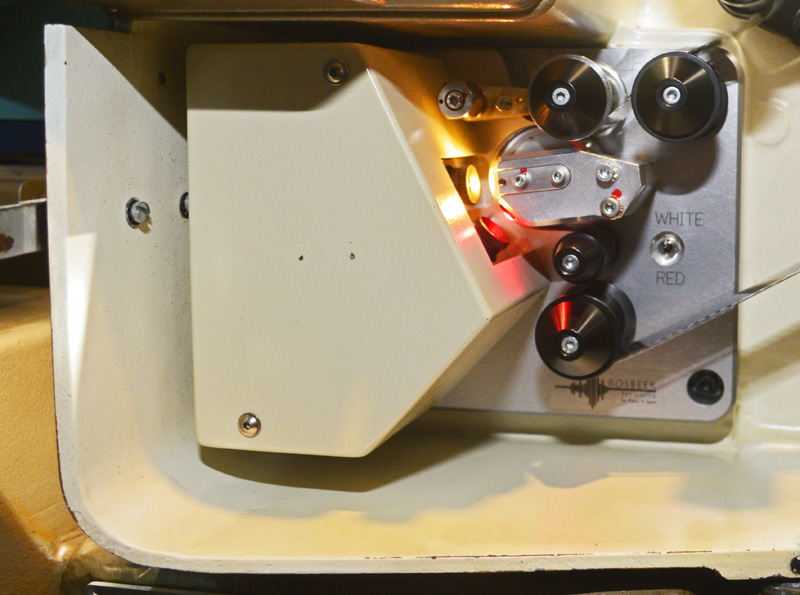
A very useful accessory to have for any theater that needs to project both older variable area prints and more recent ones with a cyan track: our Rosbeek Techniek dual white/red LED readers. Rosbeek takes your existing Kinoton analog/Dolby digital Norelco head and converts it to a dual white/red analog reader. Unilateral and RCA tracks have an order of magnitude more headroom and s/n with the white LED than they would with a red one, and sound significantly better even than with an conventional exciter.
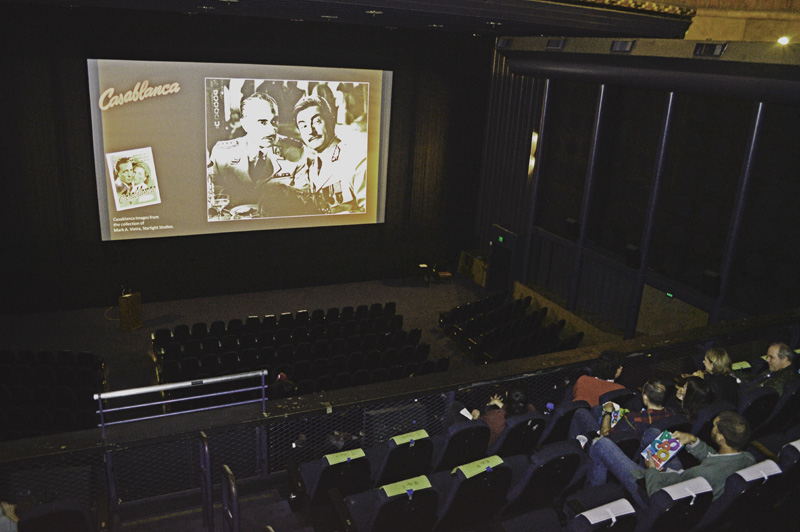
The audience arriving. The walkin Powerpoint shows are done by our publicity department. It's a nice touch to change the masking to 1.37 from this setting at the start of the feature, because the top and bottom bars move out, and so the screen gets bigger.
As for the show itself, there is definitely something in it to the claims that nitrate has a special look. This wasn't even the best (in terms of photographic quality) nitrate print that I've seen projected, but the detail in the image - especially in the midrange - is something I've only ever seen in a tiny number of acetate or polyester prints. Whether that's a quality of the nitrate base itself, a difference in the emulsion between 1302, 5302 and 2302, or something that labs did differently in those days, I don't know. In any case, it's great that we can now play the surviving nitrate prints out there for audiences to make up their own minds.
Last night's show was a private screening for an invited audience, mainly for the organizations that funded and sponsored the project, and American Cinematheque members. However, we have plans to start public nitrate screenings very soon, and I'll post details when things are finalized.
Posted by Mark Gulbrandsen (Member # 72) on 11-08-2016, 03:26 PM:
I'd be curious to know more about the Rossbeek, their site is very uninformative.
I would have retained the original Phillips reproducer and had the lateral guide roller on it split and spring loaded to eliminate film weave past the scanner. I've done that to many many Phillips reproducers, I;ve also received reproducers right from Europe that were already split. You just can't beat true white light on VD and on some oddball VA tracks and in a film fire the Phillips reproducer is gonna survive... the Kinoton... eh... likely not. Anyway the original could be swapped out with the Kinoton reproducer very easily if plugs were fitted. Amazingly the lateral guide on the Kinoton reader is also not split, so when it wears you have film weave. Yes, I know there is "supposed to be" a little taper in the thing so it runs one direction. I've found that isn't always the case. Definately not the case on the PK-60D reproducer which uses similar parts.
Your DTS Reader can mount inside the projector above the Shutter housing. Had the Kinoton scanner been left alone it would have been your SRD/Red Light, and for the occasional need for White Light the original reproducer could be swapped with it in minutes and with no alignment necessary if they are labeled which machine they go to. The mounting surfaces are precision machined. Some iffy decisions made in the sound end of things here IMHO. The rest of the booth looks great! Are the sound racks back where they originally were at?
Mark
Posted by Rick Raskin (Member # 1561) on 11-08-2016, 03:58 PM:
quote: Leo Enticknap
Note the liquid cooling reservoirs below the film projectors: a very useful thing to have when playing nitrate prints.
To clarify: Are you saying they did not previously have coolant re-circulators before the conversion? Every DP70/AAII I ran (JJs too) had them as part of the initial install. Yes, the cooling plate was always cool when running film, even with lamps pulling 150+ amps.
Posted by Scott Norwood (Member # 30) on 11-08-2016, 04:08 PM:
Nice pictures.
If that is the same print of Casablanca that played at the Eastman House Museum's nitrate weekend in 2015, your audience is incredibly lucky. Most of that is printed off of the camera negative and it is the best print of that title that I have ever seen (and probably will ever see).
I love that your nitrate-capable booth has a Barco in it, too. If only every theatre could be so well equipped to properly present the entire history of motion-pictures.
Posted by Leo Enticknap (Member # 534) on 11-08-2016, 11:51 PM:
Given the softness and lack of midtone in some of the shots, I'd be surprised if that print was straight from the camera negative. There again, I don't recall seeing any printed-through edge codes from an IP, so I guess it's possible.
quote: Mark Gulbrandsen
I would have retained the original Phillips reproducer and had the lateral guide roller on it split and spring loaded to eliminate film weave past the scanner ... Your DTS Reader can mount inside the projector above the Shutter housing. Had the Kinoton scanner been left alone it would have been your SRD/Red Light, and for the occasional need for White Light the original reproducer could be swapped with it in minutes and with no alignment necessary if they are labeled which machine they go to.
OK, but we're trying to get to a place whereby we can play all of the following:
- White and red light optical analog
- SR-D, DTS (35 and 70) and SDDS
- Mag (35 and 70)
With a bare minimum of reader and component swapping needed to accomplish format changes. So even if we were to do as you suggest (swapable Kinoton and Philips readers below the gate and swapable DTS 35 and DTS 70 readers above it), that would still leave the problem of the SDDS readers.
It may be that we have to bite the bullet and accept that the top nitrate mag will have to be swapped with one assembly containing all of the digital penthouse readers when converting the machines to and from nitrate configuration, but we're still looking for a solution that will avoid us having to do that.
quote: Rick Raskin
To clarify: Are you saying they did not previously have coolant re-circulators before the conversion? Every DP70/AAII I ran (JJs too) had them as part of the initial install. Yes, the cooling plate was always cool when running film, even with lamps pulling 150+ amps.
No: they've had liquid cooling ever since they were originally installed here, in 1998. I was saying that the design of the gate (to accommodate liquid cooling), while originally designed with the high heat environment of large screen 70mm projection in mind, happens also to be a big advantage for nitrate projection.
Posted by Steve Guttag (Member # 268) on 11-09-2016, 07:09 AM:
I've never been a big fan of that style circulator because that is all it is. It just circulates the water. In later designs, such as that one, they use a plastic tub that retains the heat picked off by gate and it gives it nowhere to go. Over time, the tank heats up.
MIT improved the design by putting a radiator on top of the tank with a fan so that it became a heat exchanger that actually pulled the heat off the gate and then blew it into the projection room. The designed still had this oversized tank involved. The purpose of the big tank is to buy one time in the hopes that one will not use it enough to heat the entire tank to ineffectiveness. Conversely, with a heat exchanger, there is no point to a significant reservoir.
I ended up adopting the same heat exchanger that the Series 0 (Mark VII) DCPs used.
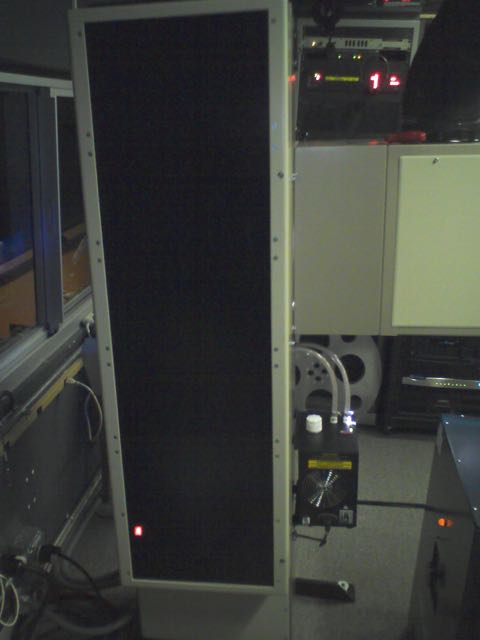
You have about a quart of coolant in the system, and you are removing more heat and it has less evaporation than the big tub. Using a good glycol like Tyfocor in a low 1:5 mix, you get YEARS on what little coolant you put in. They aren't cheap but they are far and away better than the tub o heating water. If you know of where any of the old MarkVII projectors (Christie or Barco) are and aren't being used, you can probably snag the Heat Exchangers off of them.
For higher wattages, nitrate or 16mm, I turn to chillers. BL&S turned me on to the Remcor brand. Again, low quantities of coolant are required (maybe 2-quarts) and it will maintain the temp at anywhere you dial it in (you don't want things so cold that you get condensation but 65F is a good target. Heat is the enemy of nitrate.
Posted by Mark Gulbrandsen (Member # 72) on 11-09-2016, 05:39 PM:
Well, Had the Kinoton reproducer been left alone then all but SDDS could be done within the projector head itself.
Not sure doing SDDS is even worth it because it is so unreliable of a system from the film itself all the way through to the processor. You just don't know if a given print will play back reliably or if the equipment sits unused for a long period if it'll even function again. I know there may be a few films that only have it and I understand the archival aspect of keeping it available. But only for SDDS that scanner will likely have to go outside the head. And is the hassle of removing magazines worth it when 99.8% of all movies are Quad Track...? Also in many cases the Analog SR tracks will way outperform the digital tracks of all three manufacturers. True Lies was a very fine example of where they got the SR track sounding way way better than the digital tracks were doing.
Agree with Steve on the coolant tanks. The thing about the Egyptian though is it is one or two showings and then nothing for a while. So not sure the water there has a chance to heat up very much in the duration of a 20 minute reel. If they run shows all day then it's probably gonna be steamy hot at the end of three or four showing in a row.
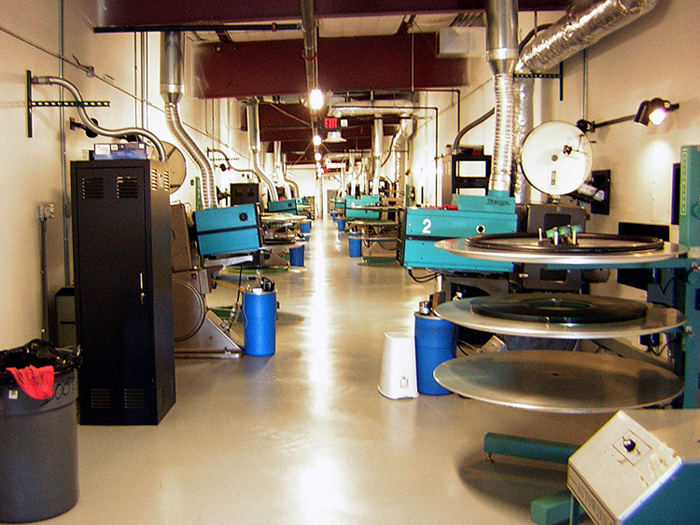
When I worked at CLACO we made similar tanks in the shop from scratch but added an automotive heater core and 4" muffin fan sitting on top to keep the water at room temperature. This could be easily added to those two coolers for about a hundred dollars in parts. The heater cores were around 40 bucks each at an auto parts store. Then you need the two fans and some copper fittings to connect it to the output of the tank. The return line feeds the heater core and thus keeps the returning water very close to room temp. Similar to how the old Ashcraft coolers worked.
Posted by Leo Enticknap (Member # 534) on 11-10-2016, 12:38 AM:
The low tech, bucket and pump cooler might be crude, but it's all we need. I'm guessing that the volume of liquid coolant in the container is large enough that it can hold all the heat that is carried away from the gate during the period the lamp is on (5-6 hours is as long as it's ever on continuously in our pattern of usage). In any case, at the end of the evening, the front of the gate backplate is still cool to the touch, and if you feel the side of the bucket, it is just a little warm, but the liquid inside can't be even close to hot.
If we were running those lamphouses for 10-12 hours at a time we might need something a little more sophisticated, though.
As for SDDS, keeping all the audio formats we had and adding the nitrate mags is a significant engineering challenge, but it is one we want to address. Point taken that if we accepted the loss of SDDS, all the others could be accommodated inside the chassis, but we did play an SDDS print from the 1990s and '00s probably every 4-6 weeks on average before the refurb, and some of our regular customers can hear the difference and give us feedback on it.
Posted by Lindsay Morris (Member # 1430) on 11-10-2016, 02:49 AM:
Leo, No idea as to what power your lamps run at but when I converted the outdoor venue from a pair of Simplex standards running carbon arcs @55A to the Century CC with a Lumex on the back running around 65A I had to setup water cooling.
The CC came with the water cooling gate assembly being an ex drive in unit & ran blistering hot without any water cooling. So hot in fact it was impossible to reliably set the screen focus as it continually moved about.
Seeing it got so hot I thought I would need plenty of water capacity so used a 200L plastic barrel sitting outside the bio as a reservoir.
Problem with that was the kids were able to lift off the lid & splash the coolant over each other. The temp in the barrel rarely got above ambient so tried a 20L barrel...just got warm by the time the night session had ended.
To keep the kids from messing with that one I shifted to just outside the front wall of the bio up on a stand so it was above the gate height inside & partly hidden by garden plantings.
When the pump died one night I thought I was in trouble but the system neatly thermo syphoned & the gate ran as cool as.
So whipped the pump out & for the remaining 5 years of film before digital it thermo syphoned quite happily.
Occasionally on very hot nights the aperture plate MIGHT get a bit warm but as compared to running with NO cooling as done initially (where one burnt the fingers on the aperture plate when you swapped it on a format change after 20mins of running) the water cooling worked a treat.
Hot nights were after 40C+ days so ambient often still 32C at 8pm.
Good to see some nitrate still being screened & I can still remember the guy who trained me grizzling that Safety Film was like looking at an image thru flywire up close. Nitrate he claimed was as clear as which he frequently pointed out to me as there were still quite a few nitrate prints being screened in 1958 here in Australia.
Only ever saw one fire where a cartoon broke & went up. Took all the paint off the feed spool box is seconds and there was probably only 50 feet of film left to run...absolutely intense heat AND smelly. ![[Smile]](smile.gif)
Recently the old CC found a new life running odd clips & shorts for copying to DVD purposes & the group I sold it to had issues with a bundle of film that a client wanted copying.
It had been stored for years as a number of tightly rolled rolls. They were almost impossible to get to lay straight in the splicer but we got them all spliced & run thru & copied AND it was full frame silent stuff. Although I could not see nitrate printed on the edge printings it certainly had that look about it and after we had done the copying I grabbed the offcuts from the splicing process & set them alight in a tin can outside.
One match and whoosh it all went up in seconds and the tin was red hot.
Turns out the shots were from movies made by the clients grandfather who was an actor in Europe & these rolls of nitrate stuff had been stored for years in the family home just sitting in a cupboard ![[Roll Eyes]](rolleyes.gif)
The lot went back on a bobbin & big note attached warning that the stuff was highly flammable & should not be kept in the home & would be better off being destroyed now they had a DVD of the shots.
Posted by Mark Gulbrandsen (Member # 72) on 11-10-2016, 01:45 PM:
I agree Leo, SDDS can sound better... when it works.
Mark
Powered by Infopop Corporation
UBB.classicTM
6.3.1.2