This is topic Screen fabric/ material in forum Film Handlers' Forum at Film-Tech Forum ARCHIVE.
To visit this topic, use this URL:
https://ft-forum.com/ft/cgi-bin/ubb/ultimatebb.cgi?ubb=get_topic;f=1;t=012053
Posted by Jonathan Wood (Member # 4614) on 09-12-2016, 03:14 PM:
Hi all,
I'm looking for a small amount of screen material, does anyone know a brand name or a generic type ? I know I can go to Harkness Hall etc, but I imagine they must buy it from somewhere ? As ever , grateful for any help or advice !
Thanks , Jon
Posted by Dave Macaulay (Member # 813) on 09-13-2016, 05:19 AM:
What's a "small amount"?
You can certainly get sample books from screen suppliers, but the pieces are very small. They will supply larger samples (like a foot or two square) if asked, but we are regular clients.
I've salvaged bits of replaced cinema screens (from physical damage where repair was impossible - slashing or something thrown at it) for small "boardroom" size screens. Most service companies probably have a few bits of screen sheet lying around.
What reflectivity do you want? What perfs? Cinema standard perfs are too big for small screens where the viewer is close.
Posted by Jonathan Wood (Member # 4614) on 09-13-2016, 09:34 AM:
Thanks Dave, I'm just looking for enough material to make a 6 foot wide non perf screen. I was wondering if there was a specific type of material that screen manufactures use. My thought being that I could source it direct rather than go through a theatrical supplier. (I'm told home cinema enthusiasts often use white blackout material from curtain shops) I've done a bit of experimenting and noticed that very smooth surfaces tend to look slightly less sharp than material with a fine lines etched into it. This is of course perhaps subjective , but it might make sense that the smooth surface reflects light more widely whereas the finely lined stuff might reflect more parallel light and in some way increase sharpness. This could all be in my head (!) but it does honestly look sharper when examining the fine detail on RP35 ? Jon
Posted by Mark Gulbrandsen (Member # 72) on 09-13-2016, 10:22 AM:
Screen manufacturers actually have the material manufactured to their design spec. And then they do all the coating of the screen surface. So you are really stuck getting it from a screen factory if you want actual screen material. Note that the three screens sold here are all different thicknesses with Severtson Screens being the thickest. I prefer Severtson and then Harkness in that order. MDI is a bunch of assholes, never call the factory to ask any questions! Although the screens are fairly good, they also the thinnest of the lot.
Mark
Posted by Jonathan Wood (Member # 4614) on 09-13-2016, 11:51 AM:
Thanks Mark
Posted by Brad Miller (Member # 2) on 09-13-2016, 11:52 AM:
quote: Jonathan Wood
My thought being that I could source it direct rather than go through a theatrical supplier.
Jonathan - If it was that simple, all of the theaters would be doing it.
quote: Jonathan Wood
I'm just looking for enough material to make a 6 foot wide non perf screen.
Non-perf and 6 foot wide eh? Just head on over to whatever UK's version of Home Depot is and pick up a sheet of white formica kitchen counter top. They will have sample colors, and you want to pick the whitest one. It works magnificently for a non-perf screen, and they are typically available in sizes up to 5x12 feet. The reflective pattern of light is very smooth and great for off-axis viewing, which you are likely to have in a home environment.
As an added bonus, it's also inexpensive and you can run bad movies on it and let your audience throw tomatoes at the screen since it wipes clean easy. ![[thumbsup]](graemlins/thumbsup.gif)
Posted by Jonathan Wood (Member # 4614) on 09-13-2016, 02:21 PM:
Thanks Brad (I think ?!)
I'll be off to Homebase on Saturday !
It will be ideal as I ONLY show bad movies ![[Wink]](wink.gif)
Posted by Marcel Birgelen (Member # 6801) on 09-13-2016, 05:27 PM:
I know a lot of people that go berserk over non-perf screen material, especially for their home theater and I just don't get it to be honest.
As soon as you have to put speakers behind it or have to do polarized 3D or you're operating at the limits of what your projector can handle, it's getting a bit more complicated. But I've had a wall triple painted with the most neutral/whitest paint we could get at the local version of Home Depot. We had it masked like you would do with a proper screen. It calibrated just fine and without any perforation, it even looked great up close...
Posted by Buck Wilson (Member # 5885) on 09-13-2016, 08:14 PM:
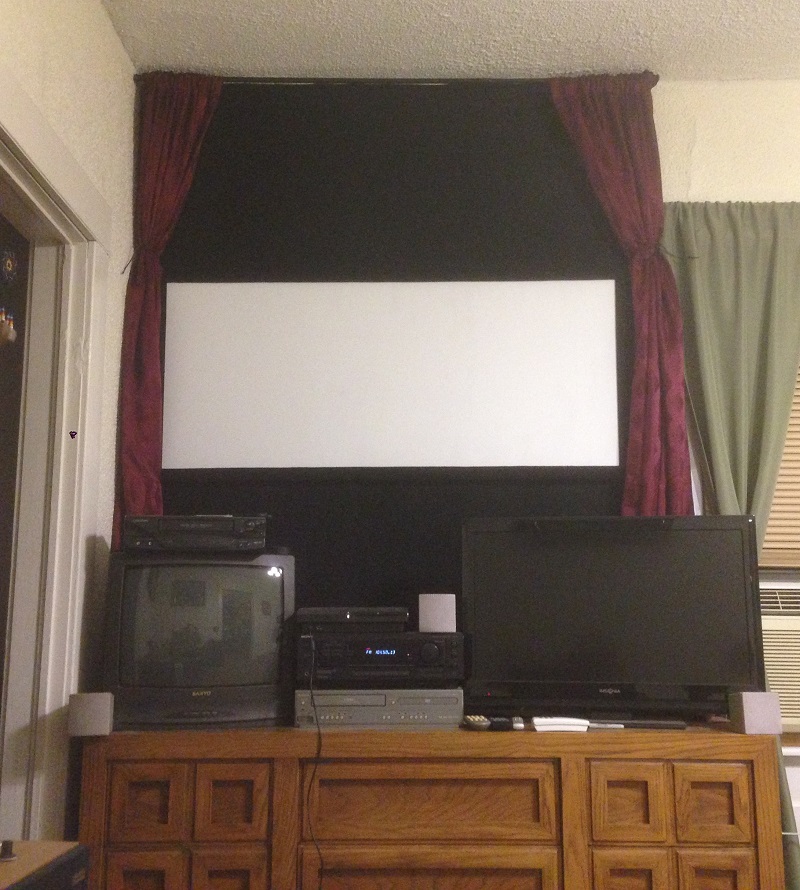
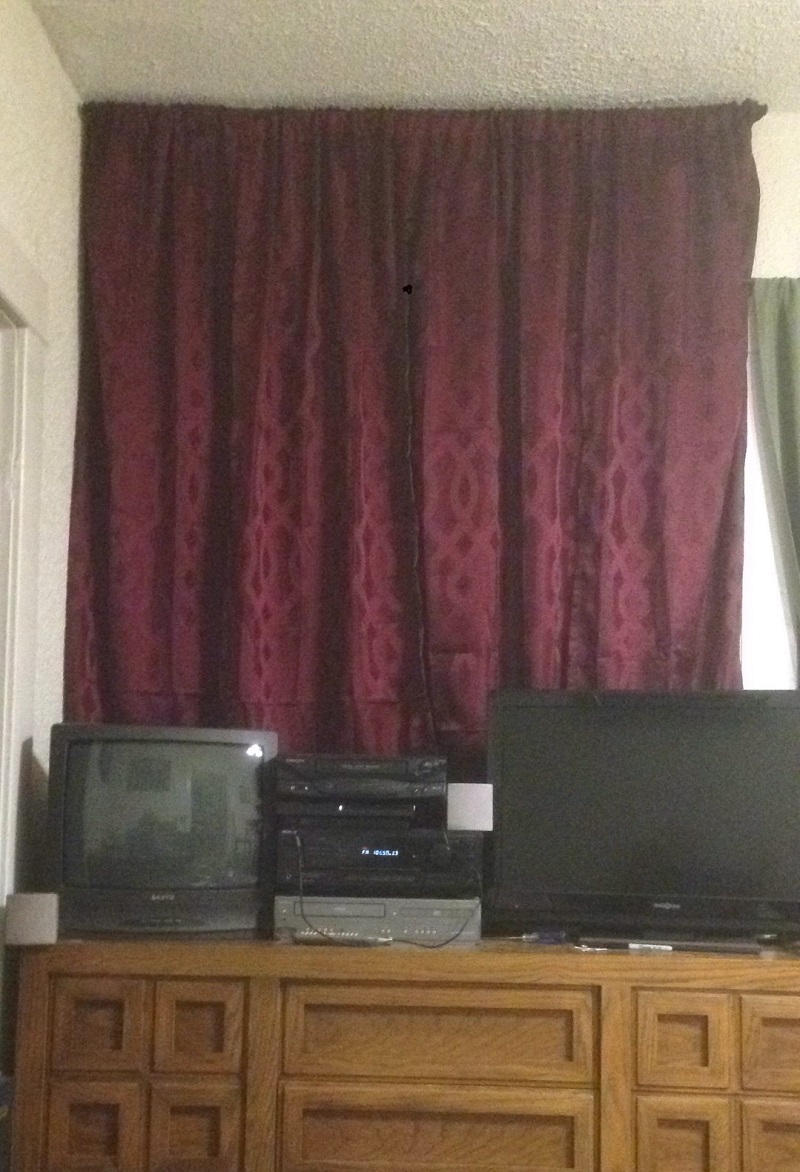
Here's my janky setup. I used a piece of some sort of project board. It's like 1/4" thick. Its like plywood, but very smooth. It came primed, I added 2 coats of flat white paint. All masking fabric is black fleece.
Not bad for EXTREME low budget. I still have a couple of finishing touches to do, but it turned out much better than I was expecting.
Posted by Brad Miller (Member # 2) on 09-14-2016, 12:17 AM:
Jonathan, that was not sarcasm. All through my college years I had a 5x12 formica screen in my apartments. It works really well.
Posted by Sean Weitzel (Member # 244) on 09-14-2016, 12:56 PM:
White expanded PVC sheets work very well also.
Posted by Jonathan Wood (Member # 4614) on 09-14-2016, 03:00 PM:
Hi Brad , no worries , I realise that,
I am going to follow your advice and try it out , another bonus is its going to be perfectly flat , so I won't have to worry about tensioning.
This might sound like a dumb question but does screen surface affect perceived sharpness? I ask this because I noticed when I did a side by side comparison of smooth regular tripod type screen material with a more rigid very finely horizontally grooved white pvc material , the grooved material seemed slightly sharper? Cheers Jon
Posted by Monte L Fullmer (Member # 2797) on 09-14-2016, 04:11 PM:
Even a white regular bed sheet works good. Six feet should be a size full sheet.
Just have to iron it first, then mount it on the frame (which you can use PVC tubing and corners) and stretch accordingly to get the wrinkles out. Make you a real nice floating screen this way.
Nice thing about using bedsheets is that sound still passes through the material when you place your speakers behind it.
Good luck - Monte
Posted by Rick Raskin (Member # 1561) on 09-14-2016, 05:19 PM:
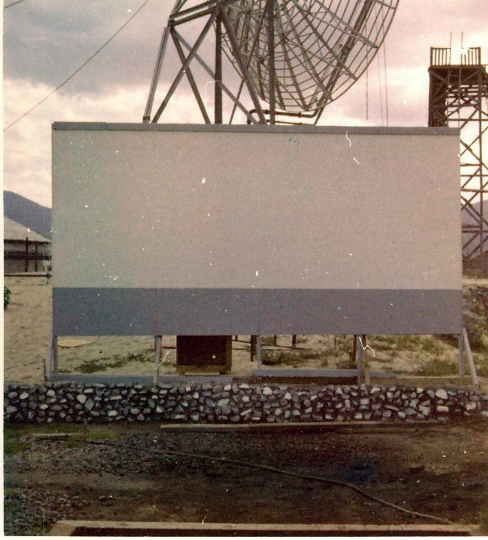
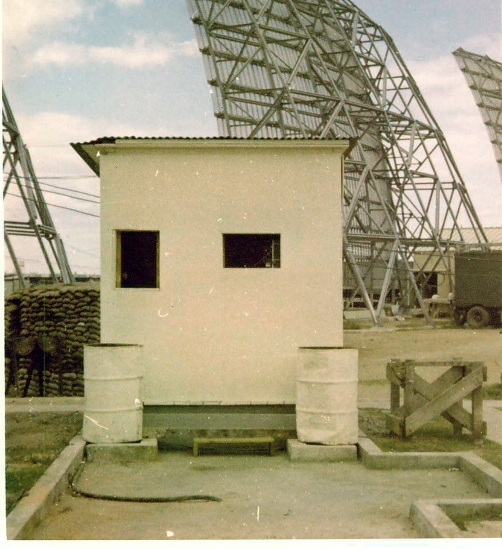
When I was in Vietnam in 1967 we had 4 sheets of plywood pained white. 16mm looked fine. Nothing compares to watching the TV show "Combat" while the real stuff was going on nearby. These were taken at a Tropo site in Nha Trang.
I was there in 2010 and there is no trace of the site ever having been there.
Posted by Ian Partridge (Member # 9377) on 09-15-2016, 05:56 AM:
A roll of Colorama 'Arctic White' photographer's studio backing paper may suit for projection. The surface is designed to give an even flat reflection and will reproduce your projected image detail without a hot spot that may occur with a polished surface.
Unlike your standard fold-up screen when it gets a marked or kinked, you can use the other side or replace from the roll.
Ian
Posted by Bill Brandenstein (Member # 7758) on 09-15-2016, 02:41 PM:
This has been an interest of mine for some time but haven't yet pulled the trigger. I can hang an 83" Draper on our shed to do our occasional backyard shows, but that's way too small for scope, and a standard pull-down screen at a suitable width is both cost and weight prohibitive. So Brad's Formica idea has intrigued me for some time.
Our local Home Depots don't seem to have Formica wider than 96". Perhaps on special order they can get the 120" widths, I haven't tried yet. The widespread availability of it worldwide is also a huge advantage.
However, Sean mentioned an idea that I've also been toying with: a PVC sheet. It can be as thin as 3mm and have excellent matte reflective properties, at 3mm or 6mm can be rolled up when not in use, and because it's PVC, it can be painted with high-gain and black matting paint if so desired. There are many PVC products on the market, but an expert in the business has suggested to me a patented product called Sintra, which may not be conveniently available in your area, but can be viewed at Foam Board Source. And even THEY don't offer the 120-inch size!
What we've been considering is having them fabricate a 146-inch wide screen by glueing "wings" on the ends, and with a paint job, the seams should become invisible.
Formica sounds like a LOT easier!
Posted by Rex Oliver (Member # 7593) on 09-17-2016, 12:34 AM:
Improvised projection screen-for those on a really tight budget-try using the back of an old vinyl billboard poster-of course it must be white.Old billboard posters can be ordered quite cheaply from Billboard Tarps.com.the backs of these are either white or black.The Formica idea sounds great-but being rigid cannot be folded or rolled for transport or storage.You may have to clean the billboard poster before projecting onto it.Easily done.These are not perforated either.But for budget use-its fine.
Posted by Frank Angel (Member # 248) on 09-18-2016, 12:14 PM:
Monte, yes....that works! Years ago (1966 or so) a HS in West Haven CT handed me two Holmes projectors -- navy model, I think -- and asked if I could get their gym/auditorium to double as a "movie theatre". And do it on the cheap...very cheap. With a little cleaning, lub and outfitted with change-over dowsers, the projection end was easy, although I had to cut three port holes in the cinderblock wall of the coach's office to make it the projection booth (I was not his favorite person thereafter).
Because of space limitations, I had to mount the projectors one on top of the other on a stand the kids made in wood shop. Unconventional, but it worked and I don't argue with success. But what to do about the screen?
The auditorium had a stage with a fly system -- quite unusual for a HS auditorium, but it served me well. I had the head of the Theatre Crafts dept build a frame about 35ftx15ft (not quite Scope, but had physical restraints). Next went out and bought bed sheets -- lots of them; cheap ones. I had a few volunteers from the mother's auxiliary sew the sheets together and the finished big sheet was attached to the wood frame as taut as possible. It looked decent.
Next up, finding the cheapest flat white paint -- in 1969 I recall it was something like $6 a gallon. Had the kids paint the sheet and then low and behold and much to my dismay, the moisture of the paint caused the sheet material to sag and droop everywhere. I was really up the creek. Thing is, the next morning I came back thinking I would have to come up with a different solution, but there was a perfectly flat, tight screen with not a wrinkle or sag in it and taut as a drum head. Sometimes physics works for you. Seems, yes the paint caused the material to stretch and sag, but when it dried, it shrunk and pulled everything very tight.
First movie we ran was HELP! In those days the exchanges dubbed the HS as a "shut-in" and the studios gave us prints just off the break for a "handling fee" of $10; I kid you not. Yah...those were different times. Fun times, actually.
I can vouch for the formica material. Used that in my nephew's video projection setup and it worked like a charm. I've also used foamcore material, and while it had good reflective properties, occasionally from an off-axis angle it would speckle very slightly. I used it in a conference room setup. I thought perhaps if I used a very fine sandpaper and sanded the entire surface it would eliminate the shine, but it was only way off-axis and even then wasn't bad enough to try any questionable stuff. The nice thing about the foamcore as opposed to formica is the weight -- the foamcore obviously being much lighter.
Powered by Infopop Corporation
UBB.classicTM
6.3.1.2