This is topic Panastereo opt. preamp. in forum Film Handlers' Forum at Film-Tech Forum ARCHIVE.
To visit this topic, use this URL:
https://ft-forum.com/ft/cgi-bin/ubb/ultimatebb.cgi?ubb=get_topic;f=1;t=012055
Posted by Rob J. Buskop (Member # 3338) on 09-15-2016, 11:44 AM:
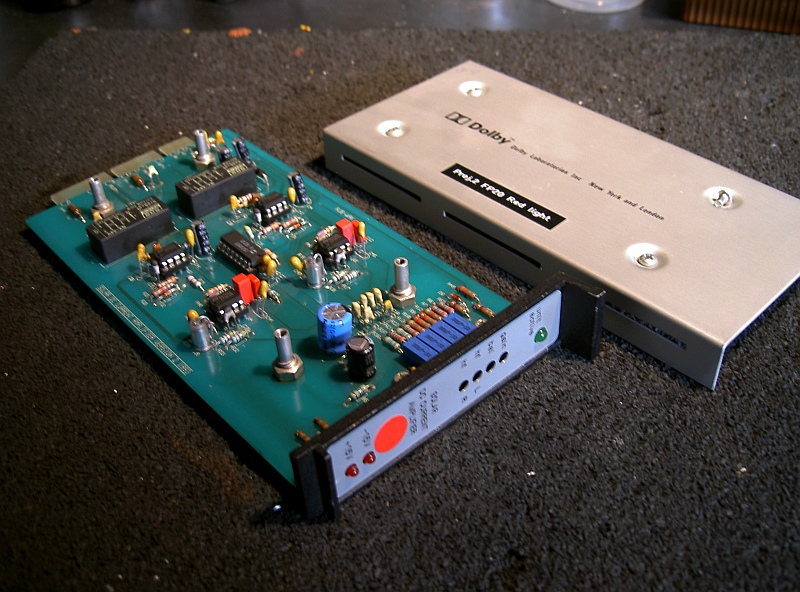
Have some 20 years ago developed new preamps as replacements for the oldies in my CP-100. Have based the design on the Kintek's with the trans impedance inverting opamp. This has served me very well. Excellent roll-off correction and very stable with a huge gain range. A while a go I had some weird "hesitating" level with the symphonic play-out of an SR movie. (House of the spirits). Somebody suggested to try another preamp, so I temporarily inserted a cat.240A into the A chain. The lack of level-smoothness was about te same, but while exactly regulated on the analyser like the fromer preamp, I detected a somewhat clearer sound (piano!) and a slightly less bass area. Amazing since the analyser readiings were duplicates of each other. Anyway that set things in motion again: Should I consider doing another mod? SR has always been "noticeable" to me for it's clear signal processing and non-ideal smoothness. Remember that Mark G. always raved about the Panastereo preamps. Does anyone have a schematic of these? It's a bit like going back to the old hi-fi days when we compared carts, preamps and speakers and had long discussions about all this. So...: Back to the old days. Love to hear your ideas and commentaries!
Posted by Rick Raskin (Member # 1561) on 09-15-2016, 11:53 AM:
Please insert a bracket [ before the IMG tag so we can see the picture.
Posted by Rick Raskin (Member # 1561) on 09-15-2016, 01:44 PM:
Thanks
Posted by Mark Gulbrandsen (Member # 72) on 09-16-2016, 05:16 PM:
No, I do not have any schematics Bob. Sadly those retired with Norm Schneider of Smart. I do however have a Panastereo CSP-1200 here in my home system. I can post any pictures you want. You might also contact Ray Derick who was the designer of it. He is on Facebook and lives down under. I can't say if Ray can even tell you what's in them or supply schematics or not since that entire product line was sold to Smart Devices.
Also, it's not JUST the preamp stage that's good sounding. It's the unit as a whole and in particular the SR noise reduction. It still has no equal to this day for overall sound or build quality.
Mark
Posted by Scott Norwood (Member # 30) on 09-16-2016, 05:23 PM:
quote: Rob J. Buskop
It's a bit like going back to the old hi-fi days when we compared carts, preamps and speakers and had long discussions about all this.
Don't people still do this? I have met a few 78 collectors and they are a particularly picky bunch, since the playback hardware characteristics had not yet been standardized when those records were made. It is truly amazing how good some 1940s recordings can sound when played back on modern, high-end equipment.
(Now back to your regularly scheduled film discussion....)
Posted by Mark Gulbrandsen (Member # 72) on 09-16-2016, 09:13 PM:
quote: Rob J. Buskop
It's a bit like going back to the old hi-fi days when we compared carts, preamps and speakers and had long discussions about all this.
Yes, people still do this and there is an entire high end audio industry out there.
Mark
Posted by Rob J. Buskop (Member # 3338) on 09-17-2016, 04:47 AM:
Yes, and is'nt that wonderful! Have a few friend who are really deep into that. Have a Technics SL-15 myself...From what I wrote you can rightfully deduct that I'm still deeply attached to my CP100. With it's discrete, very neat wiring it allows you to alter or add functions elegantly. Also interesting to find the odd error where for example the schematics are correct and the PCB layout proves to be faulty... Correct these things and wow.. it's even better! In the end I find it a lovely analog processor that, with the mods and additional functions I put in, does everything I want it to do beautifully. Anyway, I'm always in for some tweaking of the system and that's why I started this post. Thanks Mark for your reply. At some time in the past you mentioned that you had experienced a fairly large difference in the characteristics of the cat.240 and the cat.240A. Could you possibly elaborate a little bit more on that? One thing I personally like about the Kintek design approach is that they've designed the roll-off correction with a standard steepness (which is right of course) and one just moves the roll-off point along the 0 dB line and in doing so one chooses where the standard boost has to start and in doing so gets a perfectly straight response. With the Dolby approach, the roll-off point is fixed and the amount of boost is adjustable, which with a somewhat older standard reader always gives a bump at around 8kC. The inverting amp idea is also good although they've put a R of 330 Ohm in series with the inverting input... These things have a huge gain and a pre-pre for red light in not necessary. There's ample amplification available.
Do any of you have experience with sonic differences between the
afore mentioned pre's and possibly others?
Posted by Steve Guttag (Member # 268) on 09-17-2016, 07:31 AM:
The biggest difference I remember in the CAT240 and CAT240A was the switch from a transformer based input to an active based input. As for Panastereo, it was the best preamp I worked with. You could get ruler flat responses and even when setting up Azimuth, you'd get better straighter lines on PN.
The preamps are around (inside CSP1200s) and Ray Derrick is as well (both here and on Facebook). It is definitely worth looking at, if you like to tinker.
Posted by Sam D. Chavez (Member # 1841) on 09-17-2016, 12:59 PM:
Main difference between the 240 and A version is the active balanced front end vs. the transformer on the earlier version. It's quite an esoteric design but don't notice any sonic improvement.
I just did a project in an old movie palace that used Component Engineering readers with a CP65, 4 projectors. Old electrical power, different panels, etc., no real electrical ground. The CE reader would hum when used with a 240A but was totally happy with the 240. Tried all sorts of tricks to dodge the problem. No luck at all. There's no substitute for a transformer for true isolation.
The CP100 preamp slot did have a fairly well known crosstalk problem between left and right and you could see it come up on the Dolby level meters when applying slit loss. It would break into ringing if boosted enough. I concluded at the time it was in the edge connector wiring or board layout but can't recall the details. Something to watch out for though.
Posted by Steve Guttag (Member # 268) on 09-17-2016, 06:36 PM:
I seem to recall that the CAT108 also had crosstalk issues on the earlier versions. It was fixed before the 108C though.
Posted by Sam D. Chavez (Member # 1841) on 09-18-2016, 12:16 AM:
Actually the 108C was the fix for crosstalk. I think it the crosstalk was on projector 2.
Posted by Steve Guttag (Member # 268) on 09-18-2016, 04:35 AM:
Are you sure? I think the 108-4 had the fix. The 108C added in the ground plane fill, which, I'm sure, improved its performance yet again. But I'd have to dig up the various schematics to prove it (for something that just doesn't matter anymore anyway) but if it was the 108C, then so be it. The 108C was a good preamp for the CP50/200.
Posted by Sam D. Chavez (Member # 1841) on 09-18-2016, 12:04 PM:
It's true, it really does not matter. As I remember there was some clever little trick like feedback to minimize the inherent crosstalk issue (due to backplane issues) as well as a number of other enhancements on the 108C. But my memory is far from infallible after all this time.
The more important overall point is this the kind "values" Dolby practiced. Going back and fixing and improving circuitry on processors out of production just to get closer to ideal. Privately held companies bearing the owners name get to do this. At its best, Dolby was run as a laboratory that picked the right products and made money. The rest is history.
Posted by Steve Guttag (Member # 268) on 09-19-2016, 09:41 AM:
So I checked anyway. The crosstalk circuit was added for the 108-4 and was implemented 9FEB1982. It was the first revision of the CAT108 that I could find. The "fix" was a form of feedback from P1 right to P2 Left.
Posted by Sam D. Chavez (Member # 1841) on 09-19-2016, 01:51 PM:
Keep looking. Who you going to believe, me or your lying eyes?
Posted by Rob J. Buskop (Member # 3338) on 09-20-2016, 08:56 AM:
I have to extend my compliments to the memory of Mr. Chavez. When I got interested in the CP-100 in 1992, one of the first things that became apparent was the "less than ideal.." design of the preamps indeed. What was even more unpleasant than the crosstalk, was the fact that the designer(s?)had introduced a HF feedback set-up that effectively at higher gains worked like a positive feedback, with strong oscillation tendencies. If you pushed it a little bit.., wham!.., there it went with the meters jumping against the stops. Awful. That's when I started with the new design, based upon the principle of the inverting preamp or current to voltage schematic as also done by Kintek some time before.
The end result as shown above is working flawlessly, but as we designed it in 1993 (!), the academic question is: Is there any improvement attainable by implementing later design philosophies?
How does it compare to Cat.240 & 240A or Panastereo's performance? I'm now in the process of trying to get an analytical answer from Delft Tech University where they might be willing to me a favor and do a computerised analysis of the different designs.
I'm going on a 2 week holiday now, but will continue this quest on my return and will keep you posted on eventual outcomes of interest. All your imput has been highly appreciated. Thank you!
Posted by Mark Gulbrandsen (Member # 72) on 09-20-2016, 11:33 AM:
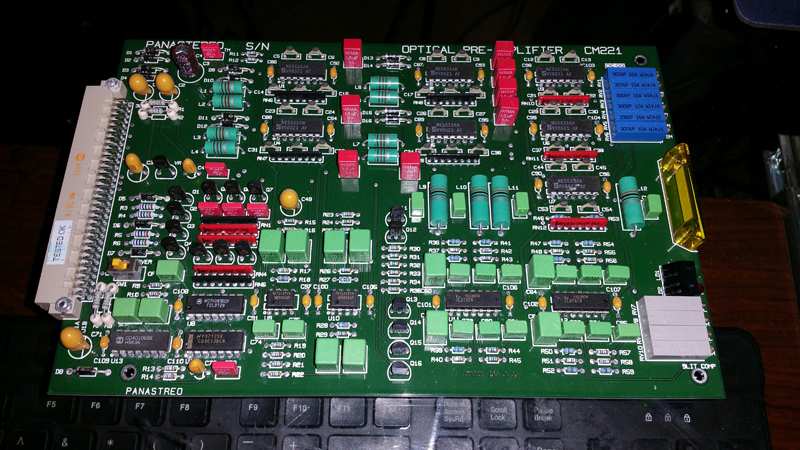
For those wondering what the Panastereo preamp is here is a picture of the little jewel...
Any collector that is truly serious about film sound should seek out an entire CSP-1200 processor. Not just the preamp card. There is way more to it than just this single card!!
Posted by Fabian Schreyer (Member # 5120) on 09-21-2016, 03:20 AM:
By the way: How do the Cat. 108-4 and 108C compare? I have always been told that the C-version would be a HUGE step from the 108-4.
Posted by Steve Guttag (Member # 268) on 09-21-2016, 07:12 AM:
The depending on who's findings your believe from above...your results may vary.
The big change is the ground plane fill. There were also some loading resistors added to the output of the preamp but the essentials of the it remain unchanged. I think they reworked the slit loss correction slightly to be be more friendly to reverse scan readers (flatter response).
Posted by Rob J. Buskop (Member # 3338) on 09-21-2016, 08:48 AM:
Thanks Mark for posting that nice picture of the Panastereo preamp card. Does it work as a transformerless balanced input? I suppose it does. Of course I fully agree with your statement that
this is just a part of a, as a whole, superior system. In this case however I'm just trying to find out about the possible design- and performance differences between a group of optical preamps.
I think I've located Mr. Ray Derrick and hope he'll be able to supply me with a schematic so we can do a full scale comparison as planned. Have the schematics of the Cat.240 and the 240A, so with the Panasound's and my Kintek adaptation we have four examples of different pedigree. Very interesting!
Posted by Gordon McLeod (Member # 33) on 09-21-2016, 09:57 AM:
It is balanced input with no transformer and treats the cell as a current source so it has verey low distortion
Posted by Steve Guttag (Member # 268) on 09-23-2016, 08:50 PM:
I looked at a 108-4...didn't find the feedback compensation circuit. Well played Mr. Chavez.
The layout of the 108C is also radically changed (and done via computer) versus the original 108.
Posted by Sam D. Chavez (Member # 1841) on 09-25-2016, 12:26 PM:
Thank God my memory served me well this time.
Powered by Infopop Corporation
UBB.classicTM
6.3.1.2