This is topic There's a Brand New 70mm Print of "2001" BUT . . . in forum Film Handlers' Forum at Film-Tech Forum ARCHIVE.
To visit this topic, use this URL:
https://ft-forum.com/ft/cgi-bin/ubb/ultimatebb.cgi?ubb=get_topic;f=1;t=012067
Posted by Mark Ogden (Member # 43) on 10-06-2016, 12:46 PM:
. . . only Leo gets to run it. Ha! ![[thumbsup]](graemlins/thumbsup.gif)
[URL=http://www.latimes.com/entertainment/movies/la-et-mn-american-cinematheque-2001-a-space-odyssey-20161006-snap-story.html]http://www.latimes.com/entertainment/movies/la-et-mn-american-cinematheque-2001-a-space-odyssey-20161006-snap-story.html[/UR L]
As part of the ongoing Beyond Fest, on Sunday night “2001: A Space Odyssey” will show at the Egyptian Theater in Hollywood with actors Keir Dullea and Gary Lockwood in attendance. And while that is cause enough for excitement among movie fans, it is possible the real star of the evening could be the physical print of the movie itself.
The event will be the debut screening for a new 70-mm print that the American Cinematheque will have exclusive exhibition rights to in a five-year deal with Warner Brothers. The Cinematheque will schedule two extended runs for the print per year, one at the Egyptian and one at the Aero Theatre in Santa Monica.
Though Sunday night’s event is already sold out, the print will screen again in December when it receives a run at the Egyptian on Dec. 9, 10, 11, 16, 17, 18, 26 and 27.
“We have to show ‘2001’ at each theater at least once a year,” said Cinematheque programmer Gwen Deglise in a statement. “It is one of our most requested titles. Our patrons tell us they want to see it as the director intended, in 70 mm. We decided we needed a new print to satisfy the interest in this title and to insure that viewing it was a satisfying experience.”
As digital projection has become the norm for commercial exhibition, many cinema fans have struck up a renewed excitement at seeing film prints, especially in a city like Los Angeles, with multiple venues still capable of film projection. Many filmmakers themselves have taken a stand not just about shooting on film but regarding how their movies are shown as well. Recently filmmakers Quentin Tarantino with “The Hateful Eight,” Christopher Nolan with “Interstellar” and Paul Thomas Anderson with “The Master” have all had their movies shown in 70 mm.
“Our audience has a keen interest in film prints,” said Grant Moninger, a programmer with both the American Cinematheque and Beyond Fest in a statement. “It matters to them whether they see a film on 35 mm vs. 70 mm or digital. If you haven’t seen ‘2001’ in 70 mm you have not seen the film.”
Directed by Stanley Kubrick, who co-wrote the screenplay with science fiction author Arthur C. Clark, “2001: A Space Odyssey” is generally considered among the greatest films ever made, part philosophical poem, part space adventure tale. Its technical achievements are still a cause of wonder as its deep-rooted questions about the nature of humanity and our place in the universe maintain their enigmatic pull.
The film won the 1969 Academy Award for special visual effects, and was also nominated for directing, art direction and writing. It is on the National Film Registry of the Library of Congress.
For more information, go to americancinematheque.com.
Posted by Steve Kraus (Member # 476) on 10-06-2016, 01:22 PM:
I trust that the exclusivity applies to that print only (which they will presumably hold on to) and does not mean that other venues won't be able to book the title in 70mm.
Posted by Scott Norwood (Member # 30) on 10-06-2016, 02:03 PM:
Mag or DTS?
Regardless, it is probably a good thing that there will be at least one venue where people can go to see a mint 70mm print of this title. At this point, there are probably fewer than a dozen venues in the US that have the equipment and personnel to handle 70mm correctly. If this print were in general circulation, it would probably be trashed pretty quickly, unfortunately. ![[Frown]](frown.gif)
Posted by Sean Weitzel (Member # 244) on 10-06-2016, 03:04 PM:
Mag striping hasn't been available in years. I'm of the belief that the mag print of Tron that was struck in 1999 was probably one of the last. One other question I have is does anyone know how many existing 70mm prints of 2001 were or are in circulation and approximately when were they struck? The only one I know for sure was a magnetic one struck in 1995.
Posted by Scott Norwood (Member # 30) on 10-06-2016, 03:38 PM:
There were mag prints of Lawrence in 2002. Beyond that, I do not know of any.
Two prints of 2001 have passed through here in the last year or so: a format 41 mag print from the '90s and a DTS print from the mid-2000s.
Posted by Steve Guttag (Member # 268) on 10-06-2016, 04:27 PM:
The AFI/Silver just ran a 70mm DTS print of 2001 that was struck in 2014 and it is said it looked VERY GOOD. They too had the stars in attendance for a Q&A after the show.
There are three DTS soundtracks for 2001. The original 6-track, the 5.1 (which is what was shipped with the print) and an 8-channel that is a morph of the two previous versions. It has 5-across, 2 surrounds and subwoofer. I have NOT heard the 8-channel one to know just how it was handled. The XD-10 players at the AFI could have handled it though. Essentially it would work for a normal 5.1 system but with LC/RC on the extra two channels and coming out of the LC/RC outputs. Normally, the 6-channel versions use Ls/Rs outputs for LC/RC and the Subwoofer output becomes Mono Surround. This is a carryover from the DTS6-SV days. The disc is supposed to be silk-screened with the channel configuration. The AFI ran the 6-channel version as that would be historically accurate.
Posted by Daniel Schulz (Member # 1881) on 10-06-2016, 05:14 PM:
quote: Steve Guttag
There are three DTS soundtracks for 2001. The original 6-track, the 5.1 (which is what was shipped with the print) and an 8-channel that is a morph of the two previous versions. It has 5-across, 2 surrounds and subwoofer. I have NOT heard the 8-channel one to know just how it was handled.
The 8 channel disc contains exactly the same mix as the 6 channel disc; it's just configured for the XD10 so that theaters can wire up using the labeled outputs on the XD10 and not have to re-patch every time they switch between 5.1 and 8.0. There are 5 screen channels and a mono surround channel (the Ls and Rs contain the same information), and the LFE channel is silent.
Posted by Leo Enticknap (Member # 534) on 10-06-2016, 06:24 PM:
It'll play in 5.1 DTS on Sunday, and that's the only audio FotoKem have given us. If there is a special venue mix, and especially if that's more authentic to the 1968 presentations, I'd love to have it. We have XD-20s feeding an AP20, so the switch between 5.1 and special venue is as easy as setting up another channel routing profile in the AP20.
We did a full rehearsal screening for Cinematheque staff last week, and it looks wonderful. Very slight graininess for 1960s authenticity, but very sharp and the color is great.
I'm a little nervous about Sunday: the last time we played 2001 in 70mm, it didn't end well! Hopefully we won't have to call on any of our customers to play bouncer during the psychadelic freakout / Ligeti molesting your eardrums reel this time.
Kudos is also due to my boss at the Cinematheque for agreeing to my request to schedule two projectionists, so we can cross check our cleaning and threading and make sure that the print stays spotless. Some of the reels are as short as 11 minutes, so we'll be getting a bit of a workout.
We're sold out for Sunday - sorry - though there may be a standby line. As the article says, there will be a week of screenings at the Egyptian and another at the Aero towards the end of the year, so hopefully everyone who wants to will have a chance to see it before too long.
Steve - as far as I'm aware, the five year exclusive deal applies to this print only, given that the Cinematheque paid for it. I don't know of any restriction on the others out there. All I do know is that the few remaining other ones are so difficult to get hold of, that we repeatedly weren't able to do so: it was either a case of playing the sh!tty 77GB DCP, or not playing the show at all. That DCP is so bad that our programmers decided that we can't play it (a decision I totally support). That was really why our programmers did this deal with Warners, whereby we'd front the cost of the new print, in exchange for an exclusive time window to make that cost back. As far as I know, there are no more restrictions on the others than there are already.
Posted by Aron Toplitsky (Member # 6950) on 10-07-2016, 12:14 AM:
This is GREAT news! Guess I will be getting some folks together for this hopefully in December.
Saw The Master in 70MM at The Egyptian a few weeks ago and it looked great!
Leo I was told by Grant that the new 4K Ben Hur looks great. I saw it at The Egyptian a few years back and I think it was a 2K DCP. I have to honestly say, I was not impressed. Unfortunately I just missed the latest showing.
Any possibility the studio may one day create a new 70MM print for Ben Hur? That would be awesome!
Posted by Buck Wilson (Member # 5885) on 10-07-2016, 12:53 AM:
This is fantastic! Glad to know it's possible.
Wonder how much that cost....
Posted by Carsten Kurz (Member # 5396) on 10-07-2016, 06:57 AM:
Is there any information about the source of this print, it's production process, master, etc.?
- Carsten
Posted by Terry Monohan (Member # 8285) on 10-07-2016, 10:09 AM:
Great news for the Egyptian Hollywood Theatre. The remodel done many years ago has left this once big 70mm cinema with a way smaller screen and not curved and the curtains have not been replaced. I loved the D-150 screen that they had near the end before the earthquake did the place in. Have the curved screen up for 6 months a year and put in a flat one for all the classics they show with proper masking during the rest of the year. This will please everyone. Lets hope they can get sponsor funding to re do some of the other classic 70mm prints like the Todd-AO's 70mm Around The World In 80 Days, and the many true 70mm musical roadshow movies of that time that have been out of print or now on the red tint side. Maybe someone with big cash flow that likes showmanship and 70mm or 35mm CinemaScope film will try to put back a semi curved screen, re bulb back the nice color lights in the ceiling and sides, replace the curtains with up and down waterfall drapes. A few years ago a friend of mine Steve M at THS offered them a set of nice used clean curtains and they refused them for free. Management said they had no room on the sides. In this case put the ones in that go up. Seems like at all the 70mm film festivals that show up each year around the world the same old 70mm prints are shown all the time. Many are not in the best of shape these days. Hope they can restore some that have been lost over the years. The main thing the classic Egyptian Theatre needs to do before the next tourist season 2017 starts is put back some sort of front neon marquee on Hollywood Blvd. So many tourists go walking past the locked gates or for court and have no idea what the place is and what is showing and times also try to get the fountains working again and fix the leak. Bring on 70mm film and advertise It for a new generation to enjoy at the old UA Egyptian Hollywood Theatre. With the new money they just received on some fix ups maybe some can be used for some of the things I have mentioned and more 70mm restorations.
Posted by Scott Norwood (Member # 30) on 10-07-2016, 01:43 PM:
Question for Daniel:
To confirm, disks labelled as "70mm 6 track L LS C RS R SW LC RC" have the proper XD10/XD20 channel assignments? And the disks labelled "70mm 6 track L LC C RC R Surr." have the special venue channel assignments? The former is definitely correct for the Somerville installation (XD20 with CP200 with five screen channels), whereas the latter has the wrong channel assignments.
Posted by Leo Enticknap (Member # 534) on 10-07-2016, 03:57 PM:
quote: Aron Toplitsky
Leo I was told by Grant that the new 4K Ben Hur looks great. I saw it at The Egyptian a few years back and I think it was a 2K DCP. I have to honestly say, I was not impressed. Unfortunately I just missed the latest showing.
I'm guessing that what you saw was the 4K DCP played on our 2K projector - we only got a 4K digital projector for the main house at the Egyptian in June. It did play in 4K on September 18 (same DCP, different projector), and I could see a difference: scanned film grain was clearly visible, and the focus in the low depth of field shots (e.g. closeups) seemed to pop out a little more, too.
quote: Aron Toplitsky
Any possibility the studio may one day create a new 70MM print for Ben Hur? That would be awesome!
My understanding is that the restoration workflow was totally digital, starting with scanning the camera negative. If so, you'd need to filmout to a 65mm IN in order to make 5/70 prints. This can be done, but I'm not aware of having seen any 70mm prints made this way.
Incidentally, the only 70mm print of this title that we were able to find is in Australia, slightly faded and unsqueezed and cropped to 2.2:1, so therefore they decided that the DCP is probably the better bet, given a choice between those two. Unlike the 2001 DCP, this one looks pretty good.
quote: Buck Wilson
Wonder how much that cost....
A little over $18k.
quote: Carsten Kurz
Is there any information about the source of this print, it's production process, master, etc.?
Can't tell you definitively, but am guessing that it was a straight contact print from an IN produced from the 2001 restoration - the same one from which the 70mm prints released in 2001 were struck.
quote: Terry Monohan
Seems like at all the 70mm film festivals that show up each year around the world the same old 70mm prints are shown all the time. Many are not in the best of shape these days.
Agreed, and that's one of the reasons we're doing this (the main one being that 2001 in 70mm is the title that members and regular customers ask us to show most often, and for the last few years we simply haven't been able to get a print).
quote: Terry Monohan
The main thing the classic Egyptian Theatre needs to do before the next tourist season 2017 starts is put back some sort of front neon marquee on Hollywood Blvd. So many tourists go walking past the locked gates or for court and have no idea what the place is and what is showing and times also try to get the fountains working again and fix the leak.
Because it's in the Hollywood historic district, the city imposes serious restrictions on what you're allowed to put on the front of buildings. If there was no neon marquee when the place opened in 1922, it likely wouldn't be allowed now. That's why the blocks of Hollywood between Highland and Vine look a bit shabby (with the exception of the two Scientology buildings, that have both had blank checks thrown at them to restore them to looking like when they first went up) - no development is allowed that change the exterior look of the street seriously from what it was like in the '20s, '30s and '40s.
As for the fountains - drought restrictions, and sadly, I doubt if we'll be able to run those anytime soon.
Posted by Steve Guttag (Member # 268) on 10-07-2016, 04:00 PM:
Scott,
I've seen all three discs side-by-side with silk screen labels.
The first one you listed is called "8-channel" and is:
L, Ls, C, Rs, R, SW, LC, RC
This is a 1-disc (DVD) only.
The one labeled 6-channel is labeled:
L, LC, C, RC, R, S (note the LC/RC designations may have been IL/IR for intermediate Left and Right...I never call them that) (always a 2-disc set)
And the 5.1 discs are playable everywhere. Since I never run with those, it wouldn't surprise me if they are available in both single and double disc versions. The ones I saw side-by-side with the other two were double-disc.
Posted by Daniel Schulz (Member # 1881) on 10-11-2016, 01:46 AM:
Confirming what Steve says in the post above.
We only used DVD for the 8-track version, as an additional fail-safe - the older DTS players cannot play DVDs, whereas the XD10 and XD20 can load from a DVD.
5.1 disc sets were always supplied as A&B CD sets, so as to provide compatibility with any DTS or Datasat player in use.
Posted by Mark Ogden (Member # 43) on 10-11-2016, 10:34 AM:
quote: Leo Enticknap
A little over $18k.
Now that the Cinematheque has paid for its own print, do you still have to kick a percentage back to Warners when you run it, or can you just play it and keep everything until you recoup the cost?
Posted by Leo Enticknap (Member # 534) on 10-13-2016, 01:32 AM:
We still have to pay Warners per the standard rental terms for each screening, as if we had booked the DCP.
Posted by Tyler Purcell (Member # 9213) on 10-14-2016, 08:48 PM:
So bummed I missed the big screening, but will catch it next time around.
I was told the 2001 IN was in rough shape and couldn't have more prints struck from it, but I guess that was incorrect.
Do you know if the cinematheque is going to this for any other movies? Or is this "deal" only for 2001?
One other side note, which theater is better to see it at? Areo or Egyptian, which has never "impressed" me thanks to the somewhat small screen.
Posted by Leo Enticknap (Member # 534) on 10-22-2016, 09:22 PM:
We're thinking tentatively about trying to do the same thing with LOA and Vertigo, as these are the 70mm titles that consistently draw the biggest audiences time and time again, and the studio prints in distribution are deteriorating very quickly. We need to see how the math pans out with 2001 first, though.
I would suggest the Egyptian over the Aero for pix and sound quality. The screen has a significantly larger surface area and the power amps are all brand new, for starters. Avoid the front 10 rows or so of the main floor, though, as the sightlines are not good. The balcony is best for sightlines and for a mono movie I'd always suggest sitting there, but you are very close to a lot of surround speakers, which is not the best for movies with multi-channel audio.
However, the Aero does have the advantage of free roadside parking that is relatively easy to find if you don't mind arriving 40-60 minutes before showtime and walking 2-3 blocks (head for the blocks of Euclid, 14th and 15th between Alta and San Vicente, plus the streets intersecting them). Parking anywhere near the Egyptian is either a case of paying through the nose at the Hollywood and Highland Center, or going into one of the little private lots on the blocks around Selma or Franklin, and being prepared for a quite a walk. You're very unlikely to find a spot in the lot on Las Palmas at the back of the theater after mid-afternoon on a weekday, or at all on the weekends.
Posted by Steve Guttag (Member # 268) on 10-23-2016, 12:15 AM:
I would definitely try to add The Sound of Music to the list. It is currently an unavailable 70mm release (but there are fresh INs because Fox did restore it and make 70mm vault prints, not for distribution). That title ALWAYS draws an audience. I'd put it above Vertigo, as far as 70mm goes. LOA is always going to draw and everyone plays it so yeah, the wear and tear on the print by "others" is incentive to having one's own copy.
I wonder if this might become the new model for "distribution" of 70mm. Sort of like IMAX...you buy your print and pay the studio to show it. The up sides are no shipping costs after receiving it and complete damage control. The downsides are your costs are all up front and the space to store it though it isn't too bad if stored on cores.
Posted by Frank Cox (Member # 6258) on 10-23-2016, 12:39 AM:
Ok, so what is LOA? I know I'm going to feel silly when someone tells me but I've been trying to figure out what movie has that acronym and I still have no idea.
Edit: Lawrence of Arabia. The light just came on.
Posted by Tyler Purcell (Member # 9213) on 10-23-2016, 03:30 PM:
The LOA print was pretty destroyed. It's funny because post intermission, the reels were in MUCH better shape, but pre intermission they were destroyed. Some reels were better then others, but over-all I'd give the print I saw at the Aero a C-. Not the worst print I've seen, but for sure not a good representation of the film. I wasn't very impressed with the print grain wise either. It was tremendously noisy and the colors were muted compared to the DCP. I don't know if these prints were made from the restoration IN or what, but they weren't anything like the original negative.
I was planning on seeing Vertigo tonight, we'll see how that goes.
One side note, the left projector at the Aero (as if you were in the booth) was perfect, but the right one had some issues. There was more gate wobble and the center of the image wasn't in focus, but the edges were. Both projectors had little to no flicker and the projectionist did a great job with the reel changes, everything went off without a hitch.
It's very cool the American Cinematheque is doing these screenings and have been since it's inception. It would be very cool if there could be some money raised to have a small inventory of private prints made of these classic movies. I'd go so far as to put "Patton" on the list as well.
Posted by Scott Norwood (Member # 30) on 10-23-2016, 04:43 PM:
Is there anything wrong with the existing, circulating print of Patton? It was in pretty good shape when I saw it a few years ago at the AFI.
Posted by Rick Raskin (Member # 1561) on 10-23-2016, 05:11 PM:
quote: Tyler Purcell
...the right one had some issues. There was more gate wobble and the center of the image wasn't in focus, but the edges were.
That would be #2 (assuming a 2 projector booth). What machines do they have?
Leo: care to chime in?
Posted by David Stambaugh (Member # 1102) on 10-23-2016, 09:46 PM:
Am I the only one here surprised that a new high-quality 70mm print can be struck for "only" $18K? Seriously, for a film as historically significant to cinema as 2001 that seems like chump change.
I guess it's about return on investment, not preservation. Silly me.
Posted by Steve Guttag (Member # 268) on 10-24-2016, 07:03 AM:
Why do you think it should be more? The hard work has been done. They have a printable negative to work with and it is a DTS audio version so the audio comes along for "free." So, what is boils down to is printing 10 rolls (a/b) of 70mm stock.
The cost of making a print if they didn't already have the negative is another thing...if they had to go back and generate a new IN, then yes, a 1-off would be quite the pricey thing, depending on where they would need to source that from.
Posted by David Stambaugh (Member # 1102) on 10-24-2016, 11:55 AM:
Just a layman's wild guess based on the general state of film production and the time required to make it including (hopefully) good QA.
Posted by Leo Enticknap (Member # 534) on 10-24-2016, 01:17 PM:
Aero this weekend: I inspected the LOA and Vertigo prints, and projected WSS on Saturday, but I wasn't actually in the booth on Friday or Sunday nights.
I first noticed the heavy vertical base scratching on reels 2 through 8 of LOA while inspecting it for a show in September last year:
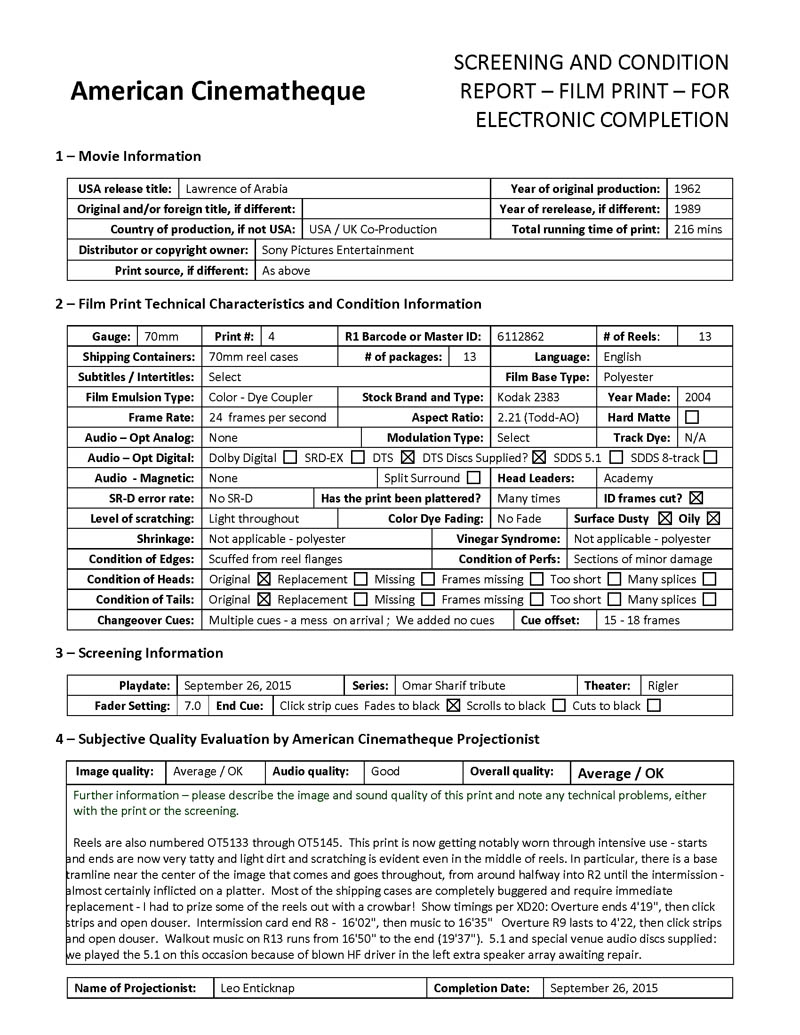
My guess would be that another venue built it up into two rolls, pre-intermission (1-8) and post-intermission (9-13), and that the damage was only done to the first one.
I agree - that print has basically had it, and if I were the programmer, I'd be deciding that we're showing the 4K DCP (which is one of the best DCP transfers of a 70mm epic I've seen, second only to Oklahoma IMHO) until a better 70mm print becomes available.
The projectors are Norelco AAs (mk. Is). We do have an ongoing issue with #2, that several of us who have looked at it have not been able to get to the bottom of. It is very noisy running 70mm stock, but not on 35. I've taken all three sprockets off and examined the teeth with a pocket microscope - I can't see any damage at all on the 70mm teeth. Swapping the gate assemblies between the two projectors doesn't move the problem, and neither does turning the sprockets around. There is definitely no perforation damage being caused, because I stop every reel that has been run on that machine two or three times on the rewind to check, and the perfs are always totally clean.
When I arrived on Saturday, the gate bands were very dirty with caked emulsion deposits: I cleaned them with rubbing alcohol until they were spotless, and did not notice any uneven focus at any point during WSS. In particular, the closing credit reel ran on that machine (against the background of the brick wall, to look like graffiti), and the focus looked sharp throughout the frame to me.
But the bottom line is that there is a gnarly issue with that machine, that needs attention from a real expert in Norelco mechanics. The noise says to me that it's got to be something to do with the alignment of film relative to one of the sprockets, causing perforations to catch the side of some sprocket teeth; but it's not bad enough to cause any visible evidence on either the perforations or the teeth.
There are three or four more minor things that also need looking at, and to address them I'm trying to set up a service visit soon, probably in early December when the last round of big festivals of the year and the installation of a laser projector at the Egyptian (during Thanksgiving week) are out of the way. This absolutely has to be done before we play our 2001 print at the Aero: the only reason I've got this lower down the priority list than the Egyptian refurb issues at present is that I know that all four 70mm prints playing the Aero this month are essentially worn out. That's not to say that I would have let them run if I had any fear whatsoever that this projector is actually damaging film: as I say, we're inspecting every reel that runs on it during the rewind for signs of perf damage (with a magnifying glass), and are finding none.
Incidentally, Vertigo was an acetate print (on 5386 stock dated 1997), so maybe the thicker film helped the focus a bit.
quote: Steve Guttag
I wonder if this might become the new model for "distribution" of 70mm. Sort of like IMAX...you buy your print and pay the studio to show it. The up sides are no shipping costs after receiving it and complete damage control. The downsides are your costs are all up front and the space to store it though it isn't too bad if stored on cores.
You also need somewhere relatively cool and dry to store them, even polyester. 2383 might be low fade, but it's not no fade.
Posted by Tyler Purcell (Member # 9213) on 10-24-2016, 01:57 PM:
Great info Leo!
Yes, I did notice the projector #2 being a lot louder as well. When it started up, it was very clear in the theater. I would say your diagnosis of the issue is spot on, which is why the registration isn't good on that unit either. It amazes me because projector #1 is flawless, absolutely perfect image and stability, but #2 had so many issues.
The focus issue you may not be able to see from the booth. I sat a lot closer to the screen and on the LOA print, the edges were clearly crisper then the center on projector #2. To me, it seemed like a gate issue, maybe compounded by the registration problems. It's hard to tell focus when the image is shifting around every frame.
I bet the issue is the intermittent assembly. That's the only "logical" issue, in my book and the only way for it to make so much noise.
On a side note, when did Norelco change names to Phillips? Isn't the Norelco version similar to the later DP70?
Posted by Leo Enticknap (Member # 534) on 10-24-2016, 02:29 PM:
I'm inclined to agree that the intermittent unit itself could be bad, but if that's the case I am surprised that the projector is not in any way abnormally noisy when running 35mm. We have a spare projector head in storage at the Egyptian, and so could try swapping a new one in. However, doing that is way above my skill level, and I don't know if the mk. I and mk. II intermittent units are interchangeable.
Info here on terminology. All the projector mechanisms were manufactured by Philips in Eindhoven, The Netherlands: they were known as the Philips DP70 outside the US, and the Norelco AA (AAII for the mk. II, single motor version) in the United States (Norelco = a contraction of North American Philips Company, the brand name under which Philips does business in the US).
Posted by Tyler Purcell (Member # 9213) on 10-24-2016, 03:31 PM:
The noise between 70mm and 35mm could simply be the amount of force needed to drag the film through the pressure plate is much greater on 70 then 35. They compensate for this by making the sprocket larger on the 70mm side. So this puts a lot more force on the gears inside.
Just an guess but I bet the intermittent gears are wasted.
I have friends in Europe who know quite a bit about the DP70's. I can ask and see if the MKI and MKII assembles are interchangeable. I know the DP70 is the best 70mm projector made. ![[Smile]](smile.gif)
Posted by Leo Enticknap (Member # 534) on 10-24-2016, 03:56 PM:
The diameter of the 70mm profile is wider because it has to pull the film down five perforations rather than four for 35mm, so it has to rotate through a greater linear distance. The amount of force acting on the film is the same for both 35 and 70, because the entire drive train - motor, transmission components, and intermittent unit - are all the same. Also, keep in mind that the DP70/AA was designed for use with acetate film (and to a lesser extent nitrate, a small amount of which was still in circulation when it was designed), which is thicker and heavier than polyester. So 70mm polyester stock, with no magnetic oxide on it, should not be stressing the gears in the intermittent unit under normal circumstances.
Also, the moment of force is more evenly distributed across the intermittent shaft on 70 than for 35, where it's concentrated on two points closer to the center, so if the gears in the cross box were worn or damaged, I'd expect the noise and picture stability to be worse on 35 than on 70, which is not the case. When it's running 35, you would not be aware of any problem with that projector.
I'm not ruling out an intermittent unit problem, especially as we've investigated everything else we can think of that could be causing the noise. But I'd be a little surprised if that turns out to be the sole cause.
Posted by Scott Norwood (Member # 30) on 10-24-2016, 03:59 PM:
(As if Leo needs more armchair repairmen...)
Could it be the pad rollers that hold the film up against the 70mm sprocket (P5-635-21)? I have seen one get chewed in a way that affected picture stability but did not damage the print or the sprocket teeth. That could explain why the 70mm picture would be worse than with 35mm.
Posted by Steve Guttag (Member # 268) on 10-24-2016, 04:21 PM:
I do take exception to your characterization of the DCP of LOA...I have found it to be the most embarrassing DCP transfer I've ever seen. It is an absolute (bad) joke. I screened it on a Christie 4K system and even did freeze frames to see if I could tell was was going on. Then threw up Samsara (also 4K DCP) to see if it was possibly a projector/configuration problem...Samsara was razor sharp and a very good representative of a 65mm/4K DCP transfer.
I, for the life of me, can't figure out what you like about the LOA transfer. Oklahoma! was also night and day better than LOA on its 4K DCP transfer. In fact, it probably looked the best of the classic titles that got the DCP "treatment." Though they absolutely fumbled on the audio for it. They didn't think to have a 6-channel version of it as a "VF" for those that could run it. I have no problem with 5.1 being the standard and it is great they made an Atmos version, but one should always preserve the original as the reference. It was an academy award winning mix, after all.
Posted by Tyler Purcell (Member # 9213) on 10-24-2016, 04:44 PM:
Is it wrong to assume in 35mm mode, there is less stress on the assembly then running 70? That's why I figured the issue could be the intermittent because theoretically it puts more stress on that assembly then 35.
Scott's idea of the rollers is very interesting. I just don't know how that would effect the SOUND of the machine.
Posted by Rick Raskin (Member # 1561) on 10-24-2016, 05:26 PM:
quote: Leo Enticknap
When I arrived on Saturday, the gate bands were very dirty with caked emulsion deposits: I cleaned them with rubbing alcohol until they were spotless, and did not notice any uneven focus at any point during WSS.
Having run many an AAII in my day I suspected the focus problem might be related to the gate bands. The noise might be from worn intermittent drive gears even thought the cross and cam might be fine. It will be interesting to see the outcome. I'm sure Mark G may have an idea or two.
Posted by Leo Enticknap (Member # 534) on 10-24-2016, 06:04 PM:
Actually, I'd welcome all the help I can get from armchair repairmen (and women!). This issue has been bugging me for the two and a half years I've been working at the Cinematheque, and the only reason I've not been prioritizing it is because we know that it isn't damaging film and there have always been more urgent/critical/deadline-attached/show-threatening things that are higher up the list.
I forgot to mention that the noise only happens when the machine is configured for 70mm and film is running. The projector sounds fine when the motor is running, with 70mm components fitted, but no film threaded. So it has to be caused by the film abrading against something. Scott - I'm ashamed to admit that swapping the pad rollers with those from the other machine didn't occur to me, though the gate did. I will try this as soon as I get a moment. The gate bands are almost new, so I'd be surprised if it were those, although, as with the pad rollers, that would fit with the problem not being there with 35mm. Again, will try a swap and a loop test as soon as time allows. Thanks, folks.
Steve - the only explanation I can think of is that we've been looking at different LOA DCPs. Unfortunately I can't give you the UUID of the one I liked, because we played it before I introduced new DCP screening report forms on which we note the UUID of the CPL that was actually played. But I wouldn't be surprised if multiple versions were made and I saw a later one than you: this has happened with DCPs of blank check restorations of other titles, after all.
Posted by Tyler Purcell (Member # 9213) on 10-24-2016, 08:37 PM:
Pardon my naivety, but don't the 70mm pad rollers always engage with the sprocket, even in 35mm mode? Or does that whole assembly swap out for the two formats?
Posted by Jonathan Goeldner (Member # 4854) on 10-24-2016, 09:55 PM:
quote: Steve Guttag
I do take exception to your characterization of the DCP of LOA...I have found it to be the most embarrassing DCP transfer I've ever seen. It is an absolute (bad) joke. I screened it on a Christie 4K system and even did freeze frames to see if I could tell was was going on. Then threw up Samsara (also 4K DCP) to see if it was possibly a projector/configuration problem...Samsara was razor sharp and a very good representative of a 65mm/4K DCP transfer.
I, for the life of me, can't figure out what you like about the LOA transfer. Oklahoma! was also night and day better than LOA on its 4K DCP transfer. In fact, it probably looked the best of the classic titles that got the DCP "treatment." Though they absolutely fumbled on the audio for it. They didn't think to have a 6-channel version of it as a "VF" for those that could run it. I have no problem with 5.1 being the standard and it is great they made an Atmos version, but one should always preserve the original as the reference. It was an academy award winning mix, after all.
actually the DCP of "2001" I saw over at the Arclight Bethesda, was by the most hideous looking transfer I've ever seen - edge enhancement galore, no sharpness to speak of, image looked soft at times, the image wasn't steady and bumped up and down for no reason. I actually had to ask one of the managers at the intermission, "this is a DCP presentation?" "yes", "oh really" [shakes head in disgust] If this is what Warner's is giving out to theaters to showcase a classic SciFi movie - I'm floored.
Posted by Simon Wyss (Member # 6218) on 10-25-2016, 05:01 AM:
Leo, strictly technical the surface of contact between film and projector gate is bigger with 70-mm. than with 35-mm. 35-mm. prints generally are lubricated for runs on American projectors.
Now 70-mm. 5-perf. COMMAG prints offer the problem that they cannot be waxed on the magnetic stripes. If you want to find out definitely about your projector(s), get yourself a couple hundred feet of 70-mm. film without magnetic striping, say dailies or so from a lab or blank stock, lubricate it and run it. If the Space Odyssey print is not striped, all the better.
To reduce the friction coefficient of the film means to greatly reduce strain on the projector mechanism. Everything can be set more lightly. A positive collateral effect of that is less buckling of the film in the gate, so better sharpness.
An old and known formula of a lubricant contains Carnauba wax and paraffin. I can provide you with it in case of interest.
Posted by Rick Raskin (Member # 1561) on 10-25-2016, 06:43 AM:
quote: Tyler Purcell
Pardon my naivety, but don't the 70mm pad rollers always engage with the sprocket, even in 35mm mode? Or does that whole assembly swap out for the two formats?
The pad roller assemblies are changed with the conversion between gauges.
Posted by Leo Enticknap (Member # 534) on 10-25-2016, 01:35 PM:
Simon - all the prints we've been talking about are polyester and unstriped, so they should not be coming even close to the limit of what that intermittent unit is designed to be able to pull.
Jonathan - yes, the 2001 DCP is f***ing abysmal, and as far as I and our programmers are aware, it's the only one in circulation. That is a big part of the reason why we decided to buy the print. If there were a really nice DCP of that movie available, both the business and cultural cases for us buying the new print would have been a lot weaker. Warners really need to address this, for the sake of audiences who want to see this classic on a big screen but cannot get to a theater that can play it in 70.
Posted by Brad Miller (Member # 2) on 10-25-2016, 01:49 PM:
Although I've not had this issue with the DP70, I've seen multiple Century JJs strip out their intermittent when running 70mm due to the additional stress of the pulldown.
Assuming the JJ is properly aligned for 35mm and the 35mm pull down is effortless in the first place, just switching over to 70mm typically doesn't magically put things into ideal alignment (despite popular belief). Typically turning the mechanism down by hand is harder with 70mm due to the slight difference in alignment (which is different between film stocks and also mag vs. dts).
For those of you with single lens JJs, put some 70mm film in the machine and turn it over by hand using the shutter knob and note any additional stress as the intermittent performs it's pull down. Then with the other hand very slightly start to open the gate a millimeter at a time as you continue to pull down via the inching knob with the other hand. Notice how much easier the entire mechanism is as the gate pressure is released ever so slightly.
While it is possible to get the 70mm gate/trap aligned acceptably to run both mag and dts 70mm prints (along with different thicknesses of mag prints), even that isn't truly ideal because if an average alignment is achieved for various 70mm thicknesses on the JJ, the 35mm alignment will typically be too loose once the parts are exchanged to run 35mm again. This is why most JJs exert more pressure (and wear) than need be on 70mm.
While there is a trick to the single lens JJ projectors to permit a one-off alignment for 70mm without impacting the 35mm alignment, it is impossible to do on a turret JJ due to the gate design. This is why I am very much not a fan of people running 70mm on JJs with a turret, as it can only truly be aligned for one type of film being ran at a time. Sometimes this differential can be minimized by shimming the 35mm gate, but typically its not enough.
If running the print dry, the mag tracks also create additional stress on the film and intermittent with any oxide shedding as oxide collects in the gate. While not immediately noticeable, this buildup of oxide is also destructive to the mag tracks with every pass. Wax will help a little bit with this, but not nearly as much as FilmGuard. Plus the wax will over time create additional dirt on the print.
When running wet with FilmGuard, there is no hint of mag wear (which is not just a JJ thing). The FilmGuard also keeps the film and gate/trap lubricated so the intermittent has much less work to do for each pulldown, and as a result the intermittent will last longer and also the sprockets will have less stress put onto them, which in turn means the intermittent sprocket teeth will also last significantly longer before they become "hooked". (Plus of course the print is cleaner and base scratches are hidden from projection.)
A number of people, including a number from this forum, have been in various booths where I've ran 70mm (either commercially or at my home screening room) and the more frequent comments are "that projector really runs 70mm super quiet" or "that projector runs 70mm film quieter than my 35mm projectors run film". That's because of the careful gate/trap alignment and lubrication (via FilmGuard).
Pro tip: Find yourself a random old and brittle scrap of 70mm acetate film with heavily damaged (specifically torn) sprockets. Get a good high resolution photograph of a the sprocket damage and then run that in a loop for an hour on the machine. (Make sure the loop is carefully guided and protected with 70mm rollers. Don't just let the film drag over the projector shell or over the upper spindle, with or without something soft on the spindle. Use an actual roller so you aren't inflicting any wear to the print other than what is actually being inflicted by the projector itself.)
Afterwards re-photograph the same frames of the print from the pre-run photos you took and very carefully compare them on your computer monitor for any additional sprocket wear (blow the high resolution photo up very large). If you've got it all aligned properly, you should not be able to detect any additional sprocket wear inflicted to the print from your projector. (And obviously if the loop is breaking on you, then your projector is absolutely not aligned properly and even when running a good condition print you will be inflicting some degree of wear to it, even if not directly noticeable on the bench after one pass.)
In regards to the #2 DP70 projector of Leo's, keeping in mind I am not a total expert with the DP70 model, my suspicion based upon the info presented above is that it will likely be one of these things:
*Azimuth of gate to trap (or gate/trap assy to film path) is off.
*Intermittent sprocket lateral alignment is not centered with respect to gate/trap.
*Gate/trap tension is too great. Remember this will cause the film to buckle very slightly in the gate (not usually visually noticeable, but will cause the center of the projected image to be out of focus).
*Hooked sprocket teeth, likely on the intermittent sprocket, but could be any of them.
*Intermittent show pressure is too great or the alignment from shoe to intermittent sprocket is off.
Remember, it's not going to be possible to visually tell if these are off just by looking at it.
As a super quick test I would also put the #1 70mm kit into #2 (with junk film of course) and see if the operational noise level drops to normal as a quick test to rule out something within the actual 70mm kit for the #2 machine.
Finally don't forget Fotokem doesn't have the ability to add the anti-static and scratch-protection that Deluxe and Technicolor added when they were processing prints. As a result newly made prints will be more susceptible to scratching than older prints. (For example, if an unused reel of Titanic was around today printed by Deluxe and a new Fotokem print of the same reel was printed today and both were spliced together on one reel and projected on "not-perfect" equipment with "less-than-stellar-operators", the Fotokem reel would suffer scratching on a given level of abuse faster than the older Deluxe print would. I'm not bashing Fotokem's quality by any means, just pointing out that they don't have the capability that used to exist back in the heyday of film printing by the big boys. Because of this, people have to be BETTER projectionists and must have TRULY properly aligned systems when running new prints even moreso than older prints.
Sadly that doesn't seem to be the case. What seems to be the case is that a bunch of theaters are latching onto a pair of 70mm projectors and running 70mm festivals. It only takes ONE of these venues to quickly destroy the entire 70mm library between all of the studios because there is typically only ONE PRINT left in circulation. When that print is scratched, it's going to take a LOT (such as footing the bill for a new print) to get a replacement struck. What's terrible is that this is currently happening at a record pace as has been noted by Leo and a number of other people whom have handled the 70mm print library recently.
The two biggest offending things regarding scratching is due to MORONS (yes there is it, I said it) running 70mm on JJs without removing the 35mm pad rollers as well as said moron understanding proper loop sizes of 70mm. Each other projector model has it's own little quirks, but in speaking of the most commonly found 70mm machine in the US, the JJ requires more skill than just "put the 70mm kit in and let's roll".
Although my personal love is for the JJ over the DP70, at least the DP70's design requires a special level of stupid to damage a print on it, unlike most other projectors.
Posted by Tyler Purcell (Member # 9213) on 10-25-2016, 01:51 PM:
Hey Leo, what would it take to get new prints of Vertigo and LOA made? Do you think if the money could be raised, the archives would let the source materials out to have another print made like they did with 2001?
Posted by Sam D. Chavez (Member # 1841) on 10-25-2016, 05:02 PM:
Agree with Brad on his tips for the JJ. I had to do quite a lot of "gate"work on a couple of JJ equipped theaters for H8 and other 70mm film. For whatever reason, the 35mm gate skates needed to move forward around .040 inches just to achieve minimum tension relative to 70mm. Before I did that, the projector had been set to favor 35mm so the 70mm was screaming through the head. No one had a complaint except when the projector didn't want to roll at startup.
I always start in these situations by running film and inching the gate open to see when the film starts to jump on the screen and then work back from there.
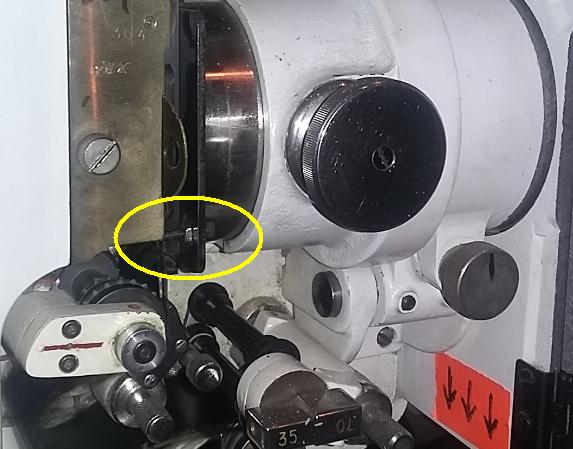
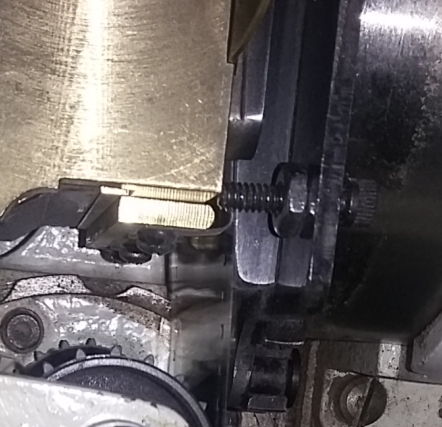
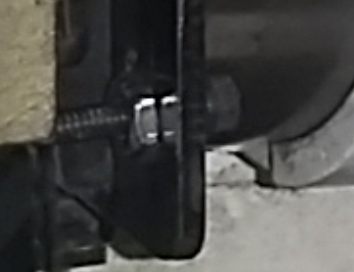
Now, on one of JJ equipped H8 locations, I had no time for this but still needed to back off the tension, so I drilled and tapped the gate plate so I could use a set screw to hit the trap, making a crude but effective stop.
An operator who we all know decided it looked like crap and took it out and the print begin to scream and powder. He learned his lesson as it took me a couple of days to get back there to sort it out.
Posted by Leo Enticknap (Member # 534) on 10-25-2016, 06:06 PM:
Brad Miller writes:
quote: Brad Miller
In regards to the #2 DP70 projector of Leo's, keeping in mind I am not a total expert with the DP70 model, my suspicion based upon the info presented above is that it will likely be one of these things:
*Azimuth of gate to trap (or gate/trap assy to film path) is off.
Possibly. Not sure how I'd check this.
quote: Brad Miller
*Intermittent sprocket lateral alignment is not centered with respect to gate/trap.
I doubt it, because there is a screw thread down the middle of the shaft, through which the sprocket is secured. So if there is any lateral "wiggle room," it's micrometers at most. I've turned the sprocket round (examining the teeth with a pocket microscope while it was off the shaft and not finding any damage on either the 35mm or 70mm teeth), which made no difference to the noise level. If the shaft itself were not properly aligned, possibly due to a loose seal as it goes through the chassis, or even a fault in the cross box, that could do it, though.
quote: Brad Miller
*Gate/trap tension is too great. Remember this will cause the film to buckle very slightly in the gate (not usually visually noticeable, but will cause the center of the projected image to be out of focus).
Definitely not that. The gate tension on a Norelco tends to tighten of its own accord as a reel runs through (it's done this on every one I've ever used), and so I always check it at the start of a reel by backing if off until I just start to see picture shake, and then tightening it just until the picture is steady. Adjusting the tension does not make any difference to the noise this projector makes.
quote: Brad Miller
*Hooked sprocket teeth, likely on the intermittent sprocket, but could be any of them.
Not that. I've checked the teeth on all three sprockets that the film passes over.
quote: Brad Miller
*Intermittent show pressure is too great or the alignment from shoe to intermittent sprocket is off.
Not that. The intermittent shoe is part of the removable gate assembly, and when I swap the assembly with that of the other projector, the noise does not move with it.
quote: Brad Miller
As a super quick test I would also put the #1 70mm kit into #2 (with junk film of course) and see if the operational noise level drops to normal as a quick test to rule out something within the actual 70mm kit for the #2 machine.
I've done that with the gate assembly, but not with the bands or pad rollers. That is what I need to check next.
Thanks to Brad and everyone for suggestions.
quote: Tyler Purcell
Hey Leo, what would it take to get new prints of Vertigo and LOA made? Do you think if the money could be raised, the archives would let the source materials out to have another print made like they did with 2001?
That's a decision for programmers and leadership to make, not me. LOA would certainly be seriously expensive (I'm guessing in the region of $30k) on account of its length. But there again, we have never attracted a crowd of less than 350ish, even for the now worn out Sony print #4, and frequently sell the Egyptian out. My guess is that a lot will depend on ticket sales for the week-long 2001 run in December.
Posted by Brad Miller (Member # 2) on 10-25-2016, 06:42 PM:
Leo, I would have to have a DP70 in front of me to remember all of the adjustments. It's been almost 20 years since I spent any serious time with that model, but if one was in front of me I'm sure I could remember. (That being said with the general love for the DP70 there should soon be someone else chime in here with the expertise to share their knowledge.)
I doubt it would turn out too good with booth acoustics, but is it possible to record 15 seconds of each projector running 70mm and email me an audio file? (I could also post it here.) Just don't get TOO close with the mic when recording and make sure the mic is in the same relative position to each projector. (You could likely just do a cell phone video.)
On the lateral intermittent sprocket alignment, is it not possible to get your head in there at such an angle to see the centering of the sprocket teeth in relation to the sprocket holes in the film? Could you stick a newer cell phone in there that has a good macro focus ability and snap a picture maybe? Alternatively (and I've never done this, but it's an idea) perhaps you could put a strip of acetate film in there, make sure to pull it down a dozen frames by hand to make sure the film is straight, then manually pull on the film with the machine at a standstill to try and force the intermittent sprocket teeth to make some stretch marks on the sprockets for a frame (which you can then inspect for centering outside of the machine).
Sam, I am very glad to see someone else has noticed the JJ gate clearance issue! Most people I talk to about this tell me there is no such problem (while I plug up my ears when they roll the projector, cringing at the extra stress on the film and intermittent).
I would have to say every JJ I've worked with needed more than a mere .040 inches of extra clearance relative to 35mm. Granted I didn't go around measuring, but I'm curious if that was a general rule you calculated, or if that was the measurement from one sample JJ you serviced back in the day?
On turret JJs I've been able to make things "better" by adding a few layers of electrical tape behind the 35mm gate, but I've never been able to add "enough" to get the 35mm clearance just right.
My procedure typically puts me at needing to leave the 35mm gate tension just barely enough to hold a film reasonably steady at 12:00, with some films needing to run between 1:00-3:00 on the dial. During that setting of the gate/lens holder assembly I also have to pay extremely close attention to the focus on screen since it is like a Kinoton lens turret in the fact there is wiggle room in all directions, but once you start tightening things down things tend to drift a little bit away from where you had it (so you have to pre-estimate to get it to land dead on where you need it). If that gate isn't sitting just right then focus (top to bottom) will definitely be compromised. It gets even more fun with dual projector setups, where I have to get in and shim the mount for side to side even focus.
Anyway, once that gate/lens holder assembly is locked down and I have perfect focus with 35mm in all 4 corners I have found 70mm will fall right into place in regards to focus...but the gate ALWAYS closes too far for running 70mm without exerting extra wear.
On the turret JJs there really is no choice but to loosen the gate mount when switching formats, but on single lens JJs you can use my old allen wrench trick from my days at GCC Northpark. In a nutshell, get yourself a set of metric allens and there is a place you can position it to prevent the gate from closing too far. The nice thing is with a set of allens, you have repeatable precision in 1/2mm increments. This came in handy back in the day when we would run a morning trade screening in 35mm, then switch to the normal 70mm engagement (which may have been dts70), then at midnight run the older 70mm print for a midnight movie (always mag and thicker than dts70). I would simply label the tail of the print with the size of allen wrench to use. We NEVER had the slightest problem with 70mm, the projectors purred very quietly and the image on screen was spot on flawless as various people who attended there can testify. ![[Wink]](wink.gif)
I had one H8 JJ in Houston that was so tight I found I couldn't turn the projector down by hand with film in the gate. It was so damn tight I didn't even want to risk damaging anything and I just optimized it for polyester 70mm since that's all those stripped-down machines will ever run again. I also had another one with horrible top to bottom focus requiring adjustment and another couple which weren't too offensively far off, but definitely needed some easing up. Regardless none of the JJs in my H8 territory were aligned properly. (I've always felt this was an area of JJs that few people seemed to have much expertise with, and the H8 run further proved that theory.)
I never thought about tapping the gate plate with a stop screw. Pretty interesting solution. Do you have photos? That might be a good idea for some of these venues that run 35mm and 70mm and just flip things around and pay no attention to what they are really doing to the prints.
Posted by Sam D. Chavez (Member # 1841) on 10-25-2016, 09:44 PM:
Did not measure the coke can shims but i kept adding them top and bottom until I got where I wanted. It was not back in the day, it was just last year at the Castro where they have all sorts of issues running a different print every couple of days.
As to the origin of the mismatch, Lonny mentioned that something about differences in gate parts on JJ and JJ2. The original JJ apparently had a sprung gate like the Century Model H projector. It was a terrible design as both the gate and the bands could both move and change the focus point when a splice came through, so was replaced by a solid gate. That supposedly led to the depth mismatch between 35 and 70 when the JJ2 came out.
Don't think I have a good picture of the setscrew detail but it was down toward the bottom where it would could catch the edge of the trap. Nothing fancy, just a 10/32 screw with a locknut.
Posted by David Stambaugh (Member # 1102) on 10-25-2016, 10:09 PM:
Leo: My comment on the cost of the print wasn't meant to be snarky. I think what you guys are doing is fantastic. I would have naively guessed more like $50K for the print. I was thinking Jeez, someone with deep pockets and a love for film (think Scorsese, Spielberg, Lucas) could commit $1M toward striking new 70mm prints of many historic movies and keep 70mm going for many years in venues like yours, and it would be pocket change to them.
![[beer]](graemlins/beer.gif)
Posted by Leo Enticknap (Member # 534) on 10-26-2016, 09:53 AM:
Thanks Brad. We've got two big festivals about to hit us at the Egyptian, as a result of which I'm not scheduled to be at the Aero again until November 20, so please forgive me if the next update on this isn't instant. Step 1 will be to try swapping pad rollers and bands, and if that doesn't help, I'll make that video/audio recording as a step 2 (will probably use my D-SLR: its built-in microphone will certainly pick up the difference between the sound of the two machines).
David - I've wondered if one option for us might be to approach a major donor or foundation with a pitch for a big project to have our own 70mm prints made of all the major classics for which good printing elements (i.e. INs and DTS track negs) exist, and thus are printable without seriously expensive back-end restoration first, with an undertaking to play one at each theater, say, once every two weeks on a year-round rotation. Daniel Schulz writes in another thread:
quote: Daniel Schulz
The occasional 5/70 release serves to keep the machinery humming on standby so it can be revved up for the release of Dunkirk.
It seems to me that over the last year we've seen small run 5/70 releases of some frankly forgettable movies. If there is an informal industry agreement to ensure that FotoKem has enough business trickling in to keep its 5/70 release printing operation viable, surely a better way to do that would be to find some way of financing new prints of the widescreen classics that we know have a long term audience? It's like the difference between popular and classical in the music business: the rock/pop album typically achieves 95% of its sales in the first week of release and then disappears without trace, but a classical album will sell slowly but steadily over 30-40 years.
Personally, I'd far rather that the industry helps to keep FotoKem's 5/70 operation on life support by ordering a slow trickle of new prints of LOA, WSS, 2001, South Pacific, Oklahoma, and the other 15-20 DTS 70 restorations that we know will pull a decent house in the few 5/70-equipped venues dotted around the world for decades to come and are a far better showcase for the medium, rather than 10 prints of Star Bores Episode 25: The Farting Menace that will be gathering dust after the opening week, only to be seen again by the hardest of hard core 70 geeks.
Posted by Tyler Purcell (Member # 9213) on 10-26-2016, 11:37 AM:
Just an FYI, Fotokem's large format lab is in no trouble. They make almost all of the IMAX dome prints in the country, so they're churning out new large format prints daily. The 5/70 business is pails in comparison to the 15/70 business.
Striking a print off an already DTS prepped IN is easy and inexpensive. For films that don't have the DTS IN already, it's a very expensive process to take the analog elements, mix them for DTS and spit out a new soundtrack. I fret that cost is a bridge too far, but new prints struck off the DTS IN, isn't that bad. The big question remains, how good is the IN? I'm not sure how they made the DTS IN for LOA, but it was not using modern film socks. I don't know how they performed the original 1988 restoration, but I assume a new IP would have been made from the camera negative that is probably deteriorated. That process would need to be done all over again for it to truly show what's in that negative, as I'm certain it's nowhere near as noisy/grainy as the print I saw. That circulating print was probably made on early 90's (pre vision) print stock. Kodak didn't update their 70mm print stock until the late 90's. I believe Titanic was one of the first 70mm released films shot and finished on Vision.
Posted by Leo Enticknap (Member # 534) on 10-26-2016, 11:52 AM:
The print of LOA you saw on Friday was on 2383 stock dated 2004. 2383 superseded 5386 for 70mm print stock around 2000. I have never seen any 2386 70mm (though I have encountered several 2386 35mm prints made between around 1997-2000), so I'm guessing that the 70mm print stock production line moved from acetate to polyester, and the new emulsion, all in one fell swoop.
Pix and sound negs are separate elements that pass through different printer gates in a single pass, as a general rule and in a typical continuous contact printer used for release printing. So I'd guess that the DTS timecode IN was probably combined with a pix IN dating from the 1988 restoration to make the 2004 batch of DTS prints. As you say, the question is what sort of condition that pix IN is in, and if further, good quality prints could be struck from it without needing to go back to an earlier generation.
Posted by Tyler Purcell (Member # 9213) on 10-26-2016, 06:05 PM:
Yep, you're right... they probably struck prints off the 1988 IN, that makes perfect sense. So what they'd need to do is go back to the IP and make a new IN with the combined soundtrack on new stock. Even better would be to make a new photochemical IP from the original camera negative on modern stocks. They COULD do this by simply scanning the camera negative in 8k and lasering it out at 8k to create a new IN with modern stocks. I doubt they'd be willing to go through all of that effort, but since the DCP is not 8k currently, maybe there is a chance they'd restore it digitally and have a beautiful file that would only need to be lasered out to film again for projection. Putting it back on film is expensive, but a lot less then a full photochemical restoration. Digital restoration @ 8k isn't too bad, there won't be much loss along the way.
Posted by Mark Ogden (Member # 43) on 10-26-2016, 06:44 PM:
Probably no-one would want to go this route, but is it even possible to mag stripe a 70mm print these days?
Posted by Tyler Purcell (Member # 9213) on 10-26-2016, 07:13 PM:
No it's not. The glue was found to be too toxic, so they don't make it or the mag stripe anymore.
Posted by Scott Norwood (Member # 30) on 10-26-2016, 09:39 PM:
How do they make mag fullcoat, then? It is in the current Kodak MP catalog....
Posted by Tyler Purcell (Member # 9213) on 10-26-2016, 11:45 PM:
Not sure how they make full coat, but it's not anything like mag striping. Remember, the glue has to survive through chemical baths with mag stripe, but it doesn't with full coat.
Posted by Sam D. Chavez (Member # 1841) on 10-27-2016, 01:03 AM:
I was under the impression the striping was the last operation on a developed and printed reel before actually recording or "sounding" it.
Posted by Leo Enticknap (Member # 534) on 10-27-2016, 01:26 AM:
Full coat is basically the same stuff as magnetic tape, only with a slightly thicker polyester base.
I don't know the details of the chemistry, but would guess that coating the entire film surface with nothing else on it is a simpler process than just coating a small part of it with one side having photographic emulsion it, the base side possibly having had an anti-halation layer on it and the base having absorbed some processing chemistry.
The reason I'd heard for 70mm mag striping being no more was that one of the chemicals involved was seriously bad for the ozone layer, and therefore had been banned under international treaties for all uses apart from a small number of medical applications for which there was no viable alternative.
Posted by Simon Wyss (Member # 6218) on 10-27-2016, 03:50 AM:
There’s one thing we have omitted until now, the interplay between film pitch and sprocket diameter. With polyester film the hole pitch should be .1870" ± four tenths or 4,75 mm ± a hundredth. As I see the situation most combined 70-35 sprocket drums are made for triacetate stock which includes a reduction of the contact diameter by one to two per mill. Polyester-base film hardly shrinks, so sprockets ought to be employed that have the full diameter of 1.190" or 30,234 mm. Polyester-base films are somewhat thinner than AC films. Due to that the loops behave differently at slipping off the teeth. They should be set smaller, too. I wonder what a caliper or micrometer reading might reveal.
Posted by Tyler Purcell (Member # 9213) on 12-11-2016, 04:18 PM:
Well, saw the new print of 2001 last night at the Egyptian. Got to hang out in the booth and talk with Mike, someone I already know. What a great print and awesome presentation. It was just flat-out perfect in every way. Unfortunately, the IP used to make the new print from, isn't in the best of shape. It makes me wonder what elements they used to make it, because it had the digital audio timecode, so it MUST be something newer. For any cinephile, it's well worth the visit and of course, seeing good 70mm is hard these days.
Posted by Gordon McLeod (Member # 33) on 12-11-2016, 05:34 PM:
DTS timecode is a anamorphic stretched 25mm negative printed on a second printer pass normally
Posted by Jim Cassedy (Member # 4115) on 12-11-2016, 06:50 PM:
quote: Sam D. Chavez
on one of JJ equipped H8 locations, I had no time for this but still
needed to back off the tension, so I drilled and tapped the gate plate so I
could use a set screw to hit the trap, making a crude but effective stop.
< also >
quote:
Don't think I have a good picture of the setscrew detail but it was
down toward the bottom where it would could catch the edge of the trap.
Nothing fancy, just a 10/32 screw with a locknut.
You can sort of see Sam's JJ gate/trap mod in these pix:
Posted by Leo Enticknap (Member # 534) on 12-13-2016, 10:53 PM:
Spoke to Mike this morning: apparently every 2001 show so far has attracted a crowd of 500 plus. This is great news, meaning that the print should pay for itself quicker than budgeted for, and that with any luck, doing this again with other "known crowd draw" DTS 70 titles should be viable.
Thanks to Barco school and a gnarly show at our other theater over the weekend (which involved hooking up a rental HDCAM SR player and all the messing around that required) last week, I haven't got to play it to a paying audience yet: my turn on Saturday!
Posted by Daniel Schulz (Member # 1881) on 12-14-2016, 01:46 AM:
quote: Tyler Purcell
Striking a print off an already DTS prepped IN is easy and inexpensive. For films that don't have the DTS IN already, it's a very expensive process to take the analog elements, mix them for DTS and spit out a new soundtrack.
This part's actually not that expensive, unless you're wanting to do an all-new mix. Most of these movies have an existing 6-track mix on a full coat mag printmaster, and it's pretty straightforward to create a Datasat soundtrack from that element.
Posted by Jean-Pierre Gutzeit (Member # 7275) on 03-15-2017, 04:33 PM:
There was a digital remix of the sound elements in 2000, and the new remix of the critical old Grammophon tapes from 1965 (Karajan, Boehm and so on) is well done. Against all other remixes of magnetic masters of classic Todd-AO productions on DTS this version was usable.
Otherwise: the picture quality of the intermediate prints is not stunning, but poor, unfortunately. I saw the first 70mm version about 60 times and own an old faded vintage print from 1968.
The new version, screened in Europe since February 2001, lacks hardly in conjunction with well balanced color timing, frame steadiness and definition.
There is no comparition with the original Raodshow release in 1968, and Warner didn't a good job on all Kubrick releases, I think. No experts in the laboratories? It is very disappointing. Fotokom has no rivals and therfore the quality is bad in all ways.
Posted by Leo Enticknap (Member # 534) on 03-15-2017, 10:42 PM:
I was about to write "It was mostly Karajan, wasn't it - I don't remember Böhm on the soundtrack," but looking on Wikipedia I see that you're right and it was Böhm conducting "Einleitung, oder Sonnenaufgang" from Also sprach Zarathustra. I suppose that the very typical Karajan on the Blue Danube Waltz - strings obliterating everything else, glossy and exaggerated phrasing, slightly slower tempo than usual - just left such a strong impression in my mind that I forgot about the other pieces. I stopped listening to Karajan recordings sort of in my 20s, and had forgotten the unique sound he aimed for, that was a big part of the reason why he became the world's highest selling classical artist. Interesting that the Ligeti pieces were not all the same orchestra and conductor, and that the Khachaturian adagio was not conducted by the composer, given that he was active as a conductor at the time.
Agreed about the sound quality - the complete Blue Danube Waltz in reel 4 sounds wonderful - very 1960s and magnetic, even after DTS-ization.
As for FotoKem, I don't think the accusation that the quality of their work is typically poor is at all fair - at least not in my experience, and I usually handle one or two of their new (or newish) prints a month (though normally 35mm). The 70 prints of Interstellar, Hateful Eight and the PTA movies I've played recently were all among the sharpest and most detailed I've played. You are right in that they were working from an interneg that, shall we say, had issues, when they made our print of 2001.
It's important to remember that our print is just a new print, not the result of a full-scale restoration. As such there are grain and contrast issues in the process shots, and some negative dirt and scratching present, for which we got flamed as being incompetent projectionists who can't be bothered to clean a projector on Facebook when it played the Egyptian.
Anyway, it's playing at the Aero next weekend and the weekend after for anyone who'd like to catch it, with the Todd-AO five stage channels plus mono surround audio mix. Looking forward to using the Aero's stage extra channels for the first time in almost a year. More info and booking links here (shameless plug).
Posted by Scott Norwood (Member # 30) on 03-16-2017, 12:12 PM:
Foto-Kem was always better than Deluxe and often better than Technicolor in the '90s and 2000s. I have nothing but good things to say about the current state of their lab work in all formats--16mm, 35mm, and 70mm.
Posted by Tyler Purcell (Member # 9213) on 03-19-2017, 01:19 AM:
Hey Leo... just got back from the Aero and the left projector is still got that jitter issue. I was kinda disappointed because I thought you figured out what it was.
Posted by Steve Guttag (Member # 268) on 03-19-2017, 07:40 AM:
Way back when...
The best labs for 70mm for me were Metrocolor followed by Technicolor-London. Deluxe would issue "pre-damaged" prints that often were soft or had image motion built-in.
I don't recall Foto-Kem's quality, historically. I can say I was very un-impressed with their work on The Hateful Eight. The image was very jittery (including the opening "static" card for the overture). While I found the focus to be erratic, that may have been due to the source elements. Overall, it was a poor representation of 70mm capabilities.
Posted by Scott Norwood (Member # 30) on 03-19-2017, 08:24 AM:
The print of H8 that we had at Somerville was rock steady. Maybe you got a bad print?
Posted by Steve Guttag (Member # 268) on 03-19-2017, 10:11 AM:
Whereas it was multiple reels that were unsteady, and given how prints were made, it would have taken really bad luck or a lack of quality control. I hear that the number of bad prints to good were pretty lopsided in the bad favor. I also hear that the reel-to-reel prints were typically the worst since they came at the end of the runs to allow for the platter prints to be built up.
Posted by Scott Norwood (Member # 30) on 03-19-2017, 10:45 AM:
Interesting. Ours was also a reel-to-reel print and it seemed fine. Maybe we got lucky.
Posted by Victor Liorentas (Member # 5272) on 03-19-2017, 11:41 AM:
I saw it platter run in Toronto and found the opening card and credits a bit soft. The actual photography on the other hand...came across so beautiful that I wanted to eat the screen,print and projector.
I was not sure if it was out of focus on the card and credits by a hair or if printed that way.
Posted by Tyler Purcell (Member # 9213) on 03-19-2017, 12:00 PM:
The first reel of the Hateful Eight I was told is purposely made with registration issues built into it. No other reel has those issues, only the first one.
Posted by Paul Linfesty (Member # 214) on 03-19-2017, 02:17 PM:
quote: Tyler Purcell
The first reel of the Hateful Eight I was told is purposely made with registration issues built into it. No other reel has those issues, only the first one.
Yes, AND those flaws were in the digital version of the 70mm roadshow version (this opened in Bakersfield AFTER the regular first run engagements had closed. It was very odd to see jitter on the overture slide at the beginning. Conceptually, it made no sense, since I have never seen that much jitter in other movies scanned from film sources (70 or 35).
Posted by Sam D. Chavez (Member # 1841) on 03-19-2017, 05:21 PM:
Directors conceit?
Posted by Mark Lensenmayer (Member # 134) on 03-20-2017, 07:30 AM:
One of the 70mm KONG prints has moved over the the Gateway Film Center near The Ohio State University in Columbus.
Posted by Leo Enticknap (Member # 534) on 03-21-2017, 01:03 PM:
Tyler - I'm not aware of any registration issues with either of your projectors. We certainly had other challenges at the Aero last weekend, the main one being that a coil fried in one of the Simplex/Zipper changeover shutters actually during Friday's show (as in, the the "over" button was pressed and the outgoing machine failed to close), meaning that changeovers in one direction had to be done by means of a contortion act involving one hand on the button and the other on the lamphouse dowser of the outgoing machine. But myself and another projectionist worked the H8 show on Friday: running an RP-91 loop as part of the setup process, both before and after the anamorph was fitted and aligned, neither I nor she could see any significant problem with the projected image. I'm guessing that it must have been Quentin's deliberate jitter that got you.
The major Aero problem that I really wish I could solve now is that the color temperature from the two projectors does not match - one of the machines is slightly whiter than the other. Only a real expert with a sharp eye would notice it on color, but it's more obvious than I'm comfortable with across the changeover with a b/w print. We use exactly the same model of bulb in both (Ushio 4kW), and both lamphouses were bought new from Kinoton at the same time (so no difference in the reflector model, presumably), and both lamphouses have an individual extract fan on the roof of the same power. The port glass, rectifiers and lenses are also all of the same model and bought at the same time, too.
Posted by Tyler Purcell (Member # 9213) on 03-21-2017, 10:46 PM:
Hey Leo - Yea the saturday show of The Master, the left projector had a pretty noticeable set of issues. The film is so dark in areas, you may not see it from the booth unless you sat down and watched the entire reel. It may not actually be "registration" it may simply be a shutter calibration issue where the pulldown process is happening before the shutter blocks the light. I would bet that is more of the issue, rather then the intermediate or gate. However with that said, I did notice soft focus issues on the bottom center of the image, which led me to believe it could be a gate issue.
On one of the reels, something happened that I can't explain. On the same projector, the center of the image was washed out for the entire reel. The corners were crisp, but almost the entire image was completely white and washed out. I couldn't explain it and I heard lots of yammering in the booth after the reel change, and the problem didn't come back.
The douser issue was kinda funny, as someone whose spent quite a bit of time in the booth, with older manual douser projectors, I chuckled when the douser started closing on it's own mid reel. I was the only person who got up and stared walking to tell'em, but it was fixed shortly after.
I was impressed by the print, it just needed a cleaning. The right projector was amazing, absolutely flawless image, zero issues. That darn left projector, you know the one that makes all the noise, that thing really needs some work. I didn't go to the Interstellar screening on sunday because frankly, I was upset with the projection. I want to see GOOD 70mm projection because frankly, it's hard to find these days. I don't mind working at the theater and seeing mediocre presentations, but when I'm a paying customer, it's hard ya know? All I wanna do is go into the booth and figure out what's wrong. I know you guys have limited budgets and parts... well, forgetaboutit... still, it's hard to attract customers, especially with 70mm screenings (film buffs mostly) if the projection isn't stellar as well. I feel bad for your situation and would love to help, but I think you've got things covered.
In terms of the color difference, it's for sure noticeable. I was thinking it has to be an issue with the reflection calibration, as the brightness between the two projectors is different. I bet if you threw a test pattern on the projector and spot meter on the screen, you'd see the difference in luminance right away. The Kinton stuff is so odd. I spent a whole evening with Jim over at UCLA discussing his Kinton experiences, he wasn't very impressed with their products. He said they needed a lot of setup time to get right and the projection units still have issues now and again, thanks to the Germans over thinking things as always. Someday, I wanna get my hands on those suckers and mess around with'em because they can do some neat things. Anyway, I bet it's just the alignment between the housing and the back of the projector or the reflector, it's gotta be something simple like that.
P.S. You guys do a great job and I don't mean to be a grouch about the issues. I just think the house could be one of the best in town with only a few small tweaks...
Posted by Mark Ogden (Member # 43) on 12-05-2017, 05:48 PM:
The American Cinematheque has announced that they have exclusive access to a brand spankin' new 70mm print of Lawrence of Arabia that it will premiere on the 15th at the Egyptian Theatre. Also, word on the street is that Boston's Somerville Theatre has ordered their own 70mm print of 2001: A Space Odyssey in time for next year's 50th anniversary of that film. Glad to see these developments, but I wonder if a trend is developing where studios would take a "if you want a decent print, buy one yourself" stance with what few 70mm equipped rep houses remain.
Posted by Leo Enticknap (Member # 534) on 12-05-2017, 10:09 PM:
If the studios are showing willingness to support the "buy one yourself" route (by granting the necessary licenses and making the dupe neg available for printing) in cases where the math can be made to work at the exhibitor's end, I don't think that's a bad thing.
I don't work for the American Cinematheque anymore, but I don't think I'm breaking any confidences by recalling that when I did, we felt that we were taking a leap into the dark with the 2001 print, and did so mainly because that looked like the one and only way of getting a reasonable 70mm print available for the public to see regularly again. We brainstormed a list of other potential titles to think about if were possible to do that again: Larry was at the top of it, despite it being about the most expensive movie possible to make a new print of (because of its length). The Sony print we had been showing three or four times a year at both the Egyptian and the Aero had worn out to the point at which the baked-in dirt on lighter scenes in particular was becoming a significant distraction.
It's great news to hear that not only does the Cinematheque believe it to be viable to do this again, but also that another major art/rep/archive theater is going to do a buy-one-yourself 70mm print.
The only other project I know of that used this approach to putting good quality film prints of important classics on regular display was the British Film Institute's "360 Classic Films" project that ran at the Museum of the Moving Image in London, during the decade or so it was open (late 1980s to late 1990s). The idea was that they would play one classic movie for every night of the year that the museum was open. From what I remember, they only managed to acquire prints of around 100 titles before the place closed. Some were donated, some were cash purchases from studios and other archives, and others were printed from the BFI's own preservation masters. Because the prints were only ever handled by professionals in a well-maintained booth, they stayed in good shape. I don't know what happened to them after MOMI closed.
The one worry I have is that this new 70mm LoA print will, according to the Cinematheque's email, derive from a digital intermediate output from the latest restoration, so the viewing experience won't be totally analog. It'll be the equivalent of listening to a vinyl LP cut from a digital original, with a DAC feeding the cutterhead's preamps. All the previous filmouts from DIs I've seen have reminded me of watching a Bluray, but with added dirt, scratches, and picture weave. You can easily tell that what you're seeing is not totally analog. It would have been nice if they could have struck more prints directly from the element used to make the 1988 restoration prints, but there must have been powerful reasons against doing that. But personally, if I'm going to see the end output of a digital restoration, I'd prefer to see a DCP. If the restoration is a photochemical workflow, I'd want to see a print.
Posted by Scott Norwood (Member # 30) on 12-05-2017, 11:04 PM:
Has the DTS mix of Lawrence been fixed yet? The one that I have heard sounds awful, due to (apparently) having been de-noised to the point that essentially all of the "room tone" is gone.
In any case, the list of venues with their own 70mm prints of 2001 at the moment is as follows:
Egyptian
Seattle Cinerama
Music Box
Somerville (not yet screened)
Are there any others?
Posted by Mark Ogden (Member # 43) on 12-06-2017, 05:58 AM:
quote: Leo Enticknap
It would have been nice if they could have struck more prints directly from the element used to make the 1988 restoration prints, but there must have been powerful reasons against doing that
Correct me if I am wrong, but I was under the impression that 70mm prints are only ever made from the original camera negative, and nothing further along, in fact I think I read that here from somebody. I recall hearing, perhaps after the 2012 digital restoration, that the photochemical elements of Lawrence were pretty much falling apart and likely couldn't take any more passes. But you're right, a scan-out of the 4K files seem pointless and potentially misleading. Saying "brand new 70mm print", while technically accurate, implies something to a film savvy moviegoer that is not being delivered here.
Posted by Steve Guttag (Member # 268) on 12-06-2017, 07:57 AM:
You're wrong. Once upon a time, all prints were off of camera negative (except for where there are opticals, of course). But that ended quite some time ago because the OCN would wear out pretty fast.
Then only a handful of studio prints for screenings and perhaps the director would be of the OCN and were generically called "EK" prints. An EK print looks night and day better than even a "select" print (prints that went though the normal IP/IN stages but were chosen to be the best examples of the result).
However, 70mm wasn't treated any differently. In 1988 LOA was restored and a new IN was generated and the resulting prints came off of that. The prints looked pretty darn good though. I'm guessing that perhaps those elements have run their course in the last 30 years or so. My guess is that they could produce a new IN from the 1988 work and print more but are choosing not to (for whatever reason, including the cost that may be required to get an acceptable IN for printing.
Posted by Thomas Hauerslev (Member # 566) on 12-08-2017, 02:00 AM:
"Baraka" was printed from the 65mm negative, and Technicolor, London manufactured 31 x 4-hour 70mm Hamlet prints. 5 of which were made from the original 65mm camera negative (Technicolor, February 28, 1997).
Posted by Steve Guttag (Member # 268) on 12-08-2017, 06:33 AM:
The equivalent of striking EK prints in 35mm. The studio will do a handful for screenings, special venues and often the director.
Posted by Bobby Henderson (Member # 840) on 12-08-2017, 10:59 AM:
I think making a 70mm print from a digital intermediate source isn't a bad thing IF both the color depth and resolution of the DI are of satisfactorily high quality. IMHO, the starting point for 70mm should be 8K and go up from there. I think there is little point to outputting a 2K or 4K DI to 70mm other than giving projectionists more practice handling 70mm film. Viewers new to watching movies on 70mm will not be impressed with imagery coming from a standard resolution DI source. They'll be asking, "what's the big deal about 70mm? I don't see a difference."
Posted by Brad Miller (Member # 2) on 12-08-2017, 04:21 PM:
quote: Bobby Henderson
They'll be asking, "what's the big deal about 70mm? I don't see a difference."
We also have the same problem when there is even the tiniest amount of dust or even a super light scratch, cinch mark or loop scratch on the print. The print and its presentation has to be literally flawless, or the digital can/will look better. Case in point, anyone not running film cleaners religiously (or using PTRs in any capacity) doesn't stand a chance of actually obtaining the "flawless" level of quality needed here.
Posted by Leo Enticknap (Member # 534) on 12-08-2017, 08:22 PM:
Interesting that contact printed 70mm showprints from the camera neg were made. Must have been quite a challenge in the mag stripe days, especially if done in a step printer.
Agreed with Bobby, though if anything I'd say that color depth is more important than resolution. What enables me to spot a DI to 35mm filmout a mile off is that the color depth just doesn't seem to equal the end result of an all-photochemical workflow. The resolution can do, to my eyes, though.
Posted by Scott Norwood (Member # 30) on 12-08-2017, 09:20 PM:
quote: Bobby Henderson
I think there is little point to outputting a 2K or 4K DI to 70mm other than giving projectionists more practice handling 70mm film.
That might actually be a worthwhile goal, given that so many people aren't very good with the format. At least, it would give the next 70mm shot-on-65mm-with-photochemical-post movie a better chance of surviving its run.
Posted by Bobby Henderson (Member # 840) on 12-09-2017, 05:24 PM:
It's extremely important for any cinema projectionist to get as much hands-on practice with both 35mm and 70mm as possible. But it's still controversial when practice is in the form of advertised screenings meant to promote things like 70mm film. In order for the 70mm film format to survive it must be shown with the best possible quality source material so audiences can clearly see the difference. Digital cinema maxes out at 4K. There doesn't appear to be any plans at all to make d-cinema projectors that go above that quality level for a long time. That leaves 70mm as the only cinema format that can be clearly better.
It's frustrating that movie studios go with the "good enough" route so often with digital technology. The cutting edge of computing technology is far more powerful than it was 10 years ago. Yet most movie and TV productions are still made in HDTV resolution 2K. They could produce 8K content now faster and with less trouble than it took for the first 2K digital intermediates over 15 years ago. Instead they've used all the performance gains to just make 2K production even faster.
I'm still scratching my head about Murder on the Orient Express. The movie was shot on 5/65mm film and had a limited number of 5/70mm prints. Unfortunately post production was a 4K digital process. I can sort of understand why a DI was used since there was so much "digital backlot" visuals in the movie. But why even bother filming the live action stuff on 65mm film? What was the point of doing that? If a 4K DI was going to be the final product they could have shot the movie on 35mm film or with any number d-cinema cameras. The 70mm prints of that movie end up being a non-event due to the 4K DI bottle neck.
Powered by Infopop Corporation
UBB.classicTM
6.3.1.2