This is topic Cinelab London Revives 65mm Negative Processor in forum Film Handlers' Forum at Film-Tech Forum ARCHIVE.
To visit this topic, use this URL:
https://ft-forum.com/ft/cgi-bin/ubb/ultimatebb.cgi?ubb=get_topic;f=1;t=012079
Posted by Mark Gulbrandsen (Member # 72) on 10-28-2016, 10:45 AM:
There must be some big plans for shooting 65mm footage because setting up this processor in this day and age is no small feat.
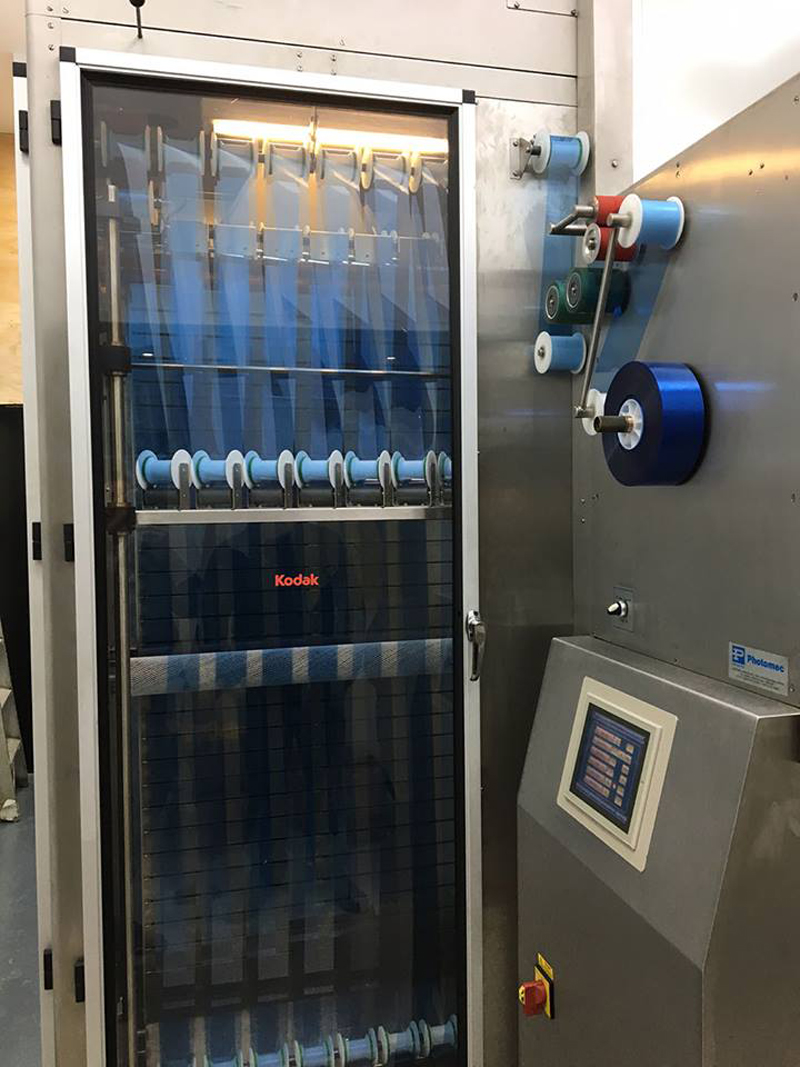
You should be able to see this link even if you don't have a Facebook account.
Kodak Facebook Page
Posted by Tom Ostertag (Member # 8318) on 10-28-2016, 08:21 PM:
Glorious!
Is that leader it's loaded with? Are the lack of perfs normal?
Posted by Bill Brandenstein (Member # 7758) on 10-28-2016, 09:19 PM:
Processing lines always stay threaded with leader; when an actual run is in progress, it's fed in at a set speed after being attached to the end of the leader. Once the end of the run is reached, leader is attached and run until the whole processing line is depleted of film so that it stays threaded.
Posted by Carsten Kurz (Member # 5396) on 10-29-2016, 04:46 AM:
Could that be for Dunkirk release prints, or is there a reason to assume this machine will only process negative?
What makes a negative processor a negative processor? Special film handling, lower speed?
- Carsten
Posted by Randy Stankey (Member # 64) on 10-29-2016, 07:31 AM:
My first guess would be chemistry, mostly. Timing & temperature would be my next guess.
Although a given set of chemistry can be used for many different types of film stock, the exact combinations of developer, stop, reversal agent, redeveloper, fixer, clearing agent and preservatives will be optimized for each type of film used. Temperatures and processing times for each stage of development will also vary.
Developing film isn't always a fixed process. There can be a lot of Kentucky Windage involved, especially if the photographer/director wants a particular look or effect in the final product.
I would say that setting a machine up to process a certain type of film then tearing it down, cleaning out all the chemical residue from the previous batches then setting it all up again and developing test strips before processing a new type of film is enough of a pain in the ass (not to mention cost) that it's better to set up separate machines for each film type.
Even when I develop single rolls of film at home, I like to batch process several rolls with the same process just to save time, trouble and chemicals.
Posted by Dave Macaulay (Member # 813) on 10-29-2016, 12:14 PM:
Nolan is releasing another epic in 70mm/35mm/Imax 15/70 so maybe another processing facility is being funded by him or Imax? I don't know how many exist now?
Posted by Leo Enticknap (Member # 534) on 10-29-2016, 01:12 PM:
quote: Carsten Kurz
Could that be for Dunkirk release prints, or is there a reason to assume this machine will only process negative?
It's 65mm, so 70mm stock wouldn't physically fit in the flanges of the rollers. So it can only be used with 65mm camera and intermediate stocks.
As Randy mentions, the processing chemistry and sequence (of immersion times and temperatures) is different for different types of emulsion, though. For example, 2383 (release print stock) uses process ECP-2D. 5207 (Vision 3 camera negative stock) uses ECN-2. Processing machines can be reconfigured and adapted to change processes, but this is a significant and time-consuming operation.
Posted by Mark Gulbrandsen (Member # 72) on 10-29-2016, 02:58 PM:
Changing processes within a machine is rarely if ever done because of cross contamination between different types of chemicals.
You are talking LOTS of chemical here, not just a few quarts, then all the lines, pumps and storage tanks.
Mark
Posted by Tyler Purcell (Member # 9213) on 10-30-2016, 01:47 AM:
I read somewhere there is another Lab in the UK (or central Europe) that can do 65mm negative and 70mm release prints. Kodak said prior to Dunkirk production started that they were processing "locally"... so I'm very confused about that.
Posted by David Buckley (Member # 2600) on 10-30-2016, 02:46 PM:
Is that a brand new processor, or an old one that has been re-commissioned?
Posted by Mark Gulbrandsen (Member # 72) on 10-30-2016, 03:02 PM:
Tyler,
There used to be a really nice 65/70mm lab near Paris. But they also shut down about a year or two ago.
Also, I could not really tell if this processor was being recommissioned or if it was brand new. I;d just have to say that it "looks new".
Posted by Leo Enticknap (Member # 534) on 10-30-2016, 05:40 PM:
I'd be surprised if it's all brand new, given how much surplus lab equipment must be floating around following the transition to digital. Completely recommissioned and refurbished, possibly using parts from multiple machines and some new ones, would seem to me to be more likely.
Powered by Infopop Corporation
UBB.classicTM
6.3.1.2