This is topic 35mm Film Shrink-Ruler & Film Shrinkage in forum Film Handlers' Forum at Film-Tech Forum ARCHIVE.
To visit this topic, use this URL:
https://ft-forum.com/ft/cgi-bin/ubb/ultimatebb.cgi?ubb=get_topic;f=1;t=012110
Posted by Jerry Axelsson (Member # 3175) on 02-11-2017, 09:37 AM:
Hello film enthusiasts,
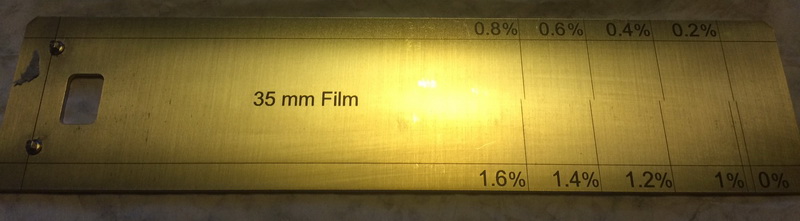
A friend of mine which has a professional mechanical shop just made me a few nice shrink-rulers for 35mm film.
They look like this.
What kind of measurement device do you use out there?
How shrunken prints do you still screen out there?
(and on which projectors?)
I test material which is shrunk 0.6% and do not run material which is shrunk over 0.8%
Posted by Leo Enticknap (Member # 534) on 02-11-2017, 01:59 PM:
How tolerant a projector mechanism is to shrunken stock essentially comes down to two factors: the sprocket teeth, and how much gate pressure it needs.
The Norelcos in use at our two main houses have sprocket teeth designed to be compatible with CS perforations and the ability to hold a steady picture with very low gate tension (thanks to the unique gate band arrangement), with the result that they can cope with KS ones that are significantly shrunk.
We recently played a print that its owner reported was shrunk up to 1.5% in some sections (I couldn't check this myself, because we don't have a shrinkage gauge), without the machine even sounding higher pitched than usual while running. Some other projectors I've used, however (e.g. Cinemeccanica Vic 5) would cause perforation damage to even sightly shrunk stock with enough gate tension applied to keep the picture steady. In fact, given that the newest acetate release prints are now getting on for two decades old, I wouldn't want to risk running anything pre-polyester on one unless it's been in atmospheric controlled storage all its life and therefore is almost unshrunk.
Posted by Frank Angel (Member # 248) on 02-11-2017, 02:57 PM:
Fox (CS) sprockets seem to be a lot more tolerant. We have prints that are more than 40 years old and run like butter in our XLs -- steady picture with normal pressure and if anything, occasionally you hear a little singing on the hold back sprocket in the soundhead. I don't have a shrinkage gauge either (would like to get one tho), but for these old acetates, it's not a question of have they shrunk, but how much.
Didn't LaVezze at one point offer sprockets that were designed to cause less wear on the hole structure VKS -- i.e., "very kind to sprockets"? Would they be even better than CS for shrunken prints?
Posted by Jerry Axelsson (Member # 3175) on 02-11-2017, 03:24 PM:
Well, we run Kinoton FP-38E Premiere and FP-30D:s of a later
manufacture. Shrunken film up to 0.7% will work decent, but more
than that makes the film "climb over" the bottom feeding sprocket.
We ran a 1955 Tech print the other day which climed over 4 times during a reel.
This "eats up" the bottom loop which forces you to stop and reload.
We also have Kinoton FP-75E machines. They seem to cope with slightly better with shrunken film over 0.7%
The film feels more like it is kept in vice in this machine. The most likely outcome is that the sprockets will give way before film forces you to shut down the projector. If there would be a need for shrink rulers I can ask my friend if there is an option to make a few.
Regarding FOX sprockets, I agree that they usually behave quite unproblematic.
Have screened Ben Hur, Close Encounters, The Deep, Woodstock. All 4-track mag. Ran nice....
Posted by Buck Wilson (Member # 5885) on 02-12-2017, 03:54 PM:
Indeed, depending on how nice your friend is, you could likely sell a few of those units. Looks quite nice.
Posted by Donald Brown (Member # 5427) on 02-12-2017, 09:09 PM:
During the time that I have been operating outdoor theatres, one of my fondest recollections dates back to the late '80s and early '90s, when a friend of mine, who was a film collector, would visit. After the venue had closed for the night and all of the patrons had departed, we would run off reels of old drive-in advertising and intermission material.
While much of this stock was worn, warped, and shrunken, the only machine that provided any difficulty handling it was a Simplex Five Star sound head. The drum tension roller did not have a keeper, and the film frequently escaped from the intended path.
Posted by Simon Wyss (Member # 6218) on 02-13-2017, 04:05 AM:
Yeah, LaVezzi made those VKF sprocket rollers, very kind to film. They had made plastic sprocket rollers, too, cheap exchangeables.
I’d say that 8 per mille shrinkage seems to be a limit with most sprocket drums (0.8 per cent). There the film begins to mount. I measure with a piece of clear polyester stock on the print. Counting from two hole pairs together to the next hole pairs in coincidence I have the shrinkage at once. If it is, say, hole pairs number 142, I have 0.7 per cent.
Posted by Paul Gordon (Member # 3320) on 02-13-2017, 03:40 PM:
KL Archival also makes shrinkage gauges along with optical printer gates and lots of other modified film gear. I even hear he is making turn tables for all disc formats.
http://www.canadianfilm.com/KL/Shrinkage-Info.01.html
Posted by Jim Cassedy (Member # 4115) on 02-13-2017, 03:56 PM:
The only time I ever had a trouble with film shrinkage was
running a 1950's re-print of a 1930's flick which had shrunk
laterally a bit. It had an old VD track, and to make matters
worse, it had been printed from a shrunken negative, which
put an image of the sprocket holes right at the edge of the
sound-track area, much closer than they should have been.
Had no sprocket trouble when running the print, but I had
to re-adjust the (Century) sound reader to avoid picking
up the printed sprockets, and causing motor-boating.
(The only other choice was to run a blu-ray- - but tickets were sold
for a FILM and that's what people coming expected to see- - so I was
willing to go through the hassle of adjusting things for just one show.)
Posted by Frank Angel (Member # 248) on 02-15-2017, 09:31 AM:
I ran (what I wsa told) was the one surviving IBT, 4chn mag print of PORGY AND BESS (reduction from the TODD-AO negs) back in 2003 or 4. I believe it came from the UCLA. At that time, two reels were badly vinegar-ed to the point that I had to have a second projectionist in the booth to thread up the next reel so I could continually refocus on the principal actors & action as the film was malformed badly enough that it couldn't be in focus across the whole frame. But for all the warpage, the print never went off the sprocket rollers, which has to say something about how well Fox sprockets deal with print shrinkage and warpage. Even the "good" reels that stayed in focus were badly warped enough that at times you could see the soundtracks & sprocket hole edges sneaking into the image area. But DAMN that Technicolor color was sumptuously rich; and of course the mag soundtrack made for a great presentation. Too bad the Gershwins prevented it from being seen in public venues for so many years. They only allowed it to be shown by special permission.
A year later, we wanted to play it again and found out that they had shipped it to France for an engagement and they claimed the print was deemed vinegar "junk." Hard to hear that about a print that is the only extant IBT mag version. I bet I could have nursed more screenings out of it had they let us book it.
There were always stupid legal issues about that title; it was blocked from being screened to the public for decades because the Gershwin family didn't like it -- the old, "If we don't like it, YOU can't see it" syndrome. The only way they relented for us was because we were an arthouse connected with a performing arts center connected to a university, not to mention, one of our theatres was named The George Gershwin Theatre. They also put an unusually high rental price on it so as to discourage even those "special screenings" from happening. You also had to have a "scholarly discussion" after the screening. They did relent to a public screening a while ago at the Ziegfeld a few years back. I don't think it was 70mm though as those prints are said to no longer exist. My understanding was that our screening was the first time it had been screened in like a decade.
I heard there were some fairly good bootleg DVDs floating around for awhile, the claim being that they were made from an EK print. I wonder if Columbia has a DCP available or it the estate still is as touchy about it now as they were when the Gershwins were still alive. Perhaps the estate is now more interested in how much $$$ it can earn....hopefully they would be happy to book it to anyone who would play it, but, oh wait, they don't have a print! And who knows what juvenile censorship provisions the Gershwins may have been written into the legal flotsam & jettsam in order to extend this shortsighted nonsense into perpetuity.
Posted by Mitchell Dvoskin (Member # 751) on 02-15-2017, 10:03 AM:
The Ziegfeld screening was 35mm IB Tech Mag Stereo. Some of the reels were clearly warped and could not hold focus, but the rest was stunning.
I never did understand what Greshwin's problem with the film was.
Posted by Frank Angel (Member # 248) on 02-15-2017, 09:20 PM:
I will bet the Ziegfeld screening was the same UCLA print that we ran. From what the UCLA curator told us, that was the only extant 35mm IBTech mag print.
Much of the withholding problem of this title originally stems from the Gershwins being unhappy with the less than stellar critical reviews it garnered at its few roadshow opening engagements. In addition they were unnerved by the unhappy response it received by prominent Black leaders and I think possibly the NAACP was also pretty vocal about the portrayal of Blacks as prostitutes, gamblers, nare-do-wells, pimps and gamblers, not to mention the undercurrent themes of violence and corruption that run throughout and finally the very uncomfortable and disturbing image of a Black man on his knees -- a symbol of degradation not easily missed.
Many of the Black actors who Goldwyn wanted to cast would not sign on. Harry Belafonte said the part was demeaning and strongly resisted and wouldn't be persuaded even by his agent. He only begrudgingly OKed it because he was afraid he would be shunned by other producers for other parts.
But the nail in the coffin was that Sammy Davis Jr happen to wind up at a party with the Gershwins (Ira and his wife) attended. Davis who was eager to get a part in the film was trying to schmooze Goldwyn, but was such a vulgar potty mouth that Ira's wife demanded that Goldwyn promise up and down that no way was Davis to be hired even as an extra in the film. Goldwyn promised her but eventually hired him anyway. The Gershwins were no fans from then on. The family also didn't like Previn's arrangements which were more orchestral than the jazz styling that was uniquely Gershwin's.
Plus the title has been in legal limbo with the two Gershwin estates fighting over ownership rights. The estates never fully settled the legal differences along with MGM, Samuel Goldwyn, Columbia, even Warners and Turner may have at one time or another had their hooks in the rights. It's still a legal labyrinth, so with all the bickering, that means that there will probably never be any restoration work done on it and now, even if some distributor HAD the rights, there's no print to book!
Posted by Sam D. Chavez (Member # 1841) on 02-15-2017, 11:28 PM:
Wow! There's some film history right there. You should write this on Wikipedia. Maybe you have. Excellent.
Posted by Frank Angel (Member # 248) on 02-17-2017, 11:37 AM:
Most of this is well known trivia about the film. At our screening, we had a very fascinating pre-screening discussion about P&B with film historian Foster Hirsch (Otto Preminger: The Man Who Would Be King), a friend who I invite to speak at many of our classic screenings (when we were still running film). He recounted these and a lot more juicy tidbits which I wish I could remember.
quote: Simon Wyss
Counting from two hole pairs together to the next hole pairs in coincidence I have the shrinkage at once. If it is, say, hole pairs number 142, I have 0.7 per cent.
Thanks Simon, good to know, although I am with Buck on this...I sure would like to purchase one of those spiffy guages if your friend as an interest in selling a few -- they are very sexy indeed.
Posted by Jerry Axelsson (Member # 3175) on 02-17-2017, 12:43 PM:
I will speak with my friend and see if he is up for making a few more shrink-rulers.
Posted by Paul Gordon (Member # 3320) on 02-17-2017, 01:41 PM:
The Apple App store used to have a film shrinkage gauge for the Ipad. You would lay the film over the Ipad and it would read the shrinkage for any film gauge.
Here is an old link to the app:
http://www.iosnoops.com/appinfo/film-shrinkage-meter-for-ipad/904345384
Posted by David Kornfeld (Member # 9964) on 04-21-2017, 09:57 AM:
quote:
From what the UCLA curator told us, that was the only extant 35mm IB Tech mag print.
My understanding -- which, of course, could be mistaken -- is that there are three existing prints. The UCLA one, the one at the LoC, & one print in the possession of a collector. That collector recently died, & so it's anyone's guess what will have happened to that one. Heres to hoping it found a reasonable home.
I know of no surviving 70 prints. I dont even know if the OCN exists, as it may have been returned to the Gershwins when Goldwyn's rights to the opera expired. If they destroyed it, then it's gone. If they stored it badly, then it's faded, which means it's pretty much gone. If poorly stored, it may also have been hit with VS, & that would make it completely gone (I cant imagine there are seps; that would come as a real surprise). Then there are the original tracks, which would have been mastered on full coat mag, which is subject to rapid disintegration if improperly stored. Are there protection copies of those? Who knows?
All in all, doesnt look good.
Posted by Frank Bolkovac (Member # 6201) on 04-21-2017, 11:55 AM:
Shrunk film (to any degree), runs best on "Fox hole" sprockets.VKF will walk your print right out of the projector.
Posted by Frank Angel (Member # 248) on 04-21-2017, 12:24 PM:
Yes, but that only applies to standard sprocket film -- actual mag/fox hole film is worse when it starts to shrink as the tolerances are tighter. The print we ran was a bitch back then; I can't believe they haven't junked it by now...but damn it looked beautiful on the screen, at least the first five reels -- 6 & 7 were the ones needed to have focus pulled. Really nice stereo mix as well. Because we ran so many mag titles, my booth has L,C,R, S playback with Altec boxes on the front wall and a smaller box of unknown origin on the rear wall for the surround. My idea was, the projectionist should be able to hear an approximation of the house mix. Many times my booth rocked as hot as the theatre.
Posted by Axel Fransberg (Member # 5630) on 04-21-2017, 02:17 PM:
Holy grail of missing movies
What started as a request from Geffen to screen the Goldwyn production 'Porgy and Bess' ended up as a hunt to find an existing print of the musical that even the Academy has been blocked from screening for its staff.
It was 2008 when David Geffen started pressing producer John Goldwyn to arrange a screening of Porgy and Bess. The 1959 musical, based on the George Gershwin opera, was produced by Goldwyn's grandfather, legendary Hollywood pioneer Samuel Goldwyn. Geffen implied that the mogul's grandson had vowed to set up a showing of the film, but if so it had slipped Goldwyn's mind. In any case, though his family still controlled the rights, Goldwyn did not have a print and did not know how to get one.
Prints of Porgy are beyond rare. "It probably is the most elusive film that not only got a studio release but a prestige studio release," says Todd Hitchcock, director of programming at the AFI Silver Theatre near Washington, D.C. Foster Hirsch, author of a biography of the picture's director, Otto Preminger, calls it "the holy grail of unavailable films." Many archivists and some of the rights holders don't know if a complete, quality print even exists.
With an astounding cast, including Dorothy Dandridge, Sidney Poitier, Sammy Davis Jr., Pearl Bailey and even a young Maya Angelou in an uncredited appearance, Porgy was broadcast nationally on television only once, when ABC aired it March 5, 1967. There are dubious bootleg copies online, but it is not possible to buy or rent a legitimate full-length quality version in any format. And even if a pristine print were discovered today, significant obstacles prevent it from being shown in theaters.
<em>Porgy</em> was a bomb at the box office, grossing only $3.5 million.
Courtesy of Photofest
Porgy was a bomb at the box office, grossing only $3.5 million.
Perhaps Geffen was possessed with a burning desire to see Porgy simply because of the difficulty involved in screening it. Or maybe the movie had been important to the 73-year-old billionaire as a youth. (He would have been 16 in 1959.) Geffen isn't saying. But as he continued to prod, Goldwyn decided it would be best to accommodate him, quietly.
Any attempt to find a print of Porgy and Bess turns into an epic exercise in bafflement and frustration. The movie is coveted by aficionados even though few see outstanding artistic merit in it. But those very flaws help explain why this film has been charged with emotion for nearly everyone with a connection to it (and why stage revivals, like a 2012 Broadway production, reignite new rounds of controversy): The history of Porgy is a tangled tale of good artistic intentions gone awry and lasting recriminations among the Gershwin and Goldwyn factions.
Editor’s Recommendation
The World's Busiest Oscar Has Traveled Over 3 Million Miles
Read More
Still, that does not explain why prints of the film have all but vanished. It turns out finding the rarest studio movie of all time is easier than unraveling that mystery.
•••
The film version of Porgy was snakebitten from the start. Based on Gershwin's 1934 opera, the story follows a romance in the fictional South Carolina enclave of Catfish Row between the disabled Porgy (Poitier) and Bess (Dandridge), who is struggling to break free from an abusive relationship and the snares of drug-pushing pimp Sportin' Life (Davis).
The rights to Gershwin's opera long were pursued by many big-name producers, and for Sam Goldwyn, it was a dream project. His moment to make the film, when he was in his late 70s, came as the civil rights movement got traction. Many African-American actors, including Harry Belafonte, declined roles because they thought the story promoted demeaning stereotypes. Both Dandridge and Poitier appeared only reluctantly. Davis wanted to be in the movie, but Goldwyn wasn't interested, finally relenting under pressure from Davis' Rat Pack buddy Frank Sinatra. Much of the dialogue in the stage version was changed from song to spoken word; singing was dubbed for Dandridge and Poitier. Of course the film included such classics as "Summertime" and "I Loves You, Porgy."
Preminger (left) on the set of <em>Porgy</em> with Goldwyn, who never produced another film.
Getty Images
Preminger (left) on the set of Porgy with Goldwyn, who never produced another film.
Rouben Mamoulian, who had directed the stage version, was hired to make the movie, but before shooting began, the sets and costumes went up in flames. The rumored cause was arson by those who objected to the film's portrayal of African-Americans. By the time production resumed, Mamoulian had been fired over creative differences and replaced by Preminger. Biographer Hirsch says the director previously had an affair with Dandridge and treated her abusively during the shoot. Preminger clashed with Poitier, too.
The film was a commercial failure; reviews were mixed. The New York Times praised it, but Time lashed its "cinematic monotony." (THR proclaimed it "a monumental Hollywood milestone.") Poitier is said to despise Porgy to this day. It was nominated for four Oscars but received only one, for the score by Andre Previn and Ken Darby. It was a deep disappointment for Samuel Goldwyn — a memory that seems to have resonated for decades with his family. He never produced another film.
Brock Peters arrived at the film’s June 1959 premiere in New York.
Getty Images
Brock Peters arrived at the film’s June 1959 premiere in New York.
The movie was not greeted with joy in the Gershwin family, either. George had died years earlier, in 1937, but his brother Ira lived until 1983. According to Michael Strunsky, the trustee and executor of the Ira Gershwin Musical Estate and Ira's nephew (by marriage), the main reason Porgy is so hard to find comes down to the fact that Ira and his wife, Leonore, didn't care for it. Or in Strunsky's words, "They both thought it was a piece of shit."
Preminger (right) on set with Davis, who played the pimp Sportin’ Life.
Getty Images
Preminger (right) on set with Davis, who played the pimp Sportin’ Life.
And so, continues Strunsky, "They did something they had a right to do. After 20 years, they had the right to have Goldwyn call in all the prints and destroy them." And that, says Strunsky, is "absolutely what happened."
While the musical rights reverted to the Gershwins, it's less clear they had the power or will to demand the prints be destroyed. Singer and pianist Michael Feinstein worked as Ira's assistant during the period in which this destruction allegedly occurred. "Ira would never have done it," he says. On the other hand, Feinstein muses, "It's the kind of thing Leonore would say at a dinner party — 'I had it destroyed' — to emphasize her dislike of it."
Whatever she or her husband did or did not do, Porgy and Bess became a phantom movie.
Editor’s Recommendation
I Was Carrie Fisher's 1978 Oscar Date: Spielberg, Lucas and a 3 a.m. Afterparty With John Belushi
Read More
•••
As John Goldwyn tried to find a print, his first stop was Barbara Boyle, who teaches at the UCLA film school. She expected it would be in the university archive, the second-largest in the country with 375,000 television and film titles. But archive director Jan-Christopher Horak told her it was not there. (Even today, Wikipedia reports that UCLA has a copy, but that is incorrect.)
But Horak heard that one surviving Technicolor print — perhaps the only one — was in the hands of a quirky collector. That was Ken Kramer, the owner of a place in Burbank called The Clip Joint for Film. Dennis Bartok, the GM of American Cinematheque, calls Kramer's shop "a magical place, one of the most beautiful private movie worlds in existence." Packed with posters and memorabilia, the shop had a small screening room. On Tuesday nights, Kramer would fire up his popcorn machine and hold viewing parties. He sometimes would show his rarest possession, a 35mm print of Porgy. (While Porgy was shot in 70mm, there also were 35mm prints. In that format, the Technicolor of the day is comparatively stable, while 70mm prints tend to be faded and pink.) Some of his collector friends sometimes would tease him, saying that it wasn't a great movie, but he always defended it. "He loved the people in it, and they never got enough screen time in that era. And he loved the music," says his widow, Kathy Losso.
"Ken loved movies,” says Losso, photographed Feb. 13 holding her late husband’s ultra-rare print of <em>Porgy and Bess</em> at his Burbank shop, The Clip Joint for Film.
Damon Casarez
"Ken loved movies,” says Losso, photographed Feb. 13 holding her late husband’s ultra-rare print of Porgy and Bess at his Burbank shop, The Clip Joint for Film.
How did Kramer get his copy? He died in March 2016 at age 72, but Losso says he acquired it from a collector friend. "It probably wasn't a quite-legal acquisition," says Horak. "Studios don't willingly give up those kinds of prints. But in the past, things wandered off the loading dock." Some believe Kramer's copy was assembled from different fragments.
When Kramer heard Geffen's request, he had two conditions: He would bring the film only if it were to be shown at UCLA's state-of-the art James Bridges Theater. Also, Kramer wanted to meet Geffen. And so, on Sept. 28, 2009, Geffen met Goldwyn for dinner at Toscana in Brentwood, and they set off to see Porgy. The next day, Horak emailed a colleague that the screening went "smashingly well" and the print looked "very, very good."
Kramer, with his beloved projectors, agreed to screen <em>Porgy and Bess</em> for Geffen in 2009 — but only if he could meet the mogul.
Courtesy of Kathy Losso
Kramer, with his beloved projectors, agreed to screen Porgy and Bess for Geffen in 2009 — but only if he could meet the mogul.
Like Horak, Bartok believes Kramer had "the only good screenable print that exists anywhere in the world." Bartok tells THR that he has heard of a 70mm print in Europe, "but it is badly faded, and the collector who has it wants to be flown in with it and charges a loan fee, and it's ludicrously expensive and it's pink."
THR attempted to reach a collector in Germany who is said to possess a print but got no response. (Bartok, who co-authored a book about film collectors, says they tend to inhabit "a very strange, passionate, obsessive, secretive, often paranoid underground world.")
Editor’s Recommendation
Camille Paglia on Oscar Glamour Then and Now: "Grandeur of Old Hollywood Is Gone" (Guest Column)
Read More
In 2012, Hitchcock arranged a screening of the German print at the AFI Silver Theatre and had people making plans to come from as far as Australia to see it. But to his surprise, Sam Goldwyn Jr. and his longtime business partner, Meyer Gottlieb, denied permission. Hitchcock was forced to cancel (and still has not seen the film).
Preminger biographer Hirsch seems to have had better luck. He helped arrange two screenings of Kramer's print at the Ziegfeld Theatre in New York in 2007. Several Gershwin descendants came, he says, and said they were "proud of the film." And in October, Hirsch arranged a sold-out screening at the Cleveland Institute of Art Cinematheque. He had located a 35mm print belonging to the National Audiovisual Institute of Finland, which shipped it via FedEx from Helsinki.
"I've been here for over 30 years, and this was on my bucket list of movies to show before I die," says Cleveland Cinematheque director John Ewing. The quality of the print surpassed his expectations: "For my money, it was gorgeous."
Kathy Losso.
Damon Casarez
Kathy Losso.
Still, Ewing believes Kramer's copy likely is better. But Sam Goldwyn Jr. and Gottlieb were not impressed. Losso recalls one day several years ago when the two men asked if they could come to The Clip Joint to see it. She made popcorn, offered them drinks. "They watched a few reels and finished their popcorn and then said they had seen enough," she says. "They didn't like the film." Gottlieb confirms the visit to Kramer's shop. "Sam and I went to his joint," he says. The print "was not acceptable to us from a quality perspective."
In recent years, says Losso, the Goldwyns have blocked public screenings of her husband's print of the film, even rebuffing the Academy's request to screen it for its staff. Losso says her husband had great respect for Gottlieb and was scrupulous about getting permission to screen the movie for the public.
After all these years, the Gershwin and Goldwyn camps still are pointing fingers over what happened to Porgy. Complicating the situation are two distinct Gershwin factions: Michael Sukin is a New York attorney who represents the George Gershwin Family Trust, while Ira's nephew Strunsky handles the Ira-and-Leonore side of things. Sukin and Strunsky agree that both parties would like to see the film version of Porgy restored. They say they were working on that with the Goldwyn side but that the talks ground to a halt because of the cost. And Sukin says he does not even think a negative exists at this point.
Gottlieb sees it differently. In the late 1990s, he says, he and Sam Goldwyn Jr. asked the Gershwins to renew the rights to the music so the negative could be restored. And Gottlieb knows the negative still exists because it's just where he and Sam Jr. put it: in the Academy library. But after many months negotiating with "a lot of lawyers and family members" who represented the Gershwin interests, he says he suddenly got only silence, with no explanation. "I decided from a frustration perspective, emotion perspective and business perspective, there was no benefit to showing a poor-quality [print] to an audience," he says.
Editor’s Recommendation
The Truth Behind the Infamous 2000 Oscar Heist
Read More
Brothers John and Tony Goldwyn, who now control the family trust with Gottlieb, say they have no objection to restoring the film in the right circumstances. "We would all as a group be completely open and enthusiastic if all the parties could come to agreement, in a financial sense, to restore it," says Tony, best known for playing President Grant on ABC's Scandal. In other words, the Goldwyn family does not intend to finance the restoration but insists on retaining its rights to release the film in all formats.
What would it take to restore the film? Michael Pogorzelski, director of the Academy film archive, says a test scan of the negative showed it to be in good shape. But to make a 70mm print might cost in the low-six figures, and there's no impetus for the Academy to attempt to raise the money with such immovable obstacles to screening the movie.
Preminger’s biographer says the director, here on set with Dandridge (right) and an unidentified actress, was abusive to Dandridge throughout the production.
Getty Images
Preminger’s biographer says the director, here on set with Dandridge (right) and an unidentified actress, was abusive to Dandridge throughout the production.
Given the tangled rights and emotions, there may never be a restoration. But for those who are determined, there is a way to see Porgy and Bess. A 35mm print was submitted to the Library of Congress in 1960 for copyright purposes, and it still is there, though it is never screened. "We're well aware of the scarcity," says Mike Mashon, head of the Moving Image Section. The library made a video copy and digitized it, so anyone with a Library of Congress researcher's card — which is not difficult to get — can see it. The library added the film to the National Film Registry in 2011.
The Finnish print of Porgy remains in its archive, and records indicate that since 1985, it's been screened nine times. "There has been more demand during the years than what we have granted," says archivist Juha Kinberg.
And what of Kramer's print? Losso wants certain collectors to know that she doesn't store it in Kramer's office ("These guys are fanatics"). She's determined to protect a film that was so special to her late husband. "Ken loved movies, and to share that experience was his passion in life," she says. Bartok says it's hard to say what Kramer's print is worth, but he hopes to see it preserved. "I don't think it holds up as well as some other musicals of that period," he says. "But that doesn't make it less historically and musically important."
Gottlieb agrees, even if he doesn't intend to allow any existing prints to be screened. It's not that he doesn't want the film to be restored, he says — but there's that catch-22 of who would pay for it if the Goldwyns retain their rights. Porgy and Bess is "an American opera; it's a classic," says Gottlieb. "It's got wonderful music, the creme de la creme, the best stars of the time were in the movie. I think the audience deserves to see it."
Posted by Robert Harris (Member # 1712) on 05-08-2017, 12:45 AM:
There are no problems in restoring P & B. Original tracks were x-copied a decade or so ago.
Posted by Mark Gulbrandsen (Member # 72) on 05-08-2017, 11:03 AM:
There was a 70mm print of it sitting in the Four Star Theater in Hollywood in 1987...
Mark
Powered by Infopop Corporation
UBB.classicTM
6.3.1.2