This is topic 70MM Magnetic Surround Channels in forum Film Handlers' Forum at Film-Tech Forum ARCHIVE.
To visit this topic, use this URL:
https://ft-forum.com/ft/cgi-bin/ubb/ultimatebb.cgi?ubb=get_topic;f=1;t=012120
Posted by Aron Toplitsky (Member # 6950) on 03-10-2017, 08:09 PM:
Is it just me or did it seem like the surrounds were mixed louder for 70MM blow ups in the 80s? For years I've felt like digital sound for the average film and the DTS tracks for the more recent 70MM presentations, lacked a surround presence.
Is it possible the nature of the magnetic soundtrack gave a better surround presentation? Thoughts anyone?
Posted by Terry Monohan (Member # 8285) on 03-11-2017, 12:26 AM:
Yes I liked the old mag surround sound, It was on at a good level and had a little high end hiss to it very crisp at times. Most of the digital cinemas today the people in charge of the no projectionist booths have turned the surrounds way down as the old people complain they are on to heavy.Then they have the nerve to tell me that is the way the producers mixed the sound. What is strange seems like some chains have the previews turned up or they were mixed that way and when the main feature comes on all the speakers stage and surrounds are sort of flat and don't have the punch the previews did. I miss 70mm mag stereo sound. It was so powerful It blew out many of the surround speaker cones when they played 'Top Gun' at the old Cinerama Theatre in San Diego CA many years ago.
Posted by Mark Gulbrandsen (Member # 72) on 03-11-2017, 08:44 AM:
I think it all just depends on what the re-recording mixers and Director wanted to achieve. It's really their choice.
Mark
Posted by Steve Guttag (Member # 268) on 03-11-2017, 12:30 PM:
Here's the scoop. Most people with home theatres like the surround louder than intended. I deal with it all of the time. Additionally, in the 80s, it is quite possible that the theatre you went to may have turn the surrounds up a bit (happened all of the time). I've ever hear the line "I paid for them, I want to hear them).
For most of the 80s and prior, surrounds were just mono. They may have seemed louder since ALL were playing if any of them were. In fact, the legacy of the mono surround channel plagues the professional CINEMA market to this day, despite DCPs as being defined as a 5.1 soundtrack, minimum.
When stereo surrounds came out in the late 70s, they had to deal with cinemas (and movies) that had a mix of mono and stereo surrounds. So those cinema processors with stereo surrounds had their surrounds turned down 3dB per side. To which you think "Aha! I knew they turned them down in modern times!" Wrong, when Ls/Rs are playing together (e.g. mono surround material), they acoustically sum together to bring the level back up the 3dB that was removed. So, if you had a mono surround source and played it in a 5.1 theatre or 4.1 theatre, the surround level as measured is identical. When Surround EX came out in 99 (blech), same problem. The surround level had to remain the same regardless of auditorium it played in so if you played the same movie in a 4.1, 5.1 or 6.1 theatre, the measured surround level remains the same. Now, inferior EX decoders (which is an odd statement since EX was an inferior format, in my opinion) would get the levels wrong and emphasize the rear surrounds instead of have them be uniform with the rest of the array. Remember, in that same room, regardless if optical (mono surrounds), digital (stereo surrounds), or EX (sort of 3-channel surrounds), the levels should not go up/down based on what mode you had the processor in.
Now with 7.1, we cut the channel into quarters but the same rules apply Ls/BSl should play at the same level as just Ls in a 5.1 theatre. Thus, if you had all four 7.1 surround channels playing the same content as a mono surround theatre, the surround level should be identical.
What I find absurd is with DCPs, we had the opportunity to make a clean break from the mono-surround legacy. Furthermore, we had the opportunity to also get rid of the sound processor being responsible for level matching (which most techs don't seem to pay attention to). In my opinion, the people recording the movie should lay the track down without any compensation in the processor. Thus, while a 7.1 system would need to adjust its levels for a 5.1 movie, a 5.1 system playing a 5.1 movie (the new standard) should have played everything without any compensations. That is, in a typical processor where reference is 85dBc (at -20dBFS, "7", "0dB) it should have been that the surrounds were set to 85dBc like the stage channels. Instead, we had to bow to the legacy of pre-compensating of 82dBc/side so they would sum to 85dBc if played in unison. For the brief period where there was an overlap of film and digital, we have forever forced the industry to cater to a dead format (mono surrounds).
Again, I get the low-surround level complaint a fair bit but in truth, they are playing at the level the people that recorded it intended. I've done enough studio screenings to know.
Another factor, if you have crappy stage channels that are hard on the ears, you will tend to turn your fader down and with that, the surrounds. I've found that with better speakers/acoustics, the volume levels can play higher without discomfort and the surrounds have a much better presence.
Lastly, in the 80s, surrounds were typically not EQed or were minimally EQed so you may have had some extra bright sounding speakers that made themselves better known. I for one, subscribe to the belief that surrounds should not have the same ISO2969 rolloff due to their proximity to the listener and roll them much less, which does tend to give them more presence.
Remember too, in the 80s, you had the effects of a wide range of decoding equipment affecting your interpretation of the soundtrack. With DCPs, you are listening to PCM tracks with minimal processing. It should be, in most every respect, be a more faithful version of the original track.
Posted by Bobby Henderson (Member # 840) on 03-11-2017, 02:54 PM:
Another really big difference with 70mm magnetic surround:
Such audio tracks were almost always played in standard sloped auditoriums with far lower ceilings and far less cubic air space to manipulate.
Modern theaters are almost always configured with stadium seating. Such rooms have an entirely different audio character than the mildly sloped auditoriums that started disappearing 20+ years ago. It takes a substantially more powerful sound system to deliver tight, punchy, startling dynamics and sub-bass powerful enough to rumble the air in your chest. Most theater chains aren't willing to spend the money on speakers and amplifiers needed to do that. The surround speakers in stadium seated theaters are typically the same tiny cabinets installed in old mild sloped theaters. The problem is the ceiling is a whole lot taller and the room shape is very different and very uneven. If you want to hear the surrounds at all you have to sit way back in highest rear-most rows of the auditorium. This is especially true for ceiling mounted surrounds for use with new formats like Dolby Atmos.
I think movie theater chains need to re-think how they design stadium seated auditoriums. For the longest time I've thought they should have a far milder slope, just steep enough to let you see over the heads of people in the next row, rather than have their heads on levels lower than your knee caps. The ceilings wouldn't need to be so damned high. It would probably be easier and cheaper to configure effective surround systems for such rooms. And next gen formats like Atmos would be far more effective in their surround coverage.
Posted by Stephan Shelley (Member # 8587) on 03-11-2017, 03:58 PM:
Not so sure about that. A lot of theatres that showed 70mm back in the day were balcony or rear stadium setup. The Coronet in SF was main floor sloped and a large lodge stadium section behind it that went up over the lobby. This was a the house setup for Todd-A-O and Around the World in 80 Days. All of these had 30-40 foot ceilings and were wide houses to accommodate 70-90 foot screens.
Posted by Michael Cornish (Member # 6529) on 03-11-2017, 07:50 PM:
I remember running Die Hard in 70mm at the old Kenwood twin cinemas in Cincinnati. On the days that I had usher shifts when taking trash out to the dumpster the ground would shake outside during the opening scene.It was the first time the Century JJ mag pick ups had been used since the 60's according to our chain techie.After the first weekend he had to order a new pick up with gold contacts the original one gave up the ship from sitting dormant for so many years.
Posted by Bobby Henderson (Member # 840) on 03-11-2017, 09:10 PM:
quote: Stephan Shelley
Not so sure about that. A lot of theatres that showed 70mm back in the day were balcony or rear stadium setup. The Coronet in SF was main floor sloped and a large lodge stadium section behind it that went up over the lobby. This was a the house setup for Todd-A-O and Around the World in 80 Days. All of these had 30-40 foot ceilings and were wide houses to accommodate 70-90 foot screens.
I'm going on my experiences from 1980's and 1990's, having visited many 70mm equipped theaters in New York City, Washington, Atlanta and Dallas. Very few of those theaters had balconies. The best sounding ones had no balconies, especially the ones with high seating counts (like Loews Astor Plaza and the Ziegfeld in NYC or Northpark #1 in Dallas).
I've never heard a stadium seated theater have dynamics that punched the chest quite like that of the Northpark theater in Dallas. IMAX-branded theaters can get plenty loud and even really punchy with bass, but the EQ often just plain sucks. And that's really where a theater like Northpark shined.
Posted by Stephan Shelley (Member # 8587) on 03-11-2017, 09:50 PM:
Even the Northpoint in SF had an 89 foot screen sloped main floor only seated around 980 had at least 30 ft ceilings and 100 feet wide a big space.This theatre was built around the era you are talking about.
Posted by Steve Guttag (Member # 268) on 03-12-2017, 09:52 AM:
I find you analysis, Bobby, wrong. The surrounds have always followed the slope of the floor so regardless of slope floor or stadium riser; the distance between the surround speaker and listener is about the same. The size of the auditoriums has also always been a variable with the palaces of yesteryear being VERY wide but the early multiplexes being rather narrow. To this day, you still get a mix of situations.
While yes, as the risers approach the rear, it is possible for the rear surrounds to get VERY close to the listener, that would be a bad theatre design. Remember, speakers have a radiation pattern and they are "aimed" to cover the listening area, without regard to the room size. Surrounds tend to be primarily direct response devices and the use of many of them makes them diffuse. This is contrary to stage speakers where you want a direct response (1st arrival to be predominate) but often have to contend with the acoustics of the auditorium and strike the right balance of reverberation and 1st arrival to maintain intelligibility.
A typical stage horn has a 40-degree vertical coverage angle. In a slope floor theatre, you are going to point this further down to put that coverage on the seating area, however older theatres tend to be deeper, which raises the horn a bit. In a stadium theatre, the theatre is typically more shallow but more tall so you will have that horn pointing higher up to again, keep its coverage over the seating area. Now, ideally, in yesteryear we would have used variable intensity horns like the old Altec VIR but I don't know of anyone that did. We do use an outgrowth of that horn in some surround applications (under balcony and balcony side surrounds, the EVI-28).
Posted by Terry Monohan (Member # 8285) on 03-12-2017, 01:49 PM:
Thanks Steve for your notes about surround sound. If any of you live in SF Bay Area check out the stereo split surround level in large theatre #1 at Oakland's Grand Lake Theatre for the 70mmn film showing 'Kong'. Stephan,your projection work was spot on, the 70mm blow up film looked so hot last night, not a scratch or piece of dirt on the print. The best part of this new Kong 70mm film was the sound mix at your cinema in Oakland and how It sounded in the large downstairs auditorium. Sounded like I heard 4 different channels coming out of the surrounds at a decent level. The sound mixers did a great job on 'Kong' and best of all Stephan had the surround speakers turned up at a good level that It wrapped the whole movie palace into the story coming from the screen. Go see 'Kong' and listen to some of the best surround stereo split mix you will ever find in a movie in the last 10 years. 5.1 /7.1 or more this new movie had all the surround speaker sounds working for music and jungle sounds plus many other stereo effects,the movie was not that bad either. The new red LED lights in the cinema added to the feel of the film, glad they stayed on at a low level all during the movie as most theatres turn all the effect auditorium lights off when the movie is on and you sit in the dark. Stephan can these effect lights be changed from time to time to lets say Blue or Green? Thanks again for a fun night out at a first class movie theatre and to see two sets of curtains that work brought joy to all my movie friends.
Posted by Aron Toplitsky (Member # 6950) on 03-22-2017, 11:19 PM:
Thank you all for responding. Some very interesting responses.
Just when I complain about not hearing surrounds these days, I saw Skull Island this past Sunday and the surrounds were very active. I agree with Terry, it had some of the best split surround in years. I saw it in 70MM at the Arclight Hollywood and unfortunately the print had a scratch running along the left part of the frame for the entire movie. I was also a bit underwhelmed and disappointed by the LFE. It was active during some scenes, but not many. I still had a good time at the movies, the film was a lot better than expected.
Posted by Martin Brooks (Member # 1269) on 04-17-2017, 08:13 PM:
quote: Bobby Henderson
The best sounding ones had no balconies, especially the ones with high seating counts (like Loews Astor Plaza and the Ziegfeld in NYC
And those theaters were far larger than today's theaters and had more volume to fill. The Ziegfeld (1150 seats) didn't have a balcony, but it did have stadium style seating in the rear.
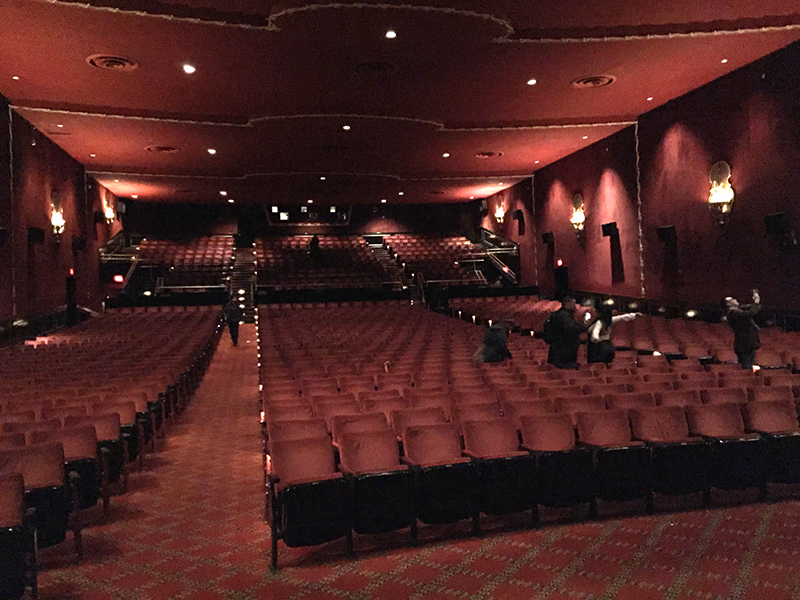
And it had very tall ceilings, probably one of the reasons it never had Atmos installed. The Astor Plaza (1530 seats) was a basement theater, so it did have lower ceilings and a moderate slope, but it was also very large.
Posted by Mark Ogden (Member # 43) on 04-17-2017, 09:21 PM:
Inside, the Ziegfeld was a beautiful theater. Putting in Atmos with all that crap hanging from the walls and ceiling would have been sacrilege. The room sounded just fine as it was.
Posted by Paul Linfesty (Member # 214) on 04-17-2017, 10:29 PM:
Ironically, the Ziegfeld's original surround speaker array was flush-mounted into the ceiling, a popular speaker location for many theatres of that era.
Posted by Monte L Fullmer (Member # 2797) on 04-20-2017, 02:52 PM:
Course Mag70mm only had the one surround channel with the other 5 channels behind screen.
Posted by Stephan Shelley (Member # 8587) on 04-20-2017, 03:11 PM:
There was Dolby split surrounds. Apocalypse Now, Dick Tracy and such. Plus starting with Star Wars only 3 screen channels and bass extension on LE and RE.
Posted by Martin Brooks (Member # 1269) on 05-03-2017, 08:33 PM:
quote: Paul Linfesty
Ironically, the Ziegfeld's original surround speaker array was flush-mounted into the ceiling, a popular speaker location for many theatres of that era.
How reliable is that recollection because that's not what I remember, but I can't say my own recollections are clear from before the Dolby era. I went to the movies at the Ziegfeld regularly from the time they presented Cabaret (in mono) in 1972. But they were equipped for 70mm discrete stereo from the time it opened in December of 1969 with "Marooned".
For the original run of "Close Encounters" they bolted the screen speakers to 3/4" plywood fronts, added 8 Cerwin Vega baby earthquakes and used 21 Bose 901 surrounds. One of the top five movie experiences of my life.
---
And yes, the Ziegfeld presented Apocalypse Now in split surround. The sound was spectacular. My wife wasn't into advanced presentation like I was and when we were sitting there waiting for the film to start, she wondered if it was worth the hassle of going into Manhattan to see the film and just as she said that, the soundtrack started with The Doors "The End" and she turned to me and said, "it's worth it!"
The mix on the Blu-ray doesn't sound anywhere near as good as it sounded that night at the Ziegfeld. At least that's how I remember it.
Posted by Brad Miller (Member # 2) on 05-03-2017, 09:19 PM:
quote: Martin Brooks
The mix on the Blu-ray doesn't sound anywhere near as good as it sounded that night at the Ziegfeld. At least that's how I remember it.
While the mind can play tricks on you from old memories, I can pretty much assure you some jackass did a "near field remix" of the bluray audio. Those guys are systematically destroying movie audio once the theatrical engagement is over. ![[fu]](graemlins/fu.gif)
Posted by William Kucharski (Member # 7246) on 05-03-2017, 10:21 PM:
Kind of peripherally related to that, I wonder what the deal is with Close Encounters of the Third Kind.
I remember as a kid seeing the 70mm presentation (and have confirmed with multiple others) that when the strings of the opening theme went to the full orchestral ffff note with the white flash, it was so loud and jarring that audiences gasped/screamed followed by some nervous laughter.
Yet, no home video presentation nor any theatrical rerelease has duplicated that - not even today with digital audio and 120dB of dynamic range available.
Anyone know why?
Posted by Bobby Henderson (Member # 840) on 05-03-2017, 11:45 PM:
Limitations of consumer home audio gear? Maybe the movie studios don't want to blow a lot of speaker drivers in home stereo systems?
Posted by Sam D. Chavez (Member # 1841) on 05-04-2017, 01:04 AM:
You can't duplicate the experience of an epic film seen and heard for the first time on a big screen. No matter how good the home screen, you're trying to repeat the experience and the memory of the first time.
Posted by William Kucharski (Member # 7246) on 05-04-2017, 07:39 AM:
But it's not just remembering an emotional experience, it's a tactile one.
Given what studios have put out on disc before, it's definitely not a case of being worried about equipment (I wonder how many subwoofers have been lost to the 15 Hz and 10 Hz tones during the intro to Edge of Tomorrow), and the Blu-ray release of Interstellar is certainly not at all compressed); the fact that re-release prints also toned down the effect point to it being a conscious decision somewhere along the line after the original 1977 release. Plus let's not overlook the fact that many home theaters have sound systems that put those 1977 theater systems to shame.
Perhaps they blew out too many theater sound systems. ![[Big Grin]](biggrin.gif)
If you Google for it, you can find many people on various boards have mentioned that note as definitely being toned down at some point.
Posted by Bobby Henderson (Member # 840) on 05-04-2017, 08:37 AM:
Far field and near field mixes aside, I feel like the sound systems in most commercial theater auditoriums are really under-powered. They can get loud, even painfully loud, in the upper high frequency bands. But they're almost always lacking in the lower registers and sub-bass.
I rarely ever encounter a commercial theater that can thump the air inside my chest. Perhaps some of this is from customer complaints, demanding the volume be turned down to a lower, less-startling level. It's also probably from corner cutting on the walls separating each auditorium. We don't have anything like THX mandating certain levels of wall treatment. It's 100% up to theater operators how much or how little they're willing to invest in isolating the audio in one room from audio in the others.
Regarding 10-15Hz sub-bass tones in Edge of Tomorrow, I'm actually willing to bet very few drivers got blown by that (if the tones were actually getting that low). Very few sub-bass enclosures can actually put out sub-bass that low. I've seen certain high end sub-bass speakers claim sub-bass response down to 8Hz. Most only get down to about the 30Hz level. For ridiculously over-driven sub-bass, I usually recall some early DVDs with THX "Broadway" trailers; certain discs had this trailer over-driven enough I had to turn down the volume or chapter-past it.
I remember Edge of Tomorrow having a really good Atmos mix, but I wasn't particularly impressed with the sub-bass. That probably had more to do with the design of the theater's sound system than what was actually in the mix.
Posted by William Kucharski (Member # 7246) on 05-04-2017, 03:12 PM:
Google "Edge of Tomorrow bass" and you'll see the spectral plots as well as lots of YouTube videos of home theater subs reacting in nice and not so nice ways. :-)
Posted by Allan Young (Member # 6332) on 05-06-2017, 08:03 AM:
I caught Brainstorm in 70mm for the first time a few weeks back.
I already knew about the mix of 35mm and 65mm footage but what I didn't know before was that the surround channel was only used (at considerable volume) during the "virtual reality" 65mm sequences.
Which was rather cool.
Posted by Martin Brooks (Member # 1269) on 06-02-2017, 09:52 AM:
quote:
I remember as a kid seeing the 70mm presentation (and have confirmed with multiple others) that when the strings of the opening theme went to the full orchestral ffff note with the white flash, it was so loud and jarring that audiences gasped/screamed followed by some nervous laughter.
Yet, no home video presentation nor any theatrical rerelease has duplicated that -
I don't remember that, but what I do remember in the original version is that near the end of the film when the glass blows out in the observation tower, the sound appeared to come from the right surrounds, even though the 70mm had mono surrounds. It was so loud, yet so clear in the presentation at the Ziegfeld in NYC, everyone in the audience turned their heads because it really sounded like something crashed down off the walls. It doesn't sound like that in the Blu-ray mix, but almost no Blu-ray 5.1 or 7.1 mix I've ever heard has ever sounded like my recollection of the 70mm mix (putting aside for a moment the fact that I saw those films with much younger and healthier ears). That's true for "West Side Story", "2001", "Close Encounters...", "Star Wars", "Apocalypse Now" and many others.
Posted by William Kucharski (Member # 7246) on 06-02-2017, 05:59 PM:
I do wonder sometimes if home video is mixed for people with soundbars and HTIB surround systems rather than those who have put a lot of effort into their home theaters.
Certainly between digital audio and the best home equipment available, it should put the sound system in most theaters to shame.
Posted by Frank Angel (Member # 248) on 06-03-2017, 01:45 AM:
Martin, I was lucky enough to see CLOSE ENCOUNTERS at the Ziegfeld and I do know and Martin verifies it, that the sound for that engagement was indeed a special setup. Having seen many other 70mm titles at that venerable grand lady, the sound for CE had the impact that it did because of the added Sensurround boxes. Noting I had ever heard before in that theater compared. When a sound system is enhanced for a specific title, unless you are able to duplicate that same configuration at home or even in another cinema, it's never going to sound quite as good.
And the question of aging hearing aside, even if you were deaf, it wasn't a matter of hearing the opening chord in CEo3rdK when he pointed to the heavens, that chord drop-kicked you in the effin chest and stomach -- same with the glass shattering on that deep quaver note -- it was 90% tactile. Give me some Cerwin Vega Sensurround bins for my living room and I bet I'll be able to duplicate it.
There is no question with the right installation designed very specifically for a particular room with its unique acoustic characteristics and designed to play back a SPECIFIC film soundtrack with the techs KNOWING the soundtrack intimately as well as the result they want, not only the overall film soundtrack, but they know what they want a specific sequence to accomplish via the sound.
They did the same thing with LION KING at Radio City Music Hall -- Disney engineers put in floor to ceiling bins on either side of the screen and when the elephants came bounding across the screen and a sheet-load of wall surrounds and massive point source line arrays in the rear corners kicked in, I can assure you, the effect was not much different that if you were standing just a few feet from a real pack of charging elephants or the herd of stampeding wildebeests. You know it didn't sound that impressive in most other theatres, even the ones with very decent systems because no one else had the advantage of a special $200,000 sound system installation with the best people in the industry tweaking it for THEIR film in THAT venue.
As for the first time.... as Sam says, quote: Sam D. Chavez
You can't duplicate the experience of an epic film seen and heard for the first time on a big screen. No matter how good the home screen, you're trying to repeat the experience and the memory of the first time.
...that goes for just about all our first experiences...just like the first time with your first love.
PS on Sensurround installs in the early days of EARTHQUAKE -- yes your the cells in your body vibrated and it made you feel like the connective stuff that holds those cells together was going to fly apart and so would you... it was spectacular. I saw it in Chicago in some massive theatre in the Loop and also in NY for a total of 5 times. The problem with Sensurround was the bins moved so much air that it caused the rest of the soundtrack coming from the stage speakers to sound like the speaker were placed behind a fan. When you get a chance, have someone stand behind a fan and see what it sounds like. I never heard that particular problem either with CE or the LION KING setups.
Powered by Infopop Corporation
UBB.classicTM
6.3.1.2