This is topic Weight of a Kinoton FP-30D. in forum Film Handlers' Forum at Film-Tech Forum ARCHIVE.
To visit this topic, use this URL:
https://ft-forum.com/ft/cgi-bin/ubb/ultimatebb.cgi?ubb=get_topic;f=1;t=012172
Posted by Stephen Furley (Member # 1277) on 07-20-2017, 02:37 PM:
Can somebody tell me the approximate weight of a Kinoton FP-30D with the small 2kW Kinoton lamphouse? I've found a data sheet online, but it can't be correct as it says 240 kg (220 lbs) without lamphouse, and that conversion from kg certainly isn't correct. This is the standard length column machine.
We need to move one slightly to get the digital machine in a better position.
Posted by Carsten Kurz (Member # 5396) on 07-20-2017, 09:20 PM:
I have the same english language brochure, with the 240kg/220lbs number. The 240kg is probably correct - the german FP30D brochure only quotes the 240kg number. 220lbs would be far to light anyway.
- Carsten
Posted by James Robertson (Member # 888) on 07-21-2017, 12:22 AM:
240 kgs.is 529lbs.
Posted by Stephen Furley (Member # 1277) on 07-21-2017, 03:20 AM:
Thank you, that's what I thought. I know they're heavy and the 240 kg figure would be the original one, the lbs the conversion, which is where the error is likely to have been made. Goodness knows why the English version even gives a figure in pounds; we converted over 40 years ago now.
Obviously the exact weight is going to vary somewhat depending on the equipment installed, we don't have lens turrets for example, but it's good enough for me to show to somebody who thinks the 240 kg figure sounds too high, and that four people could just move it manually. I have said that we need to get in somebody who knows how to move projectors safely. I've never done it, or seen it done.
Posted by Scott Norwood (Member # 30) on 07-21-2017, 06:42 AM:
quote: Stephen Furley
Goodness knows why the English version even gives a figure in pounds; we converted over 40 years ago now.
Probably because they sell them in the USA, too (and maybe also in Burma and Liberia). Scientists use the metric system here, but pretty much everyone else (especially shipping companies) uses our own version of Imperial units.
Posted by Steve McAndrew (Member # 8865) on 07-21-2017, 06:51 AM:
I have two FP30D projectors, they live on wooden trolleys to enable them to be moved. They are heavy but two people managed to tip them to put them on the trolleys. They could certainly be moved with a couple of people.
I'm in central London if I can be any help.
Hope this helps
Posted by Tony Bandiera Jr (Member # 2365) on 07-21-2017, 10:06 AM:
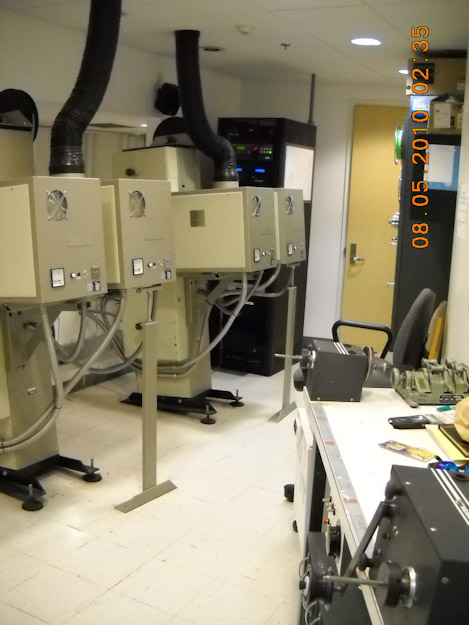
Stephen, I routinely moved my FP38D's in the UC Irvine HIB 100 screening room by myself.. LINKY to pics ...twice to get them closer for the 16mm Warhol "Chelsea Girls" presentation, and on other occasions to be able to work in the front wiring gutters.
They are far heavier than the standard FP 30 as you can see they have the FP 18 16mm as the "back door" and TWO 2k lamphouses.
Two people can very safely shift an FP 30 for your purpose.
Posted by Stephen Furley (Member # 1277) on 07-22-2017, 11:19 AM:
That's a nice setup Tony. The Barbican Cinima in London had the same machines when they borrowed prints of a couple of shorts which I had in my collection at the time for a season on British film music. They were films by BP and I think the music was by Malcolm Arnold. What are the inverted 'T' shaped things behind the machines?
The Rio, Dalston, in East London also had a single one of these machines, but with only one lamphouse. There was a periscope arrangement between lamp and projector, with a lever on top to flip a mirror into the light path for 16 mm. I've also seen a picture of a pair with single Peerless lamps with a rackover system. Not sure if they were still carbon or xenon conversions/
Those machines must be very heavy.
Steve,
When I get a few minutes I'll send you a private message, with a couple of photographs of what we're proposing to do. It's not our cinema, it belongs to the council and we just hire it from them to screen films, but they have agreed in principle to the movement of the projectors to correct the serious horizontal keystoning on the digital machine, even with the lens shifted right over. If this goes ahead we will almost certainly have to submit a risk assessment and method statement, so advice from somebody who has actually moved Kinoton projectors could be very useful.
Posted by Tony Bandiera Jr (Member # 2365) on 07-22-2017, 02:39 PM:
Thank you Stephen. The "T" shaped things are supports for 35mm lamphouses..which I found odd as the support would have been better on the 16mm side. (Or better yet, centered between the two..) I was never sure if they were even installed correctly...the original installer (who bailed the week before the room was scheduled to open, leaving behind a LOT of unfinished tasks) did not exactly have the best of reputations.
I had no issues with the machines being unstable or prone to tipping. But as you can see, I had to add the feet to the rear of the machines to get the correct projection angle. (They originally just had 1/2" diameter bolts that were screwed down though the black base legs, resting on metal electrical cover plates to protect the tile floor..)
To safely shift them, I would move the rear end first, then the front, alternating that till I got them in position. If done carefully it was no problem, and I only weighed in at about 150lbs. Two people could do it faster and safer.
I would guesstimate them to weigh in at 650-750lbs each with the 16mmm and dual lamphouses.
RE the risk assessment and method statement, sounds like a University thing. I had to submit all kinds of paperwork to do the upgrades and proposals to add a d-cinema projector (which never happened when I was there due to budget).
As for methods, hopefully someone here can come up with a "certified" method to pass on, or just print out this thread with the advice posted so far..
Posted by Phillip Grace (Member # 2262) on 07-23-2017, 01:49 AM:
Hi Stephen. I've noted a couple of points to watch when moving these Kinotons. The angle iron feet should be secured to the column with three bolts on each side. The centre one is the tilt pivot and the outer two are the tilt lock. Our machines were installed without the pivot bolts. In that case the projectors will lose their balance and flop all over the place when any of the bolts are loosened. If they were properly assembled in the first place you should find no problems moving your machines. If fitted with the small 2k lamp houses, the balance is pretty good to begin with, but if they are raked more than a couple of degrees I would be inclined to set the columns to near vertical before shifting the machines. You need a second tech to hang on to the lamphouse while the first loosens the tilt bolts. Also, if the move can be done without lifting the whole machine off the ground at the same time you should find it will be pretty comfortable. They will slide across the floor quite easily. Cheers.
Posted by Stephen Furley (Member # 1277) on 07-23-2017, 12:56 PM:
Thanks for the advice.
Tony, a co-incidence that you should mention 'Chelsea Girls'. A local art gallery is hiring the cinema on several days in September for a season of Warhol related films, and we have been asked if there is any way that we could screen this on two projectors. Since you've seen it, can you answer a few questions:
How is the sound, on one print or both, optical or magnetic? Is frame accurate synchronisation on interlocked projectors required, or would just starting two machines together and letting them run wild be close enough? I believe that the film runs for over three hours; how are the prints supplied, in 2000 foot or smaller parts, or on large spools so that they can only be run on machines which can take these?
Posted by Martin McCaffery (Member # 37) on 07-23-2017, 01:13 PM:
Chelsea Girls is supposed to be different everytime you see it. I don't know if the archivist have created a "definitive print", but the way The Factory ran it, it's just two reels running at the same time with the sound switching back and forth randomly.
Remember, large quantities of drugs were consumed by the original presenters and viewers. ![[Wink]](wink.gif)
And, nonetheless, fascinating film.
Posted by Stephen Furley (Member # 1277) on 07-23-2017, 02:00 PM:
So how do you play the sound? One projector going to the left speaker and the other to the right with nothing in the centre?
Posted by Martin McCaffery (Member # 37) on 07-23-2017, 02:27 PM:
Originally, there was no option for left or right speakers, they'd just turn the projector speaker off or on randomly.
I think the answer is, you can do it any way you want, which was the original intent of the filmmakers.
Posted by Tony Bandiera Jr (Member # 2365) on 07-23-2017, 09:42 PM:
Here's the scoop on Chelsea Girls as I remember it:
First, it was on several 400' or so reels which I ran individually. I would not suggest building onto big reels, as part of the "show" was doing things against the professional projectionist creed..such as allowing reels to tail out, running up incoming reels with the leader projected, etc.
Sound was optical.
You will need to disable the electrical link for "normal" changeovers..each machine MUST be able to open and close dowser and sound individually. The pictures run side by side for the entire show. White screens and dark screens as you rethread are expected.
As for sound, I ran the optical sound from each projector through a mixer with mic preamps so I could mix and fade the sound as needed, then ran that through the nonsync input on my (then CP65) at UCI. Don't worry about Academy mono or any other sound standards, the sound is 70's AM radio awful...another part of the "charm" of the show. You can if you wish do as Martin suggested and route the sound to the left and right, switching it on and off on each channel as needed, or mix it as I did and run it centre channel only.
The archive sent me a "cue" sheet with instructions on timing and sound mixes, with the annotation that it is up to the projectionist to feel free to improvise and have fun with the timing of sound and picture.
The sync is wild, no interlock needed. The looser the show the better. If you end up running it multiple showings, feel free to play with the timings a bit ...
As I mentioned, you may need to move the machines closer to each other (or further apart) to get both images side by side.
It was a fun show to run for sure.
Posted by Phillip Grace (Member # 2262) on 07-26-2017, 01:41 AM:
We've run Chelsea Girls here several times. It is as Tony described. Each reel is 1200 ft of 16mm film with optical sound, and is one complete "chapter" of the film. The local print comes with a comprehensive cue sheet, and we follow the picture and sound cues as far as possible. ( I dont think our version suggests free-form screenings, but I know they were always the norm). We set up a couple of portable 16mm machines inside the small auditorium, with left and right images side by side, with left projector sound to left speaker and right projector sound to right speaker, with a mixer to switch between sources, and one operator per projector - although a single projectionist could deliver the show without difficulty. The show starts with an offset of several minutes between projectors, which leaves plenty of time to move around, (or pop out for a pee, etc. - It is pretty long show! ).
Posted by Stephen Furley (Member # 1277) on 09-15-2017, 04:41 PM:
Thanks for the advice. Machine finally moved to temporary location against the back wall of the box today. Should have been yesterday, but the council didn't have an electrician available to complete the disconnection until this morning.
The port where it was will be used for a second 16 mm machine for 'Chelsea Girls' later this month. At the start of October the digital machine will move to its new position. After that the 35 mm will be re-installed in its new position. Two more rows of seats are also being refurbished during another brief period of closure.
The new position for the digital should finally cure the serious horizontal keystoning that we've had with it since it was originally installed nearly 11 years ago, while retaining both 35 mm machines, and allowing the occasional use of 16 mm as well.
I'll post some pictures when the whole job is finished.
Posted by Stephen Furley (Member # 1277) on 10-04-2017, 03:14 PM:
Thanks for the advice. The Kinoton moved out of the way a few weeks ago, and yesterday both it and the digital moved to their new positions on the track system. First digital show in the new location was yesterday evening. Vastly improved picture geometry.
It will be a few weeks before the 35 mm is back in use, some electrical work, and possibly modification of aperture plates, will be required.
Powered by Infopop Corporation
UBB.classicTM
6.3.1.2