This is topic 70mm Presentations in Louisville in forum Film Handlers' Forum at Film-Tech Forum ARCHIVE.
To visit this topic, use this URL:
https://ft-forum.com/ft/cgi-bin/ubb/ultimatebb.cgi?ubb=get_topic;f=1;t=012173
Posted by Michael Coate (Member # 757) on 07-20-2017, 03:22 PM:
New/updated article about 70mm (and other large format and roadshow) presentations in Louisville. Feedback (and reminiscences) appreciated.
Showcase Presentations in Louisville
quote:
Showcase Presentations in Louisville
A Chronology of Large Format and Roadshow Exhibition, 1956-Present
Compiled by Michael Coate
Part 1: The Cinemas
CLARKSVILLE (Indiana)
Trans-Lux
FAIRDALE (Kentucky)
South Park Drive-In
LOUISVILLE (Kentucky)
Brown
Cinema 1 (see: Showcase Cinemas)
Penthouse
Rialto
Showcase Cinemas
Stony Brook
United Artists
Part 2: The Engagements
The roadshows (i.e. reserved-seat engagements) are listed with an asterisk following their title.
m/o = a move-over engagement (i.e. a continuation of a booking from another cinema)
IMAX and other special venue presentations have not been included.
YYYY-MM-DD … TITLE … Cinema (duration in weeks) [notes or projection process if other than 70mm]
1956-08-21 … OKLAHOMA!* … Brown (19)
1957-02-20 … THE TEN COMMANDMENTS* … Brown (14) [35mm]
1957-05-28 … AROUND THE WORLD IN 80 DAYS* … Brown (18)
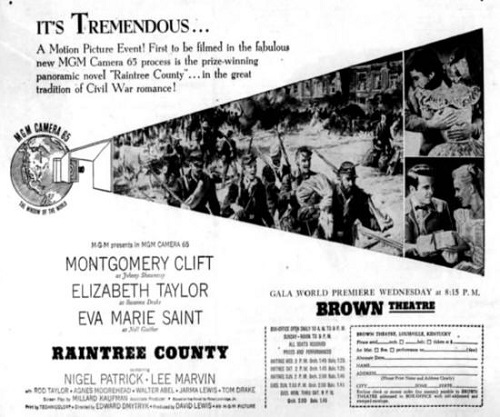
1957-10-02 … RAINTREE COUNTY* … Brown (13) [35mm] [world premiere engagement]
1957-12-29 … AROUND THE WORLD IN 80 DAYS* … Brown (4)
1958-05-08 … SOUTH PACIFIC* … Brown (27)
1959-03-13 … SLEEPING BEAUTY … Brown (6)
1959-10-15 … THE BIG FISHERMAN* … Brown (6)
1959-12-25 … PORGY AND BESS* … Brown (6)
1960-02-17 … SOLOMON AND SHEBA … Brown (5)
1960-05-19 … BEN-HUR* … Brown (23)
1960-10-28 … CAN-CAN* … Brown (12)
1961-03-16 … SPARTACUS* … Brown (8)
1961-03-29 … THIS IS CINERAMA* … Rialto (15) [Cinerama]
1961-06-22 … EXODUS* … Brown (7)
1961-07-13 … SEVEN WONDERS OF THE WORLD* … Rialto (14) [Cinerama]
1961-10-19 … CINERAMA HOLIDAY* … Rialto (13) [Cinerama]
1962-01-11 … THE KING AND I … Brown (2)
1962-01-19 … SOUTH SEAS ADVENTURE … Rialto (13) [Cinerama]
1962-01-26 … KING OF KINGS* … Brown (5)
1962-03-02 … EL CID* … Brown (10)
1962-04-20 … SEARCH FOR PARADISE … Rialto (6) [Cinerama]
1962-05-30 … WINDJAMMER … Rialto (13) [Cinerama]
1962-06-27 … WEST SIDE STORY* … Brown (14)
1962-08-29 … THE WONDERFUL WORLD OF THE BROTHERS GRIMM* … Rialto (12) [Cinerama]
1962-11-21 … THE BEST OF CINERAMA … Rialto (11) [Cinerama]
1963-02-06 … THE LONGEST DAY* … Rialto (11) [35mm]
1963-04-12 … LAWRENCE OF ARABIA* … Penthouse (11)
1963-04-25 … MUTINY ON THE BOUNTY* … Rialto (7)
1963-06-13 … HOW THE WEST WAS WON* … Rialto (26) [Cinerama]
1963-06-26 … CLEOPATRA* … Penthouse (23)
1963-12-20 … IT’S A MAD, MAD, MAD, MAD WORLD* … Rialto (26) [“Cinerama”]
1964-08-14 … CIRCUS WORLD* … Rialto (9) [“Cinerama”]
1965-02-24 … MY FAIR LADY* … Penthouse (32)
1965-04-07 … THE SOUND OF MUSIC* … Rialto (64)
1965-09-30 … THE HALLELUJAH TRAIL* … Cinema 1 (5) [“Cinerama”]
1965-10-06 … THOSE MAGNIFICENT MEN IN THEIR FLYING MACHINES* … Penthouse (11)
1965-11-03 … THE GREATEST STORY EVER TOLD* … Cinema 1 (13) [“Cinerama”]
1965-12-25 … THE AGONY AND THE ECSTASY* … Penthouse (6)
1966-02-02 … BATTLE OF THE BULGE* … Cinema 1 (9) [“Cinerama”]
1966-04-20 … RUSSIAN ADVENTURE* … Cinema 1 (4) [“Cinerama”]
1966-05-18 … MEDITERRANEAN HOLIDAY* … Cinema 1 (3) [“Cinerama”]
1966-06-29 … KHARTOUM* … Cinema 1 (7) [“Cinerama”]
1966-06-29 … THE SOUND OF MUSIC* … Penthouse m/o (15 [79])
1966-06-30 … DOCTOR ZHIVAGO* … Rialto (31)
1966-10-14 … THE BLUE MAX* … Penthouse (10) [35mm]
1966-12-20 … IS PARIS BURNING?* … Cinema 1 (6) [35mm]
1967-02-02 … THE BIBLE* … Rialto (21) ["D-150"]
1967-02-15 … HAWAII* … Cinema 2 (17) [35mm]
1967-03-08 … THE SAND PEBBLES* … Penthouse (20) [35mm]
1967-05-09 … ULYSSES* … Bard (3 days) [35mm]
1967-06-14 … THOROUGHLY MODERN MILLIE* … Cinema 2 (20) [35mm]
1967-07-12 … GRAND PRIX* … Cinema 1 (15) [“Cinerama”]
1967-12-20 … THE BIBLE … Penthouse (2)
1967-12-21 … GONE WITH THE WIND* … Rialto (26)
1968-01-31 … CAMELOT* … Cinema 2 (14)
1968-02-07 … CUSTER OF THE WEST* … Cinema 1 (4) [“Cinerama”]
1968-05-01 … AROUND THE WORLD IN 80 DAYS* … Cinema 1 (6) [35mm]
1968-06-19 … DOCTOR DOLITTLE* … Rialto (6)
1968-06-26 … 2001: A SPACE ODYSSEY* … Cinema 1 (14) [“Cinerama”]
1968-11-20 … ICE STATION ZEBRA* … Cinema 1 (9) [“Cinerama”]
1968-12-19 … STAR!* … United Artists (6)
1968-12-20 … CHITTY CHITTY BANG BANG* … Mary Anderson (10) [35mm]
1968-12-22 … FUNNY GIRL* … Cinema 2 (24) [35mm]
1969-01-22 … FINIAN’S RAINBOW* … Cinema 3 (5) [35mm]
1969-03-19 … THE LION IN WINTER* … Cinema 3 (10) [35mm]
1969-05-22 … SWEET CHARITY* … Cinema 1 (6)
1969-06-11 … OLIVER!* … Cinema 2 (14) [35mm]
1969-08-05 … CHITTY CHITTY BANG BANG … Trans-Lux (2)
1969-08-20 … KRAKATOA, EAST OF JAVA … Trans-Lux (3)
1969-11-12 … PAINT YOUR WAGON* … Cinema 1 (12) [35mm]
1969-12-17 … HELLO, DOLLY!* … United Artists (16)
1970-02-04 … GOODBYE, MR. CHIPS* … Cinema 1 (9) [35mm]
1970-05-01 … 2001: A SPACE ODYSSEY … United Artists (2)
1970-12-25 … SONG OF NORWAY* … Penthouse (7)
1971-02-03 … 2001: A SPACE ODYSSEY … Showcase (2)
1971-02-12 … RYAN’S DAUGHTER … Penthouse (14)
1971-09-15 … 2001: A SPACE ODYSSEY … United Artists (1)
1971-09-22 … GONE WITH THE WIND … United Artists (2)
1971-10-06 … DOCTOR ZHIVAGO … United Artists (2)
1971-10-20 … RYAN’S DAUGHTER … United Artists (1)
1971-10-20 … WEST SIDE STORY / AROUND THE WORLD IN 80 DAYS … Showcase (1)
1971-10-27 … WEST SIDE STORY / AROUND THE WORLD IN 80 DAYS … Trans-Lux (1)
1971-11-24 … THE BIBLE … Penthouse (1)
1972-02-16 … FIDDLER ON THE ROOF* … United Artists (19) [35mm]
1973-03-14 … THE SOUND OF MUSIC … Showcase (10)
1973-05-16 … LAST TANGO IN PARIS* … Showcase (10) [35mm]
1974-10-16 … 2001: A SPACE ODYSSEY … Showcase (2)
1975-10-22 … CAMELOT … Showcase (1)
1977-12-14 … CLOSE ENCOUNTERS OF THE THIRD KIND … Showcase (23)
1978-12-15 … SUPERMAN … Showcase (22) [70mm from Week #12]
1979-02-23 … THE EXORCIST … Showcase (7)
1979-05-25 … ALIEN … Showcase (14)
1979-11-07 … SLEEPING BEAUTY … Showcase (6)
1979-11-09 … THE ROSE … Showcase (15)
1980-05-21 … THE EMPIRE STRIKES BACK … Showcase (37)
1981-02-06 … ALTERED STATES … Showcase (7)
1981-05-22 … OUTLAND … Showcase (6)
1981-06-12 … RAIDERS OF THE LOST ARK … Showcase (57)
1982-03-19 … QUEST FOR FIRE … Showcase (5)
1982-06-04 … POLTERGEIST … Showcase (28)
1982-06-04 … STAR TREK II: THE WRATH OF KHAN … Showcase (9)
1983-05-25 … RETURN OF THE JEDI … Showcase (29)
1983-06-17 … SUPERMAN III … Showcase (8)
1983-09-30 … BRAINSTORM … Showcase (4)
1983-10-21 … THE RIGHT STUFF … Showcase (7)
1984-05-23 … INDIANA JONES AND THE TEMPLE OF DOOM … Showcase (18)
1984-06-08 … GHOSTBUSTERS … Showcase (28)
1984-12-07 … 2010 … Showcase (7)
1984-12-14 … DUNE … Showcase (6)
1985-07-19 … THE BLACK CAULDRON … Showcase (sneak preview screening)
1985-07-24 … THE BLACK CAULDRON … Showcase (10)
1985-12-04 … YOUNG SHERLOCK HOLMES … Showcase (7)
1986-05-10 … TOP GUN … Showcase (sneak preview screening)
1986-05-16 … TOP GUN … Showcase (32)
1987-06-03 … THE UNTOUCHABLES … Showcase (10)
1989-05-24 … INDIANA JONES AND THE LAST CRUSADE … Showcase (29)
1989-05-26 … LAWRENCE OF ARABIA … Stony Brook (8)
1989-06-09 … STAR TREK V: THE FINAL FRONTIER … Showcase (11)
1989-12-22 … THE TEN COMMANDMENTS … Stony Brook (2)
1990-06-15 … DICK TRACY … Showcase (15)
1992-05-09 … FAR AND AWAY … Showcase (sneak preview screening)
1992-05-16 … FAR AND AWAY … Showcase (sneak preview screening)
1992-05-22 … FAR AND AWAY … Showcase (8)
1992-12-25 … HOFFA … Showcase (7)
Note that some of the 70mm presentations included in this listing were presented in 35mm during the latter weeks of engagement due to print damage and the distributor’s unwillingness to supply a 70mm replacement print or because the booking was moved to a smaller, 35mm-only auditorium within a multiplex. As well, the reverse may have been true in some cases whereas a booking began with a 35mm print because the lab was unable to complete the 70mm print order in time for an opening-day delivery or the exhibitor negotiated a mid-run switch to 70mm. In these cases, the 35mm portion of the engagement has been included in the stated duration figure.
References/sources: Various issues of Boxoffice, The Courier-Journal and Variety; plus Dolby sound system installation records and projector and sound system trade advertisements.
Special Thanks: Louis Bornwasser and Vince Young.
If you believe this article contains any errors or omissions, please consider emailing the author or editor.
Dedicated to Rick Mitchell, 1946-2011
Posted by Michael Coate (Member # 757) on 12-28-2017, 11:56 AM:
Thanks to Louis Bornwasser I was able to track down the screening date of an item missing from the article posted above: a sneak preview of William Girdler's "The Manitou." It screened on December 10th, 1977 (several months ahead of its release), and it looks like the tech details were borrowed from the "Close Encounters" ad material.
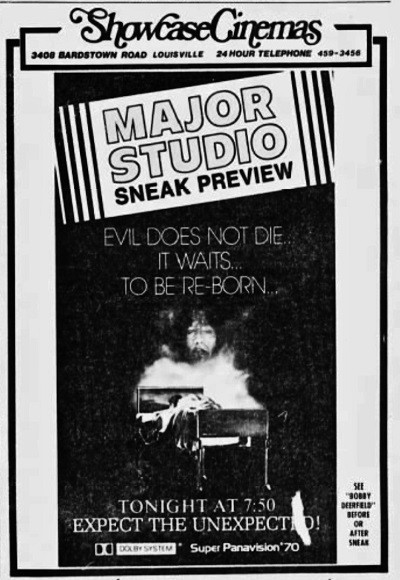
Posted by Louis Bornwasser (Member # 3063) on 01-19-2018, 10:47 AM:
Try again: 70mm went into the Brown with Raintree County. Yes, advertising was for 70mm prior, but the AA2s were not bought yet. The theatre owner advertised 70mm fraudulently and was "found out" by Mike Todd.
Later the same projectors moved to the Penthouse for Lawrence. Penthouse was newly created out of the balcony of the United Artist. (This twin split was the "pattern" for the Baronet/Coronet in NYC, which is wrongly credited as the first up/down twin split.)
Also the Rialto was our original 3 strip Cinerama theatre; later 70mm only JJ for 70. When the Rialto was torn down, the machines were sent to Century and remanufactured for 35/70 and installed in the United Artists. That is why the Rialto disappears in the listing to be replaced by the UA.
I serviced all these theatres for Altec from 1972 onward. At one point I had 70mm in UA/Penthouse, Trans Lux in Clarksville, South Park (never had a print booked; only what I tested with), Showcase Cinemas #1 and #4.(#4 was originally #3; relabeled after #2 was split.)
Note Showcase never had any 70mm except #1 and #4. (#2 was always XL-4 track 35mm only to the end.)#1 was originally to be a real Cinerama theatre so it had the screen. #4 was JJ.
Posted by Michael Coate (Member # 757) on 02-01-2018, 05:12 PM:
quote: Louis Bornwasser
Try again: 70mm went into the Brown with Raintree County. Yes, advertising was for 70mm prior, but the AA2s were not bought yet. The theatre owner advertised 70mm fraudulently and was "found out" by Mike Todd.
Oh, come on! Are you just sayin' this to wind me up, or is this what you honestly believe/remember? Whatever the case, go ahead and debate away whether or not "Raintree County" played in 70mm, but your other claim that the Brown's owner/operator was lying about playing 70mm prints of "Oklahoma!" and "80 Days" is preposterous.
I think this falls into the category of: Extraordinary claims require extraordinary proof.
Posted by Sam D. Chavez (Member # 1841) on 02-01-2018, 06:51 PM:
quote:
Oh, come on!
I don't know. Those are the details us techs recall because they are so outrageous.
Posted by Steve Guttag (Member # 268) on 02-01-2018, 10:00 PM:
Michael,
The Foxchase 4 in Virginia only ever had 3 screens. There is no limits to what theatre owners have done, claim wise, versus reality. I'm not saying that all or even most but I actually would belive Louis on this sort of thing.
Dolby used to have people scanning the newspapers to see if people were fraudulantly claiming Dolby Stereo back in the 70s/early 80s.
Heck stereo claims from mono systems due to multiple SPEAKERS being used (Same sound track). Surrounds that were turned on when the projectionist felt like it to simulate surround sound.
There was a lens advertised to give that 70mm type show from ANY film format (it was a magnifier and not even a real good one at that). It was sort of in the vein of the old TV magnifiers with with a blue tint on the top, green tint on the bottom to make your B&W TV "color."
Posted by Leo Enticknap (Member # 534) on 02-01-2018, 11:17 PM:
After the first three movies on that list, customers at the Brown must have been badly disappointed by Raintree County, whether it played in 70 or not. Cliche-ridden script, dragging continuity, melodramatic ham acting ... it would easily make my "bottom 10" list of the worst movies ever made. Weird, because Edward Dmytryk was no slouch. But even he and a blank check budget couldn't make anything out of the poor quality source material and clashing egos he had to work with. I saw it panned and scanned on a seat-back screen on an airplane. The only reason I stuck through it to the end was that the alternative was sitting in sleepless, dark boredom over the middle of the Atlantic. Even so, I still wished that the whole bloody lot of them had ended up in that swamp.
This must be one of very few widescreen epics from the '50s and '60s that has not had any significant restoration or remaster/rerelease done (Porgy and Bess is another, but that's because, it has been alleged, the Gershwin estate refuses to co-operate over rights clearances; not because no-one wants to restore the movie). Just looking at the first reel will be enough to tell you why.
Posted by Michael Coate (Member # 757) on 02-03-2018, 03:58 PM:
quote: Sam D. Chavez
Those are the details us techs recall because they are so outrageous.
quote: Steve Guttag
There is no limits to what theatre owners have done, claim wise, versus reality. I'm not saying that all or even most but I actually would belive Louis on this sort of thing.
I'm not doubting that on occasion theater owners have lied or made exaggerated claims, but in this instance why would you believe Louis? I mean, he was a little kid at the time all of this took place. (But it doesn't surprise me that some Film-Techers would side with a fellow tech instead of siding with a journalist because, well, you know, journalists and historians are all clueless and tech-challenged.)
Anyway, consider these:
Is it plausible that the Courier Journal newspaper's coverage in August *1956* that described the Louisville "Oklahoma!" premiere and renovations made to the Brown Theatre (i.e. new screen, new projection system, new sound sysytem, reduction in seats, demonstration shorts screened before feature) was all a lie?
Is it plausible that the trade reports describing the sequence and locations of the initial Todd-AO installations were a lie?
Is it plausible that the Norelco projector serial numbers and installation dates are erroneous?
Is it plausible it was a lie that trade reports claimed only reserved-seat Todd-AO presentations of "Oklahoma!" would be booked for the film's first year of release?
Is it plausible that trade reports were a lie when they announced the first 35mm presentation of "Around the World in 80 Days" would take place in another city on a date after the film had already opened in Louisville?
Is it plausible that trade reports were a lie that announced MGM would release "Raintree County" only in 35mm reduction prints?
Is it plausible that the Brown ownership would lie about the presentation type for both "Oklahoma!" and "80 Days," day after day, week after week, for the entire months-long run, even in the co-op ads placed in conjunction with the studio?
Posted by Steve Guttag (Member # 268) on 02-03-2018, 11:31 PM:
quote: Michael Coate
(But it doesn't surprise me that some Film-Techers would side with a fellow tech instead of siding with a journalist because, well, you know, journalists and historians are all clueless and tech-challenged.)
Hold up there swifty.
I tended to believe Louis because of my past experience with theatre owners and fraudulent claims on possessed technology. Hearing that an exhibitor lied about having something just wouldn't raise an eyebrow by me or any other "old-timer." Seen/heard it too many times. That is why I didn't strike me as odd that Louis would dispute a claim by a theatre owner, even if in the paper.
As for the press, in general, throughout my career, their "reporting" have been less than accurate more than accurate with respect to the cinema industry, its technology and in most other respects. They are often the blind leading the blind (movie goers). Why do that write about celluloid and silver screens, as if they're the norm? I can just about see Mike Blakesley "cringe" when he reads another report about the theatre business (by someone who is not in the business).
YOU may do your research like nobody's tomorrow and get the facts right, it is not the "norm," in my experience.
As to your other claims/pieces of information listed, I'll leave it to Louis to defend his claims for it doesn't matter to me one bit if they are true or false (but I appreciate why it would matter to you and others). I can only speak, to some degree, of the status of 70mm in the DC area...including those theatres that predate my existence on the planet. One need not be alive or in the business yet to know the history of the theatre they are working in. I didn't have to step foot in the Ontario (DC) to know it had a pair of Norelcos and that they moved to the MacArthur and then to the Fine Arts and finally Indianapolis' White River state park (one if them went their the other was stored, dropped and trashed). Theatres that did/didn't have things like 70mm tend to have tell-tale signs in the booth, even if equipment was transferred in/out plus the history of the place (once upon a time, theatre people were long-timers and ALWAYS had long-stories about its past). There is nothing new there.
I could go on but there wouldn't be any point. I would presume that Louis would have similar tales from the Louisville area. Of course, he could remember things wrong, I certainly have (not about what theatres were 70mm capable and when but about where I might have seen a movie and what format...thus far, I haven't forgotten about what movies I've show in 70mm...yet.
Posted by Leo Enticknap (Member # 534) on 02-04-2018, 12:16 AM:
My mother was a journalist and I have done quite a bit of historical research myself. The issue Michael appears to be confronted with is primary sources contradicting each other - for example, published material contemporaneous to the release stating that Raintree County played at the Brown in a 35mm reduction print, versus Louis' recollection that it played in 70.
There are many reasons why those sorts of contradictions occur. In answer to what I suspect is a rhetorical question from Michael, yes, it can happen that multiple contemporaneous sources all lie. They may all have got their deliberately false information from the same place. It may also have been mistakenly false information.
But it also happens that people's memories can be unreliable about events they experienced and took part in several decades ago. I could cite you countless occasions in which I listened to or read transcripts of oral history tapes made in the 1980s and 90s, of people describing their work in the 1930s and '40s, in which they asserted facts that I knew to be untrue - or at least, I had multiple, credible sources, created at the time of the events in question, contradicting them. This can happen for a number of reasons. Most of the time, it is simply a hazy memory. But sometimes, the subject is trying to make sure they go down in the history books in a certain way, and/or are trying to play up some aspects of their past and bury others (the most infamous example in cinema probably being Leni Riefenstahl, who spent literally half a century trying to convince anyone who would listen that she was never an ideologically committed Nazi, and threatening to sue anyone who didn't buy it).
It is for these reasons that I've never been much of a fan of oral history.
As far as this particular issue goes, what caught my eye was Louis' recollection that Mike Todd caught this theater in Louisville fraudulently advertising screenings as being in 70mm when they actually weren't. Presumably the action he took when he discovered this must have been documented somewhere. I wonder if he had a collection of personal papers, that ended up in a university library or research center somewhere? Court records generated by any lawsuits? That sounds like a very interesting topic for a feature article - dishonest technology advertising by exhibitors as a means of drumming up business. I'd be very interested to know if that happened on a significant scale.
Posted by Michael Coate (Member # 757) on 02-04-2018, 12:55 AM:
Just to clarify and simplify this before things spin out of control, the actual point of contention is the installation date of the 70mm projectors at the Brown Theatre in Louisville. My research suggests the installation took place in August 1956 while Louis' memory is suggesting it took place in October 1957.
Posted by Buck Wilson (Member # 5885) on 02-04-2018, 08:01 PM:
I, too, have seen plenty of false information in newspaper articles/ads regarding theaters. In my experience it has mostly been unintentional, but I wouldn't doubt cases of intentional misinformation. Several times, even, working at a theater that was a few times part of local news, I would give the journalist specific and direct information about the building/equipment, only to see it in some way twisted/backwards/incorrect in the finished article. I knew he wasn't in the theater biz so I was as clear and concise as I could be, and explained why and how, and he was writing stuff down the whole time, yet still got stuff wrong. I'm positive it wasn't intentional, as what the finished story reported didn't even make sense. Not saying that's what happened here or not, but it does happen, perhaps enough to even say 'regularly'.
Posted by James Westbrook (Member # 3690) on 02-05-2018, 03:02 AM:
In 1990, the local newspaper sent a reporter to ask theater employees about the movies they saw that summer and their reactions. The paper correctly had me comment that I thought Total Recall was a dark comedy but then she quoted me commenting about a movie I didn't comment on nor even saw.
Posted by Leo Enticknap (Member # 534) on 02-05-2018, 07:57 AM:
Most journalists try to do a good job, but keep in mind that unless you're talking to someone from Image Technology or SMPTE Journal (specialist trade publications covering our industry), they have to write about everything they're given the assignment on. Today it'll be a story about the new sound system in the local movie theater, tomorrow it'll be an auto wreck at a notorious intersection in town, the day after it'll be a college physician caught sodomizing teenage girls in his doctor's office, etc. etc.
So in order to avoid your quote being mangled, or the point you're trying to get printed being misunderstood and not making it into the story intact, keep to simple, bullet point stuff, of the sort that can pack a punch within the 300-word (or whatever) limit they're probably working to. Same thing with radio - unless it's a specialist podcast, whose audience will happily listen to people talking about movie technology for hours, they're after short, sharp soundbites.
quote: Michael Coate
Just to clarify and simplify this before things spin out of control, the actual point of contention is the installation date of the 70mm projectors at the Brown Theatre in Louisville. My research suggests the installation took place in August 1956 while Louis' memory is suggesting it took place in October 1957.
Combine that with the allegation that for at least some of the time between those two dates, they were fraudulently advertising 35mm shows as being 70, and that Mike Todd himself found out about it and put a stop to it, and you've stumbled across what would be a very interesting side project, IMHO.
Posted by Brad Miller (Member # 2) on 02-05-2018, 04:18 PM:
I know of one independent theater that put "digital sound" on their marquee in the 90s when that was the big selling point.
Now TECHNICALLY he wasn't lying, but he WAS however intentionally misleading.
They had no digital sound with their film presentations, but they DID have digital sound coming off of a cd player for intermission music.
Posted by Michael Coate (Member # 757) on 02-09-2018, 05:54 PM:
quote: The Courier-Journal; Tuesday, August 21st, 1956; Section 2, Page 4
BOYD MARTIN’S SHOW TALK: FILM ‘OKLAHOMA!’ BEST YET
As big as all outdoors, brilliant but natural in color, extremely dramatic, and superbly directed, “Oklahoma!” was shown to the “finest of captive audiences” last night at a special preview at the Brown.
Now I had thought that I had seen just about enough of “Oklahoma!” on the stage.
But, Todd-AO gives it a closer and more intimate view than even the stage production. The close-up figures are bigger than life, but so handled by Fred Zinnemann, the director, that they make fascinating groups. In the ensemble scenes they are quite within the dimensions of the human figures.
CHOREOGRAPHY PRAISED
Just as she did for the stage production, Agnes DeMille created some rare choreography, but the over-all pattern is the same.
L.J. McGinley, general manager of The Fourth Avenue Amusement Company, opened the preview with a short welcome and introductions of D. Irving Long, the company’s youthful president, and Gale Sullivan.
Sullivan, representing Magna Theatre Corporation, which is distributing the film in some 19 cities (Louisville is the last to date to get it) told what made Todd-AO different and then left the audience to see for itself.
Long assured the spectators that they would enjoy full audience participation.
PERSPECTIVE ACHIEVED
No one mentioned that Todd-AO, in many scenes, creates a real perspective that is detected without the aid of three-dimensional lenses. Perspective is not always apparent, but it is often realized. This was indicated by some exciting shorts that were shown before the grand orchestra broke loose with the Richard Rodgers overture to his most beguiling musical.
There is a rollercoaster scene that the women in the audience laughed and screamed through. There is a trip to Sun Valley that is lovely to behold. There is a thrilling ride by automobile from the top of a familiar road right into the heart of San Francisco that ends in what appears to be quite a smash-up against a truck advertising “Oklahoma!” at a street intersection.
“Oklahoma!”, however, was what the invited audience went to see. They surely had never seen it better done even on the stage for which it was created.
It, of course, has an excellent folk drama as its springboard. This is Lynn Riggs’ “Green Grow the Lilacs,” and although “Oklahoma!” followed the original script very well, the Todd-AO production is more faithful to Riggs’ dramatic incidents.
There is a real chill running through one scene when Jud tries to injure Curly with a gadget that has the murderous-looking concealed knife blade. There is a runaway — instigated, we have to admit, by Laurey in trying to elude Jud’s advances — that keeps one on the edge of his orchestra chair.
HAS DREAM BALLET
There is also that fascinating dream ballet in which Laurey tries so hard to decipher which man is the one for her,
Gene Nelson does some mighty fancy stepping, especially in his first scene, “Everything Is up to Date In Kansas City.”
Shirley Jones, who plays Laurey, is fresh and youthful and her voice is girlish and lovely. Gordon MacRae is a virile, lusty Curly and his baritone, robust, and manly voice is just right for the various numbers. He rides his horse surprisingly well and plays with easy comedy effect.
Gloria Grahame is a new sort of Ado Annie, for she has an original interpretation that is sly and impish. Charlotte Greenwood is a dominating figure as Aunt Eller, and Eddie Albert also gives a keen interpretation as the paddler, Ali Hakim.
The surprise performance, despite the excellence of some we have seen him give lately, is that of Rod Steiger as Jus Fry. It is a menacing, evil portrait to be sure, but Steiger gains a tremendous amount of sympathy for the brute.
James Whitmore is also a surprise as Paw Carnes, especially when he bursts into song.
The denouement comes with the burning of the hay stacks, a scene that Riggs created and which was left out of the musical.
SCENERY LOVELY
The climax is a rousing finish with the theme song, “Oklahoma!”
Much of the picture has been taken outdoors and the scenery is lovely to look upon. The interiors offer something different in close-ups. There is a lovely ballet of girls in one of them.
“Oklahoma!” will remain at the Brown for an indefinite run. The management hopes to lure people from 50, 100, to 200 miles away. This should be easy, because the 65-mm. projection with six channels of high-fidelity sound track, the excellence of the production, and the newness of the system should attract people from miles around.
SEATING CUT DOWN
If you loved “Oklahoma!” on the stage, you will see it in quite a new light on the Todd-AO screen.
The Brown Theater has been cleaned up, freshened up for the occasion. The seating capacity has been cut down from 1,454 seats to 1,000 in order that every seat will be a good one. The seating begins four rows back from the original position of the first row.
The Fourth Avenue Amusement Company was always a pioneer in Louisville. It was the first organization to offer sound here. And, now after all these years, the Fourth Avenue Amusement Company is first again.
Up to now Todd-AO dwarfs all other projection techniques shown here.
Posted by Steve Guttag (Member # 268) on 02-10-2018, 01:06 PM:
Note, the preshow mentioned in the article was The Miracle of Todd-AO I just saw that one recently, in fact, in its 70mm, 6-track, 30fps glory. It was a fun ride.
Posted by Louis Bornwasser (Member # 3063) on 02-11-2018, 08:23 PM:
70mm prints were in the theatre. Ads were placed. The 4 tr backup print was the only one that showed. Too bad Michael Todd is dead; he orchestrated the "sudden" 70mm installation. My sources were the Altec sound engineer before me and the Union operators who worked there. As of 10 years ago, the AAII crates were still in the booth basement full of the old Simplex 4 tr machines; perhaps there is a date on them for those who may care. "Print ad experts" from far away just don't have any credibility. Sorry.
Posted by Michael Coate (Member # 757) on 02-11-2018, 11:17 PM:
quote: Louis Bornwasser
"Print ad experts" from far away just don't have any credibility. Sorry.
People who rely on long-term memory just don't have any credibility. Sorry.
Posted by Steve Guttag (Member # 268) on 02-11-2018, 11:28 PM:
Was "The Miracle of Todd AO" ever printed on 35mm? It was a 30fps movie and whereas it was desiged to promote Todd-AO, I would find it odd if they ever made it in 35mm. When Oklahoma! Was issued, they would have to shoot each scene twice to make the 24fps/35mm print. How were they showing The Miracle of Todd-AO if not in 70mm?
Posted by Sam D. Chavez (Member # 1841) on 02-12-2018, 12:26 AM:
There were 35mm prints if that's the question. They had to shoot the film in two versions, for 24 FPS, for 30. Scene by scene I would think.
Maybe it's just me but I find Michael Coate incredibly annoying in a Grover Norquist (sp) sort of way. It seems to be all about winning each and every little argument without regard to anyones feelings. I'm sure he already knows this.
Posted by Steve Guttag (Member # 268) on 02-12-2018, 02:47 AM:
Sam,
My question was specific to "The Miracle of Todd-AO." Why would they bother with a 35mm/24fps version? It was just for Todd-AO theatres.
As for Mr. Coate; over the years, I've found his research into the history of movie releases to be impeccable. He backs up his claims with actual historical documents (newspaper reprints, articles and things that back up his claims). I can certainly understand his frustrations at being refuted by the mere memory of an individual. One can show time and again where one's memory can fail them on specific details of historical situations.
As I said before, hearing of an exhibitor boasting about equipment/technology that they don't have wouldn't have me bat an eye. I've seen it/heard it throughout my career. So I no problem believing that a cinema would lie about something.
I do find it incredibly odd that on an incredibly limited release, such as the original Oklahoma! in a new format, 70mm/Todd-AO that the studio wouldn't know if it was being faked. One would presume that the projectors would have to be bought as a prerequisite of obtaining the print. If the theatre was set up for CinemaScope, as Louis proclaims, then we are down to adding two speakers, amplifiers and a pair of lenses to make it a 70mm Todd/AO house (on the cheap, if that is what they were). Now you add in that there is a report of seeing a promotional movie, to the best of my knowledge, was only available in the new format.
The final outcome of this "discussion" matters not to just about everybody except to Michael, who, I'm sure, desires to maintain a historical factual accuracy. All that is presented to refute his print media claims is conjecture. I can understand the frustration. I would be one thing if Louis claimed he was the operator that falsely ran the movie in 35mm due to lack of 70mm installation, but instead it is via story.
70mm equipment came and went in some theatres. In my history of it at my first theatre chain, a pair of DP70s started in the Ontario, moved to the MacArthur, moved to the Fine Arts before leaving the area. Not all of those theatres closed, just the priorities of where to place the 70mm equipment changed (early on).
Posted by Sam D. Chavez (Member # 1841) on 02-12-2018, 10:37 AM:
Nicely put Mr. Guttag, I tend to agree with all your points as I usually do but it is possible and similar things have happened. There was this thing called a film exchange back at that time. Every sizable city had one, usually located on "Film Row".
So, Theatre 70 opens a brand new very posh 70mm theatre in Oakland with great fanfare. There was not much 70 being released but there was 4 track Mag in common use.
So I'm working al a weed infested drive in, the "Oakland" if memory serves, located in Hayward area. Usually not a day and date kind of venue. So "Hurry Sundown" opens with great fanfare. We, without notice, get a glorious brand new 4 track Mag print which I can actually run, in Mag mono of course. Meanwhile, Theatre 70 gets a run of the mill 35mm mono optical print. So these things could and did happen back then.
There's plenty to go on here. Michael, do your magic. My actual knowledge and making up the film and scrambling to see if the mag system actually works vs. your newspaper co-op ads.
You are on!
Posted by Mike Rivest (Member # 5500) on 02-12-2018, 03:10 PM:
Here's that article about Oklahoma at the Brown
Newspapers.com page
Posted by Steve Guttag (Member # 268) on 02-12-2018, 04:00 PM:
That ad is scary. I may be thinking in 1980s verbage but it speaks of the process in which Oklahoma! was made. It makes no real mention of the PRESENTATION format other than the curved screen (something that CinemaScope would have too). If that was written in the 80s, I'd suspect funny business since there was no mention of the PRESENTATION format.
Posted by Sam D. Chavez (Member # 1841) on 02-12-2018, 08:14 PM:
That master ad matte was provided by the studio and selected by the Brown's ad person. They would have the art in advance and used the version they liked best and fit their ad budget. You would not think the top level ad mattes would be given to everyone playing the film, but only to cinemas that could play 70. Who knows but there is some reason to question it. Does anyone know if it opened in 35mm and 70mm day and date?
Posted by Steve Kraus (Member # 476) on 02-13-2018, 12:00 AM:
With regards to Raintree County did it ever play anywhere in 70mm? Because every source I've looked at from Wiki to Marty Hart (Widescreen Museum) says they never released it in 70mm.
Posted by Paul Linfesty (Member # 214) on 02-13-2018, 01:22 AM:
I thought the 35mm prints of Oklahoma! didn't debut until the beginning of 1957. The two versions had different distributors (the Todd-AO version was "released by Magna" with RKO handling the physical distribution of the 70mm prints), while 20th Century Fox distributed the 35mm CinemaScope version. Odd that the theatre would have had a 35mm back-up print from another distribution source. RKO was originally set to distribute the 35mm version (which was NOT a printdown of the 65mm originsl, but was separately shot). Their financial crisis caused them to give up the distribution and the rights went to Fox.
Posted by Steve Guttag (Member # 268) on 02-13-2018, 04:52 AM:
I cannot speak to 1950s distribution (long before my time in the industry or even being on the planet). Since I started in the industry in 1980, any 70mm print we received had a 35mm backup print shipped with it as a backup. I presume that this practice started somewhere.
Posted by Martin Brooks (Member # 1269) on 02-17-2018, 12:15 PM:
quote: Steve Kraus
With regards to Raintree County did it ever play anywhere in 70mm? Because every source I've looked at from Wiki to Marty Hart (Widescreen Museum) says they never released it in 70mm.
Yeah, in70mm.com says there were no 70mm prints. I just checked the NY Times display ad from the premiere date (12/20/1957) and while it says "First Production Filmed in the Fabulous MGM Camera 65" there is no mention of it being presented in 70mm, not that that was always present in advertising for 70mm films.
It played in NYC at the Loews State and the Plaza. The Loews State certainly eventually was equipped for 70mm, but I don't know if it was on this early date, since the previous two 70mm films, "Oklahoma" and "Around the World in 30 Days" played the Rivoli.
The Loews State didn't play another 70mm film until "Ben Hur" in November of 1959 (unless there was a move-over that I'm unaware of).
Posted by Michael Coate (Member # 757) on 02-19-2018, 04:05 PM:
From The (Louisville) Courier-Journal; August 5th, 1956; Section 5, Page 2. The closure was for fifteen days.
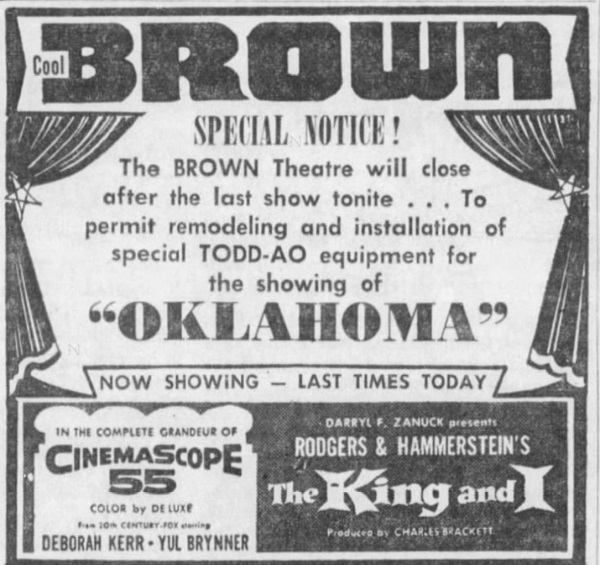
Posted by Steve Guttag (Member # 268) on 02-19-2018, 05:54 PM:
Are we to believe they showed the King and I in CinemaScope 55 from that ad? It was shot in that process but I don't know of any commercial runs with it as the presentation format. It can be a hot topic of debate.
Posted by James Westbrook (Member # 3690) on 02-21-2018, 02:44 PM:
Back when I was researching my local theaters in the microfilm section of my local library I would encounter "stereophonic sound" ads for movies playing at one of the local drive-ins. It was in the directory sized ad art from the distributor. Whoever built the directory ads up at the theater's office probably just clipped it down to size and pasted it on the art board and handed it to their newspaper ad rep without examining the details.
The Brown theater ad is likely a similar situation where the ad art for The King and I had the Cinemascope 55 logos in it and the individual in the office who assembled the ads used that one. Maybe all the ad slicks had Cinemascope 55 on them.
I gave up the researching after some local blog posted my list of local theaters and I inadvertently omitted the State theater. Then I got into an argument about a non-existing drive-in. I decided it was not worth sitting in an uncomfortable chair in front of a microfilm viewer to pursue the hobby and gave up. I have enough data to know, when I encounter a movie like Bullitt, that I can look it up and find it opened first run at the Village theater. That, and $5 can get me a Route 44 Iced Tea at Sonic.
Posted by Rick Raskin (Member # 1561) on 02-21-2018, 05:23 PM:
To my knowledge the Cinemascope 55 format was never projected commercially.
Posted by Travis Cape (Member # 466) on 02-21-2018, 05:47 PM:
Louis has told me that story. I'll go with it, it's a good story. It confirms that many exhibitors are liars, which we all know is true. The truth also doesn't matter, exhibitors are still liars even if the Brown really had 70mm for Oklahoma.
I've already stumbled across advertisements from the 1970's proclaiming state of the art projection in a theater with Super Simplex's and mono and another in 2001 that had ORC consoles from the 1980's etc. Exhibitors lie, except for Mike.
Posted by Martin Brooks (Member # 1269) on 02-21-2018, 08:09 PM:
quote: Rick Raskin
To my knowledge the Cinemascope 55 format was never projected commercially.
True. In 2004, Cineric was involved in the restoration of the two 55mm films. They made a presentation about the restoration process at a SMPTE meeting and the handout states the following:
"...The plan was to produce 55mm prints by reduction printing the 8 perf negative to a 6 perf print with room for six magnetic sound tracks, but because of technical and distribution problems the idea was scrapped. Instead, 35mm reduction negatives were made from the the 55mm originals, and both films were shown at the time of their release in standard 35mm CinemaScope. "The King and I" was re-issued in 1961 with two 70mm prints made directly from the 55mm negative. These prints, billed under the name Grandeur 70, with their 5 perf, 2.2:1 aspect ratio were actually reduction prints having less image area than the 55mm original negative."
Posted by Martin McCaffery (Member # 37) on 02-21-2018, 08:29 PM:
quote: Travis Cape
Exhibitors lie, except for Mike.
If that really is his name ![[evil]](graemlins/evil.gif)
Posted by Paul Linfesty (Member # 214) on 02-21-2018, 11:20 PM:
quote: Steve Guttag
That ad is scary. I may be thinking in 1980s verbage but it speaks of the process in which Oklahoma! was made. It makes no real mention of the PRESENTATION format other than the curved screen (something that CinemaScope would have too). If that was written in the 80s, I'd suspect funny business since there was no mention of the PRESENTATION format.
Might be scary, but "Produced in Todd-AO" was the verbage that was used throughout 1955-1970 to be used only with the exhibition of 70mm prints (deep curve screen optional after Around the World in 80 Days and all subsequent films being 24fps). Only the 70mm prints featured the "Produced in Todd-AO credit...only if the 70mm print was used were the newspaper ads, posters, etc to say Produced in Todd-AO, at least from the 60's on. (yes, I know some ads for Around the World and South Pacific just said "In Todd-AO). But the credits for the 35mm version didn't mention Todd-AO (and yes, I know some videos sourced from 35mm may very well have the Todd-AO label, but not in the original releases). THe exception seemed to be Thos Magnificent Men in Their Flying Machines, which was "Photographed in Todd-AO" and which newspaper ads actually used the CinemaScope label for the 35mm prints. Apparently, \the distinction was that Magnificent Men was mixed with 4 tracks and then tricked up to 6 tracks, although Sound of Music carried the 'Produced" label even though it was also a 4 to 6 track conversion.
BTW, in Bakersfield, CA the normally second-run Tejon Theatre got the first-run booking of STAR!. They added in their own type at the top of the ad "In Todd-AO and Technicolor." Of course, STAR! prints were color by Deluxe, but anyway, the Tejon was only a 35mm house with their widest tabs set to 2 to 1. And yet it was advertised like this for the whole week. The Tejon had also gotten the first-run booking of that other Fox flop DOCTOR DOLITTLE. I actually saw that as a child. I guess because it was first-run, they decided to show the full width of the reduction print by projecting over the opened curtains and a ittle bit on the side wall!!!
Posted by Terry Monohan (Member # 8285) on 02-23-2018, 01:58 PM:
The old Blumenfield Roxie Theatre in Oakland CA ran ads that said 'Same As Roadshow' and they even had 70mm in the ad. Only had 35mm. Put in a cheap stereo system for Disney's Mary Poppins in 4 track mag stereo. Disney made them If they wanted to play It first run in Oakland CA. Did the Brown Theatre have a curved screen for 70mm? Thanks
Posted by Michael Coate (Member # 757) on 03-01-2018, 12:33 PM:
quote: Sam D. Chavez
…but it is possible and similar things have happened. There was this thing called a film exchange back at that time. Every sizable city had one, usually located on "Film Row".
So, Theatre 70 opens a brand new very posh 70mm theatre in Oakland with great fanfare. There was not much 70 being released but there was 4 track Mag in common use.
So I'm working at a weed infested drive in, the "Oakland" if memory serves, located in Hayward area. Usually not a day and date kind of venue. So "Hurry Sundown" opens with great fanfare. We, without notice, get a glorious brand new 4 track Mag print which I can actually run, in Mag mono of course. Meanwhile, Theatre 70 gets a run of the mill 35mm mono optical print. So these things could and did happen back then.
Prints getting sent to the wrong theater seems an easy thing to occur when a film is in release with numerous prints circulating. But, unless I’m misunderstanding your comment, yours is an apples to oranges comparison to the Louisville/”Oklahoma!” situation since “Oklahoma!” was an exclusive roadshow booking (i.e. a specialized release) with hundreds of miles of clearance and commencing months before any 35mm prints circulated. It would've been impossible, in my estimation, for the Louisville theater to have been sent the wrong print or wrong advertising materials.
Anyway, Theatre 70 played “Hurry Sundown” as an East Bay exclusive, many weeks ahead of any area drive-in bookings.
quote: Sam D. Chavez
Does anyone know if ["Oklahoma!"] opened in 35mm and 70mm day and date?
quote: Paul Linfesty
I thought the 35mm prints of Oklahoma! didn't debut until the beginning of 1957.
As far as North America is concerned, "Oklahoma!" did not open day and date in both 70mm and 35mm. The best I can tell there were only 31 domestic 70mm bookings (all with a reserved-seat policy) that commenced between October 1955 and November 1956. The CinemaScope version (from a different distributor, a general-release policy, and different ad campaign) began in November 1956, with much of the country playing it during the early months of 1957.
Posted by Sam D. Chavez (Member # 1841) on 03-02-2018, 01:44 AM:
I knew you'd be back.
quote: Michael Coate
Anyway, Theatre 70 played “Hurry Sundown” as an East Bay exclusive, many weeks ahead of any area drive-in bookings.
Lets see the docs or I'll go with my recollection. The only reason I recall it is because it was so absurd. I wonder if the east bay exclusive ad also said "presented in 4 track sound?
As to apples and oranges, of course, just making the point that inaccuracies happened all the time. For example a good deal of prints in collectors hands came from exchanges. They were to be destroyed but instead were sold so the record keeping was none too good.
I do admire your research but it's not infallible.
Posted by Mark Gulbrandsen (Member # 72) on 03-02-2018, 11:14 AM:
quote: Steve Guttag
Are we to believe they showed the King and I in CinemaScope 55 from that ad? It was shot in that process but I don't know of any commercial runs with it as the presentation format. It can be a hot topic of debate.
That is a good subject for Michael to investigate. The projectors for sure did exist and at least one pair still do exist. I have pictures of that pair. Supposedly, The State Lake Theater ran it and the 35/55mm mag penthouses were still at Charlie Wolks place last time I was there.
Mark
Posted by Michael Coate (Member # 757) on 03-05-2018, 05:25 PM:
I was traveling over the weekand am just now getting back to this.
quote: Sam D. Chavez
Lets see the docs or I'll go with my recollection.
I'm not sure this is the sort of thing you'll find satisfactory/convincing, but here's the East Bay opening-day ad from the Oakland Tribune (March 22, 1967):
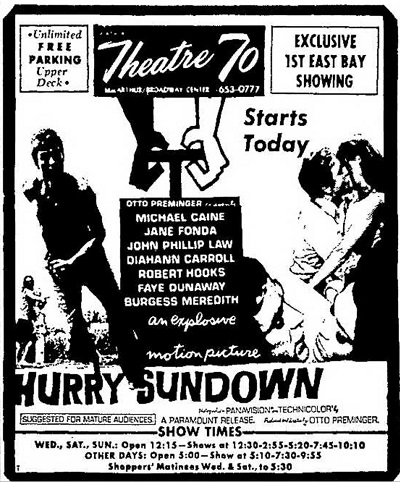
You'll have to take my word that "Hurry Sundown" played the area drive-ins several weeks later. I think it will be difficult (readability-wise) if I post the drive-in ads as they're all small and text-based and thus will be difficult to see the relevant text AND the datestamp AND the Theatre 70 ad all in same image. But if you're still not convinced, let me try to find something usable.
Posted by Sam D. Chavez (Member # 1841) on 03-05-2018, 11:58 PM:
I saw that as well.
You don't take anyones word. Why should I take yours?
Did your mother never tell you not to believe everything you read in the newspaper? In todays vernacular the ad might be called "fake news" "Oakland" opened day and date which was a bit of a surprise; not because it was all that unusual, but that it was the humble Oakland DI. DI's played day and date all the time by the "60's. This was the land of Syufy who sued to get this condition. There were much better DI's it could have played day and date, but I just know about mine and that I got the mag print.
I did not care for your vague assurance that it opened "many" weeks later in drive In's. How do you know this? I don't think you bothered to check.
For once you will need to take my word for it because I was here. If you have better evidence, produce it.
It's always possible Theatre 70 only considered indoors when they claimed an exclusive. This looks like a theatre made ad not a co-op made by the branch manager so who's to say? They either knowingly or unknowingly made an incorrect statement. So, you rely on some random theatre manager with a pair of scissors who can make any ad he can afford? No one checked up on cinemas to make sure they did not make false claims. Only a competitor would have a reason to challenge it.
An over reliance on local cinema ads is a weakness in your research methodology.
I know what I know on this one and you have no better evidence so leave it and let's move on.
Posted by Michael Coate (Member # 757) on 03-06-2018, 01:18 AM:
Sigh...
Your latest comment, Sam, exhibits precisely why I initially declined to reply to your “Hurry Sundown” challenge because I (correctly) predicted that you would simply double down and insist whatever I post is “fake news.”
Did you honestly believe I would not research beyond just that Theatre 70 ad??? Even though I will predict that you will continue to double down and insist fake news, here’s the text-based East Bay theater listings for March 22, 1967, the day on which “Hurry Sundown” opened at Theatre 70. (Theatre 70 is in top middle, while the Oakland Drive-In is in lower right.)
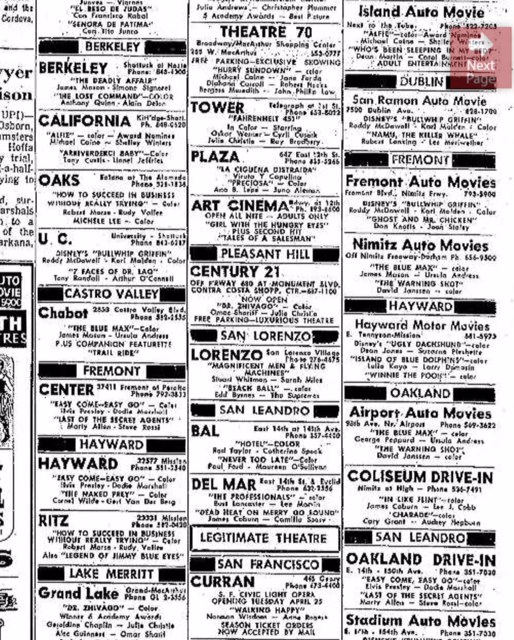
And even though I again predict you won’t believe it, the playdates for “Hurry Sundown” (based upon researching the advertising in the East Bay newspapers) were March 22nd-April 30th (1967). “Hurry Sundown” at the Oakland Drive-In was July 19th-August 1st (1967).
I’m not even going to address the mag issue since the differing playdates alone should call into question your memory of this incident.
Posted by Sam D. Chavez (Member # 1841) on 03-06-2018, 02:26 PM:
Well done Mike! I must concede the point.
I apologize if you thought I was attacking your research as "fake news". I'm as far away from the man who coined the phrase as is possible, and it seems to have riled you judging from the speed of your response. As I've said before, I do respect your work but there is always the danger of relying on cinema ads for accuracy esp. in small markets.
I do object to the way you use your findings like a blunt weapon and in fact originally got into this debate because of the shabby way you've treated others in the past. Now, no one would ever accuse me of being tactful but you could take a lesson and use some humor and charm in your work or risk ending up with books full of stats and no friends to read them.
Posted by Paul Linfesty (Member # 214) on 03-06-2018, 03:24 PM:
quote: Sam D. Chavez
So "Hurry Sundown" opens with great fanfare. We, without notice, get a glorious brand new 4 track Mag print which I can actually run, in Mag mono of course. Meanwhile, Theatre 70 gets a run of the mill 35mm mono optical print. So these things could and did happen back then.
Was this movie even released in 4-track mag? IMDB states that the mix is mono (I realize they are inaccurate sometimes). However, at this particular time Paramount wasn't really into mag stereo prints, other than their few roadshow pictures.
Posted by Sam D. Chavez (Member # 1841) on 03-06-2018, 05:54 PM:
I also saw IMDB was showing it as a mono release. My memory is not faulty on this aspect as I had it in my hands and projected it. I was the relief operator so imagine my surprise at getting a new mag print of anything and not having a clue if it would play. So I checked and it did with great fidelity, much better than in optical. I changed back and forth to confirm it was really in mag. I'm not sure if the LCR was combined into mono or if it was straight center channel feed. It was done both ways back then. Otto Preminger (sp) was was quite flashy and it was a big production so I never gave it any thought. Why look a gift horse in the mouth?
Posted by Paul Linfesty (Member # 214) on 03-06-2018, 10:32 PM:
Sam I can't imagine just using the center channel only. Typical L-C-R mixes of that era often used directional dialog. L-C-R mixed into mono makes more sense, but the most sense would be for a drive-in to just play the half optical track of the mag-optic print, considering the low fidelity of drive-in speakers.
Posted by Sam D. Chavez (Member # 1841) on 03-07-2018, 12:11 AM:
I did not say it had to make sense, but it was really just that way. A lot of DI's equipped with mag mono after "The Robe". One of the systems even used a phase flip switch in case the left or right were recorded out of phase with the center and cancelled the dialog.
On the other hand, the half optical track sounded horrible as the mag stripe bled a bit when applied and had a ragged edge that was detected by the pec cell.
You must visit our period authentic 1954 era Simplex screening room comprised of pieces from the Colonial, the location of the booth shots in the "Blob" and power amps from the Paramount in Oakland. Almost new Peerless arc Lamps from McCune AV rental stock. I keep meaning to post a photo tour. Ask Jess Daily if you know him. He's been here.
I was gifted a 4 track, mag only, IB Tech print from John Hazelton of Pixar. Country Joe heard about our screening and turned up.
Posted by Sam D. Chavez (Member # 1841) on 03-07-2018, 02:08 AM:
I see I left out the title "Woodstock" so Country Joe of the Fish would make more sense to those under 50.
Posted by Gordon McLeod (Member # 33) on 03-07-2018, 12:15 PM:
Walter Reed theatres invested in a Mag mono system in the 50's in a large way
Posted by Michael Coate (Member # 757) on 03-15-2018, 03:27 PM:
quote: Sam D. Chavez
Well done Mike! I must concede the point.
Wow…I actually expected more pushback. To your credit, at least you didn’t accuse me of photoshopping the ads as another film-tech member did a few years ago. Now if we could just get some conceding of the original point about early 70mm runs in Louisville.
Getting back to that original point of contention…
How come no one has questioned if the details were told correctly to Louis in the first place? I mean the incident would've going on two decades old by the time Louis was told the story. And now it’s being recalled again additional decades later.
Personally, I think it is the fact that “Around the World in 80 Days” played at the Brown twice that is the root of this argument. (Look over my chronology again at the top of this thread or follow the link to the real page and you’ll see it played before “Raintree County” and then again after “Raintree County.”) A factor may also have been Mike Todd reportedly approving an early termination of the Brown’s first run of “80 Days” to accommodate the “Raintree County” premiere and run. Keep in mind Todd had no involvement with “Raintree County”; he didn’t produce it nor was it shot in his process. Todd’s only connection to it was he was married to its star and accompanied her to the premiere.
At any rate, I don’t really care at this point if some of you continue to believe Louis’ claim that the Brown operator scammed his way into booking early runs of “Oklahoma!” and “80 Days” and lied about their promotion. I’ve already written comprehensive pieces on those films and that era and I’m not convinced enough to go back and revise them.
Posted by Sam D. Chavez (Member # 1841) on 03-15-2018, 06:40 PM:
quote: Michael Coate
Wow…I actually expected more pushback. To your credit, at least you didn’t accuse me of photoshopping the ads as another film-tech member did a few years ago. Now if we could just get some conceding of the original point about early 70mm runs in Louisville.
Mike, that's what I would call gloating. And it helps validate my point that you get your thrills by proving someone wrong in an in your face fashion instead of having a nice back and forth that might even provide some depth and context to your information. I really don't care for your use of the term "to your credit"
Now you come all the way back to the original Louisville topic while everyone else has moved on. The main reason I got involved in this thread is because of the completely disrespectful way you treated Louis Bornwasser. That was totally uncalled for and a cheap shot.
Posted by Gordon McLeod (Member # 33) on 03-15-2018, 07:46 PM:
I think the only accurate way to deal with this is the actual studio booking sheets
Newspaper ads are very inaccurate best
Posted by Michael Coate (Member # 757) on 03-19-2018, 02:54 PM:
quote: Sam D. Chavez
The main reason I got involved in this thread is because of the completely disrespectful way you treated Louis Bornwasser. That was totally uncalled for and a cheap shot.
Actually I think it is me who is being disrespected by some of you.
Posted by Louis Bornwasser (Member # 3063) on 03-26-2018, 10:21 AM:
Thank you, Sam.
I have never even one time mentioned Oklahoma.
Louisville back then routinely followed the nation in setting playdates. Academy Award telecasts usually contained a majority of films that had not played locally yet.
The difficulty in using newspaper clippings is that they only show what the theatre owner wanted to show or mislead. Adding to that the confusion with the guy who actually does the physical ad itself. I gave up trying to keep everyone straight with Dolby Stereo. At least 3 cinemas promoted Dolby in their ads if the film had Dolby Stereo on it.
That said, there is probably nothing left other than the ads by now; the methedology is good, but it is not perfect.
Todd was the instigator of 70mm as an investor in TODD/AO. He was vitally concerned and felt that Around the World was his masterpiece. Therefore any release in 70mm he would defend.
Posted by Will Kutler (Member # 770) on 03-27-2018, 03:53 AM:
quote: Sam D. Chavez
The main reason I got involved in this thread is because of the completely disrespectful way you treated Louis Bornwasser. That was totally uncalled for and a cheap shot.
Thank you Sam...I second your comment!
Accurate historical research includes a lot more effort than rudimentary newspaper advertisements!
I grew up in Tucson having moved there from Cleveland, Ohio circa 1975. So I was interested in the thread regarding 70mm presentations in Tucson. I gave up on Michael's "facts" when he has inaccurately given the physical locations of several theaters.
As a pre-early teenager, I used to hang out with the I.A.T.S.E. Projectionists in both the El Dorado and Buena Vista and have some stories to tell. I was hoping to have been accepted into the Tucson Local, but caught the tail-end when I.A.T.S.E. was being forced out. BTW, I physically handled the 70mm print of "Empire Strikes Back" at the El Dorado.
Posted by Rick Raskin (Member # 1561) on 03-27-2018, 06:56 AM:
quote: Sam D. Chavez
Meanwhile, Theatre 70 gets a run of the mill 35mm mono optical print. So these things could and did happen back then.
I can attest to that. I ran the roadshow of "Nicholas & Alexandra" at the KB Apex (Washington, DC) in 1971. The print was 35mm optical and to my recollection the projection format was not advertised.
Posted by Michael Coate (Member # 757) on 03-30-2018, 05:03 PM:
quote: Louis Bornwasser
I have never even one time mentioned Oklahoma.
It was implied when you stated 70mm projectors were installed at the Brown for "Raintree County" (and it was what set in motion this whole argument).
Posted by James Westbrook (Member # 3690) on 03-30-2018, 08:46 PM:
Another example of newspaper advertising being misleading...
In 1987 I was dragged into a Commonwealth theater in Midwest City Oklahoma (it was a 5 screen) to see Roxanne, the Steve Martin movie. Another relative and I wanted to see Spaceballs in the same building but got voted down, hence me being dragged into the theater, so to speak.
The directory ad mentioned all auditoriums were Dolby Stereo.
Not Ultra Stereo. Not Kentec. Dolby.
The movie starts. All content, except an occasional surround burst, was from the front center stage speaker. Mono with surrounds.
A couple years later, after UA acquired Commonwealth, I asked an engineer from the Tulsa area about that theater. "They advertised all Dolby because they were using CP-50s but they were set up for center/surround. But technically, they were Dolby."
Not my definition of Stereo, but...even UA did that with the Kentec equipped theaters. "In Stereo."
Posted by Michael Coate (Member # 757) on 05-03-2018, 12:59 PM:
quote: Will Kutler
I was interested in the thread regarding 70mm presentations in Tucson. I gave up on Michael's "facts" when he has inaccurately given the physical locations of several theaters.
It seems awfully dickish to claim I made several errors and then not even bother to cite what you believe to be the correct information.
Posted by Sam D. Chavez (Member # 1841) on 05-03-2018, 04:55 PM:
Speaking of dickish: perhaps no one wants to get into a debate with you. I would not take that as a complement. So we're supposed to help you with your accuracy?
You don't take input very well and being technically right seems to be the most important thing to you,
Posted by Michael Coate (Member # 757) on 05-04-2018, 02:34 AM:
Give me a break, Sam. The amount of disdain and contempt you have for me and my work is sickening. Why shouldn’t Kutler be held accountable? Kutler said he found several errors (i.e. five or more), but I’m going to gamble and say that he didn’t find any and that he’s just jumping on your “Let’s discredit Mike” train. I mean, if he found some mistakes, great, but he should cite them (and, preferably, post them in the appropriate thread). It’s unfair to me and any interested readers for him to throw out unsubstantiated claims. And they need to be legit errors and not issues with stylization or gray area details or personal recollections/details culled from memory that conflict with published materials or documentation.
quote: Louis Bornwasser
Louisville back then routinely followed the nation in setting playdates.
Louisville in 1950, according to the U.S. census records, ranked #30.
Louisville in 1960, according to the U.S. census records, ranked #31.
Louisville was the 16th U.S. city in which “Oklahoma!” opened.
Louisville was the 26th U.S. city in which “Around the World in 80 Days” opened.
Louisville was the 1st U.S. city in which “Raintree County” opened.
Posted by Sam D. Chavez (Member # 1841) on 05-04-2018, 09:58 AM:
Mr. Coate. Your work is fine if rather dry. it's your reaction to input that's the issue for me. You take any input as an attack. Will Kutler lives there so he probably knows where the cinemas are or were. The tell is you attack him as dickish. That seems uncalled for to me.
Posted by Sam D. Chavez (Member # 1841) on 05-04-2018, 12:31 PM:
quote: Michael Coate
he’s just jumping on your “Let’s discredit Mike” train.
If I may say, you take yourself way too seriously to think there's a "discredit Mike train.". I've pointed out that I don't care for how you treat people on this thread. That's all there is to it.
You don't swing at every pitch in Baseball, you should let one go by here as well.
Posted by Bob Ezra (Member # 841) on 05-04-2018, 03:59 PM:
Sam
you're the Bomb
Posted by Sam D. Chavez (Member # 1841) on 05-04-2018, 05:11 PM:
Hello Bob,
Is being a bomb a good thing?
Posted by Bob Ezra (Member # 841) on 05-04-2018, 07:22 PM:
hell yeah
Posted by Will Kutler (Member # 770) on 05-05-2018, 11:02 AM:
Hi Sam and Bob!
Just a note of thanks for your posts!!
Michael...you stated that the Buena Vista was located between Broadway and Speedway....no! Technically, the El Dorado was between Wilmont and Craycroft. Actually, it was closer to the intersection of Broadway and Wilmont (north side of Broadway) opposite the eastern side (Sears) of Park Mall.
<img src="http://www.film-tech.com/cgi-bin/ubb/../showpic.cgi?dir=unauthorized&file=externallink.jpg" alt="Unauthorized External Link!" />
Posted by Louis Bornwasser (Member # 3063) on 05-05-2018, 11:55 AM:
I have found that it is proper to help someone with a few details or errors. If they snark back, then you just figure that's the kind of person they are and later just leave them alone. "Nuff said.
Posted by Will Kutler (Member # 770) on 05-05-2018, 12:10 PM:
I was attempting to edit my previous post, but the system will not permit it.
Hi Sam and Bob!
Just a note of thanks for your posts!!
Michael...you stated that the Buena Vista was located between Broadway and Speedway....no!
Technically, the El Dorado was between Wilmont and Craycroft. Actually, it was closer to the intersection of Broadway and Wilmont (north side of Broadway) opposite the eastern side (Sears) of Park Mall. I found a wonderful picture of the theater's exterior: "Star Wars fans scurry across the parking lot at El Dorado Theatre in Tucson to get in line for tickets on August 5, 1977. Photo by Joe Vitti / Arizona Daily Star". I would like Brad's or Administrator's permission to add or post this picture. The auditoriums were similar to that of the Cooper Cinerama.
Benny Osuna, Jr. was the Tucson Local Business Agent who worked the El Dorado and Tucson Fox booths. His Father, Benny Osuna, Sr. worked the Tucson Fox. There is an article (with photo) from the Arizona Daily Star from Monday, August 11, 1941 showing Sr. installing the upgraded Simplex 4-Star sound system. The Tucson Fox was originally designed for Simplex/Fox "Grandeur" presentations. There are a host of articles about this within the archives of the Arizona Daily Star during the theaters construction. However that equipment was never installed. The original installation was U-Bases/Western Electric. I knew Jr. from my involvement with the Fox Restoration. Jr. was also the Projectionist on-hand who allowed me to handle the 70mm print of "Jedi" at the El Dorado when I was given permission to visit the booth as a kid. Jr. has since passed away. Thru the late great Bob Maar, I serviced the El Dorado booth as an independent contractor after it had been rebuilt as that awful 6-plex. That 6-plex was a mix of JJs and XL’s. I suspect that the JJs were from the original theater. I tried (unsuccessfully) to obtain those projectors for preservation as part of Tucson History when the 6-plex closed for good.
Dan Traweek or Tim McClanahan worked the Buena Vista, which was on Wilmont, south of Broadway and next to the Marie Callenders.
Not sure if Dan or Tim are still alive or around. The screens faced east. The north theater was platter, and the south theater was manual change-overs w/X-Ls. Basic automation was installed with “Annie”, and I was in the booth when that automation malfunctioned with one VERY angry Projectionist!
I also knew Fred Zimmerman thru my involvement with the Fox restoration. Fred ran the booth at the Cineworld 4.
Posted by Sam D. Chavez (Member # 1841) on 05-05-2018, 12:28 PM:
Good advice Louis. Wish I could always take it and walk away.
Posted by Michael Coate (Member # 757) on 05-07-2018, 05:33 PM:
quote: Sam D. Chavez
You don't take input very well
Because most of the time the input is unreasonable.
quote: Sam D. Chavez
Will Kutler lives [in Tucson] so he probably knows where the cinemas are or were.
True, but so do the four Tucsonans I interviewed for the article, and none of them had any issues with the manner in which I described the cinema locations. I'm guessing you didn't read it otherwise you would've noticed a few people who live/d there were quoted and among them was one of your (now NoCal) industry buddies whom you recently name dropped.
quote: Will Kutler
Michael...you stated that the Buena Vista was located between Broadway and Speedway....no!
Actually what was written in the article was that it was located on Wilmot between Broadway and Speedway.
quote: Michael Coate
The Buena Vista opened in 1967 as an 800+ seat single-screen cinema located on Wilmot between Broadway and Speedway.
Posted by Sam D. Chavez (Member # 1841) on 05-07-2018, 06:24 PM:
As I keep saying, you are intent on being "right' and "winning" every point to the exclusion of anything else. I would think every writer needs readers and a fan base, maybe even friends.
I just noticed your comment about name dropping. I have industry friends from all over so don't know who you reference or why that is relevant.
Posted by Rick Raskin (Member # 1561) on 05-07-2018, 06:31 PM:
Michael, I applaud your work. Obviously you have spent considerable time researching playdates for 70mm films in many locations. My brother in law Joe O has even helped you identify locations in the Washington DC metro area. Obviously you are dedicated to this worthy effort.
However, I do sense an issue with your ability to accept comment without becoming defensive. Perhaps you could understand that criticism is not a personal attack on you but rather an attempt to make your work better.
My cousin Dr. Elayne Savage wrote a book about not taking criticism personally. Perhaps you could pick up on some of the tips she offers.
Don't take it Personally
Posted by Robert Harris (Member # 1712) on 05-08-2018, 01:29 AM:
Possibly, someone in this group can confirm something.
Last week, I screened Oklahoma! In 4k, 30fps, 500 mb/s, and it was glorious on a large screen.
I pulled some examples of original frames that I had saved, and confirmed that they were 65, not 70mm.
Is there any documentation re early presentations in 65 with dubbers, and precisely when 70mm mag became the standard?
Posted by Michael Coate (Member # 757) on 05-17-2018, 02:57 PM:
quote: Rick Raskin
I do sense an issue with your ability to accept comment without becoming defensive. Perhaps you could understand that criticism is not a personal attack on you...
I've interpreted several comments in this thread as a personal attack. (Have I misinterpreted?)
Moreover, I think you guys focus too much on the messenger. As well, I detect a bias in that there seems to be unwavering support for your fellow techs and projectionists and a lack of respect for people you perceive not to be a part of your industry or community. Or, maybe you simply dislike people making charges of misremembering details from long-ago events. I mean, Mr. Bornwasser made, in my estimation, three mistakes rolled into one and incredulously we’re several pages deep in this thread and no one wants to back down.
As for Mr. Kutler, if you’re familiar with our history then I think you’ll understand why I believe his motives are questionable.
In the end, to keep the peace, I suspect we should simply agree to disagree over the relative merits of personal experience and eyewitness testimony vs. researching documentation and referencing published data. And, perhaps I should consider taking a Film-Tech vacation (or at least reduce the frequency of posting links to my work). Those of you who like what I do, you know where to find it…
Posted by Sam D. Chavez (Member # 1841) on 05-17-2018, 03:46 PM:
quote: Michael Coate
In the end, to keep the peace, I suspect we should simply agree to disagree over the relative merits of personal experience and eyewitness testimony vs. researching documentation and referencing published data.
IMHO, what makes the articles interesting is the personal experiences, etc., even when memories turn out to less than perfect. A list is just a list, no matter how much work goes into assembling it. Maybe this isn't your ideal crowd.
Powered by Infopop Corporation
UBB.classicTM
6.3.1.2