This is topic Orcon Lamphouse in forum Film Handlers' Forum at Film-Tech Forum ARCHIVE.
To visit this topic, use this URL:
https://ft-forum.com/ft/cgi-bin/ubb/ultimatebb.cgi?ubb=get_topic;f=1;t=012195
Posted by Steve McAndrew (Member # 8865) on 09-02-2017, 10:02 AM:
I have a Orcon 1600 lamphouse with a problem. The lamp strikes fine but during operation the lamp goes out very very briefly then comes back on at random inetrvals. I have tried two lamps, but both show the issue. Any advice on where to start trouble shooting would be great.
Thanks
Posted by Frank Bolkovac (Member # 6201) on 09-02-2017, 12:13 PM:
Check your "Air Flow Switch". This will be located in or near the squirrel cage cooling fan with a "paddle" on the end.Clean or replace the assembly. Many times, just short it out.
Posted by Mark Gulbrandsen (Member # 72) on 09-02-2017, 07:35 PM:
Assuming an ORCON power supply this is usually caused by a bad blocking diode. When it gets warm, the junction opens up and kills DC to the lamp. Its hard to actually diagnose. You either have to place a meter on the through (output) side of the diode and check the DC voltage, which will probably be non-existent when the lamp goes out Wrong 61000 series had this same issue. The blocking diode may be on a heat sink by itself or it may not be. It could also be one or more stud mount rectifiers opening up as the unit warms up. I've seen all forms of this happen over the years. It would help to know which rectifier you actually have.
Mark
Posted by Steve McAndrew (Member # 8865) on 09-03-2017, 01:11 AM:
Thanks for the replies.
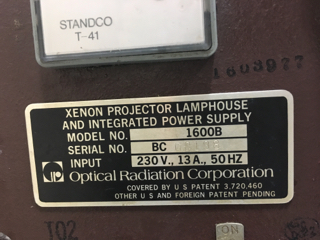
It's an Orcon 1600B, so the rectifier & lamp house are all in one. It looks as though the capacitors have been replaced at some point to more modern ones. The lamp only flickers off for a very small amount of time, half a second maybe. It also doesn't seem regular, maybe a little worse when switched on.
Posted by Mark Gulbrandsen (Member # 72) on 09-03-2017, 02:25 PM:
The blocking diode is on the diving wall inside the lamp house. It's pretty obvious. Replace it with an 85 amp stud instead of the 40 amp that's normally in them. I assume it's like this one. The four main rectifiers are a bit more work to replace, and that requires pulling the power supply assembly out of the casing.
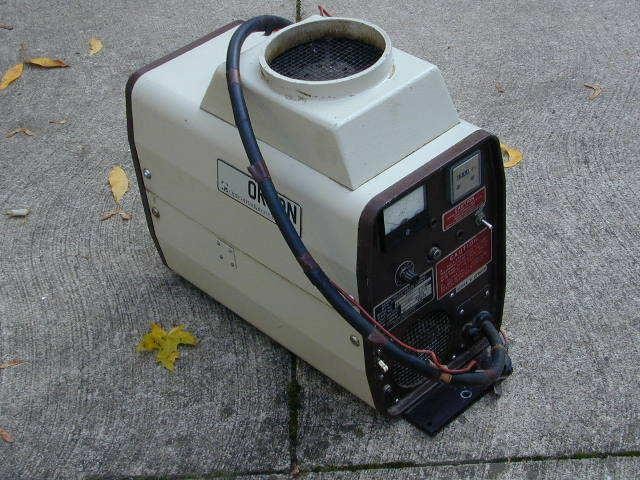
Mark
Posted by Steve McAndrew (Member # 8865) on 09-03-2017, 02:35 PM:
Thanks Mark, The 1600B is a little bigger and a slightly different design, I will take some photos of the inside and post them tomorrow.
Thanks Steve
Posted by Mark Gulbrandsen (Member # 72) on 09-03-2017, 07:52 PM:
Good idea Steve. I am not sure they ever sold a self contained model 1600 here. The 1600 always had a separate power supply. The Model 1000 is whats in the image above.
Mark
Posted by Steve McAndrew (Member # 8865) on 09-04-2017, 06:16 AM:
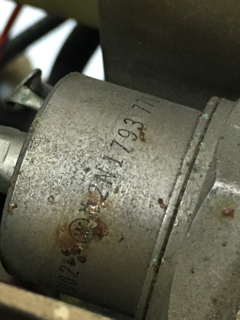
Here are some pics....
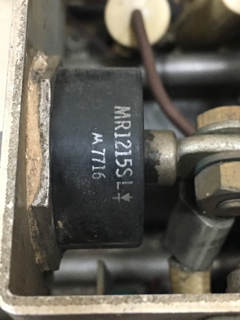
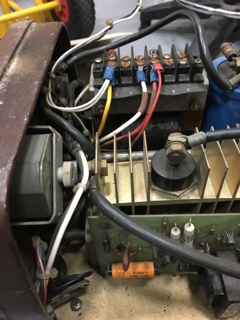
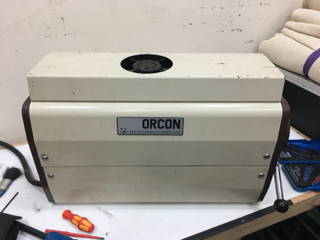
Posted by Mark Gulbrandsen (Member # 72) on 09-04-2017, 12:04 PM:
That's the most bizarre thing I have ever seen! They were never sold here like that. Anyways, all those semi's are antique and should probably be replaced as well as ALL of the electrolytics in the entire lamp house. It appears the blocking diode is in the upper right picture on it's own heat sink, but really need to see the rest of the insides and the circuit boards. A full overview image might also help if you happened to snap one. That MR1215 diode is a 100 amp fwd diode with a 10/32 stud.
Mark
Posted by Steve McAndrew (Member # 8865) on 09-04-2017, 01:30 PM:
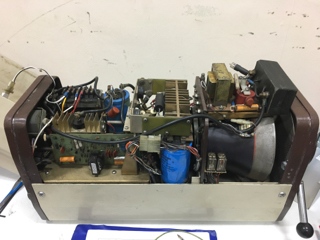
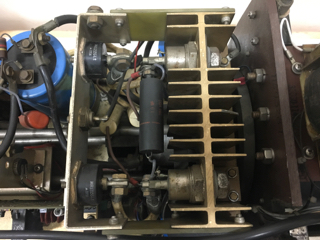
Here are some more pics, think I have managed to find some replacement diodes so will try swapping them out. As I mentioned the capacitors look fairly modern.
Posted by Mark Gulbrandsen (Member # 72) on 09-04-2017, 02:02 PM:
This ranks as one of the most bizarre things I have ever seen... But that single diode on the heat sink looks like it's probably the blocking diode. I would start there and at the same time also replace all the electrolytics on the control PCB(s). There were two control PCB's in the Model 1000, but I oly see one here. This appears to be an SCR regulated power supply like the smaller Model 1000 is, this is just a larger version of that. What the blocking diode does is isolate the low voltage ~20 volt DC from the higher voltage 140 volt starting DC. And of course on top of that is the high voltage igniter that ionizes the xenon gas in the lamp. All of the problems I have ever had with self contained ORC's are either semiconductor or capacitor related, or both.
Mark
Posted by Steve McAndrew (Member # 8865) on 09-04-2017, 04:40 PM:
I'll let you know how I get on. If I choose to change the large capacitors would I get away with using one with a higher voltage rating, the 25000uf 40V ones seem quite rare.
Posted by Mark Gulbrandsen (Member # 72) on 09-04-2017, 05:30 PM:
Higher voltage rating is fine as long as it physically fits in.
Posted by Steve McAndrew (Member # 8865) on 09-06-2017, 04:24 PM:
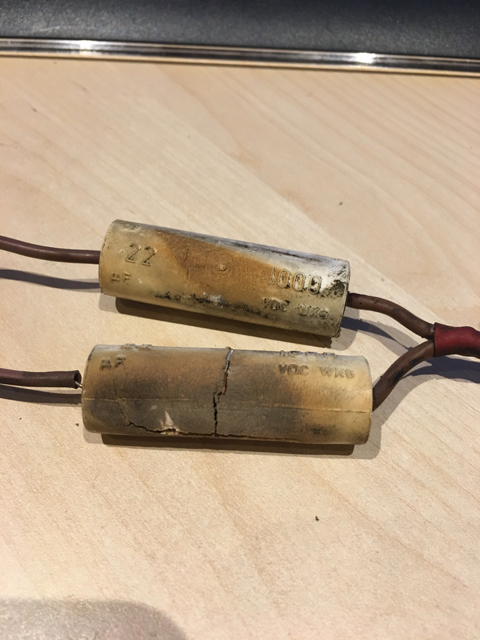
Well here is the first problem!
Luckily there are plenty of them on Ebay!
Posted by Jim Cassedy (Member # 4115) on 09-07-2017, 06:23 PM:
quote:
Well here is the first problem!
Luckily there are plenty of them on Ebay!
Be careful buying corroded caps on e-bay- -
sometimes they'll actually send you good ones. ![[Razz]](tongue.gif)
Posted by Mark Gulbrandsen (Member # 72) on 09-07-2017, 10:48 PM:
They have been baking in stray UV light from the lit lamp. Looks like the inside of how MOST Strong lamp houses get after a few years.
Posted by Steve Guttag (Member # 268) on 09-08-2017, 08:01 AM:
I never understood why Strong couldn't use UV resistant wires like most everyone else did. They'd put a shield over the igniter PCB to help protect it but the insulation would fall off the wires all over them. The other oddity is that EVERYONE used white (natural) zip ties in a lamphouse rather than uv resistant ones (black). Use black zip ties, they'll still be holding years down the road. Use white ones, after the first year, they crumble off.
Mark has you looking in the right direction. Using capacitors and diodes from the 70s are definitely the first things to start changing. Pay close attention to cracked resistors too. As things heat up (electrically and from lamp exposure), you will get intermittent connections.
Posted by Steve McAndrew (Member # 8865) on 09-09-2017, 03:00 PM:
When swapping capacitors in this unit should I try to match any other values other than voltage and capacitance?
I have swapped all the large diodes without any improvement. The flicker is present immediately when the lamp strikes, it doesn't seem to get worse when the unit gets warm. Does that suggest anything in particular? The flicker is not regular, it's almost like a loose connection type flicker.
Thanks again
Posted by Mark Gulbrandsen (Member # 72) on 09-09-2017, 03:21 PM:
quote: Steve Guttag
I never understood why Strong couldn't use UV resistant wires
They literally became an electrocution hazard when changing a lamp once the insulation started falling off. Using teflon insulated wire would have been the right way to do it, but it's kind of a pain to work with, and about 6X more expensive than even the UV resistant stuff Christie used.
Mark
Posted by Steve McAndrew (Member # 8865) on 09-13-2017, 03:21 PM:
I have replaced many of the components as suggested and it has improved things greatly. I am still left with a different type of flicker, this time it is a regular very high-frequency flicker, like a very fast strobe light. Does that suggest a fault with any particular part of the rectifier?
Thanks
Posted by Jonathan Wood (Member # 4614) on 09-15-2017, 05:32 AM:
Hi Steve, what size screen are you using ? It could be that you're just putting too much light onto the screen . If the screen is too bright , regular shutter flicker becomes more noticeable i.e. 48hz from each frame being shown twice .
Powered by Infopop Corporation
UBB.classicTM
6.3.1.2